
 Bionic Jean’s
Comments
(group member since Apr 08, 2020)
Bionic Jean’s
Comments
(group member since Apr 08, 2020)
Bionic Jean’s
comments
from the Dickensians! group.
Showing 1-20 of 8,900
 Me too John! Happy times - and thanks 😊
Thanks Nancy and Sue ... and Sara yes, good to rest when you can during this tumultuous time. I hope you find things pace themselves better, and wish for everything possible for you and both your sisters.
Yes (and what a pun!) Thanks Sara - it's good to see you and I hope things are not too difficult for you at the moment.
Thanks Werner 😊
My comments on our group read (Amelia B. Edwards - do have a look at Erich's thread - he's doing a fantastic job!) are a day behind. That's because yesterday I had a hospital appointment at the National Hospital for Neurosurgery, where Dickens went to various lectures.
Me too John! Happy times - and thanks 😊
Thanks Nancy and Sue ... and Sara yes, good to rest when you can during this tumultuous time. I hope you find things pace themselves better, and wish for everything possible for you and both your sisters.
Yes (and what a pun!) Thanks Sara - it's good to see you and I hope things are not too difficult for you at the moment.
Thanks Werner 😊
My comments on our group read (Amelia B. Edwards - do have a look at Erich's thread - he's doing a fantastic job!) are a day behind. That's because yesterday I had a hospital appointment at the National Hospital for Neurosurgery, where Dickens went to various lectures. The whole thing has been a bit of a nightmare, and the saga continued yesterday. It's too long to go into, but to top it all, there was a tube strike! It didn't affect the whole system - the London Underground is huge: 272 stations across 11 lines, covering 250 miles. So we thought we might be able to work out a route involving ones that were open and Shanks's pony. It was all a bit chaotic and congested, as you'd expect, BUT ...
Walking along unfamiliar roads, armed with our trusty A-Z, we passed a huge library in Holborn, on 3 or 4 floors, and Chris spotted a notice outside: "Dickens and Camden". There was a new exhibition on! So in we went, and it turned out to be very good indeed. Here's the blurb:
"Did you know Charles Dickens had deep links to the area we now call Camden? Explore the story at Streets of Inspiration, a free exhibition. Open until 13 June."
It concentrated on the local area, and covered all the houses he first lived in in North London. There were large photos and pictures by his illustrators, relating these and other key buildings mentioned in his works, to his life. There were bits of memorabilia too, and everything was beautifully displayed and accurately captioned. A great little exhibition which would appeal to anyone interested in Dickens, I think.
I wrote a nice little "review" for them in their comments book, and added that it would make a very good complementary visit to the current exhibition at Doughty St., museum, which is quite close. Someone had put a lot of work into this, so I hope it made them smile! I also hope to go back while it's still on, and digest it properly when I'm not so tired. Maybe take a few pictures too. But what a great surprise find 🥰
Like you Plateresca, I guessed that the two men would fall in love with the same - impossibly beautiful - woman. 🙄That seemed so predictable - like a "Penny Dreadful" - and indeed Amelia B. Edwards did publish stories in popular Victorian "penny magazines" early in her career. So I was glad the ending was a surprise. On the other hand, there was a reason that Penny Dreadfuls were so popular; they appealed to the public of the time, just as formula soaps do now. Oh, did anyone think of the beginning of E.M. Forster's A Room with a View with (view spoiler) (spoiler tag here used for anyone who hasn't read that one.) The dramatic and violent feel of the scene, the same street location in the same country (but different cities: Venice and Genoa) and the alienness to an English reader, all felt the same to me.
Plateresca said "I'm sorry the great Tors turned out to have so little significance for the plot" Oh, don't you think so? I think it's a perfect top and tail story! It's a kind of metaphor, as both boys grew up in the shadow of the tor. But both boy succeeded despite this, and in the end we see this aspect repeated: good prevails and prevents further curses by the tor (or is that too fanciful?) I do like your point Connie, that " The supernatural Matthew showed that he was the one with the cool, controlled head, just as in life."
Erich gave us the definition of a tor in geology, (and then I confused the issue - sorry - so edited my post) and this is where the bloody rituals took place.
"Druids' Tor, King's Tor, Castle Tor, and the like; sacred places, as I have heard, in the ancient time, where crownings, burnings, human sacrifices, and all kinds of bloody heathen rites were performed."
So we have that Hardy-esque sense of a doom-filled location, which imbues a memory of the past and vague feelings of unease to anyone who goes there. But also, tor is used colloquially to mean the hill itself, compounding the feeling. So the impressionable boys were brought up in a fictitious small village surrounded - or perhaps at the foot of - one brooding tor. Just like the fells in the Lake District, the weather can make them feel very threatening.
Perhaps Amelia B. Edwards could have made more of this, particularly since she indulged herself so much in describing all the different countries Ben went to, in the middle section 😆but she was such a keen traveller, and as I think Erich said, the Victorian public would be fascinated to read about exotic places (I'm thinking of the Grand Tour, but only those with money could do that!)
Thanks for this one Erich! I couldn't remember reading it before, but suspect I must have as it forms part of Mugby Junction, which was first published as a Christmas edition of Dickens's magazine All the Year Round. The eagle-eyed will have spotted that this was c. a year after Charles Dickens was involved in the terrible railway crash at Staplehurst, memories of which plagued him all his life. So well done to Plateresca and others who picked up the connection with The Signalman, as that is the first and most famous story in the edition, and the only one often read now, really. In fact as usual only the bits written by him (4 stories) are included in most books called "Mugby Junction" 🤔 As usual, Dickens wrote the frame story and various collaborators each contributed an individual story to the collection. They were Charles Allston Collins, Amelia B. Edwards, Andrew Halliday, and Hesba Stretton - names we know from other collaborations.
The issue was all railway-themed stories. Mugby Junction was first published for the end of year 1866, so I was interested to learn that this particular story was published in 1857, Erich. Had Amelia B. Edwards been keeping it up her sleeve? Since that issue had a theme, and she had published in Dickens's magazine before, perhaps he did not ask her for a new story, or need to stipulate what he wanted, as he usually did.
Did anybody wonder if the mysterious man who appeared and tried to bribe Benjamin to wreck the train might have been imaginary?
Yes indeed! Well maybe not quite. But because this was probably a ghost story, I expected that was the ghost of Mat! Whether or not it was in Ben's mind, I didn't get as far as to wonder. But on reflection the figure seemed to be in disguise, so I expect it was a political motive, as he said the duke was "bad for the country".
I didn't expect the ending ... I'll start a new post.
Just to note the connection between Amelia B. Edwards and Charles Dickens - and for those who think we may have read something by her before. We have!As Erich told us, Amelia B. Edwards was born in 1831, so she was 19 years younger than Charles Dickens He also told us that she did not finally commit herself to writing until the early 1850s, although she had shown promise before then.
On and off, in those intervening years and beyond, Amelia B. Edwards was one of Charles Dickens's uncredited in-house authors. He always said that this was to let the budding authors keep ownership, and allow them to reuse their stories. (Since Charles Dickens was so passionate about copyright and author's rights, we assume this is honest, and at least partly his true motive.) Charles Dickens liked to maintain editorial control over the stories in his magazine, and mentor the promising young authors whose work he accepted. He talked of "conducting" the collaborative works. However I wonder if there is a little dissembling here; he certainly liked to be "in charge". But writers such as Elizabeth Gaskell with North and South and Wilkie Collins with The Woman in White both famously rebelled in the end. They wanted full credit.
LINK HERE to a discussion of a long poem we read which was uncredited, but very probably by Amelia B. Edwards. She certainly contributed something to A Message from the Sea - an earlier group read. Amelia B. Edwards was a great traveller, as Erich said, and her writings on Egyptology as a science were well respected. Amelia B. Edwards was forward thinking, and her views on the injustices of racism and slavery are evident in this poem. It was first published in the second of nine extra Christmas numbers of “All The Year Round” in 1860. Sara hosted the read, and as you can see, wrote a little bio in the comment I linked to, (adding to Erich's 😊)
Nancy also mentioned possibly the most famous and often anthologised short story by Amelia B. Edwards: The Phantom Coach. This is on our timetable to be read later in the year, and hosted by Cindy.
For now though let's enjoy the 6 sensational tales chosen by Erich. Thanks for the links, Erich! I also have a couple in various anthologies of my own, both in print and on kindle, so I expect others may have too, but Erich has made it really easy for us 😊
Yes indeed, great info and summary, thanks Erich!Just to add, there are numerous tors in the West country (Devon and Cornwall) particularly on Bodmin moor and Dartmoor.
One famous one on Dartmoor is Haytor (Haytor Rocks), a granite tor with popular, accessible rock piles which you can climb up. Locals tend to use the word to mean "hill" - the gentle slope up, rather than just the rock pile - much as people in the Lake District talk of "fells" to mean their high hills.
(edited)
Happy Birthday to G.J. - Gloria!
I hope you're having a wonderful time on your special day 😊🍰🎂
Yes, it is odd how sometimes professional critics cannot help but see things through a 21st century lens - and use the language which has developed to express it. Often I find feminist academics' interpretations of Victorian literature to be laudable in themselves, but some seem highly unlikely.
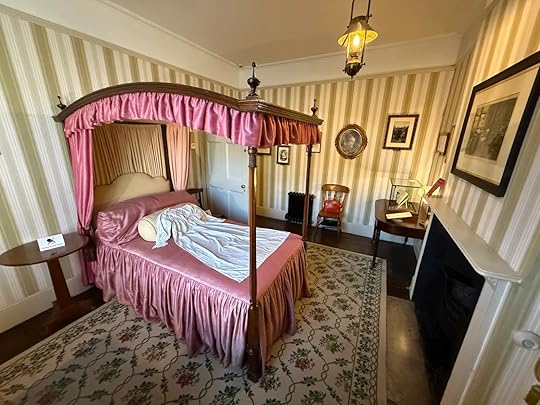
You know, whenever I visit a stately home in England and see the 4 poster beds, I always think of this story. (Perhaps others will too, now!) There are often several.For instance in Dickens's own house in Doughty St (now a museum) there are 2 that I can remember. One is quite pretty, with a non-threatening canopy. Sadly this is where Dickens's sister-in-law Mary died at 17 in his arms:
But the other, Charles and Catherine's is more the old, traditional type, and it would be so easy to just extend the top section to the ceiling, and cover it with heavy fabric:
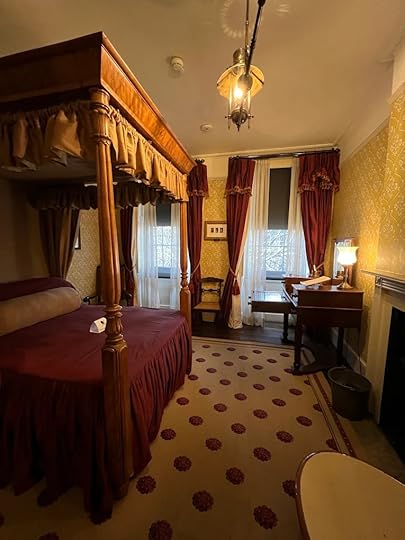
(both photos are from the museum's own website)
I wonder if he ever lay awake remembering the story he had just published ...
Erich - thank you so much for this extra article. I had wondered to myself why it was set in Paris, but just assumed it was a "traveller's tale" which the two authors both enjoyed reading and writing. Now I realise there was more to it 😊
If you don't want me to say this Plateresca I'll delete it 😊But off-topic ... Plateresca told me that she enjoyed this read so much that (view spoiler)
These gothic reads are certainly very entertaining 😆
What I enjoyed most overall was the pacing of this story. To keep the tension up, as several have remarked on, is no easy matter. Even with the middle section - which got increasingly strange - we still had that feeling of suspense, rather than any disbelief.Then how satisfying it was to have an ending rooted in reality - and in justice.
Wilkie Collins knows how to write thrilling adventure passages too. We've noticed this before in The Frozen Deep and The Dead Secret (both led brilliantly by Lori) and here we had the all-action hero clambering (soundlessly!) out of the window, and climbing down the side of the building. This is no supernatural Count Dracula, just a very fit young man!
Wilkie Collins was to repeat this scenario a few years later, in 1860, in his novel The Woman in White, which was also serialised in Dickens's magazine, although by then it was "All the Year Round". (However Dickens liked to have a team of "in-house" writers, and Wilkie Collins was a little irritated that the serial was not credited to him initially.) It was set earlier, so the houses would have the same sort of water pipes etc. outside. But what really impressed me about that episode was that it was a (view spoiler) who was so athletic 😊
I've really enjoyed reading this again with everyone. Thanks for hosting this Erich, and providing the extra research too.
Don't miss what's coming up next in Erich's stint - several stories by the sensational Victorian ghostly chiller story writer, Amelia B. Edwards.
But please do keep the comments coming!
Good idea Shirley!
I thought exactly the same thing Sam; how like Edgar Allan Poe this killing contraption is. It's a devilish device for sure. I also remember a piece you led for us by Charles Dickens - Lying Awake in THIS THREAD. We know that Dickens was an insomniac, and I'm now wondering if Wilkie Collins might have been too.
Also, Erich told us that A Terribly Strange Bed was first published in 1852 in Household Words ... well Lying Awake was also first published in Household Words, on October 30, 1852. A coincidence? I don't think so! 😲
We know that later in life the two authors had desks placed side by side, when they were writing collaborations. Like Lori I love knowing that this was the first story Dickens published by Collins, and would have loved to be a fly on the wall when they were discussing it 😊
Great extra info again today, thanks Erich and Sam!
Good to see you Kelly! I do hope you'll add comments again when you feel like it 😊
Nancy wrote: "an escapee from a Dickens story if I ever saw one!..."😂😆 I love this!
