
 J.’s
Comments
(group member since Feb 02, 2016)
J.’s
Comments
(group member since Feb 02, 2016)
J.’s
comments
from the Brain to Books Cyber Convention (FAIRGROUNDS) group.
Showing 1-20 of 27
 Lyra wrote: "Wow! Being a huge ancient Egypt fan, as well as a fan of the Aten years, I HAVE to read your books!
I was quite influenced by ancient Egypt myself, and used it as inspiration in my series. :)"
Thank you! So enjoy sharing my love of ancient Egypt with others.
Check out my YouTube video here to learn a little more about the writing of Heir of the Heretic.https://www.youtube.com/watch?v=OndMG...
Thanks for sharing! There's been a lot of exciting discoveries recently about ancient Egyptian culture, so be sure to keep watching and reading! My books have included some of that exciting stuff including DNA evidence, PET scan discoveries, and new unearthed evidence. Its pretty exciting!
8. What was the hardest part about bringing your historical world to life?
M.K.: Being as accurate about facts while giving readers a different perspective on things, historical and obscure, that they weren’t aware about before. Giving a human face and life to the different perspective, since lots of readers might be antagonized by that perspective due to years and years of prejudice and pure propaganda. Hope I have succeeded in this quest.
MICHELLE: Making sure the characters don’t use modern slang in their dialog, or what readers perceive to be modern, which isn’t always the case. Also, it’s making sure that I don’t use modern verbs, such as scan, rewind, fast forward, etc.
J. LYNN: Working with ancient societies, I have a lot of freedom to create, but this can also pose a challenge. There’s just so much we do not know. The period I write about was considered heretical after King Tut’s death, and many of the structures and records of the time period were destroyed. Some bricks were reused in other building projects, which archeologists have unearthed. However, its hard to truly appreciate the beauty of the society when all we see today are crumbling washed-out ruins. Things were colorful and grand in scale. Modern scientists are unsure how Egyptians erected obelisks because that stuff isn’t documented. I guess erecting a ginormous monument was just an ordinary day in the life of the common Egyptian! Pharaohs didn’t even record these events, and they liked to brag about their accomplishments on their tomb walls. So when reenacting these moments, it really takes a lot of cross referencing different theories and scant records to bring something so obscure to life. My books do not have an obelisk being raised, but I do walk through some wonders of the ancient world in my stories.
9. What are some books you’d recommend to readers who love your novel and want more from that time period?
MICHELLE: If you like this time period, plus a little mystery (like mine!), I’d recommend Rhys Bowen’s Her Royal Spyness series, Kerry Greenwood’s Miss Phryne Fisher series, Charles Todd’s Inspector Ian Rutledge series or his Bess Crawford series, or Jacqueline Winspear’s Maise Dobbs series.
J. LYNN: Nonfiction, I’d recommend either The Woman Who Would Be King by Kara Cooney or Red Land, Black Land: Daily Life in Ancient Egypt by Barbara Mertz. Fiction-wise, I’d recommend Child of the Morning by Pauline Gedge, Year of the Hyenas by Brad Geagley, Murder in the Place of Anubis by Lynda Robinson (this is more a cozy mystery during King Tut’s childhood and is a completely different take on the characters I write about - just FYI - but still an interesting read), and The Heretic Queen by Michelle Moran.
M.K.: The Russia House, The Perfect Spy and The Spy Who Came in From the Cold by John Le Carre. I would stop here, but in case anyone likes more action than Le Carre offers, then also The Cardinal of Kremlin by Tom Clancy and Red Sparrow by Jason Matthews.
4. Let’s talk characters. Are they all fictional or do you weave and develop historical people into your narrative?
J. LYNN: My main characters are people from history: Nefertiti, Ahkenaten, Merytaten, Ankhesenamun, Tutankhamun, etc. Only minor characters like guards or love interests have been a creation of my own mind.
M.K.: My main characters are fictional. However, they interact with quite a number of real life characters – diplomats, journalists, musicians and actors, whose names I have changed – for obvious reasons!
MICHELLE: Except for the woman I used to create the character of Henrietta, they are all fictional!
5. How do most people make a living in your time period?
MICHELLE: Interesting question, because my series is set during the Great Depression when most people were out of work. People did whatever they could to get by. Henrietta, for example, has a whole string of strange jobs—from “Dutch Girl” at the World’s Fair, to hair-curler demonstrator, to usherette at a burlesque house. Interestingly, all the jobs that Henrietta has in the book are real jobs that the woman I interviewed actually had. According to this woman, she did not have a problem getting a job, as did the rest of the country, probably because of her beauty, but she had a hard time keeping the job. She was always getting fired for slapping an owner or manager for “trying to feel her up,” a problem I naturally gave to poor Henrietta, as well.
J. LYNN: My main characters are royalty, so I focus mostly on palace life. Women had many rights in this society, so they held a variety of jobs including running businesses to being wet nurses for royal families. There were priests and priestesses for the numerous gods Egyptians worshipped. There was also the city where tomb builders and royal embalmers lived and worked. Men were often scribes or laborers. Building monuments, like the pyramids, was considered a sacred duty for Egyptians. Unlike the stereotypical images of evil overlords whipping slave laborers, working on these large-scale products was actually a great source of income for families. There were work camps created, and nourishing food was provided throughout the day evidenced by the remains of kitchens built in the camps.
M.K.: All characters in my book have a day-job – spies, diplomats, journalists, scientists, musicians etc. -- or are students.
6. What things are considered normal and acceptable in your novel’s society that would not be considered normal or acceptable today?
M.K.: Hmmm. It’s the other way round probably: being openly gay is now acceptable in many societies. In others, like Russia for example, the situation moved 2 steps forward only to get pushed 1 step back most recently. As for acceptance of spying, well, you know the current status as well as I do!
MICHELLE: Women did not have as many options and opportunities in the 1930’s as they do today. Most women did not receive higher education and few had careers. Most were expected to do menial labor or stay at home as a housewife. Society was very much controlled by men. This makes it very difficult for Henrietta to earn enough money for the family after her father’s death. She strives to maintain her virtue, and yet most of the jobs open to her are unscrupulous.
Also, people’s perception of suicide was different then. It was considered a shameful, sinful act, unforgivable by the church and society. This makes the Von Harmon’s poverty all the worse when Mr. Von Harmon kills himself in A Girl Like You. Not only is the family thrown deeper into poverty by his actions, but they are shamed as well.
J. LYNN: I got a big one when writing about ancient Egypt: The concept of royal families “keeping the bloodline pure” by marrying their immediate family members. Sisters and brothers. Fathers and daughters. First cousins. Yikes! The ancients thought this preserved their ancestral line, but really this just created problems for future generations--King Tut being a huge example. He was the product of a long line of incest. Note, this was not a practice of the common people otherwise Egyptians would have died out long ago! Only the royal families practiced this in emulation of their gods Osiris and Isis, who were also brother and sister.
7. What do people at various levels of society do for fun?
J. LYNN: Ancient Egyptians played board games. We do not know the exact rules for these, but Egyptologists have put together some rules for the popular game of Senet.
MICHELLE: The wealthy of the 1930’s were able to entertain themselves in a variety of ways, just as they do now. Parties, balls, concerts, trips, dinners, golf, tennis—these are all things the rich would have done, even in the midst of the Depression. The wealthiest members of society also usually belonged to private clubs, such as country clubs or gentleman’s clubs, which provided entertainment and social comradery. Also taking pleasure rides in automobiles was becoming a popular form of entertainment—a “Sunday jaunt” in a motor car was considered fun.
The poor, on the other hand, usually did not have much time for fun.
When they did have free time, a Sunday picnic or a walk in a park or on the outskirts of town or a game of cards might have occurred. Children made up their own games and played them in the street, such as stickball, kick-the-can, and Red Rover. Children also made scooters from scraps they found and played hopscotch and jacks. Dance halls were all the rage, and a man could pay a “taxi-dancer” ten cents a dance if he didn’t have a partner.
One thing that united both the rich and the poor was radio. Radio shows of every variety were in their hay day in the 1930’s, entertaining people with dramas, comedies, advice, mysteries, news, sports and of course, music.
Wordwizard wrote: "This was fun to read, but does it fulfill the requirements that the person be interviewing for the job? This princess wasn't looking for any kind of job."This short story began as a challenge tha..."
There is a scene of miscommunication. Merytaten thought she was being summoned to a royal house. The hiring manager thought she was the person who applied for a job. Like he mentioned, his assistant definitely misdialed! "What we have here is a failure to communicate."
Hiring Manager:
Miss Mery, I’m afraid there’s been--Merytaten: It is Merytaten, First Daughter to Pharaoh Akhenaten, She who is beloved of Aten, NOT Mery.
Hiring Manager: Miss Merytaten, I’m not sure if there was a communications breakdown or what. However, this is a job interview for an HR rep. Thus far, you have not even answered me why you are interested in the position. To save everyone’s time, if you’re not here to apply--
Merytaten: (standing) I am here at your behest. Your servant informed me that my presence was requested at this appointed time, in this appointed place. Have you led me here under false pretenses?
Hiring Manager: Heavens no, please do not misunderstand me. (To himself) My assistant may have misdialed…by like one-thousand years!
Merytaten: Is it the Hittites you serve? The Greeks, who think themselves enlightened above all others? My country had pyramids scratching the floor of the God’s realm while those fair-skinned people lived in caves and feared the shadows on the walls!
Hiring Manager: I think I know that story. Socrates?
Merytaten: So you are with the Greeks. I will tell you again, we do not need your wine and pottery. Our civilization can make our own! My father’s second wife even has a vineyard of her own.
Hiring Manager: Your father’s second…(coughs uncomfortably). You know, I believe the position we were interviewing for has just filled. I’m sorry to have wasted your time, Miss Merytaten.
Hiring Manager stands and extends a hand to Merytaten. She looks at it with disgust.
Merytaten: Are you asking for compensation? Gifts of food and gold are only given to those loyal to the Horus Throne.
Hiring Manager: Don’t you shake hands in your city?
Merytaten: No. Do you always lay your hands on royalty?
Hiring Manager: (Dropping his hand) So. This has certainly been an awkward experience. Did you need my assistant to see you out?
Hiring Manager walks to the door and opens it. It takes him a moment to realize there are two very tall, muscled guards standing outside the door, arms crossed, and dressed in a similar style to Merytaten. The manager takes a step back.
Hiring Manager: Are…are they with you?
Merytaten stands up gracefully and glides over to the doorway.
Merytaten: They are my personal guards. I wish I could say that our time has been pleasurable, but I’m afraid there has been some unfortunate breeches in etiquette. I hope your king will be merciful after I send my correspondence summarizing this meeting. I’ve known some kings to execute their messengers if they do not deliver good news. Surely your king can read the Words of the Gods?
Hiring Manager: I think you’ve got us both at a disadvantage there.
Merytaten: Well, this has certainly been an enlightening experience. Guards!
Merytaten strides out the door. One guard takes position in front and the second behind her. They begin to depart, but Merytaten stops after a couple steps and looks back through the door.
Merytaten: I hope the next time you host a princess, you learn a bit more about our customs. And at least put on some proper attire. That dull dray housecoat, red noose around your neck, and gray pants are quite ridiculous-looking.
With that, Merytaten and her entourage make a swift exit.
Hiring Manager: (loosening his tie) Noose isn't quite the word I was looking for...
Hiring Manager: Hello! Welcome to the interview for the HR position, Mery-ta-ten. Ahem, could you please share with us why you’re interested in this position?
Merytaten: Dua Netjer en ek!
Hiring Manager: Oops, excuse me. I forgot to turn on the universal translator. Okay, there. Could you repeat that?
Merytaten: Thank God for you! Blessings on your family for inviting me into your home…though your customs are strange. Food is usually served to guests of the house. Will we not be eating?
Hiring Manager: Oh, no. This isn’t my house. This is where I work. You’re here to apply for a job, right? Was that not communicated to you?
Merytaten: You are seeking my council! That is wise. Still, negotiations typically run smoother when served with food. You must speak to your king in this.
Hiring Manager: <rubs his forehead> Could you please state your name?
Merytaten: I am Merytaten, First Daughter to Pharaoh Akhenaten and heir to the Golden Throne. Have you been to the City of Light? Most of the construction has been completed now. The Temple of Aten is truly grand to behold.
Hiring Manager: Errrr…Would that be in California
Merytaten: The City of Light is the capital of the world.
Hiring Manager: I’m afraid I do not know where the city of light is then.
Merytaten: Do you mock me?
Hiring Manager: Oh no. Apologies for my…forgetfulness. Of course! The city of light! Yes, surely, I know where that is…because that’s where you’re from! *ahem* But we’re here about your application for a job.
Hiring Manager pulls up application. His jaw drops as he scans over it.
Hiring Manager: Are these pictures? Is that a duck?
Merytaten: You do not read the Words of the Gods? I assumed that you were of noble birth. Were you not trained in the House of Life?
Hiring Manager: The house of life? I graduated from the University of Minnesota with honors, Miss Mery-ta-ten, if you’re implying I am uneducated.
Merytaten: And yet you cannot read the sacred script?
Hiring Manager: The Bible?
Merytaten: (sighs) The seed cannot sprout upwards without simultaneously sending roots into the ground.
Hiring Manager: Excuse me?
Merytaten: I try not to judge others. After all, the nut doesn't reveal the tree it contains. But you seem to be rather ill-equipped to be holding negotiations with a princess of Kemet. You do not follow the most basic customs in etiquette, you cannot read--granted, I did use the cursive script--and you do not even know the City of Light. Where is your king? I must speak with him about the men who represent his court.
9. What is your next project?ILANA: I am currently at work on a companion novel to Cha’risa’s Gift. This story focuses on her son, Ahote. It delves much deeper into what happens to him during the years he spends with the Havasupai, and how it affects his life from that point on.
M.K.: I’ve just published my debut novel and need to spend some time promoting it. The next project will either be the sequel or something in the same genre. We’ll see what comes to me during the promotion period :)
J. LYNN: My next project is quite different from my previous two books; it’s a YA novel and ventures into the legend of King Arthur and the women of that time period. Briefly, the plot follows four modern-day girls from small-town Minnesota who are swept up into the mythical land of Avalon when a wish they cast into a wishing well tips the balance of power between two opposing forces. With one girl captured by evil creatures, her three friends set off on a rescue mission and a quest to prevent an evil wizard from reforging Excalibur. With the reforged blade, he could cut the veil between worlds and use his magic to enslave our world.
10. How/where can people find out more about you and your writing?
J. LYNN ELSE: My personal website is http://www.teasippinnerdymom.com (that’s “tea-sippin’ nerdy mom”). It has links or is linked to some of my other online spaces & places. You can also “like” me on Facebook at www.facebook.com/teasippinnerdymom and/or give me a follow on Twitter at @JLynnElseAuthor.
ILANA MALETZ: You can visit my website at www.ilanamaletz.com. You can also find me on Goodreads: https://www.goodreads.com/author/show.... I also have a facebook author page: https://www.facebook.com/ilanamaletz....
M.K. SOUTH: People can learn about my writing through my book which is available from all major distributors (Amazon, B&N, iBooks etc.). A few chapters are available at this event for free. As for learning more about me, well, I think my book should be able to stand on its own: the story I tell in the book is way more important than me. But in any case, you are welcome to visit my page on Goodreads (https://www.goodreads.com/author/show...) and Facebook (https://www.facebook.com/MKSouth2017/).
7. What grammatical flaw irritates you the most?
J. LYNN: I have two biggies: (1) The wrong use of ‘their’ versus ‘there’ versus ‘they’re’ and (2) the use of too many commas. I review books for the Historical Novel Society, and in a book I recently read, there was a sentences with 68 words (“ending” in a semi-colon). Commas can run rampant if left unchecked, so rein those bad boys in!
ILANA: Everyone seems to have a perspective on the use of commas. I have come to hate them!
M.K.: Articles. Because we don’t have them in my 2 native tongues and I keep these errors no matter how well I have mastered English language!! :)
8. What is your favorite literary character and why?
M.K.: James and Della Young from O. Henry’s short story The Gift of the Magi. Because, similarly, for me, love is all that matters.
J. LYNN: Anne Shirley from L.M. Montgomery’s Anne of Green Gables series. Anne was smart, spunky, kept her ideals in the face of adversity, worked hard to achieve her dreams, and was full of imagination. It’s important for girls to embrace who they are, just as Anne learned to do (especially after the disaster when trying to dye her red hair a different color!). I think these books influenced my love of stories with dynamic, independent female leads as well as enhanced my love of history. She was an independent girl-turned-woman in a time when women didn’t even have the right to vote, and the books provide a great heroine for today’s young girls. You don’t have to battle Greek gods or evil wizards to do something amazing (books I totally love, by the way). You can offer help to others, be a good friend, stand up for your beliefs, and enjoy life to the fullest and still do amazing things.
ILANA: Every book I read offers up a new potential favorite, however the ones that have hung around the longest have been both Claire and Jamie Frasier from the Outlander series, Anne Shirley from Anne of Green Gables, and Jo March from Little Women.
J. LYNN: Anne Shirley in da’ house! (I know, I’m white like white bread--pardon the interruption)
5. What is most challenging about being a writer?
M.K.: To have your work recognized and accepted by those who don’t know you -- as opposed to those who know you and want to read more of your work. Which probably means most of the readers you want to reach. But I'm yet to find out about this aspect.
J. LYNN: Since writing is not my full-time job, finding the time to write can be difficult. I have two kids who get a little frustrated with me when I have to say ‘no’ to an activity because I’m working on a book. Finding a balance of work, after-work work (aka: writing), and family time can be tough.
ILANA: Keeping my butt in the chair is the first most challenging aspect of being a writer. But right up there with it is the crash course in marketing you suddenly discover you need to learn once your book is out there.
6. Who most inspired you to pursue writing?
ILANA: I don’t think there was a single “who.” I have been an avid reader all my life. Both the moments of literary perfection and the moments of literary disappointment have all come together to create a strong sense of storytelling within me.
M.K.: My partner (now my husband), my sister and the readers on the forum for whom I wrote my fanfics for 6 years.
J. LYNN: M.K., I’m curious about those ‘fanfics!’ Any fandoms I would know?
M.K.: I wrote for “Brokeback Mountain” fandom. And yes, Of Our Own Device was inspired by it, as well as by Boris Pasternak's Dr. Zhivago and Anthony Grey's Saigon.
J. LYNN: Awesome. For myself, I’ve been creative writing since 4th grade, so I think it’s simply part of who I am. Writing gives me the chance to explore other people and places like I did through acting when I was younger. With younger kids, it’s hard to audition for plays and/or be out every night at rehearsals. I’ve also had strong writing examples growing up. My dad has been writing for many years. He is currently a free-lance writer and writes two columns for the local newspaper. I’m proud to see that writing “legacy” being passed down to my children too. A few years ago, my son and daughter would take computer paper, fold it in half, staple it, then use those pages to write and draw their own picture books. My daughter continues to write her own stories via the computer, and I often have to bargain with her for computer time to work on my book!
4. Describe your writing process?
J. LYNN: When writing about a historical figure, you have the basic outline of that person’s life. Though little is known about King Tut’s wife, we know about significant events during her lifetime. My process involved finding the emotions and providing choices to her during those circumstances. I kept the historical events as accurate as I could; however, when it came to everyday life and decision making, I let the character take me on a journey. I researched what I could and worked with my character to decide on where to go. It was a mutual journey.
ILANA: Well, every day starts with a walk out in the wilderness with Lucy. Oftentimes, I will contemplate different scenes or characters while I am walking, so that by the time I’ve returned home, I often know what the day’s writing will look like. I try to dedicate 2 to 4 hours every afternoon to writing. This does not always happen because the people in my life always come first. But I find with this second book, I have become much better at keeping this writing appointment with myself, and my family has become much better at helping me to create that space.
M.K.: I have a day job, so I write in the evenings, weekends, during my business trips and any other time I manage to squeeze in into my crazy schedule :) It took me 4 years to write Of Our Own Device, mostly because the story was interwoven into real life, oftentimes historical, events, and I had to do A LOT of research. In fact, I had to check up on the accuracy of every statement I made, since I was dealing with the subjects that weren't my area of expertise -- espionage, diplomatic procedures, the Soviet rock scene, and most importantly life of gay men. Then I spent another year and a half editing it down to the size it is now--appx. 270k word. Yeah, I know...
I hope you've enjoyed this short intro into the world of my books. Ancient Egypt is a truly fascinating time. If you want to learn more about me, my writing, or other nerdy musings, please sign up for my newsletter at: http://teasippinnerdymom.us15.list-ma...The inaugural newsletter is preparing for launch!!! Don't miss it!
Here's a little showcase about all things Togas, Daggers, and Magic, which are contained in the historical fiction/fantasy novel, "Murder in Absentia."
Author’s note:This short story began as a challenge that a few of us who love writing historical fiction set for ourselves. We were to pick an historical character from one of our books and have that character interview for a job in current day, 2017. I chose Cha’risa, the central character from my book “Cha’risa’s Gift” for this challenge. Cha’risa is a Hopi medicine woman who lived from 1866-1945. The job she is interviewing for is with a development company (not a fictional one) in Scottsdale Arizona that has tried repeatedly to get approval for a project called Grand Canyon Escalade, which would allow them to build a resort property on the East Rim of the Grand Canyon using Navajo lands. All the information Lamar shares with Cha’risa is actual information associated with the project. For anyone who wants to know more about this project, and about those who are opposing it, here are a few websites you can check out.
http://www.grandcanyontrust.org/stopp...
https://www.americanrivers.org/2016/0...
https://indiancountrymedianetwork.com...
The More Things ChangeBy Ilana Maletz
The intercom squawked. “Mr. Fox, your 2:00 appointment is here.”
Lamar hit the intercom button. “Send her in, Ms. Whittier.” He sat back then smiling. He’d been hounding his associates for months to find the perfect spokeswoman, and from what he’d read in this woman’s file, she could be the answer to all of his PR problems.
As the woman entered the room, Lamar stood and walked over to her. He towered over the tiny woman, who was dressed simply in a flowered, calico dress. On her small feet was a pair of well-worn cowboy boots. While the dress was modest, the tie around her waist accentuated a still comely figure for a woman in her mid-sixties. Not a woman of much wealth, Lamar observed; that would help him with his pitch.
“Welcome,” he said, giving the woman his brightest smile.
She nodded back, not smiling, but meeting his gaze with self-assurance. She had beautiful eyes, a warm brown, that held both an innate kindness and curiosity.
“Sit,” he encouraged her, and pointed to one of his leather arm chairs. He watched as she sat. Her hair was so long, she had to move it over her shoulder to avoid sitting on it. It was perhaps her best feature, dark with dramatic gray streaks. She looked every bit the wise woman. Lamar silently congratulated his team. They may have finally gotten it right this time.
“Would you like some tea, coffee, water?” Lamar offered.
“Tea would be nice,” she said.
He smiled again and walked over to the intercom. “Ms. Whittier, can you bring some coffee for me and a cup of tea for my guest.”
“Certainly,” Ms. Whittier said over the intercom. “What kind of tea does she like?”
“Herbal,” the woman answered.
Lamar parroted that back over the intercom, and then took the seat beside her.
“So, Mrs. Connor,” he began “Shall I tell you a bit about us here, at Grand Canyon Escalade?”
“You may call me Cha’risa,” she said.
“Well, if I’m to call you Cha’risa, you must call me Lamar.”
She nodded and then asked, “If I may, Lamar, can I ask you a question before you tell me more about your company?”
“Certainly,” Lamar smiled.
“How did your people find me?”
“Ah. Well as best I understand it, my associates just put it out there, hoping for the Universe to answer, and apparently the Universe has offered up you.” He had meant to be charming, even a little funny, but she took him quite literally.
“That does explain some things,” she said.
He raised an eyebrow, and then offered, “I think what I find most intriguing about you is that you seem to have a gift for straddling two worlds. It says here you gained the trust of the citizens of Flagstaff, while at the same time maintaining a strong connection to your Native American roots.
“Well,” Cha’risa said, “All that was a long time ago now.”
Lamar brushed off her concern. “The more things change the more they stay the same, right?”
“No, not in my experience,” she replied. “People are meant to grow, to evolve. It is actually an illusion that we all keep circling around the same old issues. It isn’t a circle at all, it’s a spiral.”
“Really?” Lamar pretended to be interested, but in truth what she said made no sense to him. “So,” he continued, “shall I tell you some about Grand Canyon Escalade?”
“Yes, please do,” she encouraged.
Rubbing his hands together in anticipation, he started in. “I’ve been working for a while now on a project to make the most spectacular part of the Grand Canyon a tourist destination.”
“Really?”
“Yes, let me show you.” He grabbed some plans from his desk and carried them over to the coffee table, just as Ms. Whittier entered with the tea and coffee. “Set them right there, will you?” He nodded his head toward the end table sitting between the two chairs.
“Thank you,” Cha’risa said as the secretary set a steaming cup of peppermint tea down beside her.
The secretary smiled back at her as she placed the coffee near her boss, and then left the room. Lamar never noticed as he unfurled the plans and smoothed them out on the table before them.
“So the proposed development is located here,” Lamar pointed to a spot on the map on the eastern rim of the canyon, clearly within the Navajo reservation.
Cha’risa leaned forward studying the area intently. “That is right above the confluence.” She looked up at him questioningly.
Excited, Lamar continued to tell her more about his vision. “That’s right! The heart of the Grand Canyon, right where the Colorado and the Little Colorado meet, that’s where we’ll build a tourist attraction to rival all the others! I have big plans, Cha’risa, big plans!”
She waited for him to continue, so he jumped right back in. “Up on the rim we’ll have a hotel, a restaurant, an RV center, a cultural center, all kinds of attractions. But that’s not the best part! Right here, at the rim, we’ll build a tramway that will shuttle as many as 10,000 visitors a day down into the canyon. We’ll build an elevated walkway along the cliffs for easy access in and around the canyon floor, and we’ll also build this!” He pointed to a large amphitheater also below the rim. Can you just picture what concerts would be like inside those canyon walls, under the stars?”
When Cha’risa looked at him next, her eyes were somber.
“You do realize,” she said, “that the confluence is sacred ground for many tribes, mine included.”
“Yes, but just think of it,” Lamar insisted, “once only the most determined souls could access this place, now anyone can go see it!”
Cha’risa was quiet a moment considering her next words. Finally she spoke. “When my first husband went to this sacred site, to Sipapu and the salt caves, he ran all the way from the Hopi Pueblos. It was a journey of many miles and great hardship. When my son went, it was along a different path, but it also required a long and difficult journey both physically and spiritually.”
“So you get what I’m envisioning!” Lamar enthused. “Once this project is approved, people will be able to make the journey in comfort, in a glass tram, in just ten minutes.” He sat back beaming. It was only after an awkward silence that it began to occur to him that Cha’risa might not be seeing things quite the same way.
When she broke the silence, her words were again carefully chosen. “What makes the experience to Sipapu sacred is as much about the journey as much as it is about the place. You are putting at risk spiritual practices that have been in place for thousands of years.”
Lamar was still trying to think of a way to bring the conversation back on solid footing when Cha’risa asked, “Lamar, why do you think I would make a good representative for this project?”
Lamar gave a silent thanks that the conversation was now moving away from the all this spiritual mumbo jumbo. “Well,” he began, “we are looking for someone who can be reassuring, someone who can speak to the tribes of the region and be a voice they would respect and trust.” He looked at her then. “I think you could have a steadying influence on a lot of these loud nay sayers.”
“Are a lot of people are fighting this?”
“There are some environmental groups, some indigenous groups, and the one I personally find the most frustrating, the Grand Canyon Trust.
Tell me,” she asked. “Do you think your project can benefit the Navajo, the Hopi, the Havasupai, the Zuni?”
“Oh, it will definitely benefit the Navajo. We’re going to need a lot of service workers for all these facilities we’re building. The Navajo are in desperate need of jobs, and we’ll bring those along with us in spades.”
“So, you’re talking about maids, waitresses, handymen, landscapers, that kind of work?”
“Precisely! And you better believe it could make a big difference in addressing the levels of poverty on the reservation. Of course the Navajo have to do their part too, to make this all happen.”
“So what is it you need for them to do?” Cha’risa’s face was carefully blank.
“Well, the Navajo nation will need to pay about $65 million for the initial infrastructure, and they will be responsible for its maintenance. They’d have to sign a non-compete for any business activity along 40 thousand miles of access roads into the development. They’d also need to claw back about 420 acres of grazing rights belonging to their people.”
“That seems like a lot to me. Is that all you’re asking?”
Lamar studied her closely, and for the first time since the interview started he began to feel unnerved. He had the strong sense that if he held anything back, she would know. “There are a few more small details,” he admitted.
“Such as?”
“We would need the Navajo to pre-approve business site leases without prior review by Navajo offices of historic preservation, environmental protection, parks and recreation, and a few other key agencies. We’d also need them to override some pesky resolutions against Escalade.”
Cha’risa raised an eyebrow. “Who has resolutions against you?”
“Hmmm, well there’s the Bodaway-Gap resolution, and there are others as well by the Lechee, Cameron, Coal Mine and Tuba City chapters. There’s also one by the Dine Medicine Men’s Association and the Western Agency Grazing Committee. Oh, and there is also a pesky Inter-tribal Compact with the Hopi that we’d need the Navajo to get around…”
“Enough, Lamar. I’ve heard enough.”
His face fell. “You’re not interested, are you?”
Cha’risa shook her head.
“It pays well.” Lamar felt it had to be said.
“Look, Lamar, no matter how much you paid me, you’d never get what you needed from me.”
“Why not?”
“You do realize I’m Hopi, right? It says that in your file there?”
Lamar looked more carefully at the file then shook his head. “It just says Native American.”
“I don’t suppose you are aware that there is a long history of distrust between the Hopi and the Navajo?” Again he shook his head.
“I thought not,” she said. “I bet it also doesn’t say anything in that file of yours about the fact that I have a checkered history.”
Lamar took a closer look at the small woman in the flowered calico dress. “You do? What on earth could you have done that would raise eyebrows?”
Cha’risa shifted uncomfortably in her chair. “I have dedicated my life to healing people, but there was a time when I crossed the line between a medicine woman and a witch.”
Lamar leaned in closer. “What exactly did you do?”
She regarded him with an unblinking stare. “I killed some men with a single thought.”
Lamar gaped at her wanting to disbelieve it, but what he saw in her eyes made him gulp and sit back, putting some distance between them.
Cha’risa got up, leaving her tea untouched. “Mr. Fox, If you send 10,000 people a day into the heart of the oldest spiritual center in all of the United States, you will destroy something irreplaceable. How many places are left on this earth where we can be at one with the harmony and serenity of a sacred place? If the universe raised me from the dead and sent me to you, it is for one reason only. The Great Spirit needs me to fight against this plan that serves no one’s best interest but your own.”
She held his eyes with hers for several moments longer than was comfortable. When she left the room, an uncanny chill stayed behind. Lamar took a deep breath and then picked up his now cold cup of coffee. It was only when he tried to raise the cup to his lips that he noticed how badly his hands were shaking. He couldn’t take even a single sip.
Historical Fiction Q&A - Get to Know the Author - B2B CyCon Event
Our authors (alphabetically listed) include:
J. Lynn Else is the author of two historical fiction novels set in ancient Egypt, The Forgotten: Aten’s Last Queen and The Forgotten: Heir of the Heretic.
Ilana Maletz is the author of Cha'risa's Gift set at the turn of the century, 1900, in Northern Arizona and goes through 1945.
M.K. South is the author of the historical spy thriller Of Our Own Device which starts during the summer of 1985, the so called “Year of the Spy,” and spans the final years of the Soviet bloc.
1. What is/are the titles of your book/s? And when/how did you publish it/them?
J. LYNN ELSE: The Forgotten: Aten’s Last Queen was my debut novel. It was first p ublished August 15, 2013, via BookBaby. After a second round of edits, it was re-released on Smashwords and CreateSpace November 11th, 2015. CreateSpace allowed me to create a paperback version of my book - yay! - which was not an affordable option through BookBaby. The Forgotten: Heir of the Heretic was released December 2016 and is published through CreateSpace and is available in both ebook and paperback formats. My books can be purchased via all major online book retailers.
ILANA MALETZ: Cha’risa’s Gift is my first published book. I self-published the book in September of 2016, using Amazon Kindle Direct Publishing and Createspace.
M.K. SOUTH: Of Our Own Device is my debut novel which I have just self-published last month (March 2017) in ebook format. Now I’m working on the printed version which should be available soon too.
2. When did you first start writing? and how long have you been writing?
M.K.: I first started writing poetry and short stories when I was a teenager. They weren’t taken too seriously by the grownups around me, albeit my friends enjoyed them. I’ve been writing off and on since then, sharing my work with friends only. Of Our Own Device is the first work I have published.
J. LYNN: In Elementary school, I started dabbling in story writing. I was a Star Trek nerd growing up and joined a Star Trek: TNG writing club while in Junior High, so I wrote a lot of stories in which I could explore space, meet aliens, brave adventures, etc. It was so much more fun than being a tween with acne and braces. I attempted script writing for TV shows and even completed an X-Files script. In college, I did some playwriting. After becoming a wife and mother, I wrote and illustrated children’s books (currently unpublished). Eventually, due to my love of history, I began to explore the past and the women of ancient times.
ILANA: I don’t remember a time when I wasn’t writing. Most of my adult life I spent the majority of my time raising a family and teaching singing to middle and high schoolers. During this time, I was also doing lots of writing, I even wrote some novels, but the only things that made it out of my file drawers back then were theatrical productions I created for my students. After our move to Arizona in 2010, I felt inspired to try writing a novel again, and this time I finally wrote something that I wanted to publish.
3. What inspires you as a writer?
ILANA: Nature and beauty definitely inspire me. And the experience of leaving behind city life and moving out to northern Arizona really got my creative juices flowing. Every day, I would walk out the door with my dog, Lucy, and we'd enter into this vivid landscape of color and wide open spaces. I’d walk among towering red rocks and box canyons dotted with the fresh green of scrubby pine and juniper. It didn't matter whether the sky was a cloudless blue or the darkening grey of a coming storm. All the colors of the sky enhanced the beauty of the land all around me. It amazed me how Lucy and I could walk for miles and not see a single person. Out in that wilderness we needed each other to find the paths, steer clear of snakes, and to chase off the roving packs of coyotes. Together we spotted elk, deer, jackrabbits, and all manner of birds and lizards. I was enchanted, and all the while, I would wonder about those who may have walked these paths before me. That is what inspired me to write Cha’risa’s Gift.
M.K.: Stories that must be told. For instance, about love. Especially about impossible love that defies all harsh realities of life.
J. LYNN: I really like reading about historical women who rose above what society told them they could achieve. Women who carved out new trails and touched their dreams despite the naysayers--those are stories I like to read and want to offer to my daughter when she gets older. I wrote my book to explore what the life of King Tut’s wife might have been like during such a dynamic period in ancient Egyptian history. Her name was Ankhesenamun (fun name, I know). Her father toppled the religious foundation of the country, and then Ankhesenamun and a 9-year-old King Tut were expected to re-build the pieces after their father’s death (and she was only 12 years old when she became queen!).
WRITING HISTORICAL FICTION - AUTHOR Q&A
Our authors (alphabetically listed) include:
MICHELLE COX is the author of the Henrietta and Inspector Howard series set during the 1930s. Her books include A Girl Like You and A Ring of Truth.
J. LYNN ELSE is the author of two historical fiction novels set in ancient Egypt, The Forgotten: Aten’s Last Queen and The Forgotten: Heir of the Heretic.
M.K. SOUTH is the author of Of Our Own Device which starts during the summer of 1985, the so called “Year of the Spy,” and spans the final years of the Soviet bloc.
1. Where did the idea for your novel come from?
MICHELLE COX: I got the idea for A Girl Like You from an elderly woman I met at a nursing home. She used to tell me that “once upon a time” she had had “a man-stopping body and a personality to go with it!” She had all these stories about her amazing life. Really fabulous stuff! So I took her story and used it to build my heroine, Henrietta. You can read more about which details are actually taken from her life here: http://bit.ly/1lloguK
J. LYNN ELSE: My recent novel is similar to my first novel except that it’s from a different point of view. Novel #1 explored the life of King Tut’s one-and-only wife, Ankhesenamun. Novel #2 follows the life of Ankhesenamun’s oldest sister during what life might have been like when their father was changing the entire religious structure of their country. After finishing ATEN’S LAST QUEEN, I really wanted to dig deeper into the ‘Amarna’ time period. Thus, HEIR OF THE HERETIC was born. I originally thought I’d follow the 2nd oldest child, Meketaten, but then I shifted my focus so the main character would have a more active role in the political decisions. Thus, Merytaten became my muse.
M.K. SOUTH: The idea first emerged in 2009, then it all started coming to me as I was riding a motorbike across Colorado and New Mexico a year later. Don’t ask me why, it just did. But most of all, I wanted to write a story of an impossible love. And I’ve done it: it’s Of Our Own Device :)
2. What kind of research did you do?
MICHELLE: Besides all the interviews I did with this particular woman in the nursing home, and many of the other residents, actually, I did a lot of Google searches. Also, I used to live very near where the book is set, so that helped, too.
J. LYNN: I have 50 plus books on ancient Egypt in my personal collection (yep, I’m slightly obsessed). So I keep one by my side as I write. When I’m in a groove and don’t want to interrupt my flow, I’ll sometimes check the internet to answer quick questions like ‘what were the name of the Egyptian seasons again’ or ‘was that Thutmosis the II’s or III’s cat?’ When I’m writing something in a very specific place, like lowering the lids on a sarcophagus, then I take it slow and keep my books open beside my computer. For instance, different flowers and shrouds were placed over each lid in King Tut’s sarcophagus, so I wanted to make sure I had this order correct! Also when Merytaten is walking through Hatshepsut’s Temple of a Million Years, I wanted to make sure I had the description as accurate as possible regarding what the temple might have looked like two thousand years ago. Accuracy is very important to me as a reader, so I’ve definitely kept it a priority in my writing.
M.K.: It took me over 4 years to research for the book, primarily because it is a fictional story interwoven into factual /historical events of the Cold War period toward the end of the Soviet times. In addition, I tried to write about the topic that I had only read in books or watched movies about – espionage, the world of intelligence, diplomatic wars and on top of that, the history of LGBT in both America and the Soviet Union, where the topic was and is still a taboo. So I had to read a lot of memoirs of spy masters from both camps, diplomats, scientists, gay writers etc. I was drawing on all sources of information (incl. CIA and FBI websites) freely available to the public. Plus scanning newspapers archives for events and occurrences on any particular day. For the latter, I am indebted to Los Angeles Times’ on-line news archives which I used extensively.
3. When did you stop researching and start writing, or was it an ongoing thing?
M.K.: I started writing shortly after I’d read the first few memoirs, but continued researching and cross checking every single fact and statement I made in the book till the very last page.
MICHELLE: I’m a bit of an odd duck when it comes to writing historical fiction. Most historical fiction authors I know often get trapped down the rabbit hole of research, and many admit that this is as fun or more than the writing itself. Not for me. It’s all about the story for me. So I once I have the basic outline down of how I want the story to go, I just start writing. When I come to a spot that needs research, like a specific make of car from 1937, I insert “XXXXXX” in that spot and keep writing. Then later I go back and fill in all the “XXXXXX” spots. This way the flow of the story isn’t broken up for me as I’m writing.
J. LYNN: Ongoing. When I hear of new specials on TV or in magazines, I watch, read, and learn. Less than a year after ATEN’S LAST QUEEN (ALQ) was published, evidence was discovered that Tut did not die from a fall off a chariot but from a combination of factors. I was like dang it! So before I re-released ALQ with a preview of HEIR OF THE HERETIC, I made sure to update a few sentences to coincide with the recent archeological discovery. It wasn’t a huge plot change but a very minor detail that I ironed out. That’s the thing about writing historical fiction, new evidence can be unearthed at any time!
Our authors (alphabetically listed) include:
MICHELLE COX is the author of the Henrietta and Inspector Howard series set during the 1930s. Her books include A Girl Like You and A Ring of Truth.
J. LYNN ELSE is the author of two historical fiction novels set in ancient Egypt, The Forgotten: Aten’s Last Queen and The Forgotten: Heir of the Heretic.
M.K. SOUTH is the author of Of Our Own Device which starts during the summer of 1985, the so called “Year of the Spy,” and spans the final years of the Soviet bloc.
1. Where did the idea for your novel come from?
MICHELLE COX: I got the idea for A Girl Like You from an elderly woman I met at a nursing home. She used to tell me that “once upon a time” she had had “a man-stopping body and a personality to go with it!” She had all these stories about her amazing life. Really fabulous stuff! So I took her story and used it to build my heroine, Henrietta. You can read more about which details are actually taken from her life here: http://bit.ly/1lloguK
J. LYNN ELSE: My recent novel is similar to my first novel except that it’s from a different point of view. Novel #1 explored the life of King Tut’s one-and-only wife, Ankhesenamun. Novel #2 follows the life of Ankhesenamun’s oldest sister during what life might have been like when their father was changing the entire religious structure of their country. After finishing ATEN’S LAST QUEEN, I really wanted to dig deeper into the ‘Amarna’ time period. Thus, HEIR OF THE HERETIC was born. I originally thought I’d follow the 2nd oldest child, Meketaten, but then I shifted my focus so the main character would have a more active role in the political decisions. Thus, Merytaten became my muse.
M.K. SOUTH: The idea first emerged in 2009, then it all started coming to me as I was riding a motorbike across Colorado and New Mexico a year later. Don’t ask me why, it just did. But most of all, I wanted to write a story of an impossible love. And I’ve done it: it’s Of Our Own Device :)
2. What kind of research did you do?
MICHELLE: Besides all the interviews I did with this particular woman in the nursing home, and many of the other residents, actually, I did a lot of Google searches. Also, I used to live very near where the book is set, so that helped, too.
J. LYNN: I have 50 plus books on ancient Egypt in my personal collection (yep, I’m slightly obsessed). So I keep one by my side as I write. When I’m in a groove and don’t want to interrupt my flow, I’ll sometimes check the internet to answer quick questions like ‘what were the name of the Egyptian seasons again’ or ‘was that Thutmosis the II’s or III’s cat?’ When I’m writing something in a very specific place, like lowering the lids on a sarcophagus, then I take it slow and keep my books open beside my computer. For instance, different flowers and shrouds were placed over each lid in King Tut’s sarcophagus, so I wanted to make sure I had this order correct! Also when Merytaten is walking through Hatshepsut’s Temple of a Million Years, I wanted to make sure I had the description as accurate as possible regarding what the temple might have looked like two thousand years ago. Accuracy is very important to me as a reader, so I’ve definitely kept it a priority in my writing.
M.K.: It took me over 4 years to research for the book, primarily because it is a fictional story interwoven into factual /historical events of the Cold War period toward the end of the Soviet times. In addition, I tried to write about the topic that I had only read in books or watched movies about – espionage, the world of intelligence, diplomatic wars and on top of that, the history of LGBT in both America and the Soviet Union, where the topic was and is still a taboo. So I had to read a lot of memoirs of spy masters from both camps, diplomats, scientists, gay writers etc. I was drawing on all sources of information (incl. CIA and FBI websites) freely available to the public. Plus scanning newspapers archives for events and occurrences on any particular day. For the latter, I am indebted to Los Angeles Times’ on-line news archives which I used extensively.
3. When did you stop researching and start writing, or was it an ongoing thing?
M.K.: I started writing shortly after I’d read the first few memoirs, but continued researching and cross checking every single fact and statement I made in the book till the very last page.
MICHELLE: I’m a bit of an odd duck when it comes to writing historical fiction. Most historical fiction authors I know often get trapped down the rabbit hole of research, and many admit that this is as fun or more than the writing itself. Not for me. It’s all about the story for me. So I once I have the basic outline down of how I want the story to go, I just start writing. When I come to a spot that needs research, like a specific make of car from 1937, I insert “XXXXXX” in that spot and keep writing. Then later I go back and fill in all the “XXXXXX” spots. This way the flow of the story isn’t broken up for me as I’m writing.
J. LYNN: Ongoing. When I hear of new specials on TV or in magazines, I watch, read, and learn. Less than a year after ATEN’S LAST QUEEN (ALQ) was published, evidence was discovered that Tut did not die from a fall off a chariot but from a combination of factors. I was like dang it! So before I re-released ALQ with a preview of HEIR OF THE HERETIC, I made sure to update a few sentences to coincide with the recent archeological discovery. It wasn’t a huge plot change but a very minor detail that I ironed out. That’s the thing about writing historical fiction, new evidence can be unearthed at any time!
Here are some sketches I've done of my main characters. This first one is a comparative of a photo of a bust believed to be Meryaten beside my sketch. I found it important to see her not as a faded image from the past but as a flesh and blood person who once helped rule a nation:

This sketch is of Merytaten's parents, Nefertiti and Ahkenaten:
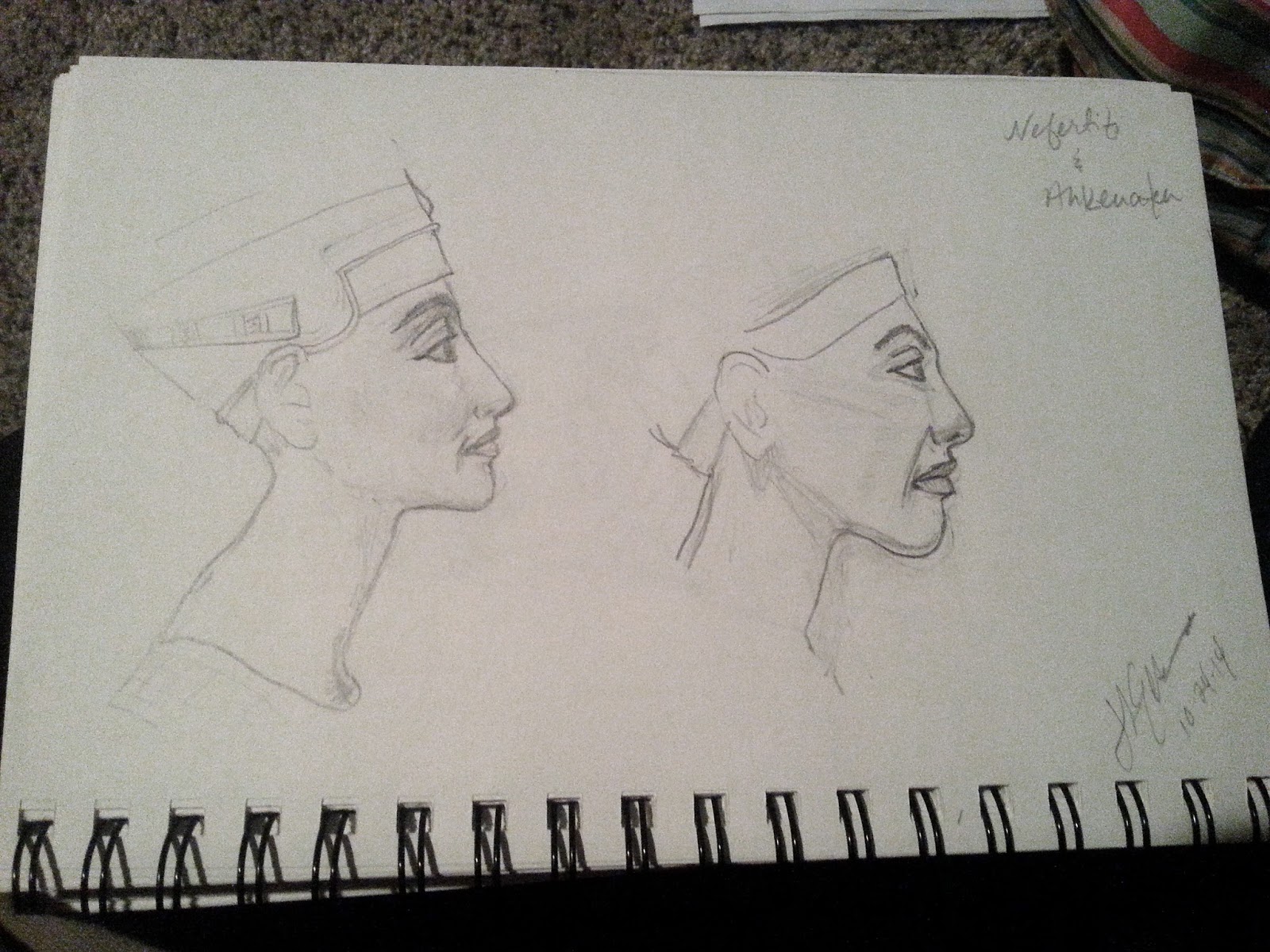
Both of these photos are included in the back matter of my book, The Forgotten: Heir of the Heretic
An excerpt from "The Forgotten: Heir of the Heretic," Chapter Three:
1342 B.C.
“How far are we now?” My eyelids were starting to droop again. I rubbed the crusts of drowsiness from them with my fingers.
“Still another day before we catch sight of the capital. I bet you will be surprised by all the changes it has undergone. Brother has spoken so much about the city’s progress.”
Henuttaneb would soon be my father’s bride. When we reached the city, they would hold a banquet in honor of their union. Shortly thereafter, she would be blessed by the priests as Second Wife of Pharaoh. It was surprising how carefree she was about the whole affair. Her mother, Tiye, held many responsibilities, yet Henu acted like she had no accountability accompanying her new position. Maybe she thought that the Great Wife would handle all things for her. My mother completed most tasks for Pharaoh already.
I responded, “It has been years. I am sure all the sights will appear different from when I first viewed the city through much younger eyes. They are more mature now.”“That sounds very wise! I will have to sound wise when I become a great wife. I hear the Vizier of Lower Kemet is a bit of a show off. Since he deals with merchants from other countries so often, it has been said that he sometimes speaks other languages while conversing. He just slips into another country’s tongue without realizing it. I guess that impresses some less-educated noblewomen. Share with me some more smart declarations, Mery. I want to share some of them at my table during the unification feast. At least everyone will understand what I’m saying unlike that foreign-speaking Vizier,” Henu finished with a giggle. I cringed a little at the short name she used for me: Mery. I had never liked the sound of it. My mother’s short name for me possessed such beauty when she said it: Mayati. It sounded like something recorded in the great writings from the past, stories about adventures and lovers or heroes and gods. Mery sounded very boring. I wanted to correct her but knew she would not listen, much less try to remember.Henu was 18 years old now and had lived a very pampered life. Her parents were all about living luxuriously. So while she had hands well suited for crafting, she was only skilled at it because she wanted to be and not because she had to be. She liked spending her time out on pleasure boats and lounging at banquets. However, her lifetime of indulgences had begun to collect around her midsection, under her chin, and on her upper arms. My mother kept herself to a strict diet. She didn’t resemble a woman who had birthed four children. One, maybe, but she did not appear to carry the accumulated weight from four pregnancies. Sometimes my aunt’s laxity regarding the events happening around her frustrated me. While I understood this was just a product of the expectations on her, it still bothered me. She had grown up with so few responsibilities whereas I was being trained to wear Pharaoh’s crown. And it was not just one crown but two, one crown was for the upper state and one was for the lower state. Together, they represented our nation’s hard-fought unity. Since the beginning of Kemet, pharaohs have worn the double crown with pride. I could only imagine what the two crowns would feel like on my head. The first pharaoh had brought together two cultures of people, once divided by their beliefs, into a single state. But while joined by shared land, each state had kept their own ideals and separate identities. Now Father and Mother were bringing the peoples together with Aten’s love in identity as well as in land. The thought of becoming ruler had been exciting the first few years during the extra training in school and with my mother. I had stood alongside her in court and watched. Mother and Father worked together on cases the viziers could not handle, which seemed to increase in number every year. They reviewed each situation efficiently, quickly, but also differently. Life centered on the citizens’ wants and jealousies for which they demanded Pharaoh to solve for them, and the solutions rarely lasted long. They were as thin and brittle as poorly-made papyrus. When Henu’s new position had been announced, I had hoped for someone to share these responsibilities with. Was that the cause my recent frustrations?“Mery, are you asleep again?” Henu cut into my thoughts.I blinked a couple times to clear my eyes and re-center them on her face, “Daydreaming a little. I’m sorry. You were saying something?” She harrumphed at me, “I didn’t want to think you had fallen asleep while I was talking, but it is pretty obvious that you did!” I sighed. Nothing I said would be able to change her heart. My mood soured. However, I knew the rest of our travels would be easier if I made peace. "You know those smart declarations? I was just thinking about the way we say things. Sometimes it is more how you say something instead of what you say. You said I sounded wise, but that’s only because of how I worded my thoughts. I do not possess much wisdom, other than what Mother has shared with me.”Henu snorted in response, “And sometimes you make no sense. Like now. ‘It is what you say but not what you say?’ I think you are being mean and trying to confuse me. Perhaps Pharaoh should make you a vizier too.”“My mother taught it to me, and I’m not trying to confuse you,” I returned sorely. It was hard to keep the defensiveness out of my voice. I knew if I bit back too hard, she would pout even more and then tell Father about it. After that, Pharaoh would yell at me for a lack of respect. He had been very moody these past cycles of the moons. Perhaps his mood was affecting all of us around him, most particularly me.“Nefertiti is smart with the kingdom, of course, but she’s not so wise when it comes to men,” Henu murmured after binding a row to the base of her basket. Something inside me boiled. Was she actually talking to me about this? Instead of letting my words escape right away, I breathed deeply through my nose and let the river’s air cool my heated response.Henu kept talking, “You know it has been whispered that she loves some commoner? How disgusting is that? Someone who scuffs dirt with their toes and kicks up sand onto their body. I bet he smells like horse dung. Have you been to the stables recently? You know the smell. Just putrid.”“Where did you hear such things?” I asked, shocked at her words. She probably thought being queen meant saying whatever you wanted without consequence. Her mother Tiye certainly held nothing back. I knew that from experience quite well.Henu leaned closer to me, like I was her co-conspirator, “There are rumors my mother has heard about how Nefertiti was intimate with this dirt-dweller after Meketaten was born. Pharaoh and Nefertiti were having a disagreement back then about the new capital. She would disappear for long periods of time. Nefertiti said she was seeking answers through prayer in the temple, but Queen Tiye knew better. My mother knows a woman’s heart. She could see something afoul in Nefertiti’s eyes and smell the scent of another man on her when she returned from praying.”“That’s vile, Henu! Please stop!” I snapped, looking away. Sadly, my aunt’s gossip could not be easily halted, even when I yanked tight on the reins. My tone did not sway her.“Oh, that is not even the worst of it! It is said that your second sister may not be of Pharaoh’s making,” Henu shared with lightness in her voice. She must not have realized that words could weigh down hearts as they sought to tear others down.“That could be considered blasphemy, Henu! Be careful of your words,” I stressed while staring hard into her eyes.How would I ever get used to living next to her, constantly spouting crass whispers? Already I felt a determination to rip the ears off my head so I would not have to hear her voice anymore, and our life together was only just beginning.“Why are you so serious?” Henu groaned. “You don’t remember, but I do. When you and Meketaten were babies, you both cried and cried. But Ankhesenpaaten was so quiet and calm. It is like a hippo’s egg dropped into the crocodile’s nest. My mother and I think Nefertiti has broken her loyalty to Pharaoh. Why else would he ask me to be his bride?”
