
Dragons, dragons and-you guessed it, dragons! discussion
Dragonology
>
Dragon species
date newest »
newest »
 Lesson one: The Wyvern Dragon!!
 The Wyvern (Draco africanus) is the largest dragon species and spends most of its time flying and "skywriting" with smoke.
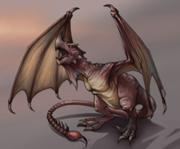
Description:
They are 18 to 20 feet high and 50 feet long. Colouration is green to greenish brown with paler green underparts and lime-green spots on the wings of older wyverns. In flight their call is similar to a crow, while they roar when attacking. They eat any large African mammals. The nomadic wyvern sometimes makes nests on crags. The wyvern egg is very large with a thick bumpy shell which changes colour to match its surroundings. The chicks are brown and lose their spines as they get older.
Trivia:
The most famous wyverns are Jamal (Raised at Castle Drake), Uswassa (Part of the Dragon Express) and Salazaar (Lived to 158).
Dragons Wiki contributor(and author of this article) Wyvern Rex has his name derived from a heraldic joke. It means, ironically, "King of pestilence."
Other Wyverns:
In both European and heraldic lore and/or legend. It is said to have a dragons head, a serpent's body, bat's wings and forelegs plus a serpent's tail with a poisonous tip. In DragonLance it is said to have a scorpion-like tail and to have scales. Wyverns are found often in heraldry. The wyvern represents war, envy and pestilence and is a sign of strength to those who bear it.The origin of the word wyvern comes from thirteenth-century word wyver which in turn is derived from the French wyvere, which means both "viper" and "life."
 Lesson 2 -
 Western Dragon
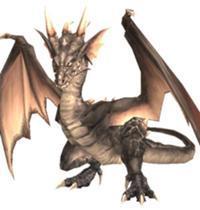
The Standard Western Dragon is one of the more common dragons known around the world. The full-grown Western Dragon is twice the height of an adult human. The closest relatives of the Standard Western Dragon are the European Dragon and the two-legged Wyvern. The dragon can be found in United States, Southern Canada, and in Europe. This dragon loves to hoard gold, and was a very violent type of dragon. Because of its violent behavior the Western Dragon almost died out, but the ones that survived evolved into a calmer type of dragon. The skin for this dragon is rough and scaly and can be a variety of colors. The egg for the Standard Western Dragon can be brown red or green, seeping smoke , very hot to the touch, and also very scaly. The Standard Western Dragon's features are
Types
• Knucker
• Gorynych
This type of dragon is very rare and is thought to be deadly and evil, but will fight of bad people from the one who they love. This dragon is different from Oriental dragons (Chinese dragons) and European dragons (Heraldic dragons) as it is two times bigger and is normally seen as a fiery red colour. This symbolises that it breathes fire, meaning that people are warned by it. This dragon is normally found in the western parts of America, and is thought to rise from the sands of Egypt on the 1st of May (the fight of the dragons) and set the desert on fire, killing all the people in boiling hot surroundings. Western dragons are the friendliest of dragons, and are completely harmless. They make fantastic playmates for children.

 Mod
Cole wrote: "I read them! Very informative, thank you!"
Mod
Cole wrote: "I read them! Very informative, thank you!"Great! Lesson three will be posted shortly. x
 What about the Chinese dragons that looks similar to the snake-no legs or arms??
These are talked about in the book Tiger's Voyage by Coolleen Houck Tiger's Voyage
Mod
These are talked about in the book Tiger's Voyage by Coolleen Houck Tiger's Voyage"
I have read those and I would count them.
Chewy and Iesha,Yes i would count both Chinese Dragons and also Hydra.
Alexis wrote: "Thank you for posting these lessons, they're fascinating!"That's great! Also, i love the inheritance cycle too; it is amazing.
mind blown! head hurts... hahahthat was pretty co to learn! :3
 HMM can I post some information on my dragons? They are not like those described above...
B.J. Whittington
B.J. Whittington
Website
Mod
B.J. Whittington
B.J. Whittington
Website"
Maybe do that on a thread for your books. I think Lucinda is trying to make a encyclepedia for dragons that is she is researching from other cultures. Sorry, I am not trying to offend, do you understand? But I would love to hear about how your dragons work! Could you make a thread for you book?
Cole wrote: I think Lucinda is trying to make a encyclepedia for dragons that is she is researching from other cultures. LOL that is why I asked, was not sure exactly what this was for.
Mod
LOL that is why I asked, was not sure exactly what this was for."
Got it. Thanks for understanding! Please write about your though!?
 Wow! Very informative - thank you. I wrote about dragons but it was purely from my imagination and I'm thinking now that I should have perhaps researched the subject in depth.
Mod
Wow! Very informative - thank you. I wrote about dragons but it was purely from my imagination and I'm thinking now that I should have perhaps researched the subject in depth.
Mod
There is so much legend and lore out there! It sparks imagination.
You should really look into them to get some ideas. I wouldn't worry about you dragons though, you made them in your image!
 There are multiple other species in Dungeons and Dragons
Metallic Dragons:
Alignment: Usually lawful-good and side with paladins and priests
Leader: Platinum Dragon King Bahamut
Gemstone Dragons
Alignment: Usually neutral and side with people/creatures of the same mindset, depending on the universe.
Leader: None
Chromatic Dragons:
Alignment: Almost always lawful-evil to chaotic-evil and side with those who lust for destruction or are seduced by the power/appearance of their queen.
Leader: Prismatic Dragon Queen Tiamat
There are also dragon-blooded dragonfire adepts. Descendants or dragons and half-dragons who can, if they train their power, transform into their ancestors' draconinc form and possibly eclipse their abilities.
Kyle wrote: "I think those ones don't really count considering that Dungeons and Dragons is an absolute fantasy game for role play."That's true. There are people with dragon blood, though. They usually have unique spiritual abilities. I would like to read into the multiple species of dragons on earth, but would rather encounter a strong and virtuous one. However, I feel the astral plane is where most of them lurk nowadays.
 think of it as a sort of magically plane, simplest way that i think of it. however i found an exact definition on the internet.
The astral plane, also called the astral world, is a plane of existence postulated by classical (particularly neo-Platonic), medieval, oriental and esoteric philosophies and mystery religions. It is the world of the celestial spheres, crossed by the soul in its astral body on the way to being born and after death, and generally said to be populated by angels, spirits or other immaterial beings.
 Lucinda wrote: "Lesson 2 -
 Western Dragon
The Standard Western Dragon is one of the more common dragons known around the world. The full-grown Western Dragon is twice the height of an adult human. The closest r..."
Ummmm, sorry to question your lessons, but this isn't exactly accurate. I'm guessing you based this upon something other than the works of Earnest Drake because there is no "western dragon". The western dragons include the European Dragon, the Knucker, the Frost Dragon, and the garguille. It's fine if want to "expand" from the work of Dr. Drake, but as he is the founder of the SASD, I would think you should use a different name for this forum. If you have forgotten, I suggest you reread Dragonology, as it provides a lot of insight on real dragons, and I'm sure the members of this forum would like the same. I'm not trying to be rude or anything, I just wanted to clear up and misconceptions. Also, Knuckers eat children, so they are not excellent playmates.


Main Dragon species:
Western dragon- four legs, two wings. These include:
European dragon; green and scaly hide
Frost dragon; light and icy hide
Knucker; green and scaly hide but snakelike and vestigial wings
Asian dragon- four legs, no wings. These include:
Asian lung (Chinese/Korean/Japanese dragon); has a hairy mane
(The three dragons can be identified based on their having five, four, or three toes respectively)
Tibetan dragon; lacks a mane
Amphithere- no legs, two wings. These include:
American amphithere; mothscale wing composition
Mexican amphithere; feathery wings
Lindworm- two legs, no wings. Small, Western like head with a snakelike body.
Wyvern- two legs, two wings. Western dragon but with only two legs.
(There are dragons that aren't here to hear and see more read "The Dragonology Chronicals.)
What others do you know? In books, films or that you have herd about.