
The Year of Reading Proust discussion

This topic is about
The Guermantes Way
The Guermantes Way, vol. 3
>
Through Sunday, 5 May: The Guermantes Way

message 1:
by
Jason
(last edited Jan 04, 2013 08:20PM)
(new)
-
added it
Sep 30, 2012 04:40PM
 This thread is for the discussion that will take place through Sunday, 5 May of The Guermantes Way, to page 93 (to the paragraph beginning: “To return to the problem of sound...”)
reply
|
flag
 A wonderful Rembrandt-like portrait of Françoise in these early pages, honest but beautiful.
 But what is really impressive is the discipline we now see which Proust applied to his writing in the first two volumes, the controlled way he measured out the story so that we never suspected that our humble narrator would one day, and relatively soon too, live within the walls of the fairy-like Duchesse de Guermantes' own Parisian 'hôtel particulier'.
 Out of all of ISOLT, this was my least favourite volume - still that is not to say it's not brilliant. In fact I payed homage to the narrator and Robert de Saint-Loup in the barracks at Doncières in my own novel.
 I'm curious if others have the same opinion of Guermantes Ways.
 As I recall, the first two volumes of ISOLT were written when Proust was rather ambulatory--he was out and about--for the subsequent volumes he was more of a shut-in and increasingly so as his health worsened while his self-medication augmented.
 Perhaps Marcelita, or someone familiar with the Carter biography, could tell us what exactly was his state of health during the writing of Guermantes Way, the dates, etc. Thanks.
 I prefer Guermantes Way to In a Budding Grove, but that reflects my interest in historical context and sociology of class rather than ideas about aesthetics that take up much of In a Budding Grove. Proust was committed thinker on aesthetics, but I can't get as engaged with those ideas.
 What I love most about this first section is the extended simile about underwater life that Proust carries on throughout the Opera scene. On page 4 he refers to Melusine, a water nymph or fairy who marries a mortal, but as usual things go wrong. After that it is one phrase after another about corals, pearls, nymphs. By page 49 he is writes of "the limpid, reflecting eyes of the water goddesses" In describing the Duchess and Princess.
Note: I am new to the group, but hoping to keep up through next volumes. This is my second year of Proust, but I am interested to do so with group. Also new to social media!
Historygirl wrote:"What I love most about this first section is the extended simile about underwater life that Proust carries on throughout the Opera scene..."This is indeed an amazing piece of composition - I feel him flexing his writing muscles even more than he did in the other volumes, really coming into his own as a practitioner and critic of all the arts, his own included. That he can reverse our expectations so neatly too is impressive. He has come to see Phèdre but the drama he describes takes place not on the stage but in the Princess de Guermantes' opera box.
And then he does one of those narrator switches he used in the first volume; suddenly our young narrator gives way to an omniscient one who knows exactly what Mme de Cambremer, (the elder?) is thinking and what she remembers hearing Swann say in the past.
Is this a third narrator or is it what Eugene calls the older narrator?
 Fionnuala wrote: "H
This is indeed an amazing piece of c..."
All those paintings of the Theatre, Opera etc.. come to my mind in this section. Here is one by Dégas.
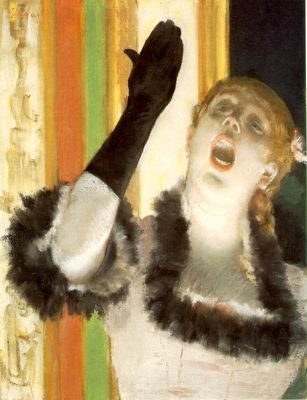
or these two by Cassat:
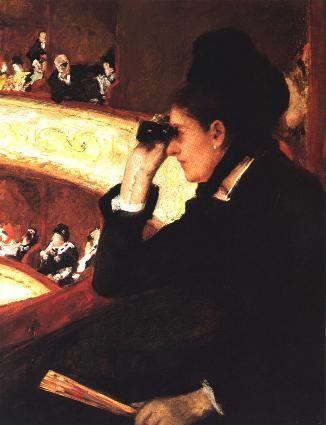
In the latter notice how in the background there is a gentleman looking at our lady.
And here a "dame en rose" against a reflecting mirror.
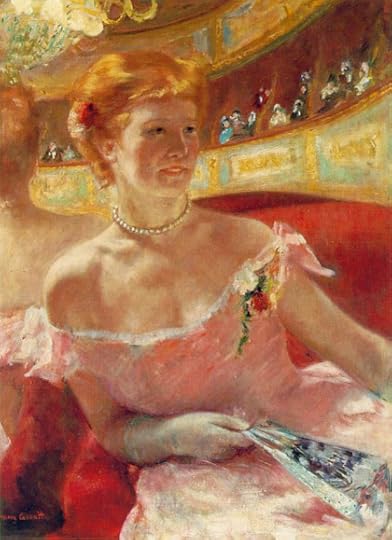 "Les gens...dans leurs loges...les glaces encadrées d'or...et les sièges rouges" it's all there in this painting, Kalliope.
Phillida wrote: "Our young narrator is not finished with cheeks. Jupien's are "plump" (p. 17, ML), but Mme. de Guermantes's are transcendent: "...she had appeared to me in a blinding flash of transfiguration, with ..."
"Les gens...dans leurs loges...les glaces encadrées d'or...et les sièges rouges" it's all there in this painting, Kalliope.
Phillida wrote: "Our young narrator is not finished with cheeks. Jupien's are "plump" (p. 17, ML), but Mme. de Guermantes's are transcendent: "...she had appeared to me in a blinding flash of transfiguration, with ..."In the Combray section I think it was orange.
Yes, it was.p. 202 in my Gallimard edition.
Talking about the Guermantes family..
",,, enfin toujours enveloppés du mystère des temps mérovingiens et baignant, comme dans un coucher de soleil, dans la lumière orangée qui émane de cette syllabe "antes"....
And the colour orange is mentioned twice in the early pages of this week's section in relation to the Guermantes name.
 Moncrieff:
 What annoyed her more than anything were the rusks of pulled bread that my father used to eat. She was convinced that he had them simply to give himself airs and to keep her ‘dancing.’ “I can tell you frankly,” the young footman assured her, “that I never saw the like.” He said it as if he had seen everything, and as if in him the range of a millennial experience extended over all countries and their customs, among which was not anywhere to be found a custom of eating pulled bread.
I had to refer to the original French to satisfy myself that Proust is referring to nothing more exotic than toast here.
Fionnuala wrote: "And the colour orange is mentioned twice in the early pages of this week's section in relation to the Guermantes name."Yes, we had discussed in the first vol why the syllable of the name was associated with the colour orange.. a colour that had not been mentioned until then.
I am still doing the scan reading of this section.. Will be able to do the proper reading tomorrow since we have a holiday (two days..!!!)
Kalliope wrote: "Fionnuala wrote: "...in relation to the Guermantes name."Yes, we had discussed in the first vol why the syllable of the name was associated with the colour orange.. a colour that had not been mentioned until then."
The Guermantes name and its particular colour seems to have the same value as the tisane-soaked madeleine, it holds within it an entire album of memories from his childhood, from his earliest years when the nurse used to sing an old song about the G family to that dappled wedding scene in the Sainte Hilaire church when he fell in love for the first time dazzled by the multidude of hues emanating from the Duchess herself.
More and more, I wonder how Proust didn't paint. He saw the world through such an intensly colored prism, he would have made an amazing fauve.
Fionnuala wrote: "I wonder how Proust didn't paint. He saw the world through such an intensly colored prism, he would have made an amazing fauve." Yes.. fully agree.. working on my review for Jeunes filles.
 Fionnuala: the theatre scene: no, it's not Mme de Cambremer the elder, but the younger (tho she's no spring chicken). We'll meet Mme de C. the elder later. And you're right..what a switch...to go from a standard first person narration to suddenly being omnisciently in Mme de C.'s head.
Richard: the rusks: I've been reading a translation by Mark Treharne which, frankly, I'm not crazy about. I liked "rusks." But he says "toast."
Fionnuala: the theatre scene: no, it's not Mme de Cambremer the elder, but the younger (tho she's no spring chicken). We'll meet Mme de C. the elder later. And you're right..what a switch...to go from a standard first person narration to suddenly being omnisciently in Mme de C.'s head.
Richard: the rusks: I've been reading a translation by Mark Treharne which, frankly, I'm not crazy about. I liked "rusks." But he says "toast."Altho he makes the thing about the dates clearer when
Franҁoise confuses "Angers" with "Algiers" She knew the name Algiers "from some very nasty dates we were customarily sent at New Year's." Moncrieff says, in effect, that she knew the name from some very nasty dates associated with New Year's...I always thought this referred to some kind of Colonial rebellion (like the Sepoy Rebellion in India). But now I realize he meant the fruit.
All in all, though, I feel as distressed as the Narrator's grandmother did at the "new" translation of The Arabian Nights.
It's not exactly toast either, Elizabeth, just to confuse you more, and perhaps 'rusk' might be a better match (but forget the pulled bread idea, I don't know where that came from). In French, it is 'biscotte' which is now shop-bought slices of twice-baked bread which come packaged in boxes like crackers or rusks.Perhaps at that time, they weren't available commercially and Françoise had to rebake the slices of bread herself and this is what she objected to?
Fionnuala wrote: "It's not exactly toast either, Elizabeth, just to confuse you more, and perhaps 'rusk' might be a better match (but forget the pulled bread idea, I don't know where that came from). In French, it i..."Isn't this what we call Melba toast after the opera singer?
 Kalliope wrote: "Fionnuala wrote: "I wonder how Proust didn't paint. He saw the world through such an intensly colored prism, he would have made an amazing fauve."
 Yes.. fully agree.. working on my review for Jeu..."
Waiting for your review.
Another note on the Narrator's lack of direct conversation; I notice, particularly in the Doncières section that there are a LOT of direct remarks from him, all centering around manipulating poor unsuspecting Saint-Loup into getting him into the Duchesse de Guermantes' good graces.
Richard wrote: "Isn't this what we call Melba toast..."I thought Melba toast was when you split a slice of toast in two after toasting so that it's super thin? Biscotte are a little chunkier and toasted on both sides.
 Fionnuala wrote: In French, it is 'biscotte' which is now shop-bought slices of twice-baked bread which come packaged in boxes like crackers or rusks.
Sounds like the Italian biscotti, only biscotti are sweet. But the cooking method is the same.
Fionnuala wrote: And then he does one of those narrator switches he used in the first volume; suddenly our young narrator gives way to an omniscient one who knows exactly what Mme de Cambremer, (the elder?) is thinking and what she remembers hearing Swann say in the past. Is this a third narrator or is it what Eugene calls the older narrator?Proust is operatic, in fact acrobatic, in his utilization of Narrators here. Relating the thoughts of Mme de Cambremer is that of a 3rd person omniscient Narrator which the 1st person Narrators couldn't know.
Proust freely slides between 1st person Narrators in the scene at l'Opéra. The younger 1st person Narrator is recognized by Mme Guermantes "...(she) poured upon me the sparkling and celestial shower of her smile. There are several instances in this scene of the older 1st person Narrator speaking but this example is more obvious: "...which deaths, scandals, illnesses, quarrels would soon alter..." How could the younger Narrator know this future. The sentence is spoken by the older Narrator.
Or does Proust intend that this older Narrator is omniscient, that it is he who recounted Swann's story and who perhaps later comes to know Mme Cambremer so intimately that he can credibly recount her thoughts too on that night at the opera?I don't think I've ever come across such an intriguing approach to point of view in a novel before. But however Proust intended it to be, it is, as you say, Eugene, quite an acrobatic feat that he achieves throughout.
Richard wrote: "Fionnuala wrote: "It's not exactly toast either, Elizabeth, just to confuse you more, and perhaps 'rusk' might be a better match (but forget the pulled bread idea, I don't know where that came from..."Yes, the Melba toast is a lot thinner and usually served with foie or pâté, while the biscotte is more of a substitute of bread with more general and less refined uses (often the bread that dieters favor).
But as Fionnuala says, as they could not be purchased ready-made would entail extra work for Françoise.
I am finding the whole initial episode with Françoise, her faulty French, and the way all the other servants behave vis à vis their employers (the Narrator's family) very funny. And the Narrator's subtle irony is wonderful.Also the way we are approaching the Guermantes through the eyes of Françoise is very effective. It creates a sense of mystery which is very different from the enchanted and imaginary one favored by the Narrator when young.
Kalliope wrote: "I am finding the whole initial episode with Françoise, her faulty French, and the way all the other servants behave vis à vis their employers (the Narrator's family) very funny. And the Narrator's..."That we get such a close-up of the servants' lives and habits and the composition of the entire household is new and very interesting from a historical point of view. I'm imagining that their apartment is in a side wing of the Guermantes building, with neighbors underneath and overhead and on the opposite side of the courtyard, that the wing facing the street was mostly occupied by the concierge and the little workshops like the ex-tailor's, and that the Duchess lived in the fourth wing at the back of the courtyard and furthest from the street, with its own private garden behind it, which the narrator can only imagine as the windows of his apartment don't give onto it. That Proust has created this complicated architectural setting so that the narrator can observe the comings and goings of the Guermantes family is intriguing.
Fionnuala wrote: "Kalliope wrote: "I am finding the whole initial episode with Françoise, her faulty French, and the way all the other servants behave vis à vis their employers (the Narrator's family) very funny. A..."Carter in his bio talks about where Proust's family lived, but the relevant sections are hard to find. I think I will reread this bio after we have finished La recherche, but from the French Wiki:
From 1900 the family lived in 45 Rue de Courcelles.
no 45 : Marcel Proust et ses parents ont emménagé dans cet immeuble très cossu, construit en 1881, le 1er octobre 1900, dans un appartement du 2e étage sur rue (angle avec la rue de Monceau). « L'appartement, au premier étage au-dessus de l'entresol, est pourvu d'un large balcon de pierre et d'une cour intérieur. M. et Mme Proust y font chambre à part ; chaque garçon a sa chambre. Une petite pièce appelée par Mme Proust le "fumoir" est dévolue aux fumigations de Marcel qui fait brûler des poudres. Il y a aussi le cabinet du docteur. Le père a son valet de chambre, Jean Blanc, que Proust conservera jusqu'en 1908. La mère dispose d'une femme de chambre et d'une cuisinière. »11 Le docteur Adrien Proust meurt dans cet appartement le 26 novembre 1903, puis Mme Proust le 26 septembre 1905. Marcel Proust conserve l'appartement, devenu trop vaste, jusqu'en décembre 1906 puis il emménage no 102, boulevard Haussmann.
Re Françoise' faulty pronunciations: some are ignorant ("Algiers for Angers") but some are archaic, or, as Proust himself says, "the purest French."Here are some examples in English:
"He holp me get in my crop"
"The raccoon cloomb the tree"
"Wrastling practice is at four o'clock"
"Let's get a-going!"
"Would you ax her for a pencil?"
Ignorant? No; those forms span Chaucer to Shakespeare. I think Françoise' speech is similar.
p.s. biscotti (if "rusks" are close)are a real pain to make; after you have laboriously made up the dough and formed it into loaves, you bake it semi-done; then take out of oven and slice, and bake the slices again. See why Françoise didn't like to make them?
Those archaic expressions are interesting, Elizabeth and Françoise was in good company sometimes in her language use, Mme de Sévigne was mentioned, I think and Saint-Simon.By the way, I loved your anecdote earlier about the 'nasty dates associated with New Year'. Translation is tricky indeed.
When I lived in Paris, reading l'Officiel des Spectacles, I found that one could go to l'Opéra to see a short Sunday afternoon performance, of what I don't recall as that was not as important to me as sitting in l'Opéra, inexpensively.Béatrice and I went; we sat in the stalls and I remember looking back at the boxes, the nearest and most ornate was Napoleon's. Perhaps I sat in the young Narrator's seat or in a seat where Proust had sat. Anyway I was where history had happened and I loved living in Paris for that.
The scene at l'Opéra is the longest so far in the novel and it is unusual in that the Narrator fixes himself in space, in the stalls of l'Opéra, by his attentions: the boxes of the aristocrats, Berma's performance on stage and the people with him in the stalls particularly the small old woman who didn't like Berma.
If you remember your geometry, you know that it takes 3 vectors or lines to fix a point at their intersection in space: the Narrator is located by his 3 relative attentions. This is the first time Proust has used triangulation by attention to fix the Narrator in space and he creates a comfortable and understandable spatial context for his readers.
I am enthralled by the aquatic imagery used for the "baignoire" of La princesse de Guermantes. What beauty!
Eugene, I have my ticket for July the 9th at the Garnier.
 Kalliope wrote: "I am enthralled by the aquatic imagery used for the "baignoire" of La princesse de Guermantes. "
The 'baignoire', is that the stalls?
Karen wrote: "Kalliope wrote: "I am enthralled by the aquatic imagery used for the "baignoire" of La princesse de Guermantes. "The 'baignoire', is that the stalls?"
No, it is the Box on the ground or first level (UK or US term) - the rez-de-chaussée.
I haven't quite got to the theatre yet, but it struck me how most of the part about Françoise is also narrated from the point of view of an omniscient 3rd person narrator. The most obvious: when Mum is ringing for the staff after their lunch; one footman goes out to smoke, Françoise goes up to tidy her stuff on the sixth floor and the butler sees to his private correspondence using paper stolen from the narrator's room. It's interesting, because the narrator would have been in the dining room or salon with his mother wouldn't he?What I also noted: there was a change from the passé simple to the imparfait at around that very point. The passé simple is used for one particular event in the past, and has a ring of reality about it, but the imperfect is used for repeated actions in the past, a bit like saying we would often go there or similar in English, so it almost starts to float away into the conjectural. As if the narrator is saying not this is how it was, but this is how it often happened, so he may have found this out much later.
Kalliope wrote: "Karen wrote: "Kalliope wrote: "I am enthralled by the aquatic imagery used for the "baignoire" of La princesse de Guermantes. "The 'baignoire', is that the stalls?"
No, it is the Box on the grou..."
Isn´t "baignoire" a "bañera"? I think in English it´s a bath-tub? Or maybe bathtubs were in a box in the ground floor?
BTW i¨ve also found the Francoise´part very funny,endearing and very real. It reminded me of Lydia -whom i still miss -. We used to have sleep-in-maids like her in Arg. some years ago, they usually had a child -Lydia´s was Ana Maria- and they were single moms from poor provinces.
I had Lydia for years -she had indeed some other name I can´t remember- but she had it changed to Lydia because she thought it was cooler.
She lived with us until she bought her own house not far from us and we visited her until her death.My children stayed with her in her new house for the night when we went out.
She was just like Francoise! She thought we were great and therefore would defend us like we were her own kin if someone said anything she didin´t like about any of us.She was proud of living with us and consider us like this sophisticated people(!) because we could speak in other languages.
She also made mistakes) with names and words like for e.g."nellyloom" instead of "linoleum" or calling my mother "la señora Granny".
Lydia also decided what we were to eat and criticized some of our friends for their attitude or conversation!
I really enjoyed this Francoise bit and I also noticed the Narrator spoke about a very real Francoise he had known and loved.There is real "tendresse" for that woman in those pages.
As to the "dates" jokes i missed it because in my Spanish translation it´s "datiles".
Karen wrote: "I haven't quite got to the theatre yet, but it struck me how most of the part about Françoise is also narrated from the point of view of an omniscient 3rd person narrator. The most obvious: when Mu..."Yes, this roaming omniscient narrator reminded me of the Un amour de Swann section... Sometimes Swann is observed from outside, but other times the narrator got inside Swann's mind... which has a stronger impact than imagining that the Narrator got to know about this from Swann later one. I am getting a similar feeling with Françoise. Actually, no, a weaker feeling with Françoise... the Narrator's irony is so strong.. I feel that he "imitates" her, rather than really get inside her head.
OOOPS! so much chatter about the old days and I forgot to mention something I noticed that really surprised me:the Guermantes lived in the same building with a tailor !How democratic or were they empoverished nobles?
Kalliope wrote: "Karen wrote: "The 'baignoire', is that the stalls?"No, it is the Box on the grou..."
Odd idea, I've never seen boxes on the ground floor. Looking round the interweb I found that there's limited visibility from those bathtubs....
Karen, it's funny but I thought it likely that he would really have observed or overheard those exchanges between the servants and that he would have guessed just exactly what they chose to do before they answered the Mistress's bell in the afternoon. I imagine there must have been unwritten rules that everyone knew about. Interesting too that the servants didn't live in the same apartment but in 'chambres de bonnes' on the sixth floor under the eaves, no doubt. Kalliope, you mentioned the 'cabinet du médecin' earlier. Does this mean they had a special room for the doctor's visits?
Kalliope wrote: " Actually, no, a weaker feeling with Françoise... the Narrator's irony is so strong.. I feel that he "imitates" her, rather than really get inside her head."
That's it, yes. The irony and that floating imparfait makes it feel imitative rather than a one-to-one portrayal.
Karen wrote: "Kalliope wrote: "Karen wrote: "The 'baignoire', is that the stalls?"No, it is the Box on the grou..."
Odd idea, I've never seen boxes on the ground floor. Looking round the interweb I found tha..."
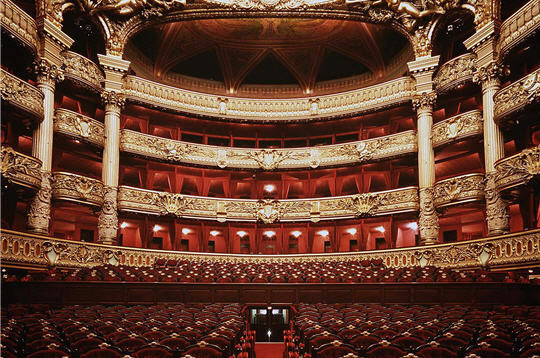
We have some of those. The Teatro de la Zarzuela, and our Opera, the Teatro Real, are that way. The box is a bit higher up than the stalls, the bigger the theatre the higher that first floor is. And I guess that is the case with the Garnier.
Here it i:
 Fionnuala wrote: "Karen, it's funny but I thought it likely that he would really have observed or overheard those exchanges between the servants and that he would have guessed just exactly what they chose to do befo..."
No, the Docteur is Proust's father. He was a famous physician (got the Croix d'Honneur). The profession of the father of the Narrator is not mentioned so far.
Kalliope wrote: "Fionnuala wrote: "Karen, it's funny but I thought it likely that he would really have observed or overheard those exchanges between the servants and that he would have guessed just exactly what the..."Of course, I forgot that he was a doctor. Odd too that he was, and Robert as well, and yet Proust himself seemed to have been anti doctors in the end...
Aren't we led to believe that the Narrator's father is a civil servant in the department of foreign affairs?
Fionnuala wrote: "Kalliope wrote: "Fionnuala wrote: "Karen, it's funny but I thought it likely that he would really have observed or overheard those exchanges between the servants and that he would have guessed just..."Yes, and when Marcel was very sick towards the end, he forbid his brother to enter the house if he was going to come to prescribe things.
As for the Narrator's father, I keep thinking he is a doctor too, but have no basis. It is just that doctors could have some sort of relations with the Government. Proust father became famous for defending and enforcing hygienic practices.
I just checked and yes Adrien Proust was "inspecteur général des services sanitaires internationaux de 1874 à 1903"
We also have an "Opera" in Buenos Aires very similar to the Paris one:http://www.youtube.com/watch?v=f1qO6t...
http://en.wikipedia.org/wiki/Teatro_C...
Kalliope wrote: Eugene, I have my ticket for July the 9th at the Garnier.?
More confusion in Karen's mind (feeling a bit like Pooh, a bear of little brain): is Mme de Guermantes and la princesse de Guermantes the same person? I was thinking for a while that this was two different people - there are so many branches of that family after all, but now here I am at the theatre and it seems to be just the one. (*Sigh* - I obviously do not know the correct form of address) - on the other hand, isn't there a duc/duchesse as well? Oh dear.
Mme de Guermantes and the Duchess are the same person but the Princess is a different person, a relation, and she has an extra name too - is it Saxe?

The Year of Reading Proust
Books mentioned in this topic
Seven Ages of Paris (other topics)Au Bonheur des Dames (other topics)
