
General Craft & DIY discussion
Art
>
Painting
date newest »
newest »
message 1:
by
Jim
(new)
Nov 02, 2012 12:13PM
 Does anyone paint? We have several oils that my wife did, but she quit years ago since we had so much going on with the kids. I've tried a bit, but don't really have the talent, although I certainly appreciate those that do.
reply
|
flag
 I started drawing around the same time I started reading, somewhere around 4 or 5 years old, I think. I draw, working with pastels or pencils, as I cannot make a brush do anything except paint barns and fences.
 I have had a small spare time business most of my adult life doing commissioned portraits of animals (dogs and horses mostly) and some country/still life studies in pastels, colored pencil and black and white (pen and ink, charcoal and pencil).
By far the absolute best book on pencil techniques is Drawing From Line To Life an incredible book I only wish I'd had 30 years ago when I was struggling with many of the techniques the author explains in detail.
It is a difficult book to find in the U.S. I finally found a copy carried by an art supply store in Texas, only after contacting the author (who is in England). It is carried by Amazon.co.uk http://www.amazon.co.uk/Drawing-Line-...
However, for anyone interested in advanced techniques in drawing with pencils, this is by far the best 'text' I have ever seen.
Pastels are fun, messy but fun. The first painting I ever actually sold was a pastel portrait of a Thoroughbred horse. The most helpful book on working with soft pastels I've found
 Do you use the chalky (?) kind of pastels or oil pastels? I've seen some gorgeous works with both, but the chalky ones scare me. Years ago I bought a very pretty one for my girl friend & it got ruined shortly after. Don't recall what killed it, but I remember we were both disappointed.
Jim wrote: "Do you use the chalky (?) kind of pastels or oil pastels? I've seen some gorgeous works with both, but the chalky ones scare me. Years ago I bought a very pretty one for my girl friend & it got ruined shortly after...."
Do you use the chalky (?) kind of pastels or oil pastels? I've seen some gorgeous works with both, but the chalky ones scare me. Years ago I bought a very pretty one for my girl friend & it got ruined shortly after. Don't recall what killed it, but I remember we were both disappointed.
Jim wrote: "Do you use the chalky (?) kind of pastels or oil pastels? I've seen some gorgeous works with both, but the chalky ones scare me. Years ago I bought a very pretty one for my girl friend & it got ruined shortly after...."I use the 'soft' pastels, which are the chalky ones, like the ability to blend with them. I also use pastel pencils (which can be sharpened to finer points) and colored pencils as well, both alone and combined with the soft pastels. I use the pencils for detail work, eyes and noses in animal portraits, etc.
They are more easily damaged than other mediums and have to be sprayed heavily with 'fixative',sometimes even between layers, to help prevent the pastel from lifting. They also need to be framed carefully, so that the pastel surface does not touch the glass (I use double or triple mats on the ones I do) and of course dropping or getting them 'banged' can loosen the pastel as well.
My biggest issue with them was always that they did not ship well. Too easy to damage being thrown or something hitting the package during shipment.
Do the fixatives ever mess up your blending? I guess there are special sprays or something? I just notice a lot of changes depending on what I finish wood with, so I'd guess the same might happen with soft pastels.
Jim wrote: "Do the fixatives ever mess up your blending? I guess there are special sprays or something? "The fixatives come in an aerosol can. The biggest trick is to agitate the can very well before spraying ... also do a *test* spray in the air before spraying the pastel. Several light coats work better than one heavy coat also.
I've not had much of an issue with it interfering with the blending, although again, several very light coats work better than one heavy one. Occasionally, I will find that a light over dark blend will end up darker than the unsprayed surface.
I forget where we were discussing Recollections in Black and White by Eric Sloane, but I think Sharon mentioned it & I realized I hadn't read it. I wound up getting a withdrawn library copy for $4 & just read it tonight while the girls watched TV. I really enjoyed it, although I don't think there was any new material in it. It was nice to have such a short book that just concentrated on this aspect of his work.My review is here:
http://www.goodreads.com/review/show/...
 Gee, there just aren't any books about what I'm currently doing with acrylics... must be breaking new ground. The goal was to make my acrylic painting as fast as oil painting, and I accomplished this by eliminating most of the mixing time and wasted paint (dries on the pallette!) by premixing the colors.
 Anyway, to accomodate the new system I needed a new kit as my premixed colors wouldn't fit in a tackle box or an "art" box. Last Winter I used scrap wood to build the new kit and had a nice white box that fit all the colors in drawers as well as the bottles, bruches, pallette etc on the top and side. But what artist wants a WHITE kit? Consequently I started painting Maine scenes, and farm scenes and designs on it but never finished before the warm weather hit and the farm got busy.
After six months I'm back at it and just about done. Today I finished touchng up a couple scenes (with my premixed paint) and the fibonacci sequence inspired design on the drawers....
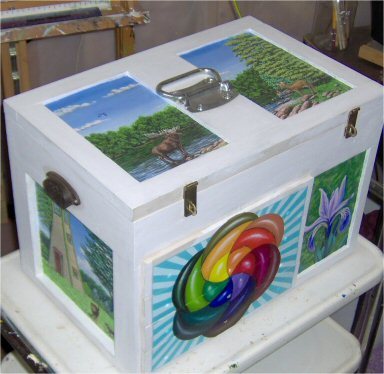
Now all that's left is whitening the white and adding some varnish!
And of course, doesn't every artist have a dark side?
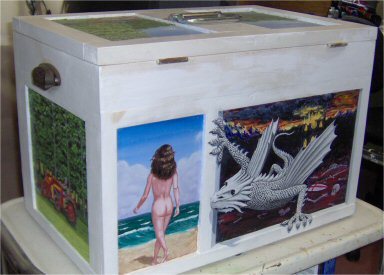 Wow! That's gorgeous. It's a brag box & well deserved, too.
Thanks Jim and Sharon! Your "Wow's" remind me that there is a book that covers "folk art" type projects. (I'm reminded because my "serious" works generally recieves the dreaded "that's interesting".) Routinely I try to take a break from serious painting and just do something fun, and the book It's Fun to Paint helped cure all that book learnin' and fine art instruction.
Just aquired a new painting book!
Wow! That's gorgeous. It's a brag box & well deserved, too.
Thanks Jim and Sharon! Your "Wow's" remind me that there is a book that covers "folk art" type projects. (I'm reminded because my "serious" works generally recieves the dreaded "that's interesting".) Routinely I try to take a break from serious painting and just do something fun, and the book It's Fun to Paint helped cure all that book learnin' and fine art instruction.
Just aquired a new painting book!Paint Your Car: A Step by Step How-To Guide
Ok, so I don't even have a car right now... after the last one died I had absolutely no interest in spending more money on a over cumputerized over sensored expensive to repair newer car. I'm saving up for a 1940's to 1960's model that, like my 1953 tractor, I can fix it! Knowing me it'll be a fixer upper that may needs painting.... can't hurt to be prepared!
Might be a lot more expensive, though. I think I mentioned that my cousin restored a '56 Chevy. He spent years & a ton of money doing it right. Would you be doing that or just getting it to run?I just buy the least expensive, decent car I can get. I don't much care what they look like, which anyone can tell when they see my 2003 S10. It's a scared, filthy little beast. The 2006 Cobalt that I use for commuting is OK looking, though. Marg has a 2005 1/2 ton Chevy. She wants a new one. Not happening any time soon, though. They're too expensive & have no resale value right now.
The thing is, with newer cars you can keep fixing them and maintaining them but at some point the repair will cost more than the car is worth. I went through several "inexpensive" vehicles when I had my busisness, and made out OK as it was worth it for the tax write off on milage. Now I want one vehicle for the little bit of driving I do, and with an antique, not only do they increase in value when you repair them, but I deserve a cool ride! Darn, I never should of junked that 76 Gremlin I'd bought brand new.... or for that matter the 63 Chevy Impala.. or the Corvair.... though the 1960 3 cylynder 3 speed on the column Saab wouldn't interest me anymore.
My first truck was a column shift, an old Chevy. I hated it. I'd have to beat the linkage with an iron bar some days to get it to move. I had another a decade or so later that wasn't as bad, though.Yes, cars do wear out. People keep telling me how they get 200k or 300k miles out of theirs. Every time mine get over 100k, they start nickle & diming me to death. Except the nickles have a couple of zeroes on the left side of the decimal point. When you add in the hassle of break downs & all, it just isn't worth it to me.
That's why my S10 isn't my commuting vehicle any more. I could probably get it back into commuting shape for about $5000, but instead I bought a 2006 Cobalt for $6000 with only 30K miles on it. I've put as many miles on it in the year I've had it mostly just commuting back & forth to work. That's 70 miles a day, over half on the highway.
When I had the vehicle I bet I drove 2000 whole miles in a year! Guess I'm not a "good" American anymore....
I wish I could drive only 2000 miles a year. I would if I didn't have to go to work. I do, however. Since I like living in the country, but have job skills that are only demanded in the city, I have a long commute.
Been there... not much fun! All that reading time wasted!
I used to listen to audio books when I was doing a lot of cross country driving hauling horses. That more or less required me to be in one place for a fairly long period of time, so it worked. Otherwise, I find that I simply do not say long enough in one place to listen successfully ... or if it is in the evening and I'm sitting in my recliner beside the wood stove ... I go to sleep!
Now that I have a vehicle I went back to the old geezer painting group. While the woman who runs it used to be a pro and will give people pointers, it's more just for comradery.I did one OK landscape, and then worked on a couple assorted scenes, but it's hard to back in the groove after nine months... (what, no welder!?!)
I was introduced to something new, other than paper, to work on with pencils through the Wet Canvas site and I'm now playing with it.Drafting film. Acetate like architects have used for years but tweaked for artists. No blue lines and slightly roughened on one or both sides to accept graphite or colored pencil, which gives it a faintly frosted look. Translucent rather than transparent.
I decided I didn't like the portrait I did of my (now deceased) foundation Oldenburg stallion, so I started over again with the drafting film.
Different. It definitely 'grabs' the graphite. I had to go to a harder grade of pencil and a lighter touch to get the light tones and it feels strange under the pencil ... slicker than paper.
Really curious to see how this works out eventually, but I think I'm going to like it. I can see a lot of possibilities.
That sounds cool, Sharon. I love pencil, charcoal, & pen sketches. It always amazes me how realistic some artists are in that medium. Be sure to post a picture for us. You can do it here in the group pictures, if you'd like.
I'll do that. I'm maybe a third finished with it, but still working on the rough draft for the third image I decided to add. Difficult angle and it's going slowly.Another very interesting application uses the translucent quality to add a 'foggy' background behind the main subject. Because of the translucence, if you mount the film over a background 'picture' you get a foggy background effect. Very unique and if it works out well for me, I have quite a few things in mind using this.
When I get to that point, I'll have to figure out how to add photos! My technological incompetence is showing again!
Hey Jim... I broke out the oils for class, though I switch to acrylics occasionally. Both mediums have advantages depending on what I'm doing.
Beginning to get get back in the groove painting knocking out a couple simple paintings every week in the group.It's funny, the "instructor" is a landscape artist and has totally different ideas about painting than me. I prefer figurative work with the emphasis on emotion rather than realism. I often answer newer people questions when she's busy with completely different answers... though answers just a valid because with art there are no "right" answers!
IE- She says,"We never use paint straight from the tubes". I say," What wonderful bright colors we can get straight from the tubes!"

General Craft & DIY
Books mentioned in this topic
Paint Your Car: A Step by Step How-To Guide (other topics)It's Fun to Paint (other topics)
Recollections in Black and White (other topics)
Painting Animals That Touch the Heart (other topics)
Drawing from Line to Life (other topics)