
The Pickwick Club discussion

This topic is about
David Copperfield
David Copperfield
>
Copperfield, Chapters 58 - 64
date newest »
newest »
 Tristram, I smiled as I read your synopsis and had the same sentiments for many of your observations. One aspect I would like to expand upon is David's evolving, from a naive child to a more confident adult?
What I find interesting about this is that he still seems to cling to the memory of the Steerforth he used to adore as a child and as a young man, the Steerforth who still has a hold on his heart...This chapter is clearly supposed to trace out David’s development towards a greater state of maturity, and the way towards this is suffering and work. While the suffering makes more of an adult of him, his work enhances his worldly position since Traddles manages to “arrange for [his novel’s] publication very advantageously for [David].”
Your point about David instantly reminiscing about his boyhood with Steerforth upon seeing him laying dead in the sand, I found David's reaction surprising. I really thought he would have held Steerforth in a little bit of contempt, but he didn't; those last words of Steerforth to David, when he bade him to think of him at his best, were honored instead. I always felt Steerforth prayed upon David, or was rather attracted to a friendship with him because of David's innocence, and even dead Steerforth commands a certain hold over David. In the midst of Ham dying while attempting to save Steerforth, David doesn't seem to register Ham's passing, alternatively he begins to reminisce about Steerforth-That's odd, I think. In the end, I would like to think David gave their relationship a peaceful closure since Steerforth would no longer walk amongst the living, but had Steerforth lived, I still don't think David would have had the fight within him either... Like he did with Uriah. I don't see David's behavior as cowardice towards Steerforth, but I do feel he shirked on some level of loyalty towards his first love, Emily, and the Peggotty family. In the end, for me, I don't see David any more sure footed towards attaining anything in his life. Granted, David is talented, but it's Traddles who sets him up for ultimate success; he loves Agnes, but he doesn't pursue her either it just fell into place for him. David may have fulfilled his desires with Agnes, his notoriety, friends and family, which is great; but I as a reader was left a little lackluster with David in the end. I would liked to have seen him achieve more mentally, building unwavering character.

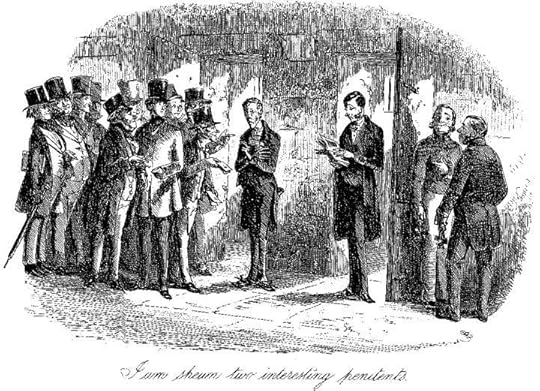
I am shewn two interesting penitents
Chapter 61
The commentary says:
"This illustration completes the narrative-pictorial sequence that one might entitle "Uriah Heep's Progress" from arch hypocrisy to rebellious humility to boldfaced fraud, punishment and social ostracism, and, ultimately, further duplicity. For this first November illustration, Phiz focuses on the figures of two supposedly reformed offenders called "Twenty Seven" and "Twenty Eight," the numbers assigned by the penal institution to the long-headed Uriah Heep and the suave James Littimer. According to J. A. Hammerton (1910), the illustration of the undiluted roguery portrayed by these deceptive egoists may be associated with the following passage":
"Traddles and I beheld in the converted Number Twenty-Seven, Uriah Heep! Twenty-eight was Mr. Littimer, who walked fourth reading a good book!"
In fact, Phiz has utilized the following fuller passage that Hammerton has reduced to its essentials:
"But, at last, we came to the door of his cell; and Mr. Creakle, looking through a little hole in it, reported to us, in a state of the greatest admiration, that he was reading a Hymn Book.
There was such a rush of heads immediately, to see Number Twenty Seven reading his Hymn Book, that the little hole was blocked up, six or seven heads deep. To remedy this inconvenience, and give us an opportunity of conversing with Twenty seven in all his purity, Mr. Creakle directed the door of the cell to be unlocked, and Twenty Seven to be invited out into the passage. This was done; and whom, should Traddles and I then behold, to our amazement, in this converted Number Twenty Seven, but Uriah Heep! . . . .
Twenty Seven stood in the midst of us, as if he felt himself the principal object of merit in a highly meritorious museum. That we, the neophytes, might have an excess of light shining upon us all at once, orders were given to let out Twenty Eight.
I had been so much astonished already, that I only felt a kind of resigned wonder when Mr. Littimer walked forth, reading a good book!."
Thus, Phiz has collapsed two textual moments into one scene, and had Uriah pocket the hymnal to distinguish him from Littimer (right), reading a rather thin Bible (perhaps just that tome of suffering and forgiveness, the New Testament). Neither "penitent" is dressed in prison uniform, but, perhaps merely for the sake of visual continuity, wear the swallowtail coats and dark waistcoats associated with middle-class respectability. Last seen in "Steerforth and Mr. Mell", the sadistic schoolmaster Mr. Creakle has unexpectedly reappeared, just as in other Dickens novels, characters from earlier in the narrative have a habit of turning up later in the story, often to effect a plot resolution; he is the somewhat rotund, benign-looking member of the establishment standing immediately beside David Copperfield. The only other youthful face in the congregation, seen immediately over Copperfield's shoulder, must be that of Traddles. On the extreme right of the plate stand the two uniformed turnkeys (not actually mentioned in the text), whose knowing looks exchanged with each other suggest a more normative response to this theatre of contrition, with the lead actors making a palpable hit, if one may judge by the appreciative smiles and gestures of the prison commissioners, not delineated in any detail by Dickens and therefore more or less cut from the same cloth in this illustration of disinterested establishmentarian public benevolence. Our delight in the scene is that the persuasive rogues have so easily deceived the prison governors.
Phiz has made the pose of the one to reflect that of the other, just as their statements of contrition and confessions of their "follies" seem to have been jointly developed. Both hypocrites, too, develop the notion that they are the ones who have been wronged, and that Copperfield, Traddles, and Mr. Wickfield should bear the responsibility for their misdeeds; but, of course, the pious frauds make much of uttering their professions of forgiveness, striking exactly the desired effect for the sober-sided, silk-hatted Board of Commissioners. Traddles and Copperfield, centre, are the only two among the distinguished guests who appear unimpressed by this cant and outward gestures of spiritual reform."
I hadn't noticed until I read the commentary that Uriah and Littimer weren't wearing prison uniforms. Why weren't they? Isn't it odd that of all the men who must be in this prison only the two we have spent so much time with are the ones allowed to dress in regular clothing? Or do all the prisoners dress the same way?
 Ami wrote: "Tristram, I smiled as I read your synopsis and had the same sentiments for many of your observations. One aspect I would like to expand upon is David's evolving, from a naive child to a more confid..."
Ami
I found your commentary to be sensitive and logical. I too struggled with David's rather compulsive attraction to Steerforth. From the beginning of their relationship it seems to me that Steerforth took much more than he gave. To think that Ham gave his life, presumably without the knowledge of who he was attempting to rescue, saddens me. Steerforth always took; Ham always gave. Ham's death scene needed more attention.
Next week we can freely discuss the use of the first person narrative. Should be fun!
Kim wrote: "I am shewn two interesting penitentsChapter 61
The commentary says:
"This illustration completes the narrative-pictorial sequence that one might entitle "Uriah Heep's Progress" from arch hypocr..."
Kim
Odd clothing, indeed. Prisoners would not be dressed as if they were about to stroll about Hyde Park ... Unless, of course, it's a new method of prisoner reform :-)
Kim wrote: ""A Stranger calls to see me"Chapter 63
The commentary says:
"The second illustration for the nineteenth (double) monthly number, issued in November 1850, completes the story of Dan'l Peggotty, ..."
Kim
"...the more intellectually able Agnes." Ouch! An interesting comment on Dora to be sure.
Again, the commentary/analysis of the illustrations is both fascinating and insightful. Thank you, Kim. H.K. Browne must have waited at Dickens's door for the MS of the coming chapters, read them, and then been quick off the mark and up all night to come up with the preliminary drawings. It would be accurate to say, I would imagine, that he, and George Cruickshank before him, were the first people to read the entire novel in instalment form.
Kim wrote: "Keeping in mind that I don't always understand what the people in these illustration commentaries are talking about, since our person doing the commentary mentioned the frontispiece and the title-p..."I found the 1858 commentaries to be very perceptive and interesting to read. Clearly, Emily is a central feature of the book, and thus her story must be seen in a broad context. Since Phiz is the illustrator again, he will have had the opportunity of not being rushed as he would have been to produce the first edition illustrations, but rather had the leisure to reflect on his work as well as the reading public's reactions to both the novel and his work, and thus produce a more clearly defined and composed illustration.
Kim: By providing the first edition illustrations as well as the 1858 illustrations and the commentaries you have, once again, given us multiple layers of ideas to consider, think about and discuss. Thank you.
 I actually liked the illustration which has Little Emily balance across the wooden plank over the angry waves with David watching her from the safe beach best of all frontispiece illustrations because not only does it foreshadow the story of Emily's fall, which is also brought about by her ambition of being a lady one day, but it also hints at David's exasperating passiveness that made him eavesdrop on Rosa Dartle torturing Emily without interfering, that made him receive letters from Mrs. Micawber without offering help and that induced him into watching Heep enhance his influence over Wickfield and Agnes without thwarting the villain's plans. In the latter two conflicts it is basically Traddles who offers a helping hand, the self-same Traddles who also spoke out against Steerforth when he humiliated Mr. Mell and caused his dismissal. I wonder whether it ever occurred to Dickens what a passive hero he had created here.
Ami,
I actually liked the illustration which has Little Emily balance across the wooden plank over the angry waves with David watching her from the safe beach best of all frontispiece illustrations because not only does it foreshadow the story of Emily's fall, which is also brought about by her ambition of being a lady one day, but it also hints at David's exasperating passiveness that made him eavesdrop on Rosa Dartle torturing Emily without interfering, that made him receive letters from Mrs. Micawber without offering help and that induced him into watching Heep enhance his influence over Wickfield and Agnes without thwarting the villain's plans. In the latter two conflicts it is basically Traddles who offers a helping hand, the self-same Traddles who also spoke out against Steerforth when he humiliated Mr. Mell and caused his dismissal. I wonder whether it ever occurred to Dickens what a passive hero he had created here.
Ami,maybe it was easier for David to smack Uriah because the latter is a social upstart whereas JAmes Steerforth comes from what is commonly called a good family. We already discussed the parallel between Uriah's wish to marry his employer's daughter and David's marriage plans with regard to Dora Spenlow. Actually, Mr. Spenlow had every reason to feel distrustful. Somehow, however, David never saw that parallel and maybe this is because he regarded himself as a middle-class person rather than as an overreacher.
Tristram wrote: "I actually liked the illustration which has Little Emily balance across the wooden plank over the angry waves with David watching her from the safe beach best of all frontispiece illustrations beca..."It looks like we are all gearing up to discuss David and his position as the first person narrator. Your comments add further to the discussion. I never thought about how the illustrations could, or, in fact, do help guide or lead the reader to their opinion of David.
I'm going to make some preliminary notes so I don't forget what I'm thinking. ;-0
Tristram wrote: "I will this time summarize the remaining chapters in one single comment. It can be done conveniently."Me too, here goes my single comment. Beginning with:
Chapter 58
"I left all who were dear to me, and went away; and believed that I had borne it, and it was past. As a man upon a field of battle will receive a mortal hurt, and scarcely know that he is struck, so I, when I was left alone with my undisciplined heart, had no conception of the wound with which it had to strive."
I was surprised he went away alone, without one person, friend or servant with him. I was slightly surprised he went at all it took him so long, but it doesn't seem like travelling through all sorts of places in all sorts of countries all by yourself would help you with your grief and mourning. I would think that being all alone you would dwell on the "bad" things even more.
Another thing was David realizing he was in love with Agnes but deciding to make the sacrifice and never tell her because he had taught her to be his sister. The reason I know that is because he told us, and told us, and told us. Tristram already mentioned the first paragraph I had marked but here are a few more:
"She was so true, she was so beautiful, she was so good,—I owed her so much gratitude, she was so dear to me, that I could find no utterance for what I felt. I tried to bless her, tried to thank her, tried to tell her (as I had often done in letters) what an influence she had upon me; but all my efforts were in vain. My love and joy were dumb."
"Whatever betides, whatever new ties you may form, whatever changes may come between us, I shall always look to you, and love you, as I do now, and have always done. You will always be my solace and resource, as you have always been. Until I die, my dearest sister, I shall see you always before me, pointing upward!'"
" I was not happy; but, thus far, I had faithfully set the seal upon the Past, and, thinking of her, pointing upward, thought of her as pointing to that sky above me, where, in the mystery to come, I might yet love her with a love unknown on earth, and tell her what the strife had been within me when I loved her here. "
"But I loved her: and now it even became some consolation to me, vaguely to conceive a distant day when I might blamelessly avow it; when all this should be over; when I could say 'Agnes, so it was when I came home; and now I am old, and I never have loved since!' "
Enough already. You love her, we get it.
Chapter 61
I read this paragraph twice, once just as if it is David telling us about his life, then again picturing Dickens writing about himself. I believe it applied to them both.
"In pursuance of my intention of referring to my own fictions only when their course should incidentally connect itself with the progress of my story, I do not enter on the aspirations, the delights, anxieties, and triumphs of my art. That I truly devoted myself to it with my strongest earnestness, and bestowed upon it every energy of my soul, I have already said. If the books I have written be of any worth, they will supply the rest. I shall otherwise have written to poor purpose, and the rest will be of interest to no one."
Then there is this line from Chapter 61:
"As my notoriety began to bring upon me an enormous quantity of letters from people of whom I had no knowledge—chiefly about nothing, and extremely difficult to answer—I agreed with Traddles to have my name painted up on his door. There, the devoted postman on that beat delivered bushels of letters for me; and there, at intervals, I laboured through them, like a Home Secretary of State without the salary. "
It reminded me right away of the preface that Dickens wrote when he published Nicholas Nickleby :
"But those who take an interest in this tale, will be glad to learn that the Brothers Cheeryble live; that their liberal charity, their singleness of heart, their noble nature, and their unbounded benevolence, are no creations of the Author's brain; but are prompting every day (and oftenest by stealth) some munificent and generous deed in that town of which they are the pride and honour."
He added this to his preface in later editions:
"If I were to attempt to sum up the thousands of letters, from all sorts of people in all sorts of latitudes and climates, which this unlucky paragraph brought down upon me, I should get into an arithmetical difficulty from which I could not easily extricate myself. Suffice it to say, that I believe the applications for loans, gifts, and offices of profit that I have been requested to forward to the originals of the Brothers Cheeryble (with whom I never interchanged any communication in my life) would have exhausted the combined patronage of all the Lord Chancellors since the accession of the House of Brunswick, and would have broken the Rest of the Bank of England.
The Brothers are now dead. "
When in Chapter 61 David and Traddles go to visit the prison, for reasons I don't understand, David tells us that Mr. Creakle" he will be glad to show me, in operation, the only true system of prison discipline; the only unchallengeable way of making sincere and lasting converts and penitents—which, you know, is by solitary confinement." This brought back Dickens visit to Pennsylvania, he wrote to Forster:
"I went last Tuesday to the Eastern Penitentiary near Philadelphia, which is the only prison in the States, or I believe in the world, on the principle of hopeless, strict, and unrelaxed solitary confinement, during the whole term of the sentence. It is wonderfully kept, but a most dreadful, fearful place. The inspectors, immediately on my arrival in Philadelphia, invited me to pass the day in the jail, and to dine with them when I had finished my inspection, that they might hear my opinion of the system. Accordingly I passed the whole day in going from cell to cell, and conversing with the prisoners. Every facility was given me, and no constraint whatever imposed upon any man's free speech. If I were to write you a letter of twenty sheets, I could not tell you this one day's work; so I will reserve it until that happy time when we shall sit round the table a Jack Straw's—you, and I, and Mac—and go over my diary. I never shall be able to dismiss from my mind the impressions of that day. Making notes of them, as I have done, is an absurdity, for they are written, beyond all power of erasure, in my brain. I saw men who had been there, five years, six years, eleven years, two years, two months, two days; some whose term was nearly over, and some whose term had only just begun. Women too, under the same variety of circumstances. Every prisoner who comes into the jail comes at night; is put into a bath, and dressed in the prison-garb; and then a black hood is drawn over his face and head, and he is led to the cell from which he never stirs again until his whole period of confinement has expired. I looked at some of them with the same awe as I should have looked at men who had been buried alive and dug up again.
"At Pittsburgh I saw another solitary confinement prison: Pittsburgh being also in Pennsylvania. A horrible thought occurred to me when I was recalling all I had seen, that night. What if ghosts be one of the terrors of these jails? I have pondered on it often, since then. The utter solitude by day and night; the many hours of darkness; the silence of death; the mind forever brooding on melancholy themes, and having no relief; sometimes an evil conscience very busy; imagine a prisoner covering up his head in the bedclothes and looking out from time to time, with a ghastly dread of some inexplicable silent figure that always sits upon his bed, or stands (if a thing can be said to stand, that never walks as men do) in the same corner of his cell. The more I think of it, the more certain I feel that not a few of these men (during a portion of their imprisonment at least) are nightly visited by spectres. I did ask one man in this last jail, if he dreamed much. He gave me a most extraordinary look, and said—under his breath—in a whisper, 'No.'"
I'm done (finally) except to go find the Fred Barnard illustrations.
Kim and TristramThank you for all the research and background information. I hope you never tire of us thanking you both for the amount of time, energy and Pickwickian spirit you offer us each week.
It really is amazing. It is appreciated. I lol often as well. If Fate ever puts all us in a room together one day, I will bring a supply of T-shirts that read "I am a Grump ... Not"
 Tristram wrote: "What I find interesting about this is that he still seems to cling to the memory of the Steerforth he used to adore as a child and as a young man, the Steerforth who still has a hold on his heart. David does not even find it strange or inappropriate to name Steerforth in the same breath with Ham, who died trying to rescue Steerforth."
I felt like Ham got the short end of the stick here. All he had in him was goodness, as far as I could see anyway, and he barely got a mention or entered into David's thoughts much at all at the end. I don't understand David's clinging to Steerforth, except that perhaps he holds onto the acceptance and camaraderie that Steerforth showed him as a boy, and can't override those good memories with the consequences of Steerforth's poor choices.
I found that chapter rather contrived: Maybe it is understandable that Traddles and David have enough curiosity to go and see how their former schoolmaster is doing, but how likely is it for them to find Heep or Littimer, let alone both of them, among the prisoners?
Ha, I was thinking the same thing, Tristram. I shook my head in disbelief, but read on and was at least happy that Heep was behind bars. Although with his over the top "umbleness" pulling the wool over the eyes of the overseers, he'll probably be released and back to his old tricks soon enough.
Coming to think of it, Traddles is one of my favourite characters in the whole novel.
I wholeheartedly agree, Tristram! And I loved it every time he ran his hand through his hair and made it stand straight on end. :)
Finally, David and Agnes are getting married!
And well, it's about time!
Ami wrote: " In the end, for me, I don't see David any more sure footed towards attaining anything in his life. Granted, David is talented, but it's Traddles who sets him up for ultimate success; he loves Agnes, but he doesn't pursue her either it just fell into place for him....I would liked to have seen him achieve more mentally, building unwavering character."You really summed this up nicely, Ami. I was saddened that Ham's death seemed to be dismissed so easily, yet Steerforth got so much attention from David. I just didn't understand that. And as to Agnes, I assumed that after 3 years away David would have reflected, realized his mistakes (which he did), but then move forward and correct those mistakes. But instead he waited and waited for a sign from Agnes instead of taking the bull by the horns and asking her to be his wife. Surely he knew that she loved him after finding out that she could have married 20 times over by now, but hadn't.
Peter wrote: "Kim and TristramThank you for all the research and background information. I hope you never tire of us thanking you both for the amount of time, energy and Pickwickian spirit you offer us each week."
I wholeheartedly agree with Peter. Thank you so much, Kim and Tristram, for all the illustrations and background information. It add quite another level to the readings each week.
I can't help you with your question Kim, and I have one of my own. Edith Dombey, while a character both Tristram and I enjoyed, is not a person of " intense inner goodness and outward beauty." Dickens does tell us Edith is attractive, but she is also haughty, and I'm not sure her inner goodness extends much beyond her sincere care for Florence's well-being. I would think Florence would fit into the characteristics of "Victorian feminine ideal" much more smoothly.
Peter wrote: "I can't help you with your question Kim, and I have one of my own. Edith Dombey, while a character both Tristram and I enjoyed, is not a person of "intense inner goodness and outward beauty.""I am also confused by who the angel is really suppose to be from reading that commentary. It was, well, confusing!
Ah...EDITH Dombey. How quickly I have forgotten our last Dickens' read already (at least the character's names, apparently). When I read the commentary, I was remembering Edith as Florence, which made sense to me at the time. So you're right, Peter, Edith doesn't seem to fit the bill as described above. But Florence does.
Peter wrote: "I can't help you with your question Kim, and I have one of my own. Edith Dombey, while a character both Tristram and I enjoyed, is not a person of " intense inner goodness and outward beauty." Di..."I hadn't even noticed the Edith Dombey comment, now I have at least two things in the commentary I don't understand.I also think that Little Nell should have been listed as one of the inner goodness women, even if it is only to annoy Tristram. :-)
Tristram wrote: "Ami,maybe it was easier for David to smack Uriah because the latter is a social upstart whereas JAmes Steerforth comes from what is commonly called a good family. We already discussed the paralle..."
Yes, Tristram, I do remember the discussion about class differentiations amongst the three men, and the level of contempt David holds Uriah in but not Steerforth. However, I couldn't help but also equate David's nostalgic flashback of Steerforth to a flaw in David's nature...I can't say I'm thoroughly enthralled with the main character at the end of this novel. At least when he was a child I could chock off his behavior around Steerforth, essentially not having the lesser man's interests in mind (cheering at Mr. Mell's departure while feeling some remorse, or laughing at Mr. Creakle's joke at the expense of a young Traddles) to David being young and naive, but as an adult, I have no excuse for him. If Ham had not been there dead as well, I'm sure I would think of the memory lapse differently.
There's something else...In one of the preliminary chapters, David says quite passionately how he would shed blood of anybody who should aspire to her (Emily) affections (157). I must have taken this to heart because these chapters were very heavily laden with foreshadowing... I was thinking David would live up to his words regardless of the fact that he may have said them as a child.
Ami wrote: "Tristram wrote: "Ami,maybe it was easier for David to smack Uriah because the latter is a social upstart whereas JAmes Steerforth comes from what is commonly called a good family. We already disc..."
In many ways David seems to be slipping down the slope of our dissatisfaction. He may be in for a rough time in next week's final commentaries.
Kim wrote: "Peter wrote: "I can't help you with your question Kim, and I have one of my own. Edith Dombey, while a character both Tristram and I enjoyed, is not a person of " intense inner goodness and outwar..."Good catch Kim. I forgot about Little Nell. She fits in with the inner goodness/outer beauty format of Dickens very well.
 Kim wrote: "Tristram wrote: "I will this time summarize the remaining chapters in one single comment."
Me too, here goes my single comment. Beginning with:
Chapter 58
"I was surprised he went away alone, without one person, friend or servant with him. I was slightly surprised he went at all it took him so long, but it doesn't seem like travelling through all sorts of places in all sorts of countries all by yourself would help you with your grief and mourning. I would think that being all alone you would dwell on the "bad" things even more.
Another thing was David realizing he was in love with Agnes but deciding to make the sacrifice and never tell her because he had taught her to be his sister. ..."
Summarizing is something I dread, so I really appreciate that together you and Tristram have summarized an entire Dickens novel!!
Kim, I shared your surprise that David went abroad alone, and that this was considered a good way to cope with mourning. I recalled that he credited Agnes with the idea, after Dora died. At last, Agnes seems to have a flaw...! It seems a bad idea. I'm puzzled by what she intended by it. Did she think he needed to suffer alone, was there perhaps some self-interest in proposing it, in bringing about a realization of how much he loved her? (One can hope.)
I think sacrifice is an ongoing theme with these relationships. It struck me with David's first marriage, that he sacrificed his own happiness to let Dora continue as a carefree child, followed by her realization that her death (the ultimate sacrifice) is for the best. Then, just as Agnes sacrificed her feelings for David's fancies, he decides to sacrifice his true feelings in case she only returns them as a sister, as he encouraged her to do.
(If her idea of going abroad did have another motive, it almost backfires.)
First things first: Thanks for your thanks, dear Pickwickians - summarizing texts has never really been one of my favourites but as long as you don't mind my putting in personal comments on the action I think I will have the mental strength to go on ;-) If it were not for Kim, who often volunteers standing in for me whenever I'm on holiday or beleaguered by family members, some threads would have been started with very taut summaries, and so I thank you, Kim, for your flexibility and for the untiring readiness with which you supply background information and illustrations with regard to each week's chapters. All these extras really make it a gratifying reading experience - together will your eager participation and the points you bring up. This group has really become my first and foremost hobby by now :-)David as a narrator and David as a character seem flawed to me, but that is some matter to be reserved for our last thread on David Copperfield, and so his strange mildness towards Steerforth, which even seems to make him fail to do justice to Ham - in my eyes - might also be discussed in more detail in our last thread.
As to the illustration, at first sight I took the angel for Doris, first of all because of the long blond hair, which I associate with David's first wife. Agnes I would have recognized in the woman on the Angel's right, the one who looks up to an elderly man, whom I take to represent Mr. Wickfield. So Agnes would be looking up to her father. I also do not share the commentator's idea that Dora would not have the quality of David's ministering angel in that her disease seems to have made her more perceptive and sensitive to other people. After all we learn that in her last encounter with Agnes she had given Agnes her permission to be his second wife, thus removing one major obstacle that might have arisen out of dithering David's qualms. At first, I found her annoyingly shallow but the more I read on the more I appreciated Dora. To me she has angelic qualities ;-)
Peter wrote: "Good catch Kim. I forgot about Little Nell. She fits in with the inner goodness/outer beauty format of Dickens very well."Yes, and Agnes is also as boring as a literary character as Little Nell. Somehow, I don't take to kindly to Dickens's heroines and I think Dickens must have been very exacting as a husband because his heroines are paragons of self-denial. Maybe this strikes me so much right now as I am also reading Far from the Madding Crowd, and whilst I don't really like Bathsheba Everdene, she has never bored me yet into the temptation of just skimming over her passages as I often did with Agnes and Little Nell.
Tristram wrote: "I am also reading Far from the Madding Crowd"My niece emailed me a list last night of the books she is supposed to read over the summer break and she wanted to know which ones I think she would like. Far from the Madding Crowd is on the list. So is Oliver Twist, Lord of the Flies, The Grapes of Wrath, Pride and Prejudice, The Book Thief, anything by Shakespeare and a novel called "Killing Mr. Griffin". I didn't answer her yet because she's 16 and I'm not sure which would be the best for her but that last one I never even heard of.
Kim wrote: "Tristram wrote: "I am also reading Far from the Madding Crowd"My niece emailed me a list last night of the books she is supposed to read over the summer break and she wanted to know which ones I..."
The overall list looks good to me. Perhaps Killing Mr Griffin could be left to quietly rest in peace.
Peter wrote: "The overall list looks good to me. Perhaps Killing Mr Griffin could be left to quietly rest in peace."My husband came home from work and mentioned my sister had stopped in and asked him if I would have any of the books on the list for my niece to read and he told her yes, probably all of them. Unfortunately, if she decides she wants to read the Killing Mr. Griffin one she's out of luck finding at our house.
Kim wrote: "Far from the Madding Crowd is on the list. So is Oliver Twist, Lord of the Flies, The Grapes of Wrath, Pride and Prejudice, The Book Thief, anything by Shakespeare and a novel called "Killing Mr. Griffin""This book list is like the old Sesame Street bit that goes "One of These Things Is Not Like the Other".
Tristram wrote: "This seems to be the usual way we comfort ourselves with regard to the lives of ruthless and egoistic people, namely by saying that they must be unhappy in their heart of hearts. Nevertheless, I don’t think this is true because I guess that heartless people cannot be unhappy at heart, they just don’t mind. – It’s obvious that the novel throws Dr. Chillip into David’s way in order to give the reader an opportunity to learn what has become of the Murdstones ..."Although the coincidences were piling up, I was glad Dr. Chillip reappeared to give his opinion on the Murdstones causing Clara's death, for another perspective on David's early life. It's sad that a doctor knew, and could not intervene, even for the second Mrs. Murdstone. I also found the dynamic interesting between the adult David and the doctor. The latter, not surprisingly, is deferential, but David does not call him 'Sir' once, despite the doctor's advanced years. I wonder if this is due to the doctor's relatively low place on the social scale, or because of David's feelings about the doctor, or about himself?
The other fleeting character I was glad to hear about again was Mr. Mell. I'm relieved to find out things turned around for him, but was David ever curious about his fate? Surely Mell was more deserving of David's curiosity than Creakle. When Creakle contacts him, it feels like another missed opportunity for David at least to make some inquiries, and see if he could rectify past wrongs (making him a stronger hero).
Two very strong points, Vanessa, which add to my dissatisfaction with David as a hero and a person I would care to meet. I can still understand that as a boy he would not have stood in for Mr. Mell or for Traddles but sided with Steerforth because he was the leader of the pack, and for a boy who is new at a school and who had been humiliated the way David had been with the poster it must have been very difficult to take up his own stance with regard to Steerforth's graceless behaviour. Later, however, he could indeed have shown some more interest in those that were wronged by Steerforth - if not in Mell, then at least in Ham.David's condescension towards Dr. Chillip really rubbed me the wrong way, too, and it is one further example of what I would call David's smugness - a topic I will enlarge on in the last thread. Here we have the great author buying a drink for the old family physician and setting aside some time to talk with him, humouring his curiosity about the craft of writing but not gratifying it. Maybe the author here is giving away a little bit more than he intended to?
Yes, this seems another instance of the line between narrator and author getting very blurry, Tristram! One small part of these closing chapters I enjoyed, without the belief-stretching coincidences, was David looking out at the moon again when reunited with his aunt in Dover (beginning of Chap 61):
... I took up my abode in my aunt's house at Dover; and there, sitting in the window from which I had looked out at the moon upon the sea, when that roof first gave me shelter, I quietly pursued my task.
This took me back to David as a child associating that view of the moon with his mother in Heaven, and the preceding passage (one of the most beautiful in the novel, I think) of being guided by her on his first journey to Dover. So when I saw the retrospective illustration Kim provided, of David & Agnes looking back on his life's journey, my first impression was that the angel was Clara. The confusing commentary about her identity suggested to me that several women are interchangeable in this regard, with Agnes being the ideal. As such I can't believe in her.
Vanessa, the first third of the novel, which contains David's childhood experiences, seems indeed to be the strongest part to me. One again, there is Dickens's inimitable skill of giving a voice to the oppressed, the helpless - and once again he uses a child's perspective. Somehow I even felt reminded of Charles Laughton's film "The Night of the Hunter" in which a psychopathic preacher is hunting two children. Substitute Murdstone for the preacher and David for the children ... there is a dense, at times threatening, at times soothing atmosphere in this film, which we will also find in the first bit of DC.Maybe it was Dickens's own childhood trauma of having to do factory work that enabled him to write like that.
Yes, I expect his own experiences gave his writing from the child's perspective its strikingly vivid quality. I haven't seen that movie, Tristram. Somehow I lost my tolerance of horror movies, when I had kids! Couldn't take the suspense anymore. But maybe I'd be able to get through a vintage one :)
It's more of a film noir or a Southern Gothic than a horror movie, Vanessa. In a way, it is a fairy tale for adults, playing on the fears they probably had when they were children and bringing them to life with the help of an enchanted atmosphere. A very poetic film!
Thanks, I'll have a look, Tristram. I like movies with atmosphere. By the way, I'm still waiting for Goodman's How to Be a Victorian. It's been on hold at the library for months -- popular book.
Vanessa wrote: "Thanks, I'll have a look, Tristram. I like movies with atmosphere. By the way, I'm still waiting for Goodman's How to Be a Victorian. It's been on hold at the library for months -- popular book."I can't find it in any bookstore.
You should come to my place then, Kim and Vanessa, for the bookshop around the corner ordered it on the first day and asked me to pick it up on the second day. If you really want to come, though, mind - esp. Kim - that it is very hot here at the moment, 40° C (I don't know how much that is in Fahrenheit), so you had better wait until autumn ;-)
Tristram wrote: "You should come to my place then, Kim and Vanessa, for the bookshop around the corner ordered it on the first day and asked me to pick it up on the second day. If you really want to come, though, m..."If you have a bookstore I'll come. I'm bringing Willow along though so be prepared. I looked up the 40 degree thing, it's 104 degrees Fahrenheit, I'll wait until autumn to come.
We use Celsius in Canada, too :) 40 degrees! Is that typical? I experienced that once (in a different hemisphere). That was enough. I'll wait too, thanks!
No, Vanessa, forty degrees is - thank God - not typical, but there are often one or two days in summer here with us when we have to put up with those high temperatures. Usually, there is going to be a thunderstorm after the second day, and things are back to normal. It is rather rare, though, and that is why our houses don't have any air-conditioning. Our insulation is so good, however, that inside the house we can bear these temperatures provided we keep our shutters down.
Kim,we have an excellent bookshop near our house, and a nice café next to it, where I usually sit outside, smoke my pipe and have my coffee and ... you might have guessed ... read.
But don't wait until autumn, for we might have some days with temperatures around 25 or nearing 30° C. You had better come in winter and would be most welcome!
Tristram wrote: "Kim,we have an excellent bookshop near our house, and a nice café next to it, where I usually sit outside, smoke my pipe and have my coffee and ... you might have guessed ... read.
But don't wai..."
Another thing I had to go look up thanks to you, 25°C is 77° F and your 30°C is 86° F. Yes it will be too warm, I could only come in September, I start decorating for Christmas in October and I barely leave the house in November and December so my people in the villages aren't here in the dark, so it will have to be in the winter. :-) Or you all could just come here and bring books. :-)
Kim wrote: "Or you all could just come here and bring books. :-)"I doubt I could bring you any books you don't already have shelved somewhere. And no, I will not enter into a discussion on the merits of the Celsius over Fahrenheit scale ;-)

just as promising and frolicful spring is turning into glorious summer these days, our attention will be turning from David Copperfield to Bleak House and we have reached the final chapters of our novel by now. However, as spring – at least in my part of the hemisphere – fools the heart of the observer and tries his patience with a plethora of rainy days, thus barring summer’s way, so these final chapters of David Copperfield seem to drag on a bit.
As I try to avoid doing what I would like to criticize in the narrator – or author –, namely use a lot of words where a dozen might do, I will this time summarize the remaining chapters in one single comment. It can be done conveniently.
Chapter 58
David, grief-stricken from so many causes, spends some time abroad, especially in Switzerland, and works on his current novel, which he calls his third work of fiction. He lists up the causes of his sorrow as follows:
”If my grief were selfish, I did not know it to be so. I mourned for my child-wife, taken from her blooming world, so young. I mourned for him who might have won the love and admiration of thousands, as he had won mine long ago. I mourned for the broken heart that had found rest in the stormy sea; and for the wandering remnants of the simple home, where I had heard the night-wind blowing, when I was a child.”
What I find interesting about this is that he still seems to cling to the memory of the Steerforth he used to adore as a child and as a young man, the Steerforth who still has a hold on his heart. David does not even find it strange or inappropriate to name Steerforth in the same breath with Ham, who died trying to rescue Steerforth. This chapter is clearly supposed to trace out David’s development towards a greater state of maturity, and the way towards this is suffering and work. While the suffering makes more of an adult of him, his work enhances his worldly position since Traddles manages to “arrange for [his novel’s] publication very advantageously for [David].” At the same time, a letter from Agnes rekindles his thoughts about his childhood friend and he seems to realize that he might have loved her all the time, and so he finally comes up with this conclusion:
”I have now recalled all that I think it needful to recall here, of this term of absence—with one reservation. I have made it, thus far, with no purpose of suppressing any of my thoughts; for, as I have elsewhere said, this narrative is my written memory. I have desired to keep the most secret current of my mind apart, and to the last. I enter on it now. I cannot so completely penetrate the mystery of my own heart, as to know when I began to think that I might have set its earliest and brightest hopes on Agnes. I cannot say at what stage of my grief it first became associated with the reflection, that, in my wayward boyhood, I had thrown away the treasure of her love. I believe I may have heard some whisper of that distant thought, in the old unhappy loss or want of something never to be realized, of which I had been sensible. But the thought came into my mind as a new reproach and new regret, when I was left so sad and lonely in the world.”
All in all he spends three years with these reflections, which he kindly condenses into one chapter for us.
Chapter 59
As the name of the chapter implies, David returns to his native island. Again, we have the motif of the passing of time nicely spread out before us:
”I have often remarked—I suppose everybody has—that one's going away from a familiar place, would seem to be the signal for change in it. As I looked out of the coach window, and observed that an old house on Fish-street Hill, which had stood untouched by painter, carpenter, or bricklayer, for a century, had been pulled down in my absence; and that a neighbouring street, of time-honoured insalubrity and inconvenience, was being drained and widened; I half expected to find St. Paul's Cathedral looking older.”
His friend Traddles, now happily married with Sophy, leads a modest life as a lawyer and is still at the service of Sophy’s army of sisters. Later on, David runs into Dr. Chillip, who fills him in on Mr. Murdstone and his sister. Apparently the young woman he had married is in the same dire position now that David’s mother was in, which leaves her just the shadow of her former self. Dr. Chillip remarks that the Murdstones
”undergo a continual punishment; for they are turned inward, to feed upon their own hearts, and their own hearts are very bad feeding.”
This seems to be the usual way we comfort ourselves with regard to the lives of ruthless and egoistic people, namely by saying that they must be unhappy in their heart of hearts. Nevertheless, I don’t think this is true because I guess that heartless people cannot be unhappy at heart, they just don’t mind. – It’s obvious that the novel throws Dr. Chillip into David’s way in order to give the reader an opportunity to learn what has become of the Murdstones – even though it was very unsatisfactory to me to see that they did not have their comeuppance. At the same time, this is probably how the cookie crumbles, and so it’s a very realistic feature of the novel.
Chapter 60
Its title, “Agnes”, made me fear for the worst, i.e. another endless bout of “She loves me, she loves me not, she loves me …” and of dithering. And this is also what we mainly get: David visits his aunt, who tells him that there might be some engagement in Agnes’s life, and David worries himself whether Agnes has “any lover who is worthy of her”. Finally he visits Agnes and sees her well-established as a school-mistress. Mr. Wickfield has recovered from his downfall and laid off drinking, and the house looks cosey and snug again without the Heeps. David tries to find out if what his aunt told him is true but he gets no definite answer. Determined to do his duty by Agnes he presses no further. By the way, we also learn the background story of Agnes’s mother, who was disowned by her adamant father for marrying Mr. Wickfield. Repeated attempts at regaining the old man’s love were rebuffed and this finally broke Mrs. Wickfield’s heart.
Agnes also comments on the influence of a writer, which might be interesting with regard to the idea that David may be in part based on Dickens himself, by saying:
”’Your growing reputation and success enlarge your power of doing good’”
This seems to be in line with Dickens’s own concern about addressing social questions in his novels and also trying to use his stories in order to fight people’s prejudices – as in the case of Little Emily and Martha.
Chapter 61
Dickens here gives us a last appearance of three villains. We see Mr. Creakle as a Magistrate and advocate of the penal system of isolation, and Uriah Heep as well as Littimer as his model prisoners. In many passages, Dickens’s own disgust with the penal system shines through, as when the narrator says that the prisoners get excellent food and shelter whereas honest workers, sailors and soldiers don’t . The purpose of this chapter seems to be to point out that villains like Uriah Heep and Littimer cannot be changed so easily because Heep manages to blind Creakle and the other magistrates with his false humility whereas Littimer does so with his smokescreen of respectability. Interesting background story: Littimer stole a large amount of money of his young master and was brought down by Miss Mowcher.
I found that chapter rather contrived: Maybe it is understandable that Traddles and David have enough curiosity to go and see how their former schoolmaster is doing, but how likely is it for them to find Heep or Littimer, let alone both of them, among the prisoners? What I really liked about that Chapter was Traddles’s account of his own modest pleasures in his married life and his way of rounding off his thoughts with the observation,
”’ […]Now, you know, Copperfield, if I was Lord Chancellor, we couldn't do this!'”
Coming to think of it, Traddles is one of my favourite characters in the whole novel.
Chapter 62
Finally, David and Agnes are getting married! There is also another interesting hint at David’s motivation for writing novels:
”'The ride will do his master good, at all events,' observed my aunt, glancing at the papers on my table. 'Ah, child, you pass a good many hours here! I never thought, when I used to read books, what work it was to write them.'
'It's work enough to read them, sometimes,' I returned. 'As to the writing, it has its own charms, aunt.'
'Ah! I see!' said my aunt. 'Ambition, love of approbation, sympathy, and much more, I suppose? Well: go along with you!'“
Is it all just ambition and the anticipation of popularity?
Chapter 63
Years have passed, David and Agnes now have a large family, and one evening Mr. Peggotty comes to see them and give them tidings on what has become of the emigrants. All of them have prospered in their way, after hard work! Mrs. Gummidge has even declined an offer of marriage in order to keep company with Mr. Peggotty and Emily, and Martha has found a husband who did not mind her past. The Micawbers have risen to fame and influence, and from a newspaper article David gathers that even his former teacher, Mr. Mell, has prospered in Australia. – David has also put up a little tablet in Yarmouth churchyard to commemorate Ham.
Chapter 64
In this final chapter, the narrator ties up the last few loose ends, and this is again an example of Dickens’s prose at its finest. Peggotty has now moved in with Aunt Betsey and Mr. Dick, replacing Janet, who has married after all. We also get a glimpse at Rosa and Mrs. Steerforth, who are indeed – as Peter mentioned – doomed to spend the rest of their lives together, torturing and comforting each other. Julia Mills also makes a brief appearance, now the worse for having married a rich Scottish man, whom she constantly quarrels with but who has instilled her with a love of luxury and riches. Traddles’s affairs have changed for the better and now he is able to afford a large house, although he and Sophy still cram themselves into its smallest rooms, leaving the rest for the Crewler sisters. They take great care of Beauty, who married a beau and profligate and still suffers from the experience. Nevertheless, all the major characters are very happy now!
Now, dear Pickwickians, you are invited to share your thoughts about the final chapters. Within a week, I’ll open a last thread for David Copperfield, this time for discussing the novel as a whole.