
Queereaders discussion

 Interview by A. B. Gayle
A. B. Gayle posted an interview with me at her blog. We discussed various topics related to BDSM fiction, such as the impact of Fifty Shades of Grey.
The interview is part of a series of interviews with BDSM writers that A. B. Gayle has been posting as a lead-up to the spring publication of her novel Leather+Lace, which I've had the opportunity to read in manuscript form. (How could I pass up the chance to read a BDSM novel set in Australia?) It's part of her Opposites Attract series; the first novel in the series, Red+Blue, received third place for the William Neale Award for Best Gay Romance in the Rainbow Awards 2012. She has an interesting Pinterest board about the elements that went into creating that novel.
New reviews: The Eternal Dungeon, Commando, and Master/Other
"I praise the author for making my emotions bounce all over the place.. . . When an author does that, in my opinion, that means the person is a very good writer. Getting a reader emotionally invested in a story and lives of the characters is not easy, but Peterson makes it ridiculously easy." —Five-star review (with major spoilers) of Rebirth (The Eternal Dungeon) by Aggie at Hearts on Fire Reviews.
"The descriptive storytelling was so great, there were times I think I could hear the bullets, and feel the heat from the fire." —Four-star review of Spy Hill (Commando) by Jerry at Top 2 Bottom Reviews (website includes not-worksafe images).
"A story of the young man's struggles to recover and to understand his place in a world that doesn't seem to want him. . . . [It's] a story of love and compassion and, ultimately, is a promise that sometimes the intent to sacrifice is equal to succeeding in that sacrifice in order to honor a debt." —Four-and-a-half-star review (with minor spoilers) of Debt Price (Master/Other) by Lisa at The Novel Approach.
"An unconventional and unexpected love story between two men who aren't free in any sense of the word, but who nonetheless forge a loving bond." —Four-star review of Pleasure (Master/Other) by Lisa at The Novel Approach.
Transformation (The Eternal Dungeon)
"Every psychologist of our day knows the origin of transformation therapy, though many prefer not to speak of it. It is considered embarrassing to be forced to admit that your primary tool for curing patients was developed by a group of torturers."
The Eternal Dungeon, a royal prison where criminals are transformed, has lost its leadership. The duty of returning the dungeon to normal falls on two Seekers (torturers) who are already burdened with their own problems. One Seeker is struggling to understand why an old love affair continues to gnaw at him. The other Seeker is faced with his greatest challenge: whether to risk that which is most precious to him in order to save his own abuser.
This novel can be read on its own or as the second volume in The Eternal Dungeon, an award-winning historical fantasy series set in a land where the psychologists wield whips.
Excerpt
That was not where Weldon's pain lay; that was not what made his heart ache whenever he saw the High Seeker and his love-mate together and sensed the depth of their passion for each other. But where his pain lay – what door was missing from his life – he did not know.
Now, for the first time in many years, he was beginning to grow afraid that someone else would learn the truth before he did.
"Mr. Chapman," Layle said softly, "if you would prefer, I can have the Record-keeper transfer Mistress Birdesmond to another Seeker."
For a moment he was tempted. Then he remembered his oath and said, "That would not be in the best interests of the prisoner, sir. Matters are proceeding well between the two of us: she has already made the error of thinking she has discovered the full truth about me, and I suspect that she has reached the limits of her ability."
"No doubt." The certainty in Layle's voice was reassuring. "I have met others like her. They have a certain inborn talent for being able to ferret out other people's secrets, and they think that is enough to enable them to become Seekers. But there is a great deal more to being a Seeker than simply breaking a prisoner." He lifted his gaze to Weldon. "In permitting Mistress Birdesmond to search you, I am placing you at some risk. Perhaps undue risk."
"Seekers are always at risk with their prisoners," Weldon responded promptly.
Layle held Weldon's gaze for a moment, and then let his eyes wander away, not replying. Weldon, following his gaze, saw that Layle's senior night guard was sitting at the table where the High Seeker's love-mate had sat on Layle's previous visits here. He was absorbed in conversation with another guard.
Weldon wondered how Layle felt at being shadowed. He doubted that the guard was here by Layle's order; no doubt the Codifier had asked the guard to keep his eye on the situation. It was not the first time this had happened, but it must be galling to Layle, who had finally found the strength to give up his chaperone, to know that he was not yet fully trusted.
Or perhaps he found it a comfort. Weldon wished he knew the High Seeker better than he did.
In his usual uncanny manner of following up on other people's unspoken thoughts, Layle said, "I am sorry that the prisoner chose to search you on so sensitive a matter from your past."
Weldon, sitting on the edge of his seat, did his best to look relaxed and unconcerned. "It has been many years, sir. I long ago realized that what happened was for the best." In fact, it had not been so long ago that he had reached this realization, but that was a matter best not spoken of. He said, more hesitantly, "My only regret is, not that I refused to enter into such a bond, but that I expressed my refusal in so hurtful a manner – a manner that prevented our other, more suitable relationship from continuing."
Layle's gaze wandered back toward the scattering of men in the room. "As you say, that was many years ago. The past is past."
"Sir, I—"
"Do you have any more questions about your work with the prisoner, Mr. Chapman?"
Layle had picked up his pen again; it was hovering over his documentwork, a pointed reminder that he was on duty at this moment. Weldon swallowed and said in a low voice, "No, sir."
 ¶ Available as an e-book (HTML, PDF, Kindle, ePub): The Transformation.
New reviews: Princeling & The Eternal Dungeon
"Another sneaky bit of psychological exploration, the author's specialty." —Four-and-a-half-star review of Noble (Princeling) [not an LGBT title] by Rosemary O'Malley at Goodreads.

"Intriguing description of alternative birth of psychology – in a dungeon. Layle is an incredible character, complex and unsettling. . . . [The series] requires much from the reader, especially when it requires from the reader to see things from the characters' perspective that is vastly different from our own. . . . Fascinating premise and characters I would like to know more about." —Four-star review (with major spoilers) of The Eternal Dungeon by Lady*M at Goodreads.
Progress report and wordage update
I've updated the progress report on my unpublished stories and have added my wordage statistics for 2012. I didn't write much last year, but I sure published a lot of my backlist as e-books. I also got a few new stories out.
As I do periodically, I've also updated my list of published writings, positions, and honors, which you can browse through by date or by subject.
The Unanswered Question (The Eternal Dungeon)
"He was weaponless. Or rather, not quite weaponless, for he knew what he was capable of doing with his body, but he bore no blade, nor any whip, nor any lead pipe with which to stun his victim, nor any rope with which to strangle the victim . . . The number of potential weapons he had deliberately laid aside was frighteningly high."
No weapons, no allies, and no guarantees that he will survive the test.
A killer has arrived at the palace of the Queendom of Yclau, ready to make an offer that the Queen may not be able to refuse. But this is a killer with a difference. For the young foreigner who struggles to fetter his own darkness is about to enter the queendom's Eternal Dungeon, where idealistic torturers strive to transform the hearts of their prisoners. Surrounded by great-spirited men who are determined to put him to the test, the young foreigner may be the only man who can recognize the flaws in the dungeon's ethical code.
This novella can be read on its own or as a prequel to The Eternal Dungeon, an award-winning historical fantasy series set in a land where the psychologists wield whips.
This is a reissue of an older story.
"This story does a great job of showing how Layle became so important to the Eternal Dungeon, and of giving more insight into his character." —Review of The Unanswered Question (with major spoilers for the first volume of the series, but not for this particular story).
Excerpt"If you ever meet our King . . ." Master Aeden had once said.
"Yes?" he had prompted impatiently. Patience came hard to him in those early days.
Master Aeden, who had been whetting his blade, gave him a level look. "Crawl on your belly," the master torturer had said flatly. "If you're lucky, you'll survive the encounter."
Layle Smith had laughed in response. He had laughed routinely in those days to any threat of danger. Now, standing in the vestibule of the King's enemy, the Queen of Yclau, he felt his stomach clench over and over, as though Master Aeden had forced boiling water down his throat. Again.
He was weaponless. Or rather, not quite weaponless, for he knew what he was capable of doing with his body, but he bore no blade, nor any whip, nor any lead pipe with which to stun his victim, nor any rope with which to strangle the victim . . . The number of potential weapons he had deliberately laid aside was frighteningly high. He fingered the book hidden in his cloak pocket, wondering how the torturers who had written it managed to break prisoners while demonstrating such unusual restraint.
Nearby, the Queen's guards eyed him uneasily. He was used to that. He had never met a man – nor a woman, for that matter – who did not fear him within a short time of meeting him. He had the aura of the High Master of hell, Master Aeden had once said, only half mocking. Layle had felt complimented at the time. Now he wished that he had a more innocent look, for the cold fearsomeness and sly intimacy he had used to bring himself to this point had encountered an unexpected barrier.
"I will not be moved," said the man sitting at the table in front of him.
The man was middle-aged, but he looked much like the elderly High Master of what had recently come to be called the Hidden Dungeon: he had the expression of a man who has seen everything and trusts no one. His eyes barely touched Layle's as he said, "You have managed to bribe and bluster and seduce and threaten and terrify your way past a dozen sets of guards in your quest to see our Queen. Those methods will not work with me."
He winced inwardly at the man's slight emphasis on the word "our." He had a good ear for accents and had never forgotten how his Yclau mother spoke – how he himself had spoken in his early childhood, before his mother died and he was left to make his own path in the Kingdom of Vovim. He had made good use of that accent ever since his arrival in the Queendom of Yclau, passing himself off as the son of an Yclau gentlewoman. Since his mother had in fact been an Yclau gentlewoman until she was abducted to Vovim by Layle's father, this was not a hard act to play.
The Queen's secretary, still not deigning to look Layle straight in the eye, picked up a pen and said reflectively, "You are rather young to be assigned the role of an assassin. I assume that you instead have some private grievance against the Queen, which you wish to air to her ear?"
Layle's dark humor took hold of him then; he just managed to keep from laughing at the idea that he was too young to murder. "I wish only to petition her, sir. I know that she is very busy with more important business, and I would not ask for a minute or two of her time if the matter were not so urgent—"
"Take him away." The secretary gestured with one hand while beginning to write with the other. "And if he re-enters the palace grounds again, I'll have Colonel Cartwright court-martial every guard in this palace."
The two guards came toward him, but slowly, reluctantly, with their hands gripping the hilts of their ceremonial swords. Layle waited until they were too close to be able to easily release their swords; then he stomped on the foot of one of them and punched the other one in the stomach. Amidst the howls of pain, he slipped free, as easily as a fish, and ran toward the Queen's door.
He had just reached the door when he heard a click behind him. He froze, recognizing the sound. Then he turned his head slowly in the direction of the click.
The secretary was standing now, both arms outstretched as he gripped a pistol that was levelled at Layle's head. "The Queen's guards may be fools," he said, "but I am not. Lie down on your belly."
Within three minutes, Layle had been stripped of all his clothes. He remained on his stomach, his fingers interlaced behind his head as he had been instructed, while the secretary and the Queen's guards discussed what they had found in his clothing. He was spending the time trying to figure out how best to extract himself from this situation. If this had happened only a month ago, the solution would have been easy: both the guards and the secretary would be dead by now. But he dared not kill, nor even maim the men.
No matter how much pleasure that would give him.
He was still contemplating this thought, and was wishing that he had developed ways over the years to disable men in a relatively harmless manner, when he heard a voice, frigid with disapproval, say, "What is going on here?"
He lifted his head cautiously. He could not see the new arrival, for the secretary, perhaps seeking to shield the arrival's modesty, had stepped forward to block the view. His back was now to Layle. The guards, frowning with concern, hurried over to their prisoner. One put his boot hard upon Layle's back, the other his blade against the back of Layle's neck.
A moment later, the first guard was lying on the floor writhing, while the second was staring with disbelief at his hand, which was dripping blood from his own sword. Layle, who was already regretting his precipitate action, ignored the secretary's pistol, which was ground against his temple. Kneeling down, he laid the guard's sword at the arrival's feet.
"Madam," he said, bowing his head to the Queen of Yclau, "might I beg your graciousness to spare a minute or two of your time?"
¶ Available as online fiction and as an e-book (HTML, PDF, Kindle, ePub): The Unanswered Question.
Life Prison (Life Prison)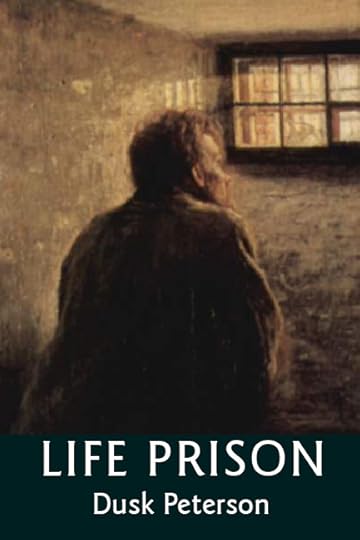
"I'd heard of guards like this; they existed in prisoners' tales like beautiful princesses exist in the tales of ugly boys. I supposed that I ought to be grateful to have been assigned such a guard. . . . I didn't feel grateful."
In the unmerciful world of Mercy Prison, there is no rule but unending pain. For Merrick, the arrival of his new guard provides hope that he may break beyond the boundaries of his life prison. But appearances can be deceptive, and Merrick does not yet recognize the danger this guard poses to his future.
Merrick's guard is bound in his own special imprisonment. The meeting of these two troubled men will determine their destinies, and the destiny of their nation's life prisons.
This novella can be read on its own or as the first story in the "Mercy's Prisoner" volume of Life Prison. Friendship, desire between men, and the costs of corruption and integrity are examined in this multicultural historical fantasy series, which is based on late Victorian prison life.
This is a reissue of an older story.
Reviews
"Combining a historical background similar to that of Victorian England with a skilled perspective into the nature of human relations and a wide range of characterization, 'Life Prison' is a real page-turner . . . This is a story – and an author – not to be missed." —Rainbow Reviews
"Written in the first person, Life Prison is a dark, eloquent, and absorbing psychological tale that delves into the mind of a killer who, perhaps incongruously, manages to evolve into a sympathetic character in spite of the horror of his crime." —Top 2 Bottom Reviews
"[Outside the prison, Merrick] would be a criminal, a reject of the society; inside he is a man." —Elisa Rolle's Reviews and Ramblings
"Liveprison. Der Name sagt alles. Sehr düster." —Mllesatine: Empfehlungen
Excerpt
When Thomas arrived the next morning – it was my weekly day of rest from work, so I was engaging in a particularly agonizing examination of the walls – I said, before he could speak, "I'm sorry about my bad temper last time. I get out of sorts occasionally."
"Not at all." His reply was cool, as were his eyes, which rested upon me heavily, like a block of ice. It came to me as I watched him that this young man, whatever his flaws might be, had received personal training from Compassion's Keeper. He could not be quite the fool he appeared to be.
I'm nothing if not flexible, as Sedgewick had pronounced on the day he tried me in a dozen different positions. I let the smile drop from my face and said in my normal voice, "Well? What brings you here?"
The coolness disappeared from his eyes, and he said, "The usual. See to your needs and all that. The dancing girls are on their way, but I'm afraid I couldn't fit the performing elephant into the stairwell."
There was a moment's silence, and then, despite myself, I burst into laughter. Thomas grinned like a boy and moved forward, keeping well away from me and resting his hand on his dagger. He inspected the rubbish hole first, then the water – going so far as to give the wall a lick – and then, satisfied, moved to the other end of the cell. "You're short a blanket," he said. "That's against regulations."
I snorted. "There aren't any regulations in the life prisons, or hadn't you noticed?"
"Well, there are customs." He was inspecting the blankets now, checking them for secreted objects. "Short-tail whip – that's the type used at Mercy. Compassion uses the black whip – longer range, harder to control. Four of the other life prisons use the straight whip – rather like a bamboo rod, but more flexible. The remainder use the bamboo rod alone. . . . Your cell could do with some tidying."
Yes, he'd been trained by a Keeper all right. I wondered whether he thought he was scaring me. "What type of bamboo rod?" I asked. "Imported or domestic? The type that splinter? We had a prisoner last year who came close to dying from the splinters alone."
"Those ought to be banned." He got up from his hands and knees from inspecting under my bed. I had retreated into the corner to allow him to do this without nervousness. As he dusted off his hands on his trousers, he said, "Mind you, if a guard does his work properly, he needn't resort to any of those." He looked over at me.
It was hard to say whether his speech was more effective as an apology or as a threat. I was beginning to think that I might have underestimated this young man. . . .
 ¶ Available as an e-book (HTML, PDF, Kindle, ePub): Life Prison. A shorter version of the novella is available as online fiction.
Coded Messages (Life Prison)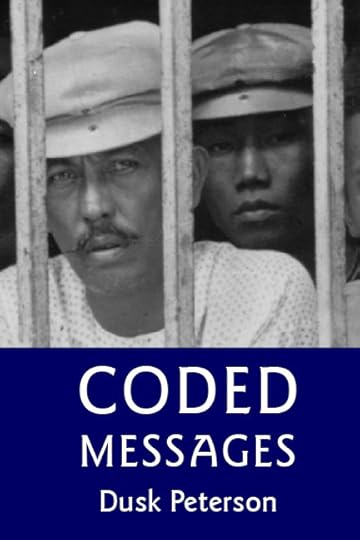
"Sweet blood, Tom, sometimes I wonder at your innocence. Why do you think that your prisoners were sent to prison? It wasn't for lacing daisy chains."
One of them rapes prisoners. The other wants to help prisoners. So why are they talking to each other?
As guards send each other telegraph messages through their prisons' coding offices, strange developments occur in the life prisons of the Magisterial Republic of Mip: hardened prisoners become reformers, idealists dally with danger, and the prison keepers struggle to keep control. The strangeness will only become odder when two guards, who hold very different views on the proper handling of prisoners, strive to find common ground.
This short story can be read on its own or as the second story in the "Mercy's Prisoner" volume of Life Prison. Friendship, desire between men, and the costs of corruption and integrity are examined in this multicultural historical fantasy series, which is based on late Victorian prison life.
This is a reissue of an older story.
Review
"Each cryptic phrase [in the telegraph messages] unleashes a whole myriad of action the reader is able to build in their imagination." —A. B. Gayle at Goodreads
Excerpt
Tom:
You might have warned me before that our letters are being read by Compassion's Keeper. You know that Mercy's Keeper has a hard enough time staying awake to do routine paperwork, much less bothering to read private correspondence between guards.
I don't know what you mean by "applicable to your own situation." I was just curious about your activities. One thing I will say for you, Tom: You livened this place up by always doing the unexpected.
Yes, Merrick's insanity has infected guards now. Our Keeper is tearing his hair out. He can't actually order those guards to rape prisoners, and none of the guards has been stupid enough to refrain from beating their prisoners when the prisoners break rules. But this is causing divisiveness in the guard-room. Up until now, except for the occasional eccentric like you, we were all agreed on how the prisoners should be treated. Now that unity is gone, and I'm not the only guard worried that the prisoners will take advantage of this fact to start a riot.
Sedgewick
o—o—o
Dear Sedge,
I should clarify what I said in my last letter. My father reads outgoing correspondence from Compassion. He considers it a matter of honor not to read incoming messages. He isn't concerned about the activities of guards in other prisons, but he doesn't entirely trust his own guards, least of all me.
I think that, when you come down to it, trust and lack of trust are what divide the guards at your prison. The guards who keep the Boundaries trust the prisoners to adhere to the rules with minimal need for punishment. The other guards don't.
How are matters with your prisoner? Is he continuing to cause problems for you?
With respect,
Thomas
o—o—o
Tom:
Wake up to the real world. What divides the guards here is that some of us like to rape prisoners and some of the guards are too goody-good for that. Bloody blades, Tom, you're never going to be able to keep control of Compassion if you continue talking like a child.
My prisoner is driving me to distraction. I might be able to take leave some time during the next century.
Sedgewick
o—o—o
Dear Sedge,
Maybe you should take leave now. I sense there is more going on than you're saying. . . .
 ¶ Available as an e-book (HTML, PDF, Kindle, ePub): Coded Messages.
Milord (Life Prison)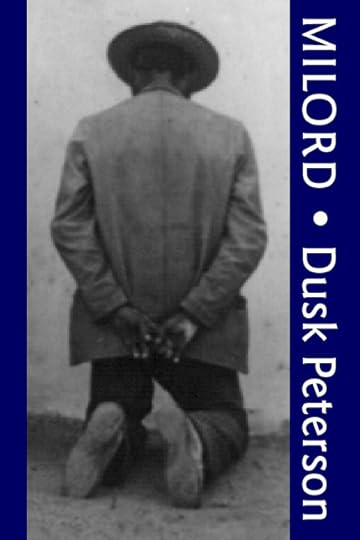
"'You've been very well-behaved here. You deserve a better assignment than Milord as your guard.'"
He was the model prisoner, respectful to his guards and loyal to his fellow prisoners. What no one knew was that he held the key to destruction.
Having pledged himself to assist in a popular movement by prisoners and guards to reform Mercy Life Prison, Llewellyn fears the future, when it is likely that the reform movement will face stiffer opposition from Mercy's Keeper. But Llewellyn's fear of the future is overwhelmed by the present knowledge that he is not what he appears to be. Until now, he has managed to hide his secret and to sway his guards to follow his chosen path.
Now he has been placed under the power of a guard who cannot be swayed and who is intent on bringing Llewellyn under his control. Can Llewellyn escape from his new guard's control? Will he really want to, once he has seen the door open to a world filled with true respect, loyalty, and love?
This novelette can be read on its own or as the third story in the "Mercy's Prisoner" volume of Life Prison. Friendship, desire between men, and the costs of corruption and integrity are examined in this multicultural historical fantasy series, which is based on late Victorian prison life.
Excerpt
Panting from his exertions, Merrick began to inspect the plumbing. "Drip pan looks fine. Nothing clogging the strainer. Let me get this pipe open. Have you chosen your guard yet?"
Llewellyn hesitated. "I'm not sure. . . ."
"There are lots of us guards abiding by the Boundaries these days," Denley pointed out, removing a cigarette from his jacket.
"I wondered . . . I thought perhaps I could do more for our Alliance if I picked a guard who doesn't keep the Boundaries."
"Try to persuade him to join the Alliance, you mean?" Denley tapped the end of his cigarette against the broken refrigerator.
"Milord," said Merrick, frowning over the plumbing pipe as he thrust his hand into it.
"You think so?" said Denley, his eyebrows raised. "He keeps the Boundaries."
"He has never admitted it, though." Merrick pushed the handkerchief into the pipe. "'I'm not going to have my judgment as a guard second-guessed by a scheme dreamed up by a clique of convicted criminals. . . .' He natters on and on about it, if the subject comes up."
"But he keeps the Boundaries?" said Llewellyn.
"Yes," replied Denley, lighting a match from the stove-fire.
"Yes, if you define the Boundaries as beating your prisoner every night." Merrick extracted the handkerchief, which showed little sign of having been inserted in the pipe.
"Not every night," Denley protested. "Be fair to him, Merrick. He's a strict disciplinarian, but he only beats prisoners who deserve it."
"Why is he called Milord, sir?" Llewellyn asked Denley.
"Oh, he's Lord Vere, officially. Comes from southern Vovim originally. He's one of those Vovimian lords who lost his land during that kingdom's civil war." Denley lit his cigarette. "He still has a lordly air to him, so we call him Milord, for fun. He doesn't mind; he'll accept a good-natured joke."
"So he's an honorable guard, but he's strict," Llewellyn concluded. "He'll only beat me if I've done something that makes me truly deserve a beating."
"Not that that will be a problem for you." Denley bestowed one of his condescending smiles upon Llewellyn. "You've been very well-behaved here. You deserve a better assignment than Milord as your permanent guard."
"Request Milord." Merrick threw aside the plumbing pipe with a gesture of disgust.
"You think I should?" Llewellyn asked uncertainly, standing up and leaning against the squat box of the refrigerator, which he and Merrick had laboriously pushed aside at the beginning of the evening, while Denley stood next to them, chatting brightly as other men did the hard work.
"He's the right guard for you." Merrick's voice was flat.
 ¶ Available as an e-book (HTML, PDF, Kindle, ePub): Milord.
Debt Price (Master/Other)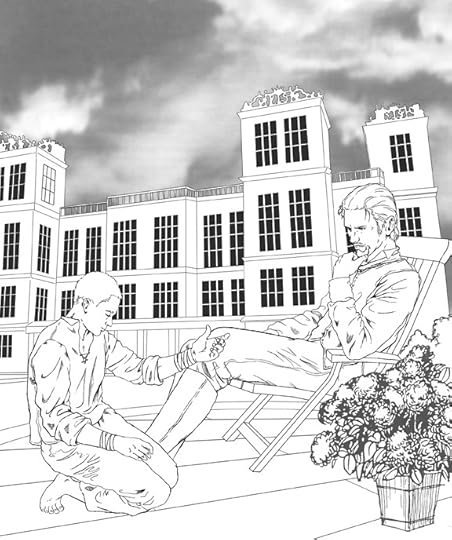
Illustration by H. Rose Melenche for Debt Price.
 "He kept his gaze cast below the belt. In the chill cell, sweat was beginning to form now on his neck, running down his back and between his bound wrists. 'Lord,' he said softly, 'I would be glad to pay to you my debt in any way I can.'"
No one would pay his debt price to gain him release from prison. So he sought to pay it himself by offering the only thing he could, his body. But one man would require more.
Convicted of helping to wage a campaign of terror against the lords who oppressed the commoners, the prisoner comes to realize the full implications of what he has done. All of his attempts to mend what he has broken will fail until he meets a young lord whose own struggles have just begun.
Set in an imaginary world based on Renaissance Europe, "Debt Price" takes the reader from the gritty punishments of prison life to the delicately balanced world of a farming estate, showing the slow healing of a prisoner who knows both what it means to be abused, and what it means to be the abuser.
This is an announcement of an older story.
Reviews
"[An] outstanding jewel [is] 'Debt Price,' the story of a young terrorist in a medieval world of lords and peasants who is sentenced for his crime to a brutal form of sex slavery at the hands of his victims . . . The story is one of tallying one's karmic debts and paying them off . . . It's a very dense, fascinating read." —Lady Cyrrh, The Annex Reviews.
"This book is not an easy read, nor is it in any way what would be described as a traditional romance. [But it is] a story of love and compassion and, ultimately, is a promise that sometimes the intent to sacrifice is equal to succeeding in that sacrifice in order to honor a debt." —The Novel Approach.
Excerpt
They kept his hands bound. He wasn't sure why; he had stopped resisting toward the end of his second week, around the time of his hundredth rape.
He no longer kept track of the men, as he had back in those early days, when he had memorized their faces with his proud eyes, calculating the debt they owed him. The thought of how he would collect that debt had been sweet to him.
Then the blazing pride began to die. He hadn't expected that; he hadn't realized at first the meaning of the chillness that began to make its way through him. He thought at first that it was due to the fact they had taken away his clothes, leaving him only with a flea-infested blanket to wrap around himself between sessions. But the chill was greater than that. It settled into his bones, and then into his heart, and then the day came when he began to cooperate with his rapists, giving the men what they wanted before they asked.
The guards lost interest in him after that. It was not as though there weren't other fields to plow, and he, precisely because he was so well-plowed, had become a field for diseases. He'd had six diseases so far, he thought, though none of them had killed him. Yet.
There came a period in time when the visits from the guards lessened, and almost – almost – the embers of his pride had begun to flicker again. But then a change had taken place in his life – a turning he had not anticipated – and an ingenious guard thought of a new way to exploit the situation.
And so after that came a string of strangers, men who had paid good money for this opportunity to visit him. They were worse, because most of them had no interest in raping him. They wanted to hurt him: to hurt him with their fists and boots, and to hurt him more with their words.
The words always had him sobbing at the end, which took the men aback. If they had seen him before, it had been at his trial, when his head had been held high and he had spoken with bold defiance, a triumphant smile on his face. It was this image that the visitors held of him, and some of them failed to notice that the youth they were beating was a usurper: not the proud young man they hated, but the fragile, defeated creature that had taken over the young man's body. He wondered sometimes, dimly, whether the proud young man had died.
When the visitors finally realized what he now was, they lost interest in him, just as the guards had. Some of them looked satisfied at the outcome, others disappointed. At any rate, the time would come when they failed to return, and a new exchange of money took place, and a new visitor set forth to break him.
What began to break him in the end was not words. Quite the opposite.
It was the same devilishly ingenious guard who thought up this plan. He must have been pleased at the results. For as the months wore on, it became clear that the last remaining fortitude in the youth was beginning to fail. The youth wondered when it would occur to the guards that, if they wanted their plan to be most effective, all they need do is stop the visitors from coming.
For now, though, greed kept the guards to their present path, and as the youth knelt shivering in his cell, awaiting his new visitor, he wondered whether this would be the one who would help him regain his courage.
Or whether this would be the last one, and his breaking would be completed.
¶ Available as an e-book (HTML, PDF, Kindle, ePub): Debt Price.
Truth and Lies (The Eternal Dungeon)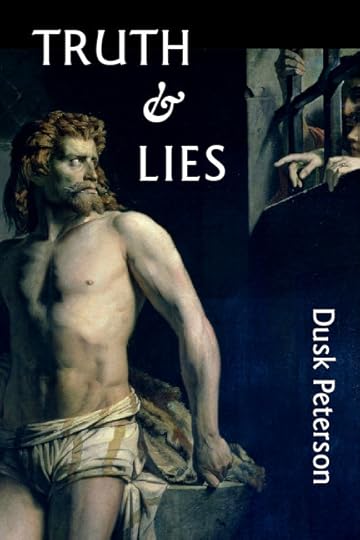
"Thatcher was having difficulty deciding who to attack first."
When you're a prisoner, having a torturer who's mad can be an advantage. Or maybe not.
Thatcher Owen is a soldier who has been sent to the Eternal Dungeon for doing his duty. Accused of committing war atrocities, he is faced with the possibility of being manipulated by his torturer into confessing to a crime that was no crime. So Thatcher sets out to trick his torturer. But how do you trick a man whose very sanity seems in question?
Seward Sobel is faced with a similar dilemma. As senior night guard to the Eternal Dungeon's High Seeker, his job is to prevent that brilliant torturer from abusing his prisoner. But how do you tell the difference between madness and genius?
As these two men perform their delicate dance of duty, their fates will depend on the High Seeker's truthfulness . . . and on the nature of his lies.
This novella can be read on its own or as the first story in the "Balance" volume of The Eternal Dungeon, an award-winning historical fantasy series set in a land where the psychologists wield whips.
This is a reissue of an older story. It's part of a gay romance darkfic series, but this particular story isn't romance.
Excerpt
The entry hall was a high, broad cavern that contained little except tables and chairs pushed against the walls, where they could easily be hidden by the shadows if a prisoner entered the hall. Now, though, the perimeter of the hall was bright with lamplight and the chatter of guards awaiting new prisoners. Seward found himself thinking of Mr. Urman, whose training would be completed soon and who would be transferred into the care of Weldon Chapman. Six months before, Mr. Urman had told Seward that he could no longer stand the idleness and would seek a transfer. Seward had rounded upon him with all the fury of a mother wolf protecting her children, but it had made no difference. It had been a full year since the High Seeker's day guards had resigned, and the Codifier had not bothered to replace them. It was doubtful that anyone would have taken their positions.
At the time of Layle Smith's madness, the dungeon inhabitants had been united behind their High Seeker, doing everything they could to keep his mind from destructing. Yet fame is fickle: as it became less and less certain that the High Seeker would recover the powers that had won him renown throughout the world, the dungeon dwellers had gradually turned away from him in indifference or disgust. So few remained loyal to Layle Smith now: the High Seeker's companion, two or three of the junior Seekers who modelled themselves after him, and a handful of senior members of the dungeon who had worked alongside him for many years.
And the High Seeker's shadow, Seward Sobel, who had been with Layle Smith since the beginning.
The High Seeker was in the midst of turning away from Weldon Chapman when Seward reached him. Seward found his gaze lingering upon his Seeker, looking for changes from the old times. He had seen the High Seeker little more than any other dungeon dwellers had during the time of his illness; Layle Smith had asked for assistance during that period from his love-mate and Weldon Chapman, but from no one else. Seward wondered whether the same man he had known lay behind the closed face-cloth of the hood, or whether the High Seeker had been irremediably altered during his absence.
The High Seeker's eyes, always cool, raked over Seward as though his senior night guard were a prisoner worthy of being racked. "Yes, Mr. Sobel," he said. "Did you have something you wished to say to me?"
Mr. Sobel was touched by the slight sickness he had felt in his stomach ever since the early days, when his attempts to reach out to a young Seeker in friendship had been rebuffed with a coldness like midwinter wind. He opened his mouth to reply, and then realized, too late, that he had not come prepared with any excuse for speaking to the High Seeker.
Twenty-one years they had worked together, and he still needed an excuse to talk to Layle Smith. He thought this, and thought also of the time of absence when he had lingered each long night in the entry hall, far beyond the time when his shift officially ended, waiting for Layle Smith to call for his services.
Now the High Seeker's eyes were growing narrow through the holes in his hood. Seward began to open his mouth again to make some excuse for his presence when a faint scream cut through his thoughts.
The chatter in the entry hall died in an instant, as though sliced clean with a blade. For a heart's breath, everyone stared at the door that led to the prisoners' cells. Screams were a daily occurrence at the Eternal Dungeon; what had caught everyone's attention was the fact that the scream had cut off abruptly. Out of the corner of his eye, Seward saw the High Seeker's hand go to the side of his belt, as though he expected to find something there.
And then the silence was broken by a whistle – a high, hard whistle that shot through the air like a cannonball. And Seward was running, running as hard as he had ever run since the day in his youth when he saw a revolver in the hand of a man who had murder in his eyes, and whose gaze was turned toward the royal princess.
He ran as he had not run for twenty-six years: but the High Seeker reached the door before him.
 ¶ Available as an e-book (HTML, PDF, Kindle, ePub): Truth and Lies.
Barbarians (The Eternal Dungeon)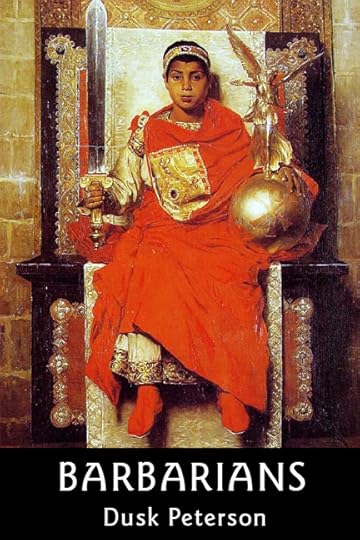
"With a movement too quick to see, the master torturer used his whip to send the prisoner to his knees. 'Crawl,' he said in the flat voice a man might use toward a stubborn animal."
Vovim was renowned for its strong monarchy, for its love of the theater, and for its skill in the art of torture. In other words, it had all the qualities needed to become a civilized nation. But would anyone be willing to defy Vovim's tyrannical king? And if they did, would they survive?
Grieving over an acrimonious departure from his love-mate, a youthful ambassador from the neighboring nation of Yclau has come to Vovim on a mission to help that barbaric kingdom's prisoners. But he faces unexpected barriers: An insane young king. The king's effeminate companion, who holds his own plans for the ambassador. And a populace whose greatest wish, it seems, is to see the ambassador die during a theatrical performance.
Then arrives the only Vovimian who seems to have a shred of sanity to him. But this man is a skilled torturer, and he is hiding depths that even the ambassador may not be able to penetrate.
This novella can be read on its own or as the second story in the "Balance" volume of The Eternal Dungeon, an award-winning historical fantasy series set in a land where the psychologists wield whips.
This is a reissue of an older story. Tags: gay, trans.
Excerpt
Though the Code forbade Seekers all private belongings, long-standing custom permitted them a small allowance for luxuries. The High Seeker, being Vovimian-born, spent most of his allowance on books and art, and one evening in autumn, while the rain beat upon the crystalline rock that shed the only light into the underground Eternal Dungeon, the High Seeker had shown Elsdon Taylor an etching of a Vovimian theater company in performance. For the next two hours, Elsdon had listened with fascination to the talk of stage scenery and costumes, of introductory mimes and dramatic dialogues, of divisions into acts, of conflicts, climaxes, and finales, and (since this was, after all, a Vovimian theater) of bloody corpses on the stage afterwards, and of the theater companies' decision whether to fake the deaths or use criminal volunteers who had decided to let their execution be a final act of theater.
"But don't the condemned criminals panic at the last moment and spoil the show?" Elsdon had asked.
The High Seeker had bestowed upon Elsdon that look he often gave when they were discussing his native land, as though a lifetime of words could not complete Elsdon's education in this matter. All he said, though, was, "Not in Vovim."
Elsdon had spent the following night dreaming that he was watching a play in Vovim, performed by the world's finest players. For the next few weeks, his thoughts had lingered upon the regret that he would never have the opportunity to watch a Vovimian theater performance – not unless luck turned his way.
Luck, unfortunately, had turned his way. Amidst all his past dreamings, it had not occurred to Elsdon that he might take part in the performance himself, and that he would play the role of the criminal.
It was perhaps not surprising to learn that the King's palace was equipped with a theater, nor that the theater was located directly across the hallway from the throne room. Nor was it particularly surprising to learn that all of the courtiers and palace guests who had been milling about in the hallway, waiting for the King to emerge from his private audience with his High Master, were delighted to accept the King's invitation to enjoy the performance. They crowded into the vast theater, jostled their way into cramped rows, and stood on benches at the back and sides of the theater in order to get their best glimpse of the stage.
The stage itself had been stripped to the bare minimum, making a striking contrast with the fripperies and frills that usually adorned a royal performance. At Master Toler's orders, the only scenery left on the stage was a blood-red curtain, which would make for an arresting contrast with both the master torturer's uniform and the prisoner's lack of clothes. The middle part of the curtain had been pulled up to reveal the naked stone wall behind, and here a wooden post had been fastened to the stage floor. Attached to it halfway up was a set of iron chains, which sparkled under the lamps. The other lamps in the room shone their light on the stage, or on the narrow walkway leading from the theater door to the stage.
Elsdon made his entrance down this walkway. He was not permitted to walk.
"Crawl," said Master Toler.
 ¶ Available as an e-book (HTML, PDF, Kindle, ePub): Barbarians.
Hidden (The Eternal Dungeon)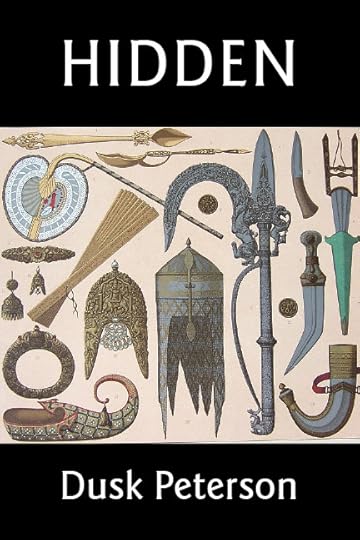
"One hundred lashes today. At least, it was supposed to be one hundred lashes, but my darling torturer (I call him that to annoy him) was fooled when I pretended to faint after the fifteenth lash. He didn't even order the guards in the corridor to poke me back to wakefulness with their bayonets. Makes me ashamed to acknowledge that we belong to the same profession."
He had been given the kindest, gentlest torturer in the dungeon. The prisoner was left with only one hope: that he could teach his torturer how to be cruel.
When the High Master of Vovim's Hidden Dungeon is arrested and placed in the hands of one of his own men, High Master Millard's immediate instinct is to show his torturer how to do a better job.
But Millard is facing seemingly insuperable odds: a lackluster torturer, a bitterly insane king, and most of all, Millard's own doubts as to whether he will be man enough to face the coming ordeal.
Perhaps he won't. And perhaps that is part of the lesson he needs to learn.
This short story can be read on its own or as the third story in the "Balance" volume of The Eternal Dungeon, an award-winning historical fantasy series set in a land where the psychologists wield whips.
This is a reissue of an older story. Tags: gay, trans.
Excerpt
Day 3: One hundred lashes today. At least, it was supposed to be one hundred lashes, but my darling torturer (I call him that to annoy him) was fooled when I pretended to faint after the fifteenth lash. He didn't even order the guards in the corridor to poke me back to wakefulness with their bayonets. Makes me ashamed to acknowledge that we belong to the same profession.
Afterwards he complied with my request for pencil and ledger-book. He even sharpened the pencil for me with his dagger. Idiot, idiot, idiot. Doesn't he realize what could be done to him if anyone finds out he's giving special favors to me?
Why am I surrounded by incompetents? This dungeon is filled with torturers who bungle simple rackings, burn themselves on their own pokers, and grow enamored with their prisoners and help them escape. I'm glad Toler isn't here to witness this.
Day 4: Another attempt at the hundred lashes, another bluffed faint. This time my darling torturer brought water to me. Any hopes I'd had, though, that he would dash it in my face were frustrated when I discovered that he was planning to give me water to assuage my thirst. I would have screamed at him, but I was too busy gulping down the water. It's been four days since I was allowed to eat or drink.
I reminded him of his duty afterwards, though. He looked hurt, and then slapped me to the ground. There might be some hope for him yet.
Day 18: The gap in time is because we actually managed to finish the hundred lashes. Instead of immediately following up on his advantage, though, my darling torturer allowed me time to heal. I might as well admit that he's a loss and resign myself to being in the care of the kindest, gentlest torturer who has ever performed in the Hidden Dungeon.
Curse it, no. He will not disgrace me like this. I'll see him dead first.
Day 19: Gave my darling torturer a small lecture yesterday about the duty of a torturer to his art. It seems to have done him good; he used the poker on me afterwards. I'm still able to write, which means he was too soft on me. I wish I could figure out how to reach him.
In the meantime, I can continue keeping this record, which I expect will be invaluable to future generations of the King's Torturers. This must be the first time in history that a prisoner has recorded his reactions while being tortured to death.
 ¶ Available as an e-book (HTML, PDF, Kindle, ePub): Hidden.
Reviews: Waterman, Master/Other, & The Eternal Dungeon
"If you like reading about masters and slaves, you will love this collection. You get caring masters, neglectful masters, abusive masters, devoted slaves defying their masters, despairing slaves being comforted and trained. . . . Also, the hurt/comfort is amazing, I cried over this book. The heroes go through such emotional agony that it's hard to believe there can be enough comfort to make it worthwhile – but it is!" — Amazon (Yingtai/Justine) on Waterman: a Turn-of-the-Century Toughs omnibus of historical fantasy and retrofuture science fiction .
"This book broke my heart. All pieces from my shattered heart were scattered in different directions. Each page cast them away, further and further away from me. When I believed hope was lost, and nothing could be saved, I had a surprise . . ." — Goodreads (Bookwatcher) on Debt Price (Master/Other).

"This is a series that shows enormous promise, with truly fabulous characters, and perfect worldbuilding. (Peterson gave me actual nightmares. That's gotta be a sign of evocative writing. I dreamed all night that I was being prepared for Seeking. It was not restful.)" — Goodreads (Emma) on The Eternal Dungeon: a Turn-of-the-Century Toughs omnibus of historical fantasy novels .
Death Watch (The Eternal Dungeon)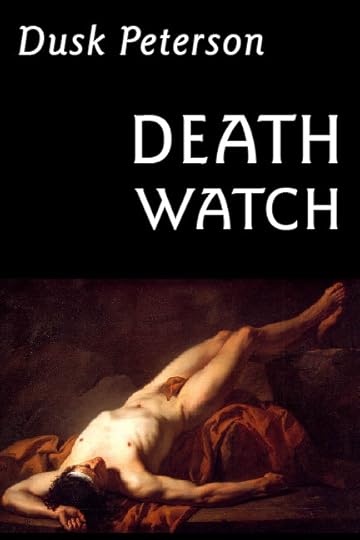
"Sometimes Layle wondered why, in the names of all the minor deities, he had chosen a love-mate who kept him continually off-balance, rather than the helpless, compliant victim he had so often dreamed about."
Death lurks everywhere in the Eternal Dungeon . . . even in a torturer's bedroom.
Trained as a young man to execute prisoners by entering their bodies, Layle Smith remains a danger to others, even after he moves to a more civilized dungeon, with strict rules on the treatment of prisoners.
Unfortunately, he's unable to convince a former prisoner of that fact. Faced with an adoring, oblivious love-mate, Layle Smith must decide whether he can hold back his dark desire, or whether he should give in to that desire . . . for his love-mate's sake.
This novelette can be read on its own or as the fourth story in the "Balance" volume of The Eternal Dungeon, an award-winning historical fantasy series set in a land where the psychologists wield whips.
This is a reissue of an older story.
Excerpt
Layle Smith caught his breath. He always caught his breath when Elsdon Taylor knelt in front of him, as the young man was wont to do at the most unexpected moments, probably because he enjoyed seeing Layle caught off-guard. Sometimes Layle wondered why, in the names of all the minor deities, he had chosen a love-mate who kept him continually off-balance, rather than the helpless, compliant victim he had so often dreamed about.
Then Elsdon would smile up at him, his eyes simultaneously filled with gentleness and wisdom, and Layle would remember.
"What is this?" Layle asked, trying to sound as commanding as a man who held the title of High Seeker ought to sound, though he very much doubted that his love-mate was fooled. Elsdon was a Seeker as well.
"My present," said Elsdon. "Did you think I'd forgotten?"
Layle, sitting in his usual armchair as he tried to finish reading a tall stack of guards' reports on the table beside him, looked down at where Elsdon knelt at his feet. Between his legs, in actual fact, a space which by all rights Elsdon should not have been able to reach without Layle noticing. Layle would have been long dead if he had been that careless with a prisoner. "Never forget that most of the prisoners in this dungeon believe that their only road to escape lies in killing you." He had told that to dozens of Seekers-in-Training over the years, including the young man kneeling before him.
When had he become so complacent to Elsdon's presence that his love-mate could take him unawares like this?
He cleared his throat. "I don't see any gift."
A dimple appeared in Elsdon's cheek. "Yes, you do."
Layle reflected to himself that Elsdon was showing unusual mercy by remaining clothed during this speech. Of course, that could be because he knew how much the High Seeker enjoyed ordering him to strip. Layle sighed and rubbed his eyes. He had not only become complacent; the pattern between him and Elsdon had become so predictable that his love-mate could plan the next move without awaiting Layle's word.
And that, he feared, was precisely what Elsdon was trying to point out to him.
He tried to stall. "Our fifth anniversary was three months ago."
"The fourth month of 355 is when we met. The seventh month is when we became love-mates."
He made a quick calculation in his head – a very quick calculation, for those early days were imprinted in his mind like gold upon scrollwork. "Then our anniversary was three days ago. That's when we first kissed."
"That was before I discovered what sort of dreamings you had about me. And when I did—"
"You quite sensibly broke matters off between us rather than risk being bedded by a sadist." He heard the harshness in his voice. After all this time, he still could not believe that Elsdon had made a wise choice in selecting him as a love-mate.
"And even more sensibly mended matters with you the next day." Elsdon sounded as blithe as he always did when discussing that decision.
"Which means yesterday was our anniversary." He strove to keep control of the conversation. The gods alone knew why; he had never won any battle that Elsdon set out to win.
He looked round the small Seekers' cell that he and Elsdon shared. All about him, he noticed for the first time in many months, were signs that he did not live alone. On a nearby table lay a technical manual on the workings of steam engines, the sort of information which made Layle's mind spin but which Elsdon happily gobbled up in his few spare moments. Nearby was a report by Elsdon about his latest prisoner, carefully composed in his school-neat handwriting. And over the bed-rail in the adjoining room lay Elsdon's hood.
Seekers never removed their hoods except when they were about to bathe or go to bed. They might raise the face-cloth of their hoods when they were in private, but the complete removal of a hood was reserved for bathtime and bedtime. For much of the year, Layle found the mere removal of Elsdon's hood to be an extremely erotic act.
And yet Elsdon had removed his hood without Layle even noticing it. And Elsdon could not have failed to miss the fact that Layle had not noticed it.
Layle rubbed his eyes again. This was beginning to look very bad.
 ¶ Available as an e-book (HTML, PDF, Kindle, ePub): Death Watch.
Interview by Hearts on Fire ReviewsAggie at Hearts on Fire Reviews interviewed me with a whole slew of questions. We ended up discussing my early days as a young writer, which writers have influenced me, the historical research for my novels, darkfic, The Eternal Dungeon and Michael's House, the connection between comedy and tragedy, original slash and m/m romance, the origins of my pen name, and (*gulp*) Twilight.
There are major spoilers for Rebirth and Whipster in the middle portion of the interview; otherwise, the interview is spoiler-free.
Copyright policies page updated
I've updated my policies on copyright, sharing, derivative works, and fan works to make clear that (1) readers who can't afford to buy my e-books can e-mail me for free copies, and (2) I permit commercially published fan works (which is no longer an oxymoron in this post-Fifty Shades of Grey world), provided that you check with me first, so that I'm not taken by surprise when your work shows up at stores.
Reviews: The Eternal Dungeon
"The story of a sweet and courageous submissive helping his tormented but formidable dominant get it together . . . It's hot like [cough], and soul-searing beyond romance." —Amazon (Yingtai/Justine) on Rebirth (The Eternal Dungeon).
"A rich and tender fantasy rooted in solid historical research. . .. I know it sounds like a BDSM fantasy cliché – terrified prisoner interrogated by grim torturer. But the prisoner is surprised, the torturer is surprised, and you will be too by the wheels within wheels within the characters, setting and plot." —Amazon (Yingtai/Justine) on The Breaking (The Eternal Dungeon).
"This story subverts heaps of slash clichés – who writes about people losing their erections, triggering their partners, or taking time out to solve equipment problems? But I didn't even notice all that good stuff because I was having far too good a time enjoying the hot first-time-ness and power dynamics." —Amazon (Yingtai/Justine) on First Time (The Eternal Dungeon).
"Powerful, tender love, against the backdrop of a brilliantly imagined dungeon of horrors, unbound by any ethical code. You get more than a whole novel's worth of character, plot twists and world-building. —Amazon (Yingtai/Justine) on The Consultation (The Eternal Dungeon).
"The resolution is so . . . beautiful. Tragic, glorious, sweet. You need words like catharsis and anagnorisis to talk about the ending of this story." —Amazon (Yingtai/Justine) on Barbarians (The Eternal Dungeon).
"This story really is dark comedy of the best kind. I mean, who gets professional advice from the person you're torturing?" —Amazon (Yingtai/Justine) on Hidden (The Eternal Dungeon).
"This is a prequel to The Eternal Dungeon, and unlike most prequels, it's good stuff on its own. You will be amazed at all the layers hiding behind the weaponless terrorist forcing his way into the palace." —Amazon (Yingtai/Justine) on The Unanswered Question (The Eternal Dungeon).
Balladeer (The Eternal Dungeon)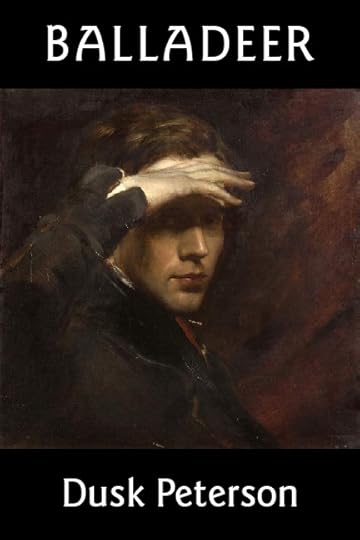
"Yeslin stood irresolute. Tangling with torturers seemed the ultimate in danger."
Sometimes it takes an outsider to point out the obvious.
Once an abandoned street-lad, Yeslin Bainbridge has become a young man with a mission: to lead the commoner laborers in a fight against the elite men who exploit them. He knows exactly where to start his mission.
The Eternal Dungeon. Here elite torturers and guards force commoners to offer confessions to crimes they may or may not have committed. Here laborers aid the torturers and guards, unaware that they are being manipulated. Here, if anywhere, Yeslin can make his initial mark on the queendom.
But he faces many challenges: Officials who seek to hide the dungeon's secrets from outsiders. Dungeon traditions that foil efforts by outsiders to learn the truth. Most of all, Yeslin faces his own conscience, for he knows that, if he is to fulfill his mission, he must lie to the person he loves most.
This novelette can be read on its own or as the fifth and final story in the "Balance" volume of The Eternal Dungeon, an award-winning historical fantasy series set in a land where the psychologists wield whips.
Excerpt
Leaning on the wooden handle of his iron shovel, Yeslin Bainbridge gasped for breath as he wiped the back of his blistered hand across his forehead. The hand came away slick with sweat. His chest was covered with sweat too, fierce with fire from the furnace before him. He would have liked to take off his shirt – he had enough sense not to wear an undervest on a job like this – but the Boss Man wouldn't permit it.
Or so he'd been told. The Boss Man hadn't shown his face yet. Nor would he, Yeslin had been made to understand. Only his voice.
"Hey, boy, why you stopping?" asked Wade, not pausing in his own stoking. "You think this is one of those picnics you masters hold?"
Wade had pitched his voice to be heard all down the corridor; the other stokers laughed. Yeslin could see them clearly in the furnace light: a dozen men of varying builds and ethnicities, but all young enough to shovel coal for hours . . . till they reached the age where their backs gave out and their throats wheezed from the accumulated dust of the coals.
Yeslin was the youngest of them, just nineteen. That placed certain challenges in his path.
He straightened up. He was not very tall, but he made up for it – he had been told in the past – by the expression that came onto his face when he confronted a bully.
It had taken him many months to learn to adopt that expression when he himself was being bullied. It had been his brother who had taught him that meekly accepting being bullied was as bad as encouraging another man to be a bully. His brother, he had found during the past three years, had good instincts in such matters.
"Oh, aye?" he said. He could not do anything about his accent, which had been beaten into him by a schoolmaster who had higher aspirations for him than his drunken birth-parents did, but he knew how to speak the local dialect, and would do so when the occasion warranted it. "So tell me, which am I? A commoner? If so, this is a matter for fists, ain't it? Or am I one of the elite? If so, speak respect to your better, lad."
Laughter came from the other stokers. Ward looked confused and a little frightened. Yeslin had guessed that this approach would have that effect. Wade was from the First District, where speaking disrespectfully to a man of the higher class was a killing matter. It must be a continuous trial to him to live in the capital of Yclau, where matters of rank were determined by speech and the cut of a man's suit. Someone like Yeslin, who spoke as though he were mid-class, yet wore the clothes of a laborer . . . No wonder Wade was angry to be working alongside him. No wonder the little jibes.
Suddenly filled with sympathy for the man, Yeslin reached over and slapped him on the back. "Nay, mate, I'm only making mock. Don't blame me for the accent I had beaten into me."
Wade's expression cleared. "Yeah, boy. Can't blame a man for following the orders of his betters."
This gave him the opening he wanted. "I suppose that it's easier to follow the orders of certain torturers, rather than the orders of other torturers. What I mean to say is, there are reasonable bosses, and then there is the other type—"
"Seekers," said Leo with a frown. A brawny man, he looked like the elite's caricatures of idiot commoners. Yeslin had already marked him as the quickest-minded man among the stokers. "They're called Seekers, not torturers. They seek the truth about the crimes that the prisoners have committed."
"So they claim," countered Yeslin, but this observation prompted so many frowns that he changed tactics. "You've seen this for yourself?"
Curt, a sandy-haired youth, said, "We don't need to. We got the Code of Seeking."
He pretended ignorance. "What's that?"
"Here." Leo reached into the breast pocket of his shirt, pulled out a slender object that was no bigger than the man's hand, and tossed it toward Yeslin.
Yeslin caught the object automatically with his free hand and stared down at it. He would have feigned astonishment at this point if he had not been so busy being genuinely astonished. A book. Written by the elite. In the breast pocket of a stoker.
All around him now was laughter. "Catching him off-guard, you are, Leo. He didn't look for that." "Guess he thinks none of us can read. Those fellows in the lighted world – they think they're better than us." "Aye, they don't understand us up there."
"Nay, I figured on you knowing your letters." Yeslin held up the book on his palm. "But bosses giving out free books to their laborers – now, that's something to ballad about."
He had said the wrong thing; he knew that, the moment he spoke. The laughter and smiles disappeared; the men exchanged glances.
It was Leo who replied, in a gruff voice, "We don't gossip about our work to the lighted world. You think you're going to gossip, well. . ." He exchanged looks with the others. The stokers had been drifting together during this conversation, no longer strung like beads along the long, narrow corridor on which the dungeon's furnaces were located. Now they began to shift together, massing into one group, in a manner that Yeslin needed no interpreter to understand.
He said quickly, "I'm no gossip." No gossip indeed. He was something more important than that, but it would take time to explain himself to the stokers.
"Aye?" Wade's eyes were narrowed. "Who are you, then? You ask a lot of questions. You don't answer none."
So he told them. No names, but he told them about his family, and about his new family after that, and how all that had ended. By the time he was through, the men were all relaxed again.
"Aye, well." Leo scratched his head. Being an indoor worker, he was capless, wearing the rough denim uniform issued to all the dungeon's stokers. From what little Yeslin had seen, the dungeon's elite didn't dress much better. "The fates will do that to a man: take him up to the heights, then drop him again. 'Least you're not all sour about it."
"Nay," Yeslin replied, scooping up more coal with his shovel. "These things happen. 'Tis probably for the best. I wouldn't want to be one of them."
He expected emphatic nods, even if some of those nods came from hypocrites who would gladly have embraced the wealth of the world if chance wandered their way. What he received instead was indifferent shrugs.
This was going to be more difficult than he'd anticipated.
He tried again. "So the tor— The Seekers. They treat us well?"
There were uneasy looks then, among the stokers. Leo said quickly, "Well enough."
"Oh, come now, Leo," said Jerry, a married man who was inclined to talk at length about his six young ones. "Be honest. You're as worried as the rest of us."
"Worried?" Yeslin raised his eyebrows.
"'Bout our jobs," said Curt. "There's talk of 'lectrifying the whole dungeon – of doing away with the coal furnaces. Doing away with our jobs."
"It's all rumor," said Leo with a growl.
"What are you going to do if it's true?" asked Yeslin.
Wade shrugged. "Look for other stoking jobs, in the lighted world. What else can we do?"
"Well . . ." said Yeslin slowly.
But Leo cut him off. "Listen!"
Everyone stood still. Away down toward the end of the corridor came a sound, indefinable at first, then growing louder, like the rustling of a thousand pieces of paper in a clerk's office.
"Work's done for the night." Leo tossed his shovel aside. "The day shift will be coming 'long in an hour or two. Let's go eat."
He had not learned what he needed to know. To steal time, he pretended that his boot had come untied. Kneeling down, he said, "Boss Man gives decent hours. Only eight hours of work."
Wade snorted. "In the summer. Come winter, it's fourteen hours."
"We follow the sun," Curt explained, bringing out a face-cloth from his trousers pocket to wipe the coal dust from his face. "Those were bats you heard, returning at dawn to the cave this dungeon lies in. In the summer, they come home soon. In the winter, they seem to stay forever in the lighted world."
"Seekers and guards, they follow the same hours." Leo frowned down at Yeslin, who was continuing to fiddle with his bootstring.
"Aye?" said Yeslin, taking care not to raise his eyes. "Well, that sort of schedule must be easier for the young Seekers than the old Seekers. Or do they have young Seekers?"
"Oh, aye," said Curt, walking blithely into the lure. "Youngest one is twenty-three. That's Mr. Taylor."
His fingers tightened on the bootstring, to the point where he almost cut himself. "Aye? Don't think I've seen him. Does he live in the dungeon?"
That prompted more laughter from the stokers. "All the Seekers live in the dungeon," said Jerry, his voice kindly. "None of them leave here. Least of all Mr. Taylor. He's the High Seeker's love-mate—"
"That's enough!" Leo's voice turned sharp. "The High Seeker, he won't stand for gossip, and neither do we. That's our pride, or have all you forgotten that?"
There was a murmur of acknowledgment from the other stokers. They looked shame-faced now, especially Jerry. Leo turned his attention back to Yeslin. "You're the worst man at boot-tying that I've ever seen in my life. You need a hand there?"
"I've broken the string." This was true enough; Jerry's remark had caused Yeslin to suddenly jerk his hand. "No worries; I got an extra string in my pocket. You go ahead. I'll catch up."
"Don't linger," Leo warned. "Boss Man don't like us staying in the inner dungeon after our work is through. Okay, lads—" He slammed closed the door to Yeslin's furnace and turned to the others. "Let's get our meal pails open, and see what we've got, and then steal from Jerry's pail."
Jerry yelped. Laughing, Ward said, "Well, if you will marry the best cook in the Alleyway district . . ."
They all closed their furnace doors and retreated toward the north end of the corridor, disappearing from view as they turned the corner. Yeslin waited until they were all gone before replacing the string, as swiftly as he could. Then he stood up. His heart was still beating hard.
 ¶ Available as an e-book (HTML, PDF, Kindle, ePub): Balladeer.
If Dante Had a Beta ReaderI have a quarter million words' worth of free reads scattered around my website. (That's just the fiction. Heaven knows how much online nonfiction I have at my site.) Here's the latest free story.
Who needs the Muses for inspiration when you have a beta reader to tell you what to do?
Excerpt
Dear Dante (do you mind if I call you Dan?),
First of all, I don't want you to be crushed by what I write below. I think you have a really good fic here, with lots of interesting characters and fantastic action. With a little work, I think you can make it good enough to post at historic_slash.
(By the way, I don't want to receive any more "I am a published author" letters from you. Stuff you can get away with in pro fic, you'll get slaughtered for in fandom. I'm trying to save you from flames – remember that.)
Let me start by giving you the bad news: Your story has some major problems.
¶ Available as online fiction: If Dante Had a Beta Reader.
The Balance (The Eternal Dungeon)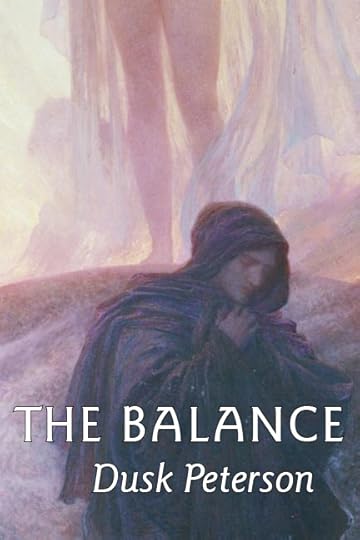
"'The Eternal Dungeon is my home now,' the High Seeker said. But as he spoke, he lifted his face and looked at the Vovimian carving, as a man might look at a beloved he must leave forever."
The Seekers (torturers) in the Eternal Dungeon have always expressed contempt toward the Hidden Dungeon in the neighboring kingdom of Vovim, whose torturers abuse prisoners without restraint. But the balance between mercy and hell is not so clear as might be thought in either dungeon, and now that balance is about to tip. Only the strength of love and integrity will determine the paths of two Seekers whose fortunes are bound together.
This novel can be read on its own or as the third volume in The Eternal Dungeon, an award-winning historical fantasy series set in a land where the psychologists wield whips.
VOLUME CONTENTS
"Truth and Lies." When you're a prisoner, having a torturer who's mad can be an advantage. Or maybe not.
"Barbarians." Vovim was renowned for its strong monarchy, for its love of the theater, and for its skill in the art of torture. In other words, it had all the qualities needed to become a civilized nation. But would anyone be willing to defy Vovim's tyrannical king? And if they did, would they survive?
"Hidden." He had been given the kindest, gentlest torturer in the dungeon. The prisoner was left with only one hope: that he could teach his torturer how to be cruel.
"Death Watch." Death lurks everywhere in the Eternal Dungeon . . . even in a torturer's bedroom.
"Balladeer." Sometimes it takes an outsider to point out the obvious.
"The Balance: Historical Note."
Excerpt
He had awoken, on that day after, to find himself lying alone in bed.
He discovered this with a quick grope of the hands over the bedcovers, without opening his eyes. As High Seeker, he was one of the Seekers entitled to a double bed, though he had slept alone until the day before. Now, it appeared, the previous pattern would continue.
He refused to open his eyes. It had all been a dreaming, then: the promise of everlasting love, the passion that had followed upon that promise, the warmth of Elsdon's body – and more importantly, the warmth of his companionship. Layle had expected it to happen one day: his dreamings had become so real that he had begun to believe them.
He refused to open his eyes. He was afraid that, if he did, he would see something that would force him to confront a far worse possibility: that he had indeed slept with Elsdon, and that Elsdon had crept away while he slept, irreparably damaged by their brief joining.
The covers of the bed were scratchy wool – more scratchy than they needed to be. A form of asceticism, a penance for what he had done in the past and what, from time to time, despite all his will, he continued to do. He lay on his back, his eyes closed, trying to force himself to rise. Time could be of the essence in healing Elsdon – if there was still any chance of healing the young Seeker whom he had hurt so badly so many times now. Perhaps it would be best to let others take over the task he had failed at. . . .
The bedsprings creaked.
He reacted automatically, which meant he reacted violently. Reaching toward the only loose object at hand – the night-table next to the bed – he grasped it by its leg, wrenched it from the floor, and had begun to swing it toward the intruder before he checked himself in time.
He opened his eyes. Elsdon, fully clothed and hooded but with his face-cloth raised, sat beside him. He looked, Layle realized with amazement, more amused than fearful.
"By all that is sacred," Elsdon said, speaking the mildest of oaths, "is this how you always greet your love-mates upon awakening?"
Layle slowly lowered the night-table, feeling the blood thunder within his body. "I've never had a love-mate before who slept with me."
"I can see why, if this is how you wake from your sleep."
Layle slowly raised himself into a sitting position. Elsdon was still smiling, he noted with growing incredulity. The Seeker-in-Training had made a joke about the fact that Layle was a killer born.
Perhaps he was still sleeping. He rubbed his eyes.
 ¶ Available as an e-book (HTML, PDF, Kindle, ePub): The Balance.
The Abolitionist (Waterman)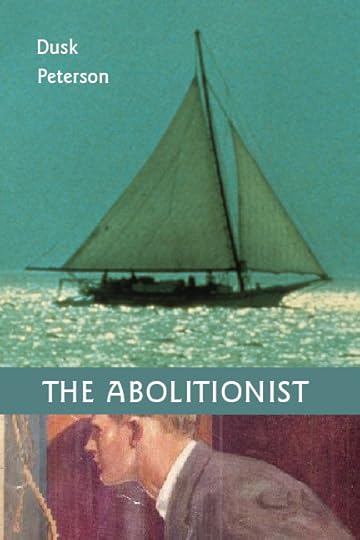
"The servants were scared stiff of him, and the masters were clearly uncertain what to say to a man who came from such an eccentric House. Nothing was different, nothing had changed. And yet everything had changed since Carr met a young foreigner who showed him not the least bit of respect."
When a foul-mouthed, seditious foreigner turns up at your door, what are the benefits of letting him in? So wonders Carr, a young man living in a bayside nation that is troubled by internal battles. In his world, servants fight against masters, tonging watermen fight against dredging watermen, and landsteads eye one another's oyster grounds with greed. It seems to Carr that the only way in which to keep such warfare from entering his own home is to keep very, very quiet about certain aspects of himself which his family would not be able to accept.
But "trouble" is a word that appears to delight the new visitor. He is ready to stir up danger . . . though he may not be as prepared as he thinks to confront what lies within Carr.
This novel about an unconventional pairing features a special appearance by a character from the Slave Breakers series by Sabrina Deane. The novel can be read on its own or as the first story in the "Master and Servant" volume of Waterman, a historical fantasy series and retrofuture series inspired by the Chesapeake Bay oyster wars, boarding school rivalries in the 1910s, and 1960s visions of things to come.
Excerpt
"Why do they call it Gunners Cove?" his visitor asked.
At that moment, clear as a crack of Bay ice at the end of winter, came the sound of gunfire. In the same instant, the fleet of the House of His Master's Kindness burst round Bentley Point, rushing like Ammippian war arrows through the grey dawn.
"Down!" shouted Carr, envisioning what would come next; for extra measure, he grabbed his visitor and pulled him prone to the deck.
Aware of his responsibilities as the highest-ranked master on the steamer, he raised his torso high enough to see what lay behind him. But no children were on the viewing deck, and all of the masters – heeding the warning of Carr's shout or of the gunfire – had either fled through the doors to the lower decks or were flattening themselves against the deck. Carr turned his head toward the water in time to see, through the railings, an Oyster Navy schooner dash around Bentley Point, hot in pursuit of the skipjacks. The police had evidently not yet noticed the steamboat ahead, for the cannon on the schooner's bow boomed. The cannonball sped across the water and plunged into the river, just ahead of the steamer. The steamer gave out a loud whistle of protest.
The fleet of His Master's Kindness, sensing salvation, sped toward the steamer, the skipjacks' sails full and proud in the breeze. As the fleet passed the bow of the steamer, Carr caught a glimpse of Rowlett, standing in the foremost boat and shouting orders to the captains of the boats behind him. Then the skipjacks were out of sight, hidden behind the squat steamer.
The Oyster Navy sent another rain of rifle bullets in the direction of the fleet. Some of the bullets hit the steamer; women screamed on the lower decks. Then the rifles were silent; the naval police dared not fire at the skipjacks once they were hidden behind a steamer crowded with masters and their families. Already, Carr could hear the masters behind him growling their indignation at the policemen's action.
"You give fucking exciting tours, Carruthers," his visitor said cheerfully as he rose and brushed the dust off his recently bought trousers. "Who's the boys in blue over there? The ones who are looking like the mice got away from the cat?" He pointed at the police schooner, which – in defiance to watermen's tradition – was painted blue to represent the policemen's desire to transform criminals. The schooner had stopped alongside the steamer, no doubt so that the police could check that they had not injured any masters.
"Excuse me," Carr said, his voice more rough than he would have liked. "I need to see whether anyone was hurt on the other decks."
 ¶ Available as a multiformat e-book (epub, html, mobi/Kindle, pdf, doc): The Abolitionist.
New DRM-free multiformat editions
All of my new e-books will now be published in DRM-free multiformat (epub, html, mobi/Kindle, pdf, doc), with somewhat more attractive layouts. All of the multiformat e-books will be available at my Gumroad store (which is most easily browsed through the story entries at this website).
My e-books with the new layout will also be available at Smashwords (DRM-free), Amazon (DRM-free), Barnes & Noble (DRM-free from November 2012 onwards), and (after a delay) other stores. Smashwords customers should be aware that the only Smashwords format that I will be preparing myself is the epub edition; all of the other formats at Smashwords are created by that store's automatic converter.
In addition to the new e-books, I'm gradually reissuing my older e-books in multiformat. I'll announce them here as they become available.
The following series is now available as DRM-free multiformat e-books (epub, html, mobi/Kindle, pdf, doc):
Life Prison. They are imprisoned until death, and their lives cannot get worse . . . or so they think. But when an unlikely alliance forms against their captors, the reformers risk losing what little comforts they possess. ¶ Life Prison is a historical fantasy series about male desire and determination in Victorian prisons.
New Turn-of-the-Century Toughs map
The map for Waterman, which shows the locations of Carr and Meredith's homes, is also available on the Turn-of-the-Century Toughs page and is linked from the Waterman page.

New interview
I'm quoted in this new article mentioning John Preston (toward the end of the article).
Pro-Gay and Ex-Gay Christians – Is There Room for Dialogue? Narratives and News on Christianity and Homosexuality during the 1990s (Narrative Nonfiction)
"Two American Anglicans would watch the events of July 1997 and be stunned by what happened. Both knew that Anglican attitudes toward homosexuality would shape the lives of people like themselves. Both believed that the decisions of the Episcopal Church and the Anglican Communion could result in more heartbreak and tragedy in the lives of same-gender-attracted people, or else the decisions could bring those same people to spiritual fulfillment and the peace of God. One of the Anglicans was a leader in a gay ministry. The other was the leader of an ex-gay ministry."
In the late 1990s, most Christian denominations and other faiths remained deeply divided on the issue of homosexuality and related topics, such as gender roles. This collection of narratives and traditional news articles looks back at that tumultuous period, when Christians around the world engaged in battles and occasional dialogue in an attempt to determine the future of the Christian Church.
This 30,000-word collection is part of the Narrative Nonfiction series, providing narratives and other nonfiction about religion, literature, gender, sexuality, and other topics.
Excerpt
Maggie Heineman was tired of moles. As a Philadelphia member of Parents, Families and Friends of Lesbians and Gays (PFLAG), she was taking part in the Marriage Mailing List, an e-mail list for people advocating the right for gay people to marry; Ms. Heineman had a gay child, so this was a matter of personal interest to her. She knew, though, that another, less sympathetic person was "lurking on the marriage list," as she put it: Robert R. Larimer, Jr., the chairman of Washington for Traditional Values. Fuming, she sent an open letter in May 1996 through the list, asking Mr. Larimer to read a speech by Mitzi Henderson of PFLAG, "Bridges of Respect." Ms. Heineman quoted Ms. Henderson as saying, "I am not recommending that we give up one iota of commitment, but I am reminding us that we must continue to share our humanity with those with whom we disagree, and invite them to do the same. Only then will we be able to enter a real dialogue."
Dialogue with the enemy, though, seemed highly unlikely. Still unsettled over this incident, Ms. Heineman turned her attention to the mailing list for which she was Webmaster, an unofficial PFLAG discussion list. In doing so, her attention was caught by a message posted by a new member of the list, an Ontario resident named Steve Calverley. He was responding to an earlier posting by someone who had said that they had never known of any gay person who "went str8." Mr. Calverley wrote:
I know too much from my own experience to let that pass without comment.I certainly don't dispute that Deb has not previously met anyone that meets that description but it has actually been my own life experience.
For fifteen years (from about age 17) I self identified as gay and was "out" for ten of them. I was in three gay relationships, the longest of which was 3-1/2 years. I was fully "out", serving a term on the board of Gays for Equality (Mississauga), played ball on the Cabbagetown Gay Softball League (1981), and, well, what else can I say. I really was there.
Seven (plus) years ago through a process that I wasn't even looking for before it began, I found myself leaving it behind. Once I understood that I was actually headed out (of the gay lifestyle) I began to actively pursue it. As a result, I left it behind and I'm very happily married now and have (finally) found what feels to me like real freedom and peace within myself.
It really is possible.
After this confounding announcement, more correspondence followed between Mr. Calverley and the other members of the list. Then, in Ms. Heineman's eyes, Mr. Calverley dropped the ball; he mentioned that he had read Mitzi Henderson's speech. Now Ms. Heineman knew what she was dealing with: a spy sent to infiltrate the PFLAG list.
 ¶ Available as a multiformat e-book (epub, html, mobi/Kindle, pdf, doc): Pro-Gay and Ex-Gay Christians – Is There Room for Dialogue?
Review: Waterman"The hero's parents are hilariously daffy and heartbreakingly heroic and heartbreakingly wrong – just like parents always are, only larger than life and twice as true. . . . Plus the story absolutely nails all kinds of abolition-related power dynamics which almost never get into slave fiction because they're so subtle and awkward – and here they're not just acknowledged, they're hot. So, in summary, the emotions and ethics and world-building are rich, deeply satisfying and sexy." —Amazon (Yingtai/Justine) on The Abolitionist (Waterman).
New series page: "Just the Facts, Ma'am"
I now have a page devoted to my current and upcoming nonfiction e-books: Just the Facts, Ma'am.
(If you're one of my fiction readers, don't worry; I still have plenty of fiction e-books lined up to publish.)
New tag: "New Adult"
I've been struggling for a while now with the problem of how to easily describe my numerous coming-of-age stories that are aimed at readers of adult literature. I finally found the term I was searching for: new adult. I've accordingly added this term to the tags page.
New e-bookstores: All Romance eBooks, etc.
I've begun uploading my books at All Romance eBooks and OmniLit. Romance-related titles will appear at both stores.
Kobo is now pairing with independent bookstores in the United States to give them a share of the profits on e-books sold through Kobo's bookstore. Not all of the bookstores on the linked list sell Kobo e-books (some simply sell Kobo e-readers), but if you have a favorite bookstore that you'd like to support, it's worth checking to see whether it's on the list.
The list of international e-bookstores carrying my titles has grown so large that I've divided it by country. I've heard that buying items from U.S. e-bookstores can be a frustrating and expensive experience for some non-U.S. readers, so I hope that this list will provide those readers with a more convenient way to buy my e-books.
The True Master (Waterman)
"Ledwin growled, 'I trust the slave is dead. The last thing our landstead needs are perverts wandering about causing trouble.'"
In a society where the rank of master or slave defines every aspect of a person's being, what do you do when you're a master and you envy your slaves?
This question is debated by the men who have gathered for the quarterly meeting of the High Masters of the Dozen Landsteads. It seems an impossible dilemma; in the Dozen Landsteads, one's rank is determined at birth. A master or a slave who wishes to hold a different rank is considered shocking.
The masters sitting in that room, receiving the service of slaves, would be even more shocked if they realized how deeply this question will affect their nation's future. Only one man there could tell them, but he is not yet free to reveal his secret.
This fantasy novella (short novel) of gay love can be read on its own or as the second story in the "Master and Servant" volume of the Waterman series.
This is a reissue of an older story.
Excerpt
Masters' children played upon the courtyard flagstones, young boys and girls making a hurried and serious consultation with each other over the conditions of the play. The decision was reached: a young boy stepped forward, looked around shyly at the adults who were watching with amusement, and knelt down before one of the girls. The boy gave an uneasy grin as the girl ruffled his hair in a masterly fashion.
"You ought to marry, Celadon."
The young High Master cast his gaze down and shook his head. He had been watching the children until a few minutes before, but now his attention was focussed upon a line of slaves carrying his wardrobe through the narrow, heavily guarded door that led to the winding stairwell of the newly completed tower. Perhaps it was only his imagination that told him the guards were watching, not the slaves, but himself, judging their new High Master with penetrating scrutiny, reading what sort of man he was from his gestures and posture.
Celadon managed to raise his eyes; the very effort exhausted him as much as though he were a weak man trying to lift a heavy stone. To his relief, the expression of the master beside him held nothing but friendly concern.
Celadon shook his head again. "I don't – I don't see why there's a need, Pentheus. I already have an heir."
Pentheus smiled, and his own gaze switched over to the young boy who was continuing to play at being a slave. "Now I will sound as though I'm asking you to strip my youngest son of the honor you have bestowed upon him. That is far from the case – Basil is well suited to inherit your rank, and I was pleased that you recognized that fact. But there are more reasons than children to marry, Celadon. You might find it easier to bear the burden of your rank if you had a companion to provide comfort to you in your leisure hours."
Celadon found that his gaze had dropped again. Cursing himself inwardly, he forced his eyes up and said, "I'm not sure— That is, I don't think my inclinations take me that way."
He kept his eyes carefully fixed upon Pentheus as he said this, but the lesser master's gaze drifted over to the male slaves, who were continuing to carry Celadon's many formal gowns into his new residence.
"Ah," Pentheus said. "Well, I can't say I'm happy about that, but at least I can be sure you would never force a slave. So the rumors I've heard are true? You've taken a bed-slave?"
Celadon gave up the struggle to keep his gaze level with Pentheus's. "I— Yes."
"Then I wish you happiness with him, Celadon; I need worry no longer that your nights will be lonely. Now, about the upcoming quarterly—"
"I don't know!" Celadon knew that his voice sounded desperate, and he tried to modulate its tone. "I haven't decided yet. I'm just not sure .. ."
"Celadon, you have been saying that for the past month. Sooner or later, you must make up your mind about the topics that the High Masters will discuss. You cannot remain silent through yet another quarterly; no true master—"
He stopped abruptly at the approach of a slave. The man knelt at Celadon's feet; without looking up, he murmured, "Master, a messenger has arrived for Master Pentheus."
"Mm." Pentheus eyed the slave, clearly wondering whether he should be the one to chastise the slave for his interruption of the conversation. He looked over at Celadon, but the High Master did not speak, so Pentheus said only, "That will be from Druce's homestead; I asked Sert to keep me informed as to Druce's condition. If you will excuse me, master?"
He gave Celadon a formal bow for the sake of the slave who was continuing to kneel at Celadon's feet. The High Master opened his mouth, then closed it again, uncertain how to respond. This caused Pentheus to give Celadon another sharp look, but the lesser master turned away and began walking through the courtyard toward the gate, where the slave-messenger from Druce's homestead was being held in waiting by the guards.
Celadon turned back to look at the slaves. They had finished bringing the wardrobe into the tower and were now carrying a series of chairs; Celadon saw that one of the chairs was high-backed and bore the symbol of the golden sunburst. He closed his eyes.
A soft cough beside him startled him into consciousness again. He had forgotten the slave who had brought the news about the messenger; the man had evidently given up hope that Celadon would order him to rise, and had risen to his feet on his own initiative. Celadon cleared his throat and said, "Thank you. You may return to your duties."
To his surprise, the slave did not move. He was wearing the heavy tunic of an outdoor slave, and it occurred to Celadon that the man might be lingering in the courtyard in order to avoid returning to the blustery winds outside the castle walls. Celadon knew that he ought to reprimand the slave for this, but he could not seem to find the words.
Of course, he never could; that was the problem. Feeling his chest grow tight, he swung his gaze away from the slave, dealing with that trouble as he had dealt with all troubles since he took the High Mastership, by remaining silent. He could feel next to his right hand the hard sheath of his dagger, and he had a sudden wild impulse to throw the dagger onto the ground and see how everyone reacted. His gaze travelled over to Pentheus, who was deep in conversation with the slave-messenger kneeling before him. Nearby, Pentheus's son bounded up from his knees and began to argue with the girl who had been mastering him.
"Summon me to your presence."
For a moment the words did not register, so unexpected were they. Then Celadon swung round awkwardly and found that the outdoor slave was still standing beside him. His gaze was level upon the High Master.
"What?" said Celadon, convinced that this new nightmare must be of his imagination.
"Summon me to your presence." The slave's words were soft, but there was a hardness at their core that stunned Celadon momentarily. He stared at the slave open-mouthed, trying to put his whirling mind to rights.
 ¶ Available as a multiformat e-book (epub, html, mobi/Kindle, pdf, doc): The True Master.
Review: The Eternal Dungeon"Dusk Peterson is 'different' . . . in a good way. Her writing style .. . can be a little difficult at first. Once you get the hang of it, though, hang on for some great reading!" — Amazon (Lee Phillips) on The Breaking (The Eternal Dungeon).
Unmarked (Waterman)
"Master Meredith, whose entitlement to a last name had not yet been determined by the courts, was sitting in a window-seat overlooking the playing fields of Narrows School when the Third House bullies found him."
In his final terms of school before his university years, Meredith is faced with a host of problems: A prefect who abuses his power. A games captain who is supposed to protect Meredith but has befriended the prefect. And a legal status that makes everyone in the school question whether Meredith belongs there, among the elite.
Unexpectedly, rescue arrives, in the shape of a fellow student who seems determined to right wrongs. There's only one problem. . . .
"Fair play" is the motto of the Third House, but that motto takes on a different meaning when Meredith is secretly wooed by a young man from a rival House.
This novel can be read on its own or as the third and final story in the "Master and Servant" volume of Waterman, a historical fantasy series and retrofuture series inspired by the Chesapeake Bay oyster wars, boarding school rivalries in the 1910s, and 1960s visions of things to come.
This is a reissue of an older story.
Excerpt
"Let's look at your arm now."
Meredith cautiously turned round. Carruthers stood fully dressed in his school uniform: shoes, trousers, shirt, vest, and a dark blue blazer – blue to represent transformation. No doubt he was entitled to a House cap as well, but he was as bareheaded as always. His hair was the color of yellow cordgrass when sun shone upon it. His eyes shimmered grey like pebbles in a pond. His skin was darker than the usual milky-white shade that distinguished masters from servants; one of the more vicious rumors circulating in the Third House was that Carruthers's parents, who were notorious Egalitarians, forced Carruthers to do servant-work during holidays. Meredith refused to believe the rumor, if only because he could not imagine any servant standing by and allowing Carruthers to do work on his behalf.
Carruthers had turned toward a table beside the students' lockers and was pulling open a first aid kit marked with the symbol of the Red Circle, for Narrows School was one of the few Dozen Landstead institutions that was charitable enough to raise funds for that international, humanitarian organization. "Giving money to the Yclau!" Rudd had once said in anger. One of Rudd's ancestors had drafted the Embargo Act of 1912.
Carruthers – like his father – clearly had no qualms about using foreign technology, for he was pulling out the kit's contents, carefully selected by the school, so as not to contravene the Embargo Act: bichloride of mercury tablets, tincture of iodine, aromatic spirits of ammonia, carbolized petroleum jelly, rubber tubes for tourniquets, adhesive plaster, picric acid gauze, cascara tablets, crystals of hydrated magnesium sulfate, and crystals of potassium permanganate. The last item – used to treat poisonous snake bites – was next to useless for a kit used on a Bay-island school, but some of the school's students who came from the mainland were convinced that every harmless water snake they saw was a venomous water moccasin.
In a prosaic manner, Carruthers focussed his attention on the kit's scissors and roll of bandages. As he cut a small square of bandage off the roll, he said, "Two pieces will do for now, I think, until we've cleaned your arm."
He was holding the scissors awkwardly, and Meredith remembered suddenly that Carruthers had sprained his right wrist at the last footer match. Meredith cried: "Oh, please, sir, let me do that for you!"
A moment later, he would gladly have borrowed Carruthers's heirship dagger and plunged it into himself. Carruthers glanced over at him, but this time he made no comment upon Meredith's eccentric eagerness. He simply handed Meredith the scissors and stepped aside. Meredith cut the final piece, sweat slickening his palms. He could feel Carruthers's gaze upon him.
"There's a bench over there that you might feel comfortable sitting on." Once again, Carruthers was being exceedingly careful in his wording. Meredith went over to the bench; then, at Carruthers's suggestion, he dragged it over to the table where the kit lay.
He felt light-headed as he sat down. The bench – which had been carved with the names of generations of Second House lads – was irregular under his bare thighs. The day had grown warm enough that Meredith had changed, that afternoon, back into his apprentice-aged clothing: short trousers and no blazer, only a vest, with his sleeves rolled up. Now Carruthers had Meredith pull up his right sleeve further so that the cloth would be well away from the cut.
"Fletcher's work, I take it." Carruthers placed his hands around Meredith's forearm and gently pressed the skin next to the cut with his fingers.
"Yes, sir. His cane." Meredith was all too aware now of the firmness of Carruthers's grip, and the tenderness of his probing.
"We'll have to hope, then, that he hasn't been sticking his cane into the ground for picket practice recently." He let go of Meredith. "The cut doesn't look deep, but tomorrow morning, when the school physician arrives, you should go straight to the sanatorium and have him check on you. If you wish, that is," Carruthers carefully amended his command.
"Yes, sir. Thank you, sir."
"He may want to treat you with tetanus antitoxin. In the meantime" – Carruthers's fingers were suddenly on Meredith's forearm again, squeezing hard – "I'll do what I can."
Meredith held his breath as Carruthers squeezed blood out of the cut, then carefully wiped off the blood with one of the pieces of sterile bandaging that Meredith had cut. "This needs a bit of antiseptic," said Carruthers, straightening up. He leaned over Meredith, reaching for a bottle labelled "Peroxide of Hydrogen."
Meredith forgot to let out his breath. Sitting as he was, his face was only inches now from Carruthers's chest. The strong smell of sweat on Carruthers's body had been replaced, after the sponge bath, with a sweet, salty scent that reminded Meredith of Bay water.
"Hold still," said Carruthers as he pulled back, adding, "if you don't mind." He poured a few drops of the antiseptic onto the wound. It fizzed, biting into the fresh wound. Meredith remained still and silent, as he had done when Carruthers had probed his cut and forced out blood.
He looked up from Carruthers's hands to see that the Head was watching him. "You're a player on the Third House footer team, as I recall?" Carruthers said.
"Yes, sir."
"Ah. That explains it." Carruthers turned his attention back to the cut.
Meredith felt a warm glow cover him then. No further words were needed from Carruthers; the Head Prefect did not need to say, "You bear pain well." His sentiments were contained in the simple words, "You're a player."
 ¶ Available as a multiformat e-book (epub, html, mobi/Kindle, pdf, doc): Unmarked.
Waterman: a Turn-of-the-Century Toughs omnibus of historical fantasy and retrofuture science fiction
Meredith is from the Eastern Shore of the Bay. Carr is from the Western Shore. . . .
In an alternate universe where the New World was settled by the Old World in ancient times, by the twentieth century the Chesapeake Bay region has become a battleground for conflicting interests. Masters, liegemen, and servants struggle for identity in a society where every man and woman is born to an assigned rank. Their nation is divided uneasily between a 1910s culture and a futuristic 1960s culture filled with jet-cars, slidewalks, and holographic computers. Oystermen sailing to their harvests continue a long fight for control of fishing grounds, little aware that a greater danger is approaching the Bay.
Into this world arrive two young men, on opposite sides of the conflict. Their meeting and personal struggles will bring them allies and enemies as they enter into the heart of the danger.
This 160,000-word omnibus contains a novel and a piece of flash fiction in Waterman, a historical fantasy series and retrofuture series inspired by the Chesapeake Bay oyster wars, boarding school rivalries in the 1910s, and 1960s visions of things to come.
This is an expanded edition of an older collection.
VOLUME CONTENTS
"Master and Servant." Born into a society with a strictly ranked system of masters and servants, Carr has sought to tread his way delicately between the clashing values of the parents who raised him and the uncle whose household Carr will one day live in. Yet when he and other students at his boarding school become the latest participants in an ongoing battle between the oystermen of their Bay, Carr finds that his position of power may bring danger, not only to himself, but also to a schoolfellow he is drawn toward.
"Queue." What should a young servant do when his employer may fire him at any moment, his employer's beautiful daughter is absorbed with her high school textbook ("How to be Firm with Servants"), and he's blocked from carrying out a simple task by a snooty cyborg?
REVIEWS OF THE 2010 EDITION
"If you like reading about masters and slaves, you will LOVE this collection. You get caring masters, neglectful masters, abusive masters, devoted slaves defying their masters, despairing slaves being comforted and trained. .. . Also, the hurt/comfort is amazing, I cried over this book. The heroes go through such emotional agony that it's hard to believe there can be enough comfort to make it worthwhile – but it is!" —Amazon (Yingtai/Justine).
"The underlying theme of the stories is inherited power relationships, the effect on individuals of being unable to fit into the established hierarchies, and the wisdom of learning from those below you." —Goodreads (Catana).
"What I love of Dusk Peterson's stories is that they are all fantasy. . . with deep roots in real history. While reading one of his books, whatever the historical period he picked and reinvented, you have the feeling [of being] plunged in a true historical novel, sometime even more an historical essay than a romance, but in the end, Dusk Peterson manages also to give you the romance, and odd as it sounds, most of the time his romances are among the most romantic I have ever read. Why odd? Since I think I have never heard Dusk Peterson associated with the romance world; so here is my suggestion to all the romance readers: go and pick one of Dusk Peterson's omnibus, this one in particular is a good pick, and give him a try, I'm sure you will not be disappointed." —My Reviews and Ramblings (Elisa Rolle).
(Continued in the next post.)
(Continued from the previous post.)Excerpt
Meredith returned from the holidays to find his form much diminished. The Dozen Landsteads' universities all held entrance examinations during the autumn holidays; anyone who was eighteen sun-circuits by the beginning of the autumn term was eligible to sit exams. As a result, every lad in the seventh form who was eighteen by then left Narrows after the autumn term, other than Carruthers, who had missed his previous summer term and was still making up his studies.
Meredith's eighteenth birthday had come past the starting point for the autumn term, so he joined the students returning to school. The seventh form was always the smallest class, what with students dropping out after sixth form if they weren't planning to attend university, and a handful of students being sent down for violations of school rules. Now, with most of the six-tri-years students gone, so few seventh-formers were left that the Head Master erased the distinction between the Lower Seventh and the Upper Seventh, allowing third- and second-ranked students to attend lessons alongside first-ranked students.
The result of this was that Meredith found himself in all but one of the lessons that were attended by both Rudd and Carruthers.
To Meredith's great relief, Carruthers never looked his way. He sat in the front row in each class, industriously taking notes, as though his being Head Prefect and Captain of the Second House wouldn't be reason enough for the instructors to pass him with alacrity. Rudd, who had watched Meredith through narrowed eyes for the first week or two, gradually lost interest in scrutinizing the activities of his fag. After a while, Meredith managed to keep his mind on schoolwork during lesson-time, rather than on the explosive combination of himself and the two Heads.
The lesson that Meredith did not share with either Head was Astronomy, the closest that Narrows had to a science course. It was allowed onto the curriculum only because astronomical mathematics was mentioned by the ancient authors and was therefore deemed respectable. Most of the lesson-work consisted of mathematical proofs. Master Trundle, who taught Astronomy, would have considered actually looking at the stars to be an activity beneath notice, while news of the latest rocket ships being launched into orbit from Yclau would have fallen under the category of Foreign Heresies.
Meredith had no great interest in foreign activities himself, but he was passionately interested in the history of the Dozen Landsteads, and it was impossible to study the history of the First Landstead without stumbling across pages upon pages of references to scientific matters. He had assembled at home – under his father's proud eye – a respectable library of scientific textbooks, while the school library turned out to have a fairly good collection of scientifiction tucked away in the section for first-ranked students and their classmates. Since he had not previously studied alongside first-ranked students, Meredith had not been permitted to enter the first-ranked section before this term. Now he discovered, upon proudly presenting his Upper Seventh card to the librarian, that at least one other person at Narrows School shared his interest in scientifiction, for several of the books he had hoped to borrow were already off the shelves when he checked. All the other lads learning astronomy seemed to be sleeping through the proceedings, so Meredith assumed that one of the school masters had a taste for thrilling adventures in outer space.
It was not until the second week of term that he came into the nook that held the scientifiction books and discovered Carruthers there, carefully examining each spine, with a stack of scientifiction books already tucked under one arm.
He looked up before Meredith could retreat. Meredith froze, staring at the book in Carruthers's hand, which Meredith had been planning to borrow. He blurted out, "You want to read Fantastic Voyages to the Moon and Beyond?" Then he felt himself turn crimson.
Carruthers said in an easy manner, "I've already read it, about twelve dozen times. Did you want to borrow it?" Before Meredith could think of what to say, Carruthers placed the book atop Meredith's stack of history books.
Meredith thought to himself that there must be a more graceful way of retreating than dropping his books and running. But every instinct in his body – the instincts that he had tried so hard to rid himself of – told him that he could not leave until Carruthers dismissed him.
The Head seemed to be expecting some sort of response. Groping for words, Meredith said, "Master Trundle mentioned that book in our lesson yesterday."
"Favorably?" Carruthers managed to hide any look of disgust at Meredith's inane remark.
"Er . . . no. He was making fun of it, actually. He said that it talked about planets around other stars, which Flaminius said couldn't exist."
Carruthers smiled. "And since Flaminius lived in the seventh tri-century, long before the invention of the telescope, of course he was the expert on such matters. . . . I wish my Government lesson wasn't at the same time as Master Trundle's lesson; I would have liked to have taken it, if only for Trundle's entertaining commentary. What topic is he covering this term?"
"Astronomy in the middle tri-centuries." It was becoming easier by the moment to talk to Carruthers; the Head Prefect seemed absorbed in the conversation, as patient as the Head Master would have been at what Meredith was saying.
"Is he, by all that is sacred? He'll never get the class to the twentieth tri-century at this rate."
"I don't think he wants to, sir," replied Meredith with a smile. "Then he might have to demonstrate actual knowledge of astronomy."
Carruthers actually laughed then; Meredith grinned, relieved. He had been sure, at the beginning of this meeting, that Carruthers was holding a grudge against him for never having turned up for the invited meeting, but now Meredith realized how ridiculous an idea that was. Carruthers had undoubtedly forgotten their conversation in the changing room within a day of its occurrence. No doubt, if Meredith had actually showed up at Carruthers's door, the Head would have found a way to politely quiz him as to his purpose there, and might even have humored Meredith by giving him . . . by giving him whatever it was that Carruthers had offered in the changing room. But the idea that the Head should care whether or not Meredith came to his rooms was patently absurd, as was the idea that Carruthers had been using Meredith as a tool in his war against Rudd. Meredith simply didn't matter that much.
Cheered by this thought, and warmed by Carruthers's politeness toward a third-ranker from a rival House, Meredith opened his mouth to make another light joke . . . and at that moment he heard Rudd, talking loudly as he entered the library, just to show that he could.
Carruthers's gaze flicked toward the door, where Rudd was continuing to raise his voice as he spoke with the second-ranked librarian, who was timidly suggesting that he speak in lower tones. Then Carruthers said quietly, "I'm heading over to the tuck shop to buy some sweets. Would you care to join me? The shop is usually deserted at this time of day, so we'd be able to hear ourselves speak for once." He gave a smile that did not quite reach his eyes.
That smile – the same one he had given in the changing room – made Meredith step backwards, as much as the vision of what Rudd would do if he discovered Meredith and Carruthers alone together in the tuck shop. "No," Meredith whispered. "Thank you. Sir. No."
He fled then, his instinct to avoid pain overcoming his instinct to await dismissal. Yet even as he fled, part of him whispered, Failed as a master, and you can't even succeed as a servant?
 ¶ Available as a multiformat e-book (epub, html, mobi/Kindle, pdf, doc): Waterman.
Fan Fiction Fan (Pixel-Stained: a documentary memoir of the electronic publishing revolution in gay genre fiction)
A decade before e-books and self-publishing shook up the publishing industry, an author faced a dilemma: When you've written stories in a genre that is rarely published, what do you do?
At the beginning of 2002, Dusk Peterson (a journalist, history writer, and aspiring professional novelist) stumbled across the fan fiction community, where tens of thousands of readers and writers enjoyed gay genre fiction, which publishers rarely published.
Peterson's Muse didn't want to write fan fiction. That didn't matter. Gleefully, Peterson began posting male/male stories with original fantasy settings and characters to "slash" fan fiction e-mail lists, at the same plunging into fanficcers' world of online fiction, "songvids," conventions, celebrations of movie premieres, and endless discussions of literature, history, sexuality, and ethics. In the process, Peterson became part of a community that was taking advantage of the Internet's power in order to distribute stories, art, and videos that couldn't be professionally published.
This first volume in the Pixel-Stained series includes reminiscences, stories, and art from yaoi author/artist mdbl; Steve Berman, founder of the gay and lesbian speculative fiction publishing company Lethe Press; J. M. Snyder, founder of the queer fiction press JMS Books; and m/m romance author Emily Veinglory.
About the series:
The president of a speculative fiction organization once described writers who post their works on the Internet as "pixel-stained technopeasant wretches." The Pixel-Stained series publishes Peterson's memoirs in the form of e-mail, posts, and other documents. These accounts depict life at several electronic literature communities connected with gay genre fiction, as witnessed from the inside of those communities. Many members of these communities were pioneers in popularizing electronic publication, paving the way for the e-book revolution and the massive wave of self-publishing.
Depicting the rise of blogging, social networking, web fiction, e-zines, e-books, and print-on-demand publishing, this memoir series shows how readers and writers in the twenty-first century have used computer technology to reshape culture and society.
Volume One contents:
0 | Introduction.
1 | Stumbling Across the Fan Fiction Community, and Diving in Headfirst.
Interlude & fiction | Tropes. With excerpts from The Fool, Life Prison, and Tops and Sops.
2 | Discovering the Joys of Fan Mail and Cons.
Interlude & art | Headers. With an illustration.
3 | Warnings and Websites.
Interlude & art | What Was Happening in the World of Original Yaoi Publishing during 2002. By mdbl, founder of Private Parlor. With illustrations.
4 | A New "Star Wars" Film Comes Out, and the Fanficcers Go Wild.
Interlude & fiction | What Was Happening in the World of Gay Speculative Fiction Publishing during 2002. By Steve Berman, founder of Lethe Press. With a story from Trysts.
5 | Discussions of Litslash and Disabilities.
Interlude & fiction | What Was Happening in the World of Original Slash Publishing during 2002. By J.M. Snyder, founder of JMS Books. With an excerpt from Operation Starseed.
6 | The World of Darkfic is Explored.
Interlude & fiction | What Was Happening in the World of M/M Romance Publishing during 2004. By Emily Veinglory, m/m romance author. With an excerpt from Alas, the Red Dragon.
7 | Grumbles About the Lack of Original Slash, Mere Days Before That Subgenre Takes Off.
Excerpt
Resurfacing
E-mail to Jedi Clara, March 2002
This doesn't seem to be my year for computers. First, my computer crashed in January for the fourth time in six months (I've been putting off taking it in for repair since then, as it involved two six-hour round trips). Then my backup computer (which had been showing signs of wanting to go belly-up) died a few days ago. Then when I checked my backup backup computer (won't do anything but word processing), I found that its disk drive was no longer working. So I've resorted to my backup backup backup computer (yes, we have a lot of half-functioning computers in this house), whose mouse won't work.
Fortunately, my family member's computer (now renamed Old Reliable) is still working. Equally fortunately, the choking sounds my backup computer was making (multiple error messages) caused me to be backing up hourly any file I worked on – I'd just finished backing up on disk a scene I'd written when the computer went, "Pop!"
So the only thing I lost that's a pain to reconstruct is my last letter to you. I'd written a lengthy letter that was along the lines of "OH MY GOD, THE PHANTOM MENACE ZINE ARRIVED, IT'S SO ABSOLUTELY GORGEOUS, I'M ABOUT TO HAVE A HEART ATTACK, YOU'RE AN UTTER SWEETHEART TO SEND ME THIS, KISS KISS KISS—" and as you can imagine, it's a bit hard to reconstruct that type of letter.
I've spent the last couple of days working on what was supposed to be my first PWP [First Time], but my characters decided to get all chatty on me. I can't figure out why my characters get the yen to stop in the middle of having hot sex in order to discuss the moral implications of what they're doing. I certainly never did anything stupid like that. (Alas.) To make matters worse, my protagonist declared that we weren't going to write about my sexual fantasies; we were going to write about his sexual fantasies. And since I find his tastes a bit squickish (whatever other problems I may have, I am not into strappadoes), I ended up discovering that erotica is not a genre I'm good at writing. My characters are too darn bossy.
Mind you, I had other problems with sticking to erotica as well. I remember when I first started reading slash erotica; it seemed to me to bear as much resemblance to real sex as cotton candy does to real food. Wonderfully sweet, but oh my goodness . . . Slash characters never have problems getting aroused. They never have to stop to argue over what type of furniture they should use for the positions they want. They never make costly errors in bed and have to beg their partner for forgiveness. And they never have to get into a cold car at three a.m. in order to drive five miles to the nearest open drugstore to buy the right supplies.
So you know the convention for First Time stories? Two pages of agonizing over whether to go to bed together, followed by ten pages of blissful sex? Well, I've turned the convention on its head and suggested that the real agonies of First Time encounters are most likely to occur in bed.
Just writing a realistic "Where the hell are we going to find lubricant at this time of night?" scene did me good.
Having thrown my characters into each other's arms and let them drone on about sexual ethics to their hearts' content, I've now sternly told them, "You're going to engage in a little action next time, damn it," and have sent them off to hell. Literally. That's what they get for foolin' with the Boss.
 ¶ Available as a DRM-free multiformat e-book (epub, html, mobi/Kindle, pdf, doc): Fan Fiction Fan.
Now available in multiformat: Debt Price (Master/Other)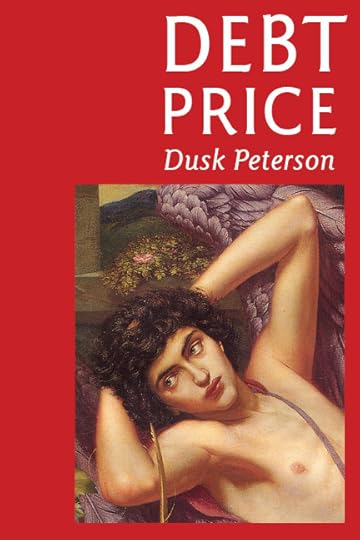
"He kept his gaze cast below the belt. In the chill cell, sweat was beginning to form now on his neck, running down his back and between his bound wrists. 'Lord,' he said softly, 'I would be glad to pay to you my debt in any way I can.'"
No one would pay his debt price to gain him release from prison. So he sought to pay it himself by offering the only thing he could, his body. But one man would require more.
Convicted of helping to wage a campaign of terror against the lords who oppressed the commoners, the prisoner comes to realize the full implications of what he has done. All of his attempts to mend what he has broken will fail until he meets a young lord whose own struggles have just begun.
Set in an imaginary world based on Renaissance Europe, "Debt Price" takes the reader from the gritty punishments of prison life to the delicately balanced world of a farming estate, showing the slow healing of a prisoner who knows both what it means to be abused, and what it means to be the abuser.
This historical fantasy novella (short novel) can be read on its own or as part of Master/Other, a speculative fiction series exploring the dangers and sweet bonds of power.
This is a reissue of an older story.
Reviews
"[An] outstanding jewel [is] 'Debt Price,' the story of a young terrorist in a medieval world of lords and peasants who is sentenced for his crime to a brutal form of sex slavery at the hands of his victims . . . The story is one of tallying one's karmic debts and paying them off . . . It's a very dense, fascinating read." —The Annex Reviews.
"A story of the young man's struggles to recover and to understand his place in a world that doesn't seem to want him. . . . [It's] a story of love and compassion and, ultimately, is a promise that sometimes the intent to sacrifice is equal to succeeding in that sacrifice in order to honor a debt." —The Novel Approach.
ExcerptTo the right of him, sitting in a chair with his back to the youth, was a man. Slowly, like a shy beast creeping forward into danger, the youth walked toward the man. His heart was pounding so hard now that it was difficult to breathe. He could not see the man's face, but he could see the man's hand lying upon the arm of the wooden chair, and on that hand was a crystal ring.
He reached the chair finally, hesitated for a moment, then swiftly made his way round to the front and knelt before the man. After a moment he dared to look up.
The lord with the light hand was as he had been a fortnight ago: young and stern of face. He had over his lap a writing board and paper, and his left hand held a lead stylus. He was silent, looking down upon the youth.
"Lord master," the youth said softly, "I will do my best to repay to you my debt in any way I can." He placed his hand softly upon the inner part of the lord's thigh.
The lord recoiled as though a dung-beetle had run across his privates. He stood up, causing the chair to scream across the marble; the stylus broke in his hand and fell to the ground. His hand upon the writing board had turned white.
The youth, unaware that he was pressing his wrists together as though this might help, resisted the impulse to flee. Staring down at the ground, he whispered, "I thank you for paying my debt, lord master."
"Give your thanks to Hilder." The lord's voice was harsh. "He was the one who found the money for you."
The youth dared to raise his eyes to the crystal chain rising and falling upon the lord's heaving chest. The lord had moved several paces backwards, in the direction of the short flight of stone steps leading to the main door of the estate house. Still gripping his writing board, the lord said, "Hilder will take care of you."
And then he was gone, leaving the youth staring at where he had been, wondering who his new master was who would "take care of" him.
Reviews: The Three Lands & The Eternal Dungeon"When I started reading, I had no idea where this would go. The prince was very naive. The slave a bit too hardened. But it all became clear and a friendship developed. . . . Such a short tale left me with much to think about." —Amazon (Lee Phillips) on Re-creation (The Three Lands).
"Strangely awesome. . . . Full of twists and turns and half-revealed truths, the reader is led down a path of mysteries and surprises. . . . I found this tale to be riveting and rewarding – Dusk Peterson at her best!" —Amazon (Lee Phillips) on Love and Betrayal (The Eternal Dungeon).
"Terrible, horrible, and a true love story. I very seldom say anything is a 'must-read'. (After all, we do all have different tastes . . .) But, if you are a Yaoi lover with a taste for the darker side, Dusk Peterson's The Breaking, Love and Betrayal and Death Watch are indeed 'must-reads'." —Amazon (Lee Phillips) on Death Watch (The Eternal Dungeon), with spoilers for Rebirth and a different take on one of the characters' motives than I have, but hey, that's why readers exist, right? To bring out different facets in a character.
Searching (The Eternal Dungeon)
"Vito was beginning to wonder whether this dungeon's prisoners were questioned in pitch darkness. That was a matter of some personal concern to him."
Walking into a trap may be the only way to create one.
Danger runs high for Vito when he arrives at the Eternal Dungeon, escorted by guards. In this royal dungeon, prisoners are "searched" for their crimes, by torture and by more subtle means.
Vito knows that he will be searched. But he has his own searching to accomplish, and to do so he must undergo the scrutiny of the queendom's most accomplished torturer.
This novelette (miniature novel) can be read on its own or as the second story in the "Sweet Blood" volume of The Eternal Dungeon, an award-winning historical fantasy series set in a land where the psychologists wield whips.
ExcerptFor a prison, it was abnormally quiet.
Vito had lived in prisons for a long while now – over a dozen years, from the time he came of age. He had sampled all three of the city prisons, like a connoisseur sampling wines to test which was the finest. He had even spent time in the provincial prisons outside the queendom's capital.
Never before, though, had he encountered a prison where everyone spoke in whispers, and where business was conducted in the dark.
He looked around, straining to see. The great entry hall of the Eternal Dungeon – impressive both in size and in the fact that most of its walls were made of cave-rock – was virtually night-black. There were lamps scattered upon tables around the edge of the room, but these were all shuttered like lanterns. Guards stood by the tables, exchanging an occasional whisper. The only other sound came from the desk-seated Record-keeper, who studiously scratched away at a piece of paper with his pen, as though working in midnight black suited him.
And it was only four o'clock in the afternoon.
Vito was beginning to wonder whether this dungeon's prisoners were also questioned in pitch darkness. That was a matter of some personal concern to him. But then a stirring shuddered through the room, like wind over a field of corn.
Sounds came from the top of the steps that led to the palace above: a gate being drawn back with a screech, then heavy footsteps upon the cave-rock steps. Ignoring the vigilant escort of the dungeon guards who had brought him this far, Vito sidled his way toward the center of the hall in order to see better the stairway. Everyone else stood motionless. Even the Record-keeper had paused in his work and was now standing behind his desk.
Five men arrived: four were guards, dressed in royal scarlet, with ceremonial swords at their sides. Not the Eternal Dungeon's guards, then – those guards wore grey uniforms, utterly ungaudy. The Queen's guards, making their slow way down the steps, were struggling to hold level a stretcher.
The fifth man, who walked behind the stretcher could not be said to be gaudy either, but his appearance was most striking. He wore no vest and no jacket, and he bore no weapons. His shirt and trousers were raven-black, and covering his head and face was a black hood.
Instinctively, Vito drew to the edge of the room, near the door that led further into the dungeon. The guards who flanked that door flicked a glance at him, then ignored him. His escorts remained oblivious to the fact he had strayed. The procession was coming closer.
All around the entry hall now, guards were bowing their heads and rubbing invisible circles upon their own foreheads with their thumbs. Vito, so newly arrived that he remained dressed for the outdoors, pulled his cap off and bowed his head. The procession had come close enough to him now that he had recognized what lay upon the stretcher: a motionless body, covered from head to foot with grey cloth.
The funeral procession neared the door to the inner dungeon. Vito raised his eyes just in time to catch closer sight of the fifth man in the procession. That man also had his head bowed, and his eyes – barely visible through the eyeholes of his hood – were hardly more than hollow pits in the dim light.
Yet something – perhaps it was merely the combination of straight spine and lowered head – caused Vito to catch his breath.
The door next to him was open now, held back by the younger guard who had been flanking it. The older guard was peering carefully round the entry hall, obviously checking to see that nobody unauthorized was given the chance to slip through the doorway. The procession left the entry hall, the Queen's guards struggling to make their way through the relatively narrow entrance. The hooded man following them did not look up.
Vito had a sudden, wild desire to follow. Instead, as the door slammed shut, he stepped forward and tugged at the sleeve of the older guard, like an impatient child. "Who was that, please? The man behind the funeral procession?"
The guard replied, with careful precision, "That was one of our junior Seekers, Mr. Taylor. Please step away from the door, sir."
Vito did so hastily. He had already seen the younger guard draw his dagger; his escorts had likewise noticed his absence and had pulled their coiled whips from their belts. Vito – who was cursed with a sense of humor that helped him not the least in his work – had the impulse to pull out his hidden revolver and offer to trade with the guards.
But he was saved from acting on this disastrous impulse by the sound of a cough. Looking back toward where he had been standing before, Vito saw the Record-keeper silently gesturing. Further down the wall along which the Record-keeper's desk was placed, a man had appeared in an open doorway. His face was hidden by a black hood, and he stood quite far away in the hall, but Vito somehow knew, without having to see them, that the man's eyes were ice-cold.
Vito drew in a long breath. His mind had travelled beyond the dagger-and-whip-wielding guards nearby. They were unimportant. The true danger in this dungeon stood before him now.
He walked slowly forward for his employment interview with the High Seeker.
¶ Available as a DRM-free multiformat e-book (epub, html, mobi/Kindle, pdf, doc): Searching.
Rainbow Awards & fall publishing plansAs I've already mentioned in this chatty entry at my blog, The Abolitionist (Waterman) is a finalist in the Gay Fantasy category of the Rainbow Awards 2013. The winners will be announced on December 8.
Thanks to the swiftness of my new beta reader, Yingtai, a whole bunch of Life Prison stories are coming soon. If you'd like to see where I am in preparing various series, check my progress report, which has just been updated.
At the moment, I'm rushing to get new e-books out before a medical procedure I'm due for in late November, but once I'm recovered from that, I hope to be able to get more of my backlist out in multiformat.
Isolation (Life Prison)
"Now I was at the last prison of all, the one I'd be at till they buried my body in quicklime."
Being locked in a prison cell can cause a man to re-examine his priorities. Especially when the door never opens.
Gavin is young, but his time may be short as he enters a prison not known for treating its prisoners gently.
Even so, he is shocked to discover what his fate will be. Faced with living conditions even worse than he was raised in, he must call upon the lessons his immigrant parents taught him for how to survive in a slum.
But his life takes an unexpected turn when a secret correspondent suggests that Gavin may be able to play a role in changing conditions at Mercy Life Prison. To do will mean risking what remains of his life, as well as turning away from the only life he has known. What reward can he hope to receive in exchange for such a sacrifice?
This short story can be read on its own or as the fourth story in the "Mercy's Prisoner" volume of Life Prison. Friendship and the costs of corruption and integrity are examined in this multicultural historical fantasy series, which is inspired by prison life at the end of the nineteenth century.
ExcerptI couldn't go and read the words of the guard's newsie, but I could be seeing the pictures, and they gave tale themselves. The news from the Queendom of Yclau, in the bottom-right corner of the newsie, wasn't the best. Mip's southern neighbor, which claimed to be the seed of all civilization in the world, had chosen to celebrate the Autumn Commoners' Festival by sending soldiers to beat up the Yclau branch of the Commoners' Guild. In the photo, there was a kiddie lying bleeding on the ground, her head bashed in by a passing soldier.
"Poor little lass," I muttered. "She should have someone to protect her."
The guard flicked another glance at me – this one a grimmer one, like as he suspected I was muttering curses against him – and then he gave back his attention to the newsie. I felt my chest tighten, having mind of all those poor commoners being beat over the head by the nightsticks of the soldiers. Then I came to have knowing that my chest was tightening for another reason. I was near on having another of my attacks.
I looked round, wild-like. Back in my last holding prison, one of the guards had gifted me with a cup to cough into. There was an empty cup next to the brandy bottle, within reach. I grabbed it and coughed up what was in my throat: a greenish-grey mess, with spots of red in it. The red spots had been worrying me for some days now.
I'd put from mind the sawbones. Right away, with a cry, he yanked the cup from me. I was figuring he didn't much care for having his cups messed up. He stared down at the cup and gave another cry of dismay. Dismally, I wondered if I'd gotten myself in trouble already.
The guard had put down his paper; he spoke something to the sawbones in Mippite. The sawbones turned and chattered away. I couldn't figure out any of the words he spoke, 'cept for one he gave tale to again over and over: Tibby. I wondered if that was the name of his girl. Drunks get soppy with having mind of love some days.
The guard got off his seat with great care. He walked over to where the sawbones stood and stared down at the cup. Then he looked up at me and smiled.
I didn't care for that smile. It was a cold smile, and I didn't have mind that the guard was the sort of man to smile 'cept at another man's bad luck.
¶ Available as a DRM-free multiformat e-book (epub, html, mobi/Kindle, pdf, doc): Isolation.
Spontaneous (Leather in Lawnville) - free award-winning BDSM story"Thinking about it, I've decided that bringing Jell-O to a gathering of leathermen wasn't my big mistake. My big mistake was bringing it on the night that Master Trent was attending."
Can an Old Guard top survive in a world with safe words? This humorous BDSM short story was runner-up for the 2006 Rauxa Prize for erotic fiction.
This is a reissue of an older story.
Review
"It's so great to see the Leather culture taken out of the normal 'club hub' and thrown into suburbia." —James Buchanan, author of the award-winning m/m BDSM novel Hard Fall.
ExcerptTrent snorted. "Danger. You young leathermen know nothing about danger. I had only one fear when I was young, and I got over that in time. But you fear everything. You fear that you won't be accepted by your vanilla neighbors, you fear that society will think you're strange. You won't do anything spontaneous or risky because you might get hurt." Trent snorted again. "All you need, you say, is stability. Say, which pocket is your hanky in tonight?"
I sighed. This was an old argument between us. "Look, just because I'm ninety-percent top doesn't mean I can't have a little fun taking the other role once in a while. That has nothing to do with stability—"
I was interrupted then. Martin was starting to make the rounds of the room, clipboard and pen in hand, asking everyone whether they were registered to vote so that they could show the world what good citizens leathermen are. Nearby, most of the club had entered into a discussion of how long the negotiations before a scene should last between a top and a bottom, and whether there should be three breaks or four for further negotiations later in the evening.
"Fucking Christ," Trent said with disgust. Then he turned to me and asked mildly, "Will you do something for me?"
"Sure," I said with a mouth full of my first bite of Ho Ho. "Anything you want."
It must have been the Ho Ho. Sugar rushes cause madness, right? Because I promise you, "Anything you want," is not what you say to Master Trent. Not when he has his black handkerchief sticking out of his left back pocket.
¶ Available as online fiction and as a FREE downloadable e-book: Spontaneous.
Review: Life Prison"[The prisoner Llewellyn] manipulates the guards to get what he wants, until he's paired up with Milord, a guard with honour and a tight control on his emotions. . . . [The setting is] a mix of historical and fantasy, with enough detail given in this short format to be able to understand what's happening in this story but with other details that are only alluded to and which made me want to seek out other stories [in the series]. .. . If you like dark romance stories then this would be a good one to pick up." — Brief Encounters (Jenre) on Milord (Life Prison), with major spoilers.
Curious (Life Prison)
"It wasn't the first time that Ulick had met a man who received enjoyment at the thought of killing. This time, however, the killer was not a convict."
His job is to guard the prisoners. But against what?
Hired to work at a prison that has recently undergone a purge, Ulick finds himself caught in the midst of a vicious battle. The prison's Keeper wants peace. The Assistant Keeper wants blood. Each of the other guards has his own motive, and his own method, for keeping the prisoners under control.
Backbiting, threats, violent encounters, forbidden desires played out at night and in stark daylight . . . all this Ulick must face in his new job. At the center of the maelstrom lies Merrick, a foul-mouthed prisoner with a notorious reputation. But behind Merrick stands another man, hidden in the shadows, and Ulick's future depends on what that man wants of him.
This novella (short novel) can be read on its own or as the fifth and final story in the "Mercy's Prisoner" volume of Life Prison. Friendship, desire between men, and the costs of corruption and integrity are examined in this multicultural historical fantasy series, which is inspired by prison life at the end of the nineteenth century.
Excerpt
"We've had trouble with the prisoners," said Mercy's Keeper.
"Sir?" Ulick could think of no other reply to make to this bland remark, which might have been spoken by any Keeper at any prison at any moment of the day.
"Seditious activities. Attempts to manipulate the guards. That sort of thing."
"Oh." Understanding reached him. "Yes, I'd read that in the newspapers."
Mercy's Keeper – who was not gracious enough to offer his name, much less offer Ulick a chair – winced, as though in distaste at the foreign orange he was munching on throughout the conversation. "Too much publicity. Pressmen should all be shot. Good thing the death sentence is back."
Ulick decided not to ask how serious the Keeper was in his statement. Instead, he took the opportunity to glance around the Keeper's office, which also served as the man's living quarters. Opulent walnut chests, imported Vovimian carpets, a wall full of books, and a kitchen's worth of food. And the food was only for his lunch. If Mercy's Keeper was suffering from the presence of his seditious prisoners, there was no sign of it.
"Blasted Boundaries," said Mercy's Keeper, as though summing up matters.
"Sir?"
"They should be shot. Every one of them. Will, if I find out who they are."
Ulick wondered whether his expression held the proper amount of bewilderment. It must have, for in the next moment, from the corner of the room, came a quiet voice. "If I may, sir. . . . I believe that your new guard may need to be briefed on our situation."
"Eh?" Mercy's Keeper twisted round in his chair to stare at the speaker. "Oh, rather. If you say so. You explain, and I'll get on with . . ." He waved his hand expansively over his desk, embracing both paperwork and food.
"Thank you, sir." The speaker, who was standing in the shadows, raised his eyes to Ulick. Looking into them, Ulick had the momentary feeling of falling down a deep well. He considered himself moderately good at reading expressions; it was one of the skills that had led him to take up guard-work. But nothing lay behind those eyes to tell him what the other man was thinking.
"In brief," said the guard quietly, holding Ulick's gaze with apparently effortless ease, "one of the prisoners here, a kin-murderer by the name of Merrick, developed a very clever plan some years ago to gain power over the guards. He executed this plan with the help of a cunning strategist, a cut-throat named Tyrrell. Their plan was to put forward something that purported to be a code of ethics for prison conduct, and to persuade the guards here to adhere to it. Many guards were fooled into doing so."
Ulick, who had been trying unsuccessfully to move his eyes away from the speaker, heard himself say, "Many guards?"
A smile entered the other man's eyes. "Including myself. I will admit that I was a victim of Merrick's plan. A guard whom I respected had chosen to adopt the Boundaries of Behavior that Merrick advocated, and . . . Well, I will not recount for you the tedious story. Suffice it to say that, for too many years afterwards, I treated my prisoners in a sickeningly soft manner. I allowed them to get away with disrespectful behavior, with attempts to control me and all the other guards, and in the end I even went so far as to ally myself with these prisoners. I tried to bring to court a suit that, if it had been won, would have resulted in the complete loss of any power that the guards possess to curb the prisoners' destructive behavior."
"Ah." Ulick cleared his throat. "Yes, I thought your face looked familiar, Mr. . . ."
"Staunton. Please, call me Sedgewick. We are not formal here at Mercy Life Prison."
As Ulick struggled for a reply, Mercy's Keeper coughed. Or perhaps he burped; it was hard to tell. In any case, Sedgewick Staunton – the notorious Sedgewick Staunton – turned his head immediately. "I apologize, sir. Here I am, rambling on when you wish to speak."
His tone was as slick as seal-skin. Mercy's Keeper, visibly moved by this gesture of deference, said, "No, no – you have summarized the situation admirably. Chaos. Rebellion. Can't trust anyone here, don't you know." He peered narrow-eyed at Ulick, who remained silent.
"Which is why, in your wisdom, you have brought in a new guard." Sedgewick – as Ulick supposed he must think of Staunton now – inserted this comment smoothly.
"Exactly!" cried Mercy's Keeper, chiming his wine glass with a spoon, like an after-dinner speaker. "Can't trust the others. Need to bring in a guard with integrity."
Ulick just managed to keep from wincing. He knew what the word "integrity" meant in the prison system.
Seemingly Sedgewick did as well, for the cold smile was back in his eyes. "You need a guard who can be your informer," he translated with surprising candidness.
Mercy's Keeper actually grinned at him. "You've never been one to mince words, Sedgewick."
"I like to think I have my own form of integrity." There was no smile in Sedgewick's eyes as he turned his gaze back toward Ulick. "I'll be direct, then: Our Keeper needs information. We've managed to separate Merrick from his co-conspirator, Tyrrell—" Sedgewick's sharp gesture suggested how violent that separation had been. "However, our Keeper believes that Merrick is still receiving assistance from a member of this prison."
"A guard," Mercy's Keeper clarified. "That's been your theory, Sedgewick."
"In all likelihood, a guard," Sedgewick agreed. "We know that, despite our efforts to isolate him, Merrick is continuing to send messages to prisoners at other levels of this prison than his own. He could only do that with help from a guard."
"The prisoners aren't permitted to travel between levels, then?" asked Ulick, grasping upon the one piece of practical information he had been granted since his arrival at Mercy Prison during the previous hour.
"Certainly not!" Mercy's Keeper sounded shocked. "Conspiracies! Violence! Can be expected when prisoners are allowed to gallivant about."
"As we sadly discovered, sir."
Something about the tone of Sedgewick's voice led Ulick to suspect that the guard was mocking Mercy's Keeper. The Keeper evidently missed this note, however; he simply faltered before saying, "Yes, yes. Was a mistake, letting Merrick and Tyrrell have the run of the prison." Then, apparently seizing upon a chance to pass this ill judgment onto another person, he glared at Sedgewick. "You gave me bad advice about that."
"I did indeed." There was no mockery to Sedgewick's tone now, only the hint of a deeply banked inferno. "Well, I learned my lesson. I am only sorry, sir," he added, "that my lesson was gained at your expense."
Mercy's Keeper gave a gesture that was apparently intended to convey the largesse of his gracious forgiveness, but was spoiled by the fact that the gesture caused the peas on his fork to splatter to the ground. "No, no. Evil, conniving prisoners. Can't always anticipate their villainy."
"Which is why we need an informer." Sedgewick turned his attention back to Ulick, still standing silently in front of the Keeper's desk. "You are new here. If Merrick's past patterns prove true, you will be approached – possibly by Merrick himself, more likely by the guard who is his co-conspirator. You will be probed to see whether your sentiments align with the current regime of this prison. If Merrick's co-conspirator probes you, it is likely that his approach will be subtle. If Merrick himself probes you . . . Merrick has no gift for subtlety. He will be brutally blunt in his approach. In either case, if you are found to be fertile ground, either Merrick or his co-conspirator will seek to convert you to their cause – to the keeping of the Boundaries."
"The Boundaries." Ulick leapt onto this word. "I've heard mention of them in the newspapers, but no details were provided. May I know what the Boundaries are?"
"Certainly not!" bellowed Mercy's Keeper, pausing in the midst of digging into his strawberry trifle.
"I'm afraid," said Sedgewick with a blandness that suggested he held no sorrow whatsoever in making this announcement, "that discussion of the Boundaries of Behavior is now strictly forbidden in this prison, whether by prisoners or by guards. All that you need know about the Boundaries – the so-called ethical rules which Merrick and Tyrrell plotted together – is that they are considered to be a danger to the smooth running of Mercy Life Prison." The hint of amusement returned to his eyes.
Ulick turned his head toward Mercy's Keeper, thus dismissing Sedgewick in favor of the man who actually held charge over this prison. "Is that your wish, sir?" he asked.
Mercy's Keeper seemed surprised to be consulted. "Of course. Sedgewick is my right-hand man; any order he gives can be considered to come from me."
Ulick turned his gaze back to Sedgewick, only to discover that the other guard's look of amusement had increased. "Keeping order in this prison," Sedgewick said softly, "is my primary duty."
"I see." Ulick kept his tone level. He had no wish to make enemies within an hour of his arrival, but he was becoming increasingly convinced that the notoriety which the press had ascribed to Sedgewick Staunton had been fairly earned.
Perhaps Ulick's tone was quite not so level as he would have liked, for the coldness in Sedgewick's gaze increased, without the amusement diminishing one whit. "Perhaps, sir," said Sedgewick, addressing the Keeper without moving his gaze from Ulick, "you would like me to introduce your new guard to his duties. Then you can take your afternoon nap."
Ulick's gaze snapped over to Mercy's Keeper, convinced that Sedgewick had finally gone too far. The Keeper, though, was in the midst of yawning.
"A good idea," Mercy's Keeper said. "A good idea. Need to be fresh for my evening duties, don't you know."
"Certainly, sir." The slickness had returned to Sedgewick's voice. "Your unremitting discipline in maintaining your health is a model for us all. Ulick?" He gestured toward the door, and Ulick was left with no choice but to nod his farewell to the Keeper and turn his back in order to open the door.
Though in truth, he reflected as he pulled up the door-latch, there was no one in the entire Magisterial Republic of Mip to whom he was more reluctant to turn his back than Sedgewick Staunton.
[Continued in the next post.]
o—o—o
Although he was eager to remove his back from Sedgewick's presence, he was unable to prevent himself from pausing momentarily on the threshold of the doorway. The Keeper's quarters opened directly onto a balcony that wrapped its way round a circular hall within the cylindrical prison. The balcony was made of iron.
Ornamental iron. Carefully wrought in the Vovimian style, which imitated basketwork. Basketwork with gaps between the iron. Every step that one took on the balcony gave the illusion that one was walking on air.
Ulick closed his eyes to combat a momentary wave of dizziness, and then forced his eyes open again. He suspected that if he had known he would have to traverse this balcony whenever he reported to the Keeper here, he would not have taken employment within Mercy Prison. Then again, perhaps he would have. He had made greater sacrifices during his years as a prison guard.
His first step did not result in the iron giving way and plummeting him to the ground. Nor did the second. Now he only had to worry about the growing, irrational desire to fling himself from the balcony. He was still debating the relative merits of hugging the wall versus taking hold of the waist-high handrail when he sensed something behind him.
He turned quickly. Sedgewick, who had evidently spent some previous lifetime as a spy, had managed to sidle up behind Ulick without warning of his approach. This was no mean achievement; after seventeen years as a prison guard, and twelve attempts on his life by disgruntled prisoners, Ulick had trained himself to hear a roach scuttle toward him.
But this vermin, it seemed, had greater skills than his own. Sedgewick was busy removing a cigar from a case – he did not offer one to Ulick – and his gaze had drifted toward the hall underneath.
"Our dining hall," he explained, gesturing with the cigar. "Or that's what it would have been, if the magisterial seats had given us the promised money for furnishings. Instead, the prisoners eat in their cells, and we use this as an assembly hall for important punishments."
"Oh?" said Ulick, refusing to turn his gaze toward the rest of the hall, a sickening drop below.
"Yes, there's a whipping post over there." Sedgewick pointed to a spot a few yards away on the balcony, and Ulick glanced briefly in that direction, but saw nothing out of the ordinary: just a wooden post with a binding ring, such as any prison in Mip might use. "Important beatings are done up here, while the prisoners assemble below. It allows them to witness the punishment, and it allows us to keep careful watch on them." Sedgewick paused to light his cigar with a safety match. He carelessly tossed away the match when he was through; it fell through one of the gaps in the balcony, the flame dying before it reached the ground.
Watching it fall, Ulick felt another wave of dizziness, which he strove to hide by asking, "Are there any other punishments inflicted here besides flogging?"
"Only in the prisoners' cells." There was something in Sedgewick's voice that Ulick could not quite define. "Oh, and there's the disciplinary cells."
"The disciplinary cells?"
"Cells for solitary confinement, directly below here, in the cellar. You can see the door to the cellar over there." Sedgewick pointed over Ulick's shoulder. Ulick turned—
—and in the next moment found himself hanging over the railing of the balcony, his feet off the ground, only a hand on his collar preventing him from falling to his death.
 ¶ Available as a DRM-free multiformat e-book (epub, html, mobi/Kindle, pdf, doc): Curious.
Green Ruin, free story in the award-winning series The Eternal Dungeon
You can read Green Ruin (The Eternal Dungeon) as part of the free PDF zine Wanderlust: A Travel Anthology, edited by T. Spoon for The Slash Pile. Green Ruin has both heterosexual and gay content. The e-book editions of Green Ruin (HTML, PDF, and Kindle) remain available for $2.99.
The omnibus edition of the Eternal Dungeon series was winner of the Best Gay Fantasy category of the Rainbow Awards 2011.
The blurb:
"During the dawn hours at the Eternal Dungeon, as the day shift yawned itself awake and the night shift yawned itself to bed, the talk turned, as it always did, to the injustices of being a guard."
Three guards and a mysterious substance provide a temptation too great to be missed . . . especially when two torturers add their skills to the mix. Soon three very different men – a married man who is committed to respect and honor, a bachelor harboring secret desires, and a soldier with an unfulfilled ambition – will find themselves caught in a trap. Their rescue will come from an unexpected quarter.
This darkly humorous short story of friendship and romance can be read on its own or as a side story in The Eternal Dungeon, a historical fantasy series set in a land where the psychologists wield whips.
Excerpt
Mr. Sobel said cautiously, "One needs to be careful when imbibing strong liquor. I've heard tales—"
"Oh, tales." Mr. Boyd dismissed this with one wave of the hand.
Mr. Urman, still enjoying the task of imparting the worst news, read: "'The partial insensibility caused by the absinthe is attended with the ideal existence of long intervals of time, in which the events of a whole life are arrayed and appreciated, to be succeeded by terrific hallucinations and intellectual weakness, ending in unconscious struggling as if for life. In time, if the use of the absinthe be continued, these phenomena become permanently established and the result is inevitably fatal.'"
"Fatal memories!" Turning a page, Mr. Boyd snorted again. "Does the author really expect us to believe that?"
"You never know." Mr. Urman set aside the book, as though he had read enough.
"'A Vovimian physician tells us that after the first dose of absinthe, you are carried in imagination away from earth into a lofty and boundless realm without horizon,'" Mr. Sobel murmured as he read from his book. "'You imagine yourself travelling into the infinite spirals of rebirth. . . .'"
"'Hallucinations of various kinds, of naked women' – there's one for you, Mr. Sobel," teased Mr. Boyd.
"Mr. Boyd, please." Mr. Sobel had turned scarlet.
Unable to resist this opportunity to make mock at the dungeon's senior-most guard, Mr. Urman returned to his reading. "'He now carried his excesses still further, and added absinthe to his list of excitants. Then this youth, so chaste and reserved in his intervals of sobriety, lost his modesty with a very remarkable facility, not only when under the influence of liquor, but when simply dominated by a desire to drink. For a drink he would give himself to the first comer. . . .'"
"Sounds like an aphrodisiac," observed Mr. Boyd. "That could be handy in certain situations." He nudged Mr. Sobel, the married man.
Mr. Sobel, though, had renewed his composure. "It's a dangerous drug," he stated flatly. "Listen to what is said here: 'In the case of excessive drinkers there is first the feeling of exaltation peculiar to a state of intoxication. The increasing dose necessary to produce this state quickly deranges the digestive organs, and destroys the appetite. An unappeasable thirst takes possession of the victim, with giddiness, tingling in the ears, and hallucinations of sight and hearing, followed by a constant mental oppression and anxiety, loss of brain power, and, eventually, idiocy.'"
"Excessive drinkers," Mr. Boyd emphasized, unwilling to let go of a point. "Do you mind if I borrow a glassful of this, Mr. Sobel? It would be interesting to see what the drink tastes like. . . ."
Review: The Eternal Dungeon"I was so focused on the relationship and where it was leading that i read the book in one setting. Do yourself a favor and read this series of books. Mr Peterson does not disappoint." — Barnes & Noble (customer review) on Rebirth (The Eternal Dungeon).
In the Silence (Life Prison)
"Images came, like flickers of a candle: Dark stones. Dark metal. Faint fire. A spoon in his hand, as someone urged him to eat. A stinking pit that he knew he was duty-bound to fill. A loom nearby that he vaguely remembered he had once known how to work, but which now stood as silent as the rest of his world."
He can't speak. He can barely see. He experiences only fear and the faint whispers of something he had once known.
But an intruder into his secure retreat from danger will pull him into awareness of what stands before him. What stands there is renewed danger. . . and the hope of something more.
This short story can be read on its own or as a side story in the Life Prison series. Friendship, desire between men, and the costs of corruption and integrity are examined in this multicultural historical fantasy series, which is inspired by prison life at the end of the nineteenth century.
ExcerptSome of the prisoners began to retreat to the back of their cells, made uneasy by this breaking of the silence. He ought to as well. A prisoner was speaking. A prisoner was shouting. No good could come of this. Nothing could come of this but pain and fear and screaming.
Tears were running down his face now. He gripped the bars hard, trying to figure out what to do. He had emerged from a dream, only to find himself trapped in a nightmare. How could he make it stop?
The solid door opened suddenly. The guard named Sedgewick stood there, breathing heavily. His hair was dishevelled; his jacket was torn; his neck was turning purple. "Get chains," he snapped at Milton.
"Chains?" Turning, Milton gaped at him.
"Chains. From the showers. The manacles on chains that we use when we give the prisoners the cold-water punishment."
"The chains are bolted to the shower walls," Milton protested. "They're attached high up on the walls, above the prisoners' heads."
"Pliers. Stepladder. Be quick about it."
"Sedgewick, it sounds as though you're killing your prisoner. If you kill him, our Keeper will be angry—"
"Go." As the shouts inside the cell reached a new high pitch, Sedgewick slammed the door shut.
Milton looked around the level uncertainly. But in all the cells he glanced at, none of the prisoners were moving. Swallowing hard, Milton retreated to the stairwell.
The shouts from the battle-torn cell were so loud now that he covered his ears. He could still hear the bellow of the prisoner, who sounded like a bull let loose in a ring. "I am going to maul you so badly that you'll never be reborn!" the prisoner was shouting. "Just watch me!"
There was a loud crack. Identifying the sound, he flinched back, as though the whip had landed on him. The only response from the prisoner was another bellow, this time of profanity.
He bit his lip. He had no doubt as to the outcome of this struggle. The prisoner could not hold out against two guards armed with whips and daggers. It was a miracle he had done so already. How long would this last?
How long had it lasted? He glanced briefly over his shoulder at his cell, but it looked just the same as it had the last time he had seen it – had truly seen it.
Only the loom was gone. How had they taken the loom away without waking him from his dream? And how long ago had they done this?
He felt the bars under his hands. Bars. There had been no bars when he last saw this cell – only a solid door. The solid door was still there, but it was an inner door now, open. There were two doors to his cell now, one solid, one barred. The barred one must have been added.
How could they have added a barred door without him noticing it?
Sweat was trickling down his back now. He tried to read the time passed from the amount of ashes next to the fire. But for all he knew, the ashes might have been scooped out a dozen times or more. A whole month might have passed. Or two months?
He put his hand upon his cheek, trying to wipe away the tears that continued to stream there—
And froze. Were those wrinkles he felt next to his eyes?
He was twenty-one years old. How could he have wrinkles?
¶ Available as a DRM-free multiformat e-book (epub, html, mobi/Kindle, pdf, doc): In the Silence.
Reviews: The Three Lands and The Eternal Dungeon"Wonderfully written. A harsh tale told by the slave to a boy too young to really understand it at first. Over a few days a boy grows up and learns just how unfair his world is." — Amazon (Gina) on Re-creation (The Three Lands).
"It's so dark, so intriguing. Peterson is able to build a fascinating world in 84 pages. . . . It is a story that definitely will stay with you for a while." —Solace in Another World (Mierke) on The Breaking (The Eternal Dungeon).
Cell-mates (Life Prison)
"They had to settle the issue of sex first."
Sentenced to life in prison, Tyrrell didn't have many opportunities for bed-play . . . unless he could count what the guards did to him as "play." So his future seemed brighter when he was paired with a cell-mate he'd been eyeing for a long time with affection and lust.
If only Tyrrell could keep from becoming his cell-mate's latest murder victim . . .
This short story can be read on its own or as a side story in the Life Prison series. Friendship, desire between men, and the costs of corruption and integrity are examined in this multicultural historical fantasy series, which is inspired by prison life at the end of the nineteenth century.
Tag: Bisexual and asexual characters.
ExcerptThey had to settle the issue of sex first.
"No," said Merrick flatly as he shoved his only belonging – a toothbrush given to him by his previous guard – under the stone bed-ledge on the other side of the cell.
Well, that was a direct enough answer. Or would have been, if Tyrrell had been the type to accept 'no' for an answer.
If he had been the type to accept 'no,' he wouldn't have spent two years persuading Merrick to become his cell-mate.
"Is it because . . ." He paused, wondering how to put this delicately. Because the Magisterial Republic of Mip had originally been colonized by the two warring nations of Yclau and Vovim, cultural clashes among Mippite citizens were inevitable. It was said that even Cecelia – the great Cecelia – had been rejected by a suitor's family, which was clearly a sign of lunacy in that family. Some of the Yclau-descended folk had strange notions about maintaining the purity of their families. Anyone ethnic or foreign or darker than a pasty shade of white was considered off-limits. That would make Tyrrell extremely off-limits. "It isn't because I was born in southern Vovim, is it?"
Merrick looked annoyed. "What, do you think I have something against players?"
Tyrrell straightened his spine. Like most emigrants from Vovim, he had acted in plays from time to time. Street plays, with no props other than broken objects dug out of the local garbage heap, but they were plays just the same. "Do you?" he responded in a challenging voice.
Merrick's mouth twisted. He was busy tightening the blankets on the bed-ledge with what seemed to Tyrrell to be unnecessary thoroughness, given that they were both about to go to bed. Unless – Tyrrell brightened at the thought – Merrick intended that they use only one bed-ledge.
After a moment, Merrick said, "The Bijou. The City Opera. The Frederick.. . ."
It turned out to be a very long recital. Tyrrell was impressed. "You've been to all the theaters in this city?"
"All the theaters in the whole of eastern Mip." Merrick mumbled the words.
"Gods preserve us – that many?"
Merrick glared at his blanket. "Does it matter? I've spent plenty of time with players. Let's move on to more important subjects."
Tyrrell hated to think what Merrick's idea was of an important subject. Probably how to strangle all the guards at Mercy Life Prison. He asked, "Is it because I'm short?"
Merrick sighed as he turned toward Tyrrell. "Look," he said, "you could be six feet tall, with dashing dark eyes, and skin a delicious shade of sepia—"
Tyrrell began to tick off in his mind which men in the prison fit this description.
"—and I still wouldn't fuck you. I'm just not interested in doing that. Not with you. Not with anyone here."
"Married?" Tyrrell asked sympathetically. So many men in the prison were, or had left behind love-mates, male or female, when they were convicted of their crimes and sent to spend the rest of their lives in Mercy Prison.
Merrick's gaze turned toward the flagstoned floor. "Hell."
"You don't have to swear at me," said Tyrrell reproachfully.
"I'm not swearing. I'm praying to Hell to rise up and kidnap you to his domain so that I won't have to continue this conversation. Look—"
And suddenly his voice was low, as low as it had been when he had finally made the amazing declaration that he would submit a formal request to his guard that he be transferred to Tyrrell's cell. So Tyrrell held his breath, because he knew that Merrick was never low-voiced – never, never, never – unless he was saying something that cost him a great deal to say.
¶ Available as a DRM-free multiformat e-book (epub, html, mobi/Kindle, pdf, doc): Cell-mates.
Never (The Eternal Dungeon)
"'Never!' she exclaimed, shocked, when he asked her to marry him."
She was attending the ball at the palace to dance. That was all. Which made it annoying to face a proposal of marriage from a guard who was distinctly not the sort of man she would ever consider marrying. Certainly not.
It was even more annoying to find that she kept thinking about the man. Why would she want to continue to speak to a guard who rudely implied that she led a frivolous life?
And why oh why were all the balls in the capital suddenly so boring?
This short story can be read on its own or as a side story in The Eternal Dungeon, an award-winning historical fantasy series inspired by late nineteenth-century life.
This heterosexual romance, within a gay romance series, features a character who was established in a previous story as bisexual (though his m/m past doesn't play a role in this story). The story begins twenty-two years before Rebirth. Written as part of the 100 Darkfics challenge cycle.
Excerpt"Are you sure you want to talk to him?" her brother asked dubiously. "He is working these days in the Eternal Dungeon."
"Oh, I know all about that," she said dismissively, in order to impress her brother. "It need not affect matters. We are only meeting briefly, and I am so very bored, Harold."
Her brother grinned and said that he expected so, since this was hardly the sort of event she was accustomed to attending. He made the introduction and then, curse him, he went off to talk with the prison's Keeper, who, as it turned out, had a beautiful, grown daughter.
She and her erstwhile suitor discussed the weather. She was quite careful to avoid mentioning any connection between the weather and crime waves. She was congratulating herself on keeping the conversation well away from dangerous topics when they were interrupted by a commoner who wished to wring her suitor's hand. The commoner was crying, she realized with discomfort.
"Never thought I'd thank you," said the commoner to her companion. "Never thought I'd do anything but slit your throat. But it made a difference, my time in the Eternal Dungeon. It made all the difference in the world, I vow by all that is sacred. I've lived a straight life since then – my wife can testify to that."
Her companion demurred, saying something about playing only a small role in such matters.
The commoner, however, shook his head. "Nay," he replied. "That's what they say out here in the lighted world, that it's the Torturers we have to look out for. But it's you guards who carry out the Torturers' orders, and how you do so makes all the difference. If you'd been harsh to me, or cruel or indifferent, then nothing my Torturer said would have swayed me. But you were always civil to me – you treated me like a man, not like a miserable criminal. And once I'd seen what it was like to be treated as a man, I thirsted for it, sir. I truly did. I began to think how I might live that way. So what the Torturer said to me, that made a mark. But only because of how you'd treated me, first-off."
This was, to say the least, a disconcerting speech. She made a private resolve to ask her brother afterwards what this was about. Surely all that took place in the Eternal Dungeon was that prisoners were tortured until they confessed to their crimes?
Her companion was apologetic, once the commoner had left. "I had not meant for you to be exposed to such dark matters," he said.
Paradoxically – for she had already regretted asking to be introduced to him – she found herself saying angrily, "I should think it would be the duty of every gentlewoman in this queendom to know of how criminals are handled in prisons, since the criminals' conduct affects the lives of everyone, elite and mid-class and commoner. That is why I am here today." Which was as bold a lie as she had ever told. She resolved to make her statement true by asking her brother a few questions about the Keeper's plans for Parkside Prison.
The conversation ended then, as her brother fetched her to take her home. She was relieved, knowing that she had passed through this trial unscathed.
And so it was not a little annoying when she received a letter soon afterwards from the guard.
He apologized for being so bold, begged her forgiveness if he was creating distress in her life by contacting her. He had been struck, he said, by the remark she made about the duties of gentlewomen. . . .
¶ Available as a DRM-free multiformat e-book (epub, html, mobi/Kindle, pdf, doc) or as FREE online fiction: Never.
Taking a breakAs I've already hinted at my blog, I have skull surgery scheduled at Johns Hopkins Hospital for November 21st, a week before Thanksgiving. (Two days before the fiftieth anniversary show of Doctor Who, darn it. Whoever scheduled my surgery clearly isn't a Whovian.)
If you're interested in following the details of my progress, my personal assistant / apprentice / foster son, Jo/e Noakes, will be retweeting his tweets on the surgery and aftermath at my Twitter account. If anything major and unexpected happens, he'll also post a longer notice at my blog/list.
I'm not sure at this point how long my recovery period from the surgery will be; most likely I'll be getting back to work very gradually. If I can, I'll post my usual holiday gift story on time. Otherwise, I'll see you folks next year.
As usual when I'm offline, Noakes will be monitoring my e-mail. Please mark any urgent e-mail with the subject heading "Time-sensitive."
Chronologically correct
I've re-ordered the series pages for The Eternal Dungeon and Life Prison so that the side stories are listed in chronological order (regarding the events of the series). I've also indicated at what point the side stories occur in relation to the main stories of those series. Spoiler notices are included. (Because, like, I paid attention to panel seven of this.)
Night Shadow (Darkling Plain)
"That will be your death."
A prince who could see beyond his borders but not see the people around him. . . . An enemy who would take any measure to get what he wanted. .. . And now a stranger has brought news to the prince of an approaching danger.
Young though he is, Farsight has inherited a powerful gift from his father that allows him to protect his realm. But when a conniving king in a neighboring country sets his sights on Farsight's mountain of gold, the prince will need help to protect himself against an assassin's knife. Will a newfound companion-in-arms be enough to save Farsight, once the Night Shadow crosses the border?
This stand-alone novelette can be read on its own or as part of Darkling Plain, a collection of fantasy tales about young people in times of conflict.
This is a reissue of an out-of-print story.
ExcerptFarsight, less commonly known as Prince Clerebold, ruler of Dawnlight since the death of his father by mischance, stood on the highest, narrowest tower of his keep and looked down upon his realm. From here, far higher than the birds swooping from tree to tree, he could see clearly his people: castle dwellers walking to and fro across the drawbridge under the watchful eye of the soldiers, tradesmen bumping carts against each other in the busy streets of the town under the keep's shadow, craftsmen working in their village houses with steady concentration, commoners spreading seed in the fields under the spring sun, and, most clearly of all, the nervous soldiers near the gold-filled mountain that stood by Dawnlight's northern border with Duskedge. Within Duskedge itself, Farsight could faintly sense fear and pain, especially the prolonged agony of men held captive in a faraway castle. But the darkness that Farsight had sensed during the past weeks was quiescent, perhaps driven into sleep by the light.
Kneeling on the ledge of the crenel that provided a gap in the tower's stonework, Farsight stared down at the hundred-foot drop and murmured to himself, "If only I could see the people near me clearly. They seem so dim."
"That will be your death."
Startled, Farsight turned so suddenly that he nearly matched his father's death by pitching through the crenel into open air. Standing behind him, near the trap door leading to the winding stairs, was a man not much younger than Farsight, wearing the clothes of a commoner. He was standing so close to the prince that Farsight could see little more than mud-colored hair and eyes that matched the burnished blue sky.
"Who are you?" asked Farsight sharply, his hand moving to the gold-hilted dagger at his side. "Why are you here?"
Farsight's abrupt words seemed to startle the young man. He stepped backwards onto the trap door, stumbling as he did so. The sound of his heavy swallow followed, and the blur of his outline shifted. Narrowing his eyes to better his sight, Farsight realized, with amusement and something more, that the young man's hands had tightened nervously like those of a boy facing scrutiny.
The gesture reassured him, as did the faint sound of footsteps below the trap door, which told him that the guard was still at his post. "Why are you here?" he asked in a more moderate tone. "The guard had orders to let no one through."
"The guard?" The young man's voice was breathless and somewhat puzzled. "He wasn't at the landing when I came up. I saw him— Well, he was at one of the windows of the stairwell, fiddling with his breeches."
Farsight sighed, wondering again what sort of men he was training to be in his personal guard. He tried not to let too much of this show in his voice as he said, "That was careless of him. So – the fault is not yours, but why are you here?"
He heard the young man swallow again. "That's why. To warn you to guard yourself better."
Farsight frowned, trying to read what lay inside the young man, but he was too close. Pulling himself out from the crenel ledge, which had begun to turn warm under the morning light, the prince walked toward the eastern side of the tower, until he was as far from the young man as he could go. The young man, perhaps sensing his need, obediently stepped backwards until he was at the opposite side of the tower.
He was still too close, but Farsight could at least see now the man's features: a heavy jaw, lips too asymmetrical to attract lovers, a broken nose, a scarred temple, and blue-lit eyes bearing nothing except uncertainty. As Farsight watched, the man licked his lips anxiously.
His hand, though, was resting with practiced ease on his dagger hilt, and his cheeks were shaven – he was not a field commoner, then. "You're a soldier?" Farsight guessed aloud.
"A guard, my prince." The young man hesitated, then added, "My name is Amyas. I've been with Lord Grimbold's household until recently." With delicate timing, he allowed his hand to drop from his dagger.
Farsight felt the blood thrumming through his throat and resisted the impulse to call for his guard's protection. "You're far from home," he said. "I wouldn't have thought you'd have left Duskedge at time of war. And why call me your prince?"
"My prince, I—" Amyas faltered, staring at his mud-wrapped boots. "Because you are my prince. I was born in Dawnlight, near the border. I would have stayed here, but I couldn't find work in this land. So I went over the border and took service with Lord Grimbold, but part of our agreement was that if war broke out between our two lands, I'd be released from his service to return home."
"War broke out four months ago," Farsight observed. "That's when Royston turned his hungry eyes toward our gold-mountain near his border."
"Yes, my prince, and I left Lord Grimbold's service at that time. It occurred to me, though, that you might be in need of information, so I went to King Royston's castle and listened to the gossip there. I'd been there in the past, so no one took notice of me."
Amyas spoke with a pure simplicity, as though risking his life as a spy were the most natural activity in the world. He had a habit, Farsight noticed, of shuffling his feet on the ground, as though he were a boy who might be noticed at any moment and would need to flee the room to escape his elders' wrath.
Farsight suddenly felt very old. He smiled at Amyas and said, "So you have come to me with that information. Thank you."
Amyas looked up at him. For a moment, on the edge of his expression, something seemed on the point of breaking through. Then his eyes grew sober, and he said, "Yes, my prince. I came to warn you to guard yourself. King Royston has sent his Night Shadow to seek you."
A wind, chill from the north, travelled through the crenel behind Farsight and played like a cold blade against his back. When he could breathe once more, Farsight said, "Well. I suppose that is the easiest way for him to win this war."
Amyas took a step forward, faltered, then said in an impassioned voice, "My prince, forgive me, but— In Duskedge, I always kept to my place, so I do not wish you to think I was ill-trained there—"
Farsight managed to pull his smile back from the black pit where it had dropped. "We handle matters differently here in Dawnlight, as you'll recall from your childhood. You needn't be afraid to offer advice – I welcome your thoughts."
"Then, my prince—" Like the surge of a blade, Amyas flung the words forward: "Prince Clerebold, you're as close to death at this moment as you were when you were kneeling on that ledge! Do you know how easy it was for me to enter your presence? No guard challenged me at the drawbridge, your soldiers in the courtyard were indifferent to my presence, your courtiers gave me detailed instructions on where to find you, and your bodyguard was off making water when a man from Duskedge arrived looking for you. My prince, if I were an assassin, you'd be dead now!"
Farsight let out his breath in a long sigh and walked forward until Amyas's face blurred into the stones. "No, I wouldn't be. My guard is close by; the Night Shadow never allows himself to be seen, and he never kills anyone except his mark."
This answer appeared to disconcert the young man. A moment passed before he said, "And what if the Night Shadow decides to change its pattern for this kill? My prince—"
"Call me Farsight," the prince said mildly. "You've been too long away from home."
"Farsight . . ." Amyas fumbled with the name. "Farsight, the Night Shadow always wins. Everyone knows that. That's how Royston keeps his people in terror. And you . . . Your soldiers are the best trained in the world; Royston dare not attack you again through battle. That's why he's sending the Night Shadow. My prince, how can you have such fine soldiers at the border and such poorly trained guards at home?"
Farsight closed his eyes, released a long breath, and opened them once more to the blur that was the young man. "I'm farsighted," he said.
"My prince?" Amyas's voice was tentative.
"I'm farsighted. I can't see you unless you're far away; I can't see anyone unless they're far away. The soldiers I train at a distance – I can see them. The people I rule from a distance – I can see them. But the people I work with from day to day – I can't see them. I can't understand them, I can't know them. So I make mistakes. In some cases, mortal mistakes."
The wind rattled grit across the tower roof. Faintly from the sky above, birds called to each other, but Farsight could hear nothing more, not even the shouts of the guards on the drawbridge as they changed their watch. Below the trap door, the guard continued to shuffle in his place. By now, he must have heard Amyas's voice, but Farsight's moderate tones had apparently reassured the guard as to the nature of the interview. With exasperation, Farsight wondered whether the guard thought that Amyas had flown to the tower from one of the trees.
"Are the stories true?" Amyas's voice was subdued.
¶ Available as a DRM-free multiformat e-book (epub, html, mobi/Kindle, pdf, doc): Night Shadow.
Now available in multiformat: The New Boy (Michael's House)
"'We'll be hiring the finest craftsfolk in the city, giving them hours of training to perfect their much-demanded skills and allow them to perform their tasks to the peak of their mastery – and the peak of the satisfaction of those who buy our goods.'"
Running a business seemed a simple enough matter: you learned what the patron wanted, and you forced an employee to satisfy his needs. Then along came the new boy.
Male prostitution has a new face, with an old score to pay: an ex-whore has started a pleasure house, and he has turned all the old rules on their head. Now the centuries-old system of prostitution in the Kingdom of Vovim is in danger of being overturned in favor of a new, gentler way of doing business. But will the young man who is carrying out this revolution be able to keep himself from repeating history?
This novella can be read on its own or as the first story in the "Whipster" volume of Michael's House, a historical fantasy series set in a Progressive Era slum. Male friendship and gay love intertwine in this multicultural series based on life in America during the 1910s, a time when society seemed as stable as ever, though it was about to be turned topsy-turvy.
This is a reissue of an older story.
Review
"Tease away the outer layers [of the story], and a whole fascinating world of triumph over tragedy emerges." —Rainbow Reviews.
ExcerptMichael laid down his riding crop and sat on the fountain edge, stretching out his long legs and saying, "Nobody warned me that scolding was so great a part of whoremastering."
"It's part of being a teacher," replied Janus.
"You would know. Speaking of which, what is this?" Michael plucked a piece of paper out of his pocket and held it up for inspection. The gold seal upon it glittered in the late afternoon light.
Janus pulled himself upright, staring with disbelief at the paper. "Michael, have you been searching my room?"
"I've been searching all the rooms, to be sure we sealed up every mouse-hole. You should have picked a less obvious place to hide this than under your bed."
"It's nothing."
Michael glanced at the letter. "'Royal tutor.' 'By request of His Majesty, at the recommendation of your uncle.' It certainly sounds like something."
"It's a bribe."
"Of course it's a bribe. It's a handsome bribe. Why aren't you taking it?"
Janus sighed, reached over to pull the letter from Michael's hand, and tore the note into pieces. "Why aren't you still selling yourself, Michael? Even at your age, I'd bargain that men like that patron we met earlier this week would gladly pay for your services."
Michael raised his eyebrows. "That's not the same."
"Of course it's the same. My father, having failed through all other methods to break me away from highly unsuitable company, is offering me the biggest bribe he can produce. The letter doesn't actually say, 'If you take this job, you will never see Michael again,' but you know how unlikely it is that His Majesty and my uncle the prime minister would allow the royal tutor to spend his free evenings visiting the proprietor of a house of prostitution." Janus tossed the letter fragments into the fountain, saying, "I know what riches I value most, Michael, and I'm not prepared to give them up for a royal job."
¶ Available as a DRM-free multiformat e-book (epub, html, mobi/Kindle, pdf, doc): The New Boy.
New Three Lands fan artJ. Albert Rusla has produced another delightful bit of fan art for my Three Lands series. This one is entitled Eat the Dead. You can find it linked from the Three Lands section of Shared universes: works set in Dusk Peterson's worlds by other authors and artists.
I'm back!Sort of. I'm recovering slowly, but I'm back to bringing out stories. My surgery went fine, and so did the biopsy. (The thing that was causing problems in my skull was benign.) If you haven't already done so, you can read about the details of the surgery here.
My winter plans are to publish another volume in The Three Lands, another volume in Life Prison, all of the current Darkling Plain stories, more of the online fiction (previously issued, but it's been offline for a while) in Main Street Leather, more multiformat editions, and whatever else my Muse tosses at me.
And boy, am I happy I'm still alive and able to keep sending these stories to the world. Thank you to those of you who sent good wishes my way before the surgery; it made a big difference to my state of mind going into the surgery, which may well have contributed to the success of the surgery.
Lost Haven: a master, his servant, and a disappearing island (Waterman)
"Then he remembered (on the edge of his memory, like a smudge of land on the horizon of the Bay) the reason that he and his father had lived alone on an island where once hundreds of people had lived."
Amidst a servant's nightmare, can a haven of hope be found?
Meredith has brought his beloved master to the island where he spent the happiest days of his childhood. But when danger descends upon them, they must seek refuge, and Meredith must confront the tantalizing sorrows and rewards of change.
This short story about love between two young men can be read on its own, or as a side story in Waterman, a historical fantasy series and retrofuture series inspired by the Chesapeake Bay oyster wars, boarding school rivalries in the 1910s, and 1960s visions of things to come.
A 2013 holiday gift story for Dusk Peterson's readers.
ExcerptHe saw his master's boat long before it arrived, skimming over the afternoon-bright waters of the Bay. The closer the lithe vessel approached, the deeper the sun dipped in the sky, and the more the grey clouds huddled together like cloaked guests awaiting the start of a dinner party. Meredith began to worry that his master would arrive so late in the day that he and Meredith would be trapped there overnight, with a storm approaching. Then Meredith recalled that a house awaited them, with four walls and a roof to shut out the wind and the water – a haven on an island that he had always considered a haven, since the time he left it as a child.
The Bay, which sliced like a knife between the two shores of the Dozen Landsteads, was already growing choppy from the upcoming storm by the time that the skipjack anchored, a few yards from shore. By that time, Meredith was hiding in a grove of loblolly pines, so he did not see the yawl carry his master from the skipjack to the island. However, he did hear the uncultured voice of a servant say, "You sure you don't want us to come back, sir? Looks like a rough place to stay the night, and there's a blow coming in on the tide."
Meredith did not hear his master's reply, but it must have been reassuring, for when he peeked out again, he saw that the little yawl was being hauled aboard the skipjack, while his master stood on the shell-strewn beach, his back to Meredith, his hand waving farewell to the crew who had brought him to the island.
The anchor came up, the rising wind bellowed the sails full, and the crew began the painful job of turning the skipjack and tacking their way back to the Western Shore from whence they had come. They would be eager to return home, Meredith knew, for tonight was the final day of the festival week of Spring Manhood, when servants would feast in honor of their masters.
Meredith had never attended such a feast, either as a master or as a servant. He never would, he knew. He would be embarrassed to be toasted by servants who believed him to be a master, and as for receiving the joy of toasting his own master . . . It was enough that he finally had a master, after so many years spent masquerading as one.
Or so he told himself.
¶ Available as a FREE DRM-free multiformat e-book (epub, html, mobi/Kindle, pdf, doc) or as online fiction: Lost Haven.
Re-creation (The Three Lands)
"He could not leave this room without his father's permission. And he could not imagine going to his father and saying, 'Please let me go gather moss so that my slave can have a proper New Year for once.'"
What can you give a slave who, by law, can own nothing? That is the question faced by Peter, the teenage heir to the throne of an empire. Despite his father's desire that the imperial heir maintain a formal distance from servants, Peter finds himself drawn in friendship to the younger boy who serves as his slave.
But a shocking revelation on the eve of the New Year forces Peter to confront his own motives for keeping the slave close by. And that in turn will help him understand the deeper meaning of the gift-giving festival.
This novelette is a holiday tale that can be read on its own or as a side story in The Three Lands, a fantasy series on friendship, romance, and betrayal in times of war and peace.
A 2008 holiday gift story for Dusk Peterson's readers. This is a reissue of an older story.
Reader reviews at Amazon
"Wonderfully written. A harsh tale told by the slave to a boy too young to really understand it at first. Over a few days a boy grows up and learns just how unfair his world is." —Gina.
"This novelette was a compelling read. It inspired thought, evoked emotion (sympathy, pity, anger, and ultimately a bit of happiness). . . . The story (for me) showed a glimpse in time when a boy became a man." —Christine Staeven.
"When I started reading, I had no idea where this would go. The prince was very naive. The slave a bit too hardened. But it all became clear and a friendship developed. . . . Such a short tale left me with much to think about." —Lee Phillips.
Excerpt"Well," said Peter uncertainly, "it looks a bit like a Balance of Judgment."
He glanced over at his new slave-servant to see whether he agreed. Andrew was kneeling on the floor, carefully rolling bits of clay and attaching clay crossbars to them so that they held a vague resemblance to the Sword of Vengeance.
For a moment, Peter thought Andrew would not reply. It was becoming increasingly hard to tell which comments the other boy would reply to. If asked a direct question, Andrew would of course respond; that was part of his training. But slaves were also trained not to speak to free-men unless spoken to, and Peter had not yet figured out a way to convey that he wanted to hold ordinary conversations with his slave.
Could any conversation be ordinary, when the other person had no choice but to speak if bidden to?
Andrew said, without looking up, "I suppose that we'd need an Arpeshian to tell us."
Peter laughed. "And I don't know any Arpeshians. Do you?"
"A couple. They were young children when your grandfather, the Chara Anthony, suppressed the first rebellion in the dominion of Arpesh."
Peter started to make some light-hearted remark about Andrew being well-versed in Emorian history; then he bit his lip. No doubt all of the inhabitants of the palace slave-quarters were well-versed in the parts of Emorian history that related to wars in which the Emorians had taken slaves. Andrew could almost certainly give a detailed account of the Border Wars between Emor and Koretia.
To cover his chagrin, Peter said, "The Balance is hard enough to make." He gave another doubtful look at the object in his hand, made up of scrap bits of metal joined together by sticky sap. "I don't know how we'll manage to make the Book."
"You needn't worry about that." Andrew reached over to gather a bit of clay, and as he did so, his back came into sight. He was wearing a slave's tunic, of course, which meant his back was bare . . . except for the bandages there. "I know how to make books."
"You do?" Peter asked, surprised. He had turned his eyes away; he still could not stand to look at Andrew's back, even though the bandages hid what Lord Carle had done to him, barely a week before.
If Peter had been beaten nearly to death, he thought he would have spent the next six months moaning in his bed. Instead, Andrew seemed determined to rise from his sickbed. Peter wondered whether Andrew believed that he would be sold back to Lord Carle if he did not immediately show his worth to his new master.
Peter would have as soon impaled himself on the Sword of Judgment as give Andrew back to the master who had ordered an eleven-year-old boy to be beaten so harshly. Lord Carle had meant well, no doubt, but Peter still could not imagine why the council lord had found it necessary to go to such measures. As far as Peter could tell, Andrew was an extremely obedient servant.
Perhaps too much so. Peter looked down once more at the pathetic little object in his hand that purported to be the Balance of Judgment. Judgment weighing vengeance and mercy.
"We've forgotten about the Heart of Mercy," he said suddenly.
"I know how to make that too," Andrew replied, inspecting the tip of the clay sword in his hand.
"You're a wonder," Peter said, setting the lopsided Balance aside and rolling over onto his stomach. They were in his chamber, of course, which meant that the only places to sit were some stiff-backed chairs, the bed, and the floor. Andrew seemed to prefer the floor, though Peter had invited him onto the bed each day since the younger boy became his slave. Peter supposed this was due to some Koretian custom; he resolved inwardly to ask Andrew about that. After all, Peter's ostensible reason for having Andrew as his slave was to familiarize himself with his empire's southern dominion of Koretia. Peter's father – who was legally Andrew's owner – had said that mastering Andrew would help Peter learn how to rule his subjects.
"How did you learn to make crafts?" he asked Andrew.
"From a friend."
Peter waited, but no further details emerged. Finally Peter said, "Was he a craftsman?"
"He was a boy. But he lived with the priests, and they trained him at artisan work, in case he should need such work when he grew up and—" Andrew shut his lips tightly. He bowed his head, as though concentrating all his thoughts on the clay he was flattening with his fingers.
Peter felt then that he deserved the beating Andrew had received. A friend. A boy whom Andrew had known in the Koretian capital. Probably the boy had been enslaved during the final battle there, if not killed outright. And Andrew had been forced to speak of him.
To Peter, Chara To Be, son of the ruler who had conquered Andrew's native land.
¶ Available as a FREE DRM-free multiformat e-book (epub, html, mobi/Kindle, pdf, doc) or as online fiction: Re-creation.

Queereaders
Books mentioned in this topic
Cell-mates (other topics)Curious (other topics)
Isolation (other topics)
Searching (other topics)
Debt Price (other topics)
More...

"'I can see why this place would suit you. Your conscience need no longer bother you.'"
He has come from the Eternal Dungeon to offer his services to another prison's head torturer. The only trouble is that the head torturer likes him too much.
Separated from his love-mate and forced to serve in a prison whose practices violate the ethical code that he has long obeyed, the High Seeker of the Eternal Dungeon finds himself surrounded by temptation: the bodies of prisoners, stripped to provide pleasure for their torturers.
Then the greatest temptation of all arrives. This one, the High Seeker realizes, he may need to surrender to, for the sake of his ethical code.
This novella can be read on its own or as the fourth and final story in the "Transformation" volume of The Eternal Dungeon, an award-winning historical fantasy series set in a land where the psychologists wield whips.
This is a reissue of an older story.