
The History Book Club discussion
MIDDLE EAST
>
SYRIA

 Mod
Mod
Despite the coalition's request at an Arab League summit, the U.S. says the Patriot system in Turkey is for defensive use and not for striking Syrian warplanes.
By Patrick J. McDonnell, Los Angeles Times
March 26, 2013, 8:30 p.m.
BEIRUT — A Syrian opposition coalition was seated as the legitimate government of Syria at an Arab League summit Tuesday, and the coalition's outgoing leader promptly pushed for the United States to use Patriot missile defense batteries against Syrian warplanes.
Moaz Khatib, who resigned Sunday from the opposition coalition amid reports of deep divisions in its ranks, said he put the Patriot missile request to U.S. Secretary of State John F. Kerry during a meeting last month in Rome.
"I have asked Mr. Kerry to extend the umbrella of the Patriot missiles to cover the Syrian north and he promised to study the matter," Khatib said in a speech in the Qatari capital, Doha, where the 22-member Arab League was meeting.
U.S. officials later said there was no plan to change the strictly defensive role of Patriot missiles in Turkey.
The North Atlantic Treaty Organization has deployed Patriot batteries along the Turkish-Syrian border to guard against missile attacks from Syria. NATO has vowed that the weapons would be used only to defend Turkey and not to strike targets in Syrian airspace.
On Tuesday, the White House reiterated that there was no intention to use the Patriots to target Syrian air power, which would make NATO a belligerent in the Syrian conflict.
"At this time, NATO does not intend to intervene militarily in Syria," White House Press Secretary Jay Carney told reporters in Washington.
Western officials also responded with little enthusiasm to Khatib's suggestion that the fractious opposition group be seated at the United Nations as the legal representative of Syria.
The Syrian government in Damascus on Tuesday lambasted the presence of the opposition group at the Arab League as a sellout to Israel and the United States. Syria, a founding member of the league, calls itself the "beating heart" of Arabism.
In Damascus, state news media reported another day of intense rebel shelling of the capital, in what appears to be an accelerated campaign of bombardment. Rebels on the outskirts have been firing mortar shells into the heavily guarded capital, the seat of President Bashar Assad's government.
The strikes killed at least seven people Tuesday, including four employees of the official Syrian Arab News Agency who died when the agency's offices were targeted, the government said. The government blamed "terrorists" for the attacks, which also struck several schools and a hospital, the news service reported.
A pair of car bombs in the city killed at least two people and injured others, the news agency reported.
Car bombs and mortar rounds are favored weapons of the rebels, who are seeking to oust Assad.
Khatib, a charismatic Damascus cleric and petroleum engineer, resigned as head of the opposition coalition amid differences with other members. But there were indications Tuesday that he would rescind his resignation.
Many nations have recognized the group that Khatib has led, the National Coalition of Syrian Revolutionary and Opposition Forces, as the legitimate representative of the Syrian people. But that does not imply full diplomatic recognition.
The Arab League suspended Syria's membership in late 2011 amid criticism of the government's crackdown on the uprising against Assad's rule.
The Patriot batteries were deployed this year after a request from Turkey, which forms the eastern bulwark of the NATO alliance. The country had expressed alarm about apparently errant Syrian artillery shells landing in Turkish territory.
Syrian rebels have made major territorial gains in Syria during the two-year conflict but have been unable to counter the government's monopoly on air power. The opposition has long called on the West to deploy its air resources to create a no-fly zone in rebel-occupied parts of northern Syria. But U.S. and other Western officials have been hesitant to become directly involved in the strife.
The Syrian government and its allies, Russia and Iran, have denounced the deployment of Patriot missiles in Turkey as a provocation that could escalate tensions.
The Syrian dissident coalition has received financial and material support from other nations, especially Qatar, Saudi Arabia and Turkey, all of which share the coalition's goal of toppling Assad. The United States has also backed the group. Khatib has met with Vice President Joe Biden as well as Kerry.
News reports have indicated that Khatib's surprise resignation may be linked to his displeasure over the outsize influence of other nations, especially Qatar, on the Syrian exile group's activities. Various external backers have tried to exert influence on the coalition and on the rebels fighting in Syria.
Qatar and Turkey have worked closely with the Muslim Brotherhood, an Islamist organization, to hold sway over opposition activities. Some dissidents have complained that the Brotherhood, which has been banned in Syria for decades, has far too much power in the opposition bloc.
The Syrian government has denounced the coalition as a tool of Persian Gulf nations and Turkey.
patrick.mcdonnell@latimes.com
Source - Los Angeles Times
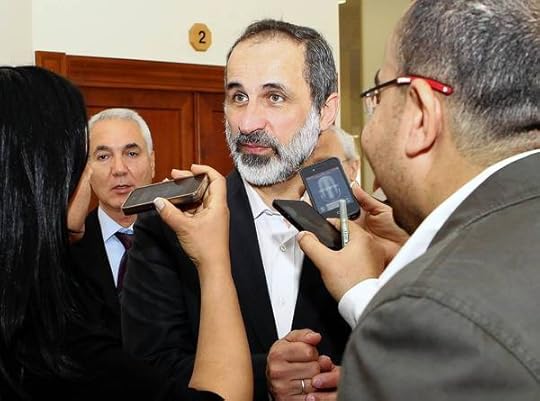
Moaz Khatib, the outgoing leader of the Syrian opposition coalition, speaks to the media in Doha, Qatar. His coalition was seated as the legitimate government of Syria at an Arab League summit in Qatar. (European Pressphoto Agency / March 26, 2013)
Mod
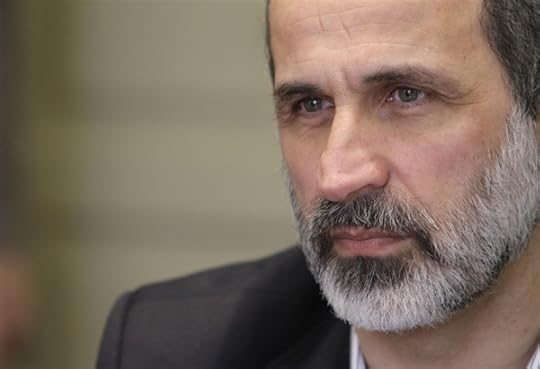
The head of the Syrian National Coalition for Opposition and Revolutionary Forces Mouaz al-Khatib resigned Sunday.
===========================================
By Daniel Arkin and Ayman Mohyeldin, NBC News
The leader of the Western-backed Syrian opposition coalition resigned Sunday, destabilizing the rebels' two-year uprising against President Bashar Assad.
Mouaz al-Khatib, a respected preacher and moderate Islamist who had spearheaded the Syrian National Coalition since it was formed last November, said in a post on his Facebook page that he was following through on a vow to leave his position if unspecified “red lines” were crossed.
“I had promised our people … to resign if the situation reaches certain red lines. Today, I honor my promise and I resign from the National Coalition to be able to work with freedom not available through official institutions,” al-Khatib said.
“We have been slaughtered under the watchful eyes of the world for two years, in an unprecedented manner by a vicious regime,” he said of the bloody civil war that has plunged the nation into chaos, leaving at least 70,000 people dead.
See remainder of article:
http://worldnews.nbcnews.com/_news/20...
 Syria: The Fall of the House of Assad
 David W. Lesch
Synopsis:
When Syrian President Bashar al-Assad came to power upon his father's death in 2000, many in- and outside Syria held high hopes that the popular young doctor would bring long-awaited reform, that he would be a new kind of Middle East leader capable of guiding his country toward genuine democracy. David Lesch was one of those who saw this promise in Assad. A widely respected Middle East scholar and consultant, Lesch came to know the president better than anyone in the West, in part through a remarkable series of meetings with Assad between 2004 and 2009. Yet for Lesch, like millions of others, Assad was destined to disappoint. In this timely book, the author explores Assad's failed leadership, his transformation from bearer of hope to reactionary tyrant, and his regime's violent response to the uprising of his people in the wake of the Arab Spring.
Lesch charts Assad's turn toward repression and the inexorable steps toward the violence of 2011 and 2012. The book recounts the causes of the Syrian uprising, the regime's tactics to remain in power, the responses of other nations to the bloodshed, and the determined efforts of regime opponents. In a thoughtful conclusion, the author suggests scenarios that could unfold in Syria's uncertain future.
Mod
This was an excerpt in a Chinese newspaper about the situation there:
The Alawites, an offshoot of Shiite Islam, are a tiny sect, representing roughly 12 percent of Syria's population. Many live in towns and villages along the mountainous Mediterranean coast. Most have either rallied behind Assad or stayed quietly on the sidelines of the 2-year-old civil war, which has killed more than 70,000 people.
70,000 of your own people is a great deal!
Here is the article which talks about some of the Alawites actually being part of the opposition:
Members of Syrian leader's Alawite sect backing rebels
CAIRO -- Dozens of people from Syrian President Bashar Assad's own minority sect met in Cairo on Sunday to send an unusual message to their fellow Alawites back home: Join the opposition before it is too late.
The Alawites have long been seen as a backbone of the Assad regime, and a decision to support the rebel force in Syria is complicated by the fact that many see their own futures interlocked with Assad's survival.
The pressure on Alawites who dare oppose Assad comes not only from the regime, but also from within their own families. Nearly all of the 50 Alawites at the opposition conference have been arrested, abused or threatened for their political views. One participant said he received an email threatening his life if he attended the conference.
Remainder of article from The China Post:
http://www.chinapost.com.tw/internati...
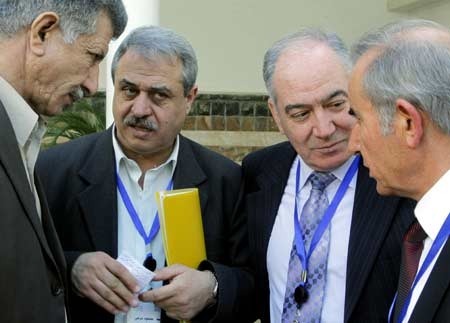
Syrian Alawites Mahmoud Maraie, second left, and Bassam al-Malek, second right, talk with other members of the Syrian Alawite sect who are opposed to Syrian President Bashar Assad, in Cairo, Sunday, March 24. (AP)
Mod
Bashar al-Assad's inner circle
Although Bashar al-Assad inherited Syria's presidency on his father's death in 2000, analysts say he does not have Hafez al-Assad's absolute grip on power. He is surrounded by military and intelligence figures, most of whom are either related to the president or are members of his minority Alawite community.
http://www.bbc.co.uk/news/world-middl...
Source: BBC
Mod
http://www.washingtonpost.com/grid/wo...
Mod
Michael Palin appeals for donations to help refugees and other victims of the humanitarian crisis in Syria, on behalf of the Disasters Emergency Committee (DEC)
The appeal was broadcast on the BBC to mark the start of the third year of the Syrian conflict.
"Over 8,000 exhausted refugees crossed Syria's borders each day last month," said Palin, who added that the problem would only worsen.
One million Syrians are believed to have left the country since the fighting began and an estimated two million more are thought to be sheltering away from their homes inside the country.
The DEC is an umbrella organisation, comprising 14 UK humanitarian aid agencies, which are working with partners on the ground in Syria to help as many people as possible.
For more information, visit www.dec.org.uk
http://www.dec.org.uk/appeals/syria-c...
Mod
https://secure.savethechildren.org/si...
USAID from the American people to Syria:
https://secure.savethechildren.org/si...
Mod
Read more: http://iipdigital.usembassy.gov/st/en...
Mod
http://www.bbc.co.uk/news/world-middl...
Source: BBC
 Mod
Mod
Mod
Mod
Source: NBC News
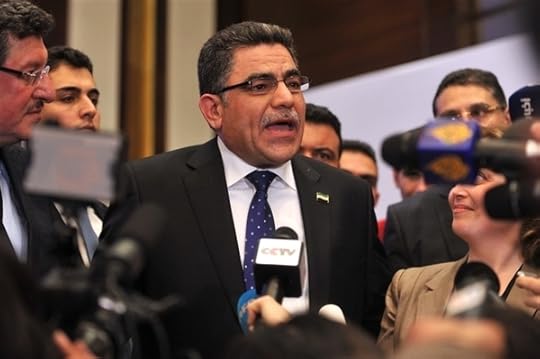
Ozan Kose / AFP - Getty Images
Ghassan Hitto, speaking to reporters after his March 18 election as Syria's interim prime minister.
===========================================
He is a “straight shooter” from Texas who worked as a telecoms executive until November. But Ghassan Hitto now finds himself the presumptive caretaker-leader of Syria as world powers plot the end of Bashar Assad’s crumbling regime.
The American citizen, born in Syria, is the new prime minister of the opposition’s interim government – the apparatus that the international community hopes will seal the end of Assad’s rule.
Friends describe Hitto, 50, as “sincere” and “practical,” but the charismatic technocrat will need all the charm he can muster to unify Syria’s fragmented opposition.
Remainder of article:
http://worldnews.nbcnews.com/_news/20...
Mod
Saturday, 30 March 2013
Source: AL ARABIYA NEWS
Al Arabiya, Dubai -
A ship raising a Tanzanian flag and carrying Iranian arms cargo is expected to cross the Suez Canal within six hours, an opposition source told Al Arabiya Saturday.
‘The ship is said to be carrying 8,500 tons of weapons and ground missiles from Iran to be given to the Syrian regime,’ the source said, adding: ‘It is scheduled to make a 'fuel stop' at a Syrian port where it will unload its cargo.’
The source also said that the vessel is owned by Syrians, although he did not specify to whom he was referring. He, however, said that the boat was registered in Lebanon and had links to the Syrian- and Iranian-backed Hezbollah.
There have been various media reports that the Islamic republic has been militarily helping the regime of Bashar al-Assad, which -- according to the U.N. -- has killed more than 70,000 people in the two years since the uprising began.
A Western official told Reuters earlier this month that Iranian weapons continue to pour into Syria from Iraq as well as other routes, including Turkey and Lebanon, which violates the U.N. arms embargo on Iran. Iraqi and Turkish officials denied the allegations.
The source also told Reuters that Iran’s acceleration of support for Assad suggests the Syrian war is entering a new phase in which Iran may be trying to end the battlefield stalemate by redoubling its commitment to Assad and offering Syria’s increasingly isolated government a crucial lifeline.
It also highlights the growing sectarian nature of the conflict, diplomats say, with Iranian arms flowing to the Shiite militant group Hezbollah. That group is increasingly active on the ground in Syria in support of Assad’s forces.
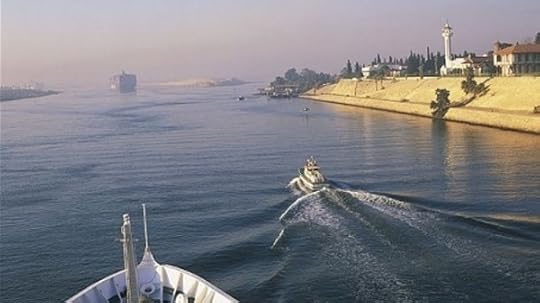
Vessel heading to Turkey is suspected to make a stop at Syrian port to unload Iranian weapons. (AFP)
Also the Times of Israel:
http://www.timesofisrael.com/ship-car...
Mod
In northern Lebanon, the kidnapping of a member of the powerful Shiite Jaafar clan has created yet another arena for Sunni-Shiite tensions fomented by Syria's unrest.
http://www.csmonitor.com/World/Middle...
Mod
by Jamie Dettmer Apr 1, 2013 4:45 AM EDT
Filmmaker Marcel Mettelsiefen spent weeks filming the horror in Aleppo. He tells Jamie Dettmer what’s really going on inside Syria.
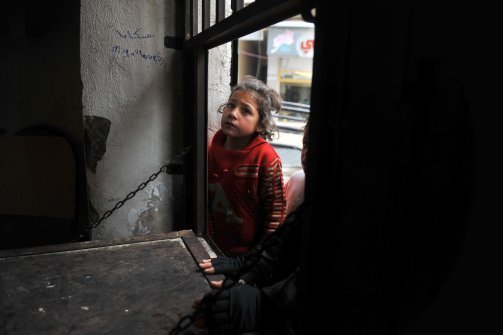
A Syrian girl waits to receive food aid in the Bustan al-Qasr district of Aleppo on March 26. The civil war has aged children beyond their years. (Bulent Kilic/AFP/Getty)
Article - very moving
http://www.thedailybeast.com/articles...
Mod
(ABC News)
By Alexander Marquardt
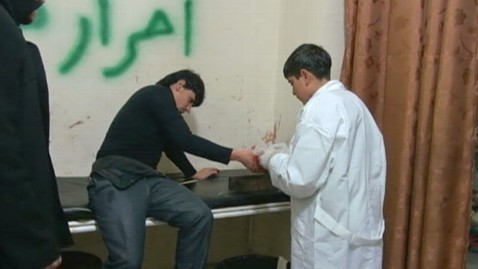
There are no white doctor’s coats that fit Mohammed Asaf.
At just 12-years-old, he’s been working in Aleppo’s busy and bloody Dar al-Shifa clinic for four months.
“In the beginning, when I saw blood, I would shiver and be frightened,” he said. “But now, I see blood like water.”
Inside the clinic, the wounded, many of them children, lie wherever there’s space, some screaming out in pain. Mohammed’s 11-year-old friend, Youssef Mohamed, works alongside him, tenderly caring for a rebel fighter.
Before the war, Aleppo had 5,000 medical workers. Today, that number has dwindled. Facilities rely on the help of kids like Mohammed and Youssef to care for the wounded in Syria’s most populous city.
None of the children should be there, but two years of civil strife have left few innocents.
Outside the clinic, between bombardments, children play, jumping rope and shooting marbles, often just feet from spent shells.
Electricity, food and water are scarce. An Islamic charity whose contributors include the al Qaeda-linked group Jabhat al-Nusra has stepped in to fill the void and win hearts and minds. It distributes bread and clothes, and has also slaughtered goats, a rare luxury.
Inside the Dar al-Shifa clinic, Mohammed runs around getting supplies and caring for patients including a comatose little girl who is a victim of the day-in, day-out fighting in the streets and bombing from the air.
Three days after video of a smiling Youssef was filmed, he was brought into his own clinic, dead from shrapnel wounds.
Seventy thousand people have now died in this war. Even if children like Mohammed survive it, his childhood is lost forever.
Mod
Countries around the globe are drawing up strategies for Syria in case the armed conflict takes a decisive turn.
Golan Heights UN Peacekeepers have been taken hostage
James Bays Last Modified: 01 Apr 2013 13:06
http://www.aljazeera.com/indepth/feat...
Source: Aljazeera
 Mod
Mod
 by Fouad Ajami
Synopsis
In The Syrian Rebellion, Fouad Ajami offers a detailed historical perspective on the current rebellion in Syria. Focusing on the similarities and the differences in skills between former dictator Hafez al-Assad and his successor son, Bashar, Ajami explains how an irresistible force clashed with an immovable object: the regime versus people who conquered fear to challenge a despot of unspeakable cruelty. Although the people at first hoped that Bashar would open up the prison that Syria had become under his father, it was not to be—and rebellion soon followed.
Ajami shows how, for four long decades, the Assad dynasty, the intelligence barons, and the brigade commanders had grown accustomed to a culture of quiescence and silence. But Syrians did not want to be ruled by Bashar's children the way they had been ruled by Bashar and their parents had been by Bashar's father. When the political hurricane known as the Arab Spring hit the region, Bashar al-Assad proclaimed his country's immunity to the troubles. He was wrong. This book tells how a proud people finally came to demand something more than a drab regime of dictatorship and plunder.
Mod
message 23:
by
Jerome, Assisting Moderator - Upcoming Books and Releases
(last edited Apr 01, 2013 02:13PM)
(new)
Mod
"http://www.stratfor.com/weekly/conseq..."
Source: STRATFOR
Mod
New alliances forming, U.S. now making its presence felt
By Nahlah Ayed, CBC News Posted: Mar 27, 2013 5:09 AM ET
Over many years of travelling to and living in Lebanon, I can't say I've ever seen a Russian warship docked at the port of Beirut.
But there they were earlier this month, gleaming in the distance, and for many Lebanese — in days as tense as these — their appearance was unsettling.
It may be — as one anonymous Russian official reportedly put it — that the ships were indeed simply restocking in a place far safer than their usual stop, Tartus, Russia's only supply base in the region. Tartus, of course, is in Syria, a staunch ally of Moscow, but a country at war.
Still, these warships made many in divided Lebanon nervous, especially those who insist they must maintain neutrality, if only in appearance, to avoid getting dragged into the Syrian conflict next door.
Lebanon has long had a tortured relationship with Syria, its former political master. But it is in a more precarious position than ever in a region increasingly polarized over Syria and its protracted conflict, now beginning its third year.
In a revolution that has morphed into a classic proxy war, Syria's battle lines have crystallized more than ever. The main protagonists are consolidating their support and pushing for clear commitments from their allies— you're either with us, or against us, they seem to be saying.
On the rebels' side, there appears to be little room anymore for prevaricating, or for anyone claiming neutrality.
You need only look at the past week of events, starting with America's diplomatic offensive.
On a visit to Israel, U.S. President Barack Obama managed to orchestrate an Israeli apology to Turkey, swiftly ending three years of animosity over an attack on a Turkish ship attempting to break Israel's blockade against Gaza.
In his first big foray abroad, U.S. Secretary of State John Kerry made a surprise visit to Baghdad on the weekend, where he met with Iraq Prime Minister Nouri al-Maliki (left) over the conflict in Syria. (Jason Reed / Associated Press)
The motive for the reconciliation: the need to be on the same page over a shared neighbour, Syria, that is falling apart.
Not only does the violence in Syria occasionally spill over into both Israel and Turkey. But the mere presence of Syria's chemical weapons — and the allegations that one side has already used them against the other — are enough for those two U.S. allies to bury their rift.
U.S. Secretary of State John Kerry then made a surprise visit to Baghdad for his own, Syria-related demand: that Iraq do more to stop Iranian arms shipments to Damascus through Iraqi airspace.
Kerry wants Iraq to inspect the daily flights, which are believed to be delivering weapons and ammunition to Tehran's long-time ally in Damascus.
Iraq — still painfully divided between its Sunni and Shia Muslims — seems reluctant to oblige Kerry on this, the government more likely to side with Tehran on Syria, much as the U.S. might hope otherwise.
Meanwhile, the New York Times reported earlier this week that the CIA is helping deliver more shipments of arms from Turkey and Arab countries, to the Syrian opposition.
The rebel side
On another front, there was more cajoling of reluctant anti-regime supporters at a meeting in Dublin: the British and French foreign ministers were pushing hard to persuade other EU members to begin sending arms to Syria's opposition fighters.
Kerry tells Iraq not to allow Iranian overflights
At a meeting in Cairo, members of Syria's Alawite community distanced themselves for the first time from their co-religionist, Syrian President Bashar al Assad.
These dissidents called on the army, which is dominated in its upper ranks by Alawites, to turn on the president and join the opposition. Sensing the possibility of a sectarian bloodbath if the rebels do gain the upper hand, they are seeking to divorce their fate from that of Assad.
Then, in a move driven chiefly by the Sunni Muslim Gulf Arab nations that have supported the Syrian uprising from the start, the Arab League voted on Monday to support the opposition with every means possible.
Their final communiqué in Doha even went so far as to spell out the right of each nation to support the opposition militarily.
Any pretext that the Syrian conflict is simply one nation's internal war has been firmly laid to rest.
Symbolically, but perhaps just as important, Syria's seat at the Arab League was also officially handed over to the opposition in a historic decision that left Assad's regime apoplectic.
Last push
The lines couldn't be clearer. Though, predictably, Lebanon abstained.
Refraining from taking sides and keeping a lid on its internal divisions hasn't been easy — Lebanon's army is constantly on call to put out sectarian fires.
And the Lebanese government just quit over the persistent conflicts between its pro- and anti-Syrian camps, leaving the country in political limbo for the moment and at risk of deeper turmoil.
But in a remarkable feat for a country that knows well the pain of being constantly tugged in opposing directions, it still manages to welcome Russian military ships, as well as Syrian rebels, with open arms — possibly the only country in the region capable of doing so now.
The rest have positioned themselves, along with their allies and their proxies, for the coming phase of Syria's war.
The support, for now, falls short of the kind of limited intervention that some in the opposition have called for, and still likely falls short of what they need to actually defeat Assad's forces.
It also comes late, given how many have already died.
For the time being, this remains a conflict left largely to the Syrians to fight out. But that, it seems, will almost certainly change.

Anti-regime protestors in the Syrian city of Aleppo burn a poster of President Bashar al Assad on Monday. (Aleppo Media Centre / Associated Press)
Mod
Syria conflict: warplanes 'strike Damascus' - live updates
http://www.guardian.co.uk/world/middl...
THE SYRIAN GOVERNMENT CARRIED OUT AIR STRIKES ON ITS OWN CAPITAL.
http://static.guim.co.uk/sys-images/G...
An image taken from video obtained from Shaam News Network, which has been authenticated based on its contents and other Associated Press reporting, shows smoke from heavy shelling in the Jobar neighbourhood in north Damascus on 2 April. Syrian government warplanes were reported to have carried out air strikes on the capital on Wednesday morning. Photograph: Anonymous/AP
Mod
Palmyra, which is in central Syria near the modern town of Tadmur, is a Unesco world heritage site, and features the ruins of a city that was once one of the most important cultural centres of the ancient world.
Syria
A video obtained by Reuters suggests that Palmyra’s Temple of Bel, which dates from the first century, has been damaged in fighting between government and rebel forces.
The footage shows a large gap in one of the columns, which the news agency says was caused by a mortar bomb, and shrapnel chips in the colonnade
The resident who filmed the footage, which was posted on YouTube in March, told Reuters: "The rebels are around the town. They hide in the desert, some to the east and some to the west." The groups attack government positions in the town at night, he said, and the government responds with mortar bombs, artillery shells and rockets. "For the past two months we have had shelling every night," he said. "The army have positioned themselves in the museum, between the town and the ruins."
The army has also entered the Roman theatre in the ancient city and positioned snipers behind its stone walls, he said.
YOUTUBE FOOTAGE:
http://www.youtube.com/watch?v=zMq5pU...
UNESCO SITE INFO:
http://whc.unesco.org/en/list/23
Mod
SOURCE FOR VIDEO AND TEXT - THE GUARDIAN
Here is the link and there are videos - some are graphic so I will warn you ahead of time - those are also noted by The Guardian:
http://www.guardian.co.uk/world/middl...
Reporter: Paul Owens
Mod
Source: Aljazeera
Israeli defence minister says Israel will not tolerate any attacks on its territory and will retaliate against source.
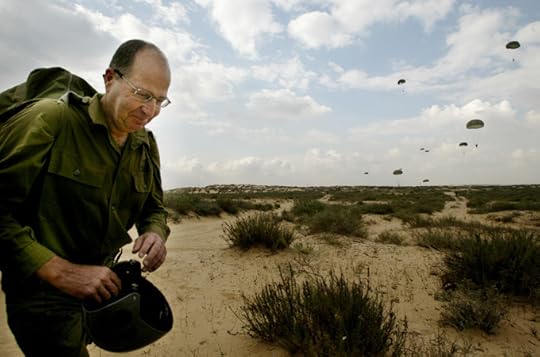
Yaalon's warning came after Israel retaliated to attacks from Syria and Gaza [File-AP]
==========================================
Israel's Defence Minister warned Palestinian fighters that the Israeli military will respond to any attacks in its territory, after a rocket was fired from Gaza into Southern Israel and an attack from Syria.
Moshe Yaalon said on Wednesday that the military will not hold back if attacked and will not allow its civilians or armed forces to come under fire "in any form".
"We shall not allow in any form the establishment of a routine of sporadic firing on our civilians or on our forces," said Yaalon.
His warning was issued after fighters in Gaza fired a rocket at southern Israel, and also a Syrian mortar shell hit Israeli-occupied sector of the Golan Heights.
In response, the Israeli military fired from a tank across the Syrian armistice line, towards the source of fire and also launched three air strikes on Gaza.
Yaalon said Gaza's Hamas rulers were responsible for any fire directed at Israel from the coastal enclave, and in the same way, President Bashar al-Assad's regime was to blame for whatever fire emanated from Syria.
"In the Golan Heights, our policy is that we have no intention of allowing a daily routine of firing from Syria towards Israeli territory, whether it is stray fire or not, and we will respond to that with a firm hand," said Yaalon.
"The moment we identify the source of the fire, we will destroy it without any hesitation, as we did last night," he said.
Tuesday's incident was the first time Israel retaliated for Gaza rocket fire since an informal cease-fire ended eight days of cross-border fighting between Israel and the Hamas-ruled territory in November.
Palestinians in Gaza have fired several rockets since the informal cease-fire took hold.
Police say no damage or injuries were reported after the Israeli strikes on late-Tuesday but Palestinian fighters fired two more rockets at Israel.
Source: Agencies
Mod
http://www.aljazeera.com/indepth/spot...
Syria
• Twenty-one people have been killed so far in fighting across Syria today, including 12 in Raqqa and nine in Idlib, according to opposition group the Local Co-ordination Committees. The LCCs said there were also “fierce clashes” in the Damascus suburb of Zabadany this morning, and several people were wounded by tank and mortar fire in the suburb of Abadeh. The group reported that 130 people were killed yesterday, including 48 in Aleppo, in the north-west of the country, and 40 in Damascus and its suburbs. The Syrian Network for Human Rights, another activist group, said 132 people had been killed yesterday. Their reports cannot be verified because most media are banned from Syria.
• The activist group the Syrian Observatory for Human Rights said that the opposition had taken an air defence base on the outskirts of Daraa, in the south west near the border with Jordan, after days of fighting. Its report cannot be verified because most media are banned from Syria. The New York Times has the full story here.
• Al Jazeera has denounced threats made against its presenters and correspondents by Syrian regime supporters on social media in recent weeks. "Al Jazeera prides itself on honest and objective reporting,” Ibrahim Helal, director of news for Al Jazeera Arabic, said. “People who feel Al Jazeera does not reflect their point of view have no basis for any argument when they use threats of intimidation and violence through social media portals like Facebook and Twitter. The fact that our staff have been targeted with messages of hate has no place in any plural society.” The TV station said it had initiated a legal case against those who made threats.
• An interview with Syrian president Bashar al-Assad is to be broadcast tomorrow, according to the president's YouTube channel. Assad speaks in public relatively rarely.

A picture made available by the Syrian presidency media office on 3 April shows Syrian president Bashar al-Assad greeting journalists with the Turkish television channel Ulusal and Aydinlik newspaper in Damascus on 2 April for an interview which is to run on 5 April, according to the president's YouTube channel. Photograph: AFP/Getty Images
Source: Aljazeera
Syria’s Media War
by Jamie Dettmer Apr 4, 2013 4:45 AM EDT
After killings and kidnappings of foreign journalists, the rebels are laying down new rules for covering the conflict. But correspondents complain of spin control. By Jamie Dettmer.
http://www.thedailybeast.com/articles...
Mod
Interactive: Tracking Syria's defections (Very Interesting)
This visualisation tracks senior military officials, members of parliament and diplomats who quit Assad's regime.
http://www.aljazeera.com/indepth/inte...
Mod
http://blogs.aljazeera.com/liveblog/t...
Mod
Jordan tightens security along Syrian border as tensions soar amid reports of arms shipments to anti-Assad forces
Source: The Guardian
Ian Black, Middle East editor
The Guardian, Friday 5 April 2013 11.34 EDT
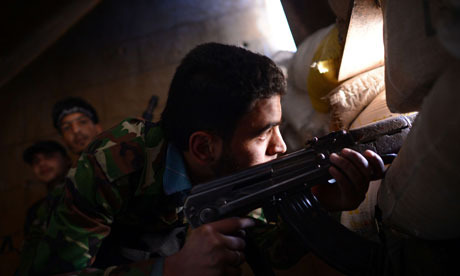
A Syrian rebel observes the positions of regime forces in Saif al-Dawla district in the northern city of Aleppo. Photograph: Dimitar Dilkoff/AFP/Getty Images
===========================================
Jordan is facing mounting tension with neighbouring Syria amid signs that it has moved to a more active role in support of the rebels fighting to overthrow President Bashar al-Assad's government.
The border between the countries was reinforced on the Jordanian side on Thursday after Syrian state media warned the western-backed kingdom it was "playing with fire" and poised "on the edge of a volcano" by backing the opposition.
Recent weeks have seen a spate of reports about arms shipments from Jordan to anti-Assad rebels who have been making gains around Deraa, the Syrian city closest to the border. Opposition sources say the military situation reflects enhanced supplies and training.
Barack Obama discussed the crisis with King Abdullah II in Amman on his Middle East tour last month. Jordan was the only Arab state the US president visited – an indication of the pressure the king is under to be more supportive of the Gulf-driven effort to drive Assad from power.
Diplomats say they have discussed plans for a buffer zone in southern Syria as well as accelerated training for rebel fighters by the US and Jordan. British and French special forces are reported to be involved in training, advice, logistics and intelligence support.
In an apparent reflection of nervousness about the issue, a government spokesman in Amman insisted on Friday that Jordan was "not part of the conflict" in Syria and maintained its support for a "peaceful solution" – the formal stance of all Arab states. The spokesman refused to comment either on the training or the buffer zone, the Al-Ghad newspaper reported.
The Washington Post cited Jordanian security officials this week as saying that a plan to complete the training of 3,000 Free Syrian Army officers by the end of June has been brought forward to the end of April in light of the border victories. The FSA is backed by western and Arab governments as a bulwark against the rise of Salafi or Jihadi-type Islamist groups.
Jordanian sources describe a "double discourse" – an official one that reiterates the formal position alongside clandestine training and Saudi-financed arms supplies delivered with the help of the CIA. Jordan's powerful Mukhabarat secret service enjoys a close relationship with its western partners, including MI6.
"The Jordanians are happy to channel support but they say 'don't put us in the front line'," said a Syrian opposition figure. "They used to be afraid that Assad's intelligence system could hit back and hurt Jordan but now he is weak they feel emboldened to be more active."
Jordanian officials repeatedly speak of the gravity of the Syrian crisis, with concern focusing on the flow of refugees across the border and the risk that extremist elements will come with them.
"Jordan can't sit idle and watch al-Qaida and other militants seizing control of its … border with Syria," Jordan's information minister, Sameeh Maaytah, was quoted as saying. "It must take proactive steps to arrive at a state of equilibrium in the security structure on the border."
An estimated 460,000 Syrian refugees are in Jordan. In one 24-hour period this week, 1,967 arrivals were recorded. If the influx continues at the current rate, Jordan could be hosting more than 1 million refugees by the end of 2013.
Abdullah Ensour, the newly appointed prime minister, has warned publicly of a "catastrophic" situation" and used even stronger language in private, according to sources in Amman.
Domestic strains have also been evident in complaints about the number of Syrian refugees. Several MPs are calling for the closure of the border. Abdul Karim al-Dughmi, a conservative politician, criticised the government's "timid position" on the crisis and blamed a "conspiracy by some Arab states" for the unrest.
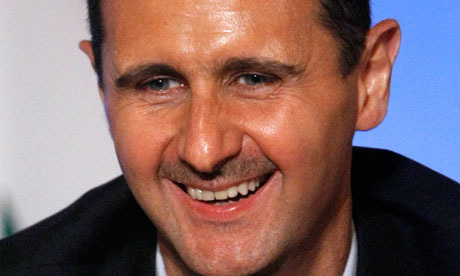
Syrian president Bashar al-Assad. Photograph: Eric Gaillard/Reuters
(Nothing seems to be bothering this guy)
Mod
Published April 05, 2013
Associated Press
This person appears to be the problem:
MOSCOW – President Vladimir Putin says the civil war in Syria has become "a massacre" and that it must be stopped through peace talks between the government and the opposition.
Speaking to the German ARD television in remarks released by the Kremlin on Friday, he rejected the Western criticism of Russia for its continuing supply of weapons to Syrian President Bashar Assad's regime. Putin said that such shipments don't violate international law, and he criticized those who send weapons to the Syrian opposition.
Putin said that peace talks should spell out the future of Syria and provide guarantees to all parties.
Russia has been Assad's main ally, shielding him from the U.N. sanctions over his crackdown on an uprising that turned into a civil war that has killed some 70,000 people
Read more: http://www.foxnews.com/world/2013/04/...
Mod
http://www.nytimes.com/2013/04/04/wor...
http://projects.nytimes.com/watching-...
Warning: some are graphic and very upsetting
Mod
The Sandcastle Girls = FICTION
Interesting because of the city/town of Aleppo is featured and because of the war in Syria. Bohjalian is also a good author.
 by
by
 Chris Bohjalian
Synopsis:
Over the course of his career, New York Times bestselling novelist Chris Bohjalian has taken readers on a spectacular array of journeys.
Midwives brought us to an isolated Vermont farmhouse on an icy winter’s night and a home birth gone tragically wrong.
The Double Bind perfectly conjured the Roaring Twenties on Long Island—and a young social worker’s descent into madness.
And Skeletons at the Feast chronicled the last six months of World War Two in Poland and Germany with nail-biting authenticity. As The Washington Post Book World has noted, Bohjalian writes “the sorts of books people stay awake all night to finish.”
In his fifteenth book, The Sandcastle Girls, he brings us on a very different kind of journey. This spellbinding tale travels between Aleppo, Syria, in 1915 and Bronxville, New York, in 2012—a sweeping historical love story steeped in the author’s Armenian heritage, making it his most personal novel to date.
When Elizabeth Endicott arrives in Syria, she has a diploma from Mount Holyoke College, a crash course in nursing, and only the most basic grasp of the Armenian language. The First World War is spreading across Europe, and she has volunteered on behalf of the Boston-based Friends of Armenia to deliver food and medical aid to refugees of the Armenian genocide.
There, Elizabeth becomes friendly with Armen, a young Armenian engineer who has already lost his wife and infant daughter. When Armen leaves Aleppo to join the British Army in Egypt, he begins to write Elizabeth letters, and comes to realize that he has fallen in love with the wealthy, young American woman who is so different from the wife he lost.
Flash forward to the present, where we meet Laura Petrosian, a novelist living in suburban New York. Although her grandparents’ ornate Pelham home was affectionately nicknamed the “Ottoman Annex,” Laura has never really given her Armenian heritage much thought.
But when an old friend calls, claiming to have seen a newspaper photo of Laura’s grandmother promoting an exhibit at a Boston museum, Laura embarks on a journey back through her family’s history that reveals love, loss—and a wrenching secret that has been buried for generations.
Other books: ALL FICTION


 by
Chris Bohjalian
Mod
by
Chris Bohjalian
Mod
In a way according to the Guardian - historical fiction.
The Dark Side of Love is a fiction that accurately (if selectively) documents Syrian social history. Its sweep reaches from 1907 to 1970, through the French occupation, the chaotic coup years, the rise of the Ba'ath and the disastrous June war. Farid and Rana swim on the great currents of 20th-century Syrian thought - communism, feminism, nationalism, Islamism - and witness the poisoning of the waters. Farid's torture scenes are painfully, brilliantly narrated. Relations between Christians, Jews and Muslims, between the countryside and the city, between men and women, and between political factions, are explored with subtlety and honesty.
 by
by
 Rafik Schami
Synopsis:
Syria, more than most, is a land of stories and storytellers. The farmers and shopkeepers describe early Islamic battles or episodes from the Crusades as if they'd attended them in person. A gathering of friends is quickly elevated into a group performance of jokes, laments, myths and conspiracies. Even Syrian surnames suggest stories: there are families called The-Milk's-Boiled, Sip-The-Yoghurt and Undone-Belt. "The deeper you swim into our stories," a village rhetorician once told me, "the more you understand that they have no floor."
Remainder of Review:
http://www.guardian.co.uk/books/2009/...
Independent Foreign Fiction Prize Nominee (2010)
Winner of the Gold Award for Adult Multicultural Fiction in the Independent Publisher Book Awards 2010
'A masterpiece! A marvel of prose that mixes myths, stories, tales, legends, and a wonderful love story... You will experience a Scheherazade in sparkling colours - a big love story, which does not spare us the sharp knives of grief.'
Die Zeit
Mod
 by Stephanie Saldana
Synopsis:
A riveting memoir about one woman's journey into Syria under the Baathist regime and an unexpected love story between two strangers searching for meaning.
When Stephanie Saldaña arrives in Damascus, she is running away from a broken heart and a haunted family history that she has crossed the world to escape. Yet as she moves into a tumbling Ottoman house in the heart of the Old City, she is unprepared for the complex world that awaits her: an ancient capital where Sunni and Shia Muslims, Christians, Alawites, Kurds, and Palestinian and Iraqi refugees share a fragile co-existence.
Soon she is stumbling through the Arabic language, fielding interviews from the secret police, and struggling to make the city her own. But as the political climate darkens and the war in neighboring Iraq threatens to spill over, she flees to an ancient Christian monastery carved into the desert cliffs, where she is forced to confront the life she left behind. Soon she will meet a series of improbable teachers: an iconoclastic Italian priest, a famous female Muslim sheikh, a wounded Iraqi refugee, and Frédéric, a young French novice monk who becomes her best friend.
What follows is a tender story of a woman falling in love: with God, with her own life, with a country on the brink of chaos, and with a man she knows she can never have. Wise, funny, and heartbreaking, The Bread of Angels celebrates the hope that appears even in war, the surprising places we can call home, and the possibility of true love.
Mod

 Robin Yassin-Kassab
Synopsis:
It is summer 2001 and Sami Traifi has escaped his fraying marriage and minimal job prospects to visit Damascus. In search of his roots and himself, he instead finds a forgotten uncle in a gloomy back room, and an ugly secret about his beloved father... Returning to London, Sami finds even more to test him as his young wife Muntaha reveals that she is taking up the hijab. Sami embarks on a wilfully ragged journey in the opposite direction, away from religion -- but towards what? As Sami struggles to understand Muntaha's newly-deepened faith, her brother Ammar's hip hop Islamism and his father-in-law's need to see grandchildren, so his emotional and spiritual unraveling begins to accelerate. And the more he rebels, the closer he comes to betraying those he loves, edging ever-nearer to the brink of losing everything.
Set against a powerfully-evoked backdrop of multi-ethnic, multi-faith London, The Road from Damascus explores themes as big as love, faith and hope, and as fundamental as our need to believe in something bigger than ourselves, whatever that might be
Mod
 by Samar Yazbek
Synopsis:
A well-known novelist and journalist from the coastal city of Jableh, Samar Yazbek witnessed in person and actively participated in the first four months of the Syrian intifada. Throughout she kept a diary of personal reflections. Her outspoken views published in print, online, and on Facebook quickly attracted the attention and fury of the regime, as vicious rumors spread about her disloyalty to the homeland and the Alawite community from which she comes. This narrative weaves together her struggle to protect herself and her young daughter after she is forced to leave her home and live on the run, detained multiple times, and eventually flees to Europe.
Filled with exhilarating hope and horrifying atrocities, A Woman in the Crossfire offers us a wholly unique perspective on the Syrian uprising. Yazbek's is a modest yet powerful testament to the strength and commitment of countless unnamed Syrians who dream of bringing an end to a forty-year-old dictatorship. Their fight for their dignity will inspire all those who read this book and challenge the world to look anew at the trials and tribulations of the Syrian uprising.
Mod
NOVEL ABOUT SYRIAN HERITAGE.
 by
by
 Mohja Kahf
Synopsis:
Syrian immigrant Khadra Shamy is growing up in a devout, tightly knit Muslim family in 1970s Indiana, at the crossroads of bad polyester and Islamic dress codes. Along with her brother Eyad and her African-American friends, Hakim and Hanifa, she bikes the Indianapolis streets exploring the fault-lines between “Muslim” and “American.”
When her picture-perfect marriage goes sour, Khadra flees to Syria and learns how to pray again. On returning to America she works in an eastern state — taking care to stay away from Indiana, where the murder of her friend Tayiba’s sister by Klan violence years before still haunts her. But when her job sends her to cover a national Islamic conference in Indianapolis, she’s back on familiar ground: Attending a concert by her brother’s interfaith band The Clash of Civilizations, dodging questions from the “aunties” and “uncles,” and running into the recently divorced Hakim everywhere.
Beautifully written and featuring an exuberant cast of characters, The Girl in the Tangerine Scarf charts the spiritual and social landscape of Muslims in middle America, from five daily prayers to the Indy 500 car race. It is a riveting debut from an important new voice
Mod
by Fouad AjamiSynopsis:
Freedom's Call and Its Cruel Price
In The Syrian Rebellion, Fouad Ajami offers a detailed historical perspective on the current rebellion in Syria. Focusing on the similarities and the differences in skills between former dictator Hafez al-Assad and his successor son, Bashar, Ajami explains how an irresistible force clashed with an immovable object: the regime versus people who conquered fear to challenge a despot of unspeakable cruelty. Although the people at first hoped that Bashar would open up the prison that Syria had become under his father, it was not to be—and rebellion soon followed.
Ajami shows how, for four long decades, the Assad dynasty, the intelligence barons, and the brigade commanders had grown accustomed to a culture of quiescence and silence. But Syrians did not want to be ruled by Bashar's children the way they had been ruled by Bashar and their parents had been by Bashar's father. When the political hurricane known as the Arab Spring hit the region, Bashar al-Assad proclaimed his country's immunity to the troubles. He was wrong. This book tells how a proud people finally came to demand something more than a drab regime of dictatorship and plunder.
Mod
FICTION
 by
by
 Dorothy Gilman
Synopsis:
After facing down hijackers on a flight to the Middle East and saving the lives of the passengers on board, a young American woman steps off the plane in Damascus in a blaze of celebrity and disappears. The CIA believes Amanda Pym was kidnapped, possibly murdered.
Masquerading as Amanda Pym’s worried aunt, Mrs. Pollifax begins her determined search, slipping through Damascus’s crooked streets and crowded souks . . . and trekking deep into the desert. Yet she is shadowed by deadly enemies, whose sinister agenda threatens not only Mrs. P. but the fragile stability of the entire Middle East. Only a miracle–or a brilliant counterplot– can forestall a disaster that will send shock waves around the world.
Mod
 BY Patrick Seale
Synopsis:
"This is a book in the finest tradition of investigative scholarship. The research is awesome. . . . Seale's great strength is his ability to explain the confusing kaleidoscopic nature of Middle Eastern diplomacy. He understands the game being played and also knows the players. . . . [An] impressive book."--Los Angeles Times Book Review
Mod
 by
by
 Dave Eggers
Synopsis
When Hurricane Katrina struck New Orleans, Abdulrahman Zeitoun, a prosperous Syrian-American and father of four, chose to stay through the storm to protect his house and contracting business.
In the days after the storm, he traveled the flooded streets in a secondhand canoe, passing on supplies and helping those he could.
A week later, on September 6, 2005, Zeitoun abruptly disappeared. Eggers’s riveting nonfiction book, three years in the making, explores Zeitoun’s roots in Syria, his marriage to Kathy — an American who converted to Islam — and their children, and the surreal atmosphere (in New Orleans and the United States generally) in which what happened to Abdulrahman Zeitoun was possible.
Like What Is the What, Zeitoun was written in close collaboration with its subjects and involved vast research — in this case, in the United States, Spain, and Syria.
MAINLY IN AMERICA BUT RESEARCHED IN SYRIA
Los Angeles Times Book Prize for Current Interest (2009)
Goodreads Choice Award Nominee for Nonfiction (2009)
Dayton Literary Peace Prize for Nonfiction (2010)
 by
Dave Eggers - NOT ABOUT SYRIA
Mod
by
Dave Eggers - NOT ABOUT SYRIA
Mod
 by Flynt Leverett
Synopsis:
Syria has long presented a difficult problem for American policymakers.
Actively supportive of groups such as Hezbollah, it has occupied Lebanon for more than 20 years. Damascus remains intransigent on Israels complete withdrawal from the disputed Golan Heights as the sine qua non for peace with that state.
It is often mentioned in the same breath as members of the infamous axis of evil. Syria occupies an important strategic position in the Middle East - one made even more significant as America considers long-term involvement in the reconstruction of Iraq.
As the policy challenges posed by Syrias problematic behavior have grown more pressing in the recent security environment, the United States has had difficulty formulating a coherent and effective policy toward Damascus.
The death of long-time dictator Hafiz al Assad has forced renewed debate on its place in the region. The transition from Assad to his son
Bashar has thrown Western consensus on how to deal with the Syrian leadership further into doubt. Inheriting Syria fills this void with a detailed analytic portrait of the Syrian regime under Bashars leadership.
It draws implications for U.S. policy, offering a bold new strategy for achieving American objectives, largely via a strategy of coordinated engagement employing both sticks and carrots.
This strategy would be independent of the Arab-Israeli peace process, thus a historical departure for the United States.
The authors long service in the foreign policy establishment has uniquely positioned him to provide valuable insights into this mysterious yet important country.
This book will be of high interest to those concerned about the Middle East, the war on terror, and the future ofAmerican foreign policy. Written for a general audience as well as the policymaking and academic communities, Inheriting Syria is an important resource for all who seek deeper understanding of this enigmatic nation and its leadership.
Mod
BE MINDFUL THIS WAS PUBLISHED IN 1967.
 by Colin Thubron (no photo)
Synopsis:
Mirror to Damascus is a unique portrait of a city now obscured by recent upheavals, by one of the most indefatigable and popular of travel writers.
Described by the author as simply “a work of love,” Mirror to Damascus is an enthralling and fascinating history of Damascus from the Amorites of the Bible to the revolution of 1966, as well as being a charming and witty personal record of a city well-loved.
In explaining how modern Damascus is rooted in immemorial layers of culture and tradition, Thubron explores the historical, artistic, social and religious inheritance of the Damascenes in an amusing and perceptive manner, whilst interspersing the narrative with innumerable anecdotes about travellers of bygone days.
Mod

 نهاد سيريس
Synopsis:
The Silence and the Roar takes place in an unnamed Middle Eastern country resembling Syria. The story follows a day in the life of Fathi Chin, an author banned from publishing because he refuses to write propaganda for the ruling government.
On this day, the entire country has mobilized to celebrate the twenty year anniversary of the reigning despot. The heat is oppressive and loudspeakers blare as an endless, unbearably loud parade takes over the streets. Desperate to get away from the noise and the zombie-like masses, Fathi leaves his house to visit his mother, but en route stops to help a student who is being beaten by the police. Fathi's ID papers are confiscated and he is forced to return home and told to report to the police station before night falls.
When Fathi turns himself in, he is led from one department to another in an ever-widening bureaucratic labyrinth. His only weapon against the irrationality of the government employees is his sense of irony. The Silence and the Roar is a funny, sexy, scathing novel about the struggle of an individual over tyranny. Tinged with a Kafkaesque sense of the absurd, it explores what it means to be truly free in mind and body, despite the worst efforts of the state to impose its will on its citizens
Mod
 by Grigoris Balakian (no photo)
THEY WERE SENT OUT INTO THE SYRIAN DESERT
Synopsis:
Never before in English, Armenian Golgotha is the most dramatic and comprehensive eyewitness account of the first modern genocide.
On April 24, 1915, the priest Grigoris Balakian was arrested along with some 250 other intellectuals and leaders of Constantinople’s Armenian community. It was the beginning of the Ottoman Turkish government’s systematic attempt to eliminate the Armenian people from Turkey; it was a campaign that continued through World War I and the fall of the Ottoman Empire, by which time more than a million Armenians had been annihilated and expunged from their historic homeland.
For Grigoris Balakian, himself condemned, it was also the beginning of a four-year ordeal during which he would bear witness to a seemingly endless caravan of blood.
Balakian sees his countrymen sent in carts, on donkeys, or on foot to face certain death in the desert of northern Syria.
Many would not even survive the journey, suffering starvation, disease, mutilation, and rape, among other tortures, before being slaughtered en route. In these pages, he brings to life the words and deeds of survivors, foreign witnesses, and Turkish officials involved in the massacre process, and also of those few brave, righteous Turks, who, with some of their German allies working for the Baghdad Railway, resisted orders calling for the death of the Armenians. Miraculously, Balakian manages to escape, and his flight—through forest and over mountain, in disguise as a railroad worker and then as a German soldier—is a suspenseful, harrowing odyssey that makes possible his singular testimony.
Full of shrewd insights into the political, historical, and cultural context of the Armenian genocide—the template for the subsequent mass killings that have cast a shadow across the twentieth century and beyond—this memoir is destined to become a classic of survivor literature. Armenian Golgotha is sure to deepen our understanding of a catastrophic crime that the Turkish government, the Ottomans’ successor, denies to this day
Mod
 by Robin Wright (no photo)
Synopsis:
A magnificent reckoning with the extraordinary changes engulfing the Middle East, by one of our greatest reporters on the region
Robin Wright first landed in the Middle East on October 6, 1973, the day the fourth Middle East war erupted. She has covered every country and most major crises in the region since then, through to the rise of Al-Qaeda and the U.S. invasion of Iraq.
For all the drama of the past, however, the region's most decisive traumas are unfolding today as the Middle East struggles to deal with trends that have already reshaped the rest of the world. And for all the darkness, there is also hope.
Some of the emerging trends give cause for greater optimism about the future of the Middle East than at any time since the first Arab-Israeli War in 1948.
Dreams and Shadows is an extraordinary tour d'horizon of the new Middle East, with on-the-ground reportage of the ideas and movements driving change across the region-and the obstacles they confront.
Through the powerful storytelling for which the author is famous, Dreams and Shadows ties together the players and events in Iraq, Iran, Egypt, Syria, Lebanon, Morocco, Turkey, the Gulf states, and the Palestinian territories into a coherent vision of what lies ahead.
A marvelous field report from the center of the storm, the book is animated by the characters whose stories give the region's transformation its human immediacy and urgency. It is also rich with the history that brought us to this point. It is a masterpiece of the reporter's art and a work of profound and enduring insight.

The History Book Club
Books mentioned in this topic
Syria: A Modern History (other topics)It Started in Damascus: How the Long Syrian Revolution Reshaped Our World (other topics)
The Damascus Events: The 1860 Massacre and the Making of the Modern Middle East (other topics)
The Damascus Seat of Power: Syria’s Heads of State, 1918-1946 (other topics)
Fragile Nation, Shattered Land: The Modern History of Syria (other topics)
More...
Authors mentioned in this topic
Daniel Neep (other topics)Rime Allaf (other topics)
Eugene Rogan (other topics)
Sami Moubayed (other topics)
James Reilly (other topics)
More...
The Syrian people are going through a very difficult time right now and to keep abreast of their struggles we at the History Book Club would like to set up a thread to shine a light on that part of the world and what they are going through.
"Syria (/ˈsɪriə/ ( listen) sirr-ee-ə ; Arabic: سوريا / ALA-LC: Sūriyā, or سورية / Sūrīyah; Syriac: ܣܘܪܝܐ; Kurdish: سوریه, Sûrî), is a country in Western Asia, bordering Lebanon and the Mediterranean Sea to the West, Turkey to the north, Iraq to the east, Jordan to the south and Israel to the southwest. A country of fertile plains, high mountains and deserts, it is home to diverse ethnic and religious groups, including Kurds, Armenians, Assyrians, Christians, Druze, Alawite Shias and Arab Sunnis. The latter make up the majority of the population.
In English, the name "Syria" was formerly synonymous with the Levant (known in Arabic as al-Sham) while the modern state encompasses the sites of several ancient kingdoms and empires, including the Eblan civilization of the third millennium BC. In the Islamic era, its capital city, Damascus, the oldest continuously inhabited city in the world,[5] was the seat of the Umayyad Caliphate, and a provincial capital of the Mamluk Sultanate of Egypt.
The modern Syrian state was established after the First World War as a French mandate, and represented the largest Arab state to emerge from the formerly Ottoman-ruled Arab Levant. It gained independence in April 1946, as a parliamentary republic. The post-independence period was tumultuous, and a large number of military coups and coup attempts shook the country in the period 1949–1971. Between 1958 and 1961, Syria entered a brief union with Egypt, which was terminated by a military coup. Syria was under Emergency Law from 1963 to 2011, effectively suspending most constitutional protections for citizens, and its system of government is considered to be non-democratic.[6] Bashar al-Assad has been president since 2000 and was preceded by his father Hafez al-Assad, who was in office from 1971.
Syria is a member of one International organization other than the United Nations, the Non-Aligned Movement; it is currently suspended from the Arab League,[8] the Organisation of Islamic Cooperation,[9] and self suspended from the Union for the Mediterranean.
Since March 2011, Syria has been embroiled in civil war in the wake of uprisings (considered an extension of the Arab Spring, the mass movement of revolutions and protests in the Arab world) against Assad and the neo-Ba'athist government. The opposition Syrian National Coalition selected Ghassan Hitto as prime minister of a rival provisional government on March 19, 2013 after being invited to do so by several foreign governments and the Arab League."
Source: Wikipedia