
The History Book Club discussion
EUROPE - EUROPEAN HISTORY
>
TURKEY

 Mod
Mod
 by
by
 Orhan Pamuk
Synopsis:
A shimmering evocation, by turns intimate and panoramic, of one of the world’s great cities, by its foremost writer.
Orhan Pamuk was born in Istanbul and still lives in the family apartment building where his mother first held him in her arms.
His portrait of his city is thus also a self-portrait, refracted by memory and the melancholy–or hüzün– that all Istanbullus share: the sadness that comes of living amid the ruins of a lost empire.
With cinematic fluidity, Pamuk moves from his glamorous, unhappy parents to the gorgeous, decrepit mansions overlooking the Bosphorus; from the dawning of his self-consciousness to the writers and painters–both Turkish and foreign–who would shape his consciousness of his city.
Like Joyce’s Dubliners and Borges’ Buenos Aires, Pamuk’s Istanbul is a triumphant encounter of place and sensibility, beautifully written and immensely moving.
The following books are not about Turkey but about Dublin and Buenos Aires/Argentina - we are citing them because they were mentioned in the synopsis.
 by
by
 James Joyce
 by
by
 Jorge Luis Borges
Mod
Jorge Luis Borges
Mod
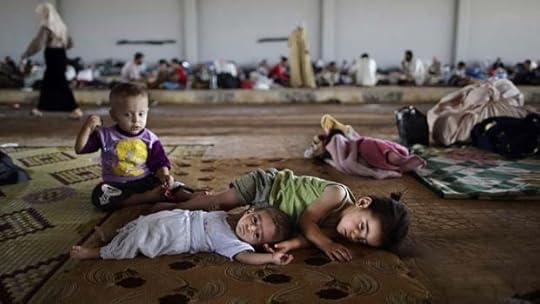
This video tells an unbelievable story of what is going on with the children. I think that Turkey is trying to assist in its own way.
Educating Syria's future 'rulers'
School in Turkey funded by charities faces challenges to foster "upcoming generations who will rule over Syria".
http://blogs.aljazeera.com/blog/middl...
For Syrian children fleeing to Turkey with their families, getting an education is a challenge if they are not living in one of the refugee camps where schools have been set up.
They cannot enrol in Turkish schools because they do not speak the local language.
But a large Syrian community living in Antakya with thousands of children sitting at home has pushed many of those concerned about the future of Syria's next generation to do something.
In August 2011, a small group of Syrians in Antakya set up the Al Basha'er School to teach their children while in exile. The effort initially started with 16 students and six teachers.
It later significantly expanded when more parents wanted their children to join with no end in sight to the war in Syria.
The school is now renting two small buildings in different parts of Antakya and is teaching 1,200 students.
It has hired enough Syrian teachers to staff the school for twelve hours a day on early and late shifts. But the problem is around 1,000 other students are on a waiting list for a desperate opportunity to enroll.
Mustafa Shaker, the school's headmaster, says the only funding the school receives is from the Damascus Suburbs Relief charity organisation set up by private Syrian individuals living in Riyadh.
He says he has appealed to the Syrian Opposition National Coalition to use its contacts to get additional funding for the school, but described the coalition's response as thus far "cold".
Remainder of article:
http://blogs.aljazeera.com/blog/middl...
 Mod
Mod
 by Grigoris Balakian (no photo)
What happened to the Armenian people at the hand of the Ottoman Turks.
Synopsis:
Never before in English, Armenian Golgotha is the most dramatic and comprehensive eyewitness account of the first modern genocide.
On April 24, 1915, the priest Grigoris Balakian was arrested along with some 250 other intellectuals and leaders of Constantinople’s Armenian community. It was the beginning of the Ottoman Turkish government’s systematic attempt to eliminate the Armenian people from Turkey; it was a campaign that continued through World War I and the fall of the Ottoman Empire, by which time more than a million Armenians had been annihilated and expunged from their historic homeland. For Grigoris Balakian, himself condemned, it was also the beginning of a four-year ordeal during which he would bear witness to a seemingly endless caravan of blood.
Balakian sees his countrymen sent in carts, on donkeys, or on foot to face certain death in the desert of northern Syria. Many would not even survive the journey, suffering starvation, disease, mutilation, and rape, among other tortures, before being slaughtered en route. In these pages, he brings to life the words and deeds of survivors, foreign witnesses, and Turkish officials involved in the massacre process, and also of those few brave, righteous Turks, who, with some of their German allies working for the Baghdad Railway, resisted orders calling for the death of the Armenians. Miraculously, Balakian manages to escape, and his flight—through forest and over mountain, in disguise as a railroad worker and then as a German soldier—is a suspenseful, harrowing odyssey that makes possible his singular testimony.
Full of shrewd insights into the political, historical, and cultural context of the Armenian genocide—the template for the subsequent mass killings that have cast a shadow across the twentieth century and beyond—this memoir is destined to become a classic of survivor literature. Armenian Golgotha is sure to deepen our understanding of a catastrophic crime that the Turkish government, the Ottomans’ successor, denies to this day.
Mod
 by
by
 Franz Werfel
Synopsis:
This stirring, poignant novel, based on real historical events that made of actual people true heroes, unfolds the tragedy that befell the Armenian people in the dark year of 1915.
The Great War is raging through Europe, and in the ancient, mountainous lands southwest of the Caspian Sea the Turks have begun systematically to exterminate their Christian subjects.
Unable to deny his birthright or his people, one man, Gabriel Bagradian—born an Armenian, educated in Paris, married to a Frenchwoman, and an officer doing his duty as a Turkish subject in the Ottoman army—will strive to resist death at the hands of his blood enemy by leading 5,000 Armenian villagers to the top of Musa Dagh, "the mountain of Moses."
There, for forty days, in the face of almost certain death, they will suffer the siege of a Turkish army hell-bent on genocide. A passionate warning against the dangers of racism and scapegoating, and prefiguring the ethnic horrors of World War II, this important novel from the early 1930s remains the only significant treatment, in fiction or nonfiction, of the first genocide in the twentieth century's long series of inhumanities.
It also continues to be today what the New York Times deemed it in 1933—"a true and thrilling novel ... a story which must rouse the emotions of all human beings." "Musa Dagh gives us a lasting sense of participation in a stirring episode of history.... Magnificent."—The New York Times Book Review
"A novel full of the breath, the flesh and blood and bone and spirit of life."—Saturday Review
Mod
Published by the Brookings Institute Press
 by Akbar Ahmed
Synopsis:
In the wake of the 9/11 attacks, the United States declared war on terrorism. More than ten years later, the results are decidedly mixed. Here world-renowned author, diplomat, and scholar Akbar Ahmed reveals an important yet largely ignored result of this war: in many nations it has exacerbated the already broken relationship between central governments and the largely rural Muslim tribal societies on the peripheries of both Muslim and non-Muslim nations. The center and the periphery are engaged in a mutually destructive civil war across the globe, a conflict that has been intensified by the war on terror.
Conflicts between governments and tribal societies predate the war on terror in many regions, from South Asia to the Middle East to North Africa, pitting those in the centers of power against those who live in the outlying provinces. Akbar Ahmed's unique study demonstrates that this conflict between the center and the periphery has entered a new and dangerous stage with U.S. involvement after 9/11 and the deployment of drones, in the hunt for al Qaeda, threatening the very existence of many tribal societies.
American firepower and its vast anti-terror network have turned the war on terror into a global war on tribal Islam. And too often the victims are innocent children at school, women in their homes, workers simply trying to earn a living, and worshipers in their mosques. Battered by military attacks or drone strikes one day and suicide bombers the next, the tribes bemoan, "Every day is like 9/11 for us."
In "The Thistle and the Drone," the third volume in Ahmed's groundbreaking trilogy examining relations between America and the Muslim world, the author draws on forty case studies representing the global span of Islam to demonstrate how the U.S. has become involved directly or indirectly in each of these societies. The study provides the social and historical context necessary to understand how both central governments and tribal societies have become embroiled in America's war. Beginning with Waziristan and expanding to societies in Central Asia, the Middle East, North Africa, and elsewhere, Ahmed offers a fresh approach to the conflicts studied and presents an unprecedented paradigm for understanding and winning the war on terror.
C-Span at American University where author is a professor:
American University professor Akbar Ahmed talked about his book, The Thistle and the Drone: How America’s War on Terror Became a Global War on Tribal Islam. He also talked about the debate over the use of drones by the Obama administration. This interview, recorded at American University in Washington, DC, was part of Book TV’s College Series.
http://www.c-spanvideo.org/program/31...
 A study of Turkey must include a biography of Atatürk like this one released in 2002.
 Ataturk: The Biography of the founder of Modern Turkey

 Andrew Mango
Synopsis
In this major new biography of Mustafa Kemal Atatürk, and the first to appear in English based on Turkish sources, Andrew Mango strips away the myth, to show the complexities of one of the most visionary, influential, and enigmatic statesmen of the century. Mustafa Kemal Atatürk was virtually unknown until 1919, when he took the lead in thwarting the victorious Allies' plan to partition the Turkish core of the Ottoman Empire. He divided the Allies, defeated the last Sultan, and secured the territory of the Turkish national state, becoming the first president of the new republic in 1923, fast creating his own legend.
Andrew Mango's revealing portrait of Atatürk throws light on matters of great importance today-resurgent nationalism, religious fundamentalism, and the reality of democracy.
Mod
Mod
 by Charles Glass
Synopsis:
Charles Glass, an award-winning commentator on the Middle East, resumes a journey through the Levant that was violently interrupted on 1987 when he was kidnapped by Shiite gunmen. The voyage, from Aqaba on the Red Sea to Alexandretta in southern Turkey, begins again in September 2001, haunted by the 9/11 attacks on America and the ensuing invasion of Iraq.
Along the route, Glass visits the Israeli settlements and Arab towns on whose land the settlements were constructed, speaks to Israeli conscripts and Palestinian demonstrators, to priests, rabbis and mullahs, politicians and assassins, the tortured and their torturers. He also revisits the scene of his captivity, confronting the men who kidnapped him over two decades ago.
Mod
 by Daniel Allen Butler (no photo)
Synopsis:
The history of the Ottoman Empire spanned more than seven centuries.
At the height of its power, it stretched over three continents and produced marvels of architecture, literature, science, and warfare.
When it fell, its collapse redrew the map of the world and changed the course of history."Shadow of the Sultan s Realm" is the story of the empire s dissolution during a tumultuous period that climaxed in the First World War.
In its telling are battles and campaigns that have become the stuff of legend Gallipoli, Kut, Beersheeba waged by men who have become larger than life: Enver Bey, the would-be patriot who was driven more by ambition than by wisdom; T. E. Lawrence ( Lawrence of Arabia ), the enigmatic leader of an irregular war against the Turks; Aaron Aaronsohn, the Jewish botanist-turned-spy who deceived his Turkish and British allies with equal facility; David Lloyd George, the prime minister for whom power meant everything, integrity nothing; Mehmet Talaat, who gave the orders that began the Armenian massacres; Winston Churchill, who created a detailed plan for the Gallipoli campaign, which should have been the masterstroke of the Great War; Mustafa Kemal, a gifted soldier who would become a revolutionary politician and earn the name Ataturk; Arthur Balfour, the British foreign secretary who would promise anything to anyone; and Edmund Allenby, the general who failed in the trench warfare of the western front but fought brilliantly in Palestine.Daniel Allen Butler weaves the stories of the men and the events that propelled them into a compelling narrative of the death of an empire. Its legacy is the cauldron of the modern Middle East
Mod
 by Peter Balakian
Synopsis:
The first-born son of his generation, Peter Balakian grew up in a close, extended family, sheltered by 1950s and '60s New Jersey suburbia and immersed in an all-American boyhood defined by rock 'n' roll, adolescent pranks, and a passion for the New York Yankees that he shared with his beloved grandmother. But beneath this sunny world lay the dark specter of the trauma his family and ancestors had experienced--the Turkish government's extermination of more than a million Armenians in 1915, including many of Balakian's relatives, in the century's first genocide.
In elegant, moving prose, Black Dog of Fate charts Balakian's growth and personal awakening to the facts of his family's history and the horrifying aftermath of the Turkish government's continued campaign to cover up one of the worst crimes ever committed against humanity. In unearthing the secrets of a family's past and how they affect its present, Black Dog of Fate gives fresh meaning to the story of what it means to be an American
Mod
The Sandcastle Girls
Interesting combination of historical fiction (places and events), non fiction (Armenian Genocide) and fiction (most of the characters and storyline).
 by
by
 Chris Bohjalian
Synopsis:
Over the course of his career, New York Times bestselling novelist Chris Bohjalian has taken readers on a spectacular array of journeys. Midwives brought us to an isolated Vermont farmhouse on an icy winter’s night and a home birth gone tragically wrong.
In his fifteenth book, The Sandcastle Girls, he brings us on a very different kind of journey. This spellbinding tale travels between Aleppo, Syria, in 1915 and Bronxville, New York, in 2012—a sweeping historical love story steeped in the author’s Armenian heritage, making it his most personal novel to date.
When Elizabeth Endicott arrives in Syria, she has a diploma from Mount Holyoke College, a crash course in nursing, and only the most basic grasp of the Armenian language. The First World War is spreading across Europe, and she has volunteered on behalf of the Boston-based Friends of Armenia to deliver food and medical aid to refugees of the Armenian genocide. There, Elizabeth becomes friendly with Armen, a young Armenian engineer who has already lost his wife and infant daughter. When Armen leaves Aleppo to join the British Army in Egypt, he begins to write Elizabeth letters, and comes to realize that he has fallen in love with the wealthy, young American woman who is so different from the wife he lost.Flash forward to the present, where we meet Laura Petrosian, a novelist living in suburban New York. Although her grandparents’ ornate Pelham home was affectionately nicknamed the “Ottoman Annex,” Laura has never really given her Armenian heritage much thought. But when an old friend calls, claiming to have seen a newspaper photo of Laura’s grandmother promoting an exhibit at a Boston museum, Laura embarks on a journey back through her family’s history that reveals love, loss—and a wrenching secret that has been buried for generations.
 Birds Without Wings
Historical fiction and non-fiction
I have read it and it is great.
I can also recommend the audibook narrated by John Lee. Just fabulous!
 by
by
 Louis de Bernières
Synopsis:
In his first novel since Corelli’s Mandolin, Louis de Bernières creates a world, populates it with characters as real as our best friends, and launches it into the maelstrom of twentieth-century history. The setting is a small village in southwestern Anatolia in the waning years of the Ottoman Empire. Everyone there speaks Turkish, though they write it in Greek letters. It’s a place that has room for a professional blasphemer; where a brokenhearted aga finds solace in the arms of a Circassian courtesan who isn’t Circassian at all; where a beautiful Christian girl named Philothei is engaged to a Muslim boy named Ibrahim. But all of this will change when Turkey enters the modern world. Epic in sweep, intoxicating in its sensual detail, Birds Without Wings is an enchantment.
Mod
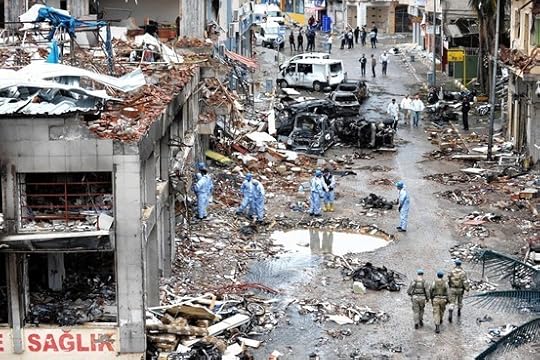
Forensic officers work on Sunday, as army commandos patrol the scene of one of the car-bomb sites a day earlier in Reyhanli, Turkey.
Turkey/Syria:
After a car bombing killed 46 in a Turkish town on the border with Syria, Turkish Foreign Minister Ahmet Davutoglu said it was time for the international community to act against the Syrian regime.
Despite Syrian denials of involvement, Davutoglu pointed to an "old Marxist terrorist organization" with ties to the Assad regime as responsible for the attack.
Prime Minister Recep Tayyip Erdogan added that Turkey will not be dragged into a war in Syria as a result of the attack, saying in a televised speech that "we will not lose our calm heads, we will not depart common sense, and we will not fall into the trap they're trying to push us into."
He also added: "Whoever targets Turkey will sooner or later pay the price."
Source: FP Morning Brief
 The Decline and Fall of the Ottoman Empire
 Alan Warwick Palmerno photo
Synopsis:
This book is pretty much described by it's title! It doesn't cover much about the rise of the osman/othman/ottoman empire, briefly describes the conquest of Constantinople. It pretty much jumps in right at the height of the empire, with the efforts to capture territory in Europe. I actually enjoyed this book. I didn't know all that much about the Ottoman Empire save for some references in movies (like Amadeus or Baron Munchhausen) and some books (like a book on smallpox vaccinations, where Lady Mary Wortley Montagu brought back what she learned from her days as an ambassador's wife about Turkish use of smallpox vaccination back to England).
I learned about the Janissaries, who they were, how they became corrupted, and how they resisted reform until they were finally abolished. How sultans ruled, with grand viziers, and how they could be brought down. How several sultans tried to modernize the armed forces, and how they failed.
i read somewhere about the greek/turkish discord but didn't really know why until this book, I had no idea that Greece was part of the Ottoman empire.
One thing i was a little disappointed at was the end, I read about Mustafa Kemal, a successful soldier in the final throes of the ottoman empire, with the battle of Gallipoli, the 'young turks', etc, and had no idea that he was now known as Mustafa Kemal Atatürk. While i get that his surname (Atatürk) was given to him after the fall of the ottoman empire, it might have been nice to have mentioned this in the book (like maybe (later known as Mustafa Kemal Atatürk). Minor quibble though!
Lords of the Horizons: A History of the Ottoman Empire by
by
 Jason Goodwin
Synopsis:
For six hundred years, the Ottoman Empire swelled and declined. Islamic, martial, civilized, and tolerant, it advanced in three centuries from the dusty foothills of Anatolia to rule on the Danube and the Nile; at its height, Indian rajahs and the kings of France beseeched the empire's aid. In its last three hundred years the empire seemed ready to collapse, a prodigy of survival and decay. In this striking evocation of the empire's power, Jason Goodwin explores how the Ottomans rose and how, against all odds, they lingered on. In doing so, he also offers a long look back to the origins of problems that plague present-day Kosovars and Serbs.
Looks good to me, so I bought it!
Mod
Alan Warwick Palmerno photoSynopsis:
This book is pretty much described by it's title! I..."
Thank you Marc - your citations are improving - thank you for trying every time.
You do not need to add the book link along with the cover we usually type it in at the top and bold it. That is what the mods do.
The Decline and Fall of the Ottoman Empire
Alan Warwick Palmer (no photo)Synopsis:
This book is pretty much described by it's title! It doesn't cover much about the rise of the osman/othman/ottoman empire, briefly describes the conquest of Constantinople. It pretty much jumps in right at the height of the empire, with the efforts to capture territory in Europe. I actually enjoyed this book. I didn't know all that much about the Ottoman Empire save for some references in movies (like Amadeus or Baron Munchhausen) and some books (like a book on smallpox vaccinations, where Lady Mary Wortley Montagu brought back what she learned from her days as an ambassador's wife about Turkish use of smallpox vaccination back to England).
I learned about the Janissaries, who they were, how they became corrupted, and how they resisted reform until they were finally abolished. How sultans ruled, with grand viziers, and how they could be brought down. How several sultans tried to modernize the armed forces, and how they failed.
i read somewhere about the greek/turkish discord but didn't really know why until this book, I had no idea that Greece was part of the Ottoman empire.
One thing i was a little disappointed at was the end, I read about Mustafa Kemal, a successful soldier in the final throes of the ottoman empire, with the battle of Gallipoli, the 'young turks', etc, and had no idea that he was now known as Mustafa Kemal Atatürk. While i get that his surname (Atatürk) was given to him after the fall of the ottoman empire, it might have been nice to have mentioned this in the book (like maybe (later known as Mustafa Kemal Atatürk). Minor quibble though!
==================================
Do you see how it looks a little neater. But the good news is that you have all of the segments needed for your citation (congrats) but seemed to have added an extra one to boot. But great progress.
Mod
by Jason GoodwinSynopsis:
For six hundred years, the Ottoman Empire swelled and declined. Is..."
==========================
Your citation is perfect Chrissie. Congrats. But if you are trying to add the book and write-up the mod way. This is what it would look like:
Lords of the Horizons: A History of the Ottoman Empire
by
Jason GoodwinSynopsis
For six hundred years, the Ottoman Empire swelled and declined. Islamic, martial, civilized, and tolerant, it advanced in three centuries from the dusty foothills of Anatolia to rule on the Danube and the Nile; at its height, Indian rajahs and the kings of France beseeched the empire's aid. In its last three hundred years the empire seemed ready to collapse, a prodigy of survival and decay. In this striking evocation of the empire's power, Jason Goodwin explores how the Ottomans rose and how, against all odds, they lingered on. In doing so, he also offers a long look back to the origins of problems that plague present-day Kosovars and Serbs.
Looks good to me, so I bought it!
========================
Although it is not necessary for the group members to do the post the mod way - it is a nice gesture and lays the information clearly out there. If you would like to follow the format - that is nice but not mandatory as long as you have the citation right which you do. But if you would like to follow it - here are a few pointers and I reposted it to show you the difference.
We type the name of the book at the top and put it in bold.
Then we add the citation which you had done correctly.
Then we add the word Synopsis: and bold it - You did do all of that aside from the bolding and then we add the review or goodreads synopsis. So just in case you were trying to follow that format - I thought I would give you some helpful pointers but like I said that is not mandatory for group members just moderators - and what we ask group members to do is to simply have the citation correct which you have done admirably. Thank you for the add.
Bentley, I fixed it, even though this was not necessary. I will try and remember to get it absolutely right next time.:0)
Mod
The Fourth Crusade and the Sack of Constantinople by
by

synopsis
In 1202, Pope Innocent III advocated yet another crusade to capture Jerusalem from the Muslims, spawning the fourth crusade. Jonathan Phillips describes the recruitment efforts, issues that arose (neither king of England nor France would help). As an FYI, the first crusade was successful, but Saladin later recaptured Jerusalem, and the next two crusades failed to recapture it back. The fourth crusade, comprising of french and german nobles, made a pact with Venice, who was to supply transport from Venice to Alexandria, capture Alexandria, then sail to the Levant and from there capture Jerusalem. But a comedy of errors arose, where, due to the terms of the Venetian pact, not enough crusaders were present to sail on Venetian vessels, so the crusaders couldn't afford to pay Venice what they owed. Anyhoo, as a result, they ended up defying the pope, conquering a nearby Catholic city, who's ruler was also part of the crusade (he departed from his city, not Venice), then ended up attacking Greek Orthodox Christian-held Constantinople. This was before the true rise of the Ottoman empire (later they too captured Constantinople and renamed it Istanbul).
Phillips not only discussed the events from point/timeline A to B. He described the instance on payment that forced the existing co-emperors of Byzantium to destroy religious artifacts for their gems, gold, and silver. He described the looting of the Christian churches by the crusaders. He also discussed the widening rift between Catholic and Greek Orthodox Christianity. He even discussed some charlatan who posed as a noble named Count Baldwin of Flanders. Baldwin was later crowned the new emperor of Byzantium.
I thought it a very good read, and funny in a sad comedy of errors way because those crusaders who set sail from Venice started out with wanting to obey the Pope's desire to liberate Jerusalem, but instead ended up killing fellow Christians, defying the pope, destroying religious artifacts, truly looting the great city of Constantinople, and never even set sail towards their original goals.
Mod
First the bolding and the title at the top are correct.
(no image) The Fourth Crusade: And the Sack of Constantinople by
Jonathan PhillipsYou can see that we place the words (no image) if there is no book cover which is what the g means and then we simply put in the book link which is the name of the book in linkable text - the by is good and you have the author's photo which is good. But you need to go back in twice and get the author's link which is the author's name in linkable text.
Then Synopsis - should be capitalized.
So it should look like this:
The Fourth Crusade and the Sack of Constantinople
(no image) The Fourth Crusade: And the Sack of Constantinople by
Jonathan PhillipsSynopsis:
In 1202, Pope Innocent III advocated yet another crusade to capture Jerusalem from the Muslims, spawning the fourth crusade. Jonathan Phillips describes the recruitment efforts, issues that arose (neither king of England nor France would help). As an FYI, the first crusade was successful, but Saladin later recaptured Jerusalem, and the next two crusades failed to recapture it back. The fourth crusade, comprising of french and german nobles, made a pact with Venice, who was to supply transport from Venice to Alexandria, capture Alexandria, then sail to the Levant and from there capture Jerusalem. But a comedy of errors arose, where, due to the terms of the Venetian pact, not enough crusaders were present to sail on Venetian vessels, so the crusaders couldn't afford to pay Venice what they owed. Anyhoo, as a result, they ended up defying the pope, conquering a nearby Catholic city, who's ruler was also part of the crusade (he departed from his city, not Venice), then ended up attacking Greek Orthodox Christian-held Constantinople. This was before the true rise of the Ottoman empire (later they too captured Constantinople and renamed it Istanbul).
Phillips not only discussed the events from point/timeline A to B. He described the instance on payment that forced the existing co-emperors of Byzantium to destroy religious artifacts for their gems, gold, and silver. He described the looting of the Christian churches by the crusaders. He also discussed the widening rift between Catholic and Greek Orthodox Christianity. He even discussed some charlatan who posed as a noble named Count Baldwin of Flanders. Baldwin was later crowned the new emperor of Byzantium.
I thought it a very good read, and funny in a sad comedy of errors way because those crusaders who set sail from Venice started out with wanting to obey the Pope's desire to liberate Jerusalem, but instead ended up killing fellow Christians, defying the pope, destroying religious artifacts, truly looting the great city of Constantinople, and never even set sail towards their original goals.
----------------------
Thank you very much for the add.
odd about the book cover, I do see it in my 'read' list, but it didn't show up when I added the book cover.
Mod
I can highly recommend:Portrait of a Turkish Family
 by Irfan Orga(no photo)
Synopsis:
Describes in chilling, yet affectionate, detail the disintegration of a wealthy Ottoman family, both financially and emotionally. It is rich with the scent of fin de siecle Istanbul in the last days of the Ottoman Empire. His mother was a beauty, married at thirteen, as befitted a Turkish woman of her class. His grandmother was an eccentric autocrat, determined at all costs to maintain her traditional habits. But the war changed everything. Death and financial disaster reigned, the Sultan was overthrown, and Turkey became a republic. The red fez was ousted by the cloth cap, and the family was forced to adapt to an unimaginably impoverished life. Filled with brilliant vignettes of old Turkish life, such as the ritual weekly visit to the hamam, as it tells the "other side" of the Gallipoli story, and its impact on one family and the transformation of a nation. "It is just as though someone had opened a door marked `Private' and showed you what was inside.... A most interesting and affectionate book."-Sir John Betjeman. "A wholly delightful book."-Harold Nicolson
Libby, it really was interesting and well written.
Libby, I will just say very shortly that the writing is descriptive and captivating. This book depicts the life of one family living through WWI. That family is Muslim, and one belonging to the German-Ottoman side! This gives a different perspective, and this I very much liked. It is NOT historical fiction but about what really happened to one family. It is so engaging that it reads like fiction. It was not particular events that attracted me to the book, but instead learning about a different way of life.
by Irfan Orga(no photo)
Mod
Libby wrote: "The Caravan Moves On
 by Irfan Orga (no photo)
Irfan Orga, author of Portrait of a Turkish Family, journeys to the centre of Turkey to stay with the Yur..."
Libby, that looks very good too!
Libby wrote: "Not Even My Name: A True Story
 by Thea Halo (no image)
Synopsis:
Not Even My Name is a rare eyewitness account of the horrors of a little-kno..."
Libby, have you read it? It is very good!
Libby wrote: "Hi Chrissie--I look forward to reading it. What did you like most about it? by Thea Halo (no photo)"The book is not just a book about Turkish ethnic cleansing. Of course you get that, but the prime message is how one should live a life. Beautiful message.
by Thea Halo(no photo)
Mod
sorry Bentley, I didn't mean to read a 3rd book in Turkey, but I just started reading it because it was thin and looked interesting... Anyhoo,Empires of the Sea: The Final Battle for the Mediterranean

 Roger Crowley
Synopsis
In the ongoing conflicts between the rising Ottoman empire and the Christian Europe, part of the conflicts was from corsair (pirate) raids from both religions on each other. Empires of the Sea starts out describing the Ottoman attack on the island of Rhodes, which was then occupied by the Christian Knights Hospitallers (aka Knights of Saint John or Order of Saint John). It turns out those knights regularly raided Ottoman merchants and Muslims on their pilgrimage to/from Mecca, taking goods and acquiring slaves. Not that the Muslims were innocent neither, as often Muslim corsairs regularly raided Christian towns and ports and ships, pretty much doing the same thing.
Crowley does a great job making you feel like you are there witnessing the struggles, the battles, the meetings and decisions by both sides. After the fall of Rhodes, the conflicts shifted to Malta and various seaside ports and towns throughout the northern Mediterranean (and to a lesser extent, the areas around northern Africa).
One gets a sense of the frustration that was felt by the defenders of Malta as greater Europe dithered and quarreled with each other, with Spain, the Vatican, France, and Venice each jockeying for power, the indecisiveness of the too-cautious Spanish King Phillip II, and the overall sense of fear and dread at the thought of facing the Ottoman navy.
At the same time, the Ottoman empire lost tremendous numbers of warriors when attacking Rhodes and Malta, coupled with the sense of a short season of campaigning, attack too early/late, the weather makes travel exceptionally risky with the ships of that time.
at the concluding battle of Lepanto, which both sides paid a heavy price, the Ottoman loss was somewhat anticlimatic even with the loss of so many ships and men. This is not the fault of the author, he is simply describing what had happened post-battle. All-in-all, a very highly entertaining and enlightening book on the Ottoman/European conflicts of 1521 to 1585 from a naval point-of-view.
Mod
Yeah, I know! Anyhoo, going to finish my middle east book, then start the persian empire (Iran!). I might stick the middle east book in Saudi Arabia (since it spans the founding of Islam, as well as what is now Iran, Iraq, Egypt, and Turkey. Lots of time!
Mod
Mod
Mod
Very interesting Libby.
 Mod
Mod
 by Soner Cagaptay (no photo)
Synopsis:
Turkey is positioned to become the twenty-first century’s first Muslim power. Based on a dynamic economy and energetic foreign policy, Turkey’s growing engagement with other countries has made it a key player in the newly emerging multidirectional world order. Turkey’s trade patterns and societal interaction with other nations have broadened and deepened dramatically in the past decade, transforming Turkey from a Cold War outpost into a significant player internationally.
Turkey’s ascendance and the changes that have taken place under the leadership of Turkey’s Muslim conservative government have prompted its policymakers to craft a new vision of their role in twenty-first century society. This developing worldview animates Turkey’s desire to sometimes take the lead with its co-religionists and occasionally challenge its partners in the West, while showing no inclination to become an irresponsible rising power. If it can consolidate liberal democracy at home, Turkey could also assume the role of serving as an example for the newly emerging governments brought about by the Arab Spring.
The cornerstone of Turkey’s rise has been the government’s ability to foster stable political conditions for economic growth, alongside a foreign policy that balances Turkey’s Muslim identity with its Western overlay, including its strong ties to the United States. Accordingly, policies that could tarnish Turkey’s reputation as a bastion of stability risk undermining its position between Europe, the United States, and the Middle East. This realization has been the catalyst for Ankara’s careful management of Eastern and Western desires and expectations. The result is a new Turkey: a twenty-first-century Muslim power that promotes stability without the confines of a regional European rubric.
Mod
 by
by
 Charles King
Synopsis:
At midnight, December 31, 1925, citizens of the newly proclaimed Turkish Republic celebrated the New Year. For the first time ever, they had agreed to use a nationally unified calendar and clock.
Yet in Istanbul—an ancient crossroads and Turkey's largest city—people were looking toward an uncertain future. Never purely Turkish, Istanbul was home to generations of Greeks, Armenians, and Jews, as well as Muslims. It welcomed White Russian nobles ousted by the Russian Revolution, Bolshevik assassins on the trail of the exiled Leon Trotsky, German professors, British diplomats, and American entrepreneurs—a multicultural panoply of performers and poets, do-gooders and ne’er-do-wells. During the Second World War, thousands of Jews fleeing occupied Europe found passage through Istanbul, some with the help of the future Pope John XXIII. At the Pera Palace, Istanbul's most luxurious hotel, so many spies mingled in the lobby that the manager posted a sign asking them to relinquish their seats to paying guests.
In beguiling prose and rich character portraits, Charles King brings to life a remarkable era when a storied city stumbled into the modern world and reshaped the meaning of cosmopolitanism.
Mod
 by Nicole Pope (no photo)
Synopsis:
Turkey today defies easy categorization. Friends speak of the Turks as blunt yet hospitable, inhabiting a land rich in history and culture, a member of the E.U. and strategic ally to the United States. Detractors cite military coups and concerns about Islamic fundamentalism. Turkey Unveiled reveals this extremely complex country, now in a newly updated edition covering the first decade of the 21st century and the most recent developments in Turkey. The authors, who speak fluent Turkish and have reported from the country for twenty years, provide a rich mosaic of contemporary Turkey and its formative past. The strengths and weaknesses of the Ottoman Empire, the Armenian tragedy, the Kurdish struggle, the controversial legacy of the brilliant but autocratic founder of modern Turkey, Mustafa Kemal Ataturk, are all here. They also provide portraits of new leaders who have broken taboos and ushered in new freedoms at a time when other forces attempt to pull Turkey back into the Middle Eastern vortex.
Mod

 Upcoming release:
There Was and There Was Not: A Journey Through Hate and Possibility in Turkey, Armenia, and Beyond
 by
by
 Meline Toumani
Synopsis:
A young Armenian-American goes to Turkey in a “love thine enemy” experiment that becomes a transformative reflection on how we use—and abuse—our personal histories
Meline Toumani grew up in a close-knit Armenian community in New Jersey where Turkish restaurants were shunned and products made in Turkey were boycotted. The source of this enmity was the Armenian genocide of 1915 at the hands of the Ottoman Turkish government, and Turkey’s refusal to acknowledge it. A century onward, Armenian and Turkish lobbies spend hundreds of millions of dollars to convince governments, courts and scholars of their clashing versions of history.
Frustrated by her community’s all-consuming campaigns for genocide recognition, Toumani leaves a promising job at The New York Times and moves to Istanbul. Instead of demonizing Turks, she sets out to understand them, and in a series of extraordinary encounters over the course of four years, she tries to talk about the Armenian issue, finding her way into conversations that are taboo and sometimes illegal. Along the way, we get a snapshot of Turkish society in the throes of change, and an intimate portrait of a writer coming to terms with the issues that drove her halfway across the world.
In this far-reaching quest, told with eloquence and power, Toumani probes universal questions: how to belong to a community without conforming to it, how to acknowledge a tragedy without exploiting it, and most importantly how to remember a genocide without perpetuating the kind of hatred that gave rise to it in the first place.
Mod
 The Young Turks have been either vilified or embraced for the changes that occurred in Turkey at the turn of the 20th century. This book may give some insight into the movement.
Preparation for a Revolution: The Young Turks, 1902 -1908
 by
by
 M. Şükrü Hanioğlu
Synopsis
This book will completely transform the standard interpretation of the Young Turk Revolution of 1908, a watershed event in the late Ottoman Empire and a key to the emergence of the modern nation-states in the Middle East and Balkans.
Preparation for a Revolution is the first book on the Young Turk Revolution to draw on both the extensive memoirs and papers of the Young Turks and on the extensive diplomatic archives around the world. The author has plumbed not only the Ottoman Archives but collected documents from archives in Bonn, Berlin, Jerusalem, London, Paris, Rome, Athens, Sofia, Tirana, Bern, Geneva, Sarajevo, Cairo, Stockholm, and Tokyo. Breaking new ground, Hanioglu describes in detail how practical considerations led the Young Turks to sacrifice or alter many of their goals for social transformation. He tells a story rich in character and plot, and reveals the many factions and competing intellectual trends that marked this tumultuous period at the end of the Ottoman Empire.
Preparation for a Revolution will prove indispensable to anyone working on the political, intellectual, and social history of the Ottoman Empire and of the states that were established on its ruins.
New release:Abdullah Gul and the Making of the New Turkey
 by Gerald MacLean (no photo)
Synopsis:
Drawing on original research, including in-depth interviews with President Abdullah Gül himself as well as his wife and close circle of colleagues and friends, this fascinating account offers readers a portrait of a man who has been at the heart of the political, economic and cultural developments, which have brought Turkey to international prominence in recent years.
In 2002 Abdullah Gül’s democratically elected party gained power and challenged Turkey’s political and religious legacy. Shortly after Gül became a key player in Turkey's attempts to receive an accession date for the European Union. In 2007 he became the first president of Turkey who was also a devout Muslim – causing political commentators to hail his victory as a "new era in Turkish politics" – and he has, ever since, been a major figure in Turkey’s diplomatic relationships in the Middle East and international political arena.
An essential source for students of contemporary Turkish culture and society, Gerald MacLean’s absorbing account of this enigmatic individual is written to be accessible to a wide circle of readers, and throws light on important episodes of Turkey’s recent history.
I just started reading this book and it has started out well. It has gotten good reviews so I am hopeful that it will live up to my expectations!Midnight at the Pera Palace: The Birth of Modern Istanbul
by
Charles KingSynopsis:
At midnight, December 31, 1925, citizens of the newly proclaimed Turkish Republic celebrated the New Year. For the first time ever, they had agreed to use a nationally unified calendar and clock.
Yet in Istanbul—an ancient crossroads and Turkey's largest city—people were looking toward an uncertain future. Never purely Turkish, Istanbul was home to generations of Greeks, Armenians, and Jews, as well as Muslims. It welcomed White Russian nobles ousted by the Russian Revolution, Bolshevik assassins on the trail of the exiled Leon Trotsky, German professors, British diplomats, and American entrepreneurs—a multicultural panoply of performers and poets, do-gooders and ne’er-do-wells. During the Second World War, thousands of Jews fleeing occupied Europe found passage through Istanbul, some with the help of the future Pope John XXIII. At the Pera Palace, Istanbul's most luxurious hotel, so many spies mingled in the lobby that the manager posted a sign asking them to relinquish their seats to paying guests.
In beguiling prose and rich character portraits, Charles King brings to life a remarkable era when a storied city stumbled into the modern world and reshaped the meaning of cosmopolitanism.
Mod

The History Book Club
Books mentioned in this topic
Turkey: The Insane and the Melancholy (other topics)Nutuk - The Speech by Mustafa Kemal Ataturk (other topics)
Gallipoli 1915 (other topics)
The Fires of Spring: A Post-Arab Spring Journey Through the Turbulent New Middle East - Turkey, Iraq, Qatar, Jordan, Egypt, and Tunisia (other topics)
Turkish Awakening (other topics)
More...
Authors mentioned in this topic
Ece Temelkuran (other topics)Mustafa Kemal Atatürk (other topics)
Tim Travers (other topics)
Shelly Culbertson (other topics)
Alev Scott (other topics)
More...
Even though Turkey is affiliated in many ways with the Middle East - it is now considered European and will be housed in he Europe folder.
About Turkey:
Turkey (Turkish: Türkiye), officially the Republic of Turkey ( Türkiye Cumhuriyeti (help·info)) is a Eurasian country, located mostly on Anatolia in Western Asia and on East Thrace in Southeastern Europe. Turkey is bordered by eight countries: Bulgaria to the northwest; Greece to the west; Georgia to the northeast; Armenia, Iran and the Azerbaijani exclave of Nakhchivan to the east; and Iraq and Syria to the southeast.
The Mediterranean Sea is to the south; the Aegean Sea is to the west; and the Black Sea is to the north. The Sea of Marmara, the Bosphorus and the Dardanelles (which together form the Turkish Straits) demarcate the boundary between Thrace and Anatolia; they also separate Europe and Asia.
The country's official language is Turkish, a Turkic language, which is spoken by approximately 85% of the population as mother tongue.
The most numerous ethnic group is the Turks, who constitute between 70% and 75% of the population according to The World Factbook.
Kurds are the largest ethnic minority and, according to the same source, number around 18% of the population while other ethnic minorities are estimated to be at 7–12%.
The vast majority of the population is Muslim.
The area now called Turkey (derived from the Medieval Latin Turchia, i.e. "Land of the Turks") has been inhabited since the Paleolithic, including various Ancient Anatolian civilizations and Thracian peoples.
After Alexander the Great's conquest, the area was Hellenized, which continued with the Roman rule and the transition into the Byzantine Empire.
The Seljuk Turks began migrating into the area in the 11th century, starting the process of Turkification, which was greatly accelerated by the Seljuk victory over the Byzantines at the Battle of Manzikert in 1071.
The Seljuk Sultanate of Rûm ruled Anatolia until the Mongol invasion in 1243, upon which it disintegrated into several small Turkish beyliks.
Starting from the late 13th century, the Ottoman beylik united Anatolia and created an empire encompassing much of Southeastern Europe, Western Asia and North Africa. After the Ottoman Empire collapsed following its defeat in World War I, parts of it were occupied by the victorious Allies.
A cadre of young military officers, led by Mustafa Kemal Atatürk and his colleagues, organized a successful resistance to the Allies; in 1923 they established the modern Republic of Turkey, with Atatürk as its first president.
Turkey is a democratic, secular, unitary, constitutional republic with a diverse cultural heritage. Turkey has become increasingly integrated with the West through membership in organisations such as the Council of Europe, NATO, OECD, OSCE and the G-20 major economies.
Turkey began full membership negotiations with the European Union in 2005, having been an associate member of the European Economic Community since 1963 and having joined the EU Customs Union in 1995.
Turkey has also fostered close cultural, political and economic relations with the Middle East, Caucasus, the Turkic states of Central Asia and the African countries through membership in organisations such as the Turkic Council, Joint Administration of Turkic Arts and Culture, Organisation of Islamic Cooperation and the Economic Cooperation Organisation.
Turkey's location at the crossroads of Europe and Asia makes it a country of significant geostrategic importance.
In addition to its strategic location, Turkey's growing economy and diplomatic initiatives have led to its recognition as a regional power.
Turkey is the world's 17th largest economy by nominal GDP and the 16th largest by purchasing power parity.
Turkey is projected to be the fastest growing OECD economy through 2017, and one of the fastest in the world through 2060, completing its transition from an upper-middle income economy into a high-income economy by 2015.
Source: Wikipedia
http://en.wikipedia.org/wiki/Turkey