
The History Book Club discussion
TRAVEL AND TRANSPORTATION
>
JETS
date newest »
newest »
message 1:
by
Bentley, Group Founder, Leader, Chief
(last edited Jan 28, 2019 11:10PM)
(new)
Apr 29, 2013 08:08PM
 Mod
Mod

reply
|
flag
Mod
10 Best Airports for a Layover
http://www.fodors.com/news/10-best-ai...
Source: Fodors
 On the other side of that coin, here is a list of the world's most hated airports which I translate as "worst".
World's 10 Most Hated Airports and Why
http://travel.cnn.com/explorations/li...
Source: CNN
 Jill I think LAX might top my list, but some of those others look awful as well. Although, Heathrow? I think it makes a huge difference which terminal is involved, although I am not sure it deserves a ten worst overall.
I don't mind Heathrow either. But don't even mention O'Hare (even though it wasn't on the list)........hate that place. I always fly into Midway when going to Chicago.
I have a nickname for DFW - "delayed for what" - describes my experience every time I fly through Dallas. O'Hare isn't much better on that score.
Jill I think LAX might top my list, but some of those others look awful as well. Although, Heathrow? I think it makes a huge difference which terminal is involved, although I am not sure it deserves a ten worst overall.
I don't mind Heathrow either. But don't even mention O'Hare (even though it wasn't on the list)........hate that place. I always fly into Midway when going to Chicago.
I have a nickname for DFW - "delayed for what" - describes my experience every time I fly through Dallas. O'Hare isn't much better on that score.
 Mod
Mod
One of Hitler's "wonder weapons" which would turn the tide of the war......but it didn't.
Mod
Mod
One of Hitler's "wonder weapons" which would turn the tide of the war......but it didn't.Fighting Hitler's Jets
 by
by
 Robert F. Dorr
Synopsis:
Fighting Hitler's Jets brings together in a single, character-driven narrative two groups of men at war: on one side, American fighter pilots and others who battled the secret “wonder weapons” with which Adolf Hitler hoped to turn the tide; on the other, the German scientists, engineers, and pilots who created and used these machines of war on the cutting edge of technology. The story begins with a display of high-tech secret weapons arranged for Hitler at a time when Germany still had prospects of winning the war. It concludes with Berlin in rubble and the Allies seeking German technology in order to jumpstart their own jet-powered aviation programs. Along the way, the author expertly describes the battles in the sky over the Third Reich that made it possible for the Allies to mount the D-Day invasion and advance toward Berlin. Finally, the book addresses both facts and speculation about German weaponry and leaders, including conspiracy theorists’ view that Hitler escaped in a secret aircraft at the war’s end. Where history and controversy collide with riveting narrative, this book furthers a repertoire that comprises some of the United States’ most exceptional military writing.
Mod
Luckily for the Allies, the German jets appeared too late in the war to make a difference.German Jets
 by Manfred Griehl(no photo)
Synopsis
As the war turned against the Third Reich, the introduction of jet aircraft represented Germany's last hope in the struggle for control of the skies. Despite early success, most German jets were destined to a short, violent life in the face of Allied air superiority. Period photographs from archives and private collections are accompanied by detailed captions to tell the story
The Nazis were far ahead of the Allies in the development of jet aircraft but things just didn't come together due to Hitler's indifference.German Jet Aircraft 1939-1945
 by Hans-Peter Diedrich(no photo)
Synopsis:
Germany was one of the leading developers of jet propulsion during the Second World War in August 1939 the worlds first jet aircraft, the Heinkel He 178, took to the air on its maiden flight. This new book examines all of the developments, production and aircraft types: He 280, Me 262, Ar 234, He 162, Ju 287, Ho IX, Me 328, P1101, Hs 132, DM 1, Ta 183 and others by such aircraft manufacturers as Heinkel, Junkers, Messerschmitt, and powerplant manufacturers BMW and Daimler-Benz. Numerous photographs and three-view drawings illustrate this extraordinary book.
The German Flying Wing JetThe B-2 Spirit blew more than a few minds when it made its public debut in 1988. But America's flying wing was not the first of such aircraft. In fact, one such plane nearly darkened the skies over Washington at the end of WWII with a nuclear present from the Fuhrer.
The head of the German Luftwaffe, Reichsmarschall Hermann Göring, was a notorious stickler, often demanding exceedingly stringent performance standards from the aircraft under his command. In 1943, he unveiled his most ambitious requirement set to date, quickly dubbed the "1000/1000/1000 rule". It dictated than any future aircraft purchased by the German air force must be capable of hauling a 1000 kg load over a distance of 1000 km at a speed of 1000 km/h. And given the state of jet engine technology at the time, that requirement eliminated just about every aircraft currently in development.
There was one however. A prototype built by brothers Reimar and Walter Horten and based on their dozen years of unpowered glider design and research. And it quickly caught the Reichsmarschall's eye and purse strings. He paid the brothers a whopping 500,000 reichsmarks ($2.76 million in 2014 USD, adjusted for inflation) for it. It would become the Horten Ho 229, the world's first flying wing jet. Had it entered the fray, this long range bomber could have done to Washington DC what the Enola Gay did to Hiroshima.
The Ho 229, which is also commonly referred to as the Gotha Go 229 because Gothaer Waggonfabrik actually constructed them, were single seater long range bombers capable of carrying two 1,100 pound (500 kg), nuclear tipped bombs clear across the Atlantic, drop them on DC, then fly back to Germany.
The flying wing design—wherein all vertical control structures (i.e. the tail) are removed to decrease drag—was nothing short of revolutionary and promised the same degree of performance advancement that jet engines provided over turbo-props. The prototype 229 measured 26 feet long with a 55 foot wingspan. Its central cockpit was constructed from welded steel tubing but the wings were made from a pair of plywood panels glued together with a mix of adhesive, sawdust, and charcoal. It's conical inlet caps were crafted from multiple layers of carbon-impregnated laminate.
These materials were impregnated with charcoal dust as one of the earliest forms stealth. The coal's carbon content absorbs radar, thereby drastically reducing the plane's radar cross-section and making it appear much smaller than it really was, about the size of conventional twin engine prop aircraft of the day.
The jet was powered by a pair of 1,900 lbf Junkers Jumo 004B turbojet engines that propelled the aircraft up to and estimated 977 km/h (not quite what Göring wanted but could likely have been achieved in later iterations) with a 60,000 foot service ceiling.
But, as the first of its kind, the Ho 229 was plagued by development issues and the first prototype crashing multiple times. But the Luftwaffe was undeterred, fast tracking the plane's development and even going so far as to assign it to an active bomber wing. Luckily, the 229's development came too late to help the German War effort. By the time it entered production in early 1945, the Allies were already marching on Berlin. The Gothaer Waggonfabrik factory, where the planes were being built, fell in April of that year.
Though all but one of the 229 prototypes were destroyed before being completed, Operation Paperclip (which sought to spirit German scientists away to America at the end of the war) ensured that the technology was not lost. Today, the only Nazi jet prototype left on Earth is represented by a static model (shown below) at the Smithsonian National Air and Space Museum's Paul E. Garber Restoration Facility in Maryland while the genuine item undergoes a piecemeal restoration. (Source: Gizmodo.com)
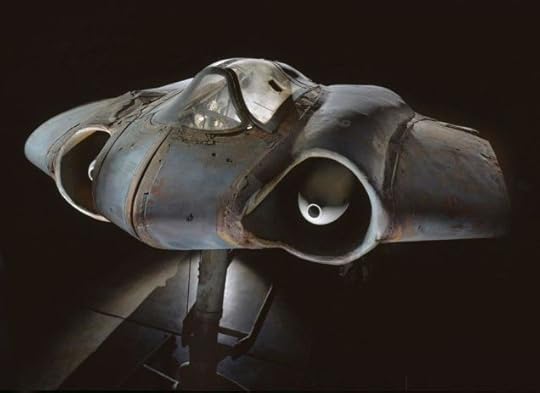
Source: Gizmodo.com
Mod
Link: https://youtu.be/zXTdw02GMgs
Air Commodore Sir Frank Whittle (1 June 1907 -- 9 August 1996) was a British Royal Air Force (RAF) engineer air officer. He is credited with single handedly inventing the turbojet engine. Whittle's engines were developed some years earlier than those of Germany's Dr. Hans von Ohain who was the designer of the first operational jet engine.
Note: There is some conflicting data as to who was first - the Germans or the English.
Source: Youtube
Mod
 by
by
 Andrew Nahum
Synopsis:
The story of the jet engine tells of what pushing technology to its limits can achieve and of the human emotions and tragedies that can leave ambition in its wake.
About the Author:
Andrew Nahum is Principal Curator of Technology and Engineering at the Science Museum, London. He recently led the curatorial team which created the acclaimed special exhibition Inside the Spitfire, and previously directed the creation of the major new synoptic gallery at the Museum on the history of technology and science entitled Making the Modern World.
He has written extensively on the history of technology, aviation and transport for both scholarly and popular journals. His books include a study of Alec Issigonis the designer of the Mini and the Morris Minor cars in Issigonis and the Mini and Frank Whittle in Frank Whittle: Invention of the Jet and he is currently completing a technological and economic study of the British aircraft industry in the years following the Second World War.
Mod
 by
by
 David T. Courtwright
Synopsis:
The airplane changed the course of history. Above all, it changed the history of the United States. When the Wright brothers invented their flying machine, Americans lived in a nation of two dimensions, circumscribed by lines drawn on a conventional map. A century later, their nation existed—in fact, reigned—in three dimensions. Two million Americans slipped the surly bonds of earth daily, carried aloft by aircraft operating in every part of the world.
The airplane turned the sky into a new domain of human activity, a fast-developing frontier. The first to brave that frontier were adventurous young men. Then came the rich and the hurried. Then just about everybody else. Until now, no one has told the story of aviation as one of frontier expansion. David Courtwright does so in Sky as Frontier. He has written an ambitious history of American aviation ranging from the patent fight between the Wright brothers and Glenn Curtiss through the tragedy of 9/11 and the Iraq War. Along the way, Courtwright stops to consider dogfighting, barnstorming, the first air mail pilots, the development of airlines, air power during World War II, flight’s impact on the environment, the troubled space frontier, and how the male-dominated aviation enterprise was domesticated and democratized.
Aviation’s frontier stage lasted a scant three decades, then vanished as flying became a settled experience. Sky as Frontier recreates that pioneer world and shows how commercial and military imperatives destroyed it by routinizing flight. At bottom, it is the story of a fateful tradeoff. Rationalization killed the adventure in flying but made possible rapid aerial expansion. With it came commercial growth and global military reach. In no other country did social life, business, and military operations become so intertwined with aerospace advances, or have such large consequences for national power and prestige.

The History Book Club
Books mentioned in this topic
Sky as Frontier: Adventure, Aviation & Empire (other topics)Frank Whittle: Invention of the Jet (other topics)
German Jet Aircraft: 1939-1945 (other topics)
German Jets 1944-1945 (other topics)
Fighting Hitler's Jets: The Extraordinary Story of the American Airmen Who Beat the Luftwaffe and Defeated Nazi Germany (other topics)
Authors mentioned in this topic
David T. Courtwright (other topics)Andrew Nahum (other topics)
Hans-Peter Diedrich (other topics)
Manfred Griehl (other topics)
Robert F. Dorr (other topics)