
The History Book Club discussion

This topic is about
Roosevelt's Centurions
PRESIDENTIAL SERIES
>
15. ROOSEVELT'S CENTURIONS - CHAPTER SEVENTEEN and EIGHTEEN, (p. 367 - 397) ~ SEPTEMBER 9TH - SEPTEMBER 15TH; No Spoilers, Please

 Chapter Overview and Summaries
Chapter 17 - D-Day, p 367 - 386
Ike briefs his senior staff prior to the invasion and considers differing variables to determine when and how the invasion will be launched. FDR nervously awaits word of the landing at Normandy. Troops land at Omaha Beach and despite a heavy battle press on to Normandy. Sixteen days after D-Day the Russians launch an offensive in the east. FDR used Averill Harriman to convince Stalin to allow the use of Russian airfields for US planes flying bombing raids in Germany, but the support is limited. Hitler confides to the Japanese ambassador that they are developing unmanned aircraft and rocket bombs, and the first strikes land in England a week after D-Day. In all, 6,000 civilians are killed and Churchill wants to retaliate with poison gas, a move opposed by FDR and Ike as a bad retaliatory measure that might spark a never ending cycle. FDR grows concerned over the vulnerability of the US east coast to a German missile attack and orders stepped up defense.
Bill Donovan, a law school classmate of FDR, was a WWI hero and Colonel. The Navy Secretary and Henry Stimson urge FDR to bring him into the war cabinet. Donovan, with support from the British, presents to FDR the idea of a an intelligence function and FDR appoints him to the vaguely titles post of Coordinator of Information. It became the first step to create what would become the CIA. Donovan quickly built an empire names OSS - Office of Strategic Services.
An unsuccessful assassination attempt is made on Hitler by a German Colonel.
FDR doubted the wisdom of pressing further into Italy but Churchill insisted it was drawing off German troops. As one historian later notes "All roads lead to Rome but Rome led to nowhere." (p. 385)
FDR welcomes Charles de Gaulle to the White House a month after D-Day. FDR finds time for some alone time with Lucy Mercer Rutherford while Eleanor is away amidst de Gaulle's visit.
Chapter 18 - MacArthur Versus King: FDR's Decision, p. 387 - 397
FDR meets with Admirals King and Nimitz and General MacArthur in Hawaii to go over the unresolved Pacific strategy. The men tour military installations and FDR speaks of everything but the topic at hand. They later meet at the villa where FDR is staying. Nimitz lays out a detailed cross Pacific Plan. MacArthur argues for liberating the Philippines. FDR and MacArthur meet privately where the general continues to press the issue FDR tours a military hospital specifically to reveal to the patients his disability.
After the Hawaii conference, the president sails to the Aleutians to visit the forlorn outpost. FDR ultimately supports both taking the Philippines and island hopping as a two pronged approach to attacking Japan in the Pacific.
 Winston Churchill
 Douglas MacArthur
 Persico gives us a good narrative about the decision to launch the European invasion.
It came down to the weather and the Germans guessed wrong. I didn't know that part where the German meteorologist said an invasion is unlikely, so many went home, including Rommel.
 Erwin Rommel
What does this tell you about Ike that he was the one that wrote the failure note just in case D-Day failed?
Erwin Rommel
What does this tell you about Ike that he was the one that wrote the failure note just in case D-Day failed? Dwight D. Eisenhower
 Yes he does, Bryan. Besides the bad weather on the 5th, the Channel waters get very dangerous for any type of amphibious landing, But it only took them 15 minutes to decide on June 6th, once the weatherman gave the go-ahead.
I had to laugh but was not surprised that Churchill wanted to land with the troops on D-Day, plus Charles deGaulle continued to be a thorn in Ike's side. He had so many personalities to deal with that I'm shocked he didn't smack somebody in the mouth.....of course that was more Patton's style!!
Winston Churchill
Dwight D. Eisenhower
Indeed, Jill, I think he smoked his troubles away, lol, his habit increased as D-Day approached.
Dwight D. Eisenhower
Mark Clark certainly timed the taking of Rome well since he did not want his victory over-shadowed by the D-Day invasion. Roosevelt was near nervous collapse the night before and he shared what was going to happen on June 6, with Eleanor and Daisy Suckley. I think part of his nervous condition at this point had a lot to do with his health which was deteriorating quickly and he had less than a year to live.
 When FDR went to Hawaii I was amazed that it had been 9 years since he last saw MacArthur. It was a bit comical when FDR asked MacArthur why he was wearing his trademark leather jacket in the hot Hawaiian sun.
 Mark wrote: "When FDR went to Hawaii I was amazed that it had been 9 years since he last saw MacArthur. It was a bit comical when FDR asked MacArthur why he was wearing his trademark leather jacket in the hot H..."
What amazed me was the disrespect MacArthur showed not just FDR, but the presidency itself, especially considering he wanted the job. And yet, FDR went out of his way to have photo ops with MacArthur.
It makes Persico's comments about Eisenhower on page 370 that much more telling - 'a man who had been an obscure Army Colonel just two years before had made a decision that would shape the century'.
You just never know what the future will bring and I believe FDR always hedged his bets.
Douglas MacArthur
Dwight D. Eisenhower
G wrote: "What amazed me was the disrespect MacArthur showed not just FDR, but the presidency itself...You just never know what the future will bring and I believe FDR always hedged his bets."Well stated.
I wonder how many readers are aware that Ike had two speeches prepared for the American people on D-Day. I find the second one which was to be used in case the invasion failed, rather moving. (pg. 373) "Our landings on the Cherbourg-Havre have failed to gain a satisfactory foothold and I have withdrawn the troops....If any blame or fault attaches to the attempt it is mine alone". The failure message was written in his own hand. No passing the buck in case of failure.
Dwight D. Eisenhower
Jill, here is a image: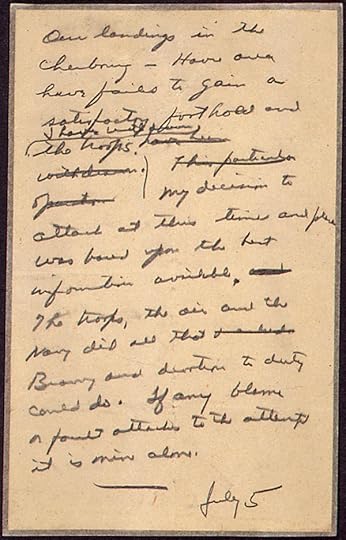 Great image, Bryan, thanks for sharing. The preparation of the notes was a stroke of practicality by Ike amidst what must have been a nerve wracking time. This really elevated his image as a soldier-statesman in my eyes. Impressive.
Dwight D. Eisenhower
Bryan wrote: "Persico gives us a good narrative about the decision to launch the European invasion.
Great image, Bryan, thanks for sharing. The preparation of the notes was a stroke of practicality by Ike amidst what must have been a nerve wracking time. This really elevated his image as a soldier-statesman in my eyes. Impressive.
Dwight D. Eisenhower
Bryan wrote: "Persico gives us a good narrative about the decision to launch the European invasion.It came down to the weather and the Germans guessed wrong. I didn't know that part where the German meteorolo..."
I was surprised the Germans let their guard down. Talk about complacency! Interesting how something like a weather forecast can impact history.
'Okay. Let's go'. will remain an iconic statement, I think, for as long as WWII is remembered, but Eisenhower's statement about being opposed to retaliation (Churchill's suggestion of poison gas) as a method of 'stopping this business' (the V bombs) showed he not only understood the moral implications but the strategic inevitability of 'measure and counter measure' scenarios. And, FDR supported him against Churchill on this. I honestly didn't even know poison gas was thought about. It made me shudder to think it was even brought up. Eisenhower was definitely not a saint, but he made some good decisions during the war.
Dwight D. Eisenhower
Winston Churchill
G wrote: "'Okay. Let's go'. will remain an iconic statement, I think, for as long as WWII is remembered, but Eisenhower's statement about being opposed to retaliation (Churchill's suggestion of poison gas) a..."We had a good discussion on the use of gas in last weeks assignment and had differing opinions. Gas warfare is a very scary thought.
Alisa, as far as the German's being caught with their pants down on the invasion, I have to keep remembering who was giving orders and moving troops....Corporal Hitler. Field Marshal Gerd von Rundstedt begged Hitler to move his troops and watch for deception but the Corporal knew best............obviously not.
Good point, Jill. I have to think they just got complacent in their belief there would not be a cross channel attack. Even if they were relying solely on weather, you would think they would still stay alert.
G wrote: "'Okay. Let's go'. will remain an iconic statement, I think, for as long as WWII is remembered, but Eisenhower's statement about being opposed to retaliation (Churchill's suggestion of poison gas) a..."I think this really shows Ike's leadership and that he was repared - as anyone can be - and confident in his decisions, recognizing the gravity of the situation.
I also agree with your earlier remark about the disrespect MacArthur showed to FDR. What on earth was he thinking? Maybe MacArthur was used to commanding the royal treatment wherever he went, much of it his own doing apparently, but he was way too casual with FDR during all this. I don't care how many stars are on your shoulders, you still have a commander in chief. Unreal.
Douglas MacArthur
Bill Donovan, a law school classmate of the President, enters the picture and is appointed by FDR to lead intelligence efforts. Donovan quickly starts building an empire. What do you think of the birth of modern day intelligence efforts, and how he went about adding people to his organization?
Oh, boy, it seems like a lot of smoke and mirrors and making things up as you go along. I get the impression we were getting more reliable stuff from the code crackers.I would like to ask him how he could get German spies into Germany itself and get information back out?
Maybe I grew more cynical due to our earlier club read:
 by
by
 Tim Weiner
Yes, I recalled our earlier book discussion and what we learned about the development of the CIA. With FDR's interest in intelligence I can understand him wanting to develop the function but Donovan just seemed to take over and doing what to add value? It's *still* not apparent to me how Donovan got away with this. It reminds me of a job I had shortly after graduating from college. My new boss on day 1 sat me down at the desk and said "you're a bright girl, you'll figure it out." Makes me think of what Donovan did - hire seemingly smart people and let them loose. It may have been ok for me but this is no way to build an intelligence agency! Smoke and mirrors indeed.
by
Tim Weiner
Stalin was the master of getting what he wanted and not giving back in return. We give them planes and asked that we be allowed to use their airfields after the Ploesti oil installations attack. Stalin said "it needs more study" (pg 375). What was there to study? As this book progresses, I am being constantly amazed that FDR and Churchill continued to put up with this tyrant. It makes me a little ashamed but I guess that we had no choice if we wanted to keep the huge Russian army on our side. What an absolute tyrant he was.
He was a tyrant but FDR and Churchill were getting something out of it too. The US and British war machines were catching up as fast as they could and needed the Russians to keep the Germans distracted in battle. Stalin was holding a valuable card. Unfortunate he was evil and tyrannical! It seems like FDR was trying to make the best of a bad situation and Churchill was doing what he could to put up with it all.
Winston Churchill
Tim Weiner
Yes, I recalled our earlier book discussion and what we learned about the development of the CIA. With FDR's interest in intelligence I can understand him wanting to develop the function but Donovan just seemed to take over and doing what to add value? It's *still* not apparent to me how Donovan got away with this. It reminds me of a job I had shortly after graduating from college. My new boss on day 1 sat me down at the desk and said "you're a bright girl, you'll figure it out." Makes me think of what Donovan did - hire seemingly smart people and let them loose. It may have been ok for me but this is no way to build an intelligence agency! Smoke and mirrors indeed.
by
Tim Weiner
Stalin was the master of getting what he wanted and not giving back in return. We give them planes and asked that we be allowed to use their airfields after the Ploesti oil installations attack. Stalin said "it needs more study" (pg 375). What was there to study? As this book progresses, I am being constantly amazed that FDR and Churchill continued to put up with this tyrant. It makes me a little ashamed but I guess that we had no choice if we wanted to keep the huge Russian army on our side. What an absolute tyrant he was.
He was a tyrant but FDR and Churchill were getting something out of it too. The US and British war machines were catching up as fast as they could and needed the Russians to keep the Germans distracted in battle. Stalin was holding a valuable card. Unfortunate he was evil and tyrannical! It seems like FDR was trying to make the best of a bad situation and Churchill was doing what he could to put up with it all.
Winston Churchill Joseph Stalin
I know it, Alisa.....I was ranting a bit but Stalin did not cooperate on anything and Britain and the US tip-toed around him like he was an egg that they might break. I wonder, if they would have put their foot down, that he might have been a bit more cooperative. He had to continue to keep the Germans at bay....he wouldn't and couldn't have withdrawn his troops at this point. I think the US/Britain would have trumped him but were afraid to take the chance since he was so secretive and unpredictable.
Joseph Stalin (I keep forgetting to put the link.....sorry).
It is a vicious cycle. What is a leader to do when they are hamstrung like this by another leader whose cooperation they need but abhor their actions on other fronts? FDR seemed a bit more willing to insert Harriman into the process when he thought it might be helpful. It begs the question of how anyone can really respond to a dictator. See any parallels to today, hmmm. . . .
So many times in history and the present, Alisa, so many times.
Joseph Stalin
I know it, Alisa.....I was ranting a bit but Stalin did not cooperate on anything and Britain and the US tip-toed around him like he was an egg that they might break. I wonder, if they would have put their foot down, that he might have been a bit more cooperative. He had to continue to keep the Germans at bay....he wouldn't and couldn't have withdrawn his troops at this point. I think the US/Britain would have trumped him but were afraid to take the chance since he was so secretive and unpredictable.
Joseph Stalin (I keep forgetting to put the link.....sorry).
It is a vicious cycle. What is a leader to do when they are hamstrung like this by another leader whose cooperation they need but abhor their actions on other fronts? FDR seemed a bit more willing to insert Harriman into the process when he thought it might be helpful. It begs the question of how anyone can really respond to a dictator. See any parallels to today, hmmm. . . .
So many times in history and the present, Alisa, so many times.I think we tolerate dictators because they serve our national interest and Stalin did at this time.
I kept shaking my head, too, through the Stalin episodes. I expect he was very secretive person, building a very secretive state to shield everyone away. The moment the pilots brought in those Western magazines...segregation! Interesting tidbits.
Joseph Stalin
Alisa wrote: "but Donovan just seemed to take over and doing what to add value? It's *still* not apparent to me how Donovan got away with this..."I agree Alisa. Donovan constantly received money from the goverment trough to fund his ventures, so if nothing else he was good at selling his ideas.
It is fortunate that Hitler's scientists didn't come up with the V-1 and V-2 rockets until it was too late. If they would have had them at the time of the Blitz, Germany, in my opinion, would have invaded Britain and the outcome of the war may have been quite different.
Jill wrote: "It is fortunate that Hitler's scientists didn't come up with the V-1 and V-2 rockets until it was too late. If they would have had them at the time of the Blitz, Germany, in my opinion, would have ..."I was thinking the same thing, how different things would have been if the Germans had the rockets ready to deploy earlier in the war. Maybe all that bombing of factories kept them so busy rebuilding that it was just enough to delayed rocket development. Hap Arnold might be vindicated on this one.
The presentations at the Hawaii conference by Nimitz and MacArthur were illustrative of the difference between these two commanders. Nimitz had a detailed plan backed by written material and delivered what was likely a well prepared presentation. MacArthur didn't even use notes! Completely different style yet each man defended their point of view.
Douglas MacArthur
Jill wrote: "It is fortunate that Hitler's scientists didn't come up with the V-1 and V-2 rockets until it was too late. If they would have had them at the time of the Blitz, Germany, in my opinion, would have ..."I agree with you, we were lucky. I liked Persico's explanation of Joe Kennedy, Jr.'s death. I did not fully appreciate the context. I always scratched my head and wondered why his plane was filled with explosives and on remote control. Well done. Sad for Kennedy family and changed its shape.
Alisa wrote: "The presentations at the Hawaii conference by Nimitz and MacArthur were illustrative of the difference between these two commanders. Nimitz had a detailed plan backed by written material and deliv..."I really enjoyed this section of this week. Again, it shows MacArthur's large ego at play here. I love it, no notes, he told FDR why he should invade the Philippines. But in the end, FDR hedged his bets on both ends by allowing both plans to move forward.
You do wonder if going back to the Philippines was good strategy.
The stand and deliver was really something. MacArthur had a huge ego, but like Patton he garnered respect by FDR. It highlights for me how FDR could put aside their idosyncracies and focus on the veracity of their positions. Fascinating.
No doubt a great gift as CINC, to see past the egos, hear what they are saying, and make a decision.
Seriously, a handy and impressive skill. It sounds so simple but in practice that is another matter. They dynamic of the Centurions' relationship with FDR is very interesting. A president surely ends up with people who all have different styles, but the natural tendancy would be to choose someone who is more similar than different. What a wild bunch FDR had on his hands, yet he was deliberate in choosing all of them. I find that so interesting.
 Mark wrote: "When FDR went to Hawaii I was amazed that it had been 9 years since he last saw MacArthur. It was a bit comical when FDR asked MacArthur why he was wearing his trademark leather jacket in the hot H..."
The leather jacket episode, by itself, tells us a lot about MacArthur. Image wasn't everything with him, but it certainly was a lot.
Bryan wrote: "So many times in history and the present, Alisa, so many times.I think we tolerate dictators because they serve our national interest and Stalin did at this time.
I kept shaking my head, too, th..."
Not to defend Stalin, a true monster, but the Soviets sacrificed far more troops than the Americans or the western Europeans. And killed a lot more Germans, too.
Per Wikipedia http://en.wikipedia.org/wiki/World_Wa... the Soviets lost between 9 and 16 million in the military alone, far more than all the other Allied countries combined. The only allied country that's even close is China.
Joseph Stalin
Alisa wrote: "He was a tyrant but FDR and Churchill were getting something out of it too. The US and British war machines were catching up as fast as they could and needed the Russians to keep the Germans distr..."More realistically put, France, England and the western front was a distraction from Russia, rather than the other way around.
If Hitler hadn't invaded Russia, I think the Axis could well have won the war. It certainly would have taken a much longer time for the West to win, if they could have at all.
Peter wrote: "Bryan wrote: "So many times in history and the present, Alisa, so many times.I think we tolerate dictators because they serve our national interest and Stalin did at this time.
I kept shaking my..."
I wonder if some part of that wasn't Stalins total disregard for Soviet troops. He regarded them as a military commodity rather than people. I don't really know enough about Soviet tactics in the war, but if we assume his military commanders took orders from him, if he was more, shall we say, humanitarian, would they have lost so many troops?
G wrote: "Peter wrote: "Bryan wrote: "So many times in history and the present, Alisa, so many times.I think we tolerate dictators because they serve our national interest and Stalin did at this time.
I k..."
Stalin did, indeed, treat his troops (and his other citizens as well) as objects rather than people.
There are many reports that anyone who retreated was shot (I am pretty sure I read about this in Stalingrad).
 by
by
 Antony Beevor
Joseph Stalin
Antony Beevor
Joseph Stalin
 Mod
Joseph Stalin
G and Peter, you raise good points. There is an argument to be made that some of the Russian troop losses came at the hand of Stalin. His view of them as pawns coupled with his ruthless tactics I am sure resulted in him sending them out as sacrificial lambs rather than soldiers.
Joseph Stalin
Alisa wrote: "G and Peter, you raise good points. There is an argument to be made that some of the Russian troop losses came at the hand of Stalin. His view of them as pawns coupled with his ruthless tactics I ..."
Mod
Joseph Stalin
G and Peter, you raise good points. There is an argument to be made that some of the Russian troop losses came at the hand of Stalin. His view of them as pawns coupled with his ruthless tactics I am sure resulted in him sending them out as sacrificial lambs rather than soldiers.
Joseph Stalin
Alisa wrote: "G and Peter, you raise good points. There is an argument to be made that some of the Russian troop losses came at the hand of Stalin. His view of them as pawns coupled with his ruthless tactics I ..."Well, countries use what they can. The USA led the world in industrial production. The Germans had amazing military discipline (and some of the best trained troops). The Russians lacked both of these, but they had space and population (partly because they were willing to use untrained troops). The English had sea power and (after a while) air power. The Japanese had a fanatical devotion to the emperor.
Yes, certainly, but it seems to me the Russian leader would have no trouble using masses of troops as pawns for questionable military or land grab purposes. He had no trouble suggesting exterminating the German troops captured by the Allies. Every leader engaged in warfare has to make a decision about sending humans into the combat zone. I'm not sure he thought of them as human.
I would agree, Alisa. His treatment of German troops and civilians was atrocious. He was determined to slaughter every German in his path regardless of the loss of his own troops. They were expendable in his opinion.
 On page 386 of chapter 18, it is said of FDR, "...the company of the woman he loved..." I wonder how well this was known publicly... It seems that FDR found a restful respite from his heavy responsibilities through his female friend.
On page 395 of chapter 18, it is said of Douglas MacArthur, "For a serving officer to oppose his commander in chief in war time was brazen." Many chiefs would no doubt have sacked DM. However, FDR had the flexibility and foresight to overlook DM's behavior because he knew he could make use of DM. One wonders what the trade-offs are for sacking or holding on to a talented subordinate in such a situation.
I think it is plural, Lewis. FDR seemed to exert his considerable charm and social skills with the ladies. In reading this I wonder if it was similar to his physical limitations: known well to those around him but otherwise kept out of the spotlight.
It's interesting that, over the last century or so, while general attitudes toward sex have definitely loosened, our concern about politicians' sex lives seems to have increased.
On page 386 of chapter 18, it is said of FDR, "...the company of the woman he loved..." I wonder how well this was known publicly... It seems that FDR found a restful respite from his heavy responsibilities through his female friend.
On page 395 of chapter 18, it is said of Douglas MacArthur, "For a serving officer to oppose his commander in chief in war time was brazen." Many chiefs would no doubt have sacked DM. However, FDR had the flexibility and foresight to overlook DM's behavior because he knew he could make use of DM. One wonders what the trade-offs are for sacking or holding on to a talented subordinate in such a situation.
I think it is plural, Lewis. FDR seemed to exert his considerable charm and social skills with the ladies. In reading this I wonder if it was similar to his physical limitations: known well to those around him but otherwise kept out of the spotlight.
It's interesting that, over the last century or so, while general attitudes toward sex have definitely loosened, our concern about politicians' sex lives seems to have increased.It seems rather contradictory.
Concern or interest? As long as the dawn of time politicians have engaged in this sort of thing but I think different cultures have different views of it, and depending as well as the circumstances. For some it may be a trust issue, or a deeper concern over national security, while others may view this as purely a personal matter of no consequence. I think it is the rise in media attention that has brought more attention to this kind of behavior. Is it any different for a president than his generals, who are also carrying on in extra-marital relations? I wonder how they have time for it.

The History Book Club
Books mentioned in this topic
Stalingrad: The Fateful Siege, 1942–1943 (other topics)Legacy of Ashes: The History of the CIA (other topics)
Legacy of Ashes: The History of the CIA (other topics)
Roosevelt's Centurions: FDR & the Commanders He Led to Victory in World War II (other topics)
Authors mentioned in this topic
Joseph Stalin (other topics)Joseph Stalin (other topics)
Antony Beevor (other topics)
Joseph Stalin (other topics)
Joseph Stalin (other topics)
More...

For the week of September 9, 2013 - September 15, 2013, we are reading Chapter SEVENTEEN and EIGHTEEN, (p. 367 - 397) of Roosevelt's Centurions: FDR & the Commanders He Led to Victory in World War II.
This week's reading assignment is:
Week Fifteen - September 9th - September 15th -> Chapter SEVENTEEN and EIGHTEEN, p. 367 - 397 - SEVENTEEN - D-Day and EIGHTEEN - Macarthur Verus King: FDR's Decision
We will open up a thread for each week's reading. Please make sure to post in the particular thread dedicated to those specific chapters and page numbers to avoid spoilers. We will also open up supplemental threads as we did for other spotlighted books.
This book is being kicked off on May 28th (the day the book is released officially). We look forward to your participation. Amazon, Barnes and Noble, Borders and other noted on line booksellers do have copies of the book and shipment can be expedited. The book can also be obtained easily at your local library, or on your Kindle. Make sure to pre-order now if you haven't already. This weekly thread will be opened up on September 9th. We offer a special thank you to Random House for their generosity.
There is no rush and we are thrilled to have you join us. It is never too late to get started and/or to post.
Alisa will be leading this discussion.
Welcome,
~ Alisa
TO ALWAYS SEE ALL WEEKS' THREADS SELECT VIEW ALL
REMEMBER NO SPOILERS ON THE WEEKLY NON SPOILER THREADS - ON EACH WEEKLY NON SPOILER THREAD - WE ONLY DISCUSS THE PAGES ASSIGNED OR THE PAGES WHICH WERE COVERED IN PREVIOUS WEEKS. IF YOU GO AHEAD OR WANT TO ENGAGE IN MORE EXPANSIVE DISCUSSION - POST THOSE COMMENTS IN ONE OF THE SPOILER THREADS. THESE CHAPTERS HAVE A LOT OF INFORMATION SO WHEN IN DOUBT CHECK WITH THE CHAPTER OVERVIEW AND SUMMARY TO RECALL WHETHER YOUR COMMENTS ARE ASSIGNMENT SPECIFIC. EXAMPLES OF SPOILER THREADS ARE THE GLOSSARY, THE BIBLIOGRAPHY, THE INTRODUCTION AND THE BOOK AS A WHOLE THREADS.
Notes:
It is always a tremendous help when you quote specifically from the book itself and reference the chapter and page numbers when responding. The text itself helps folks know what you are referencing and makes things clear.
Citations:
If an author or book is mentioned other than the book and author being discussed, citations must be included according to our guidelines. Also, when citing other sources, please provide credit where credit is due and/or the link. There is no need to re-cite the author and the book we are discussing however.
If you need help - here is a thread called the Mechanics of the Board which will show you how:
http://www.goodreads.com/topic/show/2...
Glossary
Remember there is a glossary thread where ancillary information is placed by the moderator. This is also a thread where additional information can be placed by the group members regarding the subject matter being discussed.
(Part One) http://www.goodreads.com/topic/show/8...
(Part Two) http://www.goodreads.com/topic/show/1...
Bibliography
There is a Bibliography where books cited in the text are posted with proper citations and reviews. We also post the books that the author used in her research or in her notes. Please also feel free to add to the Bibliography thread any related books, etc with proper citations. No self promotion, please.
http://www.goodreads.com/topic/show/1...
Q&A with Joseph
Please as you are reading post questions to the author's Q&A thread because Joseph Persico will be looking in periodically and will be posting answers to your questions and will be available for a chat. We are very fortunate that he is making time to spend with us.
http://www.goodreads.com/topic/show/8...