
Classics and the Western Canon discussion
Ovid - Metamorphoses
>
Ovid Sightings
date newest »
newest »
 Eman -- much as I enjoy scouting out art to go with our books, I've been a bit too stretched with personal things these weeks plus several readings/listenings going concurrently -- along with some rather critical reaction to my willingness to post links to art (from sources not directly related to this board), so I have basically tabled those efforts for the moment.
But, I must say I deeply appreciate your support, and will see if I can fit in a few. Perhaps I will start right here with a link to the carving of Eros and Psyche that is a favorite of a close family member and that is one of the featured treasures of the Louvre:
http://musee.louvre.fr/oal/psyche/img...
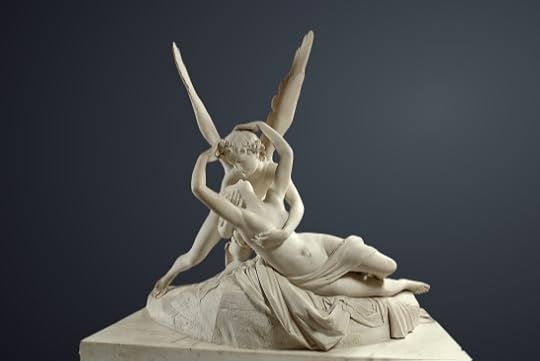
http://musee.louvre.fr/oal/psyche/psy...
These pages look at the statue from a number of perspectives and include many closeups illuminating details. There are also illustrations of other depictions of Cupid and Psyche, including the painting I specifically call out below -- for the description accompanying it as much as for the illustration, once I realized that is included in the link here. In addition, additional works of Canova depicting other mythological figures are here, as well as at least one other carving by him of E&P. The existence of these particular pages was drawn to my attention by a friend just returned from Paris who was re-living a bit of her trip online. So enjoy the feast -- not necessarily in one seating.
For a painting, also in the Louvre, with a quite different evocation of the couple, see:
http://www.louvre.fr/en/oeuvre-notice...
Note the butterfly hovering over Psyche's head, another symbol of the soul, which Psyche represents in many interpretations of the myth. (See descriptive text.) I have not tracked down the other image named, by Prud'hon -- it may be in the above pages, but I missed it in this morning's scan if it is.
Oh my, as I said above, I have a number of readings happening concurrently; one of them has been listening to Hamilton's Mythology. Wanting to know which book of The Metamorphoses the story of Cupid and Psyche was in, I just searched Ovid, and realized it isn't there! An Internet search says: "...the tale of Cupid and Psyche, which was only known through Lucius Apuleius, in the Golden Ass." So it is Hamilton and Parisian tourists, not Ovid, who have brought that myth to the foreground of my attention. I'm duly embarrassed, but the previous post includes a number of other myths depicted under one of the links and the one of Cupid and Psyche is beautiful enough that I am going to leave the post. Also, this does help remind us that although Ovid is encyclopedic, he is not a complete chronicler of the pagan Roman and Greek myths.
 Lily wrote: "Eman -- much as I enjoy scouting out art to go with our books, I've been a bit too stretched with personal things these weeks plus several readings/listenings going concurrently -- along with some ..."
I'm not concerned that the Cupid and Psyche legend isn't in Ovid -- that's such a wonderful sculpture. I am awed by the ability of the classical sculptors to craft such lifelike figures out of a huge chunk of stone, and their ability to create such emotive and passionate groupings, figures, and faces.
Larger size: http://www.wga.hu/art/w/watteau/antoi...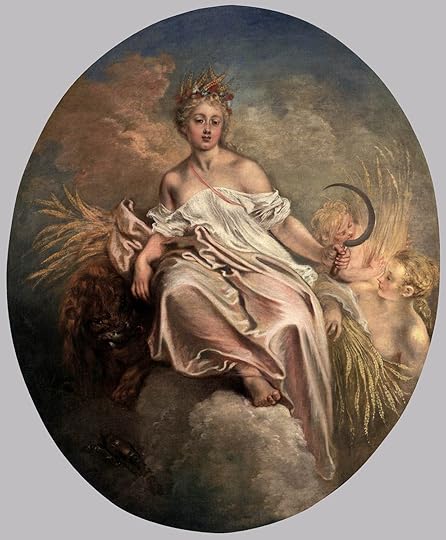
A lovely depiction of cloud-borne Ceres, with her sickle and bounty of wheat, by that excellent artist Watteau. Don't know the significance of the animal on whose head her arm rests. If that is her beloved daughter Persephone beside her, it is one of the fairest haired depictions I recall. At the National Gallery of Art in Washington. 1717-18.
http://en.wikipedia.org/wiki/Watteau
P.S. "Ceres, Roman goddess of the harvest, is surrounded by signs of the summer zodiac: Gemini, Cancer, and Leo...."
http://www.nga.gov/collection/gallery...
This location has several long lists of allusions to Pygmalion in painting, sculpture, literature (poetry, short stories, novels, plays), opera, ballet, stage, films, television, and even interactive fiction: http://en.wikipedia.org/wiki/Pygmalio...
 Diego Velázquez - Las Hilanderas (The Spinners, 1657, Madrid, Prado). Larger image: http://upload.wikimedia.org/wikipedia...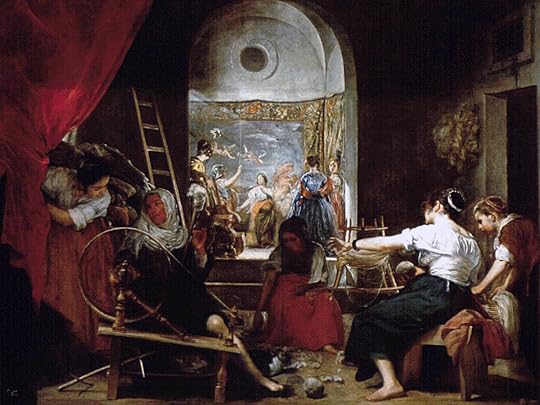
In the background we see Minerva and Arachne, elevated on a brightly lit stage. Behind them a tapestry depicting the theme of Arachne's masterpiece, the Abduction of Europe (borrowed from a painting by Titian*). No doubt we witness the moment just before the deeply humiliated Minerva will destroy both her opponent and her work. Three richly dressed young women complete the scene, one of them directly gazing at us (they may be the judges).
However, Ovid's story occupies only a small part of Velazquez' painting. In the much larger, somewhat darker, foreground we see five (again) working women, spinning the yarn needed by the artists in the centre. Some think that they are identical with the actors in the background. In that case Minerva, disguised as an old woman, is warning Arachne to stop her boasting. But I prefer to think of them as just working girls (one has a scarf, but she does not really look old).
This is important, because whatever interpretation we choose, it should not diminish the confrontation between the myth in the background and the realism up front. Even if we take the curtain on the left as an indication that the foreground too is a stage. The clash of styles is essential, and it is interesting that Velazquez used the same trick of packing a history painting within a genre piece once before (Jesus in the house of Martha - 1618, London, National Gallery**), though possibly with another intention.
Even if we limit ourselves to the Spinners, there are several explanations we could suggest. That is, if we feel the need to, because one of my favourites is that Velazquez is telling us that the art of painting can do entirely without literature. Though he was not much younger than the great baroque history painters (like Titian and Rubens), Velazquez' oeuvre shows quite different ideals, eventually inspiring Manet to break with the Salon.
But the Hilanderas may also be read as a critique on Ovid's frivolity - the severity of the Spaniard certainly contrasts with the irony of the Roman poet. Nonetheless, I feel affinity with both of them. If there is no progress in art, we are certainly getting richer and richer. It's almost embarrassing.
* https://upload.wikimedia.org/wikipedi...
** https://upload.wikimedia.org/wikipedi..."
 One great piece of Western art that was based on Ovid was Bernini's sculpture of Apollo and Daphne. Bernini, a Baroque artist, captured the moment when Daphne was just about to turn into a tree. Mere mortals cannot dream of depicting such a dynamic moment in marble, but Bernini was a terrific artist. The piece is at the Borghese Gallery in Rome. Do visit if you have the chance! It is well worth it!
I do apologize for the moment. I tried to paste the image into the post, but I was not able to do it.
http://en.wikipedia.org/wiki/File:Apo...
 Wendel wrote: "Diego Velázquez - Las Hilanderas (The Spinners, 1657, Madrid, Prado). Larger image: http://upload.wikimedia.org/wikipedia... ."
Excellent stuff!
Here is the other painting referenced by Velázquez.
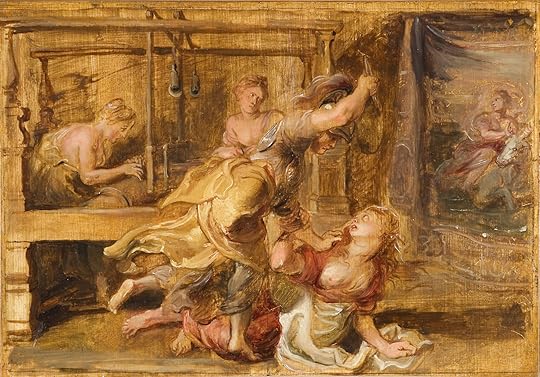
"Pallas and Arachne" by Peter Paul Rubens
Wendel wrote: "Diego Velázquez - Las Hilanderas (The Spinners, 1657, Madrid, Prado). Larger image: http://upload.wikimedia.org/wikipedia...In the background we see Minerva..."
Fascinating.
Tiberius wrote: "One great piece of Western art that was based on Ovid was Bernini's sculpture of Apollo and Daphne. Bernini, a Baroque artist, captured the moment when Daphne was just about to turn into a tree. Me..."Tiberius -- here is a YouTube of the Bernini sculpture mentioned @42 (Metamorphoses 1 -- http://www.goodreads.com/topic/show/1...
http://www.youtube.com/watch?v=e3RSRr...
I think this is the image you were probably trying to get to cooperate. I selected img from (some html is ok) from the upper right of the message box and used w=270, h=360 to keep the proportions.
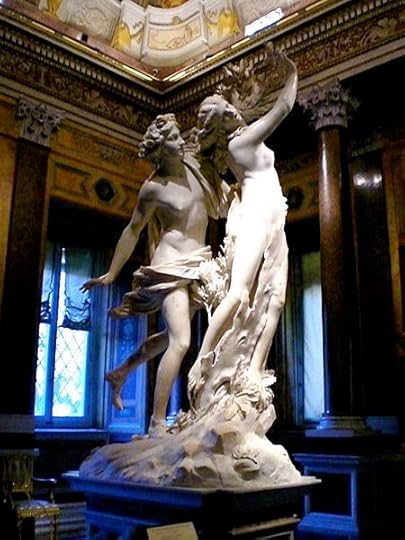
As I have said earlier, this is absolutely a favorite depiction of this myth. Thanks for drawing it to our attention again.
Ovid sighting: The night sky tonight?The Perseid meteor shower:
http://www.space.com/22329-perseid-me...
http://www.washingtonpost.com/nationa...

Classics and the Western Canon
Books mentioned in this topic
Me Before You (other topics)The Further Adventures of An Idiot Abroad (other topics)
We Have Always Lived in the Castle (other topics)
Before I Go to Sleep (other topics)
The Marrying of Chani Kaufman (other topics)
More...
We have already mentioned, in the various threads, a few instances of Ovid sighting in literature, most particularly in Shakespeare (and as Thomas has pointed out, there's an entire book on Shakespeare and Ovid), but this week I ran across several Ovid sightings which reminded me to put this thread up.
In the Book 10 thread I mentioned two works based on Pygmalion, Shaw's play and Rameau's opera.
In Book 11, I ran across a Midas sighting I hadn't previously been aware of: Nathaniel Hawthorne wrote a version of King Midas and the Golden Touch in his "A Wonder Book for Boys and Girls," in which Midas touches his daughter and turns her into a statue.
(BTW, the illustration for this story, intended for children, is astonishingly risque by modern standards! Check it out here
http://www.gutenberg.org/files/32242/...
on page 42)
Another BTW: I had wondered whether to set up separate threads for literary references and artistic references (paintings and statues), but at least for the time being will just put up this single thread. But if our resident art maven who finds all those wonderful images for us (this flowery person knows who she is!) wants to set up a separate artworks thread, that would be fine by me.