
The History Book Club discussion
MILITARY HISTORY
>
YUGOSLAV WARS OF THE 1990'S
date newest »
newest »
 They say that there is a Balkan saying:
"We have reached rock bottom. But we are still digging".
This area has certainly seen a lot of troubles!
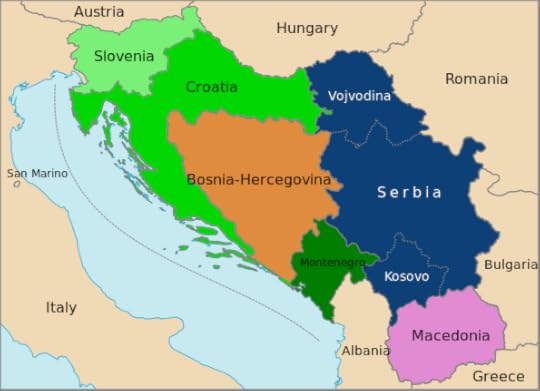
Also, is that map from Wikipedia? Is it current?
 Mod
Mod
Mod
Mod
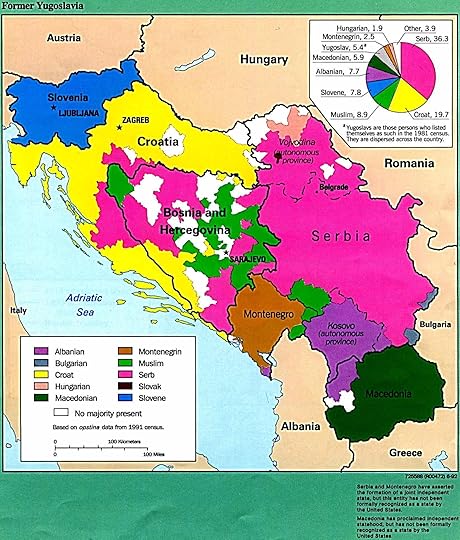
The Socialist Federal Republic of Yugoslavia: consisting of six republics, two autonomous provinces and a patchwork of ethnicity.
It looks like the one above was from 2011 - http://thevieweast.wordpress.com/tag/...
Mod
 Mod
Mod
Mod
Mod
Title:
Conflict in the former Yugoslavia
Author:
Herbert Okun (Interviewee); Goran Kapetanovic (Interviewee);
Krogh, Peter F. (Peter Frederic) (Moderator)
Abstract:
Host: Peter Krogh and guests discuss the search for a peaceful solution to conflict in the former Yugoslavia.
Description:
For centuries Southeastern Europe was the location of violent struggle across the frontiers of competing empires and religions. Following World War I, the treaty of Versailles created the Kingdom of Yugoslavia, a confederation of six constituent nations that brought together citizens of multiple religions and ethnicities under one banner. Yugoslavia survived in slightly different forms for the next several decades, thanks in large part to communist strongman Josip Tito. When communism collapsed, however, so too did the Yugoslavian borders. In 1991 the constituent republics began to break away, and fighting quickly erupted as regional leaders sought to increase their territory. In the years that followed, the Balkan states were characterized by news of broken ceasefires, the slaughter of civilians, and the failure of peace plans, causing President Clinton to characterize the search for peace in the Balkans as "the most frustrating and complex foreign policy issue in the world today". In this episode of Great Decisions, host Peter Krogh and guests examine the quest for solutions in the Balkans and ask, can peace prevail in what used to be Yugoslavia? Featuring Ambassador Herbert Okun, a retired career diplomat who worked closely on the Vance-Owen Peace Plan, and Goran Kapetanovic, the Yugoslavian Ambassador to Canada who resigned in protest over his government's failure to seriously commit itself to peaceful solutions.
http://repository.library.georgetown....
This is from the Georgetown Archives and is in English.
 Waging Modern War: Bosnia, Kosovo, and the Future of Combat
 by
by
 Wesley K. Clark
Synopsis:
In Waging Modern War, General Wesley K. Clark recounts his experience leading NATO's forces to a hard-fought and ultimately successful victory in Kosovo in 1999. As the American military machine has swung into action in the months following the attacks on the World Trade Center and the Pentagon, it has become clear that the lessons of Kosovo are directly applicable to the war against terrorism and the nations that sponsor it. The problems posed, and overcome, in the war in Kosovo-how to fight an air war against unconventional forces in rough terrain and how to coordinate U.S. objectives with those of other nations-are the problems that America increasingly faces in the today's world.
As the Los Angeles Times noted in late September of 2001, this book's "lessons are highly relevant now…. We need to think about exactly what steps will lessen, rather than increase, the terrorist threat. And we also need innovative commanders willing to improvise to meet a new kind of threat, more determined political leadership, a more flexible outlook in the Pentagon…. Gen. Clark has performed another service by highlighting these problems at a crucial moment in American history."
 Mod
Mod
 by Ivo H. Daalder (no photo)
Synopsis:
After eleven weeks of bombing in the spring of 1999, the United States and NATO ultimately won the war in Kosovo. Serbian troops were forced to withdraw, enabling an international military and political presence to take charge in the region. But was this war inevitable or was it the product of failed western diplomacy prior to the conflict? And once it became necessary to use force, did NATO adopt a sound strategy to achieve its aims of stabilizing Kosovo? In this first in-depth study of the Kosovo crisis, Ivo Daalder and Michael O'Hanlon answer these and other questions about the causes, conduct, and consequences of the war. Based on interviews with many of the key participants, they conclude that notwithstanding important diplomatic mistakes before the conflict, it would have been difficult to avoid the Kosovo war. That being the case, U.S. and NATO conduct of the war left much to be desired.
For more than four weeks, the Serbs succeeded where NATO failed, forcefully changing Kosovo's ethnic balance by forcing 1.5 million Albanians from their home and more than 800,000 from the country. Had they chosen to massacre more of their victims, NATO would have been powerless to stop them. In the end, NATO won the war by increasing the scope and intensity of bombing, making serious plans for a ground invasion, and moving diplomacy into full gear in order to convince Belgrade that this was a war Serbia would never win. The Kosovo crisis is a cautionary tale for those who believe force can be used easily and in limited increments to stop genocide, mass killing, and the forceful expulsion of entire populations. Daalder and OHanlon conclude that the crisis holds important diplomatic and militarylessons that must be learned so that others in the future might avoid the mistakes that were made in this case.
Mod
NATO's Air War for Kosovo: A Strategic and Operational Assessment
 by Benjamin S. Lambeth (no photo)
Synopsis:
This book offers a thorough appraisal of Operation Allied Force, NATO's 78-day air war to compel the president of Yugoslavia, Slobodan Milosevic, to end his campaign of ethnic cleansing in Kosovo. The author sheds light both on the operation's strengths and on its most salient weaknesses. He outlines the key highlights of the air war and examines the various factors that interacted to induce Milosevic to capitulate when he did. He then explores air power's most critical accomplishments in Operation Allied Force as well as the problems that hindered the operation both in its planning and in its execution. Finally, he assesses Operation Allied Force from a political and strategic perspective, calling attention to those issues that are likely to have the greatest bearing on future military policymaking. The book concludes that the air war, although by no means the only factor responsible for the allies' victory, certainly set the stage for Milosevic's surrender by making it clear that he had little to gain by holding out. It concludes that in the end, Operation Allied Force's most noteworthy distinction may lie in the fact that the allies prevailed despite the myriad impediments they faced.
Mod
 by David L. Phillips (no photo)
Synopsis:
Kosovo, after its incorporation into the Serbian Republic of Yugoslavia, became increasingly restive during the 1990s as Yugoslavia plunged into internal war and Kosovo's ethnic Albanian residents (Kosovars) sought autonomy. In March 1999, NATO forces began airstrikes against targets in Kosovo and Serbia in an effort to protect Kosovars against persecution. The bombing campaign ended in June 1999, and Kosovo was placed under transitional UN administration while negotiations on its status ensued. Kosovo eventually declared independence in 2008. Despite internal political tension and economic problems, the new nation has been recognized by many other countries and most of its inhabitants welcome its separation from Serbia.
In " Liberating Kosovo," David Phillips offers a compelling account of the negotiations and military actions that culminated in Kosovo's independence. Drawing on his own participation in the diplomatic process and interviews with leading participants, Phillips chronicles Slobodan Milosevic's rise to power, the sufferings of the Kosovars, and the events that led to the disintegration of Yugoslavia. He analyzes how NATO, the United Nations, and the United States employed diplomacy, aerial bombing, and peacekeeping forces to set in motion the process that led to independence for Kosovo. He also offers important insights into a critical issue in contemporary international politics: how and when the United States, other nations, and NGOs should act to prevent ethnic cleansing and severe human-rights abuses.
Mod
 by David Gibbs (no photo)
Synopsis:
In First Do No Harm, David Gibbs raises basic questions about the humanitarian interventions that have played a key role in U.S. foreign policy for the past twenty years. Using a wide range of sources, including government documents, transcripts of international war crimes trials, and memoirs, Gibbs shows how these interventions often heightened violence and increased human suffering.
The book focuses on the 1991--99 breakup of Yugoslavia, which helped forge the idea that the United States and its allies could stage humanitarian interventions that would end ethnic strife. It is widely believed that NATO bombing campaigns in Bosnia and Kosovo played a vital role in stopping Serb-directed aggression, and thus resolving the conflict.
Gibbs challenges this view, offering an extended critique of Samantha Power's Pulitzer Prize-winning book, A Problem from Hell: America in the Age of Genocide. He shows that intervention contributed to the initial breakup of Yugoslavia, and then helped spread the violence and destruction. Gibbs also explains how the motives for U.S. intervention were rooted in its struggle for continued hegemony in Europe.
First Do No Harm argues for a new, noninterventionist model for U.S. foreign policy, one that deploys nonmilitary methods for addressing ethnic violence.
Mod
 by Ivo H. Daalder (no photo)
Synopsis:
For over four years, Washington responded to war in Bosnia by handing the problem to the Europeans to resolve and substituting high-minded rhetoric for concerted action. Then, in the summer of 1995, the Clinton administration suddenly shifted course, deciding to assert the leadership that would prove necessary to end the war in Bosnia. This book --based on numerous interviews with key participants in the decisionmaking process and written by a former National Security Council aide --examines how the policy to end the war took shape. Getting to Dayton is a powerful case study of how determined individuals can exploit their positions to change U.S. government policy on crucial issues. In so doing, Daalder not only explains how Washington launched the diplomacy that culminated at Dayton, but also why the subsequent peace proved to be difficult to establish.
Mod
Release date: February 15, 2014
Bombs For Peace: NATO's Humanitarian War on Yugoslavia
 by George Szamuely (no photo)
Synopsis:
In the late 1990s NATO dropped bombs and supported armed insurgencies in Yugoslavia while insisting that its motives were purely humanitarian and that its only goal was peace. However, George Szamuely argues that NATO interventions actually prolonged conflicts, heightened enmity, increased casualties, and fueled demands for more interventions.
Eschewing the one-sided approach adopted by previous works on the Yugoslavian crisis, Szamuely offers a broad overview of the conflict, its role in the rise of NATO’s authority, and its influence on Western policy on the Balkans. His timely, judicious, and accessible study sheds new light on the roots of the contemporary doctrine of humanitarian intervention.
 Some of the are most likely already listed above, but there is a list on Goodreads of books on the Bosnian war.
 https://www.goodreads.com/list/show/7...
 I just finished a most passionate account of the Yugoslav wars:
 by Roger Cohen
Synopsis
Like Thomas Friedman's From Beirut to Jerusalem and David Remnick's Lenin's Tomb, Roger Cohen's Hearts Grown Brutal places us in the center of one of the twentieth century's major dramatic events, telling through the stories of four families the seventy-three-year saga of the state of Yugoslavia and its ultimate disintegration in the Bosnian War.Through a man named Sead and his search for a lost father, we relive the story of the Yugoslav state, founded at the end of World War I under the strong impulse of President Wilson. Through three other families -- one Muslim-Serb, one Muslim, and one Serb-Croat -- we follow Yugoslavia's collapse in 1991-95, the first major conflict of the post-Cold War era and a challenge to America's leadership and conscience. These moving sagas of Sarajevo reflect major themes of the twentieth century: the end of Empire, the ravages of fascist terror, the rise and fall of Communism, the nationalist fervor of post-Communist societies -- and yet Cohen's eyewitness account lets us experience history-making events vividly, through the small, individual passions, terrors, and betrayals of ordinary people.
Mod
 by Diana Johnstone (no photo)
Synopsis:
Military interventions on supposedly humanitarian grounds have become an established feature of the post-Cold War global order. Since September 11, this form of militarism has taken on new and unpredictable proportions. Diana Johnstone's well-documented study demonstrates that a crucial moment in establishing in the public mindand above all, within the political context of liberalism and the leftthe legitimacy of such interventions was the "humanitarian" bombing of the former Yugoslavia in 1999.
In the course of the civil wars that led to the break-up of Yugoslavia, a complex history came to be presented as a morality play in which the parts were scripted to meet the moral needs of the capitalist West. The identification of Muslims as defenseless victims and Serbs as genocidal monsters inflamed fears and hatreds within Yugoslavia, and prepared the way for power to be shifted from the people of the region to such international agencies as NATO.
Fools' Crusade tests the popular myths against the reality of Yugoslav history. Johnstone identifies the common geopolitical interests running through such military interventions, and argues persuasively that they create problems rather than solving them. She shows that the "Kosovo war" was in reality the model for future destruction of countries seen as potential threats to the hegemony of an "international community" currently being redefined to exclude or marginalize all but those who conform to the interests of the United States.
A concluding chapter shows how the script prepared for Yugoslavia is being re-enacted in Afghanistan. Whether Milosevic's trial before the International Court at the Hague or the capture of bin Laden will provide an adequate conclusion to this ideological play-making, remains an open question.
 Croation War of Independence
 by Jesse Russell(no photo)
Synopsis:
The Croatian War of Independence was fought from 1991 to 1995 between forces loyal to the government of Croatia-which had declared independence from the Socialist Federal Republic of Yugoslavia (SFR Yugoslavia)-and the Serb-controlled Yugoslav People's Army (JNA) and local Serb forces, with the JNA ending its combat operations in Croatia by 1992. In Croatia, the war is primarily referred to as the Homeland War (Domovinski rat) and also as the Greater-Serbian aggression (Velikosrpska agresija). In Serbian sources, War in Croatia (Rat u Hrvatskoj) is the most commonly used term.
Mod
Mod
 by Mary Pat Kelly (no photo)
Synopsis:
So perfectly executed was the mission to rescue Capt. Scott O'Grady that it amazed even the men responsible. Just, five hours after radio contact was first made with Basher 52 - O'Grady's call sign - the Air Force captain was safely on board the USS Kearsarge. The downed F-16 fighter pilot's rescue from a Bosnian mountainside by Col. Martin Berndt's 24th Marine Expeditionary Unit electrified the nation in June 1995 and renewed many Americans' faith in the military. This book tells the story of the mission in the words of the men who commanded, planned, and carried it out.
To get the inside account, Mary Pat Kelly traveled throughout Europe to conduct more than one hundred interviews, visiting U.S. ships and bases and UN posts in Croatia and Bosnia where participants were stationed. Adm. Leighton W. Smith Jr., commander in chief of U.S. naval forces in Europe and head of NATO forces in the Southern European theater, provides the framework with his day-to-day commentary on the efforts to find Captain O'Grady and a nearly minute-by-minute record of the rescue itself. In concert with Lt. Gen. Michael E. Ryan, commander of U.S. and NATO air forces, the admiral reveals the decision-making process that led to the "Good to Go" order. Readers then hear from the Tactical Recovery of Aircraft and Personnel (TRAP) team - the Navy and Marine Corps commanders, pilots, crew chiefs, and grunts who made it happen. Speaking for the Navy are Capt. Christopher Cole, skipper of the Kearsarge, Como. Jerome Schill, and their staffs, from the intelligence officers to the grapes who fueled the aircraft. Captain O'Grady puts his own experiences in the context of overall events.
Mod
A look at Slovenia as a result of the war of 1991 and how its economy has evolved.Slovenia: Evolving Loyalties
 by John K. Cox (no photo)
Synopsis:
A clear and concise introduction to contemporary Slovenia. It examines the country's rapid transition from a collection of provinces in the southern part of the Habsburg Empire, to a republic within Yugoslavia, to an independent state and analyzes the major political and economic developments since 1991. The perfect introduction to one of Europe's most fascinating nations.
 Yikes, I was interested in purchasing this because I am interested in the Balkans. The Amazon Kindle price is $54.95! The paperback price is $36.35, and the hardback price is $170. You can also "rent" it. I wonder what the story is on this kind of pricing. It is only 228 pages.
What??????? Are the pages bound in gold? You might try eBay....I have found lots of books there that I couldn't find otherwise or were too expensive. Just a thought.
Mod
Yikes, I was interested in purchasing this because I am interested in the Balkans. The Amazon Kindle price is $54.95! The paperback price is $36.35, and the hardback price is $170. You can also "rent" it. I wonder what the story is on this kind of pricing. It is only 228 pages.
What??????? Are the pages bound in gold? You might try eBay....I have found lots of books there that I couldn't find otherwise or were too expensive. Just a thought.
Mod
 by Dag Henriksen (no photo)
Synopsis:
In this revealing work, Dag Henriksen discloses the origins and content of NATO's strategic and conceptual thinking on how the use of force was to succeed politically in altering the behavior of the Federal Republic of Yugoslavia (FRY). The air campaign, known as Operation Allied Force, was the first war against any sovereign nation in the history of NATO and the first major combat operation conducted for humanitarian purposes against a state committing atrocities within its own borders. This book examines the key political, diplomatic, and military processes that shaped NATO and U.S. management of the Kosovo crisis and shows how air power became the main instrument in their strategy to coerce the FRY to accede to NATO's demands.
The book further shows that the military leaders set to execute the campaign had no clear strategic guidance on what the operation was to achieve and that the level of uncertainty was so high that the officers selecting the bombing targets watched NATO's military spokesman on CNN for guidance in choosing their targets. Henriksen argues that structures preceding the Kosovo crisis shaped the management to a much greater degree than events taking place in Kosovo and that the air power community's largely institutionalized focus on high-intensity conflicts, like the 1991 Gulf War, hampered them from developing strategies to fit the political complexities of crises. Because fighting and wars in the lower end of the intensity spectrum are likely to surface again, study of the Kosovo crisis offers lessons for future international conflicts in which the combination of force and diplomacy will play a very significant role.
Thanks for an interesting post, Paul. Don't forget the book and author citations, as noted below. by David Rohde (no photo)
Ann wrote: "Yikes, I was interested in purchasing this because I am interested in the Balkans. The Amazon Kindle price is $54.95! The paperback price is $36.35, and the hardback price is $170. You can also "re..."
by David Rohde (no photo)
Ann wrote: "Yikes, I was interested in purchasing this because I am interested in the Balkans. The Amazon Kindle price is $54.95! The paperback price is $36.35, and the hardback price is $170. You can also "re..."Could be a specialized academic kind of book, which can be much more expensive.
 The Yugoslav Wars of the 1990s
 by Catherine Baker (no photo)
Synopsis:
The Yugoslav wars of the 1990s involved the violent destruction of a society in the midst of the collapse of state socialism. The moment war broke out, academic and public debates began, concerning the long- and short-term causes of the wars and where responsibility should lie. Not only do these controversies continue - even coming up against each other in courts of law - but fresh areas of debate have emerged, which historians must take into account.
Catherine Baker brings together the major arguments of the most up-to-date scholarship on the Yugoslav wars. This book provides a clear introduction to the topic and demonstrates how debates have evolved, and where more research is required. Alongside this, Baker also exposes the politics and complexities of narrating and interpreting the very recent past.
 I wonder what this books says. I'm reluctant to read any books from local authors because I'm pretty sure they would be biased, but then again, the rest of the world also chose sides in that war...or so it is said.
Samanta wrote: "I wonder what this books says. I'm reluctant to read any books from local authors because I'm pretty sure they would be biased, but then again, the rest of the world also chose sides in that war......"
I wonder what this books says. I'm reluctant to read any books from local authors because I'm pretty sure they would be biased, but then again, the rest of the world also chose sides in that war...or so it is said.
Samanta wrote: "I wonder what this books says. I'm reluctant to read any books from local authors because I'm pretty sure they would be biased, but then again, the rest of the world also chose sides in that war......"Is she from your area? Her name seems to be American.
No, she is not. She is an "outsider". That's why I'm interested. I'm looking for an objective point of view, which you will NOT find here.
 Samanta wrote: "No, she is not. She is an "outsider". That's why I'm interested. I'm looking for an objective point of view, which you will NOT find here."
This is pretty strange, Samanta. I've been looking today for books about former Yugoslavia and the wars in the 90s and I've come across this one:
 by BBC journalists, which is considered to be the authoritative work in this area.
There is also this one, written by a French university lecturer,
 (it is in French, but maybe it's been translated).
Last but not least, this book
 has been recommended as a groundwork on Yugoslavia's history (Christopher Hitchens wrote the introduction for the revised edition).
Hey, Cynthia! If you are referring to my saying that you will not find objective books here, I didn't mean HBC or GR, but Croatia. I apologize if my wording was not quite understandable, but, in my defense, it was very late when I wrote this last night. :)
has been recommended as a groundwork on Yugoslavia's history (Christopher Hitchens wrote the introduction for the revised edition).
Hey, Cynthia! If you are referring to my saying that you will not find objective books here, I didn't mean HBC or GR, but Croatia. I apologize if my wording was not quite understandable, but, in my defense, it was very late when I wrote this last night. :)When you mention books, and according to the rules of HBC, you have to put the citations of the books at the end of your post and below the text. That way, the books are easily accessible to anyone interested. The required format is this:
by Allan Little (no photo)
by Maya Kandel (no photo)
by
 Rebecca West
Thank you for the selection of books. I will check them out and see if I can find them in Croatia.
A far as the second book you mentioned Mourir pour Sarajevo ?: Les États-Unis et l'éclatement de la Yougoslavie (HISTOIRE), it seem it was not translated, which is a shame, since I don't understand a word of French. :)
by Maya Kandel (no photo)
A good reason to learn French then ;-)Anyway, I'm always wary of the author's academic or professional background when I choose a non-fiction book, especially when I do not know much about the topic.
Do not worry I did not misunderstand what you had meant :-)
OK, then! :)I am too, especially with sensitive topics like this one, and believe me, this one is extremely sensitive. It defines Croatian society and our life to this day. I'm reading some news this morning and I feel truly sick.
Virtual War: Kosovo and Beyond by Michael Ignatieff (no photo)
Synopsis:
For a decade, Michael Ignatieff has provided eyewitness accounts and penetrating analyses from the world's battle zones. In Virtual War, he offers an analysis of the conflict in Kosovo and what it means for the future of warfare. He describes the latest phase in modern combat: war fought by remote control. In "real" war, nations are mobilized, soldiers fight and die, victories are won. In virtual war, however, there is often no formal declaration of hostilities, the combatants are strike pilots and computer programmers, the nation enlists as a TV audience, and instead of defeat and victory there is only an uncertain endgame.
Kosovo was such a virtual war, a war in which U.S. and NATO forces did the fighting but only Kosovars and Serbs did the dying. Ignatieff examines the conflict through the eyes of key players--politicians, diplomats, and generals--and through the experience of the victims, the refugees and civilians who suffered. As unrest continues in the Balkans, East Timor, and other places around the world, Ignatieff raises the troubling possibility that virtual wars, so much easier to fight, could become the way superpowers impose their will in the century ahead.
The Yugoslav People's Agony: The Role of the Yugoslav People's Army by Miroslav Hadzic (no photo)
Synopsis:
This volume examines the period from the death of the Yugoslav People's Army (YPA), to its resurrection as a Serbian army. Miroslav Hadzic has spent his career in the YPA and therefore he knows the institution, and most of the major players, very well. Recently arrested for his writings by the regime, this author is an analyst of army matters. This book describes and analyzes how the YPA became involved in the operetta war in Slovenia, the Serb-Croat war in Croatia; the triangular war in Bosnia; and the anti-guerrilla war in Kosovo. It also looks at the gradual subordination of the YPA to Milosevic and the prospects for its professional transformation. Analyzing the factors for establishing democratic civil control over the army in Serbian society, this book will be of extreme interest to scholars of military studies, geopolitics, international relations more generally and sociology.
A very disturbing look at the discoveries of war victims in the Bosnian war.Like Eating a Stone: Surviving the Past in Bosnia
 by
by
 Wojciech Tochman
Synopsis:
During four years of war in Bosnia, over 100,000 people lost their lives. But it was months, even years, before the mass graves started to yield up their dead and the process of identification, burial, and mourning could begin. Here we travel through the ravaged postwar landscape in the company of a few survivors (mostly women) as they visit the scenes of their loss: a hall where victims' clothing is displayed; an underground cave littered with pale jumbles of bones; a camp for homeless refugees; a city now abandoned to the ghosts of painful memories; a funeral service where a family can finally say goodbye. These encounters are snapshots and memorials, a feat of powerful reportage told from the viewpoint of people who have lost nearly everything. With the sensibility of Philip Gourevitch or Ryszard Kapuscinski, Tochman captures a painful moment in history, as an entire community comes to terms with its raw and recent past.

The History Book Club
Books mentioned in this topic
Like Eating a Stone: Surviving the Past in Bosnia (other topics)The Yugoslav People's Agony: The Role of the Yugoslav People's Army (other topics)
Virtual War: Kosovo and Beyond (other topics)
Mourir pour Sarajevo? Les Etats-Unis et l'éclatement de la Yougoslavie (HISTOIRE) (other topics)
The Death of Yugoslavia (other topics)
More...
Authors mentioned in this topic
Wojciech Tochman (other topics)Miroslav Hadzic (other topics)
Michael Ignatieff (other topics)
Maya Kandel (other topics)
Allan Little (other topics)
More...

The wars were complex: characterized by bitter ethnic conflicts among the peoples of the former Yugoslavia, mostly between Serbs (and to a lesser extent, Montenegrins) on one side and Croats and Bosniaks (and to a lesser degree, Slovenes) on the other; but also between Bosniaks and Croats in Bosnia (in addition to a separate conflict fought between rival Bosniak factions in Bosnia).
The wars ended in various stages and mostly resulted in full international recognition of new sovereign territories, but with massive economic disruption to the successor states.
Initially the Yugoslav People's Army (JNA) sought to preserve the unity of the whole of Yugoslavia by crushing the secessionist governments; however the JNA increasingly came under the influence of the Serbian government of Slobodan Milošević that evoked Serbian nationalist rhetoric and was willing to support the Yugoslav state insofar as using it to preserve the unity of Serbs in one state; as a result the JNA began to lose Slovenes, Croats, Kosovar Albanians, Bosniaks, and ethnic Macedonians, and effectively became a Serb army.
According to the 1994 United Nations report, the Serb side did not aim to restore Yugoslavia, but to create a “Greater Serbia” from parts of Croatia and Bosnia.
Often described as Europe's deadliest conflict since World War II, the conflicts have become infamous for the war crimes involved, including mass murder and genocide.
These were the first conflicts since World War II to be formally judged genocidal in character and many key individual participants were subsequently charged with war crimes.
The International Criminal Tribunal for the former Yugoslavia (ICTY) was established by the UN to prosecute these crimes.
According to the International Center for Transitional Justice, the Yugoslav Wars resulted in the deaths of 140,000 people.
The Humanitarian Law Center writes that in the conflicts in former Yugoslav republics at least 130,000 people lost their lives.
The wars are generally considered to be a series of largely separate but related military conflicts occurring during the breakup of Yugoslavia and affecting most of the former Yugoslav republics:
* War in Slovenia (1991)
* Croatian War of Independence (1991–1995)
* Bosnian War (1992–1995)
* Kosovo War (1998–1999), including the NATO bombing of Yugoslavia.
In addition, the insurgency in the Preševo Valley (1999–2001) and the insurgency in the Republic of Macedonia (2001) are also often discussed in the same context.
See remainder of write-up in Wikipedia: ttp://en.wikipedia.org/wiki/Yugoslav_Wars
Please feel free to discuss any of the above conflicts on this thread which was requested by Krystal - one of HBC's members.