
The Patrick Hamilton Appreciation Society discussion

This topic is about
David Peace
Hamilton-esque books, authors..
>
David Peace
date newest »
newest »
 I am not familiar with this author at all.
Did you create that Still Life with Book, Sandal and Leaf?
 Mod
Mod
Yes, I think that was taken on a campsite in Denmark.
Lobstergirl wrote: "I am not familiar with this author at all."
He's wonderful. Very British though - with lots of UK-centric references. I don't know how many of his books would translate. The recognition factor is a big factor for me.
Here's David Peace's Wikipedia page which gives you a fair idea of what he's about.
 I read The Damned United, Peace's attempt to get into the mind of Brian Clough during his 44-day tenure of the Leeds United managerial post in the mid-70s. It was a good read and an imaginative attempt at a modern historical novel (ie bound by facts and timescale) but with free reign to speculate on Clough's motivations, obsessions and single-mindedness and their effect on this doomed adventure.
 The film was interesting but it lacked some of the dark gravitas and brooding of Peace's book and its ending was that of a buddy movie.
Where it really took flight though was on the audiobook. It's narrated by John Simms (The Lakes, Ashes To Ashes, Doctor Who) and as well as his ability as a trained actor to inhabit Clough's character making the performance memorable, hearing the narrative brings a new dimension to the rhythm of Peace's prose.
I tend not to 'listen' to books, but audio's the medium I'd recommend for The Damned United.
Mod
Thanks David. I'll try the audio version of The Damned Utd. I really like the book, and quite enjoyed the film adaptation - however agree with your reservations.
I have read all David Peace's books except the Tokyo one, and the new one about Shankley.
I love the way Peace takes real events and creates a sort of hybrid between fiction and social history. In the same way that Hamilton used autobiographical material to inform virtually all of his books.
Actually the books where David Peace and Patrick Hamilton have most in common would be, Hamilton's The Gorse Trilogy: The West Pier, Mr Stimpson And Mr Gorse, Unknown Assailant, where he based his tales of murderous Gorse on the real-life murderer Neville Heath, who was hanged in 1946, and Peace's Red Riding Quarter (Nineteen Seventy Four, Nineteen Seventy Seven, Nineteen Eighty, and Nineteen Eighty Three). The Red Riding Quartet is especially dark - taking the Yorkshire Ripper case as its starting point and then embracing all manner of 70s West Yorkshire corruption.
Peace's other masterpiece is GB84. This from the GoodReads' page:
..."a gripping, tautly plotted dramatisation of the miners' strike in which real events (Orgreave, the Brighton bomb) and real people (Arthur Scargill, Margaret Thatcher, Ian MacGregor) mingle imperceptibly with his creations. "This novel", he notes in the acknowledgements, "is a fiction, based on fact" and those who recall The Comic Strip Present's Hollywood skit Strike will be happy, to discover that Peace does not take liberties with the strike's trajectory. Key events are faithfully chronicled here but his 1984 is, arguably, as sinisterly dystopian as anything George Orwell could have envisioned."
You'll need a long car journey to listen to all 4 CDs!I've read nothing else of Peace's, but he's on my 'retirement list'. I was a teenager in the 70s and don't really share the popular potted version of social history and think it illustrates the 'history is written by the victors' belief, the victors being Thatcherites. It will be interesting, therefore, to read the industrial belt urban perspective.
Mod
Interesting, gritty and challenging. It's not for the feint hearted but I thought GB84 and Red Riding were magnificent. I'll be interested to hear what you make of them (though that could be a while if you're still some way from retirement).
By the way Channel 4 made an interesting and suitably dark adaptation of Red Riding. It's no substitute for reading the books however it did capture the paranoia, corruption and, most significantly the legacy of the Ripper murders.
I tried watching that, but missed the second episode and didn't revisit it. I will once I've read the book, always the preferred sequence!10 years to retiral, or fewer if I simplify my lifestyle even more.
 I tried '1974' and managed to stick with it despite strong urges to cast it aside. I can't recall what it was that I disliked about the book... perhaps it was just a matter of not being able to find anything that I liked about it.
Conversely, I've really enjoyed all of the novels by Cathi Unsworth, which I found quite fun and engaging.
Mod
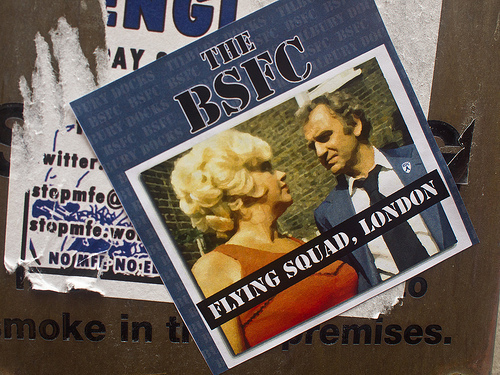
I think I know what you mean. David Peace uses repetition a lot and the subject matter is so very dark. I often felt like I needed a shower whilst reading the Red Riding Quartet. Dark, but compelling too. A strange experience. I certainly wouldn't rush back, but I'm glad I read them. At the time it felt important. Certainly one that fed into my fascination with the 1970s (another fascination to accompany Patrick Hamilton's world). How else to explain habitually watching old episodes of Top Of The Pops and The Sweeney?
By the by Mark, my copy of The Prettiest Star has arrived. I hope to read it soon.
Mod

Mark wrote: "Conversely, I've really enjoyed all of the novels by Cathi Unsworth, which I found quite fun and engaging."
How has Cathi Unsworth passed me by so far?
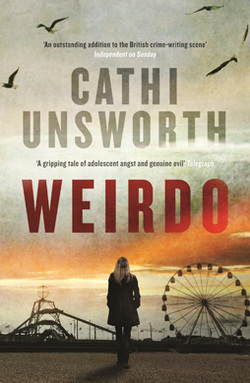
And this latest one published by Serpent's Tail - always a sign of quality. Thanks Mark - you've done it again.
Cathi Unsworth on The Great Man's 'Twopence Coloured' in The Guardian:"Hamilton's third novel takes its name from a toy theatre and constructs a between-the-wars stage set of dreary provincial fleapit and transient West End glitter from personal experience of a profession that would dazzle, exhault and thwart him. The story of awkward ingénue Jackie begins, as did Hamilton, in Hove, from where she persues her dream to West Kensington, future backdrop of the author's greatest dramas. Jackie's fate is set as she steps on the train and meets Richard, a seasoned actor who will become her mentor and then lover – but not until she has "travelled not less than 20,000 miles" in rep, across the "infinite piquancies and horrors" of "Sunday England". First published in 1928, this is a curio, a memoir of the doomed marriage between Hamilton's sister Lala and playwright-actor Sutton Vane, written before his huge theatrical successes, Gaslight and Rope. Still observing from the wings, Hamilton was teetering before the obsessions that would shape his greatest work and sharpen his social satire. Newcomers should proceed first to Hangover Square."
Mod
When I'm back at my computer I'll post that to the Twopence Coloured discussion - it's a great summary.

The Patrick Hamilton Appreciation Society
Books mentioned in this topic
Nineteen Seventy-Four (other topics)The Prettiest Star (other topics)
The Gorse Trilogy: The West Pier, Mr Stimpson and Mr Gorse, Unknown Assailant (other topics)
Nineteen Seventy-Four (other topics)
Nineteen Seventy Seven (other topics)
More...
Authors mentioned in this topic
Cathi Unsworth (other topics)Patrick Hamilton (other topics)
David Peace (other topics)
George Orwell (other topics)
David Peace (other topics)
More...
Yes, I know. He's probably not very Hamilton-esque, except in so far as he has a very distinctive voice and one that evokes a time period. In Patrick Hamilton's case, it's that pre-War London/SE England boarding house/pub milieu, and in David Peace's case it's 1970s England, mainly the north of England. David Peace's books grip me in much the same way as Patrick Hamilton's.
What do the rest of you think?
Anyone interested in David Peace, may also want to look at this fantastic interview by The Quietus with David Peace and (another of my heroes) Luke Haines
LH: We are rather stuck in the Seventies...
DP: But not in the spacehopper, Curly Wurly kind of way.