
Book Nook Cafe discussion
General Conversation
>
Poetry ~ 2014

 Auld Lang Syne
Should auld acquaintance be forgot,
And never brought to mind?
Should auld acquaintance be forgot,
And auld lang syne.
Chorus
For auld lang syne, my jo,
For auld lang syne,
We'll tak a cup o' kindness yet,
For auld lang syne,
And surely ye'll be your pint-stowp!
And surely I'll be mine!
And we'll tak a cup o' kindness yet,
For auld lang syne.
~~~Scottish poet Robert Burns
Eighteenth-century Scottish poet Robert Burns may well be most famous not for a poem he wrote, exactly, but for a poem he wrote down. According to Burns Country, a comprehensive website devoted to the poet, Burns, in a letter to an acquaintance, wrote, "There is an old song and tune which has often thrilled through my soul. You know I am an enthusiast in old Scotch songs. I shall give you the verses on the other sheet... Light be the turf on the breast of the heaven-inspired poet who composed this glorious fragment! There is more of the fire of native genius in it than in half a dozen of modern English Bacchanalians."
That song was a version that Burns fashioned of "Auld Lang Syne," which annually rings in the New Year at parties across the world, though most often sung out of tune and with improvised lyrics, as it has been described as "the song that nobody knows." Though the history of the authorship of the poem is labyrinthine and disputed, Burns is generally credited with penning at least two original stanzas to the version that is most familiar to revelers of the New Year.
The Passing of the Yearby Robert W. Service
My glass is filled, my pipe is lit,
My den is all a cosy glow;
And snug before the fire I sit,
And wait to feel the old year go.
I dedicate to solemn thought
Amid my too-unthinking days,
This sober moment, sadly fraught
With much of blame, with little praise.
Old Year! upon the Stage of Time
You stand to bow your last adieu;
A moment, and the prompter's chime
Will ring the curtain down on you.
Your mien is sad, your step is slow;
You falter as a Sage in pain;
Yet turn, Old Year, before you go,
And face your audience again.
That sphinx-like face, remote, austere,
Let us all read, whate'er the cost:
O Maiden! why that bitter tear?
Is it for dear one you have lost?
Is it for fond illusion gone?
For trusted lover proved untrue?
O sweet girl-face, so sad, so wan
What hath the Old Year meant to you?
And you, O neighbour on my right
So sleek, so prosperously clad!
What see you in that aged wight
That makes your smile so gay and glad?
What opportunity unmissed?
What golden gain, what pride of place?
What splendid hope? O Optimist!
What read you in that withered face?
And You, deep shrinking in the gloom,
What find you in that filmy gaze?
What menace of a tragic doom?
What dark, condemning yesterdays?
What urge to crime, what evil done?
What cold, confronting shape of fear?
O haggard, haunted, hidden One
What see you in the dying year?
And so from face to face I flit,
The countless eyes that stare and stare;
Some are with approbation lit,
And some are shadowed with despair.
Some show a smile and some a frown;
Some joy and hope, some pain and woe:
Enough! Oh, ring the curtain down!
Old weary year! it's time to go.
My pipe is out, my glass is dry;
My fire is almost ashes too;
But once again, before you go,
And I prepare to meet the New:
Old Year! a parting word that's true,
For we've been comrades, you and I --
I thank God for each day of you;
There! bless you now! Old Year, good-bye!
 Thank you for the poetry, Alias. It's a nice way to start the 2014 poetry thread. I hope to contribute later.
Today is the birthday of poet Kahlil Gibran , born in the mountain village in Bsharri, Lebanon (1883). He lived in Boston, and that was where Alfred A. Knopf met him, who published Gibran's book The Prophet in 1923. It didn't sell well at first, but gradually gained a readership, becoming especially popular in the 1960s; it was eventually translated into more than 30 languages. Gibran is now the third-best-selling poet in history, after William Shakespeare and Lao-Tzu.
Thank you for the poetry, Alias. It's a nice way to start the 2014 poetry thread. I hope to contribute later.
Today is the birthday of poet Kahlil Gibran , born in the mountain village in Bsharri, Lebanon (1883). He lived in Boston, and that was where Alfred A. Knopf met him, who published Gibran's book The Prophet in 1923. It didn't sell well at first, but gradually gained a readership, becoming especially popular in the 1960s; it was eventually translated into more than 30 languages. Gibran is now the third-best-selling poet in history, after William Shakespeare and Lao-Tzu.The Prophet is often quoted at weddings ("Love one another, but make not a bond of love: / Let it rather be a moving sea between the shores of your souls"), and baptisms ("Your children are not your children. / They are the sons and daughters of Life's longing for itself. / They come through you but not from you, / And though they are with you they belong not to you"), and funerals ("When you are sorrowful look again in / your heart, and you shall see that in truth / you are weeping for that which has been / your delight").
---The Poetry Foundation
National broadcasts of The Writer's Almanac are supported by The Poetry Foundation
 Kahlil Gibran
It used to be a popular member-of-the-wedding-party gift, too. DH had two and was only in 3 weddings!
Kahlil Gibran
It used to be a popular member-of-the-wedding-party gift, too. DH had two and was only in 3 weddings!
 I did a poetry lesson which included a poem I improvised as an example on my blog recently. It's at
 http://maskedpersona.blogspot.com/201...
Great blog entry, Shomeret. It could almost be used in a classroom to introduce poetry. And brava on the point about essays & setting the topic up correctly. It's a shame the author didn't have your skills as editor prior to publication. I wasn't aware of the issue of rampant use of a single photo cover. How easy to get confused. I'm glad you shared your blog with us. Thanks.
It's the birthday of Nobel Prize-winning poet and playwright Derek Walcott, born in Castries, St. Lucia, a Caribbean island nation a few hundred miles north of Venezuela. At the time of his birth, it was a British colony, and in his poetry, he writes a lot about the effects of colonialism. His poetry books include In a Green Night (1962), The Star-Apple Kingdom (1979), The Prodigal (2004), and White Egrets (2010). The Poetry of Derek Walcott 1948-2013 was just published by Farrar, Straus and Giroux.Walcott said in his 1992 Nobel Prize acceptance speech: "For every poet it is always morning in the world. History a forgotten, insomniac night; History and elemental awe are always our early beginning, because the fate of poetry is to fall in love with the world, in spite of History."
----The Poetry Foundation
National broadcasts of The Writer's Almanac are supported by The Poetry Foundation
 Just read
 Six American Poets: An Anthology by Joel Conarroe
Features Walt Whitman, Emily Dickinson, Wallace Stevens, William Carlos Williams, Robert Frost, and Langston Hughes.
I have decided this year to read as much poetry as possible. Quite honestly, I am enjoying it immensely. Langston Hughes' view of the city, full of abrupt shifts like the Jazz rifts that inspired him.
With his ebony hands on each ivory key
He made that poor piano moan with melody.
O Blues!
Swaying to and fro on his rickety stool
He played that sad raggy tune like a musical fool.
Sweet Blues!
Coming from a black man's soul.
O Blues!
This was the first poem Langston Hughes wrote at the age of fourteen.
What happens to a dream deferred?
Does it dry up
like a raisin in the sun?
Or fester like a sore--
And then run?
Does it stink like rotten meat?
Or crust and sugar over--
like a syrupy sweet?
Maybe it just sags
like a heavy load.
Or does it explode?
Also watched the DVD on The Day Carl Sandburg Died. Excellent DVD-- recommend it highly. What an interesting individual he was, as well as his wife and family. I look forward to reading his biography, as well as Abraham Lincoln: : The Prairie Years and The War Years.
Losses
I Have love
And a child,
A banjo
And shadows.
(Losses of God,
All will go
And one day
We will hold
Only the shadows.)
Masses
AMONG the mountains I wandered and saw blue haze and
red crag and was amazed;
On the beach where the long push under the endless tide
maneuvers, I stood silent;
Under the stars on the prairie watching the Dipper slant
over the horizon's grass, I was full of thoughts.
Great men, pageants of war and labor, soldiers and workers,
mothers lifting their children--these all I
touched, and felt the solemn thrill of them.
And then one day I got a true look at the Poor, millions
of the Poor, patient and toiling; more patient than
crags, tides, and stars; innumerable, patient as the
darkness of night--and all broken, humble ruins of nations.
Carol wrote:.I have decided this year to read as much poetry as possible. Quite honestly, I am enjoying it immensely."Remember this poetry thread if you come across any poetry you would like to share or any news or information on poetry or poets.
Did he write A Dream Deferred or the jazz poem at 14 ?
Thanks for sharing some of Langston's work with us. A nice way to start the day for sure. :)
Deb, is our resident poetry lover. You two will have a lot to share.
Alias Reader wrote: "Carol wrote:.I have decided this year to read as much poetry as possible. Quite honestly, I am enjoying it immensely."Remember this poetry thread if you come across any poetry you would like to share or any news or information on poetry or poets.
Did he write A Dream Deferred or the jazz poem at 14 ?..."
I read that somewhere last night but cannot find it. This is what happens when I stay up too late. I was incorrect, Hughes published it in 1952.
:) That would have been quite precocious. Either way, I enjoyed reading A Dream Differed. It's one of my favorites. Thanks for posting it.
I have enjoyed Hughes' poetry for years. He can alter scenes, bringing rural as well as city depictions to life. Thank you for sharing, Carol. I'm having a heck of a time copying & pasting stuff, so have barely tried with poetry. I miss it, too.
Just reading
 Selected Poems by Boris Pasternak -- 160 pp.
Winter Night by Boris Pasternak
Snow, snow the whole world over,
Sweeping it, end to end.
The candle burned on the table,
the candle burned.
Like a crowd of summer midges
flying to the flame,
droves of snowflakes swarmed
against the window pane.
Snow-blasts moulded circles,
arrows on the glass.
The candle burned on the table,
the candle burned.
Against the ceiling's brightness
dark shadows falling,
crossed ankles, crossed wrists,
destinies crossing.
And two shoes dropped
with a thud to the floor,
and waxen tears dropped
from candle to dress.
And in the grey-white, snowy
darkness, all was lost.
The candle burned on the table,
the candle burned.
A draught from the corner
blew: temptation's heat
raised, like an angel,
a crucifix of wings.
Snow all through February,
and time and again
the candle burned on the table,
the candle burned.
Regarding his Hamlet poetry, Pasternak lived through a profound spiritual crisis at a time called his "Hamlet moment." The change in him is suggested by the 2 version of the poem "Hamlet" he wrote in 1946. The first written in February hard only 2 stanzas --
Hamlet
Here I am. I step out on the stage.
Leaning against a doorpost,
I try to catch the echoes in the distance
Of what will happen in my age.
It is the noise of acts played far away.
I take part in all five.
I am alone. All drowns in pharisaism.
Life is no stroll through a field.
The second, written in late 1946, consists of 4 stanzas--
Hamlet
The noise dies. I walk on stage.
Leaning on the door's frame,
from the far echo I try to gauge
what they'll put against my name.
Night's shadow is focused on me,
through a thousand opera-glasses.
Abba, Father, if it may be,
see that this cup passes.
I love your stubborn plan,
I'm content to play the scene.
But another play's on hand:
for this once, let me be.
Yet the sequence of acts is set,
and the end of the road foreseen.
I'm alone: the Pharisees are me.
To live's -- not to cross a field.
Carol wrote: "Just reading Selected Poems by Boris Pasternak -- 160 pp.Winter Night by Boris Pasternak
Snow, snow the whole world over,
Sweeping ..."
Very apt poem for snowy NYC today. Thanks for sharing.
What a curious pair of poems, Hamlet. Thanks for sharing, Carol.
An attempt to understand Boris Pasternak's poem 'Hamlet' -- http://www.sundayobserver.lk/2011/05/...
After Second Birth, Pasternak wrote no poetry for ten years. In the later part of the 1930s, he attempted unsuccessfully to write the novel which later became Doctor Zhivago. He worked hardest as a translator, working with Georgian poetry in particular. He was both successful and well compensated, and was able to buy a house in a writers' village just outside Moscow in 1936, his principal home for the remainder of his life. In 1938, after translating Shakespeare's Hamlet, he was finally able to write poetry again. Hamlet (1964) is film adaptation in Russian of William Shakespeare's play of the same title, based on a translation by Boris Pasternak. It was directed by Grigori Kozintsev and Iosif Shapiro, and stars Innokenty Smoktunovsky as Prince Hamlet.
Kozintsev's film is faithful to the architecture of the play, but the text (based on Pasternak's translation) is heavily truncated, achieving a total running time of 2 hours 20 minutes (from a play which lasts four hours in full performance). The opening scene of the play is cut entirely, along with scenes 1 and 6 of Act IV, but other scenes are represented in sequence, even though some are drastically shortened. (Hamlet's final speech is reduced simply to "The rest is silence.")
Hamlet (1964) - Directed by Grigori Kozintsev - Clip 1
http://www.youtube.com/watch?v=Vp5Rz0...
Hamlet
The murmurs ebb; onto the stage I enter.
I am trying, standing in the door,
To discover in the distant echoes
What the coming years may hold in store.
The nocturnal darkness with a thousand
Binoculars is focused onto me.
Take away this cup, O Abba Father,
Everything is possible to Thee.
I am fond of this Thy stubborn project,
And to play my part I am content.
But another drama is in progress,
And, this once, O let me be exempt.
But the plan of action is determined,
And the end irrevocably sealed.
I am alone; all round me drowns in falsehood:
Life is not a walk across a field.
http://allpoetry.com/poem/8506779-Ham...
Interesting story. Has anyone here seen this film? Is it available for English-speaking viewers?
I've been reading The Wilder Life: My Adventures in the Lost World of Little House on the Prairie by Wendy McClure, about a woman following her youth's love of Laura Ingalls Wilder. She closes one chapter quoting Elizabeth Bishop's poem, which i found enchanting. I share here--Filling Station
by Elizabeth Bishop
Oh, but it is dirty!
—this little filling station,
oil-soaked, oil-permeated
to a disturbing, over-all
black translucency.
Be careful with that match!
Father wears a dirty,
oil-soaked monkey suit
that cuts him under the arms,
and several quick and saucy
and greasy sons assist him
(it's a family filling station),
all quite thoroughly dirty.
Do they live in the station?
It has a cement porch
behind the pumps, and on it
a set of crushed and grease-
impregnated wickerwork;
on the wicker sofa
a dirty dog, quite comfy.
Some comic books provide
the only note of color—
of certain color. They lie
upon a big dim doily
draping a taboret
(part of the set), beside
a big hirsute begonia.
Why the extraneous plant?
Why the taboret?
Why, oh why, the doily?
(Embroidered in daisy stitch
with marguerites, I think,
and heavy with gray crochet.)
Somebody embroidered the doily.
Somebody waters the plant,
or oils it, maybe. Somebody
arranges the rows of cans
so that they softly say:
ESSO—SO—SO—SO
to high-strung automobiles.
Somebody loves us all.
Apt poem for your car travels. :)
I hadn't thought of that, but you are right! Traveling around gives us an opportunity to see attempts to improve situations (homes, towns, etc.) & how they fared, not unlike the poem describes.
Elsewhere we were discussion Maya Angelou, as it is her birthday today. We mentioned a few poems we liked. This is my favorite. Imagine Alfre Woodard reciting it around a "Beauty Shop", as she did in the film of the same name.Still I Rise
You may write me down in history
With your bitter, twisted lies,
You may trod me in the very dirt
But still, like dust, I'll rise.
Does my sassiness upset you?
Why are you beset with gloom?
'Cause I walk like I've got oil wells
Pumping in my living room.
Just like moons and like suns,
With the certainty of tides,
Just like hopes springing high,
Still I'll rise.
Did you want to see me broken?
Bowed head and lowered eyes?
Shoulders falling down like teardrops,
Weakened by my soulful cries?
Does my haughtiness offend you?
Don't you take it awful hard
'Cause I laugh like I've got gold mines
Diggin' in my own backyard.
You may shoot me with your words,
You may cut me with your eyes,
You may kill me with your hatefulness,
But still, like air, I'll rise.
Does my sexiness upset you?
Does it come as a surprise
That I dance like I've got diamonds
At the meeting of my thighs?
Out of the huts of history's shame
I rise
Up from a past that's rooted in pain
I rise
I'm a black ocean, leaping and wide,
Welling and swelling I bear in the tide.
Leaving behind nights of terror and fear
I rise
Into a daybreak that's wondrously clear
I rise
Bringing the gifts that my ancestors gave,
I am the dream and the hope of the slave.
I rise
I rise
I rise.
Oh . . . this is great! Thanks Madrano!
That was really good, deb. Thanks for sharing that. It's the first time I've read it.
My pleasure. Here is another mentioned on Angelou's birthday.Phenomenal Woman
By Maya Angelou
Pretty women wonder where my secret lies.
I’m not cute or built to suit a fashion model’s size
But when I start to tell them,
They think I’m telling lies.
I say,
It’s in the reach of my arms,
The span of my hips,
The stride of my step,
The curl of my lips.
I’m a woman
Phenomenally.
Phenomenal woman,
That’s me.
I walk into a room
Just as cool as you please,
And to a man,
The fellows stand or
Fall down on their knees.
Then they swarm around me,
A hive of honey bees.
I say,
It’s the fire in my eyes,
And the flash of my teeth,
The swing in my waist,
And the joy in my feet.
I’m a woman
Phenomenally.
Phenomenal woman,
That’s me.
Men themselves have wondered
What they see in me.
They try so much
But they can’t touch
My inner mystery.
When I try to show them,
They say they still can’t see.
I say,
It’s in the arch of my back,
The sun of my smile,
The ride of my breasts,
The grace of my style.
I’m a woman
Phenomenally.
Phenomenal woman,
That’s me.
Now you understand
Just why my head’s not bowed.
I don’t shout or jump about
Or have to talk real loud.
When you see me passing,
It ought to make you proud.
I say,
It’s in the click of my heels,
The bend of my hair,
the palm of my hand,
The need for my care.
’Cause I’m a woman
Phenomenally.
Phenomenal woman,
That’s me.
What a terrific poem to share with young girls. It's a real confidence builder.
Isn't it? A friend gave me a small book with drawings by Paul Gaugin to "illustrate" the poem. His painted women portrayed the strength and beauty the poem depicts. Delightful gift.
Madrano wrote: "Isn't it? A friend gave me a small book with drawings by Paul Gaugin to "illustrate" the poem. His painted women portrayed the strength and beauty the poem depicts. Delightful gift."A great graduation gift for a young women starting out in life.
We're approaching that season. Good idea, Alias.
Today is the birthday of the English Romantic poet William Wordsworth , born in Cockermouth, Cumbria (1770). He and his four siblings were orphaned while he was still a student at Hawkshead Grammar School. He was always a fan of long hikes, and in 1790 he took a break from college at Cambridge to embark on a walking tour of Europe. While hiking through the Alps, he found inspiration in nature, and later said, "Perhaps scarce a day of my life will pass by in which I shall not derive some happiness from those images." After he left the Alps, he spent some time in France during the French Revolution, and through his exposure to it, Wordsworth became interested in the "common man" — mainly his voice and his concerns. He also fathered a daughter, Caroline, out of wedlock, but didn't stick around; he had to go back to England before she was born. Due to the conflict between England and France, he wasn't able to visit his daughter until she was nine years old, but he did the best he could to provide for her and her mother. Wordsworth's most important professional collaboration was with friend and fellow poet Samuel Taylor Coleridge. Together they published Lyrical Ballads (1798). The collection contained some of the poets' most famous works, like Coleridge's "The Rime of the Ancient Mariner" and Wordsworth's "Lines written a few miles above Tintern Abbey." Most critics panned the book and Wordsworth's poems, which were about ordinary subjects and were written in the "real language of men," as Wordsworth called it, rather than elevated poetic language.
--The Poetry Foundation
National broadcasts of The Writer's Almanac are supported by The Poetry Foundation
The Writer's Almanac is produced by Prairie Home Productions and presented by American Public Media.
I still have Wordsworth's book, The Prelude, from HS.He walked in the most beautiful places.
Tintern Abbey -http://upload.wikimedia.org/wikipedia...
http://2.bp.blogspot.com/_zQHSBxXt1ho...
The Lake District/The Lakes --http://upload.wikimedia.org/wikipedia...
Carol wrote: "I still have Wordsworth's book, The Prelude, from HS.He walked in the most beautiful places.
Tintern Abbey -http://upload.wikimedia.org/wikipedia......"
"Beautiful" doesn't do it justice. That is magnificent !
I know that this is for Poetry but I started out reading Hans Christian Andersen's Fairy Tales beginning with The Nightingale . . . 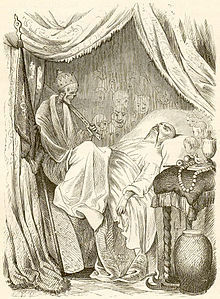
THE FAIRY TALE: Set in China, the Emperor learns that one of the most beautiful things in his empire is the song of the Nightingale. When he orders the Nightingale brought to him, a kitchen maid (the only one at court who knows of its whereabouts) leads the court to a nearby forest where the bird is found. The Nightingale agrees to appear at court. The Emperor is so delighted with the bird's song that he keeps the nightingale in captivity. When the Emperor is given a bejeweled mechanical bird he loses interest in the real Nightingale, who returns to the forest. The mechanical bird eventually breaks down due to overuse. The Emperor is taken deathly ill a few years later. The real Nightingale learns of the Emperor's condition and returns to the palace. Death is so moved by the Nightingale's song that he departs and the emperor recovers. The Nightingale agrees to sing to the emperor of all the happenings in the empire, that he will be known as the wisest emperor ever to live.
The Fairy Tale brought me to Jenny Lind, "The Swedish Nightingale" . . .
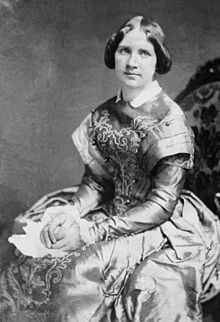
The Nightingale was very popular in 1843 due to the tale was inspired by the Andersen's unrequited love for opera singer Jenny Lind (1820-1887), known as the Swedish Nightingale. Jenny preferred a platonic relationship with Andersen. (She was an illegitimate daughter of a schoolmistress.) Lind established herself at the age of 18 years as a world class singer with her powerful soprano. Strangely enough, the Nightingale story became a reality for Jenny Lind in 1848-1849, when she fell in love with Chopin. His letters reveal that he "felt better when she sang for him", and Jenny Lind, a great philanthropist, arranged a concert in London to raise funds for a tuberculosis hospital. According to new research, she even planned, with the knowledge of Queen Victoria, to marry Chopin - in vain. Unfortunately, he died of tuberculosis in Paris on October 17, 1849, which Jenny Lind never got over. She wrote to Hans Christian Andersen from Florence on November 23, 1871: "I would have been happy to die for this, my first and last, deepest, purest love."
The fairy tale brought me to: Ode to a Nightingale by John Keats . . .
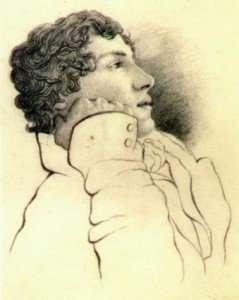
Ode to a Nightingale
by John Keats
My heart aches, and a drowsy numbness pains
My sense, as though of hemlock I had drunk,
Or emptied some dull opiate to the drains
One minute past, and Lethe-wards had sunk:
'Tis not through envy of thy happy lot,
But being too happy in thine happiness,—
That thou, light-winged Dryad of the trees
In some melodious plot
Of beechen green, and shadows numberless,
Singest of summer in full-throated ease.
O, for a draught of vintage! that hath been
Cool'd a long age in the deep-delved earth,
Tasting of Flora and the country green,
Dance, and Provençal song, and sunburnt mirth!
O for a beaker full of the warm South,
Full of the true, the blushful Hippocrene,
With beaded bubbles winking at the brim,
And purple-stained mouth;
That I might drink, and leave the world unseen,
And with thee fade away into the forest dim:
Fade far away, dissolve, and quite forget
What thou among the leaves hast never known,
The weariness, the fever, and the fret
Here, where men sit and hear each other groan;
Where palsy shakes a few, sad, last gray hairs,
Where youth grows pale, and spectre-thin, and dies;
Where but to think is to be full of sorrow
And leaden-eyed despairs,
Where Beauty cannot keep her lustrous eyes,
Or new Love pine at them beyond to-morrow.
Away! away! for I will fly to thee,
Not charioted by Bacchus and his pards,
But on the viewless wings of Poesy,
Though the dull brain perplexes and retards:
Already with thee! tender is the night,
And haply the Queen-Moon is on her throne,
Cluster'd around by all her starry Fays;
But here there is no light,
Save what from heaven is with the breezes blown
Through verdurous glooms and winding mossy ways.
I cannot see what flowers are at my feet,
Nor what soft incense hangs upon the boughs,
But, in embalmed darkness, guess each sweet
Wherewith the seasonable month endows
The grass, the thicket, and the fruit-tree wild;
White hawthorn, and the pastoral eglantine;
Fast fading violets cover'd up in leaves;
And mid-May's eldest child,
The coming musk-rose, full of dewy wine,
The murmurous haunt of flies on summer eves.
Darkling I listen; and, for many a time
I have been half in love with easeful Death,
Call'd him soft names in many a mused rhyme,
To take into the air my quiet breath;
Now more than ever seems it rich to die,
To cease upon the midnight with no pain,
While thou art pouring forth thy soul abroad
In such an ecstasy!
Still wouldst thou sing, and I have ears in vain—
To thy high requiem become a sod.
Thou wast not born for death, immortal Bird!
No hungry generations tread thee down;
The voice I hear this passing night was heard
In ancient days by emperor and clown:
Perhaps the self-same song that found a path
Through the sad heart of Ruth, when, sick for home,
She stood in tears amid the alien corn;
The same that oft-times hath
Charm'd magic casements, opening on the foam
Of perilous seas, in faery lands forlorn.
Forlorn! the very word is like a bell
To toll me back from thee to my sole self!
Adieu! the fancy cannot cheat so well
As she is fam'd to do, deceiving elf.
Adieu! adieu! thy plaintive anthem fades
Past the near meadows, over the still stream,
Up the hill-side; and now 'tis buried deep
In the next valley-glades:
Was it a vision, or a waking dream?
Fled is that music:—Do I wake or sleep?
If you want to hear a young man give an excellent analysis . . .
Ode to a Nightingale -- Excellent Analysis (14:46): http://www.youtube.com/watch?v=CrJjF1...
And then this brought me to youtube and birds . . .
Singing Nightingales -- http://www.youtube.com/watch?v=TepTnl...
British Trust for Ornithology Bird Identification Workshop -- http://www.youtube.com/watch?v=SUN_Av...
Wow ! Thanks for sharing all that, Carol. You are amazing. The first photo reminds me of the ones you see in old books. Love it !
The Emperor image was illustrated by Vilhelm Pedersen. John Keats by Walter Jackson Bate
I always loved Keats and I just totally lucked out, and purchased online his biography, "Winner of the Pulitzer Prize for Biography", copyright 1963, Belknap Press of Harvard University Press; perfect dust jacket-- no tears, no creases; hardcover-- perfect, no damage at all to spine or end boards; even all the pages in the book are white (no discoloration), no creases. This is my early birthday present!!
It's delightful to follow a person's string of thoughts. Thanks for sharing your string, Carol.
I seem a little crazy at times, but I appreciate that you are both ok with it. Thanks!
Carol wrote: "The Emperor image was illustrated by Vilhelm Pedersen. John Keats by Walter Jackson BateI always loved Keats and I just totally lucked ..."
------------
That's great. You never know when you purchased a used book online the condition it will be in. I'm glad it was in perfect condition.
It was on this day in 1802 that William Wordsworth and his sister, Dorothy (books by this author), happened upon a profusion of daffodils along the banks of the nine-mile-long Ullswater Lake. Dorothy wrote down a detailed description of the daffodils that helped inspire Wordsworth to write the famous poem "I Wandered Lonely as a Cloud" five years later. It begins:I wandered lonely as a cloud
That floats on high o'er vales and hills,
When all at once I saw a crowd,
A host, of golden daffodils;
Beside the lake, beneath the trees,
Fluttering and dancing in the breeze.
---The Poetry Foundation
National broadcasts of The Writer's Almanac are supported by The Poetry Foundation
For years daffodils was my favorite flower, so when i found this poem, i loved it. While i still like a beaming daff', it's no longer my favorite but the poem reminds me of the freshness i liked when i saw them.
Don't leave us hanging like that ! LOLSo your favorite now is ?
LOL! I'm fond of scented flowers now. Sadly, most are ephemeral, such as wisteria & lilac. *sigh* I like the way wisteria gently hangs down from overhead walkways & such. Old fashioned flowers, i think.How about you? And others? Any favorites?
No. I can't say I have a favorite. I like most flowers. Though some scents can come on strong for me. Gardenia is a bit too strong for me, for example.
Gardenia outdoors is great. When we lived in our lake house, in Gun Barrel City, TX, i'd bring a gardenia indoors & it would stink up the place. Worse than lilies, whose season it is, i suppose. Still, the pleasant scent fooled me many a time to bring it in. Sucker Deb

Native to where we live is Mountain-Laurel which grows quite large and has a pleasant smell.
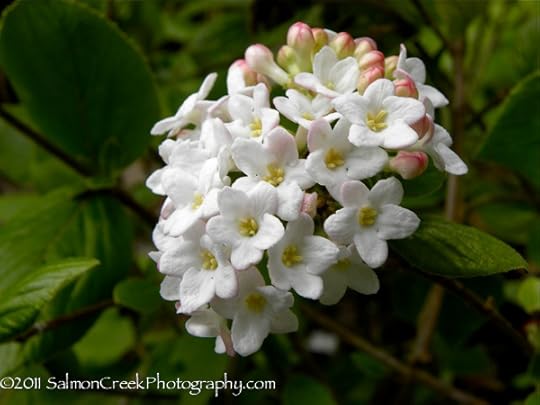

We grew up with Viburnum outside our kitchen table. They smell wonderful, so we plant some in front of our bedroom windows. Nothing beats the smell of the flowers on a spring breeze!
We also planted blueberry, strawberry, and raspberry plants but the wild life just ate them up (the birds love the blueberries.) Our yard needs to be redone, so we have work cut out . . .
The Mountain-Laurel are gorgeous !

Book Nook Cafe
Books mentioned in this topic
The Poems of Mrs. Anne Bradstreet: Together with Her Prose Remains (other topics)The Beggar's Opera (other topics)
Conversations with Czeslaw Milosz (other topics)
Czeslaw Milosz: Selected Poems (other topics)
Caribou: Poems (other topics)
More...
Authors mentioned in this topic
Anne Bradstreet (other topics)John Gay (other topics)
Czesław Miłosz (other topics)
Charles Wright (other topics)
Carolyn Forché (other topics)
More...
Post here about all this poetry !