
The Patrick Hamilton Appreciation Society discussion

This topic is about
Roland Camberton
Hamilton-esque books, authors..
>
Roland Camberton
date newest »
newest »
 Mod
Mod
http://www.theguardian.com/books/2008...
It's a great tale of how Iain Sinclair found out more about the elusive Roland Camberton
Mod

Scamp by Roland Camberton
It's another of those classic London novels from the 1950s that evokes Julian Maclaren-Ross, Patrick Hamilton, Norman Collins, Samuel Selvon and so on. Indeed it would make a brilliant companion piece to Adrift in Soho by Colin Wilson.
The back streets of Soho and the West End are brought vividly to life and, whilst the plot is slightly inconsequential, that doesn't make the book any less enjoyable. Every page provides an opportunity to experience late 1940s bohemian London and, as I think we can all agree, is a wonderful thing.
Julian Maclaren-Ross makes a few appearances as "Angus Sternforth Simms", who is usually to be found in The Corney Arms (a thinly disguised version of his home from home The Wheatsheaf).
This is the very spot, triv fans, where JMR would hold court every lunchtime and every evening in The Wheatsheaf..

(These are some friends who accompanied me on a literary tour of Fitzrovia a few months back - but that's another story for another day)
Indeed the sections of Scamp that take place in The Corney Arms could have come straight out of Paul Willetts's biography of Julian Maclaren-Ross "Fear and Loathing in Fitzrovia".
Interestingly, and despite his appearance (or perhaps because of), Julian Maclaren-Ross was particularly scathing about this book in his review of it for Times Literary Supplement on 10 November 1950...
The book is written from the standpoint of the "bum": that bearded and corduroyed figure who may be seen crouching over a half of bitter in the corner of a Bloomsbury "pub"; it is ostensibly concerned with the rise and fall of a short-lived literary review, but Mr. Camberton, who appears to be devoid of any narrative gift, makes this an excuse for dragging in disconnectedly and to little apparent purpose a series of thinly disguised local or literary celebrities.
Despite Julian Maclaren-Ross's negativity, the book won the 1951 Somerset Maugham Award (given to authors under the age of 35) and I can quite see why. As I say, the book's great strength is its evocation of late 1940's London and in particular the areas of Bloomsbury, Soho, Kings Cross, Fitzrovia, Fleet Street, and the multifarious and compelling bohemian characters that populate this world.
The book was out of print for many years until publishers Five Leaves, through their New London Editions imprint, republished it in 2010 (they've also republished two books by Alexander Baron which I have on my shelf and will be reading soon). I love books like this and am delighted that more of these titles are getting reprinted. There's a beauty and a purity in the shabby streets and seedy cafes and the lives lived on the margins.
Sadly Roland Camberton only wrote one other book before giving up writing, Rain On The Pavements, and that has also been republished by New London Editions. Needless to say I will be getting hold of that one too and reading it very soon.
I'll review this properly when I finish it in the next few days.
 I thought it was quite a tasteful move, on the part of Five Leaves, to bring both Camberton novels back into print cloaked in their original cover art by John Minton. Apart from being gorgeous bits of design in their own right, they're evocative in ways that could never be matched by contemporary design. The original packaging truly lends an air of class to the entire affair.
Mod
I thought it was quite a tasteful move, on the part of Five Leaves, to bring both Camberton novels back into print cloaked in their original cover art by John Minton. Apart from being gorgeous bits of design in their own right, they're evocative in ways that could never be matched by contemporary design. The original packaging truly lends an air of class to the entire affair.
Mod
I couldn't agree more. Using the original John Minton covers was inspired. They are gorgeous and - as you say - completely evoke the era of the original book.
I have almost finished Scamp and the longer it goes on the better it gets. Profound, wise and moving - in addition to be like a time capsule for late 40s bohemian London.
I got hold of a copy of Rain On The Pavements yesterday which I will read sometime soon. Such a shame that there's only two books to read.
Mod

Rain On The Pavements by Roland Camberton
This is Roland Camberton's second and final novel, first published in 1951. It starts in London's East End, and takes place throughout the 1920s and 1930s. It's a coming of age tale about David Hirsch, who comes from a Jewish family. So far it's another enjoyable and easy read with lots of interesting period detail and fascinating insights into a fairly traditional Jewish upbringing.
As with Scamp, New London Editions (via Five Leaves) have reproduced the original, and splendid, book cover by artist John Minton.
I'll be keen to hear whether or not, like me, you found 'Rain' to be a bit more cohesive and enjoyable than 'Scamp.' That said, though, I can strongly recommend both for those not yet initiated. If there was any justice in this world, Camberton's output would've been every bit as prodigious as that of, say, Jackie Collins.
Mod
I'm loving the stuff about his East End Jewish upbringing and all the fabulous characters he encounters. When the first chapter is called Uncle Yunkel - you know you're in for a treat.
Mark wrote: "I can strongly recommend both for those not yet initiated. If there was any justice in this world, Camberton's output would've been every bit as prodigious as that of, say, Jackie Collins."
Listen to Mark. Mark knows.
Mod
Having very recently read Scamp, the first novel by Roland Camberton, and filled by enthusiasm for that book, I got hold of this, his only one other book before giving up writing.
Rain On The Pavements, first published in 1951, was - like Scamp - also republished by Five Leaves (via their New London Editions imprint) in 2010, again complete with the book's original cover art by John Minton - a beautiful artwork that really compliments the contents and enhances the whole experience.
Roland Camberton, born Henry Cohen, came from a Jewish family in Hackney where he attended Hackney Downs School in the 1930s. He later anglicised his name to so his strictly religious family remained unaware that he was writing novels. Both Rain On The Pavements and Scamp, are based on Roland Camberton's life.
David Hirsch, the main character, is probably a self-portrait, and the book details his life growing up in a fairly orthodox Jewish family in Hackney throughout the 1920s and 1930s. Each chapter takes a portion of David's life from early childhood to gaining a scholarship to University. Each chapter introduces new characters who were, in the main, significant people in David's life, these include young uncles, school friends, teachers etc. and describes David's experiences around the East End, at school, and beyond into Soho. As with Scamp, a big part of the pleasure of this utterly enjoyable book, is the wealth of social history and detail. It all rings so true and is clearly based on personal experience. Little things, like for instance, David and a friend in Cable Street watching two of their bigger, braver school friends fighting with fascist black shirts, the book is full of this kind of detail.
Hackney is the constant throughout this wonderful book, its streets and characters providing the backdrop to many of David's experiences. As he matures, he is increasingly drawn towards the bohemian world of Soho, however throughout all his experiences what is clear is that he can never really escape from his home borough and all that it signifies.
4/5
Nice article popped up this morning about the work of John Minton, whose brilliant illustrations of the East End were used for the covers of Camberton's Scamp and Rain On The Pavements.http://spitalfieldslife.com/2017/11/0...
Mod
I only knew of his two book covers so that was a trove of great images and useful info. Those two Camberton covers are truly wonderful.
Mod
https://www.goodreads.com/poll/list/2...
I'm getting behind CQM's inspired nomination for A Kid for Two Farthings
After picking up the two Camberton novels, I did a bit of snooping around regarding Minton and his work, all of which resonated. Technology be damned, there's no substitute for a brush and a hand.Incidentally, that blog is usually quite good... it's updated each and every day, and almost always well worth a look-in.
Been thinking about picking up a copy of A Kid For Two Farthings for a while now, having never read it before. And the Pan edition, with the illustration of Diana Dors on the cover, pretty much clinches it!
Mod
I've bookmarked the Spitalfieldslife site too.
Mark wrote: "Been thinking about picking up a copy of A Kid for Two Farthings for a while now, having never read it before. And the Pan edition, with the illustration of Diana Dors on the cover, pretty much clinches it! "
This one....?
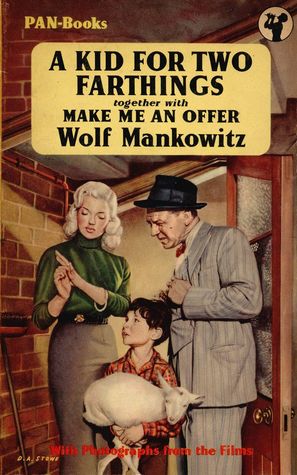 That's the one! Copies seem readily available at a decent price, so that's my mission for today.
Mod
That's the one! Copies seem readily available at a decent price, so that's my mission for today.
Mod
And if yer buying a copy you might as well give it a vote...
https://www.goodreads.com/poll/list/2...
 Nigeyb wrote: "You convinced me to snap one up (on eBay) less than £3 for a slice of cultural history. For one brief moment I thought that was Sid James alongside DD - sadly not
And if yer buying a copy you migh..."
Sid James was in the film version, I'm pretty sure that is his Sidness.
Mod
I've replied over at the all new Wolf Mankowitz thread....
https://www.goodreads.com/topic/show/...
Have you ever owned or seen any books from The Mainstone Press? I really want their new book of John Minton's collected works, but without knowing what sort of quality I'm in for -- paper? printing? -- I'm a bit hesitant to spend £35 plus shipping to the states.Any ideas?
Mod
Along similar lines, I’ve just come across this, which seems to easily merit a look-in...https://www.amazon.co.uk/gp/product/0...
 Sorry for failing to appear round these here entertaining and illuminating parts of late, but I thought you might like to know that the latest issue of Mojo (The Jam on the cover) has a feature on late 60s-early 70s pulp fiction, loosely called "the skinhead novels" when I was a teen tearaway for whom Commando comics had become a bit cliched.
Mojo seems to be describing it as 'pop music pulp fiction' https://www.mojo4music.com/articles/m... but the headline "Paperback Rioter" is absolutely splendid.
I hope it fits with this subject, and that is SURELY Sid cackling in the image above!
Mod
Yes, we have now confirmed that is indeed Sir Sidney of James on the cover.
David wrote: "a feature on late 60s-early 70s pulp fiction, loosely called "the skinhead novels" when I was a teen tearaway for whom Commando comics had become a bit cliched."
Thanks for the Mojo intel. I have that very edition, being a subscriber, but have not read it yet, except the albums of the year, so will make a cup of tea and peruse it before the day is out.
I was an avid reader of the NEL paperbacks as a young un (I would not recommend revisiting them in adulthood though) and look forward to this nostalgic backwards glance.
Thanks for the good tip. Sadly, Mojo has become impossible to find stateside, steadily more and more so over the past year. From what I’ve been told, the few distributors here that always offered it, don’t any longer. It's aggravating, but I’ve been learning to make do with pdf's posted online for illegal downloading.
That's a pity, Mark. To be honest, I keep intending to cancel my sub as I rarely have the time to read it all. And then, just as I'm reaching the end of the payment period, they'll hook me in with a 6-pager on Frankie Miller, Humble Pie or Wet Willie, and I'm suckered again.
Admittedly, less and less of Mojo's content interests me -- they’ve come a long way since issuing Howlin’ Wolf on the front cover -- but there tends to be at least a handful of issues each year that interest me. This month’s, with The Jam, for example. Maybe now that I’ve let my subscription to Viz expire, I should subscribe to Mojo!
Mod
The Mojo article was inspired by....
Girl Gangs, Biker Boys, and Real Cool Cats: Pulp Fiction and Youth Culture, 1950 to 1980 by Iain McIntyre
...I've set up a separate thread here....
https://www.goodreads.com/topic/show/...
An interesting article here on John Minton, the artist/illustrator whose work graced the covers of Roland Camberton’s two novels...http://thequietus.com/articles/23770-...
Mod
This post-war yearning for a spiritual reconnection with landscape led artists of John Minton’s generation to emulate Paul Nash and Graham Sutherland in looking back to the visionary landscapes of Samuel Palmer and William Blake as sources of inspiration. Not only did this spirit permeate book publishing but also the worlds of advertising and design, as artists who were as comfortable in print as they were on the gallery wall chose to engage freely with the commercial and applied arts.
John Minton was at the heart of this short-lived movement, which by the late 1950s had faded away, when interest shifted to abstraction. Like many of his neo-romantic contemporaries, Minton was both a painter and an illustrator, although, unlike Keith Vaughan, John Craxton and Michael Ayrton, for example, his paintings are only now beginning to receive formal recognition. His commissions, on the other hand, spanned book illustration, dust-jacket design, illustrations for magazines and journals (trade, popular and literary), advertising, commercial posters for film, travel and the GPO, wallpapers, theatre design, and mural painting.
Mod
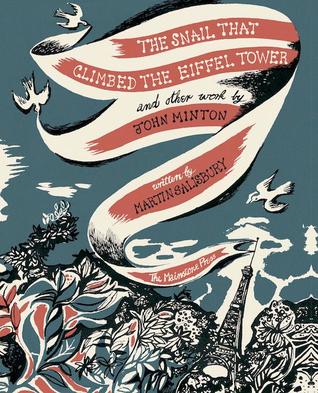
The Snail that Climbed the Eiffel Tower and Other Work by John Minton 2017: The Graphic Work of John Minton
Yours for £35
I’ve been resisting the temptation, but find myself losing my grip. I love his work, so £35 very well might turn out to be a bargain price.
Mod
https://www.themainstonepress.com/mai...
Yeah, I’ve seen, time and again, how these things go, and am usually grateful whenever I get in in time with my money. Especially since the rise of eBay... things like this tend to appreciate at an unwarranted pace, and trade hands [or often don’t] at incredibly stupid prices. Speaking of art books -- I’ve just picked up a brand new Taschen book titled The East German Handbook, which I can recommend heartily... not least of all because it qualifies as a massive bargain at just forty bucks for more than 800 pages. It’s a visual document of all things -- literally all things -- from the old East Germany. Take a peek here, and don’t skip the gallery...
https://www.taschen.com/pages/en/cata...
Beautifully printed and lovingly presented. And one hell of a shelf-bender!
Mod
 Minton was a tragic case (a suicide at 39). He is mentioned in Anthony Cronin's Dead as Doornails, which I just finished - one of MANY casualties in that book.
Patrick wrote: "Minton was a tragic case (a suicide at 39). He is mentioned in Anthony Cronin's Dead as Doornails, which I just finished - one of MANY casualties in that book."
Minton was a tragic case (a suicide at 39). He is mentioned in Anthony Cronin's Dead as Doornails, which I just finished - one of MANY casualties in that book.
Patrick wrote: "Minton was a tragic case (a suicide at 39). He is mentioned in Anthony Cronin's Dead as Doornails, which I just finished - one of MANY casualties in that book."That looks like one for the To Read list... many thanks for pointing it out!
I wrote about Dead as Doornails elsewhere:You may never look at the literary and artistic life in the same way. The book is extremely funny but also disturbing and pathetic. Most of the writers and artists that Cronin knew well in his 20s and 30s were dead before he turned 40 (hence the title). Alcohol problems were rife among them, along with various forms of psychological disturbance. When I finished the book, I realized that I would not wish to have had a single one of the experiences that Cronin describes, or to have known ANY of his friends (Brendan Behan, Patrick Kavanagh, Flann O'Brien, etc.). As Trump would say, Sad!
Mod
I will be reading Dead as Doornails: A Memoir by Anthony Cronin soon. I just picked up a copy on eBay for £4 incl P&P
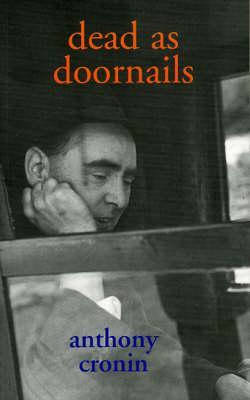
In this account of life in post-war literary Dublin, Anthony Cronin writes of the frustrations and pathologies of this generation: the excess of drink; the shortage of sex; the insecurity and begrudgery; the limitations of cultural life in mid-century Ireland, and the bittersweet pull of exile.
I am delighted that you are both taking it up!
If for no other reason, I need to learn how lives of excess squares with "the shortage of sex."
Mod
Mark Gatiss on John Minton: The Lost Man of British Art
John Minton was for a time one of the most popular 20th-century British artists, more famous than his contemporaries Francis Bacon and Lucian Freud. He has also been something of an obsession for actor and writer Mark Gatiss since he first saw one of his paintings as a teenager at the National Portrait Gallery. Mark Gatiss plunges back into Minton's world to celebrate his remarkable life and work, but also to find out why he remains all but forgotten.
As well as being a central figure in the post-war British neo-romantic movement, alongside the likes of Graham Sutherland and John Piper, John Minton was also one of the leading lights of Soho during the 1940s and 50s - a bohemian enclave where he felt at ease with fellow artists and models. In the only known footage of Minton, he is caught fleetingly, dancing wildly in a club, like a crazed marionette. It's a captivating, poignant glimpse of a man who was once at the very centre of this world.
He was a prolific painter of both landscapes and portraits, and as a gay man, Mark has always been particularly drawn to his sensitive depictions of striking young men. Minton too was gay but struggled with his sexuality during a highly repressive era when homosexuality was still illegal. However, as Mark discovers, it wasn't just his sexuality that plagued Minton, but his very standing as an artist and his desire to be considered first and foremost a painter rather than an illustrator, which is how he really found fame. On a balcony overlooking the same glorious view, Mark explains how Minton's vibrant jacket design for Elizabeth David's A Book of Mediterranean Food in 1950 was really what attracted people to buy it, as the author herself declared. But it was the 1948 publication of Time Was Away: A Notebook in Corsica that really established Minton, and it became something of a cult book for a new generation of illustrators. Following in his footsteps, Mark travels to Corsica and visits some of the original locations captured so vividly by Minton.
As well as discovering unseen photographs of the artist and previously unknown works by him, the film also gives Mark the chance to hear Minton's voice for the first time in a rare broadcast he made for the BBC Third Programme in 1947. The connections deepen further as Mark meets some of those who knew him well - former models such as actor Norman Bowler recall posing for Minton, and fellow artist David Tindle discusses the rivalries between Minton and his contemporaries, particularly Francis Bacon.
Drawing on all these remarkable first-hand reminiscences, Mark explores the reasons behind Minton's fall from grace and the tragic circumstances of his death at the age of just 39.
On iPlayer for 29 days...
https://www.bbc.co.uk/iplayer/episode...
More info here...
https://www.theguardian.com/tv-and-ra...
Gatiss speaks not as an art historian but as an informed superfan, one who truly gets him. It is this identification with the subject that makes this more than an informed documentary about an artist you (OK, I) have never heard of. It is a personal, poignant, melancholy portrait, with moments of optimism and joy.
Ah, very cool, I’m envious. Enjoy it!Actually, there’s now a very good chance that I’ll be able to watch it eventually, as we’ve recently ditched our Netflix account in favour of something called BritBox, with which we can stream heaps of BBC and ITV shows and series. Sadly, E4 is still geo-blocked but, for the time being, at least, we’re spoilt for viewing opportunities.
Mod
Mod
Mark Gatiss on John Minton: The Lost Man of British Art"
Finished! Superb it is too.
Highly recommended.
Also includes some great old clips of Soho, and the two Roberts (who crop up in Paul Willetts biog of Julian Maclaren Ross) and much more besides. Top notch. Anyone who likes this group will love it.

The Patrick Hamilton Appreciation Society
Books mentioned in this topic
Dead as Doornails (other topics)The Snail that Climbed the Eiffel Tower and Other Work by John Minton 2017: The Graphic Work of John Minton (other topics)
Girl Gangs, Biker Boys, and Real Cool Cats: Pulp Fiction and Youth Culture, 1950 to 1980 (other topics)
A Kid for Two Farthings (other topics)
A Kid for Two Farthings (other topics)
More...
Authors mentioned in this topic
Anthony Cronin (other topics)Iain McIntyre (other topics)
Wolf Mankowitz (other topics)
Roland Camberton (other topics)
Roland Camberton (other topics)
More...

Now then, I was just perusing some comments under a Guardian article, and came across this statement, which feels very pertinent to the discussion so far...
Iain Sinclair has said on a number of occasions that the English novel 'split' into two paths in the 1950s: the Kingsley Amis "Lucky Jim" provincial/campus novel (the antecedents of Martin Amis and, probably, Zadie Smith of whom Sinclair is no fan by all accounts) and the lost world of Alexander Baron and Gerald Kersh. The example he uses is "Scamp" by Roland Camberton, which won the Somerset Maugham Award in 1951 but left no trace thereafter.
The one and only follow up comment states.
...it's hard to tell if there are two wings of the English novel because, as you point out, one has been more or less been eradicated.... while the other looms very large...I think part of the reason for this is our increasing wealth as a society. It makes us want to engage in the 'campus' line rather than anything a bit murky...unless of course it comes from America. Then it seems we can't wait to read it.
So Roland Camberton, here's some more information...
This post at the West End Lane bookshop on Lost London authors states...
“Lost” London Authors
The recent republication of Roland Camberton’s long out of print works highlights, once again, our periodic neglect of certain London authors. He won the Somerset Maugham Award for his first novel Scamp in 1951, had Rain On The Pavements published in the following year, and soon afterwards disappeared without trace.
The persistent sleuthing of Iain Sinclair (via Douglas Lyne and Claire Camberton) eventually reconstructed the life of the reclusive Henry Cohen (Roland Camberton’s real name) and subsequently saw new paperbacks appear of both Scamp and Rain On The Pavements (by New London Editions), after a gap of sixty years.
Here's a rather splendid review of "Rain On The Pavements" written by goodreads member Jakey Gee. It includes this splendid final paragraph...
I first became aware of Roland Camberton via Prince of Witterers Iain Sinclair's 'Hackney that Rose Red Empire'. Probably something about Camberton having been the cousin of the brother-in-law of a man who once made an omelette for Sinclair after an anarchist chess tournament in a basement on Ridley Road in 1968 after a blues concert attended by the sister of Ulrike Meinhof (she wore a green cardigan and believed a leyline connected Homerton and Chernobyl). Anyway, this is the first genuinely sensible tip I've ever got from him.
Mark has recommended both Scamp and Rain On The Pavements and I now reading Scamp and enjoying it very much. I will add a few more comments soon.