
Divine Comedy + Decameron discussion
Boccaccio's Decameron
>
6/9-6/15: First Day, Stories 6-10 & Conclusion

message 1:
by
Kris
(new)
Apr 14, 2014 09:46AM
 Mod
Mod
reply
|
flag
 Mod
Mod
Menocal:
"There is at least one reader of Dante, Boccaccio, who in his own reworking and interpretation of Dante in the Decameron is intrigued by the complexity and problematic nature of literary and philosophical relations with the European-Arabic world- and by Dante's perceptions of them. It is a fortunate coincidence that some of the most exciting work currently being done in Boccaccio scholarship is in the area of its intertextual relations with the Commedia. To add to the context of what is already being done, our perceptions of the influential and, for Dante, menacing Arabic world could perhaps help to reshape some of these discussions. Those that come to mind immediately , for example, are stories such as VI,9 where the questions of Dante's condemnation of Guido Cavalcanti's Averroism is a central topic, as is the question of interpretation itself, which Boccaccio weaves into his recounting of how Guido was (mis) underrstood by a band of Florentines. The problem of interpretation is not absent from another story (VIII,9) that also addresses, apparently contemporary view of Arabic-derived cultural phenomena. This is one of the Bruno and Buffalmaco stories, and it incorporates a variety of relevant characters and prejudices, the doctors, Michael Scot and Avicenna, the latter being unpronounceable to Bruno:
(Last night I was with the company, and since I'm getting a little bored with the Queen of England, I had brought to me the gumedra of the Khan of Altarisi." And the doctor said, "What is the gumedra? I don't understand such names [words]." "I'm not surprised, master, since I have heard that neither Porcograsso nor Vanncenna talks about them."" You mean Hippocrates and Avicenna! he replied "what do I know!" said Bruno, "I can't understand your words [names] any more than you do mine. But the gumedra in that language of the Great Khan means what empress does in ours.")
The possible richness of this line of inquiry in the Decameron is hardly limited to Boccaccio's glosses and itnerpretations of Dante's own knowledge and opinions concerning such forces in their culture,
Boccaccio's own knowledge of and interest in multiple aspects of the Arab world in Europe, as well as on its own territory ( as he conceived it), are considerably more extensive. His attitudes, at least on the surface and given certain readings of his stories, are also considerably more eclectic.In fact, one possible conclusion to draw from tentative readings of the two stories just mentioned would be a certain dissatisfaction with Dante's hasty and not altogether evenhanded judgment of Scot and, especially, of Cavalcanti
While it has long been known and accepted that a fair number of Boccaccio's sources were "oriental," Decameron scholarship, for all its rich multiplicity and wide variation of opinion on the nature of the test and its plausible interpretations, has usually not gone beyond such source studies as far as an Arabic influence is concerned. It has not, in general, explored the possibility that the centrality of the European-Arabic world and its multiple manifestations may be embodied and reflected in that text. The very use of the term "oriental," in fact, obscures even the nature of the sources involved in certain cases,
It is more to the point, and more accurate, to note that such analogs were in many cases Andalusian, texts of which the Disciplina clericalis is the best-known source but not the only one. They embody and exemplify the marvelous eclecticism of derivation ( traditional Judaic, Arabic adaptations form India and farther east, peninsular, and so forth) and polysemousness (scatological stories in a didactic frame, for example) that are especially apparent in the work of Petreus Alfonsi. A Jew who had been educated in the Arabic tradition as well as in Hebrew and who had converted to Christianity, he wrote in his Disciplina in Latin, and both he and his work were feted throughout Europe. But while his narrative material may have entered the West under the guise of instruction for the Christian faithful, it is clearly a product of trireligious Spain and is to be unambiguously understood as such. The synthesis was characteristically Arabic, and for other Europeans, quintessentially Andalusian.
It is misleading, in such a context, to forge that it is al-Andalus and the general Arabic intellectual prominence in Europe that are directly associated with texts such as these. They are the direct source, that which brought such stories to the attention of the rest of Europe and with which such a collection would be identified by all other Europeans- Europeans who, unlike the modern scholar, might find it quite difficult to distinguish between the Persian and the Arabic source in such texts and who would distinguish poorly, if at all, between the religious traditions of Maimonides and Avicenna.
The readjustment of our perspectives on the period, in an extension and amplification of the view delineated for Dante, can immediately throw a light on certain other aspects of the Decameron. That certain of its stories derive from the tradition embodied in the Disciplina clericalis is a fact recognized as far back in our discipline as the work of Vossler. Obscured and unperceived, however, in the evaluation of such sources, or of the Arabic presence in medieval Europe as peripheral and occassional, marginal and specifically marked, is Boccaccio's own tacit recognition of its centrality, one of the riveting issues during the period of European intellectual and cultural history. More subtle, and perhaps more formative, patterns of a European-Arabic presence may be perceived if we realize how many different kinds of phenomena were associated with the world of "Vanacena": Scot, doctors, Graeco-Arabic learning, Frederick II, the "oriental'" setting, and so forth.
It has remained unnoticed that a certain pattern suggests itself for the ninth story of each day, That is the story that is , in certain reckonings, central, since it is told by the respective day's king or queen and is the last of those told on the stated subject of the day. At first glance it would appear that for a number of the days the story is concerned with some feature, problem, or story related in one way or another to Arabic or Arabic-derived cultural and intellectual forces. The two novelle mentioned above point the way, and it is no coincidence that the identification with nine in the case of the Cavalcanti story reflects Dante's own numerology in the Inferno. The heretics are first seen and identified in IX proper, and the episode with Cavalcanti (the father) follows an X, which is IX of the Inferno itself. And just cursorily remembering the settings, stories, and characters of the ninth stories ( and engaging in the most elementary and banal identification of what may constitute "Arabic" in such stories) reveals the strong possibility of an interesting pattern: the setting in Cyprus int eh first day, in Alexandria on the second; Frederick and the falcon, a seemingly unmistakable reference to Frederick II (best knnown for his treatise on falconry) in the fifth; on the sixth Cavalcanti; a Greek setting in the seventh (not forgetting that contemporary sources for the knowledge of Greek still came predominantely through Arabic and were associated with it), in th eight, the Bruno and Buffalmaco story, Salamone on the ninth, Saladin on the tenth. The suggestion here, and it can be no more than that, is that a possible pattern emerges from the relatively simply refocusing of our view, a pattern that is intriguing, worth exploring, and quite possibly rewarding for our understanding of this author, whose artistic richness is no less varied and polyvalent that Dante's but whose ideology and intent in the Decameron is much more ambivalent and controversial
I would add a final suggestion about the changed perspective on Boccaccio and the Decameron that could be facilitated by our wider cognizance and acceptance of the Andalusian texts and traditions he knew. One of the most distinguishing and intriguing features of texts such as the Disciplina clericalis and others of the same genre is that they are fused what for some might seem dramatically different, even contradictory or irreconcilable features" the scatological or scandalous story in an avowedly didactic context. Such a fusion is rhetorical device whose own roots and patterns within the Semitic tradition are less perfectly understood and certainly less than exhaustively explored. But this feature also immediately invites comparison with a text such as the Decameron. This sort of comparative work could well be done, initially at least, by merely assuming that such a comparison is legitimate and leaving genetic questions outside of our immediate focus.
In terms of our current critical emphasis on both the narrative patterns and the meaningful structural complexities of the Decameron, a wider field of comparative text could only yield more cogent and more significant results. It seems wholly appropriate, for textual reasons alone, that texts such as that of Petrus Alfonsi- and others less well known in this context but potentially just as informative, including the Thousand and One Nights- should be part of such a systematic comparative investigation of narrativity in medieval story collections, not just adduced piecemeal for the isolated story that may have been borrowed and recast. Given the well-documented popularity of Petrus's text and the fact that there is no possibility of denying its accessibility, it seems surprising that the Disciplina is not regularly adduced in such discussions. Most intriguing and potentially suggestive is the possibility that a comparison with these texts' use of the general structuring narrative to inform and ( didacticize) the otherwise moral-less or blashphemous tale withing the larger patterns may well add credence and support to the still-revolutionary and ( to some) shocking notion that Boccaccio was a fundamentally Christian writer and that his Decameron is a Christian, moral book whose lessons are apparent to careful readers, just as the Disciplina was and just as its readers must have perceived it.
That his model or models in such a narrative construct, his ways of looking at text and the ways it might fulfill a didactic, Christian purpose, might in some measure Arabic or Hebrew in inspiration and/or example would undoubtedly prove to be even more incongruous to some. But is it any more odd or incongruous than that Dante should have relied on Judeo/Arabic astronomical sources for his configurations of time and the stars in the setting of the Commedia? And if Boccaccio showed so little squeamishness in his own use and appreciation of texts from that other world, why should we. He knew Fibonacci (whose own name as well as education is a calque from the Arabic "ibn," " son of," nomenclature system, " fi (glio) Bonacci) for example, and he knews th sort of mathematical and medical work that the likes of the "gran maestro in nigromatia" Michael Scot had translated. I believe he did not expect his perspective readers to play the role of Bruno and to mispronounce Avicenna's name, to ignore who he was and what he meant in Europe in the twelfth, thirteenth, and fourteenth centuries. " (Menocal 138-142)
 Mod
Mod
You took a lot of trouble writing this out... Thank you for reminding me to read the book, sitting on my shelves.
Here is the link.
The Arabic Role in Medieval Literary History: A Forgotten Heritage
Mod
Even before the plague there had been a major financial crisis, when Edward III of England defaulted on his debts. This hurt badly the Florentine bankers, which exacerbated the already unsteady political situation. Then there was also a famine in 1346-47, before the Bubonic plague arrived in 1348.
The financial crisis affected the bank of Boccaccio's father.
 Kalliope wrote: "Just a bit of political and economic background, from the book Boccaccio: A Critical Guide to the Complete Works.
Even before the plague there had been a major financial crisis, wh..."
Very interesting. I was reading some of the Wiki pages on that and one was questioning the importance of the default of Edward III.
It was this one:
"In 1344, at about the same time as the Peruzzi company, the Bardi company went bankrupt and the Florentine writer Giovanni Villani blamed this on the repudiation of war loans by King Edward III of England. However, Villani was not an independent source; his brother was a member of the Peruzzi company that also went bankrupt. Villanni said that Edward owed the Bardi 900,000 gold florins (£135,000) and the Peruzzi 600,000 (£90,000). However, the Peruzzi's records show that they never had that much capital to lend Edward III. Edward did not default on all his loans and repaid some with cash and others with royal grants of wool, a principal export of the English economy at the time.
At the time Florence was going through a period of internal disputes and the third largest financial company, the Acciaiuoli, also went bankrupt and they did not lend any money to Edward. What loans Edward III did default on are likely only to have contributed to the financial problems in Florence, not caused them."
http://en.wikipedia.org/wiki/Compagni...
A couple of articles on the Florence banks that might be of interest (haven't read them yet):
http://www.historyworld.net/wrldhis/P...
http://www.british-history.ac.uk/repo...
And on the 3 big families that owned the top banks in Florence:
http://en.wikipedia.org/wiki/Acciaiuoli
http://en.wikipedia.org/wiki/Peruzzi
and the one Boccacio's father worked for: http://en.wikipedia.org/wiki/Bardi_fa...
 While the stories this week are brief the messages conveyed are powerful. This certainly is a tribute to Boccaccio’s writing style, as well as his inventiveness and creativity. I loved his ability to keenly weave a story within a story in the Seventh Story. And it will be interesting to see the progression of the themes throughout the passing of the days.
 I agree, Amelia. I'm enjoying his ability to tell a story so easily but so fully.
Mod
I agree, Amelia. I'm enjoying his ability to tell a story so easily but so fully.
Mod
Even before the plague there had been a major fin..."
Thank you for these...
Illustrations - Day I story 6
http://visualiseur.bnf.fr/ConsulterEl...
Franciscan confounded by the bougeois of Florence
MSS ITALIEN 63, Folio 24
More (view spoiler)

 Illustrations - Day I Story 7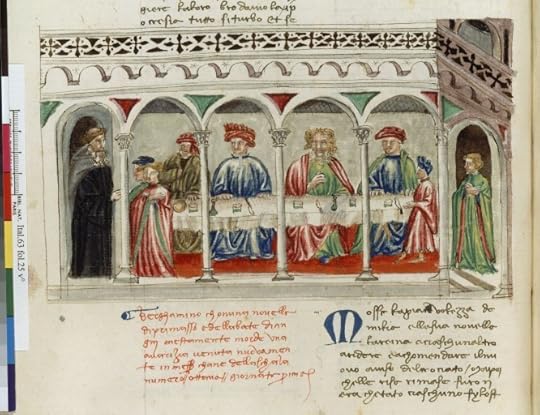
http://visualiseur.bnf.fr/ConsulterEl...
Hugues Primat et l'abbé de Cluny
MSS ITALIEN 63
Folio 25v
More (view spoiler)

 Mod
Mod
http://visualiseur.bnf.fr/ConsulterEl...
Hugues Primat et l'abbé de Cluny
MSS ITALIEN 63
Folio 25v
More
http://digi.va..."
You know BP, someone should hire you! You find the most amazing things! You should put a book together.
Illustrations - Day I Story 8
http://visualiseur.bnf.fr/ConsulterEl...
Guiglielmo Borsiere & Ermino de'Grimaldi
MSS ITALIEN 63
Folio 28
More (view spoiler)

 Illustrations - Day I Story 9
http://visualiseur.bnf.fr/ConsulterEl...
Gui de Lusignan & la plaignante gasconne
MSS ITALIEN 63
Folio 29v
More (view spoiler)

 Illustrations - Day I Story 10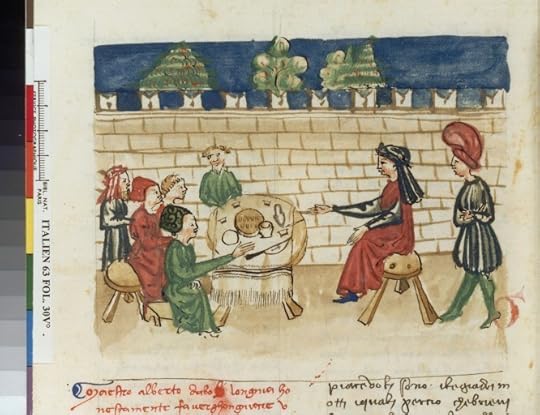
http://visualiseur.bnf.fr/ConsulterEl...
Malgherida de'Ghisolieri & alberto
MSS ITALIEN 63
Folio 30v
More (view spoiler)

 Mod
Illustrations - Day I Conclusion
Mod
Illustrations - Day I Conclusion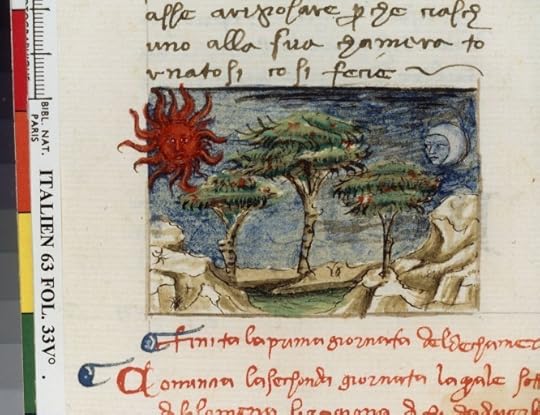
http://visualiseur.bnf.fr/ConsulterEl...
Allégorie de l'aube
MSS ITALIEN 63
Folio 33v
ReemK10 (Paper Pills) wrote: "You know BP, someone should hire you! You find the most amazing things! You should put a book together."Tee hee. I have a book with all these illustrations, which is how I know which images to post before I've actually read the stories. ^.^
ETA: There's actually one manuscript I haven't managed to track down yet: the one owned by the Foundation Cini in Venice (and referenced: Incunabolo, Tesoro, 91) which is illustrated by wood engravings and was printed by De Gregori in 1492... Probably coz it's not online! :<
Mod
Kalliope wrote: "I wonder whether I should wait and read the chapter once BP has posted our electronic illuminated manuscript."I'll try to post them early in the week. :)
Mod
How would this group of seven ladies and three men know these stories? Are they tales told by their grandmothers? What I'm asking is what were the stories(oral) being told at that time?
In Europe, the oral story-telling tradition began to develop into written stories in the early 14th century, most notably with Geoffrey Chaucer's Canterbury Tales and Giovanni Boccaccio's Decameron. Both of these books are composed of individual short stories.
The beginning of the written short story!
Mod
The impulse of collecting folk tales that was shown by the Grimms was not confined to Germany and the times they lived in. In fact, the earliest literary collection of stories with a popular origin was made in the 1500s by an Italian, Giovanni Francesco Straparola. Straparola (literally: babbler) looks like the writer's nickname. He came from Caravaggio, a town halfway between Milan and Cremona.
In 1550 Straparola published at Venice a collection of stories in the style of the Decameron. His collection "was received with the greatest favour. It passed through sixteen editions in twenty years, was translated into French and often printed in that language, and before the end of the century was turned into German." Straparola's tales were largely borrowed, and "to him belongs the honor of having introduced the Fairy Tale into modern European literature," writes Thomas Crane (see below) in the introduction to his collection.
http://oaks.nvg.org/italinell.html
In Italy fairy-tales are loved not only by the children. Round the Italian peasant fireside, they still sit in the winter evenings after their work is done - men (some of them, at least), women and children, and tell and listen, and listen and tell, for hours together, writes Anne Macdonell about a hundred years ago.
As to the personages of the stories, the giants and wizards and witches can hold their own with those of any land. But Italian fairies have a habit of taking on quite ordinary shapes. A market-woman or a milkmaid you pass by thus makes travelling in Italy very interesting. You never know when you may meet a fairy.
And if all the tales be true, there is no end to the fairies' gratitude for good services. Sometimes they even reward you when you do them a good turn without meaning it.
Wise travellers in Italy have got the happiness-giving, old fairy-tales by heart, and therefore never pull long faces, nor give themselves airs when they meet the people of the country. For maybe the chambermaid may be a fairy, or the coachman, or the old woman by the church door. So they think - perhaps and perhaps not.
Mod
Searching for the Earliest Versions of European Fairy Tales with Commentary on English Translations
by Heidi Anne Heiner
http://www.surlalunefairytales.com/in...
Mod
How would this group of seven ladies and three men know these storie..."
How could Boccaccio come up with a 100 stories?...
Mod
The novella, or short story, is the oldest of fictional genres, having among its ancestors the anecdote, the fable and the moral tale. In the Middle Ages, there were two basic sources of inspiration at the base of the prose novella: the tales from the Orient and the Christian exemplum. Though the oral tradition was indeed strong in the Middle Ages, the establishment of a dependable chronology relies on the distribution of written texts. Several Oriental texts (such as tales from the Panchatantra, The Thousand and One Nights, the Brihat Katha cycle and Barlaam and Josaphat) had already been significantly diffused in Greek, Hebrew and Latin translations by the 12th century.
The exemplum, a tale designed to teach the correctness of thought or behavior, is an extrapolation of the adage or the sententia and has its roots in homiletic texts and Christian sermons. The story is structured generally around an example of behavior which was either positive and praised or evil and criticized. The Christian exempla and the Oriental tradition of framed collections of short narratives merged in the early 12th century in the very influential Disciplina clericalis. This is a work comprising didactic examples within the frame tale of a dialogue between father and son and was well known to both rich and poor. In the 13th century, another collection appeared of a more prosaic nature which was known as The Seven Sages of Rome, or Il libro dei sette savi. It comprises a series of moralizing tales set into a frame in which a young man is faced with a death sentence and receives instruction on the right and wrong ways to behave.
The evolution of exempla into what we could fairly call novelle comes about primarily in Tuscany as a result of a period of re-elaboration and fusion of exempla into existing tales, hagiography, Provençal vidas, French fabliaux and lais, regional and classical legends, and fabulae milesiacae. Most well known among these new Tuscan novelle are those found in the anonymous Novellino (also known as Il libro di novelle et di bel parlar gientile or the Cento novelle antiche), written presumably between 1280 and 1300. In it, alongside the expected didactic slant already present in earlier compilations, are stories which exalt the power of wit and intellect and celebrate humor in and of itself. Though there is no frame in the formal sense, the author's style lends a unifying element to the diverse stories which have been taken, decontextualized, and rewoven into a new, autonomous work which stands alone as the most significant single source of inspiration for the Decameron.
(G. M. & M. P.) Adapted from Novelle italiane. Il Duecento. Il Trecento. ed. Lucia Battaglia Ricci (Milano: Garzanti, 1982) and Robert J. Clements and Joseph Gibaldi, Anatomy of the Novella. The European Tale Collection from Boccaccio and Chaucer to Cervantes (New York: NYUP, 1977).
 Very interesting!!
Speaking about roots of these kind of littles stories one after another, i think about these antic titles:
Metamorphoses by Ovid -43/-17
The Satyricon by Petronius 14/66
The Golden Ass: Or Metamorphoses by Lucius Apuleius 125/180
The Aesop Romance (also known as the Vita or The Life of Aesop or The Book of Xanthus the Philosopher and Aesop His Slave) by... Unknown! ^^
The Liar From Lucian of Samosata 125/180(it is the source of the Sorcerer's Apprentice story )
http://en.wikipedia.org/wiki/The_Sorc...
(ETA)From India: Vikram the Vampire by Unknown again...
Mod
I have Metamorphosis and The Golden Ass in my short list... and then I should also get to Aesop...
A good source is the Milesian Tales from Aristides of Miletus (first century before Christ)Sadely, it is lost...
/. .\
The Milesian tale (Μιλησιακά, Milisiaka in Greek; in Latin fabula milesiaca, or Milesiae fabula) originates in ancient Greek and Roman literature. According to most authorities, it is a short story, fable, or folktale featuring love and adventure, usually being erotic and titillating. M. C. Howatson, in The Oxford Companion to Classical Literature (1989), voices the traditional view that it is the source "of such medieval collections of tales as the Gesta Romanorum, the Decameron of Boccaccio, and the Heptameron of Marguerite of Navarre."
http://en.wikipedia.org/wiki/Milesian...
Mod
Here is the link to the book, Reem.
The Anatomy of the Novella
Mod
Mod
The Milesian tale (Μιλησιακά, Milisiaka in Greek; in Latin fabula milesiac..."
Thanks, Yann, for this. Fascinating background to the Telling of short stories.
Mod
 Kalliope wrote: "The Emperor Frederick II mentioned in Tale 7 is the one that Dante placed in Circle 6 in the Inferno, for Heresy. He had been excommunicated a couple of times. Dante however respected him for oth..."
What day are you reading Kalliope? day 1 tale 7 has no Frederick II :(
ReemK10 (Paper Pills) wrote: "How would this group of seven ladies and three men know these stories? Are they tales told by their grandmothers? What I'm asking is what were the stories(oral) being told at that time?"Probably, and we know they are being written down - not just in Decameron and in The Canterbury Tales which translates a few of the Decameron stories in particular the Griselda story which is 10/10 in Decameron, that story is also repeated in The Goodman of Paris as part of a husband's advice to his wife on how to run the household and was apparently in one of the business letters that the merchant Datini of Prato wrote to one of his business partners (see The Merchant of Prato) so these stories are certainly in circulation.
Mod
Jan-Maat, I am reading a Spanish translation.
...on the third paragraph it says: ".. desde los tiempos del emperador Federico II." (.. from the times of emperor Frederick II).
Kalliope wrote: "...on the third paragraph it says: ".. desde los tiempos del emperador Federico II." (.. from the times of emperor Frederick II)."
So it does! I am sorry to have doubted you :)
(view spoiler)
Mod
So it does! I am sorry to have doubted you :)
..."
Well... I was surprised I was right.... for once.
Mod
Mod
Mod
I just ordered the edition from University of Chicago Press (The Elegy of Lady Fiammetta) -- should arrive tonight or tomorrow.
Mod
Yes, I will be curious to know what that edition offers... The work itself is very short, about 50 pages, and I think it is a jewel. From the introduction of my edition:
It is the first attempt in any literature to portray subjective emotion exterior to the writer; since the days of Virgil and Ovid, nothing had been essayed in this region of mental analysis.
Let me know if yours comes with good additional material.
Mod
Yes, I will be curious to know what that edition offers... The work itself is very short, about 50 pages, and I think it is a jewel. From the introduction of my edition:
It is the first attempt in any literature to portray subjective emotion exterior to the writer; since the days of Virgil and Ovid, nothing had been essayed in this region of mental analysis.
Let me know if yours comes with good additional material. "
Will do!
Mod
Yes, I will be curious to know what that edition offers... The work itself is very short, about 50 pages, and I think it is a jewel. From the introduction of my edition:
It is the first attempt in any literature to portray subjective emotion exterior to the writer; since the days of Virgil and Ovid, nothing had been essayed in this region of mental analysis.
Let me know if yours comes with good additional material. "
I just got the U of Chicago edition. Not a lot of supporting materials -- they must just have bigger margins on the text than your volume has. 26 pages for Preface, Acknowledgments, and Introduction. Some notes, but I wouldn't call them extensive at all. And a Glossary and a Bibliography at the end. The text itself is 156 pages long.
Mod
Then what I have must not be complete. It would not be the first time with e-editions. I will order one like yours because it looks fascinating.
Mod
Just ordered it. I am looking forward to this.
Mod
I'm hoping to start reading it next week.
Mod
Thanks Toto. I'm trying to see if I can find the TLS article you mention posted elsewhere. I found Boccaccio's Life of Dante though:
https://archive.org/details/translati...
http://www.almaclassics.com/excerpts/...
Mod
In the introduction to a warped edition of La Fiammetta, it says that it was Bocaccio who succeeded "in convincing the city of Florence to establish a professorship in the University for the sole study of the Divine Comedy", and that he himself was the first to occupy the chair. For this he wrote the Life.
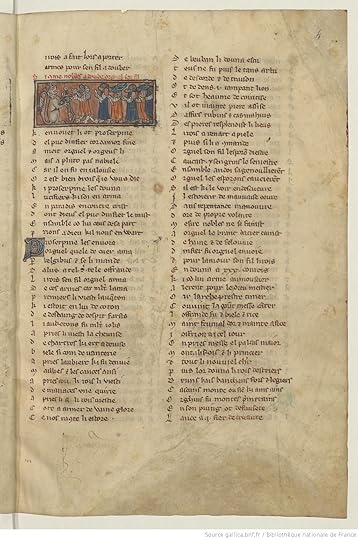
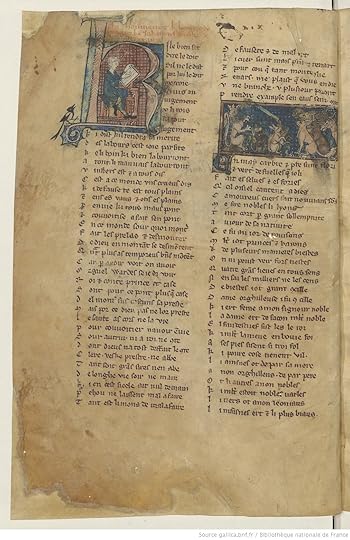
I wonder if the Decameron could be linked with the Roman de Renart ?http://gallica.bnf.fr/ark:/12148/btv1...
(view spoiler)
 Mod
Mod
http://gallica.bnf.fr/ark:/12148/btv1...
Interesting question Yann.
"The Roman de Renart (Romance of Reynard) is a series of French tales composed over a span of several years. Altogether the poem covers tens of thousands of lines and has 27 branches, or episodes. The earliest recorded branches emerged in 1170, and additions continued until 1250. About 20 different poets had a hand in writing the stories, and although the names of Pierre de Saint-Cloud, Richard of Lison, and a priest of Croix-en-Brie are linked with certain early branches, most of the writers remain anonymous.
The French tale is stylistically the most sophisticated rendition of the hugely popular tradition of Reynard the Fox, which appears elsewhere in Dutch, German, and English literature. The character of the trickster fox hails back to the fables of Aesop, but fragments of medieval Latin poems contain some source material, including Ysengrinus, written at Ghent in 1148. As with many stories from folklore, the precise origins of the Reynard characters are obscure. The names are arguably Germanic; Reynard probably derives from Raginhard, which means "strong in counsel." The German Reinhart manuscript, dated to 1180, and the Flemish variations of the stories likely draw on now-lost French originals that first circulated in the region of Alsace-Lorraine. The 13th-century English poem Of the Fox and of the Wolf and the Italian Rainardo also used the Reynard material. The trouvères (Troubadours) of northern France developed these popular folktales into a work that is at once a fabulous epic bestiary and a political allegory, cultural commentary and verse romance, fireside story and literary parody.
Like many other French romances, Renart circulated beyond France into England, Germany, and the Low Countries (modern Belgium, Luxembourg, and the Netherlands), where several analogues or similar stories appear. An episode borrowed from the Reynard tradition appears in The Nun's Priest's Tale in The Canterbury Tales of Geoffrey Chaucer, where the protagonist of the story is Chanticleer the rooster and Russell is the name of the wily fox. William Caxton's History of Reynard the Fox, based on a Dutch version, appeared in 1481. Goethe reworked the material into Reinecke Fuchs in 1794, and the English poet John Masefield's hunting poem Reynard the Fox appeared in 1921, attesting to the continuing folkloric memory and comic appeal of this immortal and charismatic trickster."
To read more:http://www.fofweb.com/History/HistRef...

Divine Comedy + Decameron
Books mentioned in this topic
La Fiammetta (other topics)La Fiammetta (other topics)
La Fiammetta (other topics)
La Fiammetta (other topics)
La Fiammetta (other topics)
More...
