
The History Book Club discussion
RUSSIA
>
RUSSIAN REVOLUTION
date newest »
newest »
 Mod
Mod
Video: https://youtu.be/2VldXUyCaeQ
Source: Youtube
Mod
 by
by
 Orlando Figes
Synopsis:
It is history on an epic yet human scale. Vast in scope, exhaustive in original research, written with passion, narrative skill, and human sympathy, A People's Tragedy is a profound account of the Russian Revolution for a new generation. Many consider the Russian Revolution to be the most significant event of the twentieth century.
Distinguished scholar Orlando Figes presents a panorama of Russian society on the eve of that revolution, and then narrates the story of how these social forces were violently erased. Within the broad stokes of war and revolution are miniature histories of individuals, in which Figes follows the main players' fortunes as they saw their hopes die and their world crash into ruins. Unlike previous accounts that trace the origins of the revolution to overreaching political forces and ideals, Figes argues that the failure of democracy in 1917 was deeply rooted in Russian culture and social history and that what had started as a people's revolution contained the seeds of its degeneration into violence and dictatorship.
A People's Tragedy is a masterful and original synthesis by a mature scholar, presented in a compelling and accessibly human narrative.
 The amazing circumstances of the Russian Revolution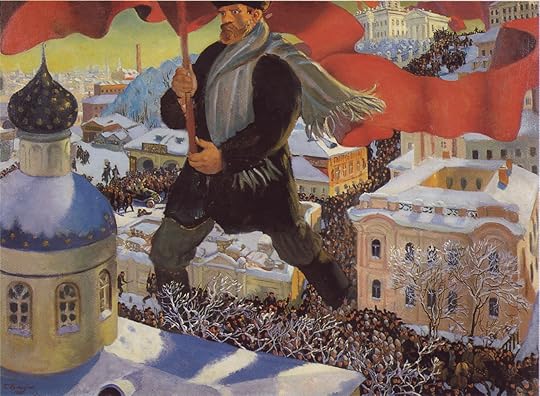
Boris Kustodiev's 1920 painting "Bolshevik." Credit: Wikimedia Commons (public domain).
This 13-minute Epic History video tells you "everything you need to know" about the people, events, and issues in Russia that contributed to the Bolshevik Revolution.
Link: https://youtu.be/cV9G1QUIm7w
More:
Biography's take on Vladimir Lenin (44-minute video)
http://www.biography.com/people/vladi...
An overview of the Bolshevik revolution and the end of the Romanov dynasty (10-minute video): https://youtu.be/VJuBX1p0Gys
Other:
Timeline of the Russian Revolution from 1887 to 1924
http://history1900s.about.com/od/Russ...
A short article on the February Revolution (March 8 - 12, 1917)
http://www.history.com/this-day-in-hi...
The Russian Civil War and consolidation of Bolshevik rule (1918 - 1920)
https://www.britannica.com/event/Russ...
Books on the Russian Revolution:
 by Richard Pipes (no photo)
by
Orlando Figes
by Richard Pipes (no photo)
by
Orlando Figes by
by
 Ivan Bunin
Discussion Topics
1) Do you feel the Romanovs deserved to be deposed?
2) Why did the Bolsheviks succeed as the dominant power despite the initial weak support among the Russian people?
Mary
Admin (T) - Russia and Russian History
Russia's RevolutionsThe 20th century brought Russia three revolutions: the 1905 Revolution, the February Revolution, and the Bolshevik Revolution. These historic events transformed Russian society, government, and economy and set the foundation for current events.

Storming the Winter Palace. Credit: Wiki Commons
The 1905 Revolution in St. Petersburg was sparked by miscommunication. Thousands of people approached the Winter Palace because they felt the tsar did not know their suffering, and wanted to inform him so he could help them. Unfortunately, nervous soldiers guarding the palace fired upon them, killing hundreds and effectively ending popular affection for the tsar. Strikes, demonstrations, and calls for political reform followed.
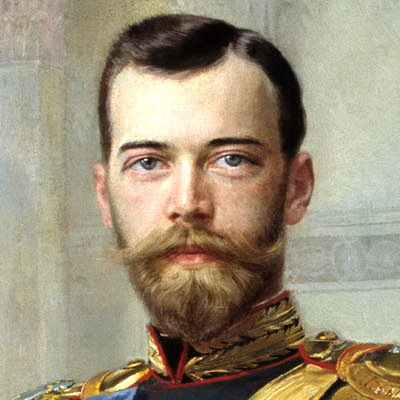
Nicholas II of Russia. Credit: Wiki Commons
Russia's participation in World War I intensified people's suffering, with widespread hunger and deprivation. Protests and strikes launched the February 1917 Revolution and brought about Tsar Nicholas II's abdication. Vladimir Lenin returned to Russia from exile to lead the Bolshevik resolution that shaped the Soviet Union.
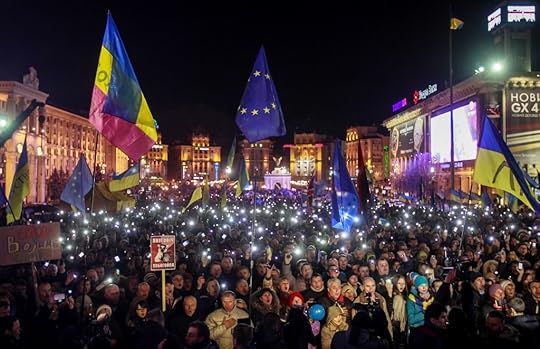
Kiev, 2013. Credit: Reuters
The Russian Roulette podcast from the Center for Strategic & International Studies discusses the February Revolution of 1917 and the 2014 Revolution in Ukraine (also known as the Revolution of Dignity or the Euromaidan Revolution) that deposed Russia-backed President Viktor Yanukovych. The revolution alarmed Russian President Vladimir Putin, who moved quickly to annex Crimea.
To take a ride through the chaos of daily life as the Bolshevik Revolution unfolded, listen to Sean's Russia Blog featuring Professor Mark Steinberg.
More:
Russian Roulette podcast: Of Revolutions, Old and New
https://soundcloud.com/csis-57169780/...
SRB podcast: Experiencing the Russian Revolution
https://soundcloud.com/sean-guillory-...
Other:
Background on the Russian Revolution
http://www.history.com/topics/russian...
The February Revolution begins
http://www.history.com/this-day-in-hi...
Revolution? What revolution? Russia asks 100 years later.
https://www.nytimes.com/2017/03/10/wo...
Discussion Topic:
1. Why do you think a democratic government failed to take hold in Russia?
2. Given the fall of the Soviet Union, is there any chance that a substantial workers' movement will re-emerge somewhere on the globe?
Mary
Admin (T) - Russia and Russian History
Mod
 by Sean McMeekin (no photo)
Synopsis:
The modern Middle East was forged in the crucible of the First World War, but few know the full story of how war actually came to the region.
As Sean McMeekin reveals in this startling reinterpretation of the war, it was neither the British nor the French but rather a small clique of Germans and Turks who thrust the Islamic world into the conflict for their own political, economic, and military ends.
"The Berlin-Baghdad Express" tells the fascinating story of how Germany exploited Ottoman pan-Islamism in order to destroy the British Empire, then the largest Islamic power in the world. Meanwhile the Young Turks harnessed themselves to German military might to avenge Turkey s hereditary enemy, Russia.
Told from the perspective of the key decision-makers on the Turco-German side, many of the most consequential events of World War I Turkey s entry into the war, Gallipoli, the Armenian massacres, the Arab revolt, and the Russian Revolution are illuminated as never before.
Drawing on a wealth of new sources, McMeekin forces us to re-examine Western interference in the Middle East and its lamentable results.
It is an epic tragicomedy of unintended consequences, as Turkish nationalists give Russia the war it desperately wants, jihad begets an Islamic insurrection in Mecca, German sabotage plots upend the Tsar delivering Turkey from Russia s yoke, and German Zionism midwifes the Balfour Declaration.
All along, the story is interwoven with the drama surrounding German efforts to complete the Berlin to Baghdad railway, the weapon designed to win the war and assure German hegemony over the Middle East.
 Hi Everyone!
 What books area a good start for those who want to start learning about the Russian Revolution?
 Mod
Mod
What books area a good start for those who want to start learning about the Russian Revolution?"
Hey, Gustavo. This is a pretty solid one-volume history:
 by
Orlando Figes
by
Orlando Figes
 As a FYI, Michael Duncan after a long hiatus has restarted his Revolutions podcast continuing with the lead up to 1917 Russian Revolution.
https://mikeduncanpodcast.com/tag/rus...
 Would Nicholas II or Michael II be considered the last Czar?
I might look up Mr Figes' book.
 Wow, Joseph, what an intricate question! Personally, I would vote for Nicholas II.
Regards,
Andrea

The History Book Club
Books mentioned in this topic
A People's Tragedy: The Russian Revolution, 1891 - 1924 (other topics)The Berlin-Baghdad Express: The Ottoman Empire and Germany’s Bid for World Power (other topics)
The Russian Revolution (other topics)
A People's Tragedy: The Russian Revolution, 1891 - 1924 (other topics)
Cursed Days: Diary of a Revolution (other topics)
More...
Authors mentioned in this topic
Orlando Figes (other topics)Sean McMeekin (other topics)
Richard Pipes (other topics)
Orlando Figes (other topics)
Ivan Bunin (other topics)
More...
"The Russian Revolution was a pair of revolutions in Russia in 1917, which dismantled the Tsarist autocracy and led to the eventual rise of the Soviet Union. The Russian Empire collapsed with the abdication of Emperor Nicholas II, and the old regime was replaced by a provisional government during the first revolution of February 1917 (March in the Gregorian calendar; the older Julian calendar was in use in Russia at the time). In the second revolution that October, the Provisional Government was removed and replaced with a communist state.
The February Revolution (March 1917) was a revolution focused around Petrograd (now Saint Petersburg), then capital of Russia. In the chaos, members of the Imperial parliament (the Duma) assumed control of the country, forming the Russian Provisional Government. The army leadership felt they did not have the means to suppress the revolution, resulting in Nicholas's abdication. The Soviets (workers' councils), which were led by more radical socialist factions, initially permitted the Provisional Government to rule, but insisted on a prerogative to influence the government and control various militias.
The February Revolution took place in the context of heavy military setbacks during the First World War (1914–18), which left much of the Russian Army in a state of mutiny.
A period of dual power ensued, during which the Provisional Government held state power while the national network of Soviets, led by socialists, had the allegiance of the lower classes and the political left. During this chaotic period there were frequent mutinies, protests and many strikes.
When the Provisional Government chose to continue fighting the war with Germany, the Bolsheviks and other socialist factions campaigned for stopping the conflict. The Bolsheviks turned workers militias under their control into the Red Guards (later the Red Army) over which they exerted substantial control.
In the October Revolution (November in the Gregorian calendar), the Bolsheviks, led by Vladimir Lenin, and the workers' Soviets overthrew the Provisional Government in Petrograd and established the Russian SFSR, eventually shifting the capital to Moscow in 1918. The Bolsheviks appointed themselves as leaders of various government ministries and seized control of the countryside, establishing the Cheka to quash dissent. To end Russia’s participation in the First World War, the Bolshevik leaders signed the Treaty of Brest-Litovsk with Germany in March 1918.
Soon after, civil war erupted among the "Reds" (Bolsheviks), the "Whites" (counter-revolutionaries), independence movements and non-Bolshevik socialists. It continued for several years, during which the Bolsheviks defeated both the Whites and all rival socialists. In this way, the Revolution paved the way for the creation of the Union of Soviet Socialist Republics (USSR) in 1922. While many notable historical events occurred in Moscow and Petrograd, there was also a visible movement in cities throughout the state, among national minorities throughout the empire and in the rural areas, where peasants took over and redistributed land.
Remainder of resource material: https://en.wikipedia.org/wiki/Russian...
Source: Wikipedia