
Well Trained Mind Readers discussion

This topic is about
Confessions
The WEM Biographies
>
Biographies: #1 - St. Augustine's Confessions

message 1:
by
Robin
(last edited May 30, 2014 04:02PM)
(new)
-
rated it 1 star
May 30, 2014 04:01PM
 Excited to start reading Augustine's Confessions, which according to SWB he was the first writer to tell the story of his life. Decided to do a refresher and read Chapter 6 in WEM about autobiography's and memoirs.
reply
|
flag
 I read it once and that was enough. I'll participate when you all are ready to discuss.
 Just got started...made it through the first few pages and now into the childhood beatings....
Okay, I am really getting into this book. Just read his reflections on the dangers of sophistry..."But what marvel that I was thus carried away to vanities...when men were set before me as models...they committed some act of barbarism (and) we censured; but when in rich and adorned in well-ordered discourse they related their own disordered life, being be praised, they gloried"
Just got started...made it through the first few pages and now into the childhood beatings....
Okay, I am really getting into this book. Just read his reflections on the dangers of sophistry..."But what marvel that I was thus carried away to vanities...when men were set before me as models...they committed some act of barbarism (and) we censured; but when in rich and adorned in well-ordered discourse they related their own disordered life, being be praised, they gloried"
 Schedule:
June 1 - 8: Book One - Book Five
June 9 - 15: Book Six - Book Eight
June 16 - 22: Book Nine - Book Ten
June 23 - 30: Book Eleven - End
For those who may be helped by having one (ie. people such as I!) :-)
I'm reading the Penguin edition translated by Gary Wills. Since this is the edition I read the first time I was looking forward to finding one by another translator. Sadly my library has mostly Wills and one, it looks like, by Philip Burton, which I've ordered. Perhaps we can post a few passages, Deborah, as we go along, just to compare the differences in translators.
 I'm reading Chadwick's translation, also, and really enjoying it.
 I have a Penguin Classics version, but it is translated by R.S. Pine-Coffin.
Bookworm R wrote: "R.S. Pine-Coffin."
I have a Penguin Classics version, but it is translated by R.S. Pine-Coffin.
Bookworm R wrote: "R.S. Pine-Coffin."Is that a joke?!!!
No, that is what it says!According to the Advisory Editor note:
R.S. Pine-Coffin, a Roman Catholic, was born in 1917. He was educated at Ampleforth and Peterhouse, Cambridge. He died in 1992.
Bookworm R wrote: "No, that is what it says!."
*** snicker **** Oh my, he must have gotten teased mercilessly about his name. I wonder what the "R.S." stands for? Never mind. I probably don't want to know ….. ;-)
I agree, Pine-Coffin....poor kid. Maybe he came from a line of coffin makers? no mistaking whom to see in town if you needed a coffin.
Deborah wrote: "Bookworm R wrote: "I have a Penguin Classics version, but it is translated by R.S. Pine-Coffin."Do you like it?"
I haven't started yet ;(
I pulled it out of the cabinet so it is nearby and plan to crack open soon.
Deborah wrote: "Cleo wrote: "I'm reading the Penguin edition translated by Gary Wills. Since this is the edition I read the first time I was looking forward to finding one by another translator. Sadly my library..."And from my version (Gary Wills):
"What does it matter if one fails to figure this out? Let such a one be content to say, How could this be? --- so long as he finds in love what he does not figure out, instead of figuring it out without finding you."
Aaaah! I can't believe the difference between Chadwick and then Wills and Outler! (I've heard it said that one should never get Barnes & Noble's books if they're translated.)
Thanks for the heads-up, Deborah. You've just saved me from being frustrated about translations. I'm heading over to Amazon directly to get the Chadwick translation. :-)
I haven't started reading yet, but to toss in the comparison I added Pine-Coffin's and copies the others to have them close for easy comparison. Maria Boulding, Translator
"What does it matter to me, if someone does not understand this? Let such a person rejoice even to ask the question, "What does this mean?" Yes, let him rejoice in that, and choose to find by not finding rather than by finding fail to find you."
R.S. Pine-Coffin, Translator
"Need it concern me if some people cannot understand this? Let them ask what it means, and be glad to ask: but they may content themselves with the question alone. For it is better for them to find you and leave the question unanswered than to find the answer without find you."
Albert C. Outler, Translator (Barnes & Noble Classics Series)
"What is it to me if someone does not understand this? Let him still rejoice and continue to ask, “What is this?” Let him also rejoice and prefer to seek you, even if he fails to find an answer, rather than to seek an answer and not find you!”
Book 1, vi (10) page 8, Henry Chadwick, Translator
"If anyone finds your simultaneity beyond his understanding, it is not for me to explain it. Let him be content to say 'What is this? (Exod. 16: 15). So too let him rejoice and delight in finding you who are beyond discovery rather than fail to find you by supposing you to be discoverable."
Gary Wills, Translator
"What does it matter if one fails to figure this out? Let such a one be content to say, How could this be? --- so long as he finds in love what he does not figure out, instead of figuring it out without finding you."
Chadwick definitely wins. There are too many pronouns in the other translations and you have to think really hard to understand to what they are referring. With the Chadwick translation, it feels like he explains more, but really, I think the writing is just better.I've been enjoying this translation immensely. I understand the flow of the book so much better. I like how Augustine starts with questioning God …… who is He …… how does He exist …… where does He exist, etc.
The passage that Deborah posted was fascinating:
“If anyone find your simultaneity beyond his understanding, it is not for me to explain it. Let him be content to say ‘What is this?’ (Exod. 16:15). So too let him rejoice and delight in finding you who are beyond discovery rather than fail to find you by supposing you to be discoverable.”
Very paradoxical that we can actually be more content by knowing less. That mentality certainly doesn't fit into our present society!
I'll be able to cheat, I have The Great Courses lecture series that goes over each book in Confessions. I'll post back later today with the info from the first lecture on the translation the professors pick and why.
Bookworm R--I want to find that Great Courses lecture series. I know there is so much in theology I don't know.
Bookworm R wrote: "I'll be able to cheat, I have The Great Courses lecture series that goes over each book in Confessions. I'll post back later today with the info from the first lecture on the translation the profes..."I have it too, but I wasn't going to cheat! Ha ha!
Seriously, I think any information would be helpful.
Finally I figured out how to see which translation I've been reading...it translated by E.B. Pusey. Maybe I should spring for the Chadwick version.
Cleo wrote: "Bookworm R wrote: "I'll be able to cheat, I have The Great Courses lecture series that goes over each book in Confessions. I'll post back later today with the info from the first lecture on the tra..."I will read each book before I listen to the lecture.
I will post link to course in bit, on road.
On tablet instead of phone now, so here is link to lecture series...St. Augustine Confessions.Their religion courses happen to be 70% off right now, but I always suggest checking your library or look into getting an Audible plan. I got a plan for the sole purpose of snagging Great Courses, as they offer them for 1 credit, so it works out to be a much cheaper option to acquire lecture series.
I wonder if anyone has counted how many questions Augustine asks in this book? (perhaps this is a job for Bookworm R, if she has the time). It's amazing. I love how a highly intelligent, respected bishop would have a million questions …… almost like a little child. It's just wonderful!
Seriously? LOLI think you will have time on your retreat. ;)
Can anyone tell me where I put my headphones? I want to listen to the first lecture. ..... I think I left them in the car darn it.
Deborah wrote: "The meaning of the passage, for me, is not being content in knowing less, but asking "What is this?" and still moving forward while waiting for understanding. …"I like your comment, "waiting for understanding." I think that's crucial.
Perhaps not "knowing less," but what really stuck me from this passage is that we have to be content if we don't get all the answers. The person searching can "find" God on a certain level, but there is the paradox of God being "undiscoverable." Or perhaps it's finding that He is undiscoverable.
What do you think "fail to find you by supposing you to be discoverable.” means? If we suppose God to be discoverable and He is not, are we then looking for a phantasma that doesn't exist, therefore He is impossible to find?
Deborah wrote: "The way I understand "fail to find you by supposing you to be discoverable" is that we may be frustrated in our effort to find God if we think we can be put him in a box. But we'll find contentment, if we understand that God has endless breadth and depth, and we'll unceasingly discover new things concerning him.
It's difficult to put in words. How do you understand it?
Argh! Goodreads just swallowed my comment!
Here it is again:
I like your explanation. I wonder if there is an element of arrogance in trying to discover the unknowable. Sort of like science thinking it can discover everything to know about human life (and therefore its Creator). I don't know and the text doesn't seem to give us a clue. In any case, it's interesting to think about. Augustine has many of these gems in his Confessions; his questions just seem to bring up more questions.
Deborah wrote: "Deborah wrote: "Cleo wrote: "Deborah wrote: "The meaning of the passage, for me, is not being content in knowing less, but asking "What is this?" and still moving forward while waiting for undersea..."Ah! Perfect! :-) I think that's it exactly!
So, the Great Courses is using a translation by Maria Boulding.I have added her translation to the top of my original post with the other translations for the phrase we used.
Oh, I found Maria's translation a little confusing. Too many paradoxes for my poor little brain!I'm going to try to listen to some of the lectures this week. I'm at about 25% through the book.
Slowly making my way forward, only read 10 of the Chapters in Book I so far.Yes, lots of questions. I equate this to his age at the time, this section is said to be written as a young teenager. He also grew up with a pagan father and a devout Christian mother. He likely was in turmoil to reconcile the differences between his father and mother's beliefs. He is asking all the questions that come to his mind, why is his mothers route correct?
I won't listen to the lecture for Book One until I have completed the reading for it. So I don't have a definite answer on how I am liking the series yet. However, The Great Courses ones usually are very informative, so I'm sure it will be helpful.
Did anyone get to Book VII: Evil is non-existent? Is Augustine saying that evil is the absence of good? What does he mean: There is no evil? Just curious is anyone had a better understanding.
Great thoughts, Deborah. C.S. Lewis talks about this Platonic theme in one of his books ……… I think it was either in The Problem of Pain or Miracles but I can't remember which …..
Perfect. I got it. I was thrown off by the message that there is no evil. There is...it is just like negative space in art. The absence of light is darkness. Etc. Thanks!
Cleo wrote: "Great thoughts, Deborah. C.S. Lewis talks about this Platonic theme in one of his books ……… I think it was either in The Problem of Pain or Miracles but I can't remembe..."
Yes, I think it was immediately following this explanation of evil.
Ruth (A Great Book Study) wrote: "There is...it is just like negative space in art. The absence of light is darkness. Etc. "Ooo, I like this! I hadn't thought about it that way!
Wow! I just read the part (Book VI) where Augustine was betrothed to a girl two years under marriageable age. My notes say that marriageable age in Rome was 12 years old, therefore she must have been 10. And he is now 30 years old. That is just …….. hard to get my head around ……
Augustine thinking of God as occupying a space seems odd but then again, perhaps not so odd. It reminds me of Dante's levels of Heaven in The Divine Comedy.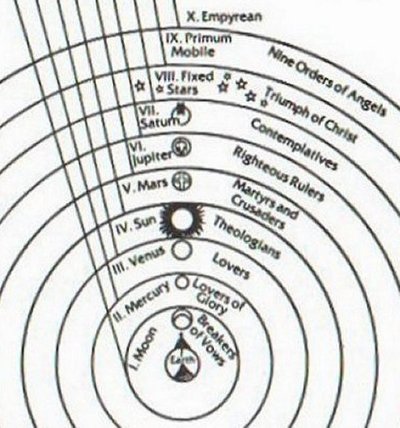
Also when depicting Heaven, many paintings of the Renaissance are levelled or ordered.
Rats, I couldn't get the painting to show up but here's the link to it.
Cleo wrote: "Wow! I just read the part (Book VI) where Augustine was betrothed to a girl two years under marriageable age. My notes say that marriageable age in Rome was 12 years old, therefore she must have ..."Yeah, that made my head spin a few times.
As a modern reader, I have a hard time understanding Augustine's angst in trying to figure out a form for God. Do any of you feel the need to understand what God looks like, what form he takes .....??? I wonder if this desire stems from Augustine's intellect. He is so intelligent and well-read, that perhaps this is something else that he needs to know. The thought of God as a large sponge was unique!
I do understand his urge to know where evil comes from. This is still a universal question. And I love Augustine's unselfconscious eagerness to ask questions. A wonderful trait to have!
Deborah wrote: "I wonder if Augustine is so consumed with the form of God is because he's trying to show that God isn't corporeal, but a spirit? It seems like he says that at one point, but I can't remember. :)"Hmmm ..... you're probably on to something. He's going from God being contained to God containing everything and then he moves on to evil, so I'm not quite sure where he's going. I'll just keep reading. His intellect far surpasses mine so perhaps understanding him is too much to ask. *** grin ***
I am missing out, it seems! Diving back into the book again tomorrow!
I am on Book 8. I am having some trouble with a passage.." But I being weak, chose the more indulgent place; and because of this alone.....I was constrained against my will to conform myself to a married life, to which I was given up and enthralled." My interpretation is that he is struggling to be chaste. Thoughts?
Do you know where in Chapter 8 the passage is? It's quite a long chapter and I'm on my Kindle, so it's not easy to flip.
Cleo, it is near the beginning if Book 8...three pages in. I'm reading in Kindle, too. My one complaint about using it is that it is hard to locate passages and pages; it may be worth the inconvenience because it saves me from buying another bookshelf.
Lisa wrote: "Cleo, it is near the beginning if Book 8...three pages in. I'm reading in Kindle, too. My one complaint about using it is that it is hard to locate passages and pages; it may be worth the inconve…"Thanks, Lisa. My translation says:
"But I being weaker chose a softer option, and because of this one factor I was inconstant in other respects and was wasting away with nagging anxieties. Moreover, there were other matters which were a tiresome distraction to me, but which I was compelled to put up with because they go with married life; once tied by that, I was restricted."
Interesting comparing the two translations. "Restricted" and "enthralled" have two different connotations. Nevertheless, I think that you're right. He mentions Paul and implies that Paul's choice in life (unmarried) was better. While he seemed to mention the physical aspect of his attachment to his "wife" earlier, now it seems that there are also other married-type habits that he is feeling restricts he ability to completely give himself to God. So I think chasteness is part of it, but I felt like, as his conversion became closer to being a reality, it became even more than that. Does that help?
Deborah wrote: "I guess I should of said convert to the Catholic faith, because the Manicheans were considered Christian too, right?"I don't think that Manicheans would be classified as Christians, at least not by Christians/Catholics, KWIM? Augustine clearly condemns their beliefs and thought process, as he later does the Arians. The Manicheans denied main Christian doctorine, so I think they would have been looked at as heretics. The Arians appear to be closer in their beliefs to Christians than the Manicheans, but conflict with them eventually brought about the Council of Nicaea, where the Nicene Creed was drawn up, to firmly establish common Christian beliefs.
I know that I sound like I know what I'm talking about, but that is basically what I think. ;-) Do we have any theology experts who have any other information?
Deborah wrote: "Cleo, here's a link to a short history of Manichaeanism that I found: http://www.earlychristianhistory.info..."Thanks, Deborah. What was very helpful. Generally that's pretty much what I thought but gives me much more information. Very interesting!
The title "Early Christian History" is misleading though. Since Christianity is centered around Christ and Manicheans beliefs about him seemed to different wildly from the Christian beliefs. There were a number of Gnostic faiths floating around at this time and while they certainly borrowed from Christianity, I don't think one can say they were a type of it. To me, it's like lumping Christians with Jews, or Muslims with Christians AND Jews. I don't think Jews would agree with the former, or Christians and Jews agree with the latter (or now modern Muslims either).
Wow, this makes me think that I need to go and read some church history and basic history from that time period. I've read On the Incarnation so that's how I know what the Church was facing with other religious sects, but other than that, that's it!
I just finished Book 9. It is hard to flip back in my Kindle, but am I correct in the understanding that his Christian mother was punished by being led to marry an abusive Manichean for calling out a servant of the family for drinking wine?
Thanks Deborah! I should not try to read as I did this morning with so many distractions... I got that his father could be angry (choleric), someone developed an affinity for wine, and that his mother died with his son in attendance. This is NOT beach side reading!
Deborah wrote: "You're welcome, Cleo. I understand what you mean, but what I was trying to understand is if the Manichaeans considered themselves Christians, at this time in history. In my understanding they did,..."Deborah wrote: "I finally found an answer to my question about the Manichaeans being Christian in a footnote in Confessions...
"The Manichees claimed to be authentic Christians, orthodox church members having in …"
Did you find the note in the text clear? It seemed sort of ambiguous to me. What "orthodox church members"? Of the Manicheans? That wouldn't make sense. It seems to refer to someone else (possibly Catholics) but it's not apparent.
I think the operative word is "claimed". I'm sure they thought they were the true Christian faith. Yet, there were many sects that "claimed" to be the true religion. I do think that the Manicheans viewed themselves as Christians, but I don't think "Christians" viewed them in that way.
Augustine spent most of his life vehemently refuting their teaching on certain points. Since he had led some of his friends to that religion he felt responsible to repudiate what he had earlier endorsed. Particular issues were authority of scripture, the free will of man and the origin of evil. And he also refuted teachings of the Donatists and the Pelagians. If I remember from my theology class, there were so many sects claiming to be "the one" and it doesn't make sense to me, particularly with hindsight, to label them all Christian (even historically), especially since the Church Fathers (like Augustine) would not. And Paul would certainly have thought their teachings heretical.
ETA:
I hate using the internet for research, but I did find this:
"Mani was eager to describe himself as a "disciple of Jesus Christ", but the early Christian church rejected him as a heretic."
I hope that helps. Their beliefs, while they accepted much of the New Testament, were pretty wild, adding all sorts of interesting aspects. They seem to have borrowed from Zoroastrianism.
Sigh! Whenever I read, I always am so aware of how much I don't know! And there's always something else to learn about!

Well Trained Mind Readers
Books mentioned in this topic
On the Incarnation (other topics)The Divine Comedy: Inferno - Purgatorio - Paradiso (other topics)
The Problem of Pain (other topics)
Miracles (other topics)
The Problem of Pain (other topics)
More...

#mediaviewer/File:Francesco_Botticini_-_The_Assumption_of_the_Virgin.jpg)