
The Old Curiosity Club discussion

This topic is about
Great Expectations
Great Expectations
>
GE, Chapters 36-37

 Mod
Mod
Is Herbert really the only one to whom his expectations have done some good?
The chapter then closes on a masterpiece of a cliff-hanger, namely on this one:
”A great event in my life, the turning point of my life, now opens on my view. But, before I proceed to narrate it, and before I pass on to all the changes it involved, I must give one chapter to Estella. It is not much to give to the theme that so long filled my heart.”
 Mod
Mod
Chpater 36 marks a very important event in Pip’s life, namely his coming of age. He has been looking forward to that day, because he thought that maybe, Jaggers would now divulge t..."
This chapter puts the spotlight squarely on Pip and Mr Jaggers. Pip is eager to get on with the next step in his expectations which he believes will be the grand reveal of his benefactor and, somehow, it appears as if this will answer all of Pip's life's questions and desires. Jaggers, on the other hand, is completely professional, and even seems overly cautious when discussing Pip's benefactor and how Jaggers will step completely aside when the benefactor is revealed.
I note your question Tristram. It does seem out of place to have Pip refer/remember back to his childhood and the events in the graveyard with the escaped convict. The act of being immobilized on a tombstone seems far removed from gaining the age of majority and being given £ 500. A loose thread, or Dickens raising a spector of the past? ...
Mod
So far in the novel we have seen little to make Pip a very likeable chap. Self-indulgent, often insensitive to others and, at times, unaware of his own acts of social cruelty, Pip sees himself as the future knight that will win Estella's heart. With the candour and even bluntness that Estella has spoken to and demonstrated towards Pip, it is hard to believe that he still persists in his self-induced belief that Estella will one day be his.
It is therefore critically important to pause and reflect upon Pip's open-hearted and thoughtful consideration of Herbert. This is a true act of thoughtfulness towards another person and much different from the barrel of oysters that was no more than a crude payment to the forge to assuage his own guilt.
So why would Dickens mark such a rapid change in Pip's personality? How can gifting money to another make your own life more secure or pay off the debts that both Pip and Herbert have accumulated? Pip's anonymous gift to Herbert is not a guilt-gift. There must be a reason that involves the plot. How can Pip's charity fit within what we know of Pip's character?
I think part of the answer resides in Walworth and I believe Dickens is using Walworth as both a symbol of what is occurring to this point in the novel as well as foreshadowing what will occur later in the novel. While Wemmick sees the action of Pip as being totally unreasonable in the city, in Walworth there are other sentiments. While Wemmick does not offer any help in London, he will, and does, offer help to Pip in Walworth. When Pip goes to Walworth the reader meets Miss Skiffins who is Mr Wemmick's lady friend. This plot development may seem inconsequential, but the humour of their very bland intimacy is important to the plot for it is the first time we have encountered a couple that accept each other for who they are without the crisis of class-consciousness that exists with Herbert's parents, the dysfunctional marriage of Jo and Mrs Jo, or the angst and fairy-tale horror of Miss Havisham.
Therefore, Chapter XXXVII is a keystone point in the novel. We see Pip being thoughtful, we see a couple who appear to be sincerely attached to one another, we learn that Wemmick has made arrangements for Herbert to gain work with Clarriker and thus receive, in another manner, his own great expectations. Pip recounts that "secret articles were signed of which Herbert was the subject , and I paid him half of my five hundred pounds." What this means is that Pip has become a secret benefactor to Herbert while Pip himself awaits to find out who his benefactor will be. There is an elegant balance of events being arranged in this chapter that might well have further implications. ...
 The Redemption of Pip has begun! I love the parallel that Peter pointed out - i.e. that Pip has become a secret benefactor with the money given to him by a secret benefactor. An "elegant balance" indeed!
 I'm intrigued by Tristram's question - Is Herbert really the only one to whom his expectations have done some good? The fact that you've raised the question implies that you have some thoughts on the matter. But other than the many shopkeepers, etc. to whom Pip is indebted, I can think of no one. Even his servant, while getting some income, is in an unfulfilling, dead end job. I look forward to hearing more discussion on this!
PS Perhaps Tristram refers to our mysterious benefactor. Pip certainly has done himself good by becoming Herbert's benefactor. Maybe there is some redemption going on with Pip's benefactor as well?
Mod
 Mod
Mod
He fell and hit his head that's the only thing I can think of. And for Pip it would have taken quite a blow to change him from what he is to what we would like him to be. Perhaps he fell down the stairs.
Mod

"The responsible duty of making the toast was delegated to the Aged"
John McLenan
1861
Text Illustrated:
"After a little further conversation to the same effect, we returned into the Castle where we found Miss Skiffins preparing tea. The responsible duty of making the toast was delegated to the Aged, and that excellent old gentleman was so intent upon it that he seemed to me in some danger of melting his eyes. It was no nominal meal that we were going to make, but a vigorous reality. The Aged prepared such a hay-stack of buttered toast, that I could scarcely see him over it as it simmered on an iron stand hooked on to the top-bar; while Miss Skiffins brewed such a jorum of tea, that the pig in the back premises became strongly excited, and repeatedly expressed his desire to participate in the entertainment."
Commentary:
The Aged P., Mr. Wemmick's father, is stationed at the hearth of Wemmick's "castle," a grandiosely renovated cottage in the London suburb of Walworth. The old man in McLenan's domestic setting wears a skull cap and slippers, suggesting that he is housebound or an invalid. About all of this, confides John Wemmick, his employer knows absolutely nothing. The responsible duty of making the toast was delegated to the Aged somewhat surprisingly does not show the vistor (Pip), John Wemmick, or his fiancée, Miss Skiffins in this cozy, fireside familial scene that smacks of Victorian sentimentality.
Mod

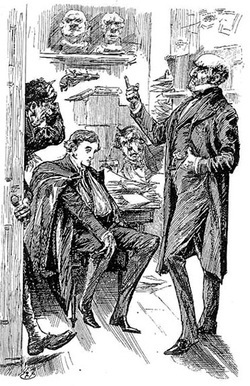
Pip in Mr. Jaggers's Office
Chapter 36
Charles Green
1877
Dickens's Great Expectations, Gadshill Edition
The Annotated Dickens provides the following caption, which is not in the original Gadshill Edition: 'Now, my young friend,' my guardian began.'" (Ch. 36).
Text Illustrated:
"In the outer office Wemmick offered me his congratulations, and incidentally rubbed the side of his nose with a folded piece of tissue-paper that I liked the look of. But he said nothing respecting it, and motioned me with a nod into my guardian’s room. It was November, and my guardian was standing before his fire leaning his back against the chimney-piece, with his hands under his coattails.
“Well, Pip,” said he, “I must call you Mr. Pip to-day. Congratulations, Mr. Pip.”
We shook hands,—he was always a remarkably short shaker,—and I thanked him.
“Take a chair, Mr. Pip,” said my guardian.
As I sat down, and he preserved his attitude and bent his brows at his boots, I felt at a disadvantage, which reminded me of that old time when I had been put upon a tombstone. The two ghastly casts on the shelf were not far from him, and their expression was as if they were making a stupid apoplectic attempt to attend to the conversation.
“Now my young friend,” my guardian began, as if I were a witness in the box, “I am going to have a word or two with you.”
“If you please, sir.”
“What do you suppose,” said Mr. Jaggers, bending forward to look at the ground, and then throwing his head back to look at the ceiling,—“what do you suppose you are living at the rate of?”
“At the rate of, sir?”
“At,” repeated Mr. Jaggers, still looking at the ceiling, “the—rate—of?” And then looked all round the room, and paused with his pocket-handkerchief in his hand, half-way to his nose.
I had looked into my affairs so often, that I had thoroughly destroyed any slight notion I might ever have had of their bearings. Reluctantly, I confessed myself quite unable to answer the question. This reply seemed agreeable to Mr. Jaggers, who said, “I thought so!” and blew his nose with an air of satisfaction.
“Now, I have asked you a question, my friend,” said Mr. Jaggers. “Have you anything to ask me?”
“Of course it would be a great relief to me to ask you several questions, sir; but I remember your prohibition.”
“Ask one,” said Mr. Jaggers.
“Is my benefactor to be made known to me to-day?”
“No. Ask another.”
“Is that confidence to be imparted to me soon?”
“Waive that, a moment,” said Mr. Jaggers, “and ask another.”
Mod

Pip Watches Wemmick and Miss Skiffins
Chapter 37
Harry Furniss
1910
Dickens's Great Expectations, Charles Dickens Library Edition
Text Illustrated:
"We ate the whole of the toast, and drank tea in proportion, and it was delightful to see how warm and greasy we all got after it. The Aged especially, might have passed for some clean old chief of a savage tribe, just oiled. After a short pause of repose, Miss Skiffins—in the absence of the little servant who, it seemed, retired to the bosom of her family on Sunday afternoons—washed up the tea-things, in a trifling lady-like amateur manner that compromised none of us. Then, she put on her gloves again, and we drew round the fire, and Wemmick said, “Now, Aged Parent, tip us the paper.”
Wemmick explained to me while the Aged got his spectacles out, that this was according to custom, and that it gave the old gentleman infinite satisfaction to read the news aloud. “I won’t offer an apology,” said Wemmick, “for he isn’t capable of many pleasures—are you, Aged P.?”
“All right, John, all right,” returned the old man, seeing himself spoken to.
“Only tip him a nod every now and then when he looks off his paper,” said Wemmick, “and he’ll be as happy as a king. We are all attention, Aged One.”
“All right, John, all right!” returned the cheerful old man, so busy and so pleased, that it really was quite charming.
The Aged’s reading reminded me of the classes at Mr. Wopsle’s great-aunt’s, with the pleasanter peculiarity that it seemed to come through a keyhole. As he wanted the candles close to him, and as he was always on the verge of putting either his head or the newspaper into them, he required as much watching as a powder-mill. But Wemmick was equally untiring and gentle in his vigilance, and the Aged read on, quite unconscious of his many rescues. Whenever he looked at us, we all expressed the greatest interest and amazement, and nodded until he resumed again."
Mod
Now, would that be fall down the stairs with his boots on? :-))
Mod
And yet again, you gift us with illustrations. Thank you.
It is by now obvious that my sympathy and pleasure comes from the Furniss illustrations. One of the reasons is the amount of detail that Furniss provides the reader/viewer. We have within these three different examples three distinctly different styles.
The McLenan is enjoyable. I think the illustration captures the mood of the scene described and the intensity that the Aged Parent has as he prepares the toast. The fact that he is in partial shadow yet highlighted by the bright fire projects a feeling of warmth and family into the Walworth property.
The Charles Green is reminiscent of a photograph. Its style is at once both the most clear and the most bland. With the exception of the death masks that watch over the discussion between Jaggers and Pip, everything else seems wooden, posed, and cold. Perhaps that was Green's purpose because Jaggers is a rather distant man, but I think it is the format of style in the illustration that conveys this feeling the most.
Then, of course, is Furniss, who is closest in style to Phiz although the date of his illustrations takes us more than 50 years forward from the McLenan example. In Furniss, however, we get a richness of detail like we experienced with Phiz. As our eye looks at the illustration we see the Wemmick-Skiffins vignette, the Aged P and then Pip who, like us, is watching the domestic scene play out in front of him. I really liked how Furniss established the scene so we look over Pip's shoulder and into the room. This perspective gives us a feeling of intimacy which does not exist in the other illustrations. This illustration projects a feeling of domestic happiness and emotional attachment. These emotions are poignant and intensified as we realize that Pip is a spectator, not a participant within this or any other domestic scene.
 Mod
Mod
Why does this particular memory haunt Pip at such a moment of his life?"
The more "readerly" question is why does Dickens have Pip have this particular memory arise at the moment in his life. It's a strange episode to recall, so Dickens presumably had some reason for it. Maybe we'll see why before too long. Perhaps it's going to have something to do with finding out who killed Mrs. Joe, still a loose end?
Mod
Spoken like a true lawyer.
Mod
It is therefore critically important to pause and reflect upon Pip's open-hearted and thoughtful consideration of Herbert. This is a true act of thoughtfulness towards another person and much different from the barrel of oysters that was no more than a crude payment to the forge to assuage his own guilt. "
Well, perhaps. But it could be another example of Pip's irresponsibility about money. He has, as was pointed out, probably more the the 500 pounds in debts already, or close to that, he has to live on this money for a year, but does he take any thought of the future? No. He is going to throw a chunk of money at a person he has, so far as we know, never met, in a quixotic gesture of friendship, to involve Herbert in a venture for which Herbert, as far as we can see, has no aptitude.
Warm-hearted, perhaps. But foolish and irresponsible? Definitely, in my view.
Mod
“What do you suppose,” said Mr. Jaggers, bending forward to look at the ground, and then throwing his head back to look at the ceiling,—“what do you suppose you are living at the rate of?”
“At the rate of, sir?”...
I had looked into my affairs so often, that I had thoroughly destroyed any slight notion I might ever have had of their bearings. Reluctantly, I confessed myself quite unable to answer the question. This reply seemed agreeable to Mr. Jaggers, who said, “I thought so!” and blew his nose with an air of satisfaction. "
Pip has no idea what his annual expenses are, what his debts are, what the 500 pounds will and will not cover, and admits as such, but before bothering to figure any of that out he's going to throw a bunch of the money at a complete speculation. And if Herbert, as we can reasonably expect, comes down crash, there goes the money, and is Herbert any better off?
And note that he uses the money for his new friend, and not a penny goes back to Joe and the forge in gratitude for all Joe did for him over the years. No, when he is in a position to help Joe, does he? Not our Pip.
Sorry, Peter, but I don't consider this a positive comment on Pip's development.
Mod
Chapter 20
Text Illustrated:
"My guardian then took me into his own room, and while he lunched, standing, from a sandwich-box and a pocket-flask of sherry (he seemed to bully his very sandwich as he ate it), informed me what arrangements he had made for me. I was to go to “Barnard’s Inn,” to young Mr. Pocket’s rooms, where a bed had been sent in for my accommodation; I was to remain with young Mr. Pocket until Monday; on Monday I was to go with him to his father’s house on a visit, that I might try how I liked it. Also, I was told what my allowance was to be,—it was a very liberal one,—and had handed to me from one of my guardian’s drawers, the cards of certain tradesmen with whom I was to deal for all kinds of clothes, and such other things as I could in reason want. “You will find your credit good, Mr. Pip,” said my guardian, whose flask of sherry smelt like a whole caskful, as he hastily refreshed himself, “but I shall by this means be able to check your bills, and to pull you up if I find you outrunning the constable. Of course you’ll go wrong somehow, but that’s no fault of mine.”
or..................................
Chapter 36
Text Illustrated:
“Well, Pip,” said he, “I must call you Mr. Pip to-day. Congratulations, Mr. Pip.”
We shook hands,—he was always a remarkably short shaker,—and I thanked him.
“Take a chair, Mr. Pip,” said my guardian.
As I sat down, and he preserved his attitude and bent his brows at his boots, I felt at a disadvantage, which reminded me of that old time when I had been put upon a tombstone. The two ghastly casts on the shelf were not far from him, and their expression was as if they were making a stupid apoplectic attempt to attend to the conversation.
“Now my young friend,” my guardian began, as if I were a witness in the box, “I am going to have a word or two with you.”
“If you please, sir.”
“What do you suppose,” said Mr. Jaggers, bending forward to look at the ground, and then throwing his head back to look at the ceiling,—“what do you suppose you are living at the rate of?”
“At the rate of, sir?”
“At,” repeated Mr. Jaggers, still looking at the ceiling, “the—rate—of?” And then looked all round the room, and paused with his pocket-handkerchief in his hand, half-way to his nose.
I had looked into my affairs so often, that I had thoroughly destroyed any slight notion I might ever have had of their bearings. Reluctantly, I confessed myself quite unable to answer the question. This reply seemed agreeable to Mr. Jaggers, who said, “I thought so!” and blew his nose with an air of satisfaction.
“Now, I have asked you a question, my friend,” said Mr. Jaggers. “Have you anything to ask me?”
“Of course it would be a great relief to me to ask you several questions, sir; but I remember your prohibition.”
“Ask one,” said Mr. Jaggers.
“Is my benefactor to be made known to me to-day?”
“No. Ask another.”
“Is that confidence to be imparted to me soon?”
“Waive that, a moment,” said Mr. Jaggers, “and ask another.”
Mod
I don't know about savage tribes, but Greek athletes used to anoint their bodies with olive oil, and then strip it off with a strigil. (There's another new word for you, Tristram, to go with dweeb!)
I wonder whether this is what Dickens is referring to?
Mod
“What do you suppose,” said Mr. Jaggers, bending forward to look at the ground, and then throwing his head back to look at the ceilin..."
Pip's conversion would not be believable if Dickens had Pip begin his generosity with Joe. Herbert is the most logical choice. Herbert is not a perfect example of financial responsibility, but we are at a point in the plot where Dickens needs to open the possibility of Pip's redemption. We are witnessing more instances of the mature voice of the narrator and with this structural shift we need a corresponding person to reflect Pip's introductory steps of conversion. For Pip to help Joe at this point in the novel would not make sense structurally.
Funding Herbert anonymously is a first step. Is it a leap of faith or a foolish action? We can only discuss the plot to where we are now, but again, consider how we now have a second set of great expectations with Herbert now freshly embarked on his career. Each person's great expectations is based on a secret. Interesting structural style on Dickens's part.
Further, with the incorporation of Wemmick in the plot Dickens has given himself a character who can represent two separate worlds of thought, ethics and morality. Dickens has already firmly established Wemmick's binary nature. The Walworth Wemmick's opinion on business is a combination of his hard-headed London-Jaggers world and his Walworth sensibility.
Pip, with baby steps, is starting a long journey and will, no doubt, encounter major obstacles, but each step will be a step where Dickens moves the plot and Pip forward towards a person who is more likeable than he is now.
Mod
I'm sure we will be in for some revelations in the last third of the book. As has already been said by one of our club members, Dickens is not the author to leave any loose ends - at least not the later Dickens -, and then in most of his novels we find the past influencing the present in ways no-one would have anticipated. Gloomy, gloomy.
Mod
Peter,
That's a very interesting parallel, which has never occurred in that light to me. I'd like to add, now that I thought a bit about it all, that there is one little difference in that while Pip knows that he has great expectations, that something is in store for him - he thinks of being married with Estella - and that he is the focus of somebody's benevolence, Herbert, on the other hand, has no idea of being supported by a benefactor but thinks that his success is all based on his ability to look about himself. Maybe, this will bring Herbert's best qualities even more to light, encourage him to work and to avoid future debts - whereas in Pip's case, his poorer qualities began to show when he was singled out for greatness and knew that he was.
Mod
That might depend on how the benefactor is and what his or her motives are. If it is Miss Havisham, we can say that ultimately, Pip's expectations, raised by her, might do her no good because while they help her further her plans of revenge, they entrap her more and more in her feelings of bitterness and spite.
Mod
No, with his boots off and tumbling down the stairs after him to finally land on his head :-)
Mod
It is therefore critically important to pause and reflect upon Pip's open-hearted and thoughtful consideration of Herbert. This is a true act of thoughtfulness towards another person..."
To be honest, those were exactly my thoughts when I reread the passage. I said to myself, "Pip already has quite a large amount of debts, so why does he not use part of the money to make good these debts and the larger amount to make sure that he will not run into new debts? - I think Dickens wants to point out here that Pip has the feeling that his own example induced Herbert to stray into a less orderly way of living and that he feels responsible for him. Had I been Pip, I would have used the 500 Pounds to get myself out of debt and my financial matters in order, first - but then I would not have run into debt in the first place.
We will see if Pip's generous (although uncautious) decision will not prove a clever thing to have done in the end.
Mod
I used to do Latin at school, and also learned about the ancient Greek, and that's why "dweeb" in fact is newer to me than "strigil" :-)
Mod
“What do you suppose,” said Mr. Jaggers, bending forward to look at the ground, and then throwing his head back to l..."
You argued very convincingly from the point of view of how a novelist would go about making Pip's moral development more believable. One could also add that it is more natural for Pip to help Herbert than Joe because Joe obviously does not need as much help as Herbert does. For all we know, Joe does not lack anything he wants, a smith being a respected and probably also remunerative trade. Were Pip to help Joe, it could probably not be done anonymously, and therefore Joe would not accept any financial aid from Pip, nor would he actually need it.
As to Herbert, Pip probably feels more called on to help his friend as he cannot deny to himself that he alone is responsible for his friend having fallen into bad habits. So, Pip tries to undo some of the harm he has thoughtlessly created with his great expectations.
Tristram wrote: "One could also add that it is more natural for Pip to help Herbert than Joe because Joe obviously does not need as much help as Herbert does."If Pip had used his money to "help" Joe, it wouldn't have been altruistic, as it seems to be with Herbert. As you said, Joe has all he needs and Pip's "help" would have been motivated by his own pride, and the shame Pip feels for Joe and his own upbringing. Such a gift would have been condescending and an insult - certainly not a step toward redemption.
Mod
You cannot lead someone into bad habits who isn't eager to go there. And actually, Herbert already has the bad habit of not working but "looking around" incessantly while who knows what he's living on. He is not the most responsible of people. (Nor, of course, is Pip. The two of them together make a very bad combination.)
Mod
Mod
That's true: Herbert is a very weak and impressionable person but still, before Pip arrived on the scene, he was pretty much out of harm's way and had Pip not behaved so irresponsibly, Herbert would not have followed his examples. And this is probably what Pip thinks - that he is, in some way, responsible for Herbert's falling into debts. And if Herbert is partly to blame himself, which he is, isn't it even more noble in Pip to have helped him?
 I love all these descriptions of Pip's various visits to Wemmick's home in Walworth. And the description of Wemmick's outrageous flirting with Miss Skiffins, his lady friend, was hilarious! Their postbox smiles :D
Tristram speculated: Is Herbert really the only one to whom his expectations have done some good?
I love all these descriptions of Pip's various visits to Wemmick's home in Walworth. And the description of Wemmick's outrageous flirting with Miss Skiffins, his lady friend, was hilarious! Their postbox smiles :D
Tristram speculated: Is Herbert really the only one to whom his expectations have done some good?I've been thinking quite a lot about the developing character of Pip
Kim's post in the ch 30-31 thread, where she quotes G.K. Chesterton hit the nail on the head I think. What's intriguing me about this is the different and melding voices of Pip, through to the fully adult one who is ostensibly narrating.
The young boy was beset with guilt, mostly due his sister, armed with "the Tickler". He was an interesting child, as even then, despite feeling guilty about everything, he had a strong sense of resentment that he didn't want to labour like Joe - and felt guilty about that too! That guilt magically disappeared when he got what he wanted. His template for the life of wealth he so desired was Satis House - such a very odd one - plus of course his burgeoning hormones with Estella.
Then we have the young, arrogant, insufferable Mr Pip. Because he can decide more for himself what to do and where to go, we see more of his essential character through his actions, though the older Pip also hammers it home with his confessional style of regret.
We also then have this future unknown Pip, one who seems to be supremely moral and wants to tell his story, warts and all, as a sort of cathartic action. And this is all filtered through Dickens who, at the best of times, finds it hard to keep his own views out of it all, and can't resist his quirky cameos and discursive episodes (nor would we want him to!) They merge and change, as time moves on, but we get echoes. I think the "commentary" on this usually comes at the end of chapters, or the end of a particular event, as the older Pip muses on his younger self.
Pip is still, even two thirds through, single-mindedly selfish in a way, even as he is being so beneficent, as we've commented, he never gives a thought to Joe, who took him on part and parcel with his sister, loved him as a son and and devoted so much time and energy to him. If he wanted to improve someone's life for the better secretly, why not Joe? Instead he chooses his mate, Herbert, who, although he's a lovely chap, has been as silly as Pip ever has been with money, and keeping dubious company ("The Finches"). So he is just as likely to squander any other money he might acquire. But what larks that would all be for a wayward youth ... ;).
Unfortunately I do find him totally believable ... just not likeable. I think dramatisations are usually very kind to Pip, and because they have to simplify the book so much, they present him as a young lad struggling with his changes of circumstances - another of Dickens's Bildungsroman. But as G.K. Chesterton pointed out, all his earlier protagonists have been more in a "hero" mould, and this one isn't.
So here's an idea about this new aspect of Pip we see. It must have been quite difficult for Dickens to curb his instinct to make us like his protagonist! He might have lost sales if his readers couldn't identify with him. I wonder if that why he chose to have a more sympathetic adult narrator, so that he could spend a lot of the novel giving us a multi-layered dislikeable "hero" as opposed to an anti-hero. If he had written a typical anti-hero that might take away some of the thrill of his vivid portrayals of really bad villains.
Thank you, Jean (and the Germans!), for the wonderful word "Bildungsroman" - I'd never heard it before. The definition Google gives me is: a novel dealing with one person's formative years or spiritual education. I like that so much more than the term "coming-of-age" story, which, these days, seems to have become a euphemism for the main character's losing his virginity.
I'm interested in all the antipathy towards Pip. I see him as young, somewhat self-centered (as the narrator, he'd have to be a bit of a navel-gazer), proud, and occasionally condescending. But, if we rely on the narrative, I don't know that those around him would find him as unlikable as most of us seem to. With a few exceptions (Trabb's boy and Orlick, mostly), he's polite and kind. And I have to wonder if most onlookers would have even noticed his shame in Joe without the benefit of knowing Pip's thoughts. In fact, Joe's very obvious discomfort was certainly a trigger for many of the feelings Pip admitted to having. Had Joe not acted like such a fish out of water, would Pip have come across as so proud? Add to that Pip's youth and immaturity (consider many young celebrities and how they behave when they suddenly find themselves with money and fame!), and I think we're being a bit unfair with our dislike of Pip. I think, at heart, he's a good person who's made a few bad decisions and is trying to "find himself" - a phrase I hate, but that seems appropriate here. God help me if I was judged by stupid things I said, did, and thought as a young adult!
So, while Pip could use someone to knock some sense into him from time to time (like Biddy), I still like him well enough.
Mod
I've been thinking quite a lot about the developing character of Pip
Kim's post in the ch 30-31 t..."
Jean
You give us a reasoned, incisive and compelling commentary. Your phrase " I do find him totally believable ... just not likeable." brings us to the core of our look at Pip. He is not yet a person we can really like, and his flaws are given out freely in the story. You are right in the fact that we are encountering many Pip's from many ages and stages in his development and, by extension, through his looking back and assessing his life. Dickens does not seem too interested in us liking Pip. Rather, I think, Dickens wants us to see Pip much like light through a prism where we trace all the multiple colours back to their point of ignition. "Here I am" the narrator seems to say, " take me for what you will."
A powerful step to offer so many layers of an individual.
Mod
Yes, Mary Lou, I also like Pip. How true it is that when I look back as well there is much I dislike about my former self.
I think GE is a very brave book, and while we must not read it ahead I'm hoping Kim and Tristram will build in some post-novel discussion time. GE is intricate. I think it can be fully appreciated only by reflection, although we are certainly having a grand time in the discussions so far.
Mod
Was he polite and kind to his sister before her injury?
Mod
In that respect, Pip is much more believable: He has certain flaws, and circumstances and surroundings have their effect on his character - but, as the narrator's more mature interpolations prove -, he has grown up and overcome most of the flaws of his youth (probably in order to adopt others that we know not of). This seems like a very realistic description of a human being, flesh, blood, and warts, to me.
We have similarly ambivalent characters in some works preceding GE, like Sydney Carton, Lady Dedlock, Mrs. Edith Dombey, to name but a few. All in all, however, I find GE the first Dickens novel to dispense completely with melodrama and simplistic black & white characterizations, and it is certainly one of the finest achievements of Dickens ...
I do think it's a mark of how far he's come as a writer, this deeper, more subtle, multilayered portrayal.Peter - "to see Pip much like light through a prism where we trace all the multiple colours back to their point of ignition" is just such a lovely apt image :)
Tristram - I'm not sure if I agree that it's "the first Dickens novel to dispense completely with melodrama" and will have to maybe see in the next thread! (ch 38) I think Miss Havisham is about to get a bit histrionic, and whenever I can mentally see Dickens's characters starting to strut about and declaiming as if they are on a stage I sigh a bit, and think OK, I'll let you go off on one for a bit Dickens ...
I do agree totally about Oliver. I never quite understand why that novel is one of people's favourites! Great story, but the writing isn't a patch on his later works in my opinion.
Mod
What can be said in its favour, is that it addressed social grievances and also contributed to setting some of them right - e.g. helping end the career of the high-handed judge whose name is Mr. Fang in the novel. I also liked it for its fierce humour but what I did not like particularly was the lack of believability of the hero himself. And how it all falls into place, conveniently, at the end of the novel.
As to melodrama, you are right about Miss Havisham. But the histrionic kind of melodrama is okay with me. What I don't like is the Little Nell kind of melodrama, the one that is actually meant to address people's pity or sympathy, and then doesn't because it is so crude.
Ah, I see! I can hear someone else commenting in my mind now ...Yes, Oliver Twist was great from that aspect, although he never tempered his vitriol, and I wonder if sometimes it alienated people.
Mod
Some people genuinely seem to have to identify with or like a character, though I never feel I need to either. I must admit though, the same people are often avid readers and get a lot of enjoyment out of their reading, so that's fine by me! But I get annoyed that people assume my hatred of Wuthering Heights is because there is no "nice" character to identify with.
Mod
Also I don't like the way the three sisters are lumped together ... Oh dear, my latent grumpiness is certainly showing at the moment!
Mod
Tristram wrote: "Just look at Oliver Twist, a child who falls in with thieves, prostitutes and burglars, but whose very language is not tainted a bit, let alone his righteousness and virtue. Somebody like that could never exist.
I also liked it for its fierce humour but what I did not like particularly was the lack of believability of the hero himself. And how it all falls into place, conveniently, at the end of the novel.
It might alienate people, just like an utterly bad hero might (like in Barry Lyndon), but then these people always start on the premise that a novel mainly should provide pleasure for them.
In other words, the author seems to be obliged to use at least one character that does not challenge the mental or emotional capacities of each individual reader? It's a quaint way of looking at a book, I think."
And what do I think about all of the above? (you better start shaking your head right now.) GRUMP!!!!!!!!!!!!!!!!!!!!!!!!!!
I'm skipping over the "dispense completely with melodrama" part, it would just be a repeat of all I said above. :-)
Mod
Mod
People who think Little Nell is anything other than a sappy twerp being part of that grumpiness-inducing phenomena.
Everyman wrote: "Mary Lou wrote: "With a few exceptions (Trabb's boy and Orlick, mostly), he's polite and kind."Was he polite and kind to his sister before her injury?"
I guess I'll answer that by asking, was there a time when he was ever impolite or unkind to her? In his thoughts and recollections, perhaps he was less than charitable, but in the actual interactions we're told about (which, granted, may be unreliable), he's too busy being "tickled" and berated for no apparent reason other than his mere existence. If you remember something I don't, I hope you'll refresh my memory.
Tristram wrote: "I always shake my head (inwardly, only, of course, because I am the pink of politeness) when people say they did not like a book because they could not identify with or like any of the characters. "Oh, dear. I'm one of those people who causes your poor head to shake (though I do appreciate your thoughtful manners!). While I like to have someonein a novel with whom I can identify (and if I actually like him/her, all the better), it doesn't need to be a main character. And that character might change with subsequent readings, depending on what's going on in my life. For example, I happened to be introduced to Sarah Gamp while sitting at my father's hospital bed during a rather critical situation. While Sarah and I have little in common and she's not all that likable, I felt an affinity with her in that moment (and would have happily shared a drink with her!). Had I met her at a different time in my life, I'm sure I would not have related to her in the same way.
But still, if I'm reading, for example, a gritty crime story with a lot of awful people who have no redeeming value, my enjoyment is diminished, even if it's considered a marvelous story.
I'm going to ignore the fact that you weren't using the description "quaint" as a positive thing, and take it as a compliment. :-)

The Old Curiosity Club
Books mentioned in this topic
Wuthering Heights (other topics)Wuthering Heights (other topics)
Barry Lyndon (other topics)
Oliver Twist (other topics)

Chpater 36 marks a very important event in Pip’s life, namely his coming of age. He has been looking forward to that day, because he thought that maybe, Jaggers would now divulge to him the identity of his benefactor. When he arrives at Jaggers’s office, where, of course, he has been summoned on that day, his conversation with Jaggers is not at all like he would have expected it to be. At the very beginning, Jaggers’s behaviour is such that Pip feels “at a disadvantage, which reminded [him] of that old time when [he] had been put upon a tombstone.”
Why does this particular memory haunt Pip at such a moment of his life?
Jaggers questions Pip as to his debts and then gives him a note of 500 £, telling him that from now on, the day of his coming of age, his yearly allowance is exactly that sum and that he is no longer supposed to draw extra money from Wemmick. Pip admits that these are ample means, but I have a feeling that his debts have already put him into a position where 500 £ are a drop in the ocean. Be that as it may, there is a major disappointment for Pip in store – namely this: Jaggers is as yet not entitled to disclose who his mysterious benefactor is, and, what’s more, he also adds that it might still be years from now before he is given the authority to solve that mystery. Jaggers also washes his hands of Pip’s expectations by again saying,
He also adds,
That left me with the question: Why is Jaggers so utterly keen on distancing himself from the whole transaction? Is he so much convinved of Pip’s lack of merit? Or is there anything the matter with the person behind the transaction that makes Jaggers rather want to avoid being jumbled together with that person? Pip, in his arrogance and his foolish love for Estella, assumes that Jaggers is just jealous of Pip’s prospect of being meant for Estella one day. I wonder why Jaggers should be jealous of that, not showing any great inclination towards human relations in the first place.
When a rather miffed Pip leaves Jaggers’s office, he consults Wemmick on his plan of helping Herbert get a start in life by using some of his 500 £. As could have been expected, the office Wemmick is anything but enthusiastic about that plan but he advises Pip to ask the Walworth Wemmick at the weekend – a hint that Pip understands. He then goes home, with Jaggers, who has in fact invited himself over to dinner at Barnard’s Inn, where he spoils the day for both Pip and Herbert by bullying them with the looks he gives them.