
Art Lovers discussion
Open for Debate
>
Your view on 'Hostile' or 'Defensive' Art
date newest »
newest »
 "Unpleasant designs take many shapes, but they share a common goal of exerting some kind of social control in public or in publicly-accessible private spaces. They are intended to target, frustrate and deter people, particularly those who fall within unwanted demographics."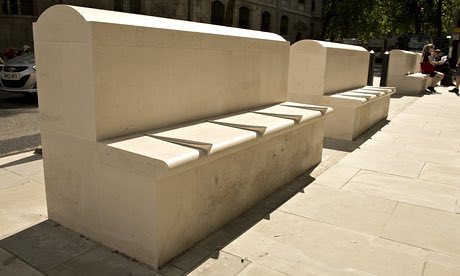
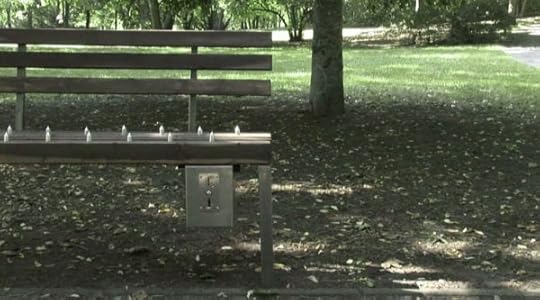
"New urban design aims to influence behaviour and has been criticised as an attempt to exclude poor people"
http://99percentinvisible.org/episode...
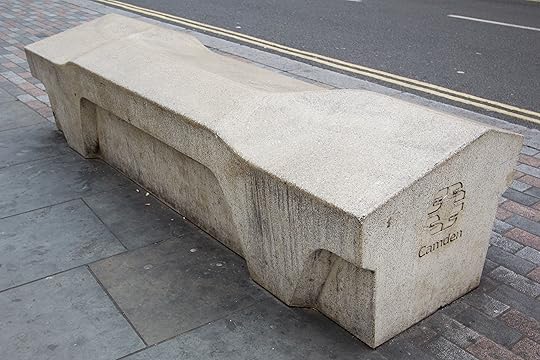
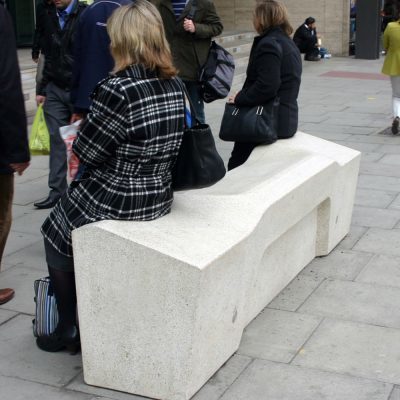
Camden Bench
"Designed by Factory Furniture, the Camden Bench is a strange, angular, sculpted, solid lump of concrete with rounded edges and slopes in unexpected places. "
Anti-homeless spikes are part of a wider phenomenon of 'hostile architecture' "New urban design aims to influence behaviour and has been criticised as an attempt to exclude poor people...
A lot of defensible architecture is added on to the street environment at a later stage, but equally with a lot of new developments it's apparent that questions of 'who do we want in this space, who do we not want' are being considered very early in the design stage," says the photographer Marc Vallée
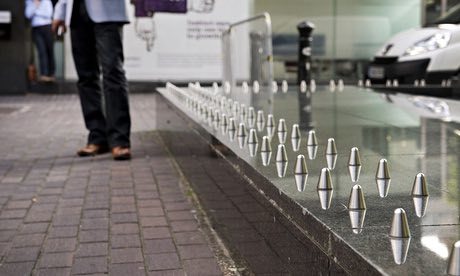
The architectural historian Iain Borden says the emergence of hostile architecture has its roots in 1990s urban design and public-space management. The emergence, he said, "suggested we are only republic citizens to the degree that we are either working or consuming goods directly.
Rowland Atkinson, co-director of the Centre for Urban Research at the University of York, suggests the spikes and related architecture are part of a broader pattern of hostility and indifference towards social difference and poverty produced within cities.
https://www.theguardian.com/artanddes...
I posted a few examples of 'hostile' art directed to the homeless, skate boarders, graffiti and loitering. I would like to discuss some things that are happening to prevent further 'hostile art'.Council urged to act over 'inhumane' use of spikes to deter homeless
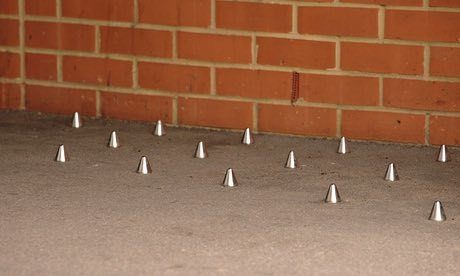
Spikes installed in entrance to luxury block of London flats spark flood of complaints
The spikes, which are thought to have been installed in the past month, are in a sheltered alcove opposite a hostel for homeless people with mental health problems.
Controversy grew over the weekend after a picture of the metal spikes was posted online, sparking outrage from people who compared them to the spikes used to keep birds away from buildings. David Wells said on Twitter: "These Anti homeless studs are like the spikes they use to keep pigeons off buildings. The destitute [are] now considered vermin."
More... https://www.theguardian.com/society/2...
Discriminatory Architecture
anti- $USER_CLASS benches by monkeon.
http://architectures.danlockton.co.uk...
How many of you are familiar with this type of art? What is your view of it? Are you for it? or against it? Why? Please comment and I think we can have an interesting discussion!
Poly wrote: "Hostile art or better architecture, started with the Bauhaus. "a machine for living"Quote from "Modern Art a Portrait of Mediocrity"
"As painting is the subject here, I will not dwell on Bauhaus ..."
I like your comment, Poly. Though this is considered 'art', what do you think of it's reasons for altering public spaces, especially toward deriding certain people or classes of people?
 This anti-public behaviour extends past public spaces. I lived for many years in Atlanta and my favorite watering hole was a coffee shop in the artist community. There was a counter for those who wanted to sit and sip, but the owner had very cleverly designed stools with crossbars that were ill placed for feet. Clients
 sat with their legs uncomfortably dangling. Regardless, us patrons stayed for hours drinking, conversing, listening to the vibes and flirting with the coffee waitresses.
The solution, of course, is to provide enough seating for a tired walking population. Then those seats occupied by bench warmers wouldn´t be needed for the sitters. Cities also are negligent in providing sufficient numbers of waste units. Too many times I have walked around looking for a waste basket that`s not overflowing.
Geoffrey wrote: "This anti-public behaviour extends past public spaces. I lived for many years in Atlanta and my favorite watering hole was a coffee shop in the artist community. There was a counter for those who w..."Thank you so much for your relevant reply, Geoffrey. And including your own personal experience to the 'cleverness' of patrons, architects, store owners, etc. who try to detract people from loitering, sleeping, etc. That's too bad that you had to experience that, but like you said, you stayed anyway! Good for you!
Does anyone have thoughts about the discrimination toward certain types of people? i.e. overweight people, homeless who don't really have anywhere to go... etc. What is your view of some of the reasons these are placed? Is it really helpful in cleaning up the city streets to make sure nobody is hanging around? Is this humane or cruel toward these specific people? Do the reasons justify the actions toward others?
I would love to hear your points of view regarding also this reason for creating barrier types of deterrents.
And as Poly said in another thread, these spikes or uncomfortable seats and other objects aren't considered art anymore, or were they ever called 'art' just to justify placing those deterrents in specific places?
 I've certainly never heard this type of "hostile architecture" referred to as art.
I've never seen the spikes on benches or similar "street furniture". It would make me angry to see it. This type of thing does make me angry. Everyone has the right to be out in public, as long as they are reasonably clothed and not harassing others. The architecture historian's comment above that "we are only republic citizens to the degree that we are either working or consuming goods directly" very much resonates with me. Increasingly, there are decreasing public spaces where people can go just to be, where they are not expected to be spending money. Public parks are one of the few places people can go where hopefully they can just hang out and chill. These parks of course should be open to all, regardless of whether they are fat or thin, homeless or not. Thus the greatness of a place like Central Park in NYC which is enormous and filled with all types, with lots of benches and lots of open spaces and grass.
I have seen the city benches with the dividers, and I've also seen these dividers on flat seating areas of corporate plazas.
I am absolutely sympathetic to the dividers being there if the purpose is to deter skateboarding, which is super annoying, loud and in my opinion a nuisance. (Cities should create skateboarding parks to get these people out of the way.) I suspect cities and corporate owners are trying to get a "twofer" with the dividers, keeping away skateboarders and homeless nappers.
 I think the person who thought it was cool to put spikes in a public area where kids could trip on them and poke an eye out should have to sleep on them every night when they go home and then tell me what how they feel about their "art".
Aaron wrote: "I think the person who thought it was cool to put spikes in a public area where kids could trip on them and poke an eye out should have to sleep on them every night when they go home and then tell ..."
I think the person who thought it was cool to put spikes in a public area where kids could trip on them and poke an eye out should have to sleep on them every night when they go home and then tell me what how they feel about their "art".
Aaron wrote: "I think the person who thought it was cool to put spikes in a public area where kids could trip on them and poke an eye out should have to sleep on them every night when they go home and then tell ..."Agreed
 The discrimination by design is really terrifying. Art should help people become more inclusive of all human differences, instead of restricting access.
 As to #6: What makes a fat person less than a thin one? Some people are fat due to biological conditions or have some disease that keep them in that "undesired" state.
As to # 2, 4, and 5: The idea of having a more prosperous society is valid, but it should not be achieved by means of excluding certain members of society. If there are poor people that might threaten that space, isn't it a sign that either the educational, economical or social system needs to be readjusted? Why are we ignoring the causes and trying to deal inadequately with the symptoms?
Ying Ying wrote: "The discrimination by design is really terrifying. Art should help people become more inclusive of all human differences, instead of restricting access... If there are poor people that might threaten that space, isn't it a sign that either the educational, economical or social system needs to be readjusted? Why are we ignoring the causes and trying to deal inadequately with the symptoms? "Great answer, Ying Ying. Thank you for adding to the discussion. I like the questions you brought up. So true! Why aren't we getting to the bottom of the problem? Making it so that homeless people don't sleep on a bench is just that much more discomfort for the unfortunate person, not helping him or her improve his or her circumstances!
That is a question, or rather a problem, that I think should be addressed by the cities. To address, as you said, the educational, economical or social systems.
Does anyone have any ideas on how this could be brought about? I am just one person and I don't live in an area where I see these types of discriminating 'art' (which I don't think deserves to be labeled as art). But how would one go about bringing these problematic obstacles--benches, spikes, etc. to the attention of the general public and perhaps make a noise about the whole situation? Any ideas?
Isn´t that what the artist from Grand Rapids has addressed?
Geoffrey wrote: "Isn´t that what the artist from Grand Rapids has addressed?"I hope so. It needs to be broader than that, though because hardly anyone knows about it.
I like this statement "Anger towards some of the blunter types of "defensible architecture" is growing. On Wednesday, activists poured concrete on top of spikes outside a central London branch of Tesco. The company said they were to prevent antisocial behaviour rather than to deter homeless people but agreed on Thursday to remove them."
https://www.theguardian.com/artanddes...


http://99percentinvisible.org/episode...