
Reading the 20th Century discussion
Poetry
>
Philip Larkin
date newest »
newest »
 Mod
Mod
 I am thinking about reading his A Girl in Winter sometime soon - December or January. I have liked the poems of his I have read but have never read any of his prose.
 MCMXIV
 Those long uneven lines
Standing as patiently
As if they were stretched outside
The Oval or Villa Park,
The crowns of hats, the sun
On moustached archaic faces
Grinning as if it were all
An August Bank Holiday lark;
And the shut shops, the bleached
Established names on the sunblinds,
The farthings and sovereigns,
And dark-clothed children at play
Called after kings and queens,
The tin advertisements
For cocoa and twist, and the pubs
Wide open all day--
And the countryside not caring:
The place names all hazed over
With flowering grasses, and fields
Shadowing Domesday lines
Under wheat's restless silence;
The differently-dressed servants
With tiny rooms in huge houses,
The dust behind limousines;
Never such innocence,
Never before or since,
As changed itself to past
Without a word--the men
Leaving the gardens tidy,
The thousands of marriages,
Lasting a little while longer:
Never such innocence again.
Philip Larkin
Larkin conjures up a past world in which children named Albert or Bertha play innocently in the brilliant sun of August not yet aware of the impending Guns of August. His tone is nostalgic but I read a good deal of irony infusing the nostalgia. These men are about to go to the deaths. They don’t know if they are on a lark or in the dark. Nature, silent, does not embrace them. Larkin mentions the servants in their tiny rooms and the poem almost necessarily becomes a critique of the past just as it remains nostalgic.
As a title, “MCMXIV” conjures up war memorials and the kinds of mostly solemn occasions in which Roman Numerals are used (I know my Roman numerals because movies like to “sign themselves” with their dates).
Like all great poems, it opens up questions instead of resolving them. Is the speaker imagining a memory? Glancing at a photograph? Trying to share sentiments that are not ruled by a subject and a predicate—in one sentence that goes on for 32 lines?
 Mod
Mod
The Frank Skinner Poetry Podcast
...is about The Whitsun Weddings (1964) by our main man Philip Larkin
It's a wonderful listen which, inevitably, makes me want to go out and buy the book...
Philip Larkin (1922-1985) remains England's best-loved poet - a writer matchlessly capable of evoking his native land and of touching all readers from the most sophisticated intellectual to the proverbial common reader. The late John Betjeman observed that 'this tenderly observant poet writes clearly, rhythmically, and thoughtfully about what all of us can understand'. Behind this modest description lies a poet who made greatness look, in Milton's prescription, 'simple, sensuous and passionate'.
This collection, first published in 1964, contains many of his best-loved poems, including The Whitsun Weddings, An Arundel Tomb, Days, Mr Bleaney and MCMXIV.
 Mod
Mod
Mod
Mod
Has anyone read either of them?
The second one……
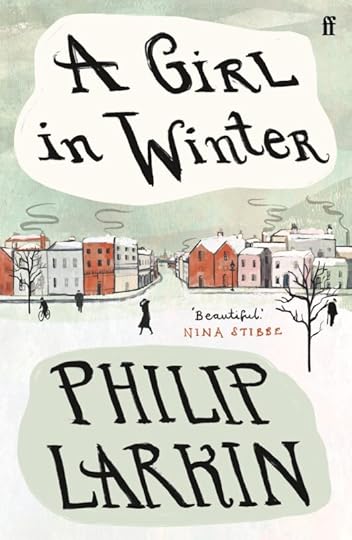
A Girl in Winter (1947)
…sounds the better of the two
Apparently it’s a quiet, atmospheric, and deeply observant book that reads more like a long-form poem than a traditional plot-driven novel and which provides the DNA for his later work. Even if you aren't a poetry fan, it stands as a beautiful, haunting portrait of loneliness that stays with you long after the final page.
🤔
 Mod
Mod
 Mod
Mod
I’m up for a buddy of A Girl in Winter (1947)
Let me know if you can source a copy
Mod
Mod
Let’s go for June
Here's the discussion thread ready to go...
https://www.goodreads.com/topic/show/...
Everyone is welcome
Katherine Lind is a refugee who has become a librarian in a wartime Northern town. One winter’s day, she receives a telegram: and her thoughts drift back to falling in love with her pen-pal, Robin Fennel, on a glorious summer exchange. But on his return from the army, their reunion is not what they imagined …
Philip Larkin's second novel was first published in 1947. This story of Katherine Lind and Robin Fennel, of winter and summer, of war and peace, of exile and holidays, is memorable for its compassionate precision and for the uncommon and unmistakable distinction of its writing.
 Mod
Mod

Reading the 20th Century
Books mentioned in this topic
Jill (other topics)A Girl in Winter (other topics)
The Whitsun Weddings (other topics)
A Girl in Winter (other topics)
by Philip Larkin
Caught in the centre of a soundless field
While hot inexplicable hours go by
What trap is this? Where were its teeth concealed?
You seem to ask.
I make a sharp reply,
Then clean my stick. I’m glad I can’t explain
Just in what jaws you were to supperate:
You may have thought things would come right again
If you could only keep quite still and wait.
***************
When I was in school a long time ago I had to do some sort of "science project" and I chose to base it on this poem. I looked up the way the disease was introduced to get rid of rabbits. And I explained how well Larkin conveys the rabbit's point of view.
The final two lines always make me burst into tears.