
Reading the 20th Century discussion
Favourite Authors
>
J.B. Priestley
date newest »
newest »
 Mod
Mod
Great Lives programme (BBC 4 Radio) on JB Priestley on the BBC iplayer
Here's the skinny....
Barry Cryer nods to his Yorkshire roots in choosing J.B. Priestley, the Bradford born author of The Good Companions and An Inspector Calls. Barry knew JB for the last ten years of his life, and fondly recalls visiting a man he loved with two members of Monty Python. Other memories include a trip to the Cafe Royal, and thoughts on Priestley's notorious love of women.
Martin Wainwright, northern editor of the Guardian, presenter of last year's radio documentary about the Postscripts, also brings to life a prolific writer nearly killed in World War One. Some say he wrote so much to avoid the memories of that war.
Recorded in front of an audience at the Arnolfini in Bristol, the programme includes colourful clips of J.B. Priestley and also Priestley's son, Tom. The only discordant note is raised by presenter Matthew Parris: "It's awfully watchable, awfully readable ... but where's the magic ? Is Priestley really very good?"
Mod
- He was the best selling UK author of the 1930s (Daphne du Maurier was second highest, and both were critically reviled)
- He was very changed by WW1 having been shelled and gassed on the Western Front. He came back determined to avoid a life of grey conformity and transformed himself into a best selling author
- He was an important founder member of CND
- His radio broadcasts were enormously popular and people would recognise his voice whenever he went into a bar
- He turned down a seat in the House Of Lords because of Labour's policy in Vietnam
- He was a lifelong socialist (although also very money orientated too)
- He loved to have a good grumble
- Time (and nostalgia) are a constant theme in his work
- He delighted in life
All in all a very enjoyable listen and one I recommend.
Mod
It was J.B. Priestley's misfortune – a lasting, personal misfortune – to achieve vast commercial success at a time when the whole concept of commercial success was being called sharply into question. The literary 1920s were an age in which the matter of a writer's cultural affiliations loomed very large, a time when gangs of vers libre poets and outraged traditionalists skirmished through the pages of the weekly reviews and the word "middlebrow" became a term of abuse. With his titanic sales –The Good Companions proved so popular in 1929 that fleets of lorries had to be engaged to distribute it – Priestley (1894-1984) was always going to be a target for this sort of snootiness: what was really remarkable, as the 1930s wore on, was his emergence as a kind of all-purpose intellectual hate-figure, a byword for everything that was wrong with the contemporary novel and, by extension, the literary scene that authenticated it.
The contempt in which Priestley was held by some of his fellow-writers can sometime seem rather startling. Virginia Woolf bracketed him with Arnold Bennett as "the tradesman of letters". The young Graham Greene caricatured him in Stamboul Train (1931) as the bluff, pipe-smoking popular novelist Mr Savory, and was threatened with a libel writ. George Orwell, alarmed by his influence on other novelists, noted of Patrick Hamilton's Priestley-haunted Twenty Thousand Streets Under the Sky(1935) that Hamilton "has set out … to write a novel about 'real life', but with the Priestleyan assumption that 'real life' means lower-middle-class life in a large town and that if you have packed into your novel, say, fifty-three descriptions of tea in a Lyons Corner House, you have done the trick." Anthony Powell not only put Priestley into his novels as a malign cultural signifier (in From a View to a Death half-witted Jasper Fosdick tries to impress a girl by offering to lend her the family copy of The Good Companions) but was still, half a century later, stuffing his diaries with references to the "stupefying banality" of Priestley's mind and his complete unsuitability for a Westminster Abbey memorial.
All this was, and is, horribly unfair – there were far more plausible candidates for highbrow disdain in the 30s than the author of English Journey – and yet, as nearly always happens when the intelligentsia takes against a particular behemoth of the book clubs, a certain amount of the mud has stuck. Nearly 30 years after his death, although Priestley's plays are regularly revived and there remains a folk memory of his considerable impact as a war-time broadcaster, his novels are usually regarded as the quaintest of period curios: sprawling, sentimental, and the forerunner of every postwar metropolitan bestseller, from Norman Collins's London Belongs to Me (1945) to RF Delderfield's The Avenue Goes to War (1964). Priestley's own verdict, in his 1962 memoir Margin Released, was that he was a victim of straightforward snobbery, that fixed English idea, as he put it, "that anything widely popular must necessarily be bad. Criticism … borrowed 'bestseller' from the book trade, where it means what it says and nothing more, and made it pejorative."
Read the rest of the article by clicking below...
Though the literati viewed him with contempt, the author of Angel Pavement was extraordinarily successful in his day. It's our loss if his novels are all but forgotten now, writes DJ Taylor
I think D.J. Taylor makes some great points in addition to referencing some of my favourite books and writers.
Mod
Here's my review..
It was Victor Gollancz who commissioned two pieces of English travel writing from two gifted but very different writers. One was "The Road to Wigan Pier" by George Orwell, the other was "English Journey".
"English Journey" is subtitled...
"English journey being a rambling but truthful account of what one man saw and heard and felt and thought during a journey through England during the autumn of the year 1933 by J.B. Priestley."
...which sums it up very succinctly.
In 1934, J.B. Priestley published this account of a journey through England from Southampton to the Black Country, to the North East and Newcastle, to Norwich and then back to his home in Highgate, London. His account is very personal and idiosyncratic, and in it he muses on how towns and regions have changed, their history, amusing pen pictures of those he encounters, and all of this is enhanced by a large side order of realism and hard-nosed opinion. The book was a best seller when it was published and apparently had an influence on public attitudes to poverty and welfare, and the eventual formation of the welfare state.
The book also makes a fascinating companion piece to "In Search Of England" by H.V. Morton, which was published a few years earlier, and was another enormously successful English travelogue, however one that provides a far more romantic version of England, an England untroubled by poverty and the depression. Like H.V. Morton's book, "English Journey" has never been out of print.
"English Journey" is a fascinating account, and the edition I read, published by Great Northern Books, is also illustrated with over 80 modern and archive photos. It's a really beautiful book and one I heartily recommend.
The introduction by the always readable and interesting Stuart Maconie made me chuckle too...
"If, as a writer, J.B. Priestley had just been brilliant, humane, elegant, virile, intelligent, witty and technically dazzling, he'd be arguably considered the pre-eminent British literary talent of his age. Sadly from him though, he also laboured beneath the crushing burden of being accessible, engaging, crystal clear and enormously popular. The mandarins of the metropolitan elite like their 'provincial' voices to stay just that if possible, or at least to have the decency to be faintly troubled and attractively doomed, like say D.H. Lawrence or John Lennon, rather than rich, successful, boundlessly gifted and ordered like J.B. Priestley or Paul McCartney. The riches and success must have been some consolation."

 "The Good Companions" is very enjoyable, but it is fair to call it middlebrow. "English Journey" manages to be informative and passionate, as well as accessible, so it would be difficult to better it.
Mod
"The Good Companions" is very enjoyable, but it is fair to call it middlebrow. "English Journey" manages to be informative and passionate, as well as accessible, so it would be difficult to better it.
Mod
 Mod
Mod
https://www.newstatesman.com/culture/...
Mod
Mod
https://www.theguardian.com/books/201...
As a massive Patrick Hamilton fan this bit was of especial interest.....
George Orwell, alarmed by his influence on other novelists, noted of Patrick Hamilton's Priestley-haunted Twenty Thousand Streets Under the Sky (1935) that Hamilton "has set out … to write a novel about 'real life', but with the Priestleyan assumption that 'real life' means lower-middle-class life in a large town and that if you have packed into your novel, say, fifty-three descriptions of tea in a Lyons Corner House, you have done the trick."
Exactly George - and your point is?
 I read his Delight several years ago when I was going through a period of extreme stress and it was so comforting that I ended up reading it once a month for several months till I was feeling better.
Mod
Victor Gollancz commissioned George Orwell and J. B. Priestley to travel around working-class areas of the UK and report on conditions. Priestley's English Journey is a more superficial view than Orwell's The Road to Wigan Pier, so I don't think Orwell's criticism is entirely unjustified. On the other hand, Orwell had a tendency to lecture and Priestley's entertainments with a social conscience might have quietly convinced more people.
I read his Delight several years ago when I was going through a period of extreme stress and it was so comforting that I ended up reading it once a month for several months till I was feeling better.
Mod
Victor Gollancz commissioned George Orwell and J. B. Priestley to travel around working-class areas of the UK and report on conditions. Priestley's English Journey is a more superficial view than Orwell's The Road to Wigan Pier, so I don't think Orwell's criticism is entirely unjustified. On the other hand, Orwell had a tendency to lecture and Priestley's entertainments with a social conscience might have quietly convinced more people.PS Powell is also entertaining, but he was an appalling snob from all accounts.
Mod
I forgive him anything for Dance To The Music Of Time which I love so much.
I read Anthony Powell: Dancing to the Music of Time by Hilary Spurling and whatever his shortcomings may have been, he was a good and loyal friend to lots of people.
Still, no doubting he, and many many others in the literary establishment were routinely dismissive of JB. Something I don't understand based on what I've read by him. And as DJ Taylor concludes....
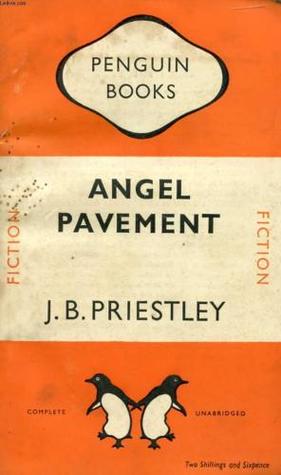
As for Angel Pavement's place in the literary canon of the 1930s, it is a terrific example of the mainstream novel's occasional habit of noticing some of the features of ordinary life that so-called highbrow productions routinely ignore and veering off into psychological territory where the much abused entity regarded as "popular fiction" rarely strays.
I've not actually read Angel Pavement (1930) - has anyone read it? If so, what's your verdict?
 I loved Inspector Calls. And that stayed with me for years. I remember having a really heated debate at school about how you impact other peoples lives but unless you have free will taken away, you are ultimately responsible for your own actions. Another pupil was getting really upset with me because she kept saying we bear responsibility for everyone's lives.
 It's a really powerful play and I went to a stage production about ten years ago. It was really good.
Mod
Nothing makes me happier than reading an old copy of a book
Here it is...

See you in October 2019....
https://www.goodreads.com/topic/show/...
Mod
I really enjoyed The Good Companions but, so far, feel that Angel Pavement has the edge. It feels more weighty and serious given its Great Depression backdrop.
I have not read any of his other novels
I have heard good things about Bright Day about which J.B. Priestley wrote
"I am not one for favourites, and I have always been irritated by questions about my favourite this, that and the other. But if I have a favourite among my novels, it is Bright Day, which I wrote towards the end of the war."
The blurb....
The novel was written towards the end of World War II. JBP disclaimed any autobiographical roots in the work, but it is nontheless resonent with his early youth and coincided with JBP's recoil from the commercial film world. Bright Day was the only serious novel that he wrote in the first person.
Gregory Dawson, the novel's hero, is a middle-aged film script writer who goes off to Cornwall to complete a script. At his hotel he spots Lord and Lady Harndean, and realizes that they are the Malcolm and Eleanor Nixey he knew when he worked as a clerk in a Bruddersford wool firm. They represent the beginning of the break-up of the bright day which had preceded the year 1914, and thus the story starts to unfold...
Vincent Brome, one of J.B. Priestleys biographers, wrote:
"Bright Day is one of Priestley's two most important and successful novels. The other is Angel Pavement."
What do you think?
 Mod
Mod
"I am not one for favourites, and I have always been irritated by questions about my favourite this, that and the other. But if I have a favourite among my novels, it is Bright Day, which I wrote towards the end of the war.""
I have bought a second copy of Bright Day for £2.50 including postage
I'm looking forward to reading it
If anyone fancies a buddy read then let me know, otherwise I'll add some comments on this thread when I get to it

Reading the 20th Century
Books mentioned in this topic
Bright Day (other topics)Angel Pavement (other topics)
The Good Companions (other topics)
Bright Day (other topics)
Angel Pavement (other topics)
More...
Authors mentioned in this topic
J.B. Priestley (other topics)Hilary Spurling (other topics)
Patrick Hamilton (other topics)
D.J. Taylor (other topics)
George Orwell (other topics)
More...

As cheerfully escapist for today's readers as it was for readers when it first came out in 1929. The Times (on The Good Companions)
Priestley was a grand writer...we should still listen to him, before time runs out...I am extremely pleased an effort is being made to re-kindle interest in this great writer. Beryl Bainbridge
Although not particularly fashionable now, in his day J.B. Priestley was a best-selling author and extremely popular with the reading public.
So who was he? Here's a biography from a J.B. Priestley website.
The Good Companions written in 1929 (in Deal, Kent), focuses on the trials and tribulations of a concert party in England between World War 1 and World War 2. It is arguably J.B. Priestley's most famous novel, and the work which established him as a national figure. It won the James Tait Black Memorial Prize and was adapted twice into film.
So let's talk J.B. Priestley. What do you think of him? What have you read? What books would you recommend?