
Classics and the Western Canon discussion
Aristotle, Nicomachean Ethics
>
Book Three
date newest »
newest »
 Cphe wrote: "Question:
What does A mean by "unqualified sense"?"
"Unqualified" means in every case or absolutely. The word Aristotle uses is "haplos," which is sometimes translated "simply." By contrast, "qualified" means in a certain way, or in some cases, but not always.
There's probably a formal logical definition to explain this, but I think that's the general sense.
 Cphe wrote: ""There are many types of courage, but the primary one for Aristotle is courage in war. He says, "one would call courageous a person who is unafraid in the face of a beautiful death."
Found this a ..."
I think that you have understood it, but it should be remembered that what Aristotle is voicing is the common Greek attitude, useful as an illustration to his contemporaries.
(And a Roman one, too, of course. Hence Horace's "Dulce et decorum est pro patria mori," "It is sweet and honorable to die for one's country" -- or, more literally perhaps, "fatherland.")
And he probably agreed with it, himself, up to a point. His own picture of the ideal way of life, when we come to it, is a good deal less military than this suggests.
 Pretty much a side comment to Aristotle's words, but reading him reminds me that it was Diane Arabus and her photographs which still provoke me to consider what should one label "beautiful." (A conversation that continues -- from the ordinances that have added access ramps to architectural and street design to the provocative volumes of Eco's
History of Beauty - On Ugliness
to events like the Special Olympics to ...) I wonder what Aristotle would say to the concept of "beautiful" in today's world. I wonder if I can adequately perceive what it meant to him. How different, how alike are they? Is any concept of "the mean" relevant here?
Cphe wrote: "One thought regarding fear, courage. A doesn't really examine the "fight or flight" response in the face of fear. It's instinctive and sudden, not an immediate feeling that one could cease."
Pretty much a side comment to Aristotle's words, but reading him reminds me that it was Diane Arabus and her photographs which still provoke me to consider what should one label "beautiful." (A conversation that continues -- from the ordinances that have added access ramps to architectural and street design to the provocative volumes of Eco's
History of Beauty - On Ugliness
to events like the Special Olympics to ...) I wonder what Aristotle would say to the concept of "beautiful" in today's world. I wonder if I can adequately perceive what it meant to him. How different, how alike are they? Is any concept of "the mean" relevant here?
Cphe wrote: "One thought regarding fear, courage. A doesn't really examine the "fight or flight" response in the face of fear. It's instinctive and sudden, not an immediate feeling that one could cease."I wonder if the "fight or flight" response is a natural reaction that Aristotle thinks we can change through training or habituation. Can we learn to be brave, or braver, in situations that call for it? Do we get more comfortable with dangerous situations the more we are exposed to them?
 Thomas wrote: "Can we learn to be brave, or braver, in situations that call for it?"
This question made me think of Stephen Crane's, The Red Badge of Courage. Crane never experienced war before he wrote the work. Increasing or learning to be brave, seems a theme of many works of literature. I also keep hearing more realistic stories of soldiers taking braver actions than normal, not to win the battle as much as to save and protect their buddies. Maybe people are inspired to be brave more then they learn to be brave?
David wrote: "I also keep hearing more realistic stories of soldiers taking braver actions than normal, not to win the battle as much as to save and protect their buddies. Maybe people are inspired to be brave more then they learn to be brave? "Aristotle says that courageous acts are done for the sake of the beautiful, and I would think friendship would fall into that category. But I wonder at what point inspiration turns to spiritedness, which is one of the things that "are called" courage in chapter 8. I think of Achilles and Patroklos -- Achilles is certainly courageous in general, and his decision to avenge Patroklos' death, even though he is shortening his life thereby, is definitely inspired. But is there a difference between these two things?
Cphe wrote: ""Can we learn to be brave, or braver, in situations that call for it"I think it is instinctive, fight or flight......instinct takes over"
But a soldier or a police officer or fire fighter must learn how to overcome that instinct, right? How do they do it?
Cphe wrote: "However it's the ordinary individual faced with a situation that they are ill equipped, trained for and who triumphs against all odds......that is the being who shows true courage, I think anyway. ..."I would disagree, Cphe. I think both the well-trained, equipped individual and the individual faced with an situation triumphed over despite the odds have a right to be considered to "show true courage." We have had a couple of remarkable stories here recently of firefighters making stunning saves. Yet, on the other hand, we know those who find themselves in a crisis that calls forth brave responses that they had no idea they would or could handle or even be capable of doing. And, of course, we also know those who have the quiet courage of caring for an injured or disabled or ill child. Or even those who face the rigors of lengthy medical rehabilitation. Or recreation of a family or a home after a natural disaster or devastating fire or ... Or... --
Anyway, Cphe, it seems to me "true courage" comes in many flavors.
Thomas wrote: "Achilles is certainly courageous in general, and his decision to avenge Patroklos' death, even though he is shortening his life thereby,..."Certainly Achilles took risk in avenging Patroklos' death, but why do you attribute that to shortening his life? There is all the stuff about Achilles was given the choice between honor and a long life, about the vulnerability of his heel, about his charmed armor forged by Hephaestus, but still, Achilles prevailed over Hector. Are you saying, because Achilles, having avenged Patroklos, now again became embroiled in the Trojan War, which led to his death, possibly by Paris?
Cphe wrote: "There was a saying I think it's from Alcoholics Anonymous something along the lines of you have nothing to fear but fear itself."As a loyal Republican, my father would have smiled at this. (And AA may well use it, too.) Many Americans (U.S. ones, at least, and of a certain age) associate the phrase with FDR's famous inaugural address in 1933: http://historymatters.gmu.edu/d/5057
https://www.youtube.com/watch?v=nHFTt...
Although that speech came at a time of economic depression, many of us also associate the phrase with the U.S.'s subsequent eventual entry into WWII.
Cphe wrote: "Question:Did Aristotle go to war?"
There is no evidence in the ancient biographical tradition that he did.
I could go on about the differences between citizen-soldiers, who Aristotle admires, and "professional" soldiers, i.e., mercenaries, of whom he disapproves. And on whether he was being fair to mercenary troops, remembering when they had failed, and not mentioning their considerable successes under the right commander.
They also came from those with few resources at home (like younger sons), or from impoverished regions, which probably encouraged other Greeks to despise them as low-class wage-earners.
I also wonder whether Aristotle was ever an adult citizen of an on-going city, with an obligation to fight for it when necessary: his birthplace, Stagira, was destroyed by Philip of Macedonia. It is supposed to have been restored by Philip, when he hired Aristotle to tutor his son, Alexander, but that story has been challenged by modern scholars.
(Aristotle as tutor to Alexander the Great is a memorable detail, but statements to this effect only show up in very late sources, such as Plutarch -- who sometimes tells us what he found interesting, without worrying about where he got it -- and Diogenes Laertius -- whose biographies of philosophers are frequently unreliable, but still essential.)
I'm only beginning Book 3, VIII, which seems to focus on courage. I've been trying to understand whether A. holds a brave person is brave in spirit or whether he holds "acting" as though brave is enough. Maybe A. has explained this and I missed it---I have had difficulties understanding him. I think of the Declaration of Independence. Hancock signed boldly. But I tend to credit more the guy who signed small and shakey, probably full of fear---but who signed nonetheless.
 I haven't finished book iii yet, but I find that I'm at a cultural remove from A. that makes this section on courage difficult to agree with. I'm willing to say that these could be semantic issues--that when A. talks about courage, it is different enough from the sense that I think of it that we are really talking past one another. But I simply cannot agree that courage is something that one acquires by repeated exposure to danger. Repeated exposure may bring wider experience, which might influence how a person reacts, or it might dull certain senses, which might also affect reaction. Now, these things might be the form of courage that A. is talking about, and if so, then I could agree. But I've always thought of courage not as the absence of fear, but as actions performed despite fear. In this second sense, I see it as wildly unpredictable--that someone who may have acted courageous at one time is incapable of rising above the fear in another, similar situation.
 But I don't know that it's essential for me to look this deep into it. To say that I disagree with A. seems pretty ridiculous. Better for me to simply try and understand him on his own terms.
Lily wrote: "Certainly Achilles took risk in avenging Patroklos' death, but why do you attribute that to shortening his life? ..."His mom, Thetis, tells him that his death will come soon after Hector's. And Mom is always right.
Adelle wrote: "I'm only beginning Book 3, VIII, which seems to focus on courage. I've been trying to understand whether A. holds a brave person is brave in spirit or whether he holds "acting" as though brave is e..."He says somewhere that spirit (or "spiritedness") often accompanies courage, which makes it sound like courage is something slightly different. It's hard to tell in this section exactly what Aristotle himself thinks because there's a lot of "it seems" and "is called", but I gather that he thinks courage is an active condition/characteristic/disposition (hexis) like other virtues.
 A courageous man feels fear, but he sets it aside and carries on with his duty. I think this does become easier with practice.
 Well, I had read some of these comments, and then read Book Three, and I was almost shocked at the discrepancy between the discussion of courage going on here, and what Aristotle says.
For him, the experienced soldier is NOT courageous, because he is not afraid. He explicitly says, if this experienced soldier came up against a superior force, then he would feel fear and he would run.
So, Bryan, it sounds like you agree with A. (and Cphe too)
My own opinion, read Book III, is that A. is so concerned, ultimately, with making the virtues out to be 'the rule of reason,' that he shrinks the meaning of 'true courage' down to almost nothing.
We haven't even gotten to moderation, also in Book III- Moderation is the rational control of pleasure, and so (almost for the sake of symmetry), courage must be the rational control of fear.
But notice, he isn't even willing to grant standing your ground for fear of shame to be courage, because that is one fear overcoming another.
But I hope I have time to go back over what he says. This is just an 'early take.'
Thomas wrote: "His mom, Thetis, tells him that his death will come soon after Hector's. And Mom is always right."[g]! Iliad Book 18.
(In tracing this, 'twas interesting to note the use of "courage" in the telling of the epic. I presume, rightly or wrongly, Homer's representations of courage were ones with which Aristotle was familiar.)
("At Iliad 9.413, Achilles must decide between going back to Greece and living to old age, or remaining at Troy and dying young, but gaining everlasting glory.")
@24 Thomas wrote: ".He says somewhere that spirit (or "spiritedness") often accompanies courage, which makes it sound like courage is something slightly different..."
Thanks for the clues. I think I found that section. Yes, the spirit is not enough. It needs the aspect of Right Reason. "Animal Spirit would be Courage of the true kind if it could have added to it moral choice and the proper motive."
So...I'm supposing I must credit the person acting with moral choice and proper motive even if they lack a robust animal spirit--but better, I'm guessing, if they possess that spirit, too. Part of the mean? Facing enemy soldiers with moral choice AND soldierly ferocity is "better" than merely adequately.
"It was said to be the character of a Brave man to withstand things which are fearful...because it is honorable to do so and the contrary is dishonorable. "
Motivation seems to factor large for Aristotle.
It's not simply doing "the right thing,"
but doing the right thing for the right reasons.
Thanks for the clues. I think I found that section. Yes, the spirit is not enough. It needs the aspect of Right Reason. "Animal Spirit would be Courage of the true kind if it could have added to it moral choice and the proper motive."
So...I'm supposing I must credit the person acting with moral choice and proper motive even if they lack a robust animal spirit--but better, I'm guessing, if they possess that spirit, too. Part of the mean? Facing enemy soldiers with moral choice AND soldierly ferocity is "better" than merely adequately.
"It was said to be the character of a Brave man to withstand things which are fearful...because it is honorable to do so and the contrary is dishonorable. "
Motivation seems to factor large for Aristotle.
It's not simply doing "the right thing,"
but doing the right thing for the right reasons.
Christopher wrote: "I was almost shocked at the discrepancy between the discussion of courage going on here, and what Aristotle says..."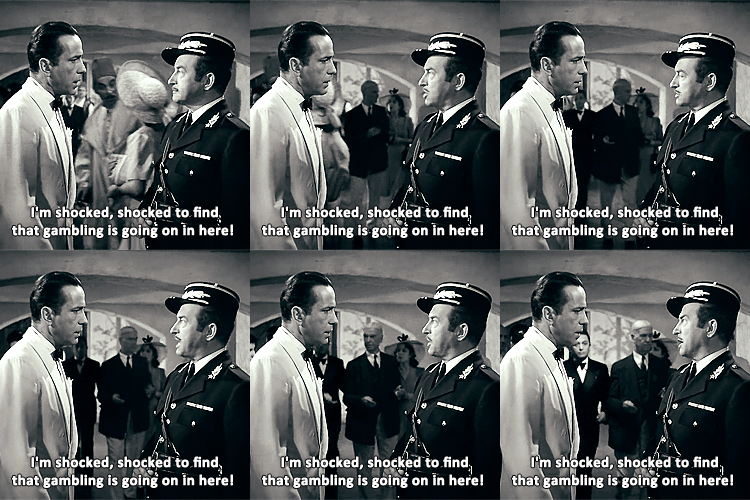 Sorry Chris--I couldn't resist.
Okay--I'll re-read. It wouldn't be the first time I'd read something and got it all turned around.
Christopher wrote: "For him, the experienced soldier is NOT courageous, because he is not afraid. He explicitly says, if this experienced soldier came up against a superior force, then he would feel fear and he would run.."Courage is a mean condition between the extremes of cowardice and excessive fearlessness (which comes in two varieties: Aristotle says one of them does not have a name, but those crazy Celts have it, and the other is fearlessness from overconfidence, which he calls "rashness.") Both extremes are vices. Courage is in the middle.
The courageous person is one "who endures or fears what one ought, for the reason one ought, when one ought...for the courageous person undergoes things and acts in accordance with what is worthy and in a way that is proportionate." (1115b15) The curious thing about this is that he says that courage is not a matter of calculation or rational expectation. It's not a matter of confidence, but of character. (1117a20).
I wonder what he thought of the Spartans at Thermopylae... Were they courageous, or rash, or crazy?
Cphe wrote: "There are many types of courage. Those trained to react in the face of danger as firefighters experience - they have the fear of the known - what they may confront. "Your comment reminds me of the US Civil War general Ulysses S. Grant. (I just happen to be reading Grant.) He was fearless in a lot of ways, maybe even "rash," and was criticized publicly for his aggressiveness in battle. The weird thing is that he was almost petrified by the sight of blood. He wouldn't even look at a rare steak. I wonder if Aristotle might consider Grant's walking through the aftermath of a battle more courageous, for Grant himself, than facing shells and bullets during the battle while it was raging.
 Cphe wrote: "Then, there is the ordinary individual in battle for example who can have no possible idea what it's like to be under fire but manage to do incredible feats..."
It seems for A. whether people are trained or effective as soldiers is less crucial than fighting nobly for the right reasons. That could be the case for this example, but this could also be an example of spiritedness, or the animal instinct towards preservation taking over.
As Ian said, "he shrinks the meaning of 'true courage' down to almost nothing". I don't think it's really "almost nothing"--there's probably still a large range of virtuous citizen-soldier type action that can happen within his parameters; but it is an extremely narrow definition of courage.
He even admits that soldiers do not require true courage to be effective or ferocious, but true courage requires virtuous and deliberate action for the sake of what is noble.
I'm getting the sense A is more interested in offering a kind of "ideal" (though not in the Platonic sense) standard against which to measure behavior, rather than a realistic description of how courage/war works in the real world.
Ignacio wrote: "Cphe wrote: "Then, there is the ordinary individual in battle for example who can have no possible idea what it's like to be under fire but manage to do incredible feats..."It seems for A. whethe..."
Ignacio,
This is well put. Upon re-reading, I think I shouldn't have said he shrinks it to 'almost nothing' (and I will take credit for saying that, if Ian did too, good for him), but as you say, he is shaping an ideal rather than describing 'real life' courage.
Ignacio wrote: "Cphe wrote: "Then, there is the ordinary individual in battle for example who can have no possible idea what it's like to be under fire but manage to do incredible feats..."It seems for A. whethe..."
As Ian said, "he shrinks the meaning of 'true courage' down to almost nothing".
Thanks for taking the time to include the acknowledgement -- but the line "he shrinks the meaning..." is actually from Christopher, in post #26.
My own impression of what Aristotle is doing here is that he is rendering problematic a lot of assumptions typically held by upper-class Greek men -- the only people attending his lectures, after all. They would probably point to someone's specific acts as revealing courage (or cowardice), and Aristotle pushes them to consider the processes of emotion and reason that could lie behind the overt action.
If this is an accurate quotation from Churchill (I haven't cross checked), I am pondering its relationship to Aristotle's comments about seeking the mean."Winston Churchill wrote of the lead-up to World War II: 'The malice of the wicked is reinforced by the weakness of the virtuous. . . . The counsels of prudence and restraint may become the prime agents of mortal danger; how the middle course adopted from desires for safety and a quiet life may be found to lead direct to the bulls-eye of disaster.'”
Christopher wrote: "and I will take credit for saying that"As well you should--it was a well-put phrase. I apologize for the misattribution! It seems I've been reading a lot of smart comments from you guys and forgot who said what. :-)
Ian wrote: "My own impression of what Aristotle is doing here is that he is rendering problematic a lot of assumptions typically held by upper-class Greek men -- the only people attending his lectures, after all"Would we characterize ancient Greek culture as a "warrior culture"? (I don't know enough to say...) It seems that many of the ideas A. is working with imply concepts of a "beautiful/noble death" and other things he says remind me that, as you say, he is speaking to a specific audience in a specific time and place. He also frequently cites the Iliad and Odyssey.
So I like this idea that he is at the same time "rendering problematic" some of those assumptions about what makes a soldier courageous or great.
Ignacio wrote: Would we characterize ancient Greek culture as a "warrior culture"? ..."There is no good *short* answer to this (I've tried) -- it would go deep into Greek military practices, weapons and armor, and associated changes in the internal politics of the various cities. I would feel happier to describe them as militant, at least until the Romans imposed their order on the still-squabbling city-states.
Too briefly: they probably did at one time have a "warrior culture." This was when aristocratic "heroes" faced each other in combat. (This is probably the basis of Homeric duels between the great champions.) They might fairly be called warriors, relying on their own strength, skill, and expensive equipment.
Changes in equipment and tactics produced a need for long fighting lines several ranks deep: the Greek phalanx, as seen in Herodotus and Thucydides. This required a lot of discipline and *group training* to hold the line and not expose your neighbors to danger, and there was little place for Homeric duels or displays of courage. They could fairly be called trained soldiers -- or at least militiamen.
Eventually these changes in how wars were fought brought with them political changes.
But the old aristocracy, which had once done all the "serious" fighting, preserved warrior values , and sometimes they show up in common attitudes among the rest of the population.
Ian wrote: "My own impression of what Aristotle is doing here is that he is rendering problematic a lot of assumptions typically held by upper-class Greek men... "Aristotle's method is frequently to begin with conventional opinions and distill them dialectically. That seems to be what he's doing here, especially in chapter 8, where he is describing the way people talk about courage. The way people talk about things and the opinions they hold are usually vague and unrefined, but Aristotle uses these opinions as a starting point. There is a kernel of truth in popular opinion, apparently. To get to that kernel he makes distinctions and peels away the inconsistencies. (This process is explained a bit at the end of Book 1 Chap 7 and the start of 1.8.)
And, in connection with the beginning, one must examine it not only from its conclusion, and the things on the basis of which it was made, but also from the things that are said about it; for when something is true, everything that pertains to it is consonant with it, but when something is false, the truth quickly shows itself dissonant with it. (1.8, Sachs)
Ian wrote: "Ignacio wrote: Would we characterize ancient Greek culture as a "warrior culture"? ..."There is no good *short* answer to this (I've tried) -- it would go deep into Greek military practices, weap..."
I smiled when I read this! Thank you for your humility, Ian. And for the elaboration (partial, from what you have attempted, I am sure) that you share here with us.
Thomas wrote: "...for when something is true, everything that pertains to it is consonant with it, but when something is false, the truth quickly shows itself dissonant with it. (1.8, Sachs) .."Isn't "pertains" often the stickler here? (Guess I need to explore how Aristotle handles contradictory truths.....)
Lily wrote: "I smiled when I read this! Thank you for your humility, Ian. And for the elaboration (partial, from what you have attempted, I am sure) that you share here with us."I second that! Thank you for the very helpful overview of Greek warrior/military culture. It makes a lot of sense that while the practices evolved, some of those "old ways" were still respected and valued. And it helps to explain some of Aristotle's attitudes.
 Thomas wrote: "Can we learn to be brave, or braver, in situations that call for it?"
When addressing the unjust and self-indulgent man, Aristotle says: "...just as when you let a stone go it was too late to recover it; but yet it was in your power to throw it...So, too, to the unjust and self-indulgent man it was open at the beginning not to become men of this kind, and so they are unjust and self-indulgent voluntarily; but now that they have become so it is not possible for them not to be so." (III.5, Ross)
So, maybe once one has given into vice they are doomed to such a life. Bravery, on the other hand, is not vice but virtue (ous? maybe?). Perhaps by practicing actions that require bravery one can better develop the qualities fitting of a brave man.
Adelle wrote: "Motivation seems to factor large for Aristotle.It's not simply doing "the right thing,"
but doing the right thing for the right reasons."
With the right temperament.
Ashley wrote: "
With the right temperament."
Yes!
With the right temperament."
Yes!
Ignacio wrote: "Lily wrote: "I smiled when I read this! Thank you for your humility, Ian. And for the elaboration (partial, from what you have attempted, I am sure) that you share here with us."I second that! Th..."
Thank you both.
I stopped trying to do a real summary when I realized that I was drawing on memories of W. Kendrick Pritchett's "The Greek State at War'" from the 1970-1980s. -- which runs to five volumes! (I then had access to a library which eventually got all the the parts.)
For this, and some of his other works, see https://www.amazon.com/W.-Kendrick-Pr...
I did finally finish book iii this evening, and Chris was right--I hadn't gotten to the chapter where A. was discussing courage, and I made some earlier comments based on some assumptions. Mea Culpa.As to what A. is saying about courage, I interpret it too mean that when a person finds a cause they believe in, courage is acting in accordance with that cause, even though there may be frightening consequences of that action. He uses the example of a man who faces death in battle. He is aware of the consequence, but acts in accordance with what he believes the right action to be.
I like his comparison with professional soldiers, which I take him to mean something more like mercenaries than a modern standing army. They can show actions that look like courage because they are used to certain aspects of battle that the citizen soldier is not, but because the underlying value of the battle is different between the two, it's the citizen soldier who most often shows true courage.
Way back up at the top, Thomas asked, " He says what comes last in an analysis come first in the synthesis. How does this explain the deliberative process? How does the deliberative process work?"If I have the right passage (112b20)--"For when a man deliberates, he seems to be seeking something and analyzing his problem in the manner described, as he would a geometrical figure: the last step in the analysis is at once the first in constructing the figure"--I didn't understand it either, but there is a footnote in my edition that explained it pretty well to me:
A. is thinking of the steps followed in constructing a geometrical figure. We first assume the completed figure as constructed and then proceed by analysis to see, one by one, what the various steps are by which it was constructed. These steps reveal the constituent parts of the completed figure, i.e., the means by which the end--here the figure--is attained. We thus begin our analysis with the completed figure, but begin our construction with the last part analyzed.
In other words, we envision the goal as completed, then mentally reverse engineer it until we get to the necessary first step in the process that will achieve that goal. At that point, we leave off envisioning and begin acting.
Bryan wrote: "I like his comparison with professional soldiers, which I take him to mean something more like mercenaries than a modern standing army. ."I find this comparison helpful as well. Acts of courage are undertaken for the sake of the beautiful, and it's easy to see that fighting a battle for one's friends or one's city/state is more beautiful than fighting for pay. It's unsettling to realize that the players on my favorite sports teams are really playing for money and not because they have any allegiance to the teams they play for.
 Bryan wrote: "In other words, we envision the goal as completed, then mentally reverse engineer it until we get to the necessary first step in the process that will achieve that goal. At that point, we leave off envisioning and begin acting."
That really helps illuminate this passage. In computing they call this sort of deliberative process an algorithm. Given how important ethics will be in building AI robots we can all live with, I wonder how many computer scientists will be brushing up on their Aristotle?
Dave wrote: "That really helps illuminate this passage. In computing they call this sort of deliberative process an algorithm. Given how important ethics will be in building AI robots we can all live with, I wonder how many computer scientists will be brushing up on their Aristotle?"I suppose it's because I've been puzzling over the notion of a "hexis" that is not strictly rational, but I've been wondering if it is possible for a computer to be virtuous in the Aristotelian sense. A computer could obviously not ever be courageous or generous, but could a computer advise a human when to be courageous, or generous? The virtues of character are to some extent a product of education... could this education ever be reduced to an algorithm?
Thomas wrote: "the notion of a "hexis""?meaning?
 Lily wrote: "Thomas wrote: "the notion of a "hexis""
?meaning?"
The active condition of the soul responsible for virtue. Collins & Bartlett translate it as "characteristic," others as "disposition." (Or my somewhat obscure preference, "active condition." That's Sachs' translation.)
It's an aptitude of sorts, but it's not passive. It's the characteristic that inclines a person toward virtuous action. (See Book 2, chapter 5)
Thomas wrote: "The virtues of character are to some extent a product of education... could this education ever be reduced to an algorithm?"It's a great question, and though it's one I don't feel fully qualified to answer, it has certainly got me thinking.
From what I've read and understood so far (up to Book 5 today), Aristotle focuses less on specific actions we should take in specific situations, which is the sort of information you might be able to input into a computer, and more on the content of our character.
Hexis is clearly a tough word to translate – I can see why some opt for hexis! – but it does seem to be a characteristic so deeply ingrained in us, so ineffably human, that it couldn't be reduced fully to an algorithm.
In sum, I'm not yet convinced a computer could be virtuous in an Aristotelian sense, mainly because there isn't that pre-existing moral putty that can be moulded into shape, just a blank state instead. That said, as we continue to understand the neurochemistry of the brain, I wouldn't rule out the possibility of a complex operating system that can be educated to be virtuous under laboratory conditions.
 I fell so behind in the reading and am just catching up. So many interesting points have already been raised.
I am fascinated by what seems to me a digression into the nature of the free will in the first 5 chapters. I also really like A.'s distinction between "wish"--a desire for an end--and "choice"--a decision regarding the means, arrived at by deliberation.
I wonder about applying it to love, i.e. the idea of "choosing" a beloved. It would appear that, if we were to apply A.'s dichotomy, the beloved would not be an end, but merely a means, and the end may be Beauty, or Good, or Happiness.
Complete digression, but I do hope A. addresses it later in the book.

Classics and the Western Canon
Books mentioned in this topic
Grant (other topics)History of Beauty - On Ugliness (other topics)
Choices seem to be different from willing or wishing things because they involve deliberation. It is interesting that for Aristotle the end is not a matter of choice, but the means are. Why is this so? I find Aristotle's description of the deliberative process rather confusing. (1112b) He says what comes last in an analysis come first in the synthesis. How does this explain the deliberative process? How does the deliberative process work?
In his discussion of the apparent good versus the truly good, Aristotle says, "the person of serious moral stature discerns each thing correctly, and in each kind of thing, the true instance shows itself to such a person." (1113a30) So can we say that good character (hexis) leads to true knowledge? Can a bad person know the truth of things?
Aristotle writes then about two key virtues, courage and temperance. There are many types of courage, but the primary one for Aristotle is courage in war. He says, "one would call courageous a person who is unafraid in the face of a beautiful death." It turns out that beauty is a focal point for courage; in fact, the beautiful is the telos, the end goal of courage. "So it is for the sake of the beautiful that the courageous person endures and does the things that are in accord with courage." (Chapter 7) Aristotle discusses some other types actions that are like courage, but he insists that truly courageous acts are done for the beautiful and nothing else. Does this surprise you? How do you make sense of this?
True courage is a product of character (hexis) rather than reason (1117a2) but temperance is a function of reason. Aristotle's description of temperance reminds me of Plato's image in the Phaedrus dialogue -- reason controls the passions the way a charioteer reins in the horses. Why is temperance a matter of rational control, but courage is not?