
Victorians! discussion

This topic is about
Vanity Fair
Archived Group Reads 2018
>
Vanity Fair: Week 1: Chapters 1-9

 In Chapter 2, we are given some of Becky's childhood background. What I gathered from this is that Rebecca Sharp was the victim of sexual abuse. We are told "she had never been a girl; she had been a woman since she was eight years old", and this was not only due to listening to the "talk of many of his wild companions." Her mother was dead, and her father was an abusive alcoholic. The leers on the faces of those "wild companions" in Thackeray's illustration of Becky and her puppets are not just those of young men innocently enjoying a a child's presenting a puppet show.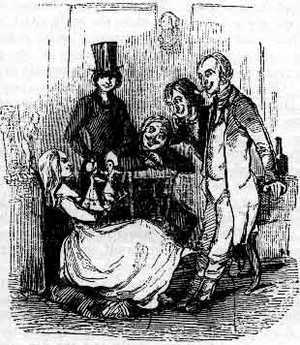
 Mod
Mod
I wonder- while your interpretation does make sense, it does also say somewhere that she much preferred the life she had with her father and the conversations there to that at Miss Pinkerton's establishment- which makes me wonder whether she would have had it been a life where she was facing abuse.
 I didn’t know Thackeray before I started reading Vanity Fair: I know more the French authors from the 19th century. I’m delighted to familiarize myself with this English literature of which I knew only Jane Austen, the Brontë sisters or George Eliot ...
From the first lines, I liked Thackeray’s writing and wit. He can be compared to the French writers that I love from the first half of the 19th century: a free spirit, a charming irony, a biting lucidity but not nasty, a pleasant sense of humor and a agreeable self-derision.
I didn’t know anything about this story except that I heard that Rebecca Sharp was a naughty girl. Well, for the moment, I liked her as soon as I met her! In fact, as soon as the scene of the dictionary on chapter I. We see in this short scene all the talent of Thackeray: by this single gesture, he describes to us all the character of Rebecca:
By throwing the dictionary, Rebecca means:
As a young girl, I reject your old vision of an old world, a world that is not even mine. I reject your definitions, I will create mine. You want to give me this book, you, Miss Jemima, submissive person: I don’t accept it because I’m not one of yours, I’m an unsubmissive person. You, Miss Jemima, you’re even more cowardly than your sister Miss Pinkerton, who hasn’t been able to impose her authority on me; by giving me this dictionary without your sister knowing it, you show your cowardice to the world. To accept this dictionary would be like saying: never mind, it doesn’t matter to be cowardly, everyone is, I absolve you. Well, no, I'm not cowardly, I'm not afraid, and I dare to say it aloud, I don’t hide, I don’t want to hide what I am, that’s my proudness, that’s my sincerity. I don’t accept half measures, maybe because I'm young and whole and don’t know the nuances of things yet, or maybe because I'm hard, that's what we'll discover in the rest of the story.
Here’s an exemple, on chapter IV, of the cutting remarks I like :
«There is no need of giving a special report of the conversation which now took place between Mr. Sedley and the young lady; for the conversation, as may be judged from the foregoing specimen, was not especially witty or eloquent; it seldom is in private societies, or anywhere except in very high-flown and ingenious novels.»
This kind of 19th century delicate and biting wit delights me!
On chapter V, I agree with Thackeray’s passage about the chidren’s education. I don’t know about Thackeray’s life, but one can imagine, that he talks about his own experience. And he finishes this passage whith William Dobbin reading,
« Well, William Dobbin had for once forgotten the world, and was away with Sindbad the Sailor in the Valley of Diamonds, or with Prince Ahmed and the Fairy Peribanou in that delightful cavern where the Prince found her, and whither we should all like to make a tour. »
Here, Thackeray the writer becomes a reader and how pleasant it is to feel is reader’s happiness in his last sentence!
Ginny wrote: "In Chapter 2, we are given some of Becky's childhood background. What I gathered from this is that Rebecca Sharp was the victim of sexual abuse. We are told "she had never been a girl; she had been..."You're perhaps right, Ginny. It could look like, but...
Lady Clementina wrote: "Ginny wrote: "In Chapter 2, we are given some of Becky's childhood background. What I gathered from this is that Rebecca Sharp was the victim of sexual abuse. We are told "she had never been a girl..."
... you're right too, LadyC.
Meanwhile, this young lady could lie to herself. If "Rebecca Sharp was the victim of sexual abuse." as Ginni thinks, first she prefers to tact as if it didn't happened. Second, her father and the men he invited at home were her only family, the only kind of "love" she has known.
Thrown in the narrow word of Miss Pinkerton and her students, she has not find someone to hear her, to understand her. So I can understand, even if it seems weird or awful, that she prefered to be in the world of her father, even if, once, something bad happened to her, because, there, people were like her: free minded (I'm not sure this is English!) :)
Mod
I liked your view of Becky- 'naughty' though she may have been, Thackeray too rooted for her. I can understand her actions- her attempt to better her life- her distaste for life at Miss Pinkerton's so yes so far, I don't see her as 'wrong' or 'forward' but just someone who has no one else to look out for her.
Re Miss Pinkerton's establishment, I found myself thinking of A Little Princess and Miss Minchin's school where (view spoiler).
Mod
Re Thackeray's time at school, it wasn't the happiest from what I've read though i didn't go into the details. I'd posted a short bio and some links here in case you're interested:https://www.goodreads.com/topic/show/...
Mod
Perhaps you're right she could have chosen to 'block' those episodes in her mind since life at Miss Pinkerton's establishment was in some senses worse. Miss Pinkerton's school I realise is a perfect example of the attitude that so many books illustrate- where the 'charity' cases even if they are working for there living are looked down upon, treated as if a favour was being done too them even if they were working for what they got.
 Having read lots of Trollope, it has been fun reading a contemporary with a different style. Initially the author sets Becky up to be admirable, but he seems to be steadily knocking her down with every chapter. It was bad enough being a sweet, compliant orphan female as so many were in books of the time period. But to be a Becky Sharp, how much tougher, she breaks so many rules.
message 10:
by
Lady Clementina, Moderator
(last edited Mar 04, 2018 07:42PM)
(new)
-
rated it 4 stars
Mod
I enjoy Trollope too.
True- it can't be 'easy' living the life of a rebel so to speak, even if you think you don't care what other people think. (Authors in that period also seem to have a limitation in that sense- a rebel too must fall in at the end or suffer) But whether compliant or a rebel, complete accemptance is something she'd never have got.
Ginny wrote: "In Chapter 2, we are given some of Becky's childhood background. What I gathered from this is that Rebecca Sharp was the victim of sexual abuse. We are told "she had never been a girl; she had been..."I'm thinking, now, that maybe Thackeray thought about what you suggest, Ginni, but decided it not to happen to Becky. An author (well, that's my case) thinks more than the story he writes... books would be too long! And this one is already long enough! :)
 Ginny wrote: "In Chapter 2, we are given some of Becky's childhood background. What I gathered from this is that Rebecca Sharp was the victim of sexual abuse. We are told "she had never been a girl; she had been..."
I believe that if Rebecca were sexually abused during that period of time living at home, she may not have been so brash in nature as she turned out. She might have become a shy introverted personality rather than an outgoing one, who would try her best to avoid attracting any unwanted attention on her for the most part (as I understand how most young sexually abused victims to be).
For that reason, I interpreted that line and her interactions with those men differently. I think she enjoyed being the center of attention, making people laugh and sharing one at the expense of others; she was a true performer at a very young age and knew how to sustain herself even among questionable company.
Gabrielle wrote: "Second, her father and the men he invited at home were her only family, the only kind of "love" she has known.Thrown in the narrow word of Miss Pinkerton and her students, she has not find someone to hear her, to understand her. So I can understand, even if it seems weird or awful, that she prefered to be in the world of her father, even if, once, something bad happened to her, because, there, people were like her: free minded (I'm not sure this is English!) :) ."
Yes, that is how I see it too Gabrielle. :)
I think Becky knows that she is a spit-fire and knows how to work the crowd, so to speak. She is very similar yet dissimilar at the time to Cynthia from "Wives & Daughters" - both grew up poor and in a similar kind of situation, with the title of governess attached to them to help them move them forward in society. They are both performers in their own right.
I think the main dissimilarity among the two lies in their luck of which company they are hence forward exposed in their life journey - Cynthia was blessed to have the Gibsons and the Kirkpatricks and she became better for it, whereas Becky is stuck with nasty people like the Crawleys.
Lady Clementina wrote: "And so it begins. The first segment I thought could be divided into three sections, chapter 1, where we are introduced ...All through these chapters, what stands out is society―society that values one for one’s wealth, status, position, family, but not for what one is as a person―Vanity Fair? And we see that reflected in all three spaces that we visit in these chapters, ...
So what did we think of these first chapters of Vanity Fair?"
I like how you broke down these first chapters Lady C. :)
But, does having a narrator in the story bother anyone? For me it initially brought a Shakespearean play vibe to the story but as it went on, I find myself wanting to be left alone, to absorb the story on my own.
For me, it also has a "War & Peace" vibe especially with the mention of the 'Borodino' during the Napoleonic Wars (I haven't read the book but I loved the most recent
So I went looking and read that Tolstoy was indeed inspired by "Vanity Fair" when writing W&P! ;)
What I also find interesting when comparing this to "Wives and Daughters" we just read, is how similar Becky, Cynthia and Mrs Gibson are and how the struggle of a governess (especially seen with Mrs G who was constantly on the fringes of higher society) is quite real in both Victorian novels. The aspiration to become someone else, higher up the societal ladder (cover reference LOL) with more money and means stands true to these women.
There are other similarities of course - the serialized story, the writing of a time period 30 -50 years before the publication date, the "family novel" etc. etc. but the difference in Gaskell and Thackeray for me lies in the general quietness of the book.
W&D felt very much like a small village story stratified across the different societies while in VF, there are hardly any still pauses or quiet reflections of the spirit (so far) and it already feels bigger in structure and tone in comparison. Suffice to say I'm struggling a bit to keep up.
message 15:
by
Lady Clementina, Moderator
(last edited Mar 05, 2018 08:39AM)
(new)
-
rated it 4 stars
Mod
All through these chapters, what stands out is so..."
I'm glad you brought up the Becky/Clare comparison. That was something that came to my mind as well-the aspiration to better their lives is something they share, certainly and while we might judge them harshly at times, they have no one to really look out for them and must rely on their own devices- also perhaps being so alone in life and in the world has shaped their characters, made them 'harder' (and colder) than others (like Molly, Amelia) who have had comfort (money) and a happy home with people to look out for and after them. Also I believe beyond money - it was also social standing that was important to them- not in the sense of importance gained but more escaping the treatment they received in their current positions in society-where they are treated as low down the ladder- despite their education ,accomplishments, everything.
Re the War and Peace/Vanity Fair comparison, and especially Dobbin and Pierre, that’s one I hadn’t thought of but when I think of it now…
I hope you do continue reading- Lois, there are plenty of twists and turns up ahead.
Mod
I seem to be agreeing with pretty much everyone on this question- when Ginny pointed out the lines and illustration, her interpretation made sense to me but for Becky’s reaction towards and indeed longing for that life which I wouldn’t expect her to have were she really a victim of abuse. But then Gabrielle brought up the point of Becky possible fading out those episodes of her past which seemed like a possibility. Then Lois brought up another important point, Becky’s character which wouldn’t possibly have been as she was had she indeed been a victim of abuse which again made sense to me too- so I seem to be back at my original impression that while the text and illustrations might suggest abuse, other circumstances, and Becky herself (her view of that life, character) seem to suggest otherwise. I think I find myself agreeing with Lois' interpretation as well that Becky enjoyed being the centre of attention- also she would have had the freedom to be who she was, be treated as an equal as opposed to the treatment she was seeing at Miss Pinkerton's
When we meet the child Dobbin, he "had for once forgotten the world", lost in his book. I like the quote "...if, I say, parents and masters would leave their children alone a little more,--small harm would accrue, although a less quantity of [Latin grammar] might be acquired." Ah, to be left alone with a book. My dearest wish at that age. And still today, for that matter.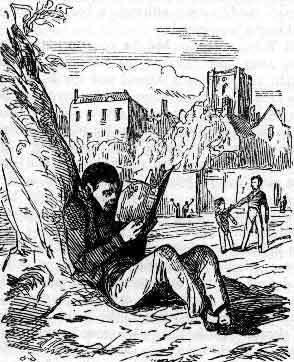 Becky and Joe "stray" in the Vauxhall Gardens. "...and now or never was the moment, Miss Sharp thought..." This illustration is not included in the Victorian Web site.
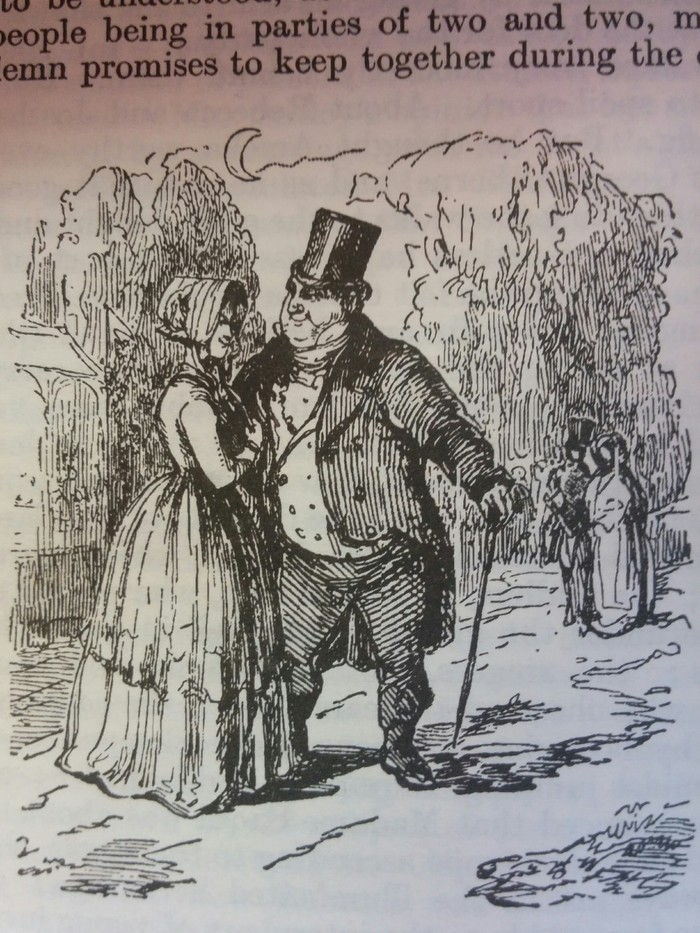 Lois wrote: "Ginny wrote: "In Chapter 2, we are given some of Becky's childhood background. What I gathered from this is that Rebecca Sharp was the victim of sexual abuse. We are told "she had never been a girl..."
Even, as I said to Ginni, I don't think that Thackeray meant that Becky could have been abused, if she'd been, she could still have this behaviour: trying to "seduce". Not all children in this kind of situtation try to erase. Some want to prove they're like anyone else, some are still looking for love, some just want, by seducing, to see in someone eyes that they are beautiful, not "dirty".
Lois wrote: "Gabrielle wrote: "Second, her father and the men he invited at home were her only family, the only kind of "love" she has known.Thrown in the narrow word of Miss Pinkerton and her students, she ha..."
Yes, there are some similaritieses between Becky and Cynthia from WandD. But Becky, for the moment, has my preference. She has much more stature, personality.
And we could say that she was lucky to meet Amelia who's really kind with her. And Amelia's father is also kind with her in the way that, as he doesn't care for his son, he also wouldn't mind if he married Becky. So, less lovable, the Sedleys could be Becky's Gibsons! :D
And the Crawleys aren't "nasty", they're just stupid! Well, I said it...! :)
Lois wrote: "Lady Clementina wrote: "And so it begins. The first segment I thought could be divided into three sections, chapter 1, where we are introduced ...All through these chapters, what stands out is so..."
Same for me, Lois!
First I found pleasant having a narrator in the story, but then, he said to much! I can't find examples, but it's like Thackeray wrote: "She eats too much cakes."
Then you think: "Sin of greed..." and you read:
"she had tendency to have the sin of greed."
And you think: "Don't tell me what to think! Leave me alone with my book! I was proud to have guess alone about the sin of greed! Or maybe I would have prefer to love the character because she likes to eat cakes!" :D
Ginny wrote: "When we meet the child Dobbin, he "had for once forgotten the world", lost in his book. I like the quote "...if, I say, parents and masters would leave their children alone a little more,--small ha..."Thank you for the pictures, Ginny!
Mod
I whole heartedly agree- then and now being alone with my book is a happy place to be in.
Mod
"
Thanks for sharing Ginny!
Mod
Thrown in the narrow word of Miss Pinkerton and her stu..."
I don't see the Crawleys as either nasty (well may be a little) or stupid so far - coarse yes, cruel even (at least Sir Pitt, at any rate) - as far as Lady Crawley is concerned- she has married Sir Pitt for those very same benefits that everyone in 'Vanity Fair' seeks - money, position, - but not considering the question of the person himself and has ended up paying the price. Pitt Crawley the younger is probably trying to be everything his father isn't- that the pomposity, piety etc.
Lady Clementina wrote: "Gabrielle wrote: "Lois wrote: "Gabrielle wrote: "Second, her father and the men he invited at home were her only family, the only kind of "love" she has known.Thrown in the narrow word of Miss Pin..."
I said they were stupid (the word is too strong, but I don't know which one could fit in English), because Mrs. Crawley does nothing to improve her situation (her husband who beats her, her boredom). This might come from the fact that she does not think about herself.
Similarly Mr. Crawley beats his wife, "a little, from time to time", because she does not stop whining. By doing this, he acts like an animal that strikes what annoys him, without seeking to understand. His behavior is quite common: whiny people, confronted with unthinking people, are often beaten.
Lady Clementina wrote: "I'm glad you brought up the Becky/Clare comparison. That was something that came to my mind as well-the aspiration to better their lives is something they share, certainly and while we might judge them harshly at times, they have no one to really look out for them and must rely on their own devices- also perhaps being so alone in life and in the world has shaped their characters, made them 'harder' (and colder) than others (like Molly, Amelia) who have had comfort (money) and a happy home with people to look out for and after them. "Yes, exactly Lady C. I certainly understood where Clare came from in trying to figure out her attitudes and her paltry maternal extincts; and even though I couldn't really feel sorry for her character, I didn't dislike the character. And the same is true for Becky. Life is hard, and harder still when there is lack of means i.e. money.
For me, 'means', social standing/position/importance ... all that comes from having some say i.e 'power' (big or small); and I do believe that money is the ultimate power. And this holds true even now.
"I hope you do continue reading- Lois, there are plenty of twists and turns up ahead."
:) I am slowly catching up Lady C. Before my posts yesterday, I had just finished the first two pages in Chap 8.
I do like the humour in the book and am enjoying it minus the few bothersome things I mentioned earlier.
ETA: I forgot to mention this, but I just got a hold of the Penguin Classics book last night and I was surprised to see a W&P mention by the editor John Carey on the back cover. He says,
"Vanity Fair has strong claims to be the greatest novel in the English Language. It is also the only English novel that challenges comparison with Tolstoy's War and Peace."
I was eager to read his introduction after that but he stops me from doing so in the very first paragraph until after I've read the whole novel since it gives the plot away. He says, "Nothing will be lost by reading the Introduction as an Afterword. Indeed, it will mean more that way."
LOL.
Mod
:)
To an extent I agree with you re money- but in Becky's and indeed Clare's case, the additional 'handicap' (to use an un-PC) word that they had to worry about was being a woman having to earn her living in that time. Mr Gibson earned his living and while not treated as an equal to those from upper echelons of society was not looked down upon as people in Clare and Becky's position were- as wife to one (obviously they'd want to marry someone with means for there wouldn't be a point simply going from struggling in one way to struggling in another) would automatically be out of that 'low' position, at any rate.
The Wordsworth eds (though my copy isn't one but I have several others) have intros that say just that- read only after you finish the novel. I wonder why they don't simply print them as afterwords.
Mod
Thrown in the..."
I wonder whether she could have done anything to stop him (perhaps if it was spunky Becky, she may have) but as one who is in the general mould of a woman in that period, submissiveness of a kind would be the usual conduct.
Ginny wrote: "This illustration is not included in the Victorian Web site."Ah, thank you for these illustrations Ginny! Much appreciated.
As I was telling Lady C, I just got a hold of the physical book last night and was surprised to see that there were no illustrations in this Penguin Classics version of the book. The editor John Carey in "A note on the Text" says that
"But the strongest argument against including the illustrations is that ... at their worst they are embarrassingly bad. ... Thackeray was a poor artist. ... As an illustrator he was even worse ... the fault lay in his drawings ... Thackeray was content to let his masterpiece appear in 1853 without illustrations. That is how it appears here."
So, I'm enjoying these because as someone who knows nothing about illustrations, I don't think they are bad at all.
Mod
I'm no expert on illustrations either- but the ones by Phiz (Hablot Knight Brown) in some of Dickens' books are much more delicate- pretty even- the features of people, particularly.
Gabrielle wrote: "And the Crawleys aren't "nasty", they're just stupid! Well, I said it...! :) "Well, Sir Pitt gives me the creeps. Mind you I've only just finished Chap 8; and after that description of her night in that decrepit Pitt London house and how he encouraged his footman to whip the children gathering wood on his property, and the way he laughs and snarls his way and came into her room asking her to put out her candle...yuck. He's nasty to me. I suppose I could have interchanged "nasty" with "horrible" and "dirty" but it seems his children too are just as gruff as he is.
Same for me, Lois!
First I found pleasant having a narrator in the story, but then, he said to much! ... Or maybe I would have prefer to love the character because she likes to eat cakes!" :D
LOL!
Lady Clementina wrote: "I don't see the Crawleys as either nasty (well may be a little) or stupid so far - coarse yes, cruel even (at least Sir Pitt, at any rate) -... that the pomposity, piety etc. "Yeah, I definitely don't see them as stupid. Coarse, cruel for sure and I'll add, dirty and horrible. I suppose it was easier for me to just call them 'nasty'.
Sir Pitt is like a horrible version of Squire Hamley from W&D. I can't stand stubborn oafs but horrible stubborn oafs...well, that's the worst combination for me.
Gabrielle wrote: "I said they were stupid (the word is too strong, but I don't know which one could fit in English), because Mrs. Crawley does nothing to improve her situation (her husband who beats her, her boredom). This might come from the fact that she does not think about herself."But how can someone weak like Mrs Crawley improve her situation Gabrielle? I think it is very difficult to break away from an abusive relationship especially when one is weak and depenedent as I believe she is.
"Similarly Mr. Crawley beats his wife, "a little, from time to time", because she does not stop whining. By doing this, he acts like an animal that strikes what annoys him, without seeking to understand. His behavior is quite common: whiny people, confronted with unthinking people, are often beaten."
That may be but it doesn't justify his behaviour. It was very wrong then and I believe that if she was a stronger character, she might have been able to stop him. To live in fear of your husband, that is not living. I feel sorry for her. She was an iron-monger's daughter and thought she made a good match.
To me, it seems as though she has no allies in that house; so what is she to do other than cry her eyes out. From what I've read so far, her children aren't any better than her husband and her step-son won't be able to do anything for her other than pray.
Lady Clementina wrote: "... but as one who is in the general mould of a woman in that period, submissiveness of a kind would be the usual conduct." Yes, for sure that is what was expected of a wife in those days. But (and again, this comes down to what I said in my previous post), I do believe if she had the means/money for example, to live in London away from her husband, she would have.
I do recall failed marriages were plenty in that period and even though divorce was not an option for many, it was still possible in other ways to absolve the relationship.
"Mr Gibson earned his living and while not treated as an equal to those from upper echelons of society was not looked down upon as people in Clare and Becky's position were- ..."
I think country doctors like clergymen fringed over the societal divide. But I think there was some prejudice though when it came to governesses.
I believe it was understood to be a position fringing as well that could potentially vault a lady further up and this was generally frowned upon those higher up the ladder (especially ones of older wealth).
Lady Clementina wrote: "I'm no expert on illustrations either- but the ones by Phiz (Hablot Knight Brown) in some of Dickens' books are much more delicate- pretty even- the features of people, particularly."Ah, I see what you mean, Lady C.
Here's one of Phiz's from "Bleak House":
http://www.victorianweb.org/art/illus...
And one from George Du Maurier who did "Wives and Daughters": http://www.victorianweb.org/art/illus...
I can see how Thackeray's leaves a lot to be desired: http://www.victorianweb.org/art/illus...
Mod
Yes, for sure that is what was expected of a wi..."
This is someone who has again 'improved' her social situation by her marriage or so she thinks so yes, as you said means would have been a problem. I was also going to comment on her coming from a different social situation- lower down on the ladder so to speak would have impacted on her character. So does Becky of course (perhaps worse in a sense), but having to look out for herself has probably made her stronger besides the spunk that must have been within any way.
Mod
Here's one for Trollope: http://www.victorianweb.org/art/illus...
Mod
Lady Clementina wrote: "Lois wrote: "So, I'm enjoying these because as someone who knows nothing about illustrations, I don't think they are bad at all..."I'm no expert on illustrations either- but the ones by Phiz (Hablot Knight Brown) in some of Dickens' books are much more delicate- pretty even- the features of people, particularly. .."
Pretty is not the point. They are an integral part of the novel, expanding and subverting the text. From the Victorian Web article:
Taken as a whole these varieties of illustration interact with the written text to produce a visual and verbal hybrid of unusual richness and complexity; uniquely placed as the author and artist, Thackeray creates a synthetic work which can only be read by deploying an interdisciplinary approach.Sounds to me like that publisher was trying to justify his cheapened edition. There is a great deal of scholarship out there to contradict that opinion. My introduction:
...the pictoral capitals (omitted, together with all the other illustrations, from the revised 1853 'cheap' edition) are a necessary feature of any complete Vanity Fair and constitute much more than incidental embellishment.The Victorian Web site only includes a few of what I call the initial letters. Almost every chapter has one. Here is Chapter 9: Sir Pitt Crawley. Ugly, creepy, sitting on a serpent, perhaps.
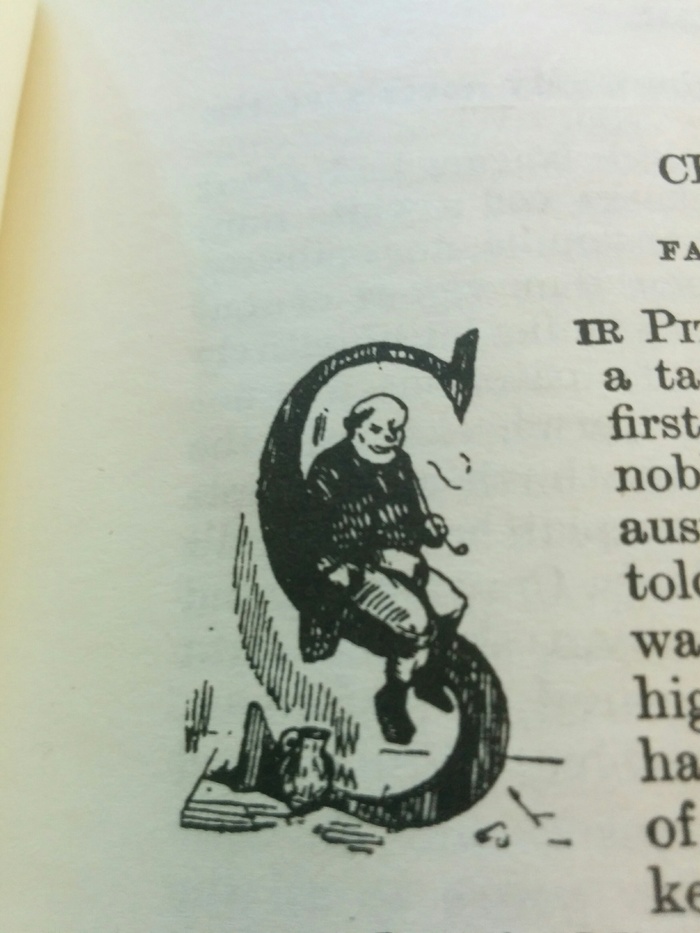
 Lois wrote: She was an iron-monger's daughter and thought she made a good match.
 As the narrator says - 'this is Vanity Fair' where an iron-monger's daughter appears to be making a splendid match in marrying a baronet, but in reality it is all in vain, for she leads a miserable life.
I wonder if Thackeray's title and theme comes from Ecclesiastes in The Bible: '
“Vanity of vanities, all is vanity."
What profit has a man from all his labor
In which he toils under the sun?
One generation passes away, and another generation comes;
But the earth abides forever.
 I am looking forward to reading everyone's comments. I have heard different opinions about Vanity Fair -- some good and some not that good -- especially when it comes to Becky Sharp. But my opinion might differ from those "other" reviews. At the end of Chapter 1 -- "and just as the coach drove off, Miss Sharp put her pale face out of the window and actually flung the book back into the garden". With that one action -- it showed me the exact core of Becky Sharp's character. I already am pulling for her. She does not have anyone one looking out for her. She has to make her own way in life. Amelia whole life is already planned for her. Will this change as her character develops and/or as the novel progresses?
 Social classes are definitely a big part in this novel. It is the dividing line between the characters that have and the characters that have not. It was way too early in the novel for Becky to get engage to Joseph. George Osborne and Amelia -- will they end up getting married?
The person I like the most is Dobbins, Figs. He stands up to Cuff to protect George Osborne. "The name of Figs, which had been a byword of reproach, became as respectable and popular a nickname as any other in use in the school." Dobbins leaves a legacy.
I am really having a hard time with Thackeray's comments in the chapters. He wants to be both -- the reader and the author. Let me be the reader. If Vanity Fair was a play -- I could understand his narration on a stage. To me , it is interfering in the flow of the novel.
Now to my favorite part -- reading all the comments!
Nina wrote: ".I wonder if Thackeray's title and theme comes from Ecclesiastes in The Bible: '.."Perhaps indirectly. It comes from The Pilgrim's Progress
Lady Clementina wrote: "And so it begins. The first segment I thought could be divided into three sections, chapter 1, where we are introduced to our two ‘heroines’ (or should I say our heroine, and anti-heroine?) (Vanity..."Thackeray immediately sets up the novel's division of social classes. It is the climb to a higher social class which is the upmost importance in the beginning chapters.
Mod
I'm no expert on illustrations either- bu..."
Thanks for pointing out those sections Ginny. The pretty/ugly discussion was more from a general point of view - the illustrations in themselves as opposed to their role in the book and because Lois pointed out a comment in the into to her edition. I must look up the letters- My edition doesn't have them and I didn't read the notes/intro in case of spoilers.
Mod
I think that's pretty much everyone's reaction to Becky, Laurene. One realises how her life is so different from the other more privileged characters like Amelia, and understands why she needs to be 'harder' and stronger- not the ideal Victorian heroine. That said, I didn't however like the dictionary throwing incident because while I see where Becky was coming from on that, I might have been more approving if Miss Pinkerton herself has condescended to give her a copy, but the younger sister (I've already forgotten her name) genuinely meant to treat her as any other student leaving the school so from her perspective, it seemed unjustified.
 Gabrielle wrote: "Ginny wrote: "In Chapter 2, we are given some of Becky's childhood background. What I gathered from this is that Rebecca Sharp was the victim of sexual abuse. We are told "she had never been a girl..."
I’m not quite sure about sexual abuse either. It would be totally Victorian to only allude to it with a veiled reference, however it did seem that her life with her father was one she missed despite its difficulties. Also Thackeray says that she had to assume the responsibilities of a grown up at an early age because of their poverty.
“she had the dismal precocity of poverty. Many a dun had she talked to, and turned away from her father's door; many a tradesman had she coaxed and wheedled into good-humour, and into the granting of one meal more. She sate commonly with her father, who was very proud of her wit, and heard the talk of many of his wild companions—often but ill-suited for a girl to hear.”
Perhaps we’ll get more insight further along in the novel.
I’m also finding Thackeray humorous and satirical as a very intrusive narrator. He reminds me of Fielding in Tom Jones.
Lady Clementina wrote: "Laurene wrote: "I am looking forward to reading everyone's comments. I have heard different opinions about Vanity Fair -- some good and some not that good -- especially when it comes to Becky Sharp..."I agree - Becky is fascinating, and I have a lot of sympathy for her, but she shows a mean streak from the beginning in her dictionary throwing.
She reminds me of Scarlett O Hara, on a smaller scale - a survivor character who is charming, but ruthless in her ambition.
Nina wrote: "As the narrator says - 'this is Vanity Fair' where an iron-monger's daughter appears to be making a splendid match in marrying a baronet, but in reality it is all in vain, for she leads a miserable life."Oh for sure Nina. And he also makes it a point to tell us how she was received by the family and neighbours upon her marriage to Sir Pitt.
Goes to show that those who rise up in rank suddenly via marriage like she did (and what Becky is aiming is do) are not looked upon well by the members who occupy the higher ranks. They will ignore you, not acknowledge your existance and will make you feel your origins and deficiencies constantly.
We've seen this attitude across many novels but at the moment an example that comes to mind is the marriage of Captain Ross Poldark and (his maid) Demelza in the Winston Graham "Poldark" novels.
As it highlights in Chap 9, I find it despicable that Sir Pitt purposely chose this pretty iron monger's daughter for what seems to me, the very intention of dominating his full control and power and to periodically unleash his violence over this weaker of the sex - something he probably wasn't able to do in his first marriage given the rank that lady occupied.
I actually really liked the dictionary throwing bit. It was shocking and equally amusing because it showed her true character in that one instant. She doesn't give a jot if it was Miss Jemima or Miss Pinkerton who presented it to her, Lady C. She's attacking the system and defying the traditionally upheld attitudes and norms of the time by that one single act.
To an establishment that wronged her in the way they treated her because of her status in society, and the assumptions they made in thinking they could manipulate her for their purposes because she had no money...it was a big middle-finger from her to it all.


The second section, chapters 2–7 is the time we, or rather Amelia and Becky spend at the Sedleys’. There are plenty of outings, and enjoyment and a warm welcome for Becky but she also finds an opportunity to change her life, and that in the form of Joseph ‘Jos’ Sedley, Amelia’s much older brother and the Collector of Boogley Woolah in India. With the exception of Amelia who is genuinely pleased with the idea, Papa and Mama Sedley may not be inclined to welcome Becky as their daughter-in-law with open arms but they aren’t opposed to the match either, more due to their indifference of sorts to Jos than any fondness for Becky. But poor Becky’s plans are thwarted, partly by circumstances (that rack-punch) and partly by an ‘enemy’ we didn’t except, George Osborne, who doesn’t want a governess as his sister-in-law. In this section we also meet George Osborne, Amelia’s fiancé, a handsome soldier, and his friend William Dobbin who comes from a very different class of society but is a gem of a person, brave enough to face up to his bullies, and take on those bullying others, though somewhat self-deprecating from his actions at school and after, it would seem.
The third section, chapters 8 and 9 take us along with Becky as she joins her new situation at the Crawleys, where she is to be governess to the daughters of Sir Pitt, a baronet. But baronet though he may be, Sir Pitt is coarse and miserly, beats his wife; his wife seems a diffident creature, who has lost her chance at happiness, and her beauty; his son and heir is pompous; and his daughters, well we haven’t seen very much of them so far but they don’t seem to be the kind of little demon we encounter sometimes in Victorian literature.
All through these chapters, what stands out is society―society that values one for one’s wealth, status, position, family, but not for what one is as a person―Vanity Fair? And we see that reflected in all three spaces that we visit in these chapters, school―Miss Pinkerton’s establishment in her own conduct towards the students and the ‘charity girl’ for so she seems to view Becky, and the school that Dobbin and Osborne attend in the conduct of the students, the bully Cuff, and George himself who judges by position as well, unwilling to have a grocer’s son as his champion, and later a governess as his sister-in-law. Becky herself is trying to better her own position, get a foothold in society, but can we blame her for it, for she has no one to look out for her, none but her own devices to rely on. Then the Crawley’s where Sir Pitt is a baronet, a person with social standing irrespective of his character or nature. Then there is Lady Crawley who has given up a chance at happiness for what society values, wealth and position, and look where that has led her. The Sedleys’ house is perhaps the one of the three spaces which is the least harsh, it judges (Becky as better than a native daughter-in-law) but doesn’t outrightly condemn (even if it is because of their indifference to Jos than any other reason). But one who is not yet a part of the family makes up for it―George Osborne.
So what did we think of these first chapters of Vanity Fair?