
Art Lovers discussion
Paintings of the Same Subject
>
Vanitas
date newest »
newest »
 "In vanitas art, the certainty of death and our mortality are still the main themes, but there’s an added emphasis on the fleetingness and insignificance of earthly glory and pleasures. Common symbols in vanitas art include the skull (representing the certainty of death); bubbles (representing the brevity and fragility of life and earthly glory); smoke, hourglasses, and watches (every minute that passes brings you closer to death); rotting fruit and flowers (representing the fragility and decay of earthly things); musical instruments and music sheets (representing the ephemeral nature of life); torn or loose books (representing earthly knowledge); and dice and playing cards (representing the role that chance and fortune play in life).
The purpose of vanitas art is moral instruction. It’s to remind the viewer that life is precious, so they better not waste it on frivolous and meaningless things."
https://www.artofmanliness.com/articl...
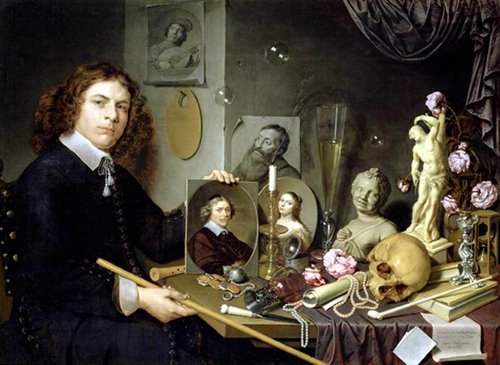
Self-Portrait with Vanitas Symbols
David Bailly
1651.
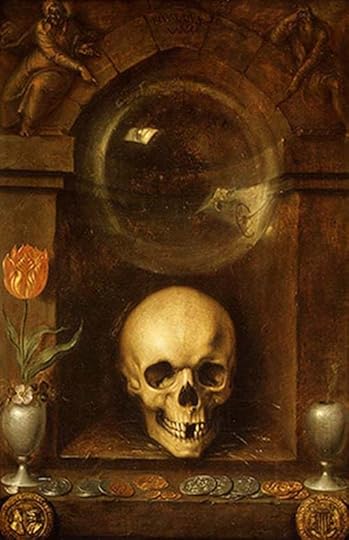
Vanitas Still Life
Jacques de Gheyn the Elder
1603
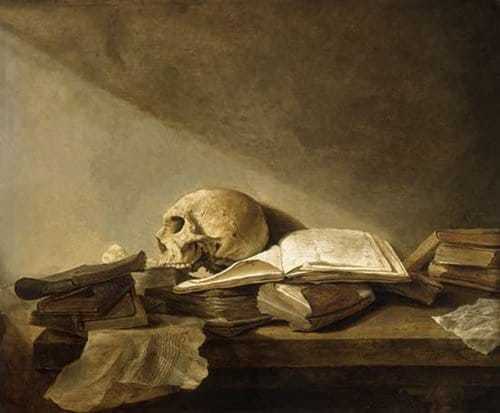
Vanitas Still Life
Jan Davidsz de Heem
17th century
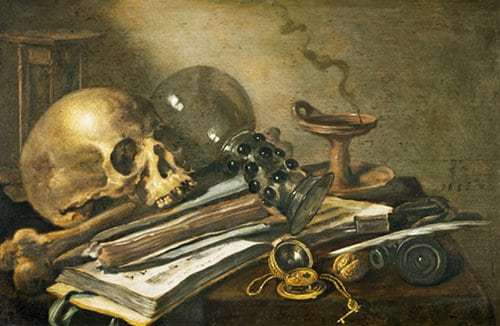
Vanitas Quiet Life
Pieter Claesz
early 17th century
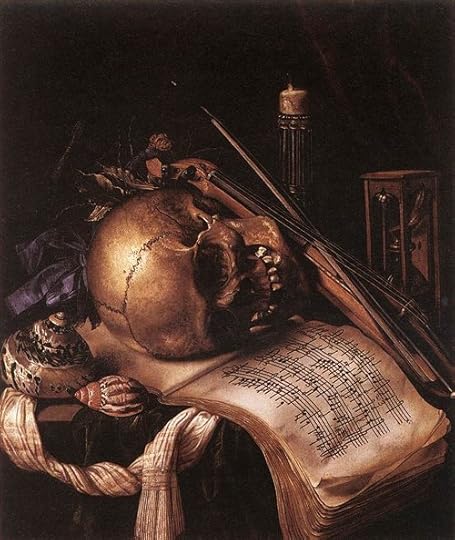
Vanitas Still Life
Simon Renard de Saint-André
middle of the 17th century.
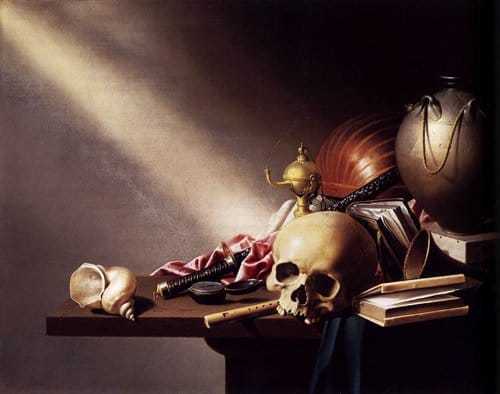
Still Life, An Allegory of the Vanities of Human Life
Harmen Steenwijck
1640.

A vanitas painting contains collections of objects symbolic of the inevitability of death and the transience and vanity of earthly achievements and pleasures; it exhorts the viewer to consider mortality and to repent. The vanitas evolved from simple pictures of skulls and other symbols of death and transience frequently painted on the reverse sides of portraits during the late Renaissance. It had acquired an independent status by c. 1550 and by 1620 had become a popular genre.
Although a few vanitas pictures include figures, the vast majority are pure still lifes, containing certain standard elements: symbols of arts and sciences (books, maps, and musical instruments), wealth and power (purses, jewelry, gold objects), and earthly pleasures (goblets, pipes, and playing cards); symbols of death or transience (skulls, clocks, burning candles, soap bubbles, and flowers); and, sometimes, symbols of resurrection and eternal life (usually ears of corn or sprigs of ivy or laurel).
The earliest vanitas pictures were sombre, somewhat monochromatic compositions of great power, containing only a few objects (usually books and a skull) executed with elegance and precision.
As the century progressed, other elements were included, the mood lightened, and the palette became diversified. Objects were often tumbled together in disarray, suggesting the eventual overthrow of the achievements they represent.
Somewhat ironically, the later vanitas paintings became largely a pretext for meticulous virtuosity in the rendering of varied textures and surfaces, but the artistic quality of the genre in no sense declined.
Several of the greatest Dutch still-life painters, including David Bailly, Jan Davidsz de Heem, Willem Claesz Heda, Pieter Potter, and Harmen and Pieter van Steenwyck, were masters of the vanitas still life, and the influence of the genre can be seen in the iconography and technique of other contemporary painters, including Rembrandt."
https://www.britannica.com/art/vanita...