
Ovid's Metamorphoses and Further Metamorphoses discussion
Ovid: Context and Background
>
Ovid: Background Information
date newest »
newest »
message 1:
by
Roman Clodia
(new)
Sep 22, 2018 06:33AM
 Background on Ovid
reply
|
flag
Publius Ovidius Naso, born 43 BCE, died 17 CE. What we know of his life tends, problematically, to come from his poetry. He was sent to Rome for his education and held a couple of minor judicial posts but seems to have abandoned public life for poetry. His patron was Marcus Valerius Messalla Corvinus before he was suddenly exiled by the emperor Augustus in 8 CE to Tomis on the Black Sea.
Ovid himself comments on his banishment as stemming from 'carmen et error' (a poem and a mistake) but refused to say more - in any case, we have to question to what extent we can or should read his poetry in uncomplicated autobiographical fashion.
Ovid continued to write from Tomis and there's some evidence that he revised the Met. He died in exile in 17 CE.
All of his works apart from the Met. were written in elegiac couplets: the Met. is in hexameters, the traditional metre of epic.
Ovid's other extant works are: Amores (trans.The Erotic Poems), Heroides, Ars Amatoria (trans. The Art of Love), Fasti, Epistulae ex Ponto (trans.The Poems of Exile: Tristia and the Black Sea Letters).
Ovid was born the year after Julius Caesar was assassinated (44 BCE) and so grew up during the civil wars. The Battle of Actium which saw the defeat of Marc Antony and consolidated the power of Augustus was in 31 BCE. Ovid outlived Augustus by three years, and died while Tiberius was emperor.
 I have to wonder if Ovid's mysterious exile-deserving poem commented on some illicit relationship of one of Augustus' supporters or relatives. Could the poem be the mistake, or is Ovid referring to two separate instances where he offended those in power?
Or on Augustus himself who never comes off well in Ovid... we'll see some oblique examples in the first book of the Met.
I was actually wondering if the poem was about Julia the Elder... but given the timing of Ovid's exile, I think not.
Ah, well certainly in the Renaissance period writers like Spenser, possibly Marlowe, definitely Ben Jonson claimed that Ovid was exiled for having an affair with Julia - but they mixed up the two Julias and often conflated them into a single figure.
I have to wonder if Ovid's mysterious exile-deserving poem commented on some illicit relationship of one of Augustus' supporters or relatives. Could the poem be the mistake, or is Ovid referring to two separate instances where he offended those in power?
Or on Augustus himself who never comes off well in Ovid... we'll see some oblique examples in the first book of the Met.
I was actually wondering if the poem was about Julia the Elder... but given the timing of Ovid's exile, I think not.
Ah, well certainly in the Renaissance period writers like Spenser, possibly Marlowe, definitely Ben Jonson claimed that Ovid was exiled for having an affair with Julia - but they mixed up the two Julias and often conflated them into a single figure. Traditionally, scholars attributed the exile to Ovid's Ars Amatoria (The Art of Love) but more recently that assertion has been questioned. We'll probably never find any evidence now... so just have to speculate. Actually, at least one scholar has argued that Ovid was never exiled at all, that it was just a pose he used to 'sell' his exile poems! Most Classicists have never taken this seriously though.
 I believe Ovid was the victim of a series of unfortunate events; Emperor Augustus has already established himself as the new leader of Rome. Yet, his rule is based on political savvy and strong patrician influence; the people are not given a voice. When Ovid composed "The Art of Love," it caused an uproar; noblemen are using garlic to impress their potential paramours while, reciting poetry. Instead of obeying their fathers; noblewomen are staying in their villa's testing love potions with wine; such un-Roman like behavior must be stopped. It got even worse when the emperor caught his own daughter reading a copy; Augustus is well known for his epic edicts. With support from the Senate, Ovid and his daughter were banished; shown as an example, that the Roman's are not barbarians. We are "civilized" not archaic vandals; but even in exile, Ovid never forgotten what it means to be Roman. His work, "Metamorphoses," solidified his status as a poet; because he refused to give up. Although he died in exile, his words live on for everyone to read such a masterpiece.
 Totally tangential, but may I recommend David Malouf's wonderful novel about Ovid in exile,
An Imaginary Life
? My review of it is here. R.
Totally tangential, but may I recommend David Malouf's wonderful novel about Ovid in exile,
An Imaginary Life
? My review of it is here. R.
 Roger wrote: "Totally tangential, but may I recommend David Malouf's wonderful novel about Ovid in exile, An Imaginary Life..."
There is also the excellent book Last World of the contemporary Austrian author Christoph Ransmayr, which ist set in in Tomis / Konstanta in our times and in the times of Ovid's exile.
Thank you, Peter. I have marked this for when I get back to proper reading again! R.
 Ovid's exile to the remotest margins of the Roman empire revoked (approx 11 months ago...in 2017)
https://www.theguardian.com/world/201...
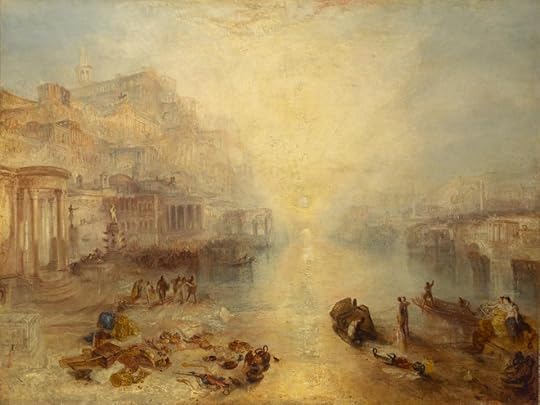
Joseph Mallord William Turner (1775–1851)
Ancient Italy — Ovid Banished From Rome, exhibited 1838
Yep, those cliff by the Tiber, I remember them well (in my dreams)!
 Roger and Peter.. I am adding your recommendations to the Group Shelves.
 From the blog by Kuhner "In Media Res": "It is believed that Ovid died in 17 or 18 A.D. — in other words, almost exactly two thousand years ago. To mark the occasion, last year the city of Rome canceled the order of Ovid’s exile."
When should we expect him back, then, Elena?
Ha, yes.. when will he come back?
From the blog by Kuhner "In Media Res": "It is believed that Ovid died in 17 or 18 A.D. — in other words, almost exactly two thousand years ago. To mark the occasion, last year the city of Rome canceled the order of Ovid’s exile."
When should we expect him back, then, Elena?
Ha, yes.. when will he come back?I had read about this 'cancellation'... a bit silly.
Trying to change history... not a good idea.
An article pointed me to a painting by Eugène Delacroix Ovid among the Scythians from 1862, which is exhibited in the Metropolitan Museum of Art, New York. I did not know it before, but maybe some of you have even seen it.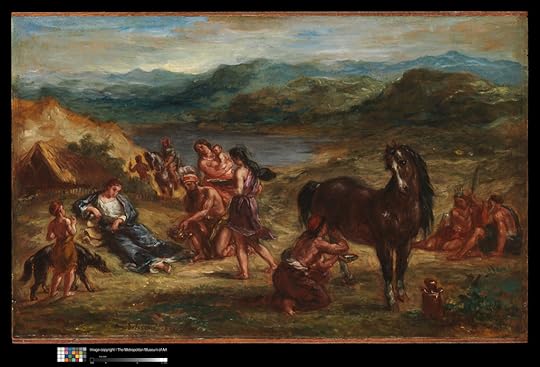 The epilogue of my edition mentions that Ovid neither was sentenced in court, nor his property confiscated, but that he was exiled by personal edict of Augustus. This and the fact that neither Tiberius, the successor to the throne, pardoned him, let scientists speculate that Ovid may have been witness to a transgression or intrigue in Augustus' closer vicinity.
I would like to add a thought to that: After the publication of Ars Amatoria Ovid must have been enormously popular, in particular among the educated youth. Therefore his exile was a highly visible sign of imperial power to the public. And the fact that Ovid was allowed to continue writing served as an incessant admonition what will happen to people who get too close to the emporer's family.
Peter wrote: "An article pointed me to a painting by Eugène Delacroix Ovid among the Scythians from 1862, which is exhibited in the Metropolitan Museum of Art, New York. I did not know it before, but maybe some ..."I just saw this painting when I visited the Delacroix exhibit at The Met in November. Peculiar both in perspective and the milking of a mare...sufficiently barbaric. ;-)
Publius Ovidius Naso (20 March 43 BC – 17/18 AD)HAPPY BIRTHDAY, Ovid !
I would have missed this! thank you, Peter...
Today on Twitter Emily Wilson just posted an audio pronunciation guide to the names in the Odyssey.She makes it easier to discuss the text without stumbling over the stress in Telemachus, or how you say the possessive in Odysseus'... I so wish we had something like that for the Met. Even in writing about the characters, it's slowing me down when I'm not sure how to pronounce the names...as the names accumulate over the course of the epic the issue becomes more daunting....these stories were originally oral tales and even in the written text the melody of the numerous names is part of the poetry...
Elena wrote: "... I so wish we had something like that for the Met...."Elena, there was a project by the universities of Berlin and Potsdam on the pronounciation of the Metamorphoses. Some of the texts were recorded anc can be listened to on
Met Recordings
Maybe this helps a bit.
Thank Peter, vielen Dank Berlin/Potsdam, this is insanely beautiful to listen to...
OK I don't usually like best sellers, but Mary Beard's SPQR provides incredible context for the Met. Including things like the way tales of rape are incorporated into foundation myths. I highly recommended her work....and I'm an archivist so I appreciate the way she analyzes the transmission of text, much of what we have is mediated through various transcription filters...but she triangulates to find what is most authentic....
Elena wrote: "OK I don't usually like best sellers, but Mary Beard's SPQR provides incredible context for the Met. Including things like the way tales of rape are incorporated into foundation myths. I highly rec..."Thank you, Elena. I have Beard's book in my Kindle waiting for my attention.
 Two supposed mysteries concerning Ovid continue to intrigue us: the reasons for his exile (in his words "carmen et error") and the disappearance of his poem "Medea". I have just completed reading Jane Alison's sensuous novel The Love-Artist wherein she sets out to solve both mysteries at once. All I can say about it is: Utterly delightful! I usually avoid romances in any way possible and this is most assuredly a romance, but it had me mesmerized from the first line to the last.
A tale worthy of Ovid himself and a wonderful companion piece to the Met.
Jim wrote: "Two supposed mysteries concerning Ovid continue to intrigue us: the reasons for his exile (in his words "carmen et error") and the disappearance of his poem "Medea". I have just completed reading J..."Thank you, Jim. I will add your recommendation to the Shelves of the Group.

Ovid's Metamorphoses and Further Metamorphoses
Books mentioned in this topic
The Love-Artist (other topics)The Last World (other topics)
The Erotic Poems (other topics)
Heroides. Amores (other topics)
The Art of Love (other topics)
More...
