
Ovid's Metamorphoses and Further Metamorphoses discussion
Ovid: Context and Background
>
The Metamorphoses: Background and Context
date newest »
newest »
message 1:
by
Roman Clodia
(new)
Sep 22, 2018 06:34AM
 For background on the Metamorphoses and Latin literature
reply
|
flag
 Thank you for the invitation.
 I was about to suggest our moderators get us non-experts started with a list of books for background reading, but I see the "Bookshelf" is already there... and filling up!
Looking forward to the journey.
 Thanks for the invite. Not sure so far how to use the community section of the site. My version of the book is a 1974 Penguin Classics translated by Mary M. Innes. I just read it a little under a year ago, and only gave it 3 stars. I look forward to learning what all the excitement is about. My overall impression is that the work lacks any thematic overview, and really seems just an incredibly tossed salad of Greek and Roman myths/legends designed more to show the author's erudition than any real insight into the human condition, ever-changeable as that may be.
Good to see you here, Steve.
Thanks for the invite. Not sure so far how to use the community section of the site. My version of the book is a 1974 Penguin Classics translated by Mary M. Innes. I just read it a little under a year ago, and only gave it 3 stars. I look forward to learning what all the excitement is about. My overall impression is that the work lacks any thematic overview, and really seems just an incredibly tossed salad of Greek and Roman myths/legends designed more to show the author's erudition than any real insight into the human condition, ever-changeable as that may be.
Good to see you here, Steve. I don't want to pre-empt discussions but it might be worth thinking about what literary expectations and criteria of judgement we carry into a text, and whether they should always be applied as a prerequisite 'given'?
For example, should we compare the Met. with the novel? - which becomes the dominant literary form (when? C18th? C19th?) but which didn't exist in the same way in Ovid's time.
Interesting points for discussion later so thanks for your thoughts.
(I'm continuing a thought from the General Chat here, since this is rather specific.)Speaking of Leda—a major topic in painting as Kalliope said, but technically speaking tangential to the Meta.:
Are we due a separate discussion thread for Greek vs Roman myth? In particular, what counts as "Context and Background" of the Metamorphoses? I just finished Graves's Greek Myths, which I felt gave me more context simply because it told the myths using Greek sources (presumably the sources, even if oral, Ovid would have had to work with when he was writing).
For example, it's a different experience reading about Marsyas being flayed by Apollo in gory detail (Meta. Book VI) and reading 500 words on the background of the contest that led to the flaying (Ch 21 of Graves). They complement each other in way I now retrospectively think is quite apt and almost impossible to ignore.
I'm also interested in the mythological differences, e.g. the Roman god Janus who gets a mention in Ovid (but didn't exist as such for the Greeks), which is interesting from the point of view of what Ovid's Meta. adds to the overall mythology that influences Western culture under the Greco-Roman label.
But perhaps these are specific interests that aren't shared here? And/or getting into the Greek background is taking the group too far off-topic?
Interesting questions, Quiver - I would say it's certainly fascinating to explore what uses Ovid made of prior Greek literature and myth.
 The two main ideas with which I approach it:
The principal reason I was interested in reading it was because of its influence on Shakespeare and other English literature, due to its being so widely taught in early modern schools.
And in much more modern context, Metamorphoses has often been mentioned in the last few years in discussions of upsetting and triggering literature on university curricula.
 I own this book and I kind of love it--a collection of essays, some erudite, some playful, arranged by method of literary criticism (historical, political, feminist, etc):
Approaches to Teaching the Works of Ovid and the Ovidian Tradition by Barbara Weiden Boyd
I believe this is the only time I've recommended a book that 0 people have rated or reviewed on GR!
Someone asked somewhere about manuscript traditions for the Met. - I'm afraid I don't know the answer but will try to do some research and post it here. What I can say is the first printed edition of Ovid was published in Bologna in 1471, a complete works including the Met., with another edition in Rome of the same year, and the Aldine edition in Venice in 1516-17.
Ovid is also somewhat unusual in comparison with other Latin poets in that his works were translated into English during the sixteenth century. This has the effect of widening Ovid's English readership beyond a Latin-educated elite. Golding's translation of the whole of the Metamorphoses was completed in 1567.
An additional point about the Metamorphoses worth noting is that it was sometimes printed with engravings: the first illustrated edition of the Metamorphoses was produced in Bruges in 1484 by Colard Mansion, one of the city’s pioneers of printing, and was followed in 1497 by a Venetian edition. In England, George Sandys printed his 'Ovid's Metamorphoses Englished, Mythologiz'd, and Represented in Figures' in 1632, the 'figures' being full-page engravings that summarised the stories of each book in minute detail. I think these books comment on the intensely visual nature of Ovid's stories, as we'll see.
 Roman Clodia wrote: "Someone asked somewhere about manuscript traditions for the Met. - I'm afraid I don't know the answer but will try to do some research and post it here.
 What I can say is the first printed editio..."THANKS for this background. And the proof that Ovid's tales were somehow inherently "visual." All those early engravings would have been expensive to produce, but the stories just call for pictures...
 Roman Clodia wrote: "..An additional point about the Metamorphoses worth noting is that it was sometimes printed with engravings: the first illustrated edition of the Metamorphoses was produced in Bruges in 1484 by Colard Mansion..."
Thank you for sharing your knowledge, Clodia - it's whetting my appetite nicely! The Colard Mansion illustrations are impressive:
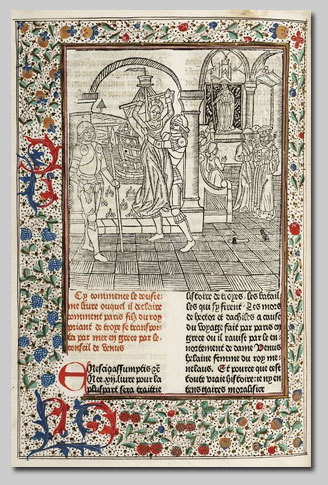 Thanks for sharing, Fio - fascinating that the illustration above takes priority over the text that is left languishing at the bottom. Also that the figures have been 'modernised' into late medieval/early Renaissance dress with the suits of armour. The Met. 'travels' so easily, it seems.
What struck me is that the layout of the scene recalls Piero della Francesco's Flagellation of a few decades before:
Thanks for sharing, Fio - fascinating that the illustration above takes priority over the text that is left languishing at the bottom. Also that the figures have been 'modernised' into late medieval/early Renaissance dress with the suits of armour. The Met. 'travels' so easily, it seems.
What struck me is that the layout of the scene recalls Piero della Francesco's Flagellation of a few decades before: Fascinating, Fio! I just knew this group would come up with things I'd never discover/realise on my own.
 Do you know which of the tales is being illustrated in the Mansion page? It made me think of Andromeda but that doesn't seem quite right.
On a related matter, I remember hearing a research paper on how Renaissance printers re-used engravings from very different books to reduce their costs. In my own research, I've come across medical/anatomical drawings being re-purposed in Renaissance 'pornographic' texts!
Roman Clodia wrote: "Fascinating, Fio! I just knew this group would come up with things I'd never discover/realise on my own. Do you know which of the tales is being illustrated in the Mansion page? ..."
All I can find out, Clodia, is that the image is from the first page of the introduction to Colard Mansion's version of The Metamorphoses, called Ovide Moralisé.
The Piero painting was fresh in my mind because I saw it in Urbino last month :-)
Roman Clodia wrote: "On a related matter, I remember hearing a research paper on how Renaissance printers re-used engravings from very different books to reduce their costs. In my own research, I've come across medical/anatomical drawings..."I can imagine Vesalius' life-like anatomical engravings suiting many purposes.
 Fionnuala wrote: "The Colard Mansion illustrations are impressive..."
What struck me is that the layout of the scene recalls Piero della Francesco's Flagellation of a few decades before...
Remarkable, Fio...wonderful comparison!
Roman Clodia wrote: "Someone asked somewhere about manuscript traditions for the Met. - I'm afraid I don't know the answer but will try to do some research and post it here."I, too, have been trying to envision the 'manuscript traditions' for the Met. In its time, it would have been an oral tradition? Which would have allowed it its own metamorphosis?
Ovid apparently completed the Met just as he was being banished from Rome to the edge of the "world" in what is now Romania. How did he reach his readers? At least he finished this comprehensive masterpiece.
Ce Ce wrote: "I, too, have been trying to envision the 'manuscript traditions' for the Met. In its time, it would have been an oral tradition?"My understanding is that no manuscripts survived from antiquity but that fragments were transmitted and were pieced together at some point c.8-9th century - don't quote me on this, though! So yes, there's no guarantee that the text we have is what Ovid actually wrote.
The Met. was always a written text, though, not oral. Certainly Ovid himself probably gave recitals as part of 'literary Rome' but it was a poem to be read - we can look at some of the writerly jokes as we go through.
Elena wrote: "Ovid apparently completed the Met just as he was being banished from Rome to the edge of the "world" in what is now Romania. How did he reach his readers? At least he finished this comprehensive ma..."Ah, Romania was the edge of the *Roman* world - so there was always traffic of people, goods, ideas and texts between the two. However much Ovid talks up the 'barbaric' place of exile in his 'Tristia' and 'Epistulae ex Ponto' (the exile poems), this is partly literary conceit.
In the Tristia, the poet ('Ovid', a narrative construct) talks of sending his books off to Rome to speak on his behalf.
Certainly Ovid continued to revise the Met. from the Black Sea - I'm never sure whether the Met. really was unfinished - or whether it's a pointed joke about Virgil and the 'unfinished' Aeneid which he asked, on his deathbed, to be burned.
Ce Ce wrote: "Fionnuala wrote: "The Colard Mansion illustrations are impressive..."What struck me is that the layout of the scene recalls Piero della Francesco's Flagellation of a few decades before...
Remarkable, Fio..."
In a kind of reverse parallel, isn't it interesting how the biblical creation story echoes Ovid's account of the creation of the world in Book 1, even to the flood and the couple who survived it.
Roman Clodia wrote: "My understanding is that no manuscripts survived from antiquity but that fragments were transmitted and were pieced together at some point c.8-9th century - don't quote me on this, though! So yes, there's no guarantee that the text we have is what Ovid actually wrote. The Met. was always a written text, though, not oral. Certainly Ovid himself probably gave recitals as part of 'literary Rome' but it was a poem to be read - we can look at some of the writerly jokes as we go through."
Thank you for this! So it was written and meant to be shared and read. However, much later...700 to 800 years passed...perhaps fragments (that were not original) were pieced together to form the basis for the many translations we are now reading.
While Ovid planted the seed, it seems Metamorphoses has likely had a vibrant evolutionary life of its own. It's own Genesis.
Fionnuala wrote: "In a kind of reverse parallel, isn't it interesting how the biblical creation story echoes Ovid's account of the creation of the world in Book 1, even to the flood and the couple who survived it."I'm just copying this over to the 'Book 1' discussion thread...
 If you are interested in Ovid's life and work I recommend Katharina Volk's Ovid which is a pretty good introduction and a quick read.
 Jasmine wrote: "If you are interested in Ovid's life and work I recommend Katharina Volk's Ovid which is a pretty good introduction and a quick read."
Thank you, Jasmine. I will look into it and will add it to the Group Shelves.

Ovid's Metamorphoses and Further Metamorphoses
Books mentioned in this topic
Ovid (other topics)Ovid (other topics)
Approaches to Teaching the Works of Ovid and the Ovidian Tradition (other topics)
The Greek Myths: The Complete and Definitive Edition (other topics)
