
Art Lovers discussion
Introduce an Artist and/or Work
>
Raphaelle Peale
date newest »
newest »

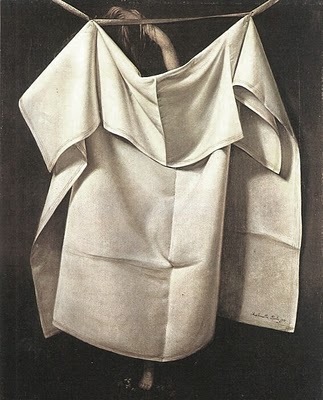
After The Bath (Venus Rising from the Sea - A Deception)
Raphaelle Peale
1849
"By 1823 Raphealle Peale had become an alcoholic and was painting solely to pay his bills--reducing his prices, even raffling off man of his still lifes. After the Bath, which shows the lighter, fun-loving side of his nature, was done at the end of his difficult life. It was painted by Raphaelle apparently to shock & fool his hot-tempered wife, Patty, who nagged him day & night. This illusion of a naked woman behind a sheet was supposedly so successful that Patty tried to pull the sheet away and instead--much to her husband's amusement--found herself scratching the canvas. Although the work is best known for its witty subject, the superb treatment of light on the creased white linen sheet marks it as a masterpiece among American still-life compositions."
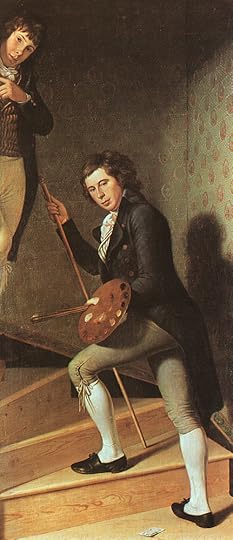
Portrait of Raphaelle Peale on Staircase
Charles Willson Peale
1795
Raphaelle Peale & Martha (Patty) McGlathery, his red-haired bride, met, when he was 20 in 1794. The couple were neighbors in Philadelphia, where Raphaelle's parents had a large home on the corner of Third & Lombard Sts.; Matthew McGlathery, his wife, also named Martha, & their daughter lived in a modest row home around the corner at 25 George St.The Peale & McGlathery families were from different spheres in Philadelphia society. Charles Willson Peale (American artist, 1741-1827) outlived 3 wives, fathered 16 children, & founded an artistic dynasty lasting nearly a century. Peale created the country's first museum of natural history & made the city's first use of gas to illuminate it. He received the first patent from the U.S. Patent Office, was a master of painting in oils, watercolor & miniatures. The bride's father Matthew McGlathery was a builder & carpenter who helped construct Carpenter's Hall in Philadelphia.
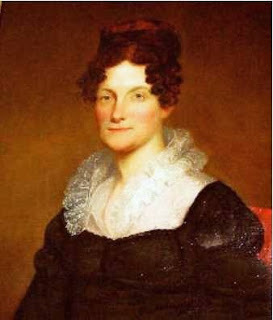
Martha (Patty) McGlathery Peale
Raphaelle Peale
Raphaelle was the oldest child of Charles Willson & Rachel Peale. Both father & son had a talent for art, music & poetry, plus a penchant for mechanical inventions & a love of entertainment. But Raphaelle was plagued by mood swings exascerbated by excessive drinking. At age 12, he had begun assisting his father in the museum, located initially in their home. An expanding number of exhibits prompted Peale to move both his family & collection to the recently completed Philosophical Hall, on south 5th St. Later the museum required even larger quarters, the "Long Room" on the 2nd floor of Independence Hall. To obtain exotic specimens of birds & animals, 18 year old Raphaelle was sent on a collecting expedition to South America.In 1794, Charles Willson Peale decided to devote himself completely to the prospering museum, & relinquished portrait painting to Raphaelle & Rembrandt, a younger brother. That same year Raphaelle painted Patty's portrait & determined to marry her. Reportedly Charles Willson opposed the match, but father & son remained close. The following year, the youthful artist made his professional debut at a major 1795 exhibition; where he showed 13 portraits & still lifes, at which he was particularly adept.
Most of that year, he & Rembrandt devoted to copying 60 of their father's best known portraits for exhibition in Charleston & Savannah. The Peale brothers did obtain portrait commissions for themselves. They sailed back to Philadelphia not long before Raphaelle's wedding at the Third Presbyterian Church at Fourth & Pine Sts on May 25, 1797. Home with his new bride for hardly 3 years, Raphaelle taught himself taxidermy by mounting specimens for the museum. His large portraits never sold well. Still lifes, at which he excelled, were not in vogue. But miniatures were. Peale mastered the technique of applying watercolors to thin slices of ivory. Early in 1800, he was in Baltimore, where he advertised that in a few months he already had painted 72 miniatures as keepsakes.
During his last 2 decades, Raphaelle journeyed through the South's eastern states seeking commissions, as his increasingly heavy drinking led to illness & loss of income. Peale's only genuine financial success was with the physiognotrace, a recently invented device for tracing small silhouette profiles on paper. Wherever he traveled - Virginia, Maryland, South Carolina & Georgia - people flocked to have their profiles made. In less than a year, he reportedly cut an incredible 86,430 silhouettes &, more importantly, earned his only real wealth. But soon the fad died. Later trips were failures. Charles Willson Peale wrote of family events. (July, 1803) "...Patty is up & bravely, would you guess it, in half an hour — no less than twins. Mrs. McGlathery is much with her; you need not fear that anything will be wanting at home..." Sadly, the twins died. By month's end, Raphaelle was home for the baptism of 3 children born earlier. Four children were born in later years.
The elder Peale recounted Patty's heartache resulting from her husband's travels & drinking. "...She complained it is hard to live separated. I justified it from the necessity of the case, & I also gave her some hints how to make home more agreeable to induce those we are connected with to stay with each other. She said we are very happy when he don't drink, & yet she said you could not do without it, for if you passed one day, a tremour came on you & you was miserable until you had it . . My answer is that it was wrong for anyone to drink anything but water..."Crippled at times by drink & gout, Raphaelle continued traveling until 1824, the year before his death. Too ill to leave home, he turned to poetry, writing "lovesick poems - little couplets" for a baker to place in cakes. On March 5, having given the baker his latest efforts, Raphaelle complained of an attack of gout in the stomach. A hot toddy, intended to help, caused him to collapse & die. Raphaelle is buried in St. Peter's churchyard, just a few steps from the grave of his father & next to Patty, the house carpenter's daughter, who died in 1852.
https://bjws.blogspot.com/2012/11/unu...
The Crucified Christ with the Virgin Mary, Saints and Angels
Raphaelle Peale

Raphaelle Peale was born in Annapolis, Maryland in 1774. He was the eldest son of Charles Willson Peale, under whom he first studied in Philadelphia. He was the first of Peale's children to survive infancy. In the early 1790s, he helped his father run the Peale Museum in Philadelphia. In 1796 he attempted, together with his brother Rembrandt, to organize a portrait gallery, which apparently failed, for in 1799 he had settled in Philadelphia as a miniature painter.
He spent the major part of his life in Philadelphia. Raphaelle was the tragic figure in the Peale household. Full of impish humor and artistic genius, he was never able to earn a living from his art. In the absence of commissions he turned his imagination to helping his father in the invention of stoves, fireplace improvements and wooden bridges, and in the mounting of the larger animals in the museum. In 1803, John L. Hawkins, the English inventor, allowed Raphaelle to take his physionotrace, a profile cutting machine, with him on an extended Southern trip. The device was a huge success and Raphaelle made a small fortune cutting thousands of profiles. But he spent it quickly, and for the most part, like other family members, faced constant financial crises.
In 1797, at the age of twenty-three, Raphaelle married Martha (Patty) MaGlathery, an Irish beauty. She bore him seven living children, four of them boys and three girls. Three others did not live.
Raphaelle's hands became more arthritic, and, as a combination of alcoholism and gout made steady work impossible, he grew more dependent on his father. His wife was forced to take in boarders to support the family. In 1815 he abandoned miniature painting and turned to still life, most of which was "trompe l'oeil' or deceptions, as Raphaelle called them. He was one of the first important painters of still life in this country and his work, together with that of his uncle, James Peale, to which it bears great similarity, exerted a profound influence on the development of this kind of painting in America.
He traveled extensively and advertised his work in local newspapers by offering discounts and guarantees. As his last job before he died, he was reduced to writing "lovesick poems" for a baker to put on cakes. On March 5, 1825, just days before his 51st birthday, he died of cold exposure on a Philadelphia street while under the influence of alcohol.
http://gratzgallery.com/inventory/ind...