
The Sword and Laser discussion

This topic is about
Zeroes
2018 Reads
>
Zs: sci-fi?

 Ruth (tilltab) wrote: "Since comments about whether or not this book is sci-fi have shown up in the book's introduction thread, I figured I'd start a specific thread on the subject.
It's a topic that comes up a lot: Is ..."
I think it has to have some projection into the future of the author...
IN this one it appears to be (view spoiler).. So near future SF, of the hard variety.
 It starts out as a techno thriller, but before the end it certainly is sci-fi.
 Ruth (tilltab) wrote: "To me, a book about hackers already fits. I don't see the need for anything extra. "
If it’s something that can happen in everyday life then it isn’t Science Fiction.
Replace “hackers” with any other technology-related job and I suspect you’ll have a completely different view.
To me, a book about vacuum cleaner repairmen already fits.
To me, a book about auto line workers already fits.
To me, a book about data entry interns already fits.
To me, a book about truck drivers already fits.
Science Fiction requires extrapolation as an essential element. Without that it’s just fiction.
 Mod
Mod
I'm 50% of the way through Zeroes and though it isn't yet sci-fi, I am seeing hints towards it becoming sci-fi.
 I recently finished the book. The first half of the book I enjoyed because it reminded me a lot of SF books I read nearly 25-30 years ago that were definitely SF at the time - it was a bit of a thrill to realise that what I was reading now was pretty realistic...we're living in the future!
The second half of the book suddenly morphs into something very Science Fiction (with the "science" part being increasingly questionable).
If you are wondering whether this is an S&L type book, just wait. If you get to the end and are telling me that this book is about the real world, then I'm going to be heading to the hills to dig a bunker.
Wait....it would explain a lot...
 Trike wrote: "Replace “hackers” with any other technology-related job and I suspect you’ll have a completely different view."
Hmm, I think the difference between this and the professions you have picked is that a story about a data entry intern is more likely to be about that interns life, and not about the way in which they input data. I think even the best writer would be hard pressed to find a story in the technical side of data entry. At best, you have a story about the data itself, which again, moves focus away from the technical and into the human. Hackie hackers that hack, on the other hand, is interesting enough to take the lead.
 Anders wrote: "It starts out as a techno thriller, but before the end it certainly is sci-fi."
This.
Ruth (tilltab) wrote: "Trike wrote: "Replace “hackers” with any other technology-related job and I suspect you’ll have a completely different view."Hmm, I think the difference between this and the professions you have ..."
Okay, scratch that one. (Although manipulating data can have catastrophic effects on society, no computer code required. Look at how the Russians have interfered with numerous elections, or Cambridge Analytica intentionally swaying public perceptions “merely” through data mining and manipulation.)
But anyone repairing vacuums/TVs/cars, or managing their driving time (and finding loopholes in the system), or anything like that is engaging with technology in the exact same way hackers do. Manipulating it, altering it, potentially making it better or malicious.
A TV repairman who unlocks all the hidden functions built into your set so you can access things you didn’t pay for? That’s a form of hacking. Yet my brother did exactly that to my parents’ TV a couple years ago. Not sci-fi.
Truck drivers gaming the system by spoofing GPS tracking and weight measuring? That’s also a form of hacking and has been going on for a few years now. Not sci-fi.
Hacking is a thing that happens everyday in the real world. Russia has hacked other countries’ power grids and shut off their internet with nothing more sophisticated than massive DoS attacks. Russia crashed Ukraine’s power grid a few years ago by using a virus called Crash Override. The US effectively shut down Iran’s nuclear program with a worm known as Stuxnet, which is about 15 years old already. (And, frighteningly, out there in the wild, evolving and changing.)
So no, without the speculation and/or extrapolation, the use of technology by itself isn’t enough to qualify as Science Fiction.
 I'd say a techno-thriller with cyberpunk elements, but this cyberpunk is just like an old rock band from the 80s, which decided to get some dough and 'reunited for the last tour'. Classic cyberpunk was lean and mean, not like this book, which is too like a action movie scenario.
Trike wrote: "without the speculation and/or extrapolation, the use of technology by itself isn’t enough to qualify as Science Fiction."
I'd say a techno-thriller with cyberpunk elements, but this cyberpunk is just like an old rock band from the 80s, which decided to get some dough and 'reunited for the last tour'. Classic cyberpunk was lean and mean, not like this book, which is too like a action movie scenario.
Trike wrote: "without the speculation and/or extrapolation, the use of technology by itself isn’t enough to qualify as Science Fiction."It's a fair point. I guess my argument is that it is the focus on technology, rather than the use, that makes it fit for me. But then, I'm not that picky about definitions - I've always been terrible at knowing what boxes things go in - it's all vague and ishy for me, and sci-fi as a genre has always sounded pretty vague in itself. So I throw this book in the sci-fi-ish section of my brain, even if the beginning is as sci-fi as it gets. My brain is a messy place. You wouldn't like it, Trike.
Mod
This."
yep 2nd half definitely pushes it firmly into sci-fi
 it is Sci Fi because it has a tried & true Sci Fi Trope. And it comes in the last quarter of the book. It not just about hacking. Okay the TV repair come in to fix the TV, then, now you have a smart TV. But the TV decides that, based on what you watch, you no longer have a right to live. So the TV goes on and off ruining your sleep, record depressing shows and no matter what buttons you push it is Fox News and Bravo.
Stephen wrote: "it is Sci Fi because it has a tried & true Sci Fi Trope. And it comes in the last quarter of the book. It not just about hacking. Okay the TV repair come in to fix the TV, then, now you have a smar..."
it is Sci Fi because it has a tried & true Sci Fi Trope. And it comes in the last quarter of the book. It not just about hacking. Okay the TV repair come in to fix the TV, then, now you have a smart TV. But the TV decides that, based on what you watch, you no longer have a right to live. So the TV goes on and off ruining your sleep, record depressing shows and no matter what buttons you push it is Fox News and Bravo.
Stephen wrote: "it is Sci Fi because it has a tried & true Sci Fi Trope. And it comes in the last quarter of the book. It not just about hacking. Okay the TV repair come in to fix the TV, then, now you have a smar..."Perhaps if it was a Service Call to install a swibble...
 Tassie Dave wrote: "KevBayer wrote: "Anders wrote: "It starts out as a techno thriller, but before the end it certainly is sci-fi."
This."
yep 2nd half definitely pushes it firmly into sci-fi"
I have finished and yes it starts off as a techno thriller and then moves into real SF at the end. But, in my opinion it definitely went off the rails towards the end.
 Mod
Mod
*ducks*
 Tom wrote: "Could fiction that relies on science as its central driving framework be considered science fiction whether it speculates/extrapolates or not?
 *ducks*"
No.
(wonders why Tom is crouching under the desk)
 (Nuclear bomb safety drill).
I think sci-fi should have its roots in science but stretch the fiction past what is possible by today's standards. But at the same time, I think speculating too much on genre leads to tediously splitting hairs.
Mod
I think sci-fi should have its roots in science but stretch the fiction past what is possible by today's standards. But at the same time, I think speculating too much ..."
This is my position too. A lot of times picking at genre is used as a cover for some other criticism.
(considers pile of oddly separated follicular matter on floor)To me the extrapolation is key. Otherwise you have a story about a scientist or involving science that's just... fiction. Think about a story that's about, say, a virologist's work, but that is all grounded in present-day science about viruses etc. You can tell a story about a deadly, Ebola-like virus getting loose but we know that one - it's happened a few times and while we know it can be worse than what's happened, we're likely talking a bad but containable tragedy. It might be a great story, but it's not going to be SF, more like a medical thriller. If the author takes the step of "this virus wipes out 99% of people" or "It turns them into zombies" and then tells us the story of the world after those events, that's extrapolation and become some kind of SF.
 So...Wargames *isn't* a scifi movie? *ducks under desk with Tom*
Okay, while I'm wildly free associating, my favorite bit in Wargames is when they're all running down a hall in the bunker. Who's in front? Ally Sheedy. Because she's an athlete, so of course she'd outpace a sedentary hacker and an aging General.
Tom wrote: "Could fiction that relies on science as its central driving framework be considered science fiction whether it speculates/extrapolates or not? *ducks*"
Nah, that's called work.
Now some theory papers I have been reading, they border on fiction, (Chameleon Fields seriously)....
John (Taloni) wrote: "So...Wargames *isn't* a scifi movie? *ducks under desk with Tom*i..."
Nah. Military-hacker thriller.
 Rick wrote: "John (Taloni) wrote: "So...Wargames *isn't* a scifi movie? *ducks under desk with Tom*
i..."
Nah. Military-hacker thriller."
I'm pretty sure the U.S. Military did not have an Artificial Intelligence that advanced in 1983. To this day I don't believe they have been foolish enough to allow an AI to have the ability to launch nukes.
Mod
I think I'd feel safer with AI in charge of the launch codes, than the semi-intelligent baboon that now is :-?
 ::gives Tassie Dave an upvote::
 Obviously cross-genre -- a science fiction techno-thriller with lots of suspense and action elements.
Ian wrote: "Rick wrote: "John (Taloni) wrote: "I'm pretty sure the U.S. Military did not have an Artificial Intelligence that advanced in 1983. ..."
Obviously cross-genre -- a science fiction techno-thriller with lots of suspense and action elements.
Ian wrote: "Rick wrote: "John (Taloni) wrote: "I'm pretty sure the U.S. Military did not have an Artificial Intelligence that advanced in 1983. ..."Not sure of your point. If you're arguing it was an extrapolation then it doesn't fit the "Science, but without extrapolation" category that Tom was positing.
Tassie Dave - at least there would be intelligence involved...
 Tassie Dave wrote: "I think I'd feel safer with AI in charge of the launch codes"
The first fictional AI with launch codes that I recall was Colossus published in 1966. Anything earlier?
it is a well know fact the Nuclear football has been replace with a Nintendo Switch.
 Read through everyone's stuff here and I think there a lot of good points. Really, this book is SF is The Matrix is SF. Otherwise not. Because (view spoiler) is something you think science could one day do or not.
 As for the larger discussion - to the degree to which it matters: to me SF is a story that, at the time when it's written, has a possibility of being being possible by technology development or extrapolating the laws of science. Otherwise, it's fantasy. So Scalzi's The God Engines is fantasy. Even though it's got a lot of SF tropes in it.
message 34:
by
Tassie Dave, S&L Historian
(last edited Nov 16, 2018 09:28PM)
(new)
-
rated it 4 stars
Mod
I disagree with that. There is a lot of sci-fi that uses ideas that assumes a scientific hypothesis is possible, for the sake of the story, where it is almost likely that that hypothesis is going to be impossible.
i.e time travel to the past, FTL spaceships, teleportation of large objects
But "most" people would put those stories firmly into the sci-fi genre. Soft sci-fi, but still sci-fi.
Tom wrote: "Could fiction that relies on science as its central driving framework be considered science fiction whether it speculates/extrapolates or not? *ducks*"
No. Without speculation or extrapolation it is merely fiction. As Rick says, the most common version of the “fiction about science” story is the medical thriller. There are entire subgenres of the Mystery genre concerned with various forms of forensic investigation. (Which I personally lay at the feet of popular TV series like Quincy, M.D. and, later, CSI. Quincy is nearly forgotten today, but despite never breaking the Top 30 in the ratings, more people watched it than Friends at its peak.)
M*A*S*H was an historical medical comedy. ER was a contemporary medical drama. Mercy Point was a Science Fiction medical drama. Basically the same story with different flavors.
Waterfowl have nothing to do with it.
John (Taloni) wrote: "So...Wargames *isn't* a scifi movie? *ducks under desk with Tom*”Of course it’s SF. The extrapolation bit is having AI run the nuclear defense system. It’s the sort of SF Isaac Asimov called “tomorrow fiction”, as in extrapolation of the very near future rather than blue sky speculation, where the story could come the headlines of tomorrow,
John (Taloni) wrote: "Okay, while I'm wildly free associating, my favorite bit in Wargames is when they're all running down a hall in the bunker. Who's in front? Ally Sheedy. Because she's an athlete, so of course she'd outpace a sedentary hacker and an aging General."
WarGames is brilliant start to finish, and all the characters are logical and consistent.
When Sheedy and Broderick are on the island talking to the creator of Joshua the AI, Dr. Falken, Falken tells them if they want to survive the coming nuclear holocaust they need to get as far away from there as possible. He says to them, “Listen carefully: Path. Follow path. Gate. Open gate. Through gate. Close gate. Last ferry 6:37. Run, run, run.” He is a genius programmer. He is THE genius programmer. Those instructions sound exactly like the directions a programmer would give.
They miss the ferry and Sheedy immediately starts taking off her shoes saying they can swim for it. Broderick comes up with a bunch of excuses why they can’t before admitting, “I can’t swim, okay Wonder Woman?,” She replies, “What kind of asshole lives in Seattle and doesn’t learn to swim?” “I always thought there’d be time!”
So good.
And when Broderick is locked in the medical exam room, he doesn’t do Action Hero stuff like kick down the door and knock out the guard, he does what a brilliant but dweeby teenage hacker does: assesses his environment and co-opts the tech to his advantage. He rifles the drawers, coming up with a handheld tape recorder the doctor uses to make notes. Then he bangs on the door to get the guard’s attention. The guard punches in the key code and Broderick tries to get talk his way out. This fails, as he knew it would. He then hooks the recorder to the lock and plays back the sound, which unlocks the door. As the guard is flirting with the nurse, Broderick sneaks out.
(All of which is highly implausible, but it’s so perfectly logical that you don’t question its efficacy.)
 Tom wrote: "Could fiction that relies on science as its central driving framework be considered science fiction whether it speculates/extrapolates or not?
 *ducks*"
Isaac Asimov wrote a story called “A Whiff of Death” which was always being put in the Science Fiction area, but it was a murder mystery with science as it’s background. Some publishers will pigeonhole, more so then...
Louis wrote: "Isaac Asimov wrote a story called “A Whiff of Death” which was always being put in the Science Fiction area, but it was a murder mystery with science as it’s background. Some publishers will pigeonhole, more so then... "As a very righteous and angry teenager (and big Asimov fan), this was one of the worst crimes in existence. I lost count of the number of times I reshelved "A Whiff of Death" in both the library and local book shop.
It was a one man crusade for correct book placement.
Rivers of London always appears in crime books (which I suppose is accurate) missing its core readership of fantasy... Next to each other in the local library so not such a big deal...
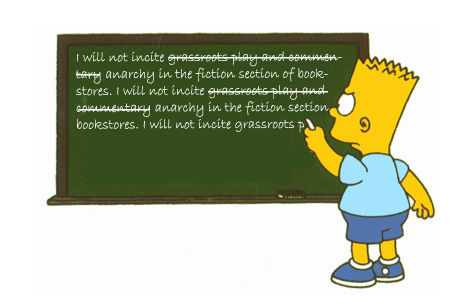
 I'm constantly reshelving books at my two local bookstores. They don't like it.
Just last week I was moving 2666 from the SF/F section to the general fiction section, and got caught. They said their computer tells them where to put it. Drives me crazy.
Don't reshelve things in bookstores unless you own it. It's rude, presumptuous and not your place to do.
Mod
or they put it on the wrong shelf. That's being very helpful to your fellow readers ;-)
It's rude of them (staff) to put things where you don't expect them to be.
No. DO NOT RESHELVE THINGS. It's NEVER OK. If you think something is really on the wrong shelf, like a customer put a Cormac McCarthy book in the romance section, even then, leave it. People in bookshops go through their sections fairly regularly, stocking things and dealing with stuff like this. The reason it's out of line, though, is this...
Customer walks in. Asks a staff person for Book X. Staff person might look it up on the computer or in a smaller shop know where that would be shelved. They walk the customer to that area and... it's not there. It's not there because some annoying, self-important customer has moved it. The store likely loses a sale and the customer doesn't get their book.
If you want to shelve books at home according to some idiosyncratic method, go for it. Want to do it in bookstore? Don't, unless you own it.
Mod
It's not something to get upset about.
Tasha wrote: "I'm constantly reshelving books at my two local bookstores. They don't like it.Just last week I was moving 2666 from the SF/F section to the general fiction section, and got caught. ..."
You guys lay off Tasha. She has to do *something* when there aren’t any parents around that she can give unsolicited child-rearing advice to.
Can I point out firstly that we're a tad off topic and secondly I hereby apologise for the actions of my angry teenager former self. I have since worked in a library to reform the system from the inside.
I know this is still off-topic but the only time it's okay to reshelve things is to put books in the correct series order. I'm always moving the Malazan series at my store to the correct sequence.
 Rick wrote: "No. DO NOT RESHELVE THINGS. It's NEVER OK. If you think something is really on the wrong shelf, like a customer put a Cormac McCarthy book in the romance section, even then, leave it. People in boo..."
I've worked at two different libraries and three bookstores; one I managed for 9 1/2 years (one of the two I'm talking about.) I know how to shelve books, but thanks for your input.
Doesn't matter. It's *not your property*. You're out of line to reorder other people's stuff, period. You might think you know where something should go but if they expect it to be in one place and you've arrogantly taken it on yourself to move that thing, you run into the issue I outlined above.

The Sword and Laser
Books mentioned in this topic
2666 (other topics)2666 (other topics)
A Whiff of Death (other topics)
Colossus (other topics)
Reamde (other topics)
It's a topic that comes up a lot: Is this book sci-fi enough? What makes a book sci-fi? Etc.
To me, a book about hackers already fits. I don't see the need for anything extra. If the book is about technology and how it's used, that is enough for me. Obviously the hacking has to be central. The Girl with a Dragon Tattoo has hacking, but there, the focus is on a bunch of gross rape stuff, to be incredibly reductive to that book's plot. But here, though I am not too far along, we have bunch of hackers being selected, presumably to do hacker stuff. I shrug and think of that as sci-fi. If it's stuff that people can actually do in real life, that still counts to me. Of course. there are other opinions. ;P