
Book Nook Cafe discussion
General Conversation
>
Poetry ~~ 2019

 I thought this was a nice poem to start the new year.
Still I Rise
BY MAYA ANGELOU
You may write me down in history
With your bitter, twisted lies,
You may trod me in the very dirt
But still, like dust, I'll rise.
Does my sassiness upset you?
Why are you beset with gloom?
’Cause I walk like I've got oil wells
Pumping in my living room.
Just like moons and like suns,
With the certainty of tides,
Just like hopes springing high,
Still I'll rise.
Did you want to see me broken?
Bowed head and lowered eyes?
Shoulders falling down like teardrops,
Weakened by my soulful cries?
Does my haughtiness offend you?
Don't you take it awful hard
’Cause I laugh like I've got gold mines
Diggin’ in my own backyard.
You may shoot me with your words,
You may cut me with your eyes,
You may kill me with your hatefulness,
But still, like air, I’ll rise.
Does my sexiness upset you?
Does it come as a surprise
That I dance like I've got diamonds
At the meeting of my thighs?
Out of the huts of history’s shame
I rise
Up from a past that’s rooted in pain
I rise
I'm a black ocean, leaping and wide,
Welling and swelling I bear in the tide.
Leaving behind nights of terror and fear
I rise
Into a daybreak that’s wondrously clear
I rise
Bringing the gifts that my ancestors gave,
I am the dream and the hope of the slave.
I rise
I rise
I rise.
***** Here is the author reading her poem
https://www.youtube.com/watch?v=JqOqo...
If you happen to have Amazon Prime I see you can read the bestselling poetry book Milk and Honey by Rupi Kaur for free. I just downloaded a copy for myself.
It has over 6000 reviews on Amazon !
The book is divided into four chapters, and each chapter serves a different purpose. Deals with a different pain. Heals a different heartache. Milk and Honey takes readers through a journey of the most bitter moments in life and finds sweetness in them because there is sweetness everywhere if you are just willing to look
pages 208
 "Still I Rise" is one of my favorite poems by Angelou. You are right--great start to this New Year.
Thanks for the reminder of Kaur's book. I'm on the waiting list at my library now.
 please please read sticky notes by indy yelich !
she is a 20 year old writer from Auckland, NZ, based in NYC and her debut poetry collection is stunning !
You may be familiar with the work of her sister, Lorde and her mother, poet Sonja Yelich. Indy clearly has the genes and talent in her blood !
I read the reviews of sticky notes here on GoodReads and they, too, were favorable, for the most part. I couldn't find a complete poem to share here, unfortunately, but the bits shared in the reviews sounded good. Thanks for the tip on Indy Yelich's poetry, seasons.
Poet Mary Oliver died this week. Her poems embraced nature as the treasure it is, often relating it to our daily lives. I'm going to share a few of her works here the next couple of days. As many of us have snow in the forecast, i'll begin with this one.Beyond the Snowbelt
Over the local stations, one by one,
Announcers list disasters like dark poems
That always happen in the skull of winter.
But once again the storm has passed us by:
Lovely and moderate, the snow lies down
While shouting children hurry back to play,
And scarved and smiling citizens once more
Sweep down their easy paths of pride and welcome.
And what else might we do? Let us be truthful.
Two counties north the storm has taken lives.
Two counties north, to us, is far away, -
A land of trees, a wing upon a map,
A wild place never visited, - so we
Forget with ease each far mortality.
Peacefully from our frozen yards we watch
Our children running on the mild white hills.
This is the landscape that we understand, -
And till the principle of things takes root,
How shall examples move us from our calm?
I do not say that is not a fault.
I only say, except as we have loved,
All news arrives as from a distant land.
madrano wrote: "I'm going to share a few of her works here the next couple of days. As many of us have snow in the forecast, i'll begin with this one."Thanks for sharing the winter/snow poem.
Today at my local Trader Joe's in NYC the line was about 15 minutes long and wrapped around the store as people seemed to have misheard the forecast of a few inches of snow and somehow heard End Times Apocalypse.
I recall last year when snow was forecast they actually had to close the store and let shoppers in only as others left as the store was at 100% capacity.
I thought I would build on your winter poem, deb, as my daily read in Year of Wonder: Classical Music for Every Day was for the composer Morten Lauridsen (b.1943)Apparently he and the author of Year of Wonder are fans of the poetry by Rainer Maria Rilke
Lauridsen brings the German poet's verse to life in music she notes. One line she quotes is: 'roses climb his life as if he were their trellis.'
Here is today's classical selection.
Mid Winter Songs
Les Chansons Des Roses: V. Dirait-On (Morten Lauridsen, piano)
https://www.youtube.com/watch?v=34buz...
Here is another version
Dirait-on. Morten Lauridsen
https://www.youtube.com/watch?v=gWXVZ...
People--a snow storm & they load up for an apocalypse?! The fear of missing a meal or not having the snack we'll crave, maybe?Neat music. Thanks for the links.
I found another Oliver poem about snow, which i'll share since we are in the mood...
Snowy Night
by Mary Oliver
Last night, an owl
in the blue dark
tossed
an indeterminate number
of carefully shaped sounds into
the world, in which,
a quarter of a mile away, I happened
to be standing.
I couldn’t tell
which one it was –
the barred or the great-horned
ship of the air –
it was that distant. But, anyway,
aren’t there moments
that are better than knowing something,
and sweeter? Snow was falling,
so much like stars
filling the dark trees
that one could easily imagine
its reason for being was nothing more
than prettiness. I suppose
if this were someone else’s story
they would have insisted on knowing
whatever is knowable – would have hurried
over the fields
to name it – the owl, I mean.
But it’s mine, this poem of the night,
and I just stood there, listening and holding out
my hands to the soft glitter
falling through the air. I love this world,
but not for its answers.
And I wish good luck to the owl,
whatever its name –
and I wish great welcome to the snow,
whatever its severe and comfortless
and beautiful meaning.
madrano wrote: and I just stood there, listening and holding out
my hands to the soft glitter
falling through the air. ."
I like that poem a lot, deb. It sort of reminds me to live and enjoy the moment.
I agree. Indeed, i think much of her poetry serves to remind us of that point. It's another reason i like her work.It seems i have saved a number of Oliver poems but won't share them all. Here is one to read daily.
Morning Poem
by Mary Oliver
Every morning
the world
is created.
Under the orange
sticks of the sun
the heaped
ashes of the night
turn into leaves again
and fasten themselves to the high branches ---
and the ponds appear
like black cloth
on which are painted islands
of summer lilies.
If it is your nature
to be happy
you will swim away along the soft trails
for hours, your imagination
alighting everywhere.
And if your spirit
carries within it
the thorn
that is heavier than lead ---
if it's all you can do
to keep on trudging ---
there is still
somewhere deep within you
a beast shouting that the earth
is exactly what it wanted ---
each pond with its blazing lilies
is a prayer heard and answered
lavishly,
every morning,
whether or not
you have ever dared to be happy,
whether or not
you have ever dared to pray.
 Mary Oliver's poems are so evocative of the environment. Just wonderful. 🙂🌿🌹
Very nice. Thanks for sharing, deb.
Believe me, it is my pleasure. Too often the only time i reread much poetry is when i want to post here. For links to more of Oliver's poems-- http://famouspoetsandpoems.com/poets/... They are a great resource when seeking out poems & poets, btw.
Mary Oliver's poems are so evocative of the environment. Just wonderful. 🙂🌿🌹
Very nice. Thanks for sharing, deb.
Believe me, it is my pleasure. Too often the only time i reread much poetry is when i want to post here. For links to more of Oliver's poems-- http://famouspoetsandpoems.com/poets/... They are a great resource when seeking out poems & poets, btw.I'll end with this one, as it was her death which began the thread...
When Death Comes
by Mary Oliver
When death comes
like the hungry bear in autumn;
when death comes and takes all the bright coins from his purse
to buy me, and snaps the purse shut;
when death comes
like the measle-pox
when death comes
like an iceberg between the shoulder blades,
I want to step through the door full of curiosity, wondering:
what is it going to be like, that cottage of darkness?
And therefore I look upon everything
as a brotherhood and a sisterhood,
and I look upon time as no more than an idea,
and I consider eternity as another possibility,
and I think of each life as a flower, as common
as a field daisy, and as singular,
and each name a comfortable music in the mouth,
tending, as all music does, toward silence,
and each body a lion of courage, and something
precious to the earth.
When it's over, I want to say all my life
I was a bride married to amazement.
I was the bridegroom, taking the world into my arms.
When it's over, I don't want to wonder
if I have made of my life something particular, and real.
I don't want to find myself sighing and frightened,
or full of argument.
I don't want to end up simply having visited this world.
madrano wrote: and I look upon time as no more than an idea,and I consider eternity as another possibility,
"
and I look upon time as no more than an idea,
and I consider eternity as another possibility,
I like this notion.
Agreed. This line calls to me, a nonbeliever as well--"I want to step through the door full of curiosity, wondering:
what is it going to be like, that cottage of darkness?"
As a kid my dad was called "Curiosity Carey" (his first name was Carey). And i like thinking that when he died these were his last feelings, which those lines evoke.
madrano wrote: ""I want to step through the door full of curiosity, wondering:what is it going to be like, that cottage of darkness?"
As a kid my dad was called "Curiosity Carey" (his first name was Carey). And i like thinking that when he died these were his last feelings, which those lines evoke.
"
This made me tear up and smile. Thanks for sharing that personal memory.
I'm pleased that it moved you, Alias. I so well remember the beautiful story you shared about your father on the subway & the man he "saw". That still touches me.
madrano wrote: "I'm pleased that it moved you, Alias. I so well remember the beautiful story you shared about your father on the subway & the man he "saw". That still touches me."So funny you mentioned that, deb. Last night I was reading There Will Be No Miracles Here: A Memoir and the author quotes the opening of Invisible Man-Ralph Ellison and it made me think of that very time on the subway with my dad.
"I am an invisible man. No, I am not a spook like those who haunted Edgar Allan Poe; or am I one of your Hollywood-movie ectoplasm. I am a man of substance, of flesh and bone, fiber and liquids-- and I might even be said to possess a mind. I am invisible, understand, simply because people refuse to see me."
It's a good opening, imo. Did you feel as though your dad kissed your forehead? I know i would!
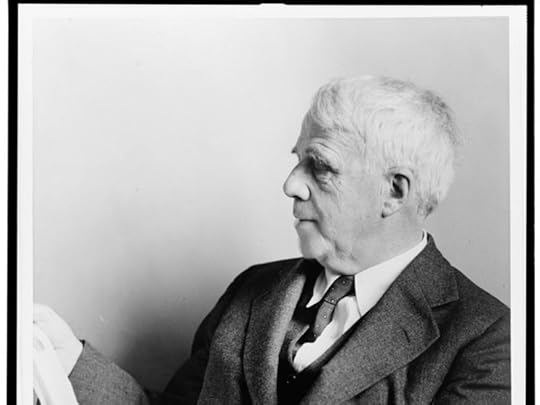
"To hear a literary work in the author's own voice is a treat and can ignite new feelings about the words. Robert Frost died on this day in 1963."
https://www.smithsonianmag.com/smart-...
Treat, indeed. It's neat to hear poets recite their poems but it also illustrates why "Poetry Reading" is part of some speech tournament's competitions. Sometimes hearing the poet's words from the poet disappoints me, i must admit. The way Frost reads doesn't seem to connote the meaning i give to the same poem. Initially i thought he was angry but i now suspect that he just wanted to make sure he was loud enough and enunciated clearly. Just a guess.Maya Angelou and Vachel Lindsay are two poets whose work i enjoy hearing as they recite them. Their lively readings give intensity to their work.
"The Chinese Nightingale", read by Lindsay--
https://www.youtube.com/watch?v=9c0N1...
(This is a long piece. To read the poem, https://www.poemhunter.com/poem/the-c... )
"Phenomenal Woman", read by Maya Angelou--
https://www.youtube.com/watch?v=VeFfh...
Phenomenal Woman
By Maya Angelou
Pretty women wonder where my secret lies.
I’m not cute or built to suit a fashion model’s size
But when I start to tell them,
They think I’m telling lies.
I say,
It’s in the reach of my arms,
The span of my hips,
The stride of my step,
The curl of my lips.
I’m a woman
Phenomenally.
Phenomenal woman,
That’s me.
I walk into a room
Just as cool as you please,
And to a man,
The fellows stand or
Fall down on their knees.
Then they swarm around me,
A hive of honey bees.
I say,
It’s the fire in my eyes,
And the flash of my teeth,
The swing in my waist,
And the joy in my feet.
I’m a woman
Phenomenally.
Phenomenal woman,
That’s me.
Men themselves have wondered
What they see in me.
They try so much
But they can’t touch
My inner mystery.
When I try to show them,
They say they still can’t see.
I say,
It’s in the arch of my back,
The sun of my smile,
The ride of my breasts,
The grace of my style.
I’m a woman
Phenomenally.
Phenomenal woman,
That’s me.
Now you understand
Just why my head’s not bowed.
I don’t shout or jump about
Or have to talk real loud.
When you see me passing,
It ought to make you proud.
I say,
It’s in the click of my heels,
The bend of my hair,
the palm of my hand,
The need for my care.
’Cause I’m a woman
Phenomenally.
Phenomenal woman,
That’s me.
Maya Angelou, “Phenomenal Woman” from And Still I Rise. Copyright © 1978 by Maya Angelou. Used by permission of Random House, an imprint and division of Penguin Random House LLC. All rights reserved.
A terrific poem for our times, deb.It's fun and interesting to hear the author read their works.
Sometimes it is a whole new take on the work from when I read it myself.
I agree, Alias. Way back in high school, one of my teachers slammed me for interpreting a poem wrong. Since she was "the boss", i let it pass, while still feeling i was right in my fashion. Poetry, like much art, is open to interpretation, which may well be why some artists title their work "Untitled". :-) When a poet reads their own work, that can be a big help, though.Barbara, i really liked the way Angelou read poetry, not only her own. Many of her own poems empower women in a lovely way. Here she performs (no other way to put it) my favorite poem from her "Still I Rise". Wow!
https://www.youtube.com/watch?v=qviM_...
Because she was a dancer and actor, i imagine she knew exactly what dress to wear. When she utters the lines about the tides, her blouse illustrates it. ANYway, here are the words, which you may note, she altered in her filmed piece.
Still I Rise
You may write me down in history
With your bitter, twisted lies,
You may tread me in the very dirt
But still, like dust, I'll rise.
Does my sassiness upset you?
Why are you beset with gloom?
'Cause I walk like I've got oil wells
Pumping in my living room.
Just like moons and like suns,
With the certainty of tides,
Just like hopes springing high,
Still I'll rise.
Did you want to see me broken?
Bowed head and lowered eyes?
Shoulders falling down like teardrops.
Weakened by my soulful cries.
Does my haughtiness offend you?
Don't you take it awful hard
'Cause I laugh like I've got gold mines
Diggin' in my own back yard.
You may shoot me with your words,
You may cut me with your eyes,
You may kill me with your hatefulness,
But still, like air, I'll rise.
Does my sexiness upset you?
Does it come as a surprise
That I dance like I've got diamonds
At the meeting of my thighs?
Out of the huts of history's shame
I rise
Up from a past that's rooted in pain
I rise
I'm a black ocean, leaping and wide,
Welling and swelling I bear in the tide.
Leaving behind nights of terror and fear
I rise
Into a daybreak that's wondrously clear
I rise
Bringing the gifts that my ancestors gave,
I am the dream and the hope of the slave.
I rise
I rise
I rise.
 “The Road Not Taken” by Robert Frost (1874-1963)
Two roads diverged in a yellow wood,
And sorry I could not travel both
And be one traveler, long I stood
And looked down one as far as I could
To where it bent in the undergrowth;
Then took the other, as just as fair,
And having perhaps the better claim,
Because it was grassy and wanted wear;
Though as for that the passing there
Had worn them really about the same,
And both that morning equally lay
In leaves no step had trodden black.
Oh, I kept the first for another day!
Yet knowing how way leads on to way,
I doubted if I should ever come back.
I shall be telling this with a sigh
Somewhere ages and ages hence:
Two roads diverged in a wood, and I—
I took the one less traveled by,
And that has made all the difference.
--------------------------------------------------
Meaning of the Poem
This poem deals with that big noble question of “How to make a difference in the world?” On first reading, it tells us that the choice one makes really does matter, ending: “I took the one less traveled by, / And that has made all the difference.”
A closer reading reveals that the lonely choice that was made earlier by our traveling narrator maybe wasn’t all that significant since both roads were pretty much the same anyway (“Had warn them really about the same”) and it is only in the remembering and retelling that it made a difference. We are left to ponder if the narrator had instead traveled down “The Road Not Taken” might it have also made a difference as well. In a sense, “The Road Not Taken” tears apart the traditional view of individualism, which hinges on the importance of choice, as in the case of democracy in general (choosing a candidate), as well as various constitutional freedoms: choice of religion, choice of words (freedom of speech), choice of group (freedom of assembly), and choice of source of information (freedom of press). For example, we might imagine a young man choosing between being a carpenter or a banker later seeing great significance in his choice to be a banker, but in fact there was not much in his original decision at all other than a passing fancy. In this, we see the universality of human beings: the roads leading to carpenter and banker being basically the same and the carpenter and bankers at the end of them—seeming like individuals who made significant choices—really being just part of the collective of the human race.
Then is this poem not about the question “How to make a difference in the world?” after all? No. It is still about this question. The ending is the most clear and striking part. If nothing else, readers are left with the impression that our narrator, who commands beautiful verse, profound imagery, and time itself (“ages and ages hence”) puts value on striving to make a difference. The striving is reconstituted and complicated here in reflection, but our hero wants to make a difference and so should we. That is why this is a great poem, from a basic or close reading perspective.
https://classicalpoets.org/2016/01/07...
The New Colossus” by Emma Lazarus (1849-1887)Not like the brazen giant of Greek fame,
With conquering limbs astride from land to land;
Here at our sea-washed, sunset gates shall stand
A mighty woman with a torch, whose flame
Is the imprisoned lightning, and her name
Mother of Exiles. From her beacon-hand
Glows world-wide welcome; her mild eyes command
The air-bridged harbor that twin cities frame.
“Keep, ancient lands, your storied pomp!” cries she
With silent lips. “Give me your tired, your poor,
Your huddled masses yearning to breathe free,
The wretched refuse of your teeming shore.
Send these, the homeless, tempest-tossed to me,
I lift my lamp beside the golden door!”
Meaning of the Poem
Inscribed on the Statue of Liberty in New York harbor, this sonnet may have the greatest placement of any English poem. It also has one of the greatest placements in history. Lazarus compares the Statue of Liberty to the Colossus of Rhodes, one of the Seven Wonders of the Ancient World. Like the Statue of Liberty, the Colossus of Rhodes was an enormous god-like statue positioned in a harbor. Although the Colossus of Rhodes no longer stands, it symbolizes the ancient Greek world and the greatness of the ancient Greek and Roman civilization, which was lost for a thousand years to the West, and only fully recovered again during the Renaissance. “The New Colossus” succinctly crystallizes the connection between the ancient world and America, a modern nation. It’s a connection that can be seen in the White House and other state and judicial buildings across America that architecturally mirror ancient Greek and Roman buildings; and in the American political system that mirrors Athenian Democracy and Roman Republicanism.
https://classicalpoets.org/2016/01/07...
“The Tiger” by William Blake (1757-1827)Tiger Tiger, burning bright,
In the forests of the night;
What immortal hand or eye,
Could frame thy fearful symmetry?
In what distant deeps or skies.
Burnt the fire of thine eyes?
On what wings dare he aspire?
What the hand, dare seize the fire?
And what shoulder, and what art,
Could twist the sinews of thy heart?
And when thy heart began to beat,
What dread hand? and what dread feet?
What the hammer? what the chain,
In what furnace was thy brain?
What the anvil? what dread grasp,
Dare its deadly terrors clasp!
When the stars threw down their spears
And water’d heaven with their tears:
Did he smile his work to see?
Did he who made the Lamb make thee?
Tiger Tiger burning bright,
In the forests of the night:
What immortal hand or eye,
Dare frame thy fearful symmetry?
Meaning of the Poem
This poem contemplates a question arising from the idea of creation by an intelligent creator. The question is this: If there is a loving, compassionate God or gods who created human beings and whose great powers exceed the comprehension of human beings, as many major religions hold, then why would such a powerful being allow evil into the world. Evil here is represented by a tiger that might, should you be strolling in the Indian or African wild in the 1700s, have leapt out and killed you. What would have created such a dangerous and evil creature? How could it possibly be the same divine blacksmith who created a cute harmless fluffy lamb or who created Jesus, also known as the “Lamb of God” (which the devoutly Christian Blake was probably also referring to here). To put it another way, why would such a divine blacksmith create beautiful innocent children and then also allow such children to be slaughtered. The battery of questions brings this mystery to life with lavish intensity.
Does Blake offer an answer to this question of evil from a good God? It would seem not on the surface. But, this wouldn’t be a great poem if it were really that open ended. The answer comes in the way that Blake explains the question. Blake’s language peels away the mundane world and offers a look at the super-reality to which poets are privy. We fly about in “forests of the night” through “distant deeps or skies” looking for where the fire in the tiger’s eye was taken from by the Creator. This is the reality of expanded time, space, and perception that Blake so clearly elucidates elsewhere with the lines “To see a world in a grain of sand / And a heaven in a wild flower, / Hold infinity in the palm of your hand, / And eternity in an hour” (“Auguries of Innocence”). This indirectly tells us that the reality that we ordinarily know and perceive is really insufficient, shallow, and deceptive. Where we perceive the injustice of the wild tiger something else entirely may be transpiring. What we ordinarily take for truth may really be far from it: a thought that is scary, yet also sublime or beautiful—like the beautiful and fearsome tiger. Thus, this poem is great because it concisely and compellingly presents a question that still plagues humanity today, as well as a key clue to the answer.
https://classicalpoets.org/2016/01/07...
“Daffodils” by William Wordsworth (1770-1850)I wandered lonely as a cloud
That floats on high o’er vales and hills,
When all at once I saw a crowd,
A host, of golden daffodils;
Beside the lake, beneath the trees,
Fluttering and dancing in the breeze.
Continuous as the stars that shine
And twinkle on the milky way,
They stretched in never-ending line
Along the margin of a bay:
Ten thousand saw I at a glance,
Tossing their heads in sprightly dance.
The waves beside them danced; but they
Out-did the sparkling waves in glee:
A poet could not but be gay,
In such a jocund company:
I gazed—and gazed—but little thought
What wealth the show to me had brought:
For oft, when on my couch I lie
In vacant or in pensive mood,
They flash upon that inward eye
Which is the bliss of solitude;
And then my heart with pleasure fills,
And dances with the daffodils.
Meaning of the Poem
Through the narrator’s chance encounter with a field of daffodils by the water, we are presented with the power and beauty of the natural world. It sounds simple enough, but there are several factors that contribute to this poem’s greatness. First, the poem comes at a time when the Western world is industrializing and man feels spiritually lonely in the face of an increasingly godless worldview. This feeling is perfectly harnessed by the depiction of wandering through the wilderness “lonely as a cloud” and by the ending scene of the narrator sadly lying on his couch “in vacant or in pensive mood” and finding happiness in solitude. The daffodils then become more than nature; they become a companion and a source of personal joy. Second, the very simplicity itself of enjoying nature—flowers, trees, the sea, the sky, the mountains etc.—is perfectly manifested by the simplicity of the poem: the four stanzas simply begin with daffodils, describe daffodils, compare daffodils to something else, and end on daffodils, respectively. Any common reader can easily get this poem, as easily as her or she might enjoy a walk around a lake.
Third, Wordsworth has subtly put forward more than just an ode to nature here. Every stanza mentions dancing and the third stanza even calls the daffodils “a show.” At this time in England, one might have paid money to see an opera or other performance of high artistic quality. Here, Wordsworth is putting forward the idea that nature can offer similar joys and even give you “wealth” instead of taking it from you, undoing the idea that beauty is attached to earthly money and social status. This, coupled with the language and topic of the poem, which are both relatively accessible to the common man, make for a great poem that demonstrates the all-encompassing and accessible nature of beauty and its associates, truth and bliss.
https://classicalpoets.org/2016/01/07...
“Holy Sonnet 10: Death, Be Not Proud” by John Donne (1572-1631)Death, be not proud, though some have called thee
Mighty and dreadful, for thou art not so;
For those whom thou think’st thou dost overthrow
Die not, poor Death, nor yet canst thou kill me.
From rest and sleep, which but thy pictures be,
Much pleasure; then from thee much more must flow,
And soonest our best men with thee do go,
Rest of their bones, and soul’s delivery.
Thou art slave to fate, chance, kings, and desperate men,
And dost with poison, war, and sickness dwell,
And poppy or charms can make us sleep as well
And better than thy stroke; why swell’st thou then?
One short sleep past, we wake eternally
And death shall be no more; Death, thou shalt die.
Meaning of the Poem
Death is a perennial subject of fear and despair. But, this sonnet seems to say that it need not be this way. The highly focused attack on Death’s sense of pride uses a grocery list of rhetorical attacks: First, sleep, which is the closest human experience to death, is actually quite nice. Second, all great people die sooner or later and the process of death could be viewed as joining them. Third, Death is under the command of higher authorities such as fate, which controls accidents, and kings, who wage wars; from this perspective, Death seems no more than a pawn in a larger chess game within the universe. Fourth, Death must associate with some unsavory characters: “poison, wars, and sickness.” Yikes! They must make unpleasant coworkers! (You can almost see Donne laughing as he wrote this.) Fifth, “poppy and charms” (drugs) can do the sleep job as well as Death or better. Death, you’re fired!
The sixth, most compelling, and most serious reason is that if one truly believes in a soul then Death is really nothing to worry about. The soul lives eternally and this explains line 4, when Donne says that Death can’t kill him. If you recognize the subordinate position of the body in the universe and identify more fully with your soul, then you can’t be killed in an ordinary sense. Further, this poem is so great because of its universal application. Fear of death is so natural an instinct and Death itself so all-encompassing and inescapable for people, that the spirit of this poem and applicability of it extends to almost any fear or weakness of character that one might have. Confronting, head on, such a fear or weakness, as Donne has done here, allows human beings to transcend their condition and their perception of Death, more fully perhaps than one might through art by itself—as many poets from this top ten list seem to say—since the art may or may not survive may or may not be any good, but the intrinsic quality of one’s soul lives eternally. Thus, Donne leaves a powerful lesson to learn from: confront what you fear head on and remember that there is nothing to fear on earth if you believe in a soul.
“Sonnet 18” by William Shakespeare (1564-1616)Shall I compare thee to a summer’s day?
Thou art more lovely and more temperate:
Rough winds do shake the darling buds of May,
And summer’s lease hath all too short a date:
Sometime too hot the eye of heaven shines,
And often is his gold complexion dimm’d;
And every fair from fair sometime declines,
By chance, or nature’s changing course, untrimm’d;
But thy eternal summer shall not fade
Nor lose possession of that fair thou ow’st;
Nor shall Death brag thou wander’st in his shade,
When in eternal lines to time thou grow’st;
So long as men can breathe or eyes can see,
So long lives this, and this gives life to thee.
Meaning of the Poem
Basically, the narrator tells someone he esteems highly that this person is better than a summer’s day because a summer’s day is often too hot and too windy, and especially because a summer’s day doesn’t last; it must fade away just as people, plants, and animals die. But, this esteemed person does not lose beauty or fade away like a summer’s day because he or she is eternally preserved in the narrator’s own poetry. “So long lives this, and this gives life to thee” means “This poetry lives long, and this poetry gives life to you.”
From a modern perspective this poem might come off as pompous (assuming the greatness of one’s own poetry), arbitrary (criticizing a summer’s day upon what seems a whim), and sycophantic (praising someone without substantial evidence). How then could this possibly be number one? After the bad taste of an old flavor to a modern tongue wears off, we realize that this is the very best of poetry. This is not pompous because Shakespeare actually achieves greatness and creates an eternal poem. It is okay to recognize poetry as great if it is great and it is okay to recognize an artistic hierarchy. In fact, it is absolutely necessary in educating, guiding, and leading others. The attack on a summer’s day is not arbitrary. Woven throughout the language is an implicit connection between human beings, the natural world (“a summer’s day”), and heaven (the sun is “the eye of heaven”). A comparison of a human being to a summer’s day immediately opens the mind to unconventional possibilities; to spiritual perspectives; to the ethereal realm of poetry and beauty. The unabashed praise for someone without a hint as to even the gender or accomplishments of the person is not irrational or sycophantic. It is a pure and simple way of approaching our relationships with other people, assuming the best. It is a happier way to live—immediately free from the depression, stress, and cynicism that creeps into our hearts. Thus, this poem is strikingly and refreshingly bold, profound, and uplifting.
Finally, as to the question of overcoming death, fear, and the decay of time, an overarching question in these great poems, Shakespeare adroitly answers them all by skipping the question, suggesting it is of no consequence. He wields such sublime power that he is unmoved and can instead offer remedy, his verse, at will to those he sees befitting. How marvelous!
https://classicalpoets.org/2016/01/07...
What a lovely bouquet of poetry, Alias. Thank you for sharing these. The poignant John Donne is as profoundly bittersweet today as it was mighty when i first read it. Ah, age!And i keep wondering when the present Executive Branch will pry the Emma Lazarus poem from the Statue of Liberty.
Oddly enough, even without knowing this is Poetry Month, i checked out a book of poetry this morning from our library. Yesterday i saw poet Tracy K. Smithon PBS's "Articulate with Jim Cotter" and fell in love. Just now (trying to find the name of the Cotter show) i learned she is presently the US Poet Laureate. I look forward to reading her work...and will share here, knowing this is the Month!
madrano wrote: And i keep wondering when the present Executive Branch will pry the Emma Lazarus poem from the Statue of Liberty..."lol
 Thanks, Alias, for reminding me of some of those classic poems and introducing me to a couple I wasn't familiar with. Thinking of poems reminded me of a book of poems that some of the students in the school I work at have to read. It's My Man Blue by Nikki Grimes. It describes the relationship between a young man and the older man who has become a surrogate father to him. One of the things teachers make the students do when studying these poems is to write a similar poem that relates to someone in their life. One of my students wrote a version of the title poem My Man Blue about me and that was just one of those moments that kind of touches you somewhere deep inside yourself.
Dru83 wrote: My Man Blue about me ..."
Thanks, Alias, for reminding me of some of those classic poems and introducing me to a couple I wasn't familiar with. Thinking of poems reminded me of a book of poems that some of the students in the school I work at have to read. It's My Man Blue by Nikki Grimes. It describes the relationship between a young man and the older man who has become a surrogate father to him. One of the things teachers make the students do when studying these poems is to write a similar poem that relates to someone in their life. One of my students wrote a version of the title poem My Man Blue about me and that was just one of those moments that kind of touches you somewhere deep inside yourself.
Dru83 wrote: My Man Blue about me ..."♥ It can be a very rewarding profession.
Dru, what a wonderful tribute to you and your work. I'll have to locate the Grimes book, as it sounds good.I mentioned that i began Tracy K. Smith's Wade in the Water: Poems yesterday. Her writing is intriguing and takes some rereading for me to appreciate the nuances. What drew me to her from the PBS i mentioned above was mention of her "erasure poem" which features the The Declaration of Independence. The form was new to me but it's apparently been around for some time. Either i didn't "get" them or just hadn't heard the term, which follows:
"Erasure poetry, or blackout poetry, is a form of found poetry wherein a poet takes an existing text and erases, blacks out, or otherwise obscures a large portion of the text, creating a wholly new work from what remains.
Erasure poetry may be used as a means of collaboration, creating a new text from an old one and thereby starting a dialogue between the two, or as a means of confrontation, a challenge to a pre-existing text."
What i am sharing here is one offered on the program and in the book. The entire poem is italicized, btw, and i am trying to space this as printed. To my mind it helps if one is familiar with the original.
Declaration
He has
sent hither swarms of Officers to harass our people
He has plundered our—
ravaged our—
destroyed the lives of our—
taking away our—
abolishing our most valuable—
and altering fundamentally the Forms of our—
In every stage of these Oppressions We have Petitioned for
Redress in the most humble terms:
Our repeated
Petitions have been answered only by repeated injury.
We have reminded them of the circumstances of our emigration
and settlement here.
—taken Captive
on the high Seas
to bear—
Ok, not exactly how it was in the book but the spaces between "stanzas" indicate the erasures. Just wanted to share a taste of this form.
madrano wrote: "her "erasure poem" which features the The Declaration of Independence. The form was new to me but it's apparently been around for some time. Either i didn't "get" them or just hadn't heard the term, which follows:..."Interesting.
Not really the same at all but it reminded me of the Magnetic Poetry that you jumble then try to form poem.
https://magneticpoetry.com/
Our Story
Dave Kapell, founder of Magnetic Poetry, was suffering from writer's block while trying to compose song lyrics. To overcome this problem, he wrote down interesting words on pieces of paper and rearranged them, looking for inspiration. What he hadn't figured into this experiment was his allergies. One good sneeze and any progress was sent flying across the room. Dave decided to glue the words to pieces of magnets and stick them to a pizza tin. Then he got hungry and the now magnetized words made their way to the refrigerator door. Before too long, Dave wasn't the only one rearranging his would-be song lyrics. When friends came over, Dave noticed they started to move the magnets around, amusing themselves by writing the first magnetic poems.
After seeing his friends having fun, Dave thought he might be able to sell his word kits at a local craft fair. He made up 100 kits and set up shop at Calhoun Square, a mall in the Uptown area of Minneapolis. All 100 kits were gone after 3 hours. That night, he recruited as many friends as pizza and beer could draw and made up more kits--all of which sold as rapidly the next day.
From these beginnings, Magnetic Poetry® has now sold over three million word kits, over one billion word tiles--growing from the Original Kit to a kid's line of kits, to foreign language kits, to Voice/theme kits.
I've seen those magnetic poetry kits. Clever idea it seems. I can see why you thought of it when reading about Erasure Poetry.I have yet to find another poem from the book i want to share. However, given Poetry Month, i want to contribute a poem daily. SO, this is a small poem that i read in an art museum in Abilene, Texas, in February. I'll write more about the museum itself elsewhere but want to share the poem here.
Uses of Sorrow
Mary Oliver
(In my sleep I dreamed this poem)
Someone I loved once gave me
a box full of darkness.
It took me years to understand
that this, too, was a gift.
“The Uses of Sorrow” by Mary Oliver, from Thirst, 2007. Beacon Press.
madrano wrote: "I'Someone I loved once gave mea box full of darkness.
It took me years to understand
that this, too, was a gift.
“The Uses of Sorrow” by Mary Oliver, from Thirst, 2007. Beacon Press. .."
Would you interpret that as you have to experience sadness to really appreciate the good times ?
Yes, basically i did. How about you? I tried to find an online photo of the artwork by Linda Ridgway, the one mentioned above, where i first saw the poem. The piece was a flat rectangular black box, about 3x1', maybe 5" high. Inside were dead (dried) long stemmed roses, side by side.
The poem called to me, the art--not so much...or maybe i need to reconsider it. If given a box of darkness, why did the artist put dead roses in it? Possibly to represent how she later interpreted the darkness? Or that she's stored dead roses in the box? Whatever, the poem grabbed me.
I found a poem by Tracy K. Smith i wanted to share. The first two stanzas hooked me.Everything That Ever Was
Tracy K. Smith
Like a wide wake, rippling
Infinitely into the distance, everything
That ever was still is, somewhere,
Floating near the surface, nursing
Its hunger for you and me
And the now we’ve named
And made a place of.
Like groundswell sometimes
It surges up, claiming a little piece
Of where we stand.
Like the wind the rains ride in on,
It sweeps across the leaves,
Pushing in past the windows
We didn’t slam quickly enough.
Dark water it will take days to drain.
It surprised us last night in my sleep.
Brought food, a gift. Stood squarely
There between us, while your eyes
Danced toward mine, and my hands
Sat working a thread in my lap.
Up close, it was so thin. And when finally
You reached for me, it backed away,
Bereft, but not vanquished, Today,
Whatever it was seems slight, a trail
Of cloud rising up like smoke.
And the trees that watch as I write
Sway in the breeze, as if all that stirs
Under the soil is a little tickle of knowledge
The great blind roots will tease through
And push eventually past.
From Life on Mars. Copyright © 2011 by Tracy K. Smith
madrano wrote: The poem called to me, the art--not so much...or maybe i need to reconsider it. If given a box of darkness, why did the artist put dead roses in it? "Now that is interesting.
If you box in something/someone and don't let it live, you kill it?
Sort of if like the saying, if you love something set it free ?
Sting - If You Love Somebody Set Them Free
https://www.youtube.com/watch?v=Ql2Rc...
madrano wrote: "I found a poem by Tracy K. Smith i wanted to share. The first two stanzas hooked me.Everything That Ever Was
Tracy K. Smith
Like a wide wake, rippling
Infinitely into the distanc..."
Interesting. The section
"Up close, it was so thin. And when finally
You reached for me, it backed away,
Bereft, but not vanquished, Today,
Whatever it was seems slight, a trail
Of cloud rising up like smoke."
Those lines say to me that all is not well in this relationship. There is a small crack that will eventually, with time, widen and break through.
The way I am interpreting it, it seems quite sad.
I am not very good at understanding poetry, so I may be waaaaay off base. :)
Alias, your comments on the Oliver poem & the Ridgway art are what i'm thinking as well. If Ridgway hadn't added the roses and offered the empty box the poet described, i might have liked it better. Obviously the artist has her own ideas about the box. For me, if it had the see-through top/lid she created, then it wasn't really the poet's dark box...some light had to enter.You mention in discussing the Smith poem "Everything That Ever Was" that you aren't good at understanding poetry. IMO, as in all art, there can be more than one interpretation. If she wanted us to see clearly what she meant she could have written, "I'm not sure our relationship is going to last." Or something similar. For me this is part of the pleasure of reading poetry.
First, is the string of words combined to create an image or idea. Then there is the "mystery" of exploring what the poet meant. Of course, often the same thing can be said of art on a wall or music, or any art.

Book Nook Cafe
Books mentioned in this topic
Leaves of Grass and Other Writings (other topics)New Enlarged Pocket Anthology of Robert Frost's Poems (other topics)
On My Way to Where (other topics)
The Myth of a Woman's Fist (other topics)
The Journals of Susanna Moodie (other topics)
More...
Authors mentioned in this topic
Walt Whitman (other topics)Edna St. Vincent Millay (other topics)
Robert Frost (other topics)
André Previn (other topics)
Mia Farrow (other topics)
More...

Please share your favorite poems here. Heard any poetry news? Let us know. Heard of some new poetry books? Do tell !
Post here about all poetry !