
The History Book Club discussion
AUSTRALIA/OCEANIA
>
AUSTRALIA
date newest »
newest »
 Mod
Mod
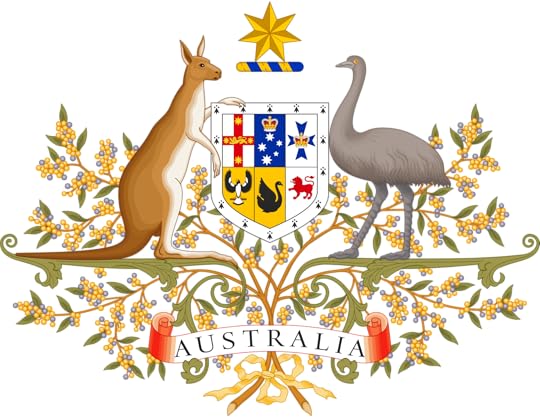
Commonwealth Coat of Arms of Australia granted by Royal Warrant signed by King George V on 19 September 1912. “
Quarterly of six, the first quarter Argent a Cross Gules charged with a Lion passant guardant between on each limb a Mullet of eight points Or; the second Azure five Mullets, one of eight, two of seven, one of six and one of five points of the first (representing the Constellation of the Southern Cross) ensigned with an Imperial Crown proper; the third of the first a Maltese Cross of the fourth, surmounted by a like Imperial Crown; the fourth of the third, on a Perch wreathed Vert and Gules an Australian Piping Shrike displayed also proper; the fifth also Or a Swan naiant to the sinister Sable; the last of the first, a Lion passant of the second, the whole within a Bordure Ermine; for the Crest on a Wreath Or and Azure A Seven-pointed Star Or, and for Supporters dexter a Kangaroo, sinister an Emu, both proper. ”
Mod
"Advance Australia Fair" is the national anthem of Australia. Created by the Scottish-born composer Peter Dodds McCormick, the song was first performed in 1878 and sung in Australia as a patriotic song.
It replaced "God Save the Queen" as the official national anthem in 1984, following a plebiscite to choose the national song in 1977.
Other songs and marches have been influenced by "Advance Australia Fair", such as the Australian vice-regal salute
Lyrics:
The lyrics of "Advance Australia Fair" were officially adopted in 1984 as follows:
Australians all let us rejoice,
For we are young and free;
We've golden soil and wealth for toil;
Our home is girt by sea;
Our land abounds in nature's gifts
Of beauty rich and rare;
In history's page, let every stage
Advance Australia Fair.
In joyful strains then let us sing,
Advance Australia Fair.
Beneath our radiant Southern Cross
We'll toil with hearts and hands;
To make this Commonwealth of ours
Renowned of all the lands;
For those who've come across the seas
We've boundless plains to share;
With courage let us all combine
To Advance Australia Fair.
In joyful strains then let us sing,
Advance Australia Fair.
Remainder of article: https://en.wikipedia.org/wiki/Advance... of article: https://en.wikipedia.org/wiki/Advance...
Source: Wikipedia
Hear the anthem: https://youtu.be/Dqtkckl6s5Y
Mod
Capital
Canberra
35°18′29″S 149°07′28″E
Largest city
Sydney
National language
English
Religion
https://en.wikipedia.org/wiki/Religio...
Demonym(s)
Australian
Aussie (colloquial)
Government
Federal parliamentary constitutional monarchy
• Monarch
Elizabeth II
• Governor-General
Sir Peter Cosgrove
• Prime Minister
Scott Morrison
• Chief Justice
Susan Kiefel
Legislature
Parliament
• Upper house
Senate
• Lower house
House of Representatives
Independence from the United Kingdom
• Federation Constitution
1 January 1901
• Statute of Westminster Adoption Act
9 October 1942 (with effect
from 3 September 1939)
• Australia Act
3 March 1986
Area
• Total
7,692,024 km2 (2,969,907 sq mi) (6th)
• Water (%)
0.76
Population
• 2019 estimate
25,227,700[6] (51st)
• 2016 census
23,401,892
• Density
3.3/km2 (8.5/sq mi) (236th)
GDP (PPP)
2018 estimate
• Total
$1.313 trillion[8] (19th)
• Per capita
$52,191[8] (17th)
GDP (nominal)
2018 estimate
• Total
$1.500 trillion[8] (13th)
• Per capita
$59,655[8] (10th)
Gini (2012)
44.9[9]
medium · 26th
HDI (2017)
Increase 0.939[10]
very high · 3rd
Currency
Australian dollar (AUD)
Time zone
UTC+8 to +10.5 (Various[N 3])
• Summer (DST)
UTC+8 to +11 (Various[N 3])
Date format
dd/mm/yyyy
Driving side
left
Calling code
+61
ISO 3166 code
AU
Internet TLD .
au
Mod
 by
by
 Bill Bryson
Synopsis:
A CLASSIC FROM THE NEW YORK TIMES BESTSELLING AUTHOR OF ONE SUMMER
Every time Bill Bryson walks out the door, memorable travel literature threatens to break out. His previous excursion along the Appalachian Trail resulted in the sublime national bestseller A Walk in the Woods. In A Sunburned Country is his report on what he found in an entirely different place: Australia, the country that doubles as a continent, and a place with the friendliest inhabitants, the hottest, driest weather, and the most peculiar and lethal wildlife to be found on the planet. The result is a deliciously funny, fact-filled, and adventurous performance by a writer who combines humor, wonder, and unflagging curiousity.
Despite the fact that Australia harbors more things that can kill you in extremely nasty ways than anywhere else, including sharks, crocodiles, snakes, even riptides and deserts, Bill Bryson adores the place, and he takes his readers on a rollicking ride far beyond that beaten tourist path. Wherever he goes he finds Australians who are cheerful, extroverted, and unfailingly obliging, and these beaming products of land with clean, safe cities, cold beer, and constant sunshine fill the pages of this wonderful book. Australia is an immense and fortunate land, and it has found in Bill Bryson its perfect guide
Mod
Stone tools scattered on the seafloor mark the oldest underwater site ever found on the continent.

Australia has a deep human history stretching back 65,000 years, but many of its oldest archaeological sites are now underwater. In an encouraging sign that Aboriginal artifacts and landscapes may actually be preserved offshore, archaeologists have discovered a 7,000-year-old site submerged along Australia's continental shelf, the first of its kind. Their discovery is outlined today in the journal PLoS One.
At the end of the last ice age, about 12,000 years ago, when glaciers melted and sea level rose, waters inundated one-third of Australia’s habitable land. As part of a project called Deep History of Sea Country, Jonathan Benjamin, a professor of maritime archaeology at Flinders University in Adelaide, led a team that searched for submerged sites off Murujuga (also known as the Dampier Archipelago), a dry and rocky coastal region in northwestern Australia.
This area has a wealth of inland archaeological sites, including more than one million examples of rock art. About 18,000 years ago, the shoreline of Murujuga would have extended another 100 miles further than the current coast. But Benjamin and his colleagues had little to go on when they began to search the offshore territory.
Remainder of article:
https://www.smithsonianmag.com/scienc...
Source: Smithsonian
More:
https://www.express.co.uk/news/scienc...
https://phys.org/news/2020-07-aborigi...
https://phys.org/news/2020-07-aborigi...
https://theconversation.com/in-a-firs...
 by Sarah Colley (no photo)
 Thought I would add some general history books on Australia:
Two shorter histories include:
 by Stuart Macintyre (no photo)
 by Geoffrey Blainey

More comprehensive but well written multi-volume histories include:
 by Jan Kociumbas (no photo) with more volumes in this series
 by Alan Atkinson (no photo) with another two volumes in the series
and
 by Thomas Keneally
 with two more volumes in this series
Mod
with two more volumes in this series
Mod
This book in goodreads has only two parts of the citation available - book cover, no author's photo and there is an author's link. So you simply add in parenthesis at the end (no photo)
 by Stuart Macintyre (no photo)
This book in goodreads has all three parts available - book cover, author's photo and theauthor's link.
 by
Geoffrey Blainey
by
Geoffrey BlaineyThis book in goodreads has only two parts of the citation available - book cover, no author's photo and there is an author's link. So you simply add in parenthesis at the end (no photo)
by Jan Kociumbas (no photo)This book in goodreads has only two parts of the citation available - book cover, no author's photo and there is an author's link. So you simply add in parenthesis at the end (no photo)
by Alan Atkinson (no photo)This book in goodreads has all three parts available - book cover, author's photo and author's link.
by
Thomas Keneally
 Mod
Mod
Release date: February 11, 2021
Navigating by the Southern Cross: A History of the European Discovery and Exploration of Australia
 by Kenneth Morgan (no photo)
Synopsis:
In this comprehensive study, Kenneth Morgan provides an authoritative account of European exploration and discovery in Australia. The book presents a detailed chronological overview of European interests in the Australian continent, from initial speculations about the 'Great Southern Land' to the major hydrographic expeditions of the 19th century. In particular, he analyses the early crossings of the Dutch in the 17th century, the exploits of English 'buccaneer adventurer' William Dampier, the famous voyages of James Cook and Matthew Flinders, and the little-known French annexation of Australia in 1772.
Introducing new findings and drawing on the latest in historiographical research, this book situates developments in navigation, nautical astronomy and cartography within the broader contexts of imperial, colonial, and maritime history.
Mod

The History Book Club
Books mentioned in this topic
Navigating by the Southern Cross: A History of the European Discovery and Exploration of Australia (other topics)The Europeans in Australia: Volume One: The Beginning (other topics)
A Concise History of Australia (other topics)
A Shorter History of Australia (other topics)
The Europeans in Australia: Volume One: The Beginning (other topics)
More...
Authors mentioned in this topic
Kenneth Morgan (other topics)Geoffrey Blainey (other topics)
Stuart Macintyre (other topics)
Jan Kociumbas (other topics)
Alan Atkinson (other topics)
More...
Australia, officially the Commonwealth of Australia is a sovereign country comprising the mainland of the Australian continent, the island of Tasmania and numerous smaller islands.
It is the largest country in Oceania and the world's sixth-largest country by total area.
The neighbouring countries are Papua New Guinea, Indonesia and East Timor to the north; the Solomon Islands and Vanuatu to the north-east; and New Zealand to the south-east.
The population of 25 million is highly urbanised and heavily concentrated on the eastern seaboard.
Australia's capital is Canberra, and its largest city is Sydney. The country's other major metropolitan areas are Melbourne, Brisbane, Perth and Adelaide.
Australia was inhabited by indigenous Australians for about 60,000 years before the first British settlement in the late 18th century. It is documented that Aborigines spoke languages that can be classified into about 250 groups. After the European exploration of the continent by Dutch explorers in 1606, who named it New Holland,
Australia's eastern half was claimed by Great Britain in 1770 and initially settled through penal transportation to the colony of New South Wales from 26 January 1788, a date which became Australia's national day. The population grew steadily in subsequent decades, and by the 1850s most of the continent had been explored and an additional five self-governing crown colonies established.
On 1 January 1901, the six colonies federated, forming the Commonwealth of Australia. Australia has since maintained a stable liberal democratic political system that functions as a federal parliamentary constitutional monarchy, comprising six states and ten territories.
Being the oldest, flattest and driest inhabited continent, with the least fertile soils, Australia has a landmass of 7,617,930 square kilometres (2,941,300 sq mi).
A megadiverse country, its size gives it a wide variety of landscapes, with deserts in the centre, tropical rainforests in the north-east and mountain ranges in the south-east.
A gold rush began in Australia in the early 1850s, which boosted the population of the country. Nevertheless, its population density, 2.8 inhabitants per square kilometre, remains among the lowest in the world. Australia generates its income from various sources including mining-related exports, telecommunications, banking and manufacturing.
Indigenous Australian rock art is the oldest and richest in the world, dating as far back as 60,000 years and spread across hundreds of thousands of sites.
Australia is a highly developed country, with the world's 13th-largest economy. It has a high-income economy, with the world's tenth-highest per capita income.
It is a regional power, and has the world's 13th-highest military expenditure.
Australia has the world's ninth-largest immigrant population, with immigrants accounting for 26% of the population. Having the third-highest human development index and the eighth-highest ranked democracy globally, the country ranks highly in quality of life, health, education, economic freedom, civil liberties and political right with all its major cities faring well in global comparative livability surveys.
Australia is a member of the United Nations, G20, Commonwealth of Nations, ANZUS, Organisation for Economic Co-operation and Development (OECD), World Trade Organization, Asia-Pacific Economic Cooperation, Pacific Islands Forum and the ASEAN Plus Six mechanism.
Remainder of article: https://en.wikipedia.org/wiki/Australia
Source: Wikipedia
Location:
Flag: