
The History Book Club discussion
CIVIL RIGHTS
>
MASS INCARCERATION
date newest »
newest »
 Mod
Mod
 by Joe Soss (no photo)
Synopsis:
Over the past three decades, the contours of American social, economic, and political life have changed dramatically.
The post-war patterns of broadly distributed economic growth have given way to stark inequalities of income and wealth, the GOP and its allies have gained power and shifted U.S. politics rightward, and the role of government in the lives of Americans has changed fundamentally.
Remaking America explores how these trends are related, investigating the complex interactions of economics, politics, and public policy.
Remaking America explains how the broad restructuring of government policy has both reflected and propelled major shifts in the character of inequality and democracy in the United States.
The contributors explore how recent political and policy changes affect not just the social standing of Americans but also the character of democratic citizenship in the United States today.
Lawrence Jacobs shows how partisan politics, public opinion, and interest groups have shaped the evolution of Medicare, but also how Medicare itself restructured health politics in America.
Kimberly Morgan explains how highly visible tax policies created an opportunity for conservatives to lead a grassroots tax revolt that ultimately eroded of the revenues needed for social-welfare programs.
Deborah Stone explores how new policies have redefined participation in the labor force—as opposed to fulfilling family or civic obligations—as the central criterion of citizenship.
Frances Fox Piven explains how low-income women remain creative and vital political actors in an era in which welfare programs increasingly subject them to stringent behavioral requirements and monitoring.
Joshua Guetzkow and Bruce Western document the rise of mass incarceration in America and illuminate its unhealthy effects on state social-policy efforts and the civic status of African-American men.
For many disadvantaged Americans who used to look to government as a source of opportunity and security, the state has become increasingly paternalistic and punitive.
Far from standing alone, their experience reflects a broader set of political victories and policy revolutions that have fundamentally altered American democracy and society.
Empirically grounded and theoretically informed, Remaking America connects the dots to provide insight into the remarkable social and political changes of the last three decades.
About the Authors:
JOE SOSS is the Cowles Professor for the Study of Public Service at the Hubert H. Humphrey Institute of Public Affairs, University of Minnesota.
JACOB S. HACKER is professor of political science at Yale University and resident fellow of the Institution for Social and Policy Studies.
SUZANNE METTLER is Clinton Rossiter Professor of American Institutions in the Government Department at Cornell University.
Mod
 by
by
 Michelle Alexander
Synopsis:
"Jarvious Cotton's great-great-grandfather could not vote as a slave. His great-grandfather was beaten to death by the Klu Klux Klan for attempting to vote.
His grandfather was prevented from voting by Klan intimidation; his father was barred by poll taxes and literacy tests.
Today, Cotton cannot vote because he, like many black men in the United States, has been labeled a felon and is currently on parole."
As the United States celebrates the nation's "triumph over race" with the election of Barack Obama, the majority of young black men in major American cities are locked behind bars or have been labeled felons for life.
Although Jim Crow laws have been wiped off the books, an astounding percentage of the African American community remains trapped in a subordinate status--much like their grandparents before them.
In this incisive critique, former litigator-turned-legal-scholar Michelle Alexander provocatively argues that we have not ended racial caste in America: we have simply redesigned it. Alexander shows that, by targeting black men and decimating communities of color, the U.S. criminal justice system functions as a contemporary system of racial control, even as it formally adheres to the principle of color blindness.
The New Jim Crow challenges the civil rights community--and all of us--to place mass incarceration at the forefront of a new movement for racial justice in America.
 Mod
Mod
Prisons, jails, and other correctional authorities must make every effort to release unnecessarily incarcerated people and improve healthcare and conditions of confinement.
Published March 27, 2020 - Updated April 27, 2020
Associated Press
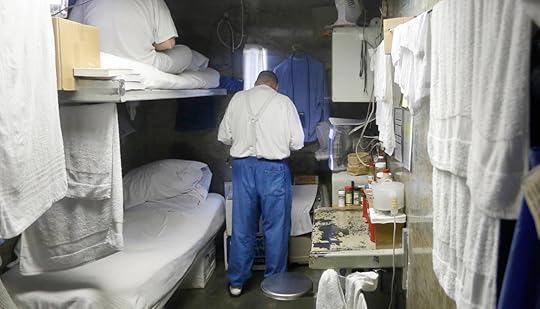
Prisons and jails frequently suffer from overcrowding. Even in the best of times they are, by definition, facilities where people are placed in close contact with each other on a near-constant basis. Factor in the unique health challenges faced by incarcerated people and the limited availability of quality healthcare, and it’s no surprise that correctional facilities are uniquely vulnerable to diseases such as Covid-19.
Correctional administrators have limited control over how long people spend incarcerated, but they can use what authority they possess to release people outright or direct people to less restrictive forms of confinement. They can also ease conditions of confinement and increase access to health products. Some correctional authorities have already begun this work.
As of April 26, there are 799 people in BOP custody and 319 BOP staff members who have tested positive for Covid-19. 27 people incarcerated in BOP facilities have died from Covid-19.
Elderly and sick people and those incarcerated for parole violations should be released or recommended for release under compassionate release provisions or another authority. Barring that, prison officials should use their discretion to transfer people to community corrections options.
Federal Response
As of April 27, the BOP has released 4351 people to home confinement.
*On April 6, Attorney General Barr sent a memo to federal prosecutors urging them to consider Covid-19 related risk when making bail decisions. The memo cited the risk inherent in increasing jail populations during the pandemic, as well as concerns about risks to individuals. Notably, the memo still instructs prosecutors to detain people who pose a public safety threat, despite concerns about the virus.
*On March 31, the Bureau of Prisons announced that, effective April 1, everyone currently incarcerated in the federal prison system will be confined to their cell for 14 days.
*On April 5, the Bureau of Prisons issued an update to their home confinement policy in response to Covid-19. Notably, individuals can be released to home confinement without submitting a request. At the same time, anyone who thinks they're eligible for home confinement may apply for release and provide a release plan to their case manager.
*According to the Director of the Bureau of Prisons, as of April 21 the BOP had released 1,300 people to home confinement in response to Covid-19. Although this is a step in the right direction, this number is only a small fraction of the 170,000 individuals in BOP custody.
*On April 20, some people incarcerated in BOP custody were told that officials were no longer considering early releases for inmates who have served less than half their sentence, a reversal of an April 9 announcement from BOP staffers. According to advocates and family members, many individuals had already been put into pre-release quarantine before the reversal was announced.
*As of April 23, the Trump Administration has once again changed the criteria used to consider incarcerated individuals for early release. The new standard broadens the conditions for release to include incarcerated individuals who have served at least 25 percent of their sentences and who have less than 18 months remaining on their term.
Link to remainder of article: https://www.brennancenter.org/our-wor...
Other:
 by
Michelle Alexander
by
Michelle AlexanderSource: Brennan Center for Justice
 Wow! I had no idea ... some of us are simply clueless or worse.
Regards,
Andrea

The History Book Club
Books mentioned in this topic
The New Jim Crow: Mass Incarceration in the Age of Colorblindness (other topics)The New Jim Crow: Mass Incarceration in the Age of Colorblindness (other topics)
Remaking America: Democracy and Public Policy in an Age of Inequality (other topics)
Authors mentioned in this topic
Michelle Alexander (other topics)Michelle Alexander (other topics)
Joe Soss (other topics)
According to the ACLU, "Despite making up close to 5% of the global population, the U.S. has nearly 25% of the world’s prison population. Since 1970, our incarcerated population has increased by 700% – 2.3 million people in jail and prison today, far outpacing population growth and crime.
One out of every three Black boys born today can expect to go to prison in his lifetime, as can one of every six Latino boys—compared to one of every 17 white boys. At the same time, women are the fastest growing incarcerated population in the United States.
There are twice as many people sitting in local jails awaiting trial and presumed innocent than in the entire federal prison system. And each year, 650,000 men and women nationwide return from prison to their communities. They face nearly 50,000 federal, state, and local legal restrictions that make it difficult to reintegrate back into society.
Our prison system costs taxpayers $80 billion per year. This money should be spent building up, not further harming, communities. Investment, not incarceration, is how we improve safety."
More:
https://www.aclu.org/issues/smart-jus...
Source: ACLU