
The Old Curiosity Club discussion
The Old Curiosity Shop
>
TOCS: Chapters 11-15

 Mod
Mod
This chapter opens with the news that Nell’s grandfather has survived his health crisis “but his mind was weakened and its functions were impaired.” He makes no complaint and “appeared to have lost all count of time.” This leads to the fact that if Nell helped her grandfather before his illness, she has now become his sole means of functioning in society after his illness. Added to Nell’s worries and responsibilities is Quilp who seems more than willing to push Nell and her father into the streets of London as soon as possible. Quilp tells Old Trent that the possessions of the house have been sold and they also are to be removed very soon.
I couldn’t help be see shades of Lear and Cordelia in this chapter. Old Trent, like Lear, has lost grasp on reality and Nell is now like Lear’s daughter Cordelia, who is ever-faithful, but unable to alter the turmoil of the situation that surrounds them. Nell and her grandfather talk about their own Shakespearean version of “gilded butterflies” and plan to go far away from London and find “quiet places afar off, and rest, and peace” where they can “wander barefoot through the world.” Sounds idyllic, and there is Quilp to contend with, so they decide to “steal away to-morrow ... not to be seen or heard ... and leave no trace or track for them to follow by.” Nell prepares a staff for her father’s “feeble steps” and packs their merger possessions. The staff is her grandfather’s physical support; Nell will be his emotional and psychological backbone.
Thoughts
Quilp has taken possession of the curiosity shop, and he and Brass have sold all of Trent’s possessions. Trent’s illness has rendered him feeble and helpless and so Little Nell must assume the role of parent. To what extent do you find these circumstances believable?
There is a hidden agenda in the above question. As we move forward in our reading we will see the relationship between Nell and her grandfather become increasingly key to our acceptance of the believability of the plot. In our earlier readings we have met characters such as Mr Pickwick, Mr Brownlow, Kate Nickleby, Newman Noggs and the Cheeryble brothers. To what extent did you find such characters credible and believable?
How would you describe a good character in Dickens? Does this character have to have a “believable” credibility to be accepted as satisfying to a reader?
We must get used to Nell weeping; after all, she is still a child. When she thinks of leaving her bird, for instance, she weeps. We are told she “wept bitterly for the loss of the little creature” until she thought it would fall into the hands of Kit “who would keep it for her sake.” With this thought in mind Nell “went to rest with a lighter heart.” At sunrise Nell takes her father’s hand and they “trod lightly and cautiously down the stairs” only to find the door locked and the key gone. Nell recalls that Quilp kept the keys on the table in his bedroom. Nell then goes “into her own little chamber” where Quilp is sleeping in her bed, gets the required key, and leaves her old bedroom. Once safely outside it becomes immediately apparent that it was “plain that she was thenceforth [her grandfather’s] guide and leader ... and putting her hand in his, led him gently away.” We are told that “it was the beginning of a day in June; that the deep blue sky unsullied by a cloud and teeming with brilliant light [and] the healthful air of morning felt like breath from angels.” The chapter ends with the statement that [f]orth from the city, while it still slumbered, went the two poor adventurers, wandering they know not whither.”
Thoughts
So much to consider here. Let’s start by recalling Dickens’s comment that likened Nell to an allegory. For purposes of these thoughts I am going to suggest differing sub-plots and allusions that could be seen running through this chapter.
In TOCS we have an old man who has one faithful child and another who is angry and bitter. I see a resemblance here to Shakespeare’s King Lear. Do you see any other echoes of King Lear so far in the novel and, if so, what are they?
We have seen a couple of references to Nell’s bird so far in the novel. How could her pet bird and Kit figure into the novel from what we have read so far?
Quilp has now taken possession of both Nell’s room and her bed. Last week Xan raised the question of the relationship among Old Trent, Quilp and Nell. If we think about (or accept) Freud and his theories, we have an additional reason to be uncomfortable as readers. Quilp sleeps with the keys to the house in Nell’s old bedroom. Nell is locked in her home. Nell must creep into her old bedroom and steal the key from Quilp in order to gain her freedom. I find some touches of Freud here. Do you think Dickens was telegraphing any sexual suggestion to his readers? This novel was, of course, written before Freud. As we move through the remainder of the book (as well as reflect upon what we have already read), however, it is remarkable how often Quilp is portrayed as leaning in or out of windows, doorways, or emerging from archways. Is it possible that Dickens could, consciously or unconsciously, have been portraying Quilp through his suggestive language, actions, and innuendo as a prime study for what would be today Freudian analysis?
When Nell and her grandfather leave the curiosity shop they do so and greet a sunny day in June where they are alone and the air “fell like the breath of angels” around them. What does this description suggest to you?
We are told that they left the city and began “wandering they knew not whither.” Does the idea of two people being cast into the world to wander suggest anything to you in Biblical terms?
Mod
As Nell and her grandfather leave the curiosity shop we remain at it as morning arrives. This is a very interesting chapter as Dickens brings almost all the other characters we have met together. There is much action, character interaction, and character revelation. Indeed, the bird also makes a guest appearance. Let’s get to it, shall we?
Quilp and Brass must have smoked and drank much the previous night. There is a knocking at the door and it takes Quilp a few moments to register that fact. Quilp realizes that the key to the door is missing and after tossing some blame Brass’s way, Quilp makes his way to the door, thrusts it open, and pounces on the person on the other side “biting the air in the fulness of his malice.” After a two minute tussle he finds he has been fighting not his wife who has been locked out of the house (and thus bedroom) but Dick Swiveller who gamely engages with the disgruntled Quilp. Swiveller says he has come to ask after Mr Trent and Nell. Swiveller and Mrs Quilp are invited into the shop and Quilp takes great delight in “inflicting a few pinches on her arms, which were seldom free from impressions of his fingers in black and blue colours.” Quilp’s physical cruelty is constantly apparent. To me this creates more tension around the possibility that Quilp may, in fact, at some time, physically assault Little Nell
Quilp learns that Nell is gone but covers himself by telling Swiveller that Nell will no doubt write because “Nelly’s very fond of me. Pretty Nelly.” We read that Nell may, in fact, also be of some romantic interest to Dick Swiveller. This is a bit of a surprise. Quilp is troubled by Nell’s departure, and this emotion is heightened by the possibility that Mr Trent may have had some secret store of money that Quilp was unaware of in the home. Swiveller leaves, a van arrives, and the curiosity shop’s contents are removed. Then Kit arrives and Quilp learns that Kit does not know where Nell is. Next, Quilp’s assistant spots Nell’s bird and Quilp orders the bird’s death. What follows is the second fight of the chapter, this one between Kit and Quilp’s assistant. Kit wins, runs home with the bird in its cage, and then finds the bird a place in his mother’s home. Kit places the bird in a window. Next, Kit sets off to find a horse to hold so he can make some money to buy seed for the bird. And so the chapter ends.
Thoughts
What might be the reason Dickens had so many of the secondary characters make an appearance in this chapter?
This is a chapter where two fights occur, one between Quilp and Dick Swiveller, and one between Kit and Quilp’s young assistant. What might be some of the reasons for such violence in the chapter?
The curiosity shop is now empty of furniture and Nell and her grandfather’s whereabouts are unknown. What do you think will happen to the shop now? Why?
The second fight occurs between Kit and Quilp’s shop boy. It occurs after Quilp says he will wring the neck of Nell’s bird. What do you think the sub-text of this fight might be? How might this event be foreshowing of what might occur later in the novel? What could Kit’s taking possession of Nell’s bird and taking it home suggest?
There is a mild suggestion that Dick Swiveller might have some emotional feelings for Nell. We also know that Kit finds Nell to be attractive. What reasons might Dickens have for introducing such information into the novel?
Mod
As this chapter opens we learn that when Kit goes by Nell’s old home it was “entirely deserted and looked as dusty and dingy as if it had been so for months.” Here is another incidence of how a person’s home - or former home in this incidence - reflects its inhabitants. Where are Nell and her father? Are they safe? Dickens will make us wait a wee bit longer. And where is Quilp? Why did he not stay at the house after it was deserted? Was is solely to keep his twisted eyes on the furniture? Or the grandfather? Or Nell?
We read of Kit that “he was by no means of a sentimental turn, and perhaps had never heard that term in all his life.” What we do learn about him is that he had a highly developed sense of responsibility. We saw that last chapter with his desire to keep Nell’s bird safe from harm. In this chapter we will see much more evidence of his character. As chance would have it Kit gets a job minding a rather wilful pony named Whisker for a kindly old gentleman named Garland. The couple stop at a Notary’s to mark their son Abel’s completion of his internship. All is kindness and politeness in the office. After the signing of the papers the Garland’s with Abel return to the pony cart. No one has the right change to pay Kit, and so Kit is paid a shilling and asked to return to the same office at the same time next Monday to work out the remainder of the sixpence. Kit happily agrees and returns home after spending the money on household necessities and, of course, not forgetting to purchase some seed for Nell’s bird.
Thoughts
At first glance, it might seem that this chapter has little value in establishing or advancing the plot. I would suggest, however, that there is much of value in it.
How does this chapter further establish Kit’s character? How does the horse help us in understanding Kit’s character?
Dickens enjoys binary relationships in his novels. Who would be the direct opposite of the Garlands in this novel? Why?
For fun, what character or characters did you see as being much like the Garlands in NN? Do you notice anything about surnames that help establish their characters?
How would you characterize the tone of this chapter? What earlier chapter in this week’s reading would you see as being the opposite in tone? Why would Dickens establish such different circumstances in the chapters?
Mod
This chapter brings us back to Nell and her grandfather as they depart London. The second paragraph of this chapter finds Dickens stepping out of his role as narrator and incorporating an interpolation of meditation upon friends and partings. Such a paragraph frames this chapter as Nell and her grandfather are not only leaving the physical presence of London, but also departing from the people who they care for and the memories which were established while they lived in the curiosity shop. Nell and her grandfather are facing the real possibility that they will never see London or their friends again, or even be able to imagine their former lives in quite the same way. Even in this early phase of the novel, Dickens has made it clear that Nell is the parent and her grandfather is now the dependant child. Their leaving of the city is the beginning of a long journey. Their method of leaving suggests no possibility of return. As London wakes up in TOCS I am reminded of Wordsworth’s poem “Composed upon Westminister Bridge” and the lines “This City now doth like a garment wear/The beauty of the morning; silent bare ...”. Dickens writes of of London in the morning that “the light, creation’s mind, was everywhere, and all things owned its power.”
The next paragraph begins “The two pilgrims, often pressing each other’s hands ... pursued their way in silence.” We then read that as the city wakes so the noise and bustle increases, and we see poverty, and then “rotting houses” and “shabby fathers” and houses “burnt down and blackened and blistered by the flames” and places where “oyster shells, heaped in confusion” shared space with churches erected “to show the way to Heaven.” Nell and her grandfather find a place to rest outside of London where they can look back on London, and the dome of Saint Paul’s. We learn that while they lived in the curiosity shop there “had been an old copy of the Pilgrim’s Progress, with strange plates ... over which she had often poured whole evenings, wondering whether it was true.” I think the earlier reference to Bunyan’s Pilgrim’s Progress is a key element to the developing allegory of the novel. Little Nell finds a pool of clear water in a field and “laved her hands and feet” and “cast the water on [her grandfather] with her hands, and dried it with her simple dress.” Let is remember this act of washing for another similar event in this chapter.
Thoughts
Some chapters offer a flood of thoughts and possibilities and, to me, this is a prime example. Where to start? First, while Pilgrim’s Progress was mentioned and we are told that Little Nell is very familiar with the book and its illustrations. I believe Dickens included the reference to Bunyan’s novel as an informal template to consider. Nell and her grandfather have embarked on a journey to rid themselves of evil and to try and find peace. We could also consider their journey by reflecting upon Joseph Campbell’s concept of the Monomyth. There is also a very clear vein of allegory running through this chapter which will continue to unfold as our reading continues. Characters and places that convey symbolic meanings will constantly appear. As many of you know I find Carl Jung and his ideas on archetypes very helpful in interpreting events in many novels. TOCS will be such a text.
I have made passing reference to Shakespeare’s King Lear, Wordsworth’s “Westminister Bridge,” Bunyan’s Pilgrim’s Progress and Joseph Campbell’s theory of the Monomyth. That’s much to consider. What works for me may not be effective for you. Together, however, we will find much to consider in this novel and hopefully come to some satisfying interpretations.
We are told that Little Nell and her grandfather link hands and, “like pilgrims” go on their way. What visual image comes to your mind with this description? What other books or pictures have you seen that also are suggested by this description?
Little Nell washes herself and then “casts water” on her grandfather. Later in the chapter the kindly farmer’s wife who fed Nell and her father notices from Nell’s gait that her feet are blistered and sore. To help Nell the woman washes Nell’s feet and “applied some simple remedy, which she did so carefully and with such a gentle hand ... that the child’s heart was too full to admit of her saying more than a fervent ‘God bless you.’” To what extent do you see these three acts of washing and cleansing to have a foundation in any religious act/acts?
After a kindly cart driver gives them a lift along the way, they are directed to a town by taking a path which leads them through a churchyard and so “towards this spot, they directed their weary steps.” What might be a reason Dickens ends this chapter with Nell and her grandfather entering a churchyard?
In terms of structure, the first hours of Nell and her grandfather’s journey have met with kindness from others. What do you expect in the coming chapters? Why?
My Reflections
In these five chapters we have further witnessed the evil nature of Quilp in word, deed, and action. We have also read of those who offer kindness and concern. Dickens frequently employs this overtly binary contradiction for emphasis. With Nell and her grandfather we have two innocents who are intent on moving through the world in order to escape evil and find peace.
We have firmly established the characters of Nell, her grandfather, Quilp, Brass, Kit, and his mother. Other characters who have appeared seem to fall rather neatly into the category of either very good or very bad. While it is tempting to label the characters as either good or bad, it might be wise to hold off our final judgements on all characters. This is an early Dickens and he may change his mind. It will be interesting to watch how Dickens may move some characters from one spectrum to another.
I want to share with you my favourite part of this section’s writing. I think we all find Dickens’s phrasing and description to be remarkable. Here is my favourite. It is taken from Chapter the Fifteenth and occurs when Nell and her grandfather look back on London. It is the sight that a traveller might see if he looked back from a hill towards London:
“[l]ooking back at old Saint Paul’s looming through the smoke, its cross peeping above the cloud (if the day were clear) and glittering in the sun; and casting his eyes upon the Babel out of which it grew until, he traced it down to the furthest outposts of the invading army of bricks and mortar whose station lay for the present nearly at his feet - might feel at last that he was free of London.”
When this description is paired with the astounding illustration titled “ A Rest by the Way” it is very exciting. I love looking at and learning about the illustrations. Kim does us all an enormous service when she tracks down the illustrations for each week’s readings. In TOCS there will be another illustration that I hope will astound you, but you must be patient. It comes near the end of the novel.
 Mod
Mod
And Quilp sleeping in Nell's bed while she's upstairs with her grandfather is just creepy. He would get arrested for the things he does and says about her today, at least I hope he would. He gets worse all the time. He makes Brass smoke when he knows it makes him sick, so why does he do it? To be horrible. When he thinks it is his wife at the door he decides to run out and wreak his ill-humour on his wife. Again, to be horrible. I was never so glad to see Dick Swiveller in my life. I love this:
‘There’s plenty more of it at the same shop,’ said Mr Swiveller, by turns advancing and retreating in a threatening attitude, ‘a large and extensive assortment always on hand—country orders executed with promptitude and despatch—will you have a little more, Sir—don’t say no, if you’d rather not.’
‘I thought it was somebody else,’ said Quilp, rubbing his shoulders, ‘why didn’t you say who you were?’
‘Why didn’t you say who you were?’ returned Dick, ‘instead of flying out of the house like a Bedlamite?’
‘It was you that—that knocked,’ said the dwarf, getting up with a short groan, ‘was it?’
‘Yes, I am the man,’ replied Dick. ‘That lady had begun when I came, but she knocked too soft, so I relieved her.’ As he said this, he pointed towards Mrs Quilp, who stood trembling at a little distance.
‘Humph!’ muttered the dwarf, darting an angry look at his wife, ‘I thought it was your fault! And you, sir—don’t you know there has been somebody ill here, that you knock as if you’d beat the door down?’
‘Damme!’ answered Dick, ‘that’s why I did it. I thought there was somebody dead here.’
And now Mrs. Quilp discovers that Nell and Grandpa are gone. Now I'm wondering, I can see why Quilp is upset over them leaving the way they did, them sneaking out while everyone else is sleeping, because it gives him the idea that they do have money he didn't know about. But I am wondering why they left the way they did. Grandfather makes the comment they must sneak away so no one takes her from him. Why would they? Would it be because they are just going, they know not where? That sounds like a line from a book, but it fits.
Quilp had told them they had to leave, he knew they were leaving on Friday and he seemed to want them to go, so why didn't they just walk out the door with nothing to hide? When Quilp tells Dick that they are gone, but he doesn't know why they left so quietly he adds, "But they have their reasons, they have their reasons." I'd like to know what they are. And Dick, who has arrived to begin winning Nell's heart, finds he will have to come up with some new scheme for money, Nell is gone.
Mod
He had no sixpence, neither had the old lady, nor Mr Abel, nor the Notary, nor Mr Chuckster. The old gentleman thought a shilling too much, but there was no shop in the street to get change at, so he gave it to the boy.
‘There,’ he said jokingly, ‘I’m coming here again next Monday at the same time, and mind you’re here, my lad, to work it out.’
‘Thank you, Sir,’ said Kit. ‘I’ll be sure to be here.’
He was quite serious, but they all laughed heartily at his saying so, especially Mr Chuckster, who roared outright and appeared to relish the joke amazingly. As the pony, with a presentiment that he was going home, or a determination that he would not go anywhere else (which was the same thing) trotted away pretty nimbly, Kit had no time to justify himself, and went his way also. Having expended his treasure in such purchases as he knew would be most acceptable at home, not forgetting some seed for the wonderful bird, he hastened back as fast as he could, so elated with his success and great good fortune, that he more than half expected Nell and the old man would have arrived before him.
Besides all that he has to fight two different times when he is near Quilp and his boy, once at Quilp's business, I can't remember why, and now for Nell's little bird. Why Quilp didn't just open the cage and let it go I don't know.
 Random thoughts:
Like Kim, I, too, am exceedingly curious about Nell and Trent's mysterious exodus. When they found a kind family who offered them food and a place to stay the night, Trent insists, rather cryptically, they must press on, despite their exhaustion and Nell's blisters. I fear there will be another revelation where Trent is concerned that will irritate the hell out of me.
I haven't read Bunyon or the other works Peter referenced, but the Biblical allusions are overwhelming.
Is anyone else reminded of Pip and Herbert (GE) when Kit and the upside-down boy tussle?
As to Peter's question about the Garlands, they remind me of the Cheerybles in NN, but also the Boffins in OMF, and maybe even a little bit of the Meagles in LD.
Peter, I also enjoy the passage about looking back from from a field and seeing the dome of St. Paul's, though for me it's a more personal thing. When we flew in to London and I looked out the plane's window, I saw the cathedral and immediately felt a sense of coming home. (I'm told there's a German word for this - fernweh, being homesick for a place ones never been... or have only been a couple of times, in my case. Tristram can tell me if that's accurate.) Alternatively, when I fly into DC and see the Capitol the Washington Monument, etc. all I feel is a sense of history and patriotism, but never that warm feeling of belonging and coming home, even though I am.
I don't know it is enough to be a theme yet, but I'm noticing a lot of emphasis on hands so far. When the novel opens, Nell is lost and takes the stranger's hand as he leads her home. In this segment, Trent is lost mentally, if not exactly physically, and we see Nell take his hand and lead him away from the shop. A word search shows we've seen "hand" 93 times to this point in the book. I'm not sure if this is intentional, but I'll be keeping an eye out as we go on.
Consider this paragraph from chapter 12:'We call this a state of childishness, but it is the same poor hollow mockery of it, that death is of sleep. Where, in the dull eyes of doating men, are the laughing light and life of childhood, the gaiety that has known no check, the frankness that has felt no chill, the hope that has never withered, the joys that fade in blossoming? Where, in the sharp lineaments of rigid and unsightly death, is the calm beauty of slumber, telling of rest for the waking hours that are past, and gentle hopes and loves for those which are to come? Lay death and sleep down, side by side, and say who shall find the two akin. Send forth the child and childish man together, and blush for the pride that libels our own old happy state, and gives its title to an ugly and distorted image."
I'm awestruck that a man so young would even have such thoughts, let alone be able to articulate them.
When Nell is packing, it says, "... old garments, such as became their fallen fortunes..."It would seem that perhaps they have better clothes, but she leaves them behind because it's no longer appropriate for them to look more prosperous than they now are. If that's the case, it's the dumbest thing I've ever heard. Crazy Victorians and their sense of propriety!
Mod
Like Kim, I, too, am exceedingly curious about Nell and Trent's mysterious exodus. When they found a kind family who offered them food and a place to stay the night, Trent insists..."
Mary Lou
Thank you for your thoughtful and perceptive answers. Yes, indeed, Pip being turned upside down by Magwitch is a similar metaphor. The world has been turned upside down. There is a change in perception, an alternative insight occurring. There is a suggestion that all is not as it seems.
There are Garland echoes. For me the surnames Garland and Cheeryble sound so, well, so happy and pure. The Garlands must be forces of good in the novel. With Kit as their employee, we see Dickens expanding the scope of Goodness. The forces of good are marshalling. Don’t you just love how Dickens creates his narratives?
If you would like to track the number of times the word hand or hands appear throughout the novel it would be appreciated. It will be interesting to see what the hands are doing. Is one person holding another person’s hand? Do one or more people self-identify in the novel because their habit is to rub their hands together? I will continue to track the birds in the novel. Lots yet to come.
“Being homesick for a place one’s never been.” What a great phrase. Let’s hope Tristram will confirm the word for the definition. I never knew there was such a concept or word. I too have that feeling for the Lake District in England.
I hope you are enjoying the Biblical allusions. I think The Old Curiosity Shop’s foundations are constructed upon allusion and the concept of the journey. We shall see if the trend continues. :-)
Mod
Peter I just started reading a book and the main character, the main one so far anyway, raises birds.
Among these vines, singing from morning till night, hung the Senora's canaries and finches, half a dozen of each, all of different generations, raised by the Senora. She was never without a young bird-family on hand; and all the way from Bonaventura to Monterey, it was thought a piece of good luck to come into possession of a canary or finch of Senora Moreno's' raising.
I thought of you that entire time. :-)
Mod
It would seem that perhaps they have better clothes, but she leaves them behind because it's no longer ap..."
Hmm.....that does sound strange now that you mention it. I can't imagine why you wouldn't take your better clothing along, they would have to last longer than your oldest garments would.
Mod
Kim
The thought that you have horrid school memories makes me sad. How could any teacher not have been thrilled with such an inquisitive person in their classroom. What they missed ...
Ah birds. When I’m not inside reading I really enjoy being outside tramping about and enjoying our feathered friends. Being now in Toronto, and in the middle of a polar vortex, I’m housebound. Thank heavens for books.
Mod
It wasn't the teachers, I was able to stay away from them with my last name started with Z I was always in the back of the room thank God. It was the kids, and it was the time I missed because I had seizures, and migraines, and reactions to medication, and side effects from medicine, and when you fall over in class, or stumble because you are dizzy, or have huge gums that bleed constantly - from one of my medicines - you get made fun of. If only there would have been home schooling then my school experience would have been much better. I would have graduated the top of my class, I would have been prom queen, and homecoming queen, class valedictorian, president of the class.....the list never ends. :-)
Kim, that makes me so sad. Kids can be just awful. Rest assured, in our class of Curiosities, you are all that, and Miss Congeniality to boot.
Mod
Thanks. I did hate every minute of it, until I was probably a junior in high school, a couple of things happened then. The most important is I suddenly didn't care anymore. I don't know what happened, but one day I took a look around me and thought them spending their time attempting to torture me, and other kids that weren't perfect, was saying something about them, and the something wasn't that nice. I also thought that in a few years down the road we'd all be equal, living in every day houses, within a few miles of each other, and working at the same jobs in the valley and that's what happened. They ended up being not so much better than me after all.
Another thing that helped around this time is I took Home-Economics class, I'm not sure if I had a choice to take it, but I had it. My last name started with a Z which often came in handy. This time our brilliant school district put all the girls whose names started with A to L in one class, the girls whose names started with M to W were in another class and the rest of the girls were in a class with the football team who took it just for an easy credit. I was the only girl with a name with a letter after W so I got the class with the football team. The team had no interest in learning to cook, clean, or sew curtains, so they used to act up, and act up a lot. Then the teacher would write up a detention slip which meant they wouldn't be able to play in the game that week, and she would always give it to me to take to the office. I wasn't about to be the one that was responsible for getting our best players out of the game that week, so I'd just put the slips in my locker. Eventually the teacher figured out that it was strange the boys still were playing every week and found out I never handed the slips in, and I ended up failing the class, but I had a bunch of football players that loved me after that. It helped my life at school a lot. :-) I still didn't like it though, too many awful years took it's toll. And I ended up with quite the group of kids around me, once I quit caring what anyone thought I seemed to gather all those other kids who weren't making out much better than I was, two of them were gay, one girl wasn't the same religion as the rest of us so everyone ignored her, or even made fun of her, people like that, there was one girl who was one of the ugliest people I'd ever seen, and they made sure she knew it, these were the people I had with me, my sister says she's still embarrassed by it. I still gather the same kind of people around me, they're a perfect fit for me. :-)
 Chapter 11
Kit continues to impress. I now have two characters I like: Swiveller and Kit.
Loved the description of Brass: "with a nose like a wen (cyst). There you go. With one word Dickens has condemned Brass to plague status.
Also the description of those waiting for the old man to die was ghoulishly captivating:
There was watching enough, now, but it was the watching of strangers who made a greedy trade of it, and who, in the intervals in their attendance upon the sick man huddled together with a ghastly good fellowship, and ate and drank and made merry; for disease and death were their ordinary household gods.
 Mod
Mod
I'd say this means that although Kit seems uncouth, uneducated and belongs to what might have been called the lower classes, he is yet of an exceedingly noble nature, comparable to a temple which does not look very costly but which harbours a noble spirit. Dickens could simply have said "Never judge a book by its cover", but for some reason he preferred the more stilted diction. By the way, these moralizing effusions by the intruding narrator are quite annoying to me, but luckily they are mainly limited to Dickens's earlier works and seem to get rarer as Dickens matures.
Mod
It would seem that perhaps they have better clothes, but she leaves them behind because it's no longer ap..."
I think Little Nell takes the shabby clothes because technically speaking they no longer own the shop nor anything within it, her grandfather having forfeited all his possessions to Quilp, and maybe Nell is therefore too scrupulous to take away the better clothes, thinking this some kind of theft against Quilp. That's at least how I interpreted this passage.
Mod
You are absolutely right, Mary Lou: There is the word Fernweh, which is the opposite to Heimweh (homesickness) and which means that you long to go and see the world. There is also the wonderful word Wanderlust, which, I think, has made its way also into English, and which is linked with Fernweh in that it means the urge to go from A to B to C to D and so on.
Mod
Mod
Mod
GRUMP!!!!!!!
 Wow, Peter. Excellent analysis of this week's chapters. I like the connections to Freud, King Lear, the monomyth, etc. When Nell and Grandfather left the house, I got the sense that a "big journey" awaits.
I agree about the creepy, sexual undertones when Quilp took over the house, polluted it with smoke, and slept in Nell's bed. Unsettling imagery. This line confirmed it for me,
"Nell shrank timidly from all the dwarf’s advances towards conversation..." (Ch. 11)
Advances towards what? The phrasing seemed weird, so I looked up the etymology of "conversation," and, yes, it was a synonym for sex since the 14th century. "Criminal conversation" was the legal term for adultery from the late 18C.
The narrator continues, "[Nell] fled from the very sound of his voice; nor were the lawyer’s smiles less terrible to her than Quilp’s grimaces. She lived in such continual dread and apprehension of meeting one or other of them on the stairs or in the passages if she stirred from her grandfather’s chamber, that she seldom left it..."
Poor Nell! She lived in fear. I don't think she would have been safe at Kit's house. She had to flee the city.
Mod
Chapter 12I don't think Nell turns down Kit's offer because she's worried about what Quilp will do to him and his family. I think she turns it down for two reasons:
1. The promise she made to her grandfather concerning Kit and having nothing to do with him.
2. The fear that if Quilp and Brass know their whereabouts, they will, through the law, separate them.
It is in chapter 12 the grandfather warns Nell that, because of all that's transpired, Q&B could get him declared mad and separate her from him. That can't be done if their whereabouts are unknown. But it can be done if they live across the street.
What's sad is they probably should be separated. Grandfather, caught in the throes of despair, is not thinking clearly. After they decide to sneak away, he says to Nell something to the effect that it will be nice to lie down and stretch his legs out under the sky.
They are paupers, and he's playing Huckleberry Finn. He is no longer her guardian; she's his. And he may be becoming feebleminded. What's best for her is separation, just not into the hands of Quilp. Unfortunately her brother is worthless.
Mod
Xan’s reference to Mark Twain’s Huckleberry Finn gives another example of a novel that can be decoded by referring to Campbell’s Monomyth. I will not overburden either my commentary or questions with the necessity to know Campbell. He is, however, one of my major influences on how I approach the reading of texts.
https://en.m.wikipedia.org/wiki/Hero%...
Mod
I like that one.
Mod
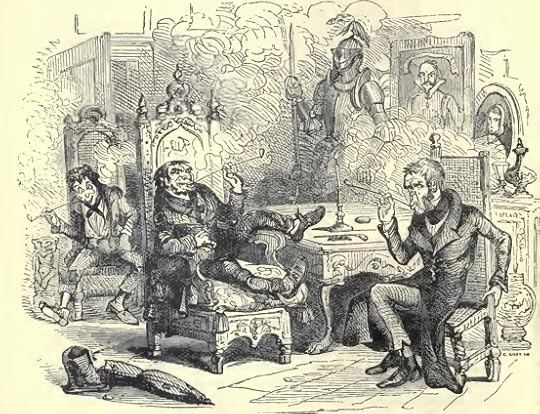
The Legal Gentleman named Brass
Chapter 11
Phiz
Text Illustrated:
The legal gentleman, whose melodious name was Brass, might have called it comfort also but for two drawbacks: one was, that he could by no exertion sit easy in his chair, the seat of which was very hard, angular, slippery, and sloping; the other, that tobacco-smoke always caused him great internal discomposure and annoyance. But as he was quite a creature of Mr Quilp’s and had a thousand reasons for conciliating his good opinion, he tried to smile, and nodded his acquiescence with the best grace he could assume.
This Brass was an attorney of no very good repute, from Bevis Marks in the city of London; he was a tall, meagre man, with a nose like a wen, a protruding forehead, retreating eyes, and hair of a deep red. He wore a long black surtout reaching nearly to his ankles, short black trousers, high shoes, and cotton stockings of a bluish grey. He had a cringing manner, but a very harsh voice; and his blandest smiles were so extremely forbidding, that to have had his company under the least repulsive circumstances, one would have wished him to be out of temper that he might only scowl.
Quilp looked at his legal adviser, and seeing that he was winking very much in the anguish of his pipe, that he sometimes shuddered when he happened to inhale its full flavour, and that he constantly fanned the smoke from him, was quite overjoyed and rubbed his hands with glee.
‘Smoke away, you dog,’ said Quilp, turning to the boy; ‘fill your pipe again and smoke it fast, down to the last whiff, or I’ll put the sealing-waxed end of it in the fire and rub it red hot upon your tongue.’
Luckily the boy was case-hardened, and would have smoked a small lime-kiln if anybody had treated him with it. Wherefore, he only muttered a brief defiance of his master, and did as he was ordered.
‘Is it good, Brass, is it nice, is it fragrant, do you feel like the Grand Turk?’ said Quilp.
Mr Brass thought that if he did, the Grand Turk’s feelings were by no means to be envied, but he said it was famous, and he had no doubt he felt very like that Potentate.
Mod
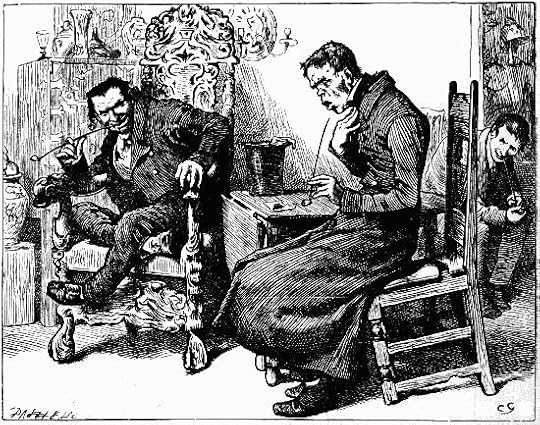
"Is it good, Brass, is it nice, is it fragrant?"
Chapter 11
Charles Green
Text Illustrated:
‘Smoke away, you dog,’ said Quilp, turning to the boy; ‘fill your pipe again and smoke it fast, down to the last whiff, or I’ll put the sealing-waxed end of it in the fire and rub it red hot upon your tongue.’
Luckily the boy was case-hardened, and would have smoked a small lime-kiln if anybody had treated him with it. Wherefore, he only muttered a brief defiance of his master, and did as he was ordered.
‘Is it good, Brass, is it nice, is it fragrant, do you feel like the Grand Turk?’ said Quilp.
Mr Brass thought that if he did, the Grand Turk’s feelings were by no means to be envied, but he said it was famous, and he had no doubt he felt very like that Potentate.
Mod
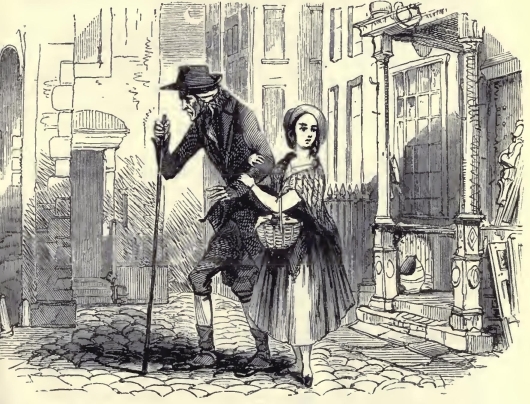
The Pilgrimage begins
Chapter 12
Phiz
Text Illustrated:
They got the door open without noise, and passing into the street, stood still.
‘Which way?’ said the child.
The old man looked, irresolutely and helplessly, first at her, then to the right and left, then at her again, and shook his head. It was plain that she was thenceforth his guide and leader. The child felt it, but had no doubts or misgiving, and putting her hand in his, led him gently away.
It was the beginning of a day in June; the deep blue sky unsullied by a cloud, and teeming with brilliant light. The streets were, as yet, nearly free from passengers, the houses and shops were closed, and the healthy air of morning fell like breath from angels, on the sleeping town.
The old man and the child passed on through the glad silence, elate with hope and pleasure. They were alone together, once again; every object was bright and fresh; nothing reminded them, otherwise than by contrast, of the monotony and constraint they had left behind; church towers and steeples, frowning and dark at other times, now shone in the sun; each humble nook and corner rejoiced in light; and the sky, dimmed only by excessive distance, shed its placid smile on everything beneath.
Forth from the city, while it yet slumbered, went the two poor adventurers, wandering they knew not whither.
Commentary:
It would be misleading to suggest that the illustrated novel dominated Victorian fiction, since throughout the era many writers, major and minor, published their books without pictures, and without any apparent sense that something was lacking. The Brontës come immediately to mind among the major Victorian novelists, and with a few exceptions both George Eliot and George Meredith published their novels un-illustrated, while Anthony Trollope's novels contained illustrations during only a limited segment of his long career. Nonetheless, the illustration of novels in their first appearance was widespread; for certain authors it was a significant factor in the process of creation and in the total form of their books. Generalizations about so large a field are inevitably treacherous, but if we are to understand the role of illustrations in Dickens' novels, and in particular those of is main illustrator, Hablot Knight Browne, we must hazard some theories about the historical, aesthetic, and interpretative implications of this mixture of artistic media.
To account historically for the pervasiveness of illustrations in :Victorian fiction we must look back to the Posthumous Papers of the Pickwick Club, whose publication began in 1836. Dickens' financial success with Pickwick's mode of publication — monthly, one-shilling parts, with two full-page illustrations in each — encouraged other authors and publishers to try something similar. Among the many novelists operating at least sporadically in [1/2] this mode we may mention Charles Lever, W. Harrison Ainsworth, William Makepeace Thackeray, and Anthony Trollope. It can be argued that the non-intellectual, largely middle class audiences to whom the publishers hoped to sell the novels of Dickens, Lever, Ainsworth, Thackeray, and Trollope found the illustrations especially attractive as a supplementary form of visualization, whereas more intellectual novelists such as Eliot and Meredith did not require illustrations for their particular audiences.
Even if these generalizations are valid, further distinctions must be made among the five illustrated novelists mentioned. Lever and Ainsworth were both something more than hacks and something less than artists. Dependent to some degree upon their illustrators to attract sales, they made no particularly complex or original use of illustrations. Trollope (though he was gratified to have so famous an artist as Millais to illustrate several novels) was not very interested in the illustrations, and the fact that he would always complete his novel before the publication of Part 1 — in contrast to the other four novelists, who published the installments while the novels were in progress — would tend to diminish if not eliminate meaningful collaboration between author and illustrator. On the other hand, even though their work in the dual medium originated in a series of historical accidents, Thackeray and Dickens found it a congenial mode and made it into a distinct sub genre of the novel.
Mod
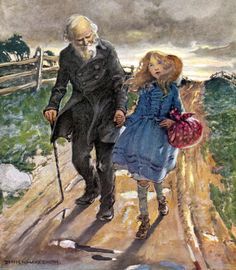
Little Nell and her Grandfather
Chapter 12
Jessie Willcox Smith
Mod
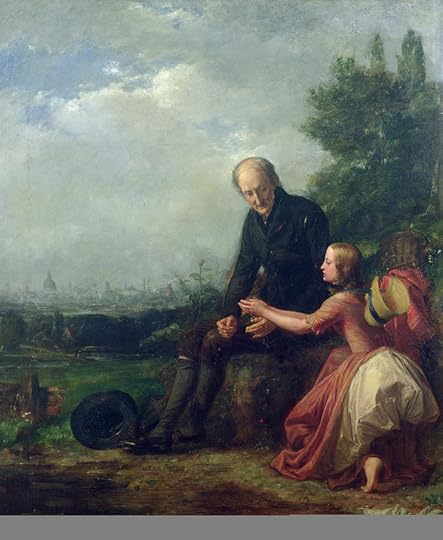
Little Nell and her Grandfather
Chapter 12
William Holman Hunt
Mod
Thanks for the illustrations. If I did smoke they would convince me to stop; since I do not smoke they have convinced me never to start. :-)
Mod

Little Nell and her Grandfather
Harold Copping
Mod
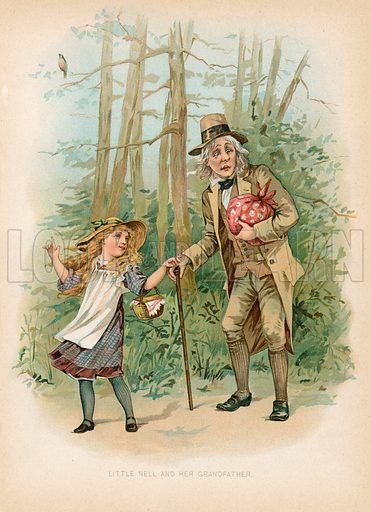
Little Nell and her Grandfather
Chapter 12
Illustration for Beautiful Stories about Children by Charles Dickens retold by his Granddaugther and others.
Mod
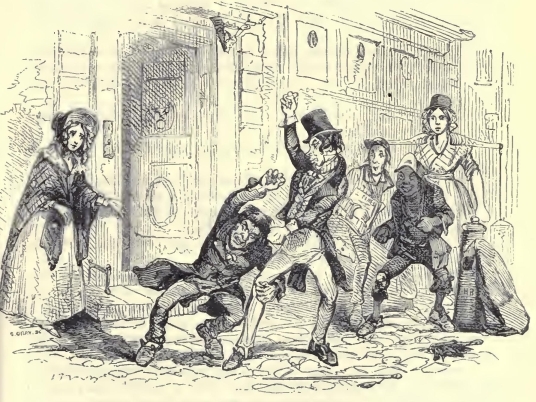
Mr. Swiveller's Pugilistic Skill
Chapter 13
Phiz
Text Illustrated:
With this view, he drew back the lock very silently and softly, and opening the door all at once, pounced out upon the person on the other side, who had at that moment raised the knocker for another application, and at whom the dwarf ran head first: throwing out his hands and feet together, and biting the air in the fulness of his malice.
So far, however, from rushing upon somebody who offered no resistance and implored his mercy, Mr Quilp was no sooner in the arms of the individual whom he had taken for his wife than he found himself complimented with two staggering blows on the head, and two more, of the same quality, in the chest; and closing with his assailant, such a shower of buffets rained down upon his person as sufficed to convince him that he was in skilful and experienced hands. Nothing daunted by this reception, he clung tight to his opponent, and bit and hammered away with such good-will and heartiness, that it was at least a couple of minutes before he was dislodged. Then, and not until then, Daniel Quilp found himself, all flushed and dishevelled, in the middle of the street, with Mr Richard Swiveller performing a kind of dance round him and requiring to know ‘whether he wanted any more?’
‘There’s plenty more of it at the same shop,’ said Mr Swiveller, by turns advancing and retreating in a threatening attitude, ‘a large and extensive assortment always on hand—country orders executed with promptitude and despatch—will you have a little more, Sir—don’t say no, if you’d rather not.’
‘I thought it was somebody else,’ said Quilp, rubbing his shoulders, ‘why didn’t you say who you were?’
‘Why didn’t you say who you were?’ returned Dick, ‘instead of flying out of the house like a Bedlamite?’
‘It was you that—that knocked,’ said the dwarf, getting up with a short groan, ‘was it?’
‘Yes, I am the man,’ replied Dick. ‘That lady had begun when I came, but she knocked too soft, so I relieved her.’ As he said this, he pointed towards Mrs Quilp, who stood trembling at a little distance.
‘Humph!’ muttered the dwarf, darting an angry look at his wife, ‘I thought it was your fault! And you, sir—don’t you know there has been somebody ill here, that you knock as if you’d beat the door down?’
‘Damme!’ answered Dick, ‘that’s why I did it. I thought there was somebody dead here.’
Commentary:
Despite their very great differences as men and as novelists, Dickens and Thackeray shared common influences, such as the emblem book and the satirical engraving, which made available to them a range of visual and verbal techniques including metaphor, allusion, and analogy. Thackeray, as his own illustrator, used these techniques most frequently in the wood-engraved initial letters and tailpieces to chapters, illustrations additional to the two etchings per monthly part.
By the time Vanity Fair began publication, Dickens and Browne had already established their relationship in five novels, three of which were in what became the commonest format for their collaboration: monthly parts with two etched illustrations in each, usually a total of nineteen parts in all, the final one of double length with four etchings. (Because of the haphazard nature of its origins, Pickwick was a few parts longer, and A Tale of Two Cities, the last Dickens novel to be illustrated by Browne, appeared in only eight installments.) Dickens' comfort with the format is suggested by the fact that be used it twice more after dropping Browne as illustrator, in Our Mutual Friend and the unfinished Edwin Drood. From the very Browne seems to have taken it upon himself to introduce his own emblematic details, thereby commenting upon or pointing up some aspect of the text, and by the time of Martin Chuzzlewit, the third collaboration with Dickens in monthly installments, a complex relationship had developed between text and illustration.
Mod
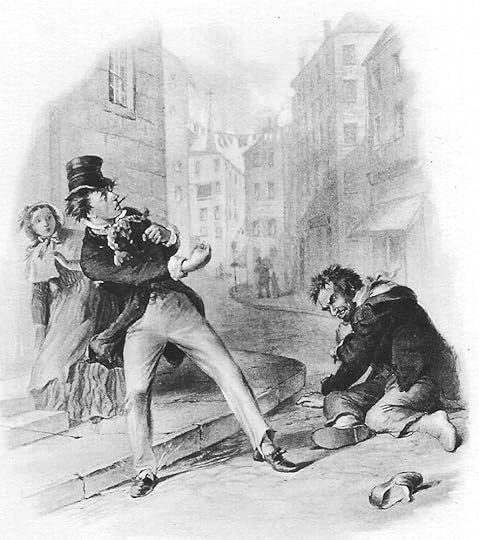
Dick Swiveller and Quilp, from 'The Old Curiosity Shop'
Chapter 13
Felix O. C. Darley
Text Illustrated:
With this view, he drew back the lock very silently and softly, and opening the door all at once, pounced out upon the person on the other side, who had at that moment raised the knocker for another application, and at whom the dwarf ran head first: throwing out his hands and feet together, and biting the air in the fulness of his malice.
So far, however, from rushing upon somebody who offered no resistance and implored his mercy, Mr Quilp was no sooner in the arms of the individual whom he had taken for his wife than he found himself complimented with two staggering blows on the head, and two more, of the same quality, in the chest; and closing with his assailant, such a shower of buffets rained down upon his person as sufficed to convince him that he was in skilful and experienced hands. Nothing daunted by this reception, he clung tight to his opponent, and bit and hammered away with such good-will and heartiness, that it was at least a couple of minutes before he was dislodged. Then, and not until then, Daniel Quilp found himself, all flushed and dishevelled, in the middle of the street, with Mr Richard Swiveller performing a kind of dance round him and requiring to know 'whether he wanted any more?'
"There's plenty more of it at the same shop," said Mr. Swiveller, by turns advancing and retreating in a threatening attitude, "a large and extensive assortment always on hand — country orders executed with promptitude and despatch — will you have a little more, sir — don't say no, if you'd rather not." .
Commentary:
Whereas the original serial illustration, Mr. Swiveller's Pugilistic Skill, involves a Regency dandy raising his fist and a dwarf looking suspiciously like a caricature of Shakespeare's Richard the Third grabbing his assailant's leg with one hand while futilely attempting to defend himself with the other (his short cane unavailable as a means of defence), the seventh Darley character sketch shows the two separated. In Darley's reworking of Phiz's original, the London street, shown in aerial perspective, recedes into the distance, the tenements in the background containing shops at the ground level. In Darley's version an alarmed Mrs. Quilp is the sole spectator, and the door-knocker and entrance of the Quilp dwelling is absent, as are the three bystanders (right in the earlier plate). As a realist Darley has drawn his figures in the round and avoided caricature as he shows the aftermath of the assault captured in the original illustration. Dick makes a pugilistic gesture as he shifts his weight to his left foot, prepares to strike again. Quilp is dazed, struggling to get up. So violent has the assault been that Quilp has apparently lost his shoe in the fray, and (according to Darley) is far more disoriented than the text suggests. However, Darley has undercut the physical comedy by making Quilp a real person rather than a caricature dwarf.
Mod
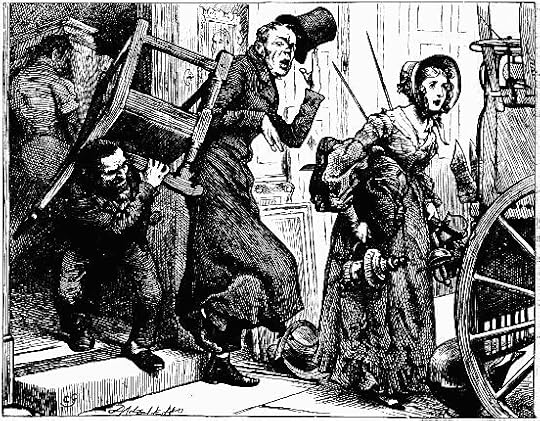
Not to be behindhand in the bustle, Mr. Quilp went to work with surprising vigour
Chapter 13
Charles Green
Text Illustrated:
By this time, certain vans had arrived for the conveyance of the goods, and divers strong men in caps were balancing chests of drawers and other trifles of that nature upon their heads, and performing muscular feats which heightened their complexions considerably. Not to be behind-hand in the bustle, Mr Quilp went to work with surprising vigour; hustling and driving the people about, like an evil spirit; setting Mrs Quilp upon all kinds of arduous and impracticable tasks; carrying great weights up and down, with no apparent effort; kicking the boy from the wharf, whenever he could get near him; and inflicting, with his loads, a great many sly bumps and blows on the shoulders of Mr Brass, as he stood upon the door-steps to answer all the inquiries of curious neighbours, which was his department. His presence and example diffused such alacrity among the persons employed, that, in a few hours, the house was emptied of everything, but pieces of matting, empty porter-pots, and scattered fragments of straw.
Mod
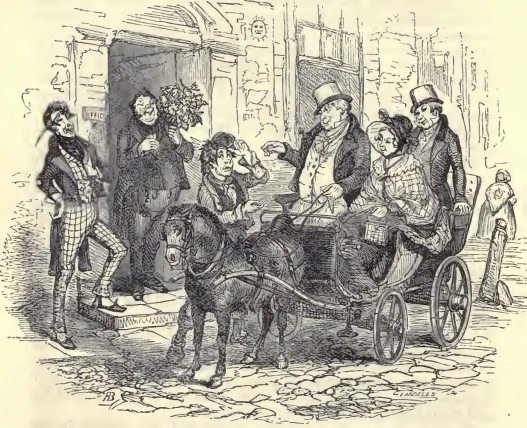
Kit makes an Appointment
Chapter 14
Phiz
Text Illustrated:
Out they came forthwith; Mr Witherden, who was short, chubby, fresh-coloured, brisk, and pompous, leading the old lady with extreme politeness, and the father and son following them, arm in arm. Mr Abel, who had a quaint old-fashioned air about him, looked nearly of the same age as his father, and bore a wonderful resemblance to him in face and figure, though wanting something of his full, round, cheerfulness, and substituting in its place a timid reserve. In all other respects, in the neatness of the dress, and even in the club-foot, he and the old gentleman were precisely alike.
Having seen the old lady safely in her seat, and assisted in the arrangement of her cloak and a small basket which formed an indispensable portion of her equipage, Mr Abel got into a little box behind which had evidently been made for his express accommodation, and smiled at everybody present by turns, beginning with his mother and ending with the pony. There was then a great to-do to make the pony hold up his head that the bearing-rein might be fastened; at last even this was effected; and the old gentleman, taking his seat and the reins, put his hand in his pocket to find a sixpence for Kit.
He had no sixpence, neither had the old lady, nor Mr Abel, nor the Notary, nor Mr Chuckster. The old gentleman thought a shilling too much, but there was no shop in the street to get change at, so he gave it to the boy.
‘There,’ he said jokingly, ‘I’m coming here again next Monday at the same time, and mind you’re here, my lad, to work it out.’
‘Thank you, Sir,’ said Kit. ‘I’ll be sure to be here.’
He was quite serious, but they all laughed heartily at his saying so, especially Mr Chuckster, who roared outright and appeared to relish the joke amazingly. As the pony, with a presentiment that he was going home, or a determination that he would not go anywhere else (which was the same thing) trotted away pretty nimbly, Kit had no time to justify himself, and went his way also. Having expended his treasure in such purchases as he knew would be most acceptable at home, not forgetting some seed for the wonderful bird, he hastened back as fast as he could, so elated with his success and great good fortune, that he more than half expected Nell and the old man would have arrived before him.
Mod
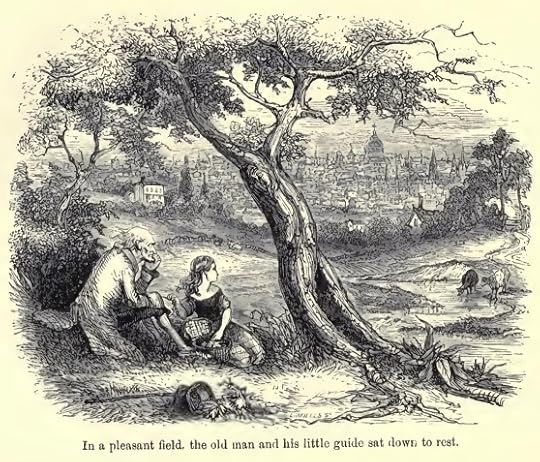
A Rest By The Way
Chapter 15
Phiz
Text Illustrated:
Then came a turnpike; then fields again with trees and hay-stacks; then, a hill, and on the top of that, the traveller might stop, and—looking back at old Saint Paul’s looming through the smoke, its cross peeping above the cloud (if the day were clear), and glittering in the sun; and casting his eyes upon the Babel out of which it grew until he traced it down to the furthest outposts of the invading army of bricks and mortar whose station lay for the present nearly at his feet—might feel at last that he was clear of London.
Near such a spot as this, and in a pleasant field, the old man and his little guide (if guide she were, who knew not whither they were bound) sat down to rest. She had had the precaution to furnish her basket with some slices of bread and meat, and here they made their frugal breakfast.
The freshness of the day, the singing of the birds, the beauty of the waving grass, the deep green leaves, the wild flowers, and the thousand exquisite scents and sounds that floated in the air—deep joys to most of us, but most of all to those whose life is in a crowd or who live solitarily in great cities as in the bucket of a human well—sunk into their breasts and made them very glad. The child had repeated her artless prayers once that morning, more earnestly perhaps than she had ever done in all her life, but as she felt all this, they rose to her lips again. The old man took off his hat—he had no memory for the words—but he said amen, and that they were very good.
There had been an old copy of the Pilgrim’s Progress, with strange plates, upon a shelf at home, over which she had often pored whole evenings, wondering whether it was true in every word, and where those distant countries with the curious names might be. As she looked back upon the place they had left, one part of it came strongly on her mind.
‘Dear grandfather,’ she said, ‘only that this place is prettier and a great deal better than the real one, if that in the book is like it, I feel as if we were both Christian, and laid down on this grass all the cares and troubles we brought with us; never to take them up again.’
Commentary:
There is also a fundamental difference between what Dickens, Cattermole, and Browne achieve in the Clock novels and what Thackeray does with "woodcuts dropped into the text" in Vanity Fair and Pendennis. Thackeray's directly illustrative etchings and woodcuts are generally much less striking in effect than are his numerous initial letters and tailpieces, most of which are wittily emblematic as they provide symbolic commentary. In contrast, there are only twenty-five initial letters throughout the Clock, and few have any connection with the text; at the same time, the Clock's full-size cuts are, with a few important exceptions, devoid of emblematic details. Further, in contrast to Browne's developing practice in the monthly-part novels (where he increasingly emphasizes parallels between etchings), the relation of his and Cattermole's individual cuts in the Clock is largely sequential rather than thematic.
After the necessarily halting start, given the change in plans regarding The Old Curiosity Shop, which was originally intended as a short story, the illustrations settle down into a fairly consistent pattern: two cuts per number, usually full size but sometimes one a small tailpiece, and occasionally an initial letter at the opening of a number. Early in the work the narrative and hence the graphic sequences are short, but by the fifteenth weekly number there is a six-cut sequence running through three numbers and five chapters; and from the second half of Number 19 through Number 23 a sequence of nine cuts, all by Browne, runs from chapter 24 through chapter 32. Considering that Browne was "never at home with the technique of wood cutting" because he could not envision "what changes an engraver might make in the appearance of his drawing", the frantic pace involved in illustrating a weekly rather than a monthly publication, the effect of employing various engravers, and the other work Phiz had in hand at the time, the results are of surprisingly high quality, although the engravers did seem to have trouble with facial expressions. Phiz frequently seemed to treat the medium as if he expected the results to equal those obtained by etching, but the engravers often obliged by providing as subtle shading as can be produced by the method. In this respect the results are generally more successful than those achieved by his co-illustrator. Phiz was notably more skillful than Cattermole in dealing with human figures close up, and even his worst engraver, C. Gray, could not always drag him down to his level of crudity.
Victorian illustrated novels, and in particular those of Dickens and Thackeray, present certain aesthetic and interpretative problems. In many of Thackeray's novels we have a self-illustrated writer, whose artistic intention may be thought of as unified even though he works in two media. But with Dickens and his illustrators we cannot, despite Dickens' practice of giving detailed instructions, assume such a single intention. Because the illustrations include elements which are specified by the author, but are not the author's own creations, and further because the artist introduces details of his own, we find that the illustrator is at once collaborator, attempting to express the author's intention visually; interpreter, offering his own comments on the meaning of the work; and perhaps even an artist, sometimes creating independently valuable works of art. The paramount problem for readers of Dickens, a problem at once both aesthetic and interpretative, is how to "read" the text and illustrations in conjunction with one another. Thackeray's intentions can hardly be doubted.
Kim wrote: "The Legal Gentleman named BrassChapter 11
Phiz"
Have to be three of the ugliest men I have ever laid eyes on.
Kim wrote: "A Rest By The WayChapter 15
Phiz"
I like this illustration (copy of illustration?) a lot. It looks different than the usual Phiz fare.
Mod
Chapter 15
Phiz
Text Illustrated:
Then came a turnpike; then fields again with trees and hay-stacks; then, a hill, and on the top of that, the traveller might stop, and—lookin..."
I’m glad Kim posted this illustration and Xan enjoyed it. To me, this is the second of three illustrations that are essential to the novel. The first was Nell asleep in The Old Curiosity Shop from Chapter One. The third we must wait for patiently. But for now, let’s consider this one.
To me it represents the key point of the novel. Nell and old Trent have fled London, but their destination is not yet known. As they rest under a tree in a rural setting they look back on London and all the evil it represents. In the distance we see the dome of St Paul’s which is one of the most important emblem of London. St Paul’s rises from its surroundings and acts as a beacon. This illustration functions as the liminal between London and the world that will now be entered by Nell and her grandfather.
Saint Paul’s was an important emblem for Hablot Browne. It appears in other illustrations throughout Dickens, most notably in “The River” which is found in David Copperfield. In this illustration we find Martha about to commit suicide in the Thames while David and Peggotty are seen in the rear of the illustration coming to save her. Browne placed the dome of St Paul’s in the background of this illustration as well. What is remarkable is that from where Martha is, the dome would not be visible, yet Browne chose to situate it in the perspective of the illustration anyway. Martha is saved, and goes on to live in Australia.
For this illustration in TOCS I have always been fascinated by the tree which forms the centre of the picture. When one looks at the bottom right of the illustration we see that the trunk is cleft into two parts. The roots spread along the ground like feet. If we follow the divided nature of the trunk upwards we note the trunk becomes solid. Then we note that there are two branches that spread outwards, one towards the right and one to the left. The trunk leans towards Nell and her father. Taken as a whole, the tree takes the form of a kneeling person, from the roots which are presented as feet to the cleft trunk which are shaped as legs. Finally, the two branches spread like arms, and its leafy branches cover and protect our pilgrims.
Also seen in the illustration is a stream with cattle. From this stream Nell “cast the water on him with her hands, and dried it with her simple dress.” The presence of water this illustration takes on clear allusions to the Bible as well.
Finally, when we consider that Dickens mentioned in this chapter that at the Old Curiosity Shop was “an old copy of the Pilgrim’s Progress, with strange plates ... over which she had often pored whole evenings, wondering whether it was true in every word, and where those distant countries with their curious names might be” we have an incredible conflation of text, illustration, allusion and prolapsis. The illustration has turned Bunyan’s novel into the template for TOCS. The mention of the Pilgrim’s Progress is the central synecdoche for TOCS. We as readers are reading an updated version of Bunyan’s novel. In our hands is that book, complete with illustrations, titled The Old Curiosity Shop. Browne’s placement of Trent’s walking stick at the bottom left of the illustration links the two books further.
Taken together, we have an illustration of protection, safety and, with the presence of St Paul’s in the background, we have the representation of faith and love.
Good set of illustrations. The one with the tree looked like a person to me, too, but I wasn't sure what it meant. I thought maybe it symbolized Christ crucified, but now that Peter mentioned a kneeling person, I can see that too.
Mod
Hi Alissa
The tree could well suggest the figure of a crucified Christ. Saint Paul’s dome in the distance, the mention of a form of baptism, the drying of her grandfather, and the direct mention of Pilgrim’s Progress all point to a Christian interpretation of the illustration.
Too bad Fred can't or won't help Nell with the Quilp situation. I'm tempted to call in Nicholas Nickleby.
Alissa wrote: "I looked up the etymology of "conversation," and, yes, it was a synonym for sex since the 14th century. "Criminal conversation" was the legal term for adultery from the late 18C...."Thanks, Alissa - very illuminating!


We open the chapter with the news that Nell’s grandfather has a “raging fever accompanied with delirium” and that “he lay for many weeks in imminent peril of his life.” What this means is that Nell is more alone, more isolated, and needs to become more self-reliant. Their home is now in the filthy hands of Quilp and he is settling into his ownership and establishing it, for now, as his own residence. He again begins a “wholesome fumigation” by endlessly smoking and insists his friend and lawyer Mr Brass do the same. The curiosity shop becomes filled with their unwholesome odour.
Brass is not the most upstanding member of the legal profession. His appearance reflects his character and morality. He is described as “a tall, meagre man, with a nose like a wen, a protruding forehead, retreating eyes, and hair of a deep red... . He had a cringing manner ... [and a] foreboding voice.” Quilp orders him to smoke more too to “keep off fever.” All this smoke. It must be as repellent as the smokers, and they are really repellant. Into this unwholesome scene enters Little Nell and Brass remarks “Oh beautiful sir, beautiful indeed... Quite charming.” Like Quilp, Brass makes me very uneasy, especially the way they both speak about and treat Nell.
What follows in a conversation charged with sexual innuendo and tension. Quilp asks Nell if she is going to stay at the shop and then comments on what a “nice little room” Nell has. “Quite a bower. You’re sure you are not going to use it?” When Nell says no Quilp comments to Brass that Nell is quite shy and “very sensitive... . The bedstead is about my size, I think I shall make it my little room.”
Thoughts
The world of Nell is becoming more and more constrained. Her father is very ill, she has been obliged to turn from her friendship with Kit, and, worst of all, Quilp and Brass have taken up residence in the curiosity shop. Added to that we hear Quilp ponder the possibility of claiming Nell’s bedstead (and by suggestion) Nell herself. With such diminished circumstances, what are her options at this point in the novel?
Quilp loves to smoke and he demands Brass join him. What might be the metaphorical suggestion of such an action and habit?
Quilp’s other habit is to rub his hands together. To what extent do you think this is Dickens simply giving Quilp an identifiable physical tic? Could such an action suggest more?
The lawyer Brass is new character in the novel. How might his role in the novel be extended as the novel progresses?
One night while sitting at her usual window Nell hears her name called. It is Kit. He hopes that Nell does not believe he deserves his present treatment. Nell knows the goodness of Kit, and yet she is conflicted as to how to react. Kit tries to cheer Nell. He is the only positive force in Nell’s life at this point in the novel. Nell reveals her fear for the future and tells Kit that she knows she will be very poor and will “scarcely have bread to eat.” Kit acknowledges that fact, admits he hasn’t “got much sense” but he is still willing to be a faithful servant. Further, he offers his home with his mother to shelter Nell and her father. Kit says their home is small, but clean, and he would be happy to wait on her and her father. He is not asking money for such attention. He just wants to help. Brass and Quilp are awakened by the conversation; Kit leaves the area. The chapter ends with Nell reflecting on her conversation with Kit. Nell “was touched to the quick by [Kit’s] kind and generous spirit, however uncouth the temple in which it dwelt.” Dickens concludes the chapter with the words “Thank Heaven that the temple of such spirits are not made with hands, and that they may be more worthily hung with poor patchwork than with purple and fine linen.”
Thoughts
What are your impressions and thoughts of Kit’s actions and offer to Little Nell? In what ways does this chapter further develop Kit’s character?
If we reflect on the use of physical structures described so far in the novel we have quite the array of places: the Old Curiosity Shop, Quilp’s home, Quilp’s warehouse, and the description of Kit’s home. What patterns of description seem to be emerging? What comparisons and contrasts can be suggested?
How would you describe what Dickens means when he writes of Kit “however uncouth the temple in which it dwelt.”