
The History Book Club discussion
HEALTH- MEDICINE - SCIENCE
>
ZOOLOGY
date newest »
newest »
 Mod
Mod

Hello! - Tortoise
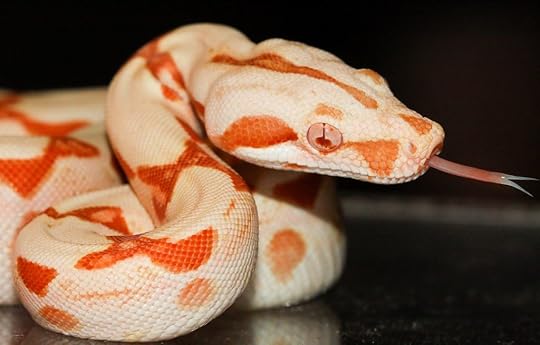
Snakes
Herpetology (from Greek ἑρπετόν herpetón, meaning "reptile" or "creeping animal") is the branch of zoology concerned with the study of amphibians (including frogs, toads, salamanders, newts, and caecilians (gymnophiona)) and reptiles (including snakes, lizards, amphisbaenids, turtles, terrapins, tortoises, crocodilians, and the tuataras).
Birds, which are cladistically included within Reptilia, are traditionally excluded here; the scientific study of birds is the subject of ornithology.
Thus, the definition of herpetology can be more precisely stated as the study of ectothermic (cold-blooded) tetrapods.
Under this definition "herps" (or sometimes "herptiles" or "herpetofauna") exclude fish, but it is not uncommon for herpetological and ichthyological scientific societies to "team up", publishing joint journals and holding conferences in order to foster the exchange of ideas between the fields, as the American Society of Ichthyologists and Herpetologists does.
Many herpetological societies have been formed to promote interest in reptiles and amphibians, both captive and wild.
Herpetology offers benefits to humanity in the study of the role of amphibians and reptiles in global ecology, especially because amphibians are often very sensitive to environmental changes, offering a visible warning to humans that significant changes are taking place.
Some toxins and venoms produced by reptiles and amphibians are useful in human medicine. Currently, some snake venom has been used to create anti-coagulants that work to treat strokes and heart attacks.
Remainder of article:
https://en.wikipedia.org/wiki/Herpeto...
Source: Wikipedia
Mod
'Extinct' Galapagos tortoise found after 100 years
Alex Stambaugh, CNN • Updated 21st February 2019
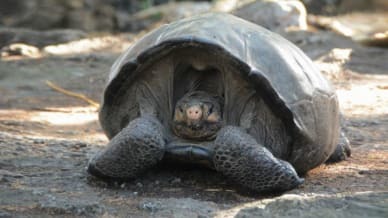
Hello! The rare Fernandina Giant Tortoise, believed extinct, was seen earlier this week for the first time in 100 years. - Ministry of the Environment
(CNN) — A species of giant tortoise believed to have been extinct for more than 100 years has been discovered on the Galapagos island of Fernandina, according to Ecuador's government.
The last known time a Fernandina Giant Tortoise was seen alive was 1906.
An adult female believed to be more than a century old was seen alive on Sunday during an expedition by the Giant Tortoise Restoration Initiative (GTRI), according to a government statement.
Washington Tapia, GTRI director and expedition leader, said that genetic studies will be carried out to "reconfirm" that the tortoise found belongs to the Fernandina Island species.
Experts believe she is not alone. The tracks and scent of other tortoises, believed to be of the same species, were also observed by the team.
Conservationists have taken the tortoise to a breeding center on the nearby island of Santa Cruz.
The Fernandina Giant Tortoise is one of 14 giant tortoise species native to the Galapagos Islands, most of which are endangered.
The tortoises have been killed over the past two centuries, both for food and for their oil, according to the Galapagos Conservancy, which jointly forms GTRI with the Galapagos National Park.
"This encourages us to strengthen our search plans to find other (tortoises), which will allow us to start a breeding program in captivity to recover this species," said Danny Rueda, director of the Galapagos National Park.
The Galapagos archipelago includes 19 islands in the Pacific Ocean roughly 621 miles (1,000km) from the Ecuadorian coast.
Fernandina, the third largest and youngest of the islands, remains the most volcanically active.
The Galapagos were declared a national park in 1959 and a UNESCO World Heritage Site in 1978.
Source: CNN Travel
More:
 by Paul Chambers (no photo)
 by Tammy M. "Gagne" Proctor (no photo)
 by Judy Cutchins (no photo)
 by Franck Bonin (no photo)
 by Craig B. Stanford (no photo)
 by
by
 Isabella Hatkoff
 by
by
 Rebecca E. Hirsch
Children's Book
 by Ruth Heller (no photo)
Mod
by Ruth Heller (no photo)
Mod
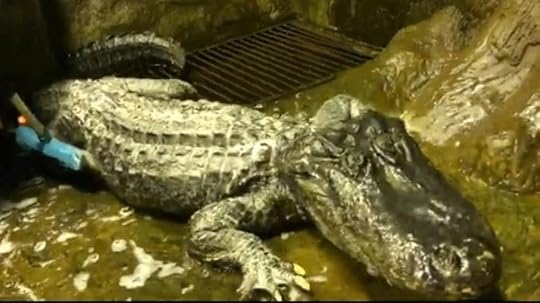
An alligator who survived World War Two in Berlin and was rumoured - wrongly - to have belonged to Nazi leader Adolf Hitler has died in Moscow Zoo.
"Yesterday morning, our Mississippi alligator Saturn died of old age. He was about 84 years old - an extremely respectable age," the zoo said.
Saturn was gifted to Berlin Zoo in 1936 soon after he was born in the US. He escaped the zoo being bombed in 1943.
British soldiers found him three years later and gave him to the Soviet Union.
How he spent the intervening years always remained a mystery, but since July 1946 the alligator has been a hit with visitors in Moscow.
"Moscow Zoo has had the honour of keeping Saturn for 74 years," the zoo said in a statement.
"For us Saturn was an entire era, and that's without the slightest exaggeration... He saw many of us when we were children. We hope that we did not disappoint him."
Remainder of article:
https://www.bbc.com/news/amp/world-eu...
Source: BBC

The History Book Club
Books mentioned in this topic
A Sheltered Life: The Unexpected History of the Giant Tortoise (other topics)Giant Galápagos Tortoise (other topics)
Ice Age Giants of the South (other topics)
Turtles of the World (other topics)
The Last Tortoise: A Tale of Extinction in Our Lifetime (other topics)
More...
Authors mentioned in this topic
Paul Chambers (other topics)Tammy M. "Gagne" Proctor (other topics)
Judy Cutchins (other topics)
Franck Bonin (other topics)
Craig Stanford (other topics)
More...

Zoology (/zuˈɒlədʒi, zoʊ-/) is the branch of biology that studies the animal kingdom, including the structure, embryology, evolution, classification, habits, and distribution of all animals, both living and extinct, and how they interact with their ecosystems. The term is derived from Ancient Greek ζῷον, zōion, i.e. "animal" and λόγος, logos, i.e. "knowledge, study".
Remainder of article:
https://en.wikipedia.org/wiki/Zoology
Source: Wikipedia