
The Old Curiosity Club discussion
The Old Curiosity Shop
>
TOCS Chapters 46 - 50

 Mod
Mod
So, Chapter 47 gives us Kit’s mother and the single gentleman once more because, as the narrator says, “his history should [not] be chargeable with inconstancy, and the offence of leaving its characters in situations of uncertainty and doubt”. Is this a case of tongue-in-cheek? After all, Dickens probably knew very well what he was doing when he had all those cliff-hanger endings for the final chapters of his weekly instalments.
So, after following Nell and her Grandfather for half a dozen or so of chapters, we are now back with Kit’s mother and the single gentleman, who start out for the town where they suppose Mrs. Jarley’s waxen empire to be on display. During the journey, Mrs. Nubbles grows rather afraid of the single gentleman because of all the peculiarities of manner he evinces – we may put them down to nervousness and impatience, though –, and the gentleman, at times remembering his fellow-traveller’s comfort for all his impatience of meeting the wayfarers, takes recourse to rather odd measures such as inducing Kit’s mother to drinking lots of brandy-and-water against the cold or of ordering all the food one inn can provide and drawing the conclusion that the woman must be ill for she does not eat it all at once. He also offers to be godfather to Mrs. Nubbles’s baby. This baby, as well as Jacob, by the way, is only “half-babtized.” I was taken aback at this strange term and looked it up in the annotations of my Penguin edition, which let me know that a child who was “half baptized” was baptized privately and hastily, i.e. at home instead of in church. This was normally done when the child’s health was poor so that there was reason to fear it would die before a proper christening could be scheduled. – What might this little detail tell us about Mrs. Nubbles’s living conditions?
Finally, the two travellers arrive at their destination and find a wedding ceremony just having taken place: The single gentleman immediately suspects that someone might be forcing Little Nell into matrimony, and barges in on the wedding company. He soon learns, however, that it is none other but Mrs. Jarley and Mr. George who have united in wedlock, and all they can tell him about Little Nell is that she one morning they found her and her grandfather to have suddenly disappeared. They undertook everything to retrace her, partly from solicitude with regard to the child, partly to clear themselves of any suspicions of foul play that might come to adhere to them, but everything was to no avail. At this juncture, it looks as though the single gentleman is again thrown back to where he started from. Nevertheless, he offers the Georges a reward for the cares they took, but the couple can in no way be moved to accept the money. This gave me the impression that Mrs. Jarley / George really meant well with Nell and had taken a genuine liking for her. More shame on her Grandfather, whose behaviour had forced her to leave this person who was so kind to her!
Did you notice how the crowd behaved when the single gentleman arrived at the place of the wedding? What does this description tell us of Dickens’s knowledge about human masses? What might it foreshadow with regard to Barnaby Rudge? Just take this wonderful sentence:
”Anything that makes a noise is satisfactory to a crowd.”
Mod
”’Would the gentleman like this room?’ said a voice, as a little out-of-the-way door at the foot of the well staircase flew briskly open and a head popped out. ‘He’s quite welcome to it. He’s as welcome as flowers in May, or coals at Christmas. Would you like this room, sir? Honour me by walking in. Do me the favour, pray.’”
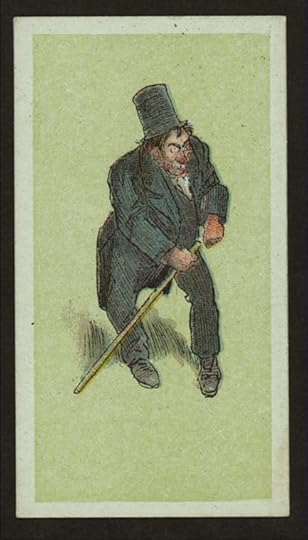
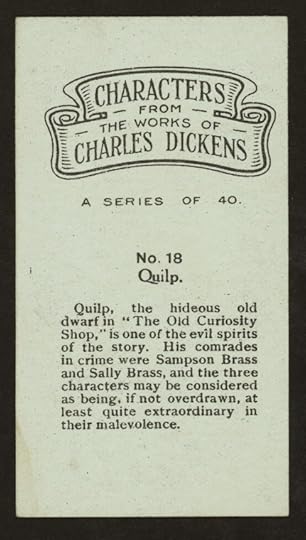
The practised reader of TOCS only needs to get the hints of a door flying “briskly open and a head popp[ing] out” to know whose voice is making this over-zealous offer. Why, the speaker is none other but Quilp! When the single gentleman declines this invitation, Quilp makes the door go to “like a figure in a Dutch clock when the hour strikes”, being true to his abrupt jerkiness. On making enquiries with the landlord as to how long Quilp has already been at the inn, the gentleman learns that the other guest arrived by the night-coach in the morning but also that “[w]hen the chambermaid asked him just now if he should want a bed, sir, he first made faces at her, and then wanted to kiss her.” Once again, we have this strange duality in Quilp: Not only does he want to kiss the servant – this falls in with his obtrusive behaviour towards Nell and the strange compliments he pays to Sally Brass –, but he also takes a delight in making faces and scaring the woman. He definitely is much like a character from a Punch-and-Judy show, isn’t he?
Eventually, the interview between Quilp and the two newcomers does take place, and here, too, the dwarf behaves in a grotesque way, paying Mrs. Nubbles and her family compliments in a voice growing shriller and shriller, and in a manner betraying underhandedness and, maybe, even menace. Unlike Mrs. Nubbles, the single gentleman is not afraid of Quilp and therefore he does not allow the fiend to intimidate him but stands his ground in the ensuing conversation in which he reproaches the dwarf with having driven Nell and the old man from their home, with withholding information from him and with tailing them on their journey. Quilp glibly answers that he has not driven anyone anywhere but that the two absconded without his knowledge one night and that, apart from that, his taking over the old man’s property was done with a proper warrant. He also says that for all he knows it might be the single gentleman and Mrs. Nubbles who are following him. The single gentleman not being afraid of the dwarf, and the latter being obstinate, the conversation ends in a deadlock, with neither side giving any valuable information to the other, and as soon as the door has closed upon the gentleman and Kit’s mother, Quilp once more gives vent to his spiteful and anarchic nature:
”Chuckling as though in very great glee, and recompensing himself for the restraint he had lately put upon his countenance by twisting it into all imaginable varieties of ugliness, Mr Quilp, rocking himself to and fro in his chair and nursing his left leg at the same time, fell into certain meditations, of which it may be necessary to relate the substance.”
It seems as though there is such an amount of evil energy within Quilp that he just has to make faces and go through all sorts of contortions; in other words, he seems to be chaos incarnate. It is at this moment that the narrative clears us up with regard to a question we might long have entertained, namely why on earth Quilp should have gone to Mrs. Nubbles’s chapel on that very day when Kit went there to look for her. It is sad to say, but none other than Dick Swiveller plays a baleful role in this matter for when Quilp accidentally drops by at the Brasses’ office, he finds his stool pigeon – that’s at least the role Quilp must have chosen for Swiv – in a state of inebriation and most ready to tell him that there is one thing he is not going to tell anybody, namely that Kit had an interview with the single gentleman. Quilp, hearing this, is determined to find out more about that interview, and thinking that the young man’s mother is probably most susceptible to his bullying, he sets out for the chapel where, as he knows, she is most likely to be. The rest is already known by the reader.
Poor Swiv – do you think he would have a bad conscience if he came to know what he has done here? In a way, the matter does not end here, for Quilp takes this episode as an occasion to increase his own ill-will against Kit, seeing that the single gentleman puts so much trust in him:
”’I am suspected and thrown aside, and Kit’s the confidential agent, is he? I shall have to dispose of him, I fear. If we had come up with them this morning,’ he continued, after a thoughtful pause, ‘I was ready to prove a pretty good claim. I could have made my profit. But for these canting hypocrites, the lad and his mother, I could get this fiery gentleman as comfortably into my net as our old friend – our mutual friend, ha! ha! – and chubby, rosy Nell. At the worst, it’s a golden opportunity, not to be lost. Let us find them first, and I'll find means of draining you of some of your superfluous cash, sir, while there are prison bars, and bolts, and locks, to keep your friend or kinsman safely. I hate your virtuous people!’ said the dwarf, throwing off a bumper of brandy, and smacking his lips, ‘ah! I hate ‘em every one!’”
These words, which Quilp says to himself, like a proper villain in a proper Elizabethan play, not only let us know the motive the dwarf has for wanting to find out more about Nell and her Grandfather, but they also bode very ill for Kit. Quilp says he is going to dispose of the young man. What can he possibly mean by that? Murder? Or slander? Or what else? – It’s also interesting that Quilp says that he hates virtuous people. Does he feel himself like an outcast in a way – e.g. like Iago, a proper villain in a proper Elizabethan play?
The rest of the chapter gives us another typically Quilp-like episode: When Kit’s mother travels home without the single gentleman, the dwarf gets on the roof of the coach, and makes use of this opportunity to stalk and intimidate the poor woman in every possible way, even at the peril of his own life when he pops his head inside the coach windows, staring at her with goggle eyes and playing all sorts of Punch-and-Judy tricks on her. Consequently, when they arrive in London, Mrs. Nubbles is beside herself with fear and nervousness, and Kit, who has come to pick her up, has it out with Quilp, saying:
”’You let my mother alone, will you?’ said Kit. ‘How dare you tease a poor lone woman like her, making her miserable and melancholy as if she hadn’t got enough to make her so, without you. An’t you ashamed of yourself, you little monster?’
‘Monster!’ said Quilp inwardly, with a smile. ‘Ugliest dwarf that could be seen anywhere for a penny – monster – ah!’
‘You show her any of your impudence again,’ resumed Kit, shouldering the bandbox, ‘and I tell you what, Mr Quilp, I won’t bear with you any more. You have no right to do it; I’m sure we never interfered with you. This isn#t the first time; and if ever you worry or frighten her again, you’ll oblige me (though I should be very sorry to do it, on account of your size) to beat you.’”
What do you think how Kit deals with this situation? Note that Quilp repeats the insult Kit made in his conversation with the other boy quite some time ago; in other words, the dwarf is not a man who forgets a slight, and maybe, this is not too good for Kit …
Mod
Be that as it may, when Quilp comes home and sees light through the window and hears all sorts of voices, also male ones, he immediately feels jealous and decides to spy on the people inside. A soft knock at the door summons the upside-down-boy, who tells him that they assume he must have drowned because he had not been at home for so many days. Strangely, both Quilp and the boy seem to find great delight in this state of affairs, and Quilp now listens in on what the people inside his living-room are saying and doing. At the table, there are Mr. Brass and Mrs. Jiniwin, both partaking generously of Quilp’s rum. Standing behind Brass, there are two men who have apparently dragged the Thames with a view of finding Quilp’s dead body, but now even those two are reinvigorating themselves with Quilp’s rum. Sitting in an armchair, there is Mrs. Quilp, not exactly sad but still serious and obviously not as cosily employed as the rest of the company. Quilp observes this scene through a chink in the wall from the adjacent room.
It is like a scene from a comedy: Quilp spying on how Brass is musing on life and death, and the brevity of it all (at least of life), and his feeling that Quilp might still be watching them in a way. And then how Brass is trying to compose a poster with Quilp’s description, with Mrs. Jiniwin insisting on her son-in-law’s having crooked legs and a flat nose, and how that worthy matron points out the necessity of finding the dwarf’s corpse in order to be sure. And how finally Quilp jumps into the room, blowing up the whole party, making Mrs. Jiniwin flee immediately – what a mother is she to leave her daughter in such a situation? – and all the others not dither for long until he is alone with his own wife, upon whom he locks the door! So, for all the fun in the chapter, it does end on a dark tone.
What does this minor event – minor with regard to the larger frame of the novel – tell you about Quilp’s relationship with his wife, Mrs. Jiniwin and Brass? What do the respective people’s words and actions tell us about them? What is the function of this little scene within the novel?
Mod
”Matrimonial differences are usually discussed by the parties concerned in the form of dialogue, in which the lady bears at least her full half share.”
Can you think of any couples in Dickens’s fiction who illustrate this statement to a T? What might this remark tell us about the author’s own idea as to what a perfect relationship or marriage should be like in terms of the distribution of power?
The conversation between Quilp and his wife is definitely dominated by the husband, who cows and browbeats his wife, while she, partly through the dwarf’s grotesque antics, is “well-nigh beside herself with alarm.” Mrs. Q. tries to justify herself, especially her assumption that her husband must have met with some fatal disaster, by saying that it was cruel of him to stay away from home for such a long time without giving previous note, and it really seems as though his wife had been worrying about him – “’[…] I am glad to see you, Quilp; indeed I am.’”– , which is, I say it again, strange. The narrator appears to know this, too, and so he makes the following remark:
”In truth Mrs Quilp did seem a great deal more glad to behold her lord than might have been expected, and did evince a great deal of interest in his safety which, all things considered, was rather unaccountable.”
So instead of clearing up the mystery, our narrator joins us in wondering about it, which is very clever of him. What makes Quilp so irresistible even to a woman like his wife, who constantly suffers from his temper?
Quilp does not think of reconciling himself with his wife, although she is obviously relieved to have him back, but he now claims that he is going to lead a bachelor’s life for a while, i.e. to stay away from home where and how long he pleases, and he therefore makes his wife – and his mother-in-law, whom he summons and intimidates into assisting her daughter – pack his things. Afterwards, he consigns his luggage – with the exception of the cask of Jamaica, which he carries himself, but which, I think, has a tendency to lose weight in the course of events – to his boy, whose name we finally get to know: It’s Tom Scott, which is quite a lacklustre name considering that its bearer is a character in a Dickens novel. Quilp then installs himself in his shack, on his island in the river, where he compares himself with Robinson Crusoe, the most obvious difference between those two being, however, that Quilp’s island life is one of his own seeking whereas Defoe’s hero did what he could to get away from his island. There is one little detail that casts a shadow on Kit’s future, namely this one: When Quilp moves into his new bachelor’s home, he says this,
”’[…] Nobody near me here, but rats, and they are fine stealthy secret fellows. I shall be as merry as a grig among these gentry. I’ll look out for one like Christopher, and poison him – ha, ha, ha! […]’”
Apart from the threat against Kit, what else strikes you about these words? While we might be musing on this question, Quilp has not been idle but made his way to Bevis Marks, where Dick Swiveller is just about to have dinner. Albeit, Dick is in a despondent state of mind at present, thinking that the law “’ […] isn’t moist enough, and there’s too much confinement. […]’” Apart from that, Dick has just received a morsel of the wedding cake that was served on the occasion of Sophy Wackles getting married to Mr. Cheggs, a circumstance that greatly adds to Dick’s feelings of frustration.
Let’s stop for a second and ask ourselves once more what might be the purpose in Dick’s life. He seemed ready enough to follow Fred’s plan of his getting married with Nell and all the riches she seemed to have a claim to, and now again he is pining for Sophy Wackles? Is it genuine feeling, or just the colour of the grass on the other side of the fence? And then, he complains about the confinement of his present situation and his dreams of running away. – And what do you think of his calling Sally “’the sphynx of private life’”?
In the course of their conversation, we also learn that Fred Trent has “accepted a responsible situation in a locomotive gambling-house, and was at that time absent on a professional tour among the adventurous spirits of Great Britain.” Can anyone make head or tail of this? What is a “locomotive gambling-house”? Whatever it is, there remains no doubt that our narrator must have decided on getting Fred completely out of the way. But then there are cases in Dickens’s novels when a character disappears, e.g. to undertake a voyage, and then finally turns up again; will this happen here, too? – Dick also tells Quilp that he introduced Fred to the single gentleman one day (which Quilp takes rather ill as something that has not been arranged with him beforehand), but that the gentleman not only failed to take kindly to Nell’s brother, but instead blamed him for having brought Nell and the old man into poverty.
On his way home, Quilp calmly thinks over the advantages and disadvantages he has from cultivating Dick’s acquaintance, and he comes to the conclusion that for the time being, he will go on using Dick as an unsuspecting spy but that there will probably be the day when he will expose Dick’s part in Fred’s plans in order to win the favour of the single gentleman. – Do you think this a realistic plan? Is the single gentleman likely to be won over to Quilp by anything Quilp could do, save hanging himself?
The chapter ends with a visit of Mrs. Quilp’s on Crusoe’s island, where she vainly entreats her husband to come back to his house and end his voluntary exile, only to be verbally abused and turned out of the place by the dwarf. He seems to be little short of a lord of hell here, what with all the smoke he produces and the smoke that is the result of a badly fixed oven in his cabin. I really do wonder why his wife wants him back!
 Mod
Mod
This week we are once again given the opportunity to keep tabs on Kit, his mother, the single gentleman and Dick Swiveller, and last not least, on Quilp – although Chapter 46, of..."
Three cheers for schoolmasters that always pop up when you need them :-)
Yes. It is about time someone took Nell’s grandfather to task. He seems to be the person least able to see that she is in distress although he is the only person who has both the background and knowledge to know what she has been through. Of course, his own addictions have blinded him to the frailties of his own granddaughter.
More churches and graveyards. Dickens’s descriptions are detailed and evocative, but they are seldom very subtle. Little Nell is not in the best of health. When she sees this new place could it be she realizes that she has found her final place of rest, that her pilgrimage is almost complete, that her task of saving her grandfather has been realized?
 I, too, wondered what Mrs. Quilp was thinking, seeking him out and asking him to come home. Some variation of Stockholm syndrome, maybe. It surely can't be that she (gulp!) truly loves him.
 Mod
Mod
Grump.
Mod
Tristram
Yes. I think it was Dickens’s intent to make the journey a “symbol-laden” time. My feeling is that Dickens knew what he wanted to say but his stylistic formatting was still in its early more rough-edged stages. Thus, in this chapter, we get wonderful bursts of Dickens as he is finding his mature voice, but we still find a heavy residue of him clinging to important concepts that go “clunk” as he writes. His own voice is still emerging.
Mrs Nubbles and the single gentleman make a rather strange pair, but I think Dickens is frequently at his best when he turns his eye to minor characters. Is there any writer who has created more memorable minor characters? I don’t think so.
Who cannot cheer the marriage of Mrs Jarley and George? Here we have another prime example of Dickens’s ability to create engaging characters. I agree with Tristram. The concern and efforts Mrs Jarley exhibits towards her tracing Nell’s whereabouts proves she is a good person. Just imagine the horror if grandfather had stolen money from her. Nell, quite obviously, made the correct decision to whisk her father away from the temptation of robbing Mrs Jarley.
Now marriages ... we have the marriage of Mrs Jarley and we have the pair of the single gentleman and Mrs Nubbles joined in the pursuit of Nell. Could we possibly have another wedding in its early embryonic stage? Just wondering ....
Mod
Three cheers for Kit who is willing to stand up for his mother against Quilp. With the events between the single gentleman and Quilp earlier in the chapter we also see someone willing to confront Quilp. Perhaps Dickens is beginning to signal the early cracks in Quilp’s seemingly impenetrable character.
I noticed again how Quilp is often portrayed as thrusting himself into the spaces of others, this time when on a carriage. Also, poor Nell. Quilp apparently still harbours a distinct appetite for her.
I agree with Tristram’s comments about Quilp as being like Iago. There is definitely an aura of Quilp against the unfair world in this novel. The quotation supplied by Tristram “I am suspected and thrown aside ... “ reads like a soliloquy. Here the reader is allowed into the inner thoughts of Iago. There is more than a touch of Shakespeare’s play Othello in TOCS. Certainly, both Iago and Quilp have total distain for women, both are lustful characters and both are very adept at finding and then using one’s weaknesses against themselves.
Apologies for not being as active this week. Life is hectic just now, and I'll probably be quieter than usual for the next several weeks. But I'm still here, still reading, and still enjoying everyone's observations.
Mod
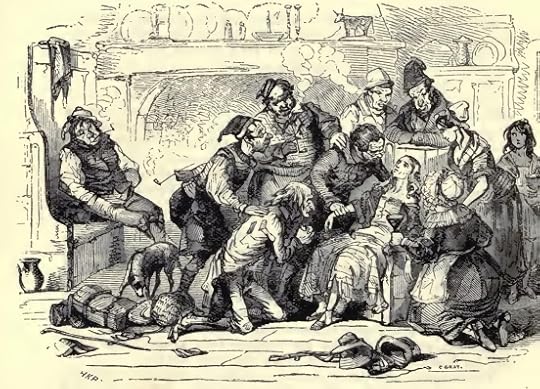
Nell in a faint
Chapter 46
Phiz
Text Illustrated:
There was a small inn within sight, to which, it would seem, he had been directing his steps when so unexpectedly overtaken. Towards this place he hurried with his unconscious burden, and rushing into the kitchen, and calling upon the company there assembled to make way for God’s sake, deposited it on a chair before the fire.
The company, who rose in confusion on the schoolmaster’s entrance, did as people usually do under such circumstances. Everybody called for his or her favourite remedy, which nobody brought; each cried for more air, at the same time carefully excluding what air there was, by closing round the object of sympathy; and all wondered why somebody else didn’t do what it never appeared to occur to them might be done by themselves.
The landlady, however, who possessed more readiness and activity than any of them, and who had withal a quicker perception of the merits of the case, soon came running in, with a little hot brandy and water, followed by her servant-girl, carrying vinegar, hartshorn, smelling-salts, and such other restoratives; which, being duly administered, recovered the child so far as to enable her to thank them in a faint voice, and to extend her hand to the poor schoolmaster, who stood, with an anxious face, hard by. Without suffering her to speak another word, or so much as to stir a finger any more, the women straightway carried her off to bed; and, having covered her up warm, bathed her cold feet, and wrapped them in flannel, they despatched a messenger for the doctor.
Mod
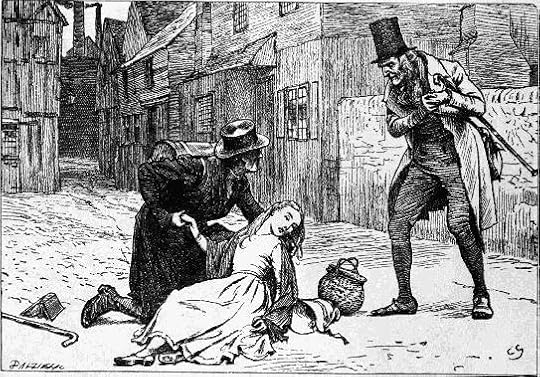
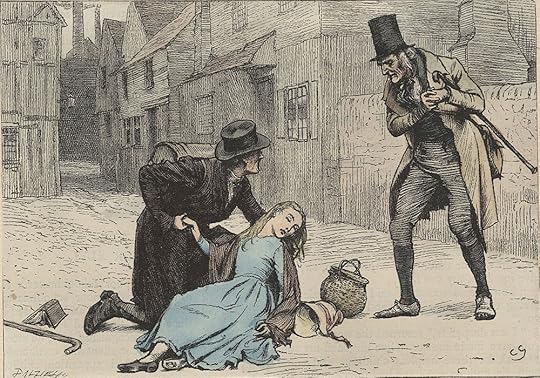
"She is quite exhausted," said the schoolmaster.
Chapter 46
Charles Green
Text Illustrated:
"It was the poor schoolmaster. No other than the poor schoolmaster. Scarcely less moved and surprised by the sight of the child than she had been on recognising him, he stood, for a moment, silent and confounded by this unexpected apparition, without even the presence of mind to raise her from the ground.
But, quickly recovering his self-possession, he threw down his stick and book, and dropping on one knee beside her, endeavoured, by such simple means as occurred to him, to restore her to herself; while her grandfather, standing idly by, wrung his hands, and implored her with many endearing expressions to speak to him, were it only a word.
‘She is quite exhausted,’ said the schoolmaster, glancing upward into his face. ‘You have taxed her powers too far, friend.’
‘She is perishing of want,’ rejoined the old man. ‘I never thought how weak and ill she was, till now.’
Casting a look upon him, half-reproachful and half-compassionate, the schoolmaster took the child in his arms, and, bidding the old man gather up her little basket and follow him directly, bore her away at his utmost speed."
Mod
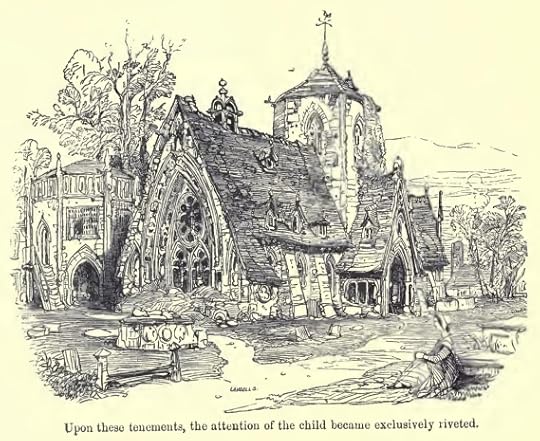
Upon these tenements, the attention of the child became exclusively riveted.
Chapter 46
George Cattermole
Text Illustrated:
‘See—here’s the church!’ cried the delighted schoolmaster in a low voice; ‘and that old building close beside it, is the schoolhouse, I’ll be sworn. Five-and-thirty pounds a-year in this beautiful place!’
They admired everything—the old grey porch, the mullioned windows, the venerable gravestones dotting the green churchyard, the ancient tower, the very weathercock; the brown thatched roofs of cottage, barn, and homestead, peeping from among the trees; the stream that rippled by the distant water-mill; the blue Welsh mountains far away. It was for such a spot the child had wearied in the dense, dark, miserable haunts of labour. Upon her bed of ashes, and amidst the squalid horrors through which they had forced their way, visions of such scenes—beautiful indeed, but not more beautiful than this sweet reality—had been always present to her mind. They had seemed to melt into a dim and airy distance, as the prospect of ever beholding them again grew fainter; but, as they receded, she had loved and panted for them more.
‘I must leave you somewhere for a few minutes,’ said the schoolmaster, at length breaking the silence into which they had fallen in their gladness. ‘I have a letter to present, and inquiries to make, you know. Where shall I take you? To the little inn yonder?’
‘Let us wait here,’ rejoined Nell. ‘The gate is open. We will sit in the church porch till you come back.’
‘A good place too,’ said the schoolmaster, leading the way towards it, disencumbering himself of his portmanteau, and placing it on the stone seat. ‘Be sure that I come back with good news, and am not long gone!’
So, the happy schoolmaster put on a bran-new pair of gloves which he had carried in a little parcel in his pocket all the way, and hurried off, full of ardour and excitement.
The child watched him from the porch until the intervening foliage hid him from her view, and then stepped softly out into the old churchyard—so solemn and quiet that every rustle of her dress upon the fallen leaves, which strewed the path and made her footsteps noiseless, seemed an invasion of its silence. It was a very aged, ghostly place; the church had been built many hundreds of years ago, and had once had a convent or monastery attached; for arches in ruins, remains of oriel windows, and fragments of blackened walls, were yet standing; while other portions of the old building, which had crumbled away and fallen down, were mingled with the churchyard earth and overgrown with grass, as if they too claimed a burying-place and sought to mix their ashes with the dust of men. Hard by these gravestones of dead years, and forming a part of the ruin which some pains had been taken to render habitable in modern times, were two small dwellings with sunken windows and oaken doors, fast hastening to decay, empty and desolate.
Upon these tenements, the attention of the child became exclusively riveted. She knew not why. The church, the ruin, the antiquated graves, had equal claims at least upon a stranger’s thoughts, but from the moment when her eyes first rested on these two dwellings, she could turn to nothing else. Even when she had made the circuit of the enclosure, and, returning to the porch, sat pensively waiting for their friend, she took her station where she could still look upon them, and felt as if fascinated towards that spot.
Commentary:
George Cattermole, who was born in Dickleburgh on 10 August 1800, the youngest son of a Norfolk squire, was a dozen years older than the brilliant young writer who would become his relative by marriage — Charles Dickens. In his early teens, Cattermole trained as a draghtsman for John Britton, a York mediaevalist and antiquarian publisher whose illustrated books on Britain's mediaeval architecture brought the young artist early fame. A prominent member of the highly exclusive Society of Painters in Water Colours, Cattermole by the mid-1830s was already regarded as "England's foremost painter of scenes commemorating bygone times". One of the most significant moments in the artist's life was his introduction to the young and upcoming writer "Boz" (Charles Dickens) at some time in 1836 at the Gore House (London) salon of Countess of Blessington. The twenty-four-year-old Dickens was much impressed with the dashing, fun-loving, stagecoach-driving thirty-six-year-old bachelor whose rooms in The Albany had once been occupied by Lord Byron (who apparently had left some of his furniture behind). Perhaps because he was already a well-established artist when Boz was still a struggling writer of sketches, and perhaps because in 1839 he had declined a knighthood for his oils and watercolours on mediaeval subjects, Charles Dickens was always slightly in awe of Cattermole, who on 20 August 1839 married Clarissa Elderton, a distant relative of Dickens's mother (Elizabeth neé Barrow), at St. Marylebone, London.
From 1837 to 1841 Dickens and Cattermole often celebrated 'convivial occasions' together at their homes, and with members of the Shakespeare Club (until it disbanded in December 1839) and the Portwiners (a group, including Forster, Thackeray, Bulwer-Lytton, Charles and Edwin Landseer, Macready, Lemon, and Maclise, who assembled in Cattermoles' drawing-room). Cattermole gave sumptuous dinners in the elaborately decorated rooms of the house on Clapham Rise into which he and his bride had moved, and, though increasingly reclusive and nervous [as the 1840s drew to a close], he could host such occasions splendidly. . . . [Despite Cattermole's deteriorating health and spirits, there was a brief flare-up of conviviality when Cattermole consented to play Wellbred in Dickens's 1845 amateur theatrical production of Ben Jonson's Every Man in His Humour.
Since Cattermole had already illustrated Architectural Antiquities of Great Britain, Leitch Ritchie's analysis of the works of Sir Walter Scott (Scott and Scotland, 1833), and the earlier "period" novels of Sir Edward G. D. Bulwer-Lytton, Dickens felt that sentimental and tender-hearted "Kittenmoles" (to use Boz's 1841 nickname for him) would be the ideal companion-illustrator for Phiz (Hablot Knight Browne), who was perfectly suited to the execution of the numerous rascals, rogues, and scape-graces of the story. Responding to the sentiments thereby aroused rather than to the designs themselves, Dickens constantly praised Cattermole's contributions to The Old Curiosity Shop, and, despite the artist's occasional tardiness in delivering the required designs for the weekly serialization, always treated him with deference.
Although the mode of illustration upon which Dickens had decided for his novel, the woodblock, offered the advantage of being printed with the text rather than on a separate page, it was time-consuming to execute so that a single illustrator — Hablot Knight Browne or "Phiz" had become his usual collaborator — would not be equal to the task. The collaborative team (or "Clock Works" as Dickens dubbed it) consisted of Samuel Williams and Daniel Maclise supporting the chief illustrators, George Cattermole and Phiz. However, in the end the supporting artists contributed only a single plate each while Phiz contributed the designs for most of the plates and Cattermole contributed fourteen drawings for ten plates and tail-pieces.
Since Cattermole's strength lay in the depiction of architectural backdrops as opposed to character drawings, his plates are set largely indoors; his execution of the old curiosity itself is highly effective. With his antiquarian and architectural bent, Cattermole was the logical choice for executing what Valerie Lester Browne describes as the story's "loftier" subjects, including the highly emotional scene of Nell's death. Jane Rabb Cohen has described the scenes that Dickens allotted to Cattermole and Brown respectively as "picturesque" and "grotesque". Chapman and Hall published the first volume edition of The Old Curiosity Shop on 15 December 1841, priced at thirteen shillings and printed from the Clock's stereotype plates. It bore the title:
The Old Curiosity Shop.
A Tale.
By Charles Dickens.
With Illustrations
By
George Cattermole And Hablot K. Browne.
Complete In One Volume.
That Cattermole's name precedes Browne's may suggest that the older, more established artist was both Dickens's and the public's favorite at the time. It was not simply a strategy playing upon name recognition. Cohen states that Dickens deliberately placed Cattermole's name ahead of Browne's because he felt that "Cattermole's name would undoubtedly enhance the prestige of the undertaking".
Mod
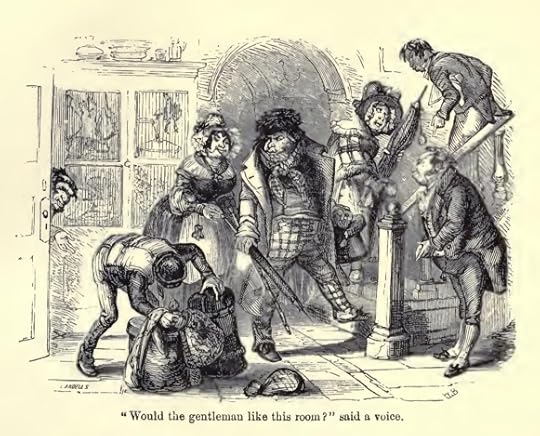
"Would the gentleman like this room?" said a voice.
Chapter 48
Phiz
Text Illustrated:
Not at all participating in the general sensation, but wearing the depressed and wearied look of one who sought to meditate on his disappointment in silence and privacy, the single gentleman alighted, and handed out Kit’s mother with a gloomy politeness which impressed the lookers-on extremely. That done, he gave her his arm and escorted her into the house, while several active waiters ran on before as a skirmishing party, to clear the way and to show the room which was ready for their reception.
‘Any room will do,’ said the single gentleman. ‘Let it be near at hand, that’s all.’
‘Close here, sir, if you please to walk this way.’
‘Would the gentleman like this room?’ said a voice, as a little out-of-the-way door at the foot of the well staircase flew briskly open and a head popped out. ‘He’s quite welcome to it. He’s as welcome as flowers in May, or coals at Christmas. Would you like this room, sir? Honour me by walking in. Do me the favour, pray.’
‘Goodness gracious me!’ cried Kit’s mother, falling back in extreme surprise, ‘only think of this!’
She had some reason to be astonished, for the person who proffered the gracious invitation was no other than Daniel Quilp. The little door out of which he had thrust his head was close to the inn larder; and there he stood, bowing with grotesque politeness; as much at his ease as if the door were that of his own house; blighting all the legs of mutton and cold roast fowls by his close companionship, and looking like the evil genius of the cellars come from underground upon some work of mischief.
‘Would you do me the honour?’ said Quilp.
‘I prefer being alone,’ replied the single gentleman.
‘Oh!’ said Quilp. And with that, he darted in again with one jerk and clapped the little door to, like a figure in a Dutch clock when the hour strikes.
‘Why it was only last night, sir,’ whispered Kit’s mother, ‘that I left him in Little Bethel.’
‘Indeed!’ said her fellow-passenger. ‘When did that person come here, waiter?’
‘Come down by the night-coach, this morning, sir.’
‘Humph! And when is he going?’
‘Can’t say, sir, really. When the chambermaid asked him just now if he should want a bed, sir, he first made faces at her, and then wanted to kiss her.’
‘Beg him to walk this way,’ said the single gentleman. ‘I should be glad to exchange a word with him, tell him. Beg him to come at once, do you hear?’
The man stared on receiving these instructions, for the single gentleman had not only displayed as much astonishment as Kit’s mother at sight of the dwarf, but, standing in no fear of him, had been at less pains to conceal his dislike and repugnance. He departed on his errand, however, and immediately returned, ushering in its object.
Mod
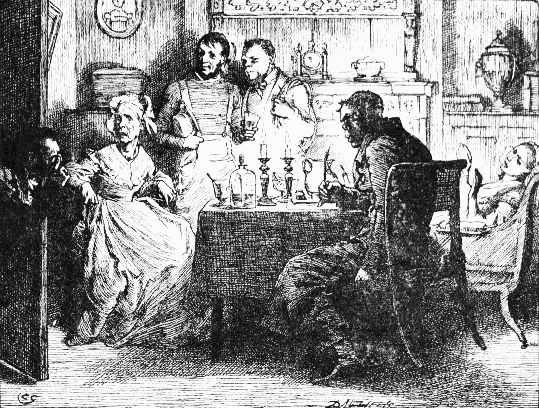
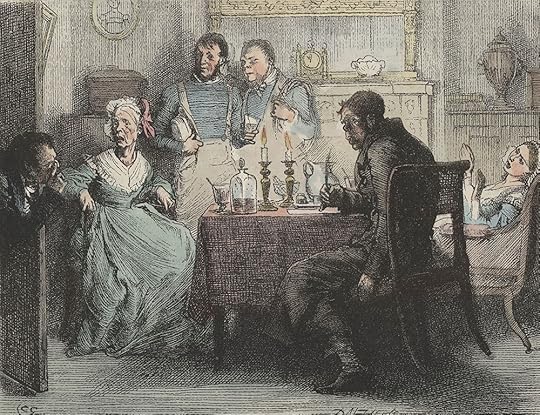
"Aquiline!" cried Quilp, thrusting in his head."
Chapter 49
Charles Green
Text Illustrated:
‘With regard to the descriptive advertisement,’ said Sampson Brass, taking up his pen. ‘It is a melancholy pleasure to recall his traits. Respecting his legs now—?’
‘Crooked, certainly,’ said Mrs Jiniwin. ‘Do you think they were crooked?’ said Brass, in an insinuating tone. ‘I think I see them now coming up the street very wide apart, in nankeen’ pantaloons a little shrunk and without straps. Ah! what a vale of tears we live in. Do we say crooked?’
‘I think they were a little so,’ observed Mrs Quilp with a sob.
‘Legs crooked,’ said Brass, writing as he spoke. ‘Large head, short body, legs crooked—’
‘Very crooked,’ suggested Mrs Jiniwin.
‘We’ll not say very crooked, ma’am,’ said Brass piously. ‘Let us not bear hard upon the weaknesses of the deceased. He is gone, ma’am, to where his legs will never come in question.—We will content ourselves with crooked, Mrs Jiniwin.’
‘I thought you wanted the truth,’ said the old lady. ‘That’s all.’
‘Bless your eyes, how I love you,’ muttered Quilp. ‘There she goes again. Nothing but punch!’
‘This is an occupation,’ said the lawyer, laying down his pen and emptying his glass, ‘which seems to bring him before my eyes like the Ghost of Hamlet’s father, in the very clothes that he wore on work-a-days. His coat, his waistcoat, his shoes and stockings, his trousers, his hat, his wit and humour, his pathos and his umbrella, all come before me like visions of my youth. His linen!’ said Mr Brass smiling fondly at the wall, ‘his linen which was always of a particular colour, for such was his whim and fancy—how plain I see his linen now!’
‘You had better go on, sir,’ said Mrs Jiniwin impatiently.
‘True, ma’am, true,’ cried Mr Brass. ‘Our faculties must not freeze with grief. I’ll trouble you for a little more of that, ma’am. A question now arises, with relation to his nose.’
‘Flat,’ said Mrs Jiniwin.
‘Aquiline!’ cried Quilp, thrusting in his head, and striking the feature with his fist. ‘Aquiline, you hag. Do you see it? Do you call this flat? Do you? Eh?’
‘Oh capital, capital!’ shouted Brass, from the mere force of habit. ‘Excellent! How very good he is! He’s a most remarkable man—so extremely whimsical! Such an amazing power of taking people by surprise!’
Quilp paid no regard whatever to these compliments, nor to the dubious and frightened look into which the lawyer gradually subsided, nor to the shrieks of his wife and mother-in-law, nor to the latter’s running from the room, nor to the former’s fainting away. Keeping his eye fixed on Sampson Brass, he walked up to the table, and beginning with his glass, drank off the contents, and went regularly round until he had emptied the other two, when he seized the case-bottle, and hugging it under his arm, surveyed him with a most extraordinary leer.
Mod
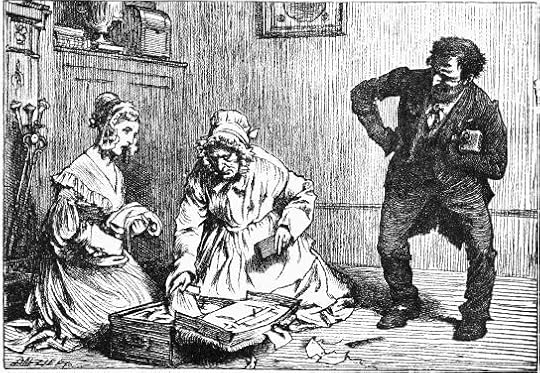
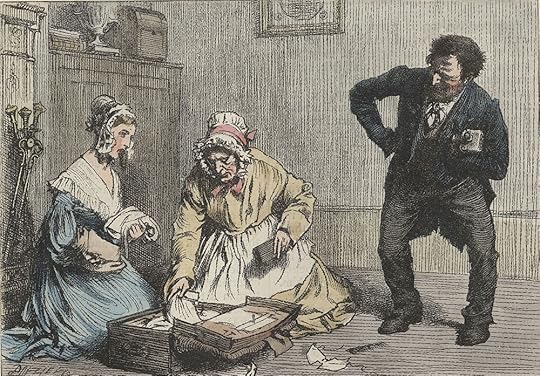
Both mother and daughter, trembling with terror and cold, obeyed
Chapter 50
Charles Green
Text Illustrated:
With these exclamations, Mr Quilp caught up the poker, and hurrying to the door of the good lady’s sleeping-closet, beat upon it therewith until she awoke in inexpressible terror, thinking that her amiable son-in-law surely intended to murder her in justification of the legs she had slandered. Impressed with this idea, she was no sooner fairly awake than she screamed violently, and would have quickly precipitated herself out of the window and through a neighbouring skylight, if her daughter had not hastened in to undeceive her, and implore her assistance. Somewhat reassured by her account of the service she was required to render, Mrs Jiniwin made her appearance in a flannel dressing-gown; and both mother and daughter, trembling with terror and cold—for the night was now far advanced—obeyed Mr Quilp’s directions in submissive silence. Prolonging his preparations as much as possible, for their greater comfort, that eccentric gentleman superintended the packing of his wardrobe, and having added to it with his own hands, a plate, knife and fork, spoon, teacup and saucer, and other small household matters of that nature, strapped up the portmanteau, took it on his shoulders, and actually marched off without another word, and with the case-bottle (which he had never once put down) still tightly clasped under his arm. Consigning his heavier burden to the care of Tom Scott when he reached the street, taking a dram from the bottle for his own encouragement, and giving the boy a rap on the head with it as a small taste for himself, Quilp very deliberately led the way to the wharf, and reached it at between three and four o’clock in the morning.
Mod
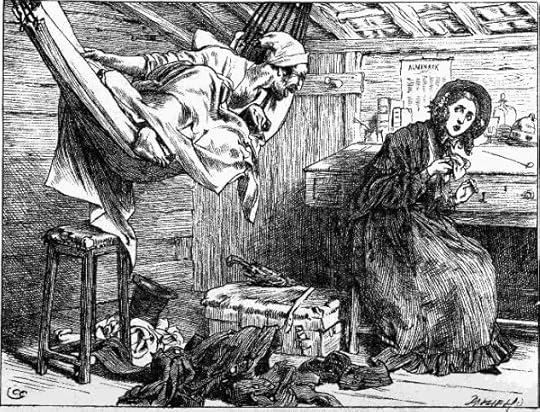
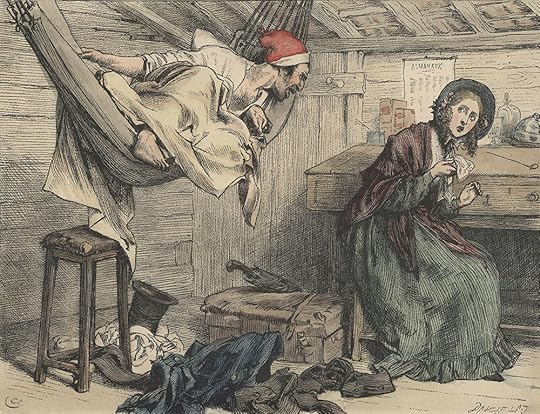
"Halloa!"
Chapter 50
Charles Green
Text Illustrated:
The first sound that met his ears in the morning—as he half opened his eyes, and, finding himself so unusually near the ceiling, entertained a drowsy idea that he must have been transformed into a fly or blue-bottle in the course of the night,—was that of a stifled sobbing and weeping in the room. Peeping cautiously over the side of his hammock, he descried Mrs Quilp, to whom, after contemplating her for some time in silence, he communicated a violent start by suddenly yelling out—‘Halloa!’
‘Oh, Quilp!’ cried his poor little wife, looking up. ‘How you frightened me!’
‘I meant to, you jade,’ returned the dwarf. ‘What do you want here? I’m dead, an’t I?’
‘Oh, please come home, do come home,’ said Mrs Quilp, sobbing; ‘we’ll never do so any more, Quilp, and after all it was only a mistake that grew out of our anxiety.’
‘Out of your anxiety,’ grinned the dwarf. ‘Yes, I know that—out of your anxiety for my death. I shall come home when I please, I tell you. I shall come home when I please, and go when I please. I’ll be a Will o’ the Wisp, now here, now there, dancing about you always, starting up when you least expect me, and keeping you in a constant state of restlessness and irritation. Will you begone?’
Mrs Quilp durst only make a gesture of entreaty.
‘I tell you no,’ cried the dwarf. ‘No. If you dare to come here again unless you’re sent for, I’ll keep watch-dogs in the yard that’ll growl and bite—I’ll have man-traps, cunningly altered and improved for catching women—I’ll have spring guns, that shall explode when you tread upon the wires, and blow you into little pieces. Will you begone?’
‘Do forgive me. Do come back,’ said his wife, earnestly.
‘No-o-o-o-o!’ roared Quilp. ‘Not till my own good time, and then I’ll return again as often as I choose, and be accountable to nobody for my goings or comings. You see the door there. Will you go?’
Mod
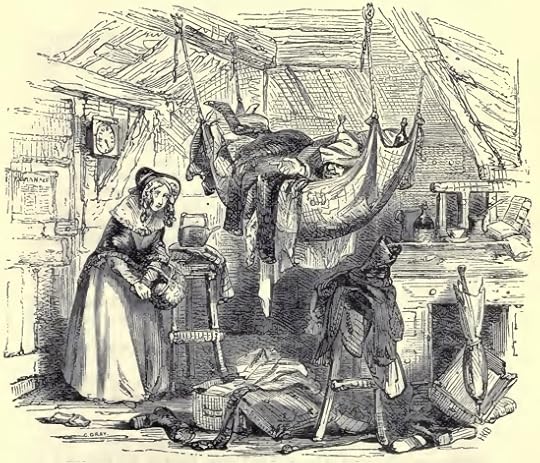
Mrs. Quilp visits Bachelor's Hall
Chapter 50
Phiz
Text Illustrated:
The first sound that met his ears in the morning—as he half opened his eyes, and, finding himself so unusually near the ceiling, entertained a drowsy idea that he must have been transformed into a fly or blue-bottle in the course of the night,—was that of a stifled sobbing and weeping in the room. Peeping cautiously over the side of his hammock, he descried Mrs Quilp, to whom, after contemplating her for some time in silence, he communicated a violent start by suddenly yelling out—‘Halloa!’
‘Oh, Quilp!’ cried his poor little wife, looking up. ‘How you frightened me!’
‘I meant to, you jade,’ returned the dwarf. ‘What do you want here? I’m dead, an’t I?’
‘Oh, please come home, do come home,’ said Mrs Quilp, sobbing; ‘we’ll never do so any more, Quilp, and after all it was only a mistake that grew out of our anxiety.’
‘Out of your anxiety,’ grinned the dwarf. ‘Yes, I know that—out of your anxiety for my death. I shall come home when I please, I tell you. I shall come home when I please, and go when I please. I’ll be a Will o’ the Wisp, now here, now there, dancing about you always, starting up when you least expect me, and keeping you in a constant state of restlessness and irritation. Will you begone?’
Mrs Quilp durst only make a gesture of entreaty.
‘I tell you no,’ cried the dwarf. ‘No. If you dare to come here again unless you’re sent for, I’ll keep watch-dogs in the yard that’ll growl and bite—I’ll have man-traps, cunningly altered and improved for catching women—I’ll have spring guns, that shall explode when you tread upon the wires, and blow you into little pieces. Will you begone?’
‘Do forgive me. Do come back,’ said his wife, earnestly.
‘No-o-o-o-o!’ roared Quilp. ‘Not till my own good time, and then I’ll return again as often as I choose, and be accountable to nobody for my goings or comings. You see the door there. Will you go?’
Mr Quilp delivered this last command in such a very energetic voice, and moreover accompanied it with such a sudden gesture, indicative of an intention to spring out of his hammock, and, night-capped as he was, bear his wife home again through the public streets, that she sped away like an arrow. Her worthy lord stretched his neck and eyes until she had crossed the yard, and then, not at all sorry to have had this opportunity of carrying his point, and asserting the sanctity of his castle, fell into an immoderate fit of laughter, and laid himself down to sleep again.
 Mod
Mod
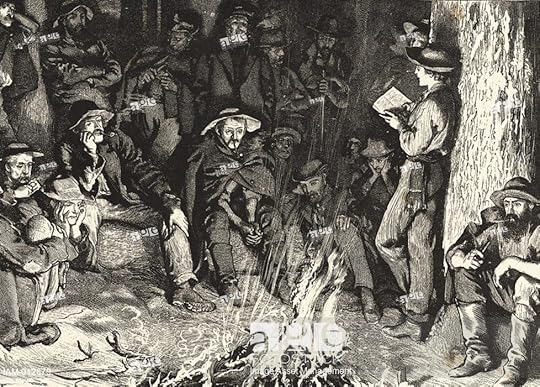
I can't find who the artist is, it says this under the illustration:
Listening to The Old Curiosity Shop in the West. Illustration for Bret Hart's poem 'Little Nell', based on a popular anecdote . When Charles Dickens' book was published in serial form in 1841 boats arriving in New York were beseiged by people wanting the next episode and it was then passed westwards.
Do you see Tristram? People couldn't wait to see what happens to Little Nell each week.
Mod
Mary Lou
No worries. Like many Dickens characters who are not in all the chapters we know you will be returning soon.
Mod
Chapter 46
George Cattermole
Text Illustrated:
‘See—here’s the church!’ cried the delighted schoolmaster in a low vo..."
How interesting. I love the anecdote about the links between Dickens and Cattermole. He sounds like a very interesting person.
Mod
Chapter 50
Charles Green
Text Illustrated:
The first sound that met his ears in the morning—as he half opened his eyes, and, finding himself so unusually near the ceiling, entertained..."
The black and white version of this illustration is much more effective. It is more somber, brooding, and disquieting. Besides, who can really think Quilp would have a hat like Santa’s.
 Peter wrote: "Who cannot cheer the marriage of Mrs Jarley and George?"
I'm very attached to Mrs. J and glad she didn't turn out to be a villain. Also I felt bad for Nell that she was leaving so abruptly without explanation (and really, why? Maybe there was some stated reason but I can't remember--surely Mrs. J deserved a little trust?)--leaving Mrs. J maybe thinking her deceptive or ungrateful, so I'm glad to find Mrs. J generous-hearted enough that this was not the case.
As for the mysterious graves in the graveyard? Yawn. I have a feeling we are headed for an Oliver Twist ending where there is a TON of plot wrapped up in the last chapter and we can't really even care about it because it's sort of too late for it to matter.
I'm pleased though to see the crowd defaulting to my own assumption that the single gentleman (and what a perfect character name--I will be sorry when he gets a real one) is Nell's father, even though I do feel this makes it less likely that we are right.
I s'pose her real father is in one of the graves in the graveyard, and her mother in the other.
Yawn.
Mod
Mary Lou,
I hope your reasons for being not as active as usual are not too worrying. I wish you all the best and am looking forward to having you back again in your old form!!!
Mod
Strange to say, but I find myself gifted with a lot more patience in that respect.
Mod
I'm very attached to Mrs. J and glad she didn't turn out to be a villain. Also I felt bad for Nell that she was leaving so ab..."
I can understand your giving in to the soporific effect of Little Nell and her once more feeling drawn to a churchyard, Julie. I must say that I am enjoying most of this re-reading of TOCS, however, but that is entirely because of Dick, Kit and the Brasses. I forgot how funny they were.
Mod
You are absolutely right, Peter. No one can create minor characters so full of life and life's whims. It is remarkable that even after a couple of years one can still vividly remember certain scenes in which these minor characters were involved or some phrases they'd often use, such as "Barkins is willing". On the other hand, if you take a writer like Trollope, you find his characters very life-life and full of nuances but will have trouble remembering their names after a couple of years.
Tristram wrote: "Peter wrote: "Is there any writer who has created more memorable minor characters? I don’t think so."You are absolutely right, Peter. No one can create minor characters so full of life and life's..."
I do feel I'll remember the doctor for a while!
Tristram wrote: "Mary Lou wrote: "Apologies for not being as active this week. Life is hectic just now, and I'll probably be quieter than usual for the next several weeks. But I'm still here, still reading, and sti..."Yes, Mary Lou, hope things are ok, and looking forward to having you back!
Thanks to everyone for your concern and good wishes. My daughter and her family are moving overseas in a week and a half. Their house here has sold, so they've moved in with us in the interim. As their future accommodations come furnished, most of their worldly possessions have moved in with us as well. It's a bit chaotic, as you might imagine. Having an older dog convalescing from knee surgery, along with a puppy, a toddler, and two extra adults in the house is exhausting. Calgon, take me away!
Mod
Mary Lou
Deep breaths my friend. You are super-busy. I hope all goes well with your daughter’s move. Having moved across the country this year was quite the experience for my wife and myself. I cannot even begin to imagine what moving overseas both with and without some furniture would be like. Yikes!
You are one strong woman.
Mod
Mod
Mod
Strange to say, but I find myself gifted with a lot more patience in that respect."
There should be a "grump" posted around here somewhere, but since I don't see one, here goes:
Grump.
 Tristram wrote: "Dear Curiosities,
This week we are once again given the opportunity to keep tabs on Kit, his mother, the single gentleman and Dick Swiveller, and last not least, on Quilp – although Chapter 46, of..."
Thank goodness for the angels in this story, the schoolmaster coming to her rescue…what were the odds of that? I did wonder what Grandfather would have done had Nell fainted, nobody else around to help her. He probably would have cried and then scoured her pockets for any loose change. SMH!
I don’t know about you, but I for sure was wondering why anyone should offer a good position like that to such an obscure and modest man like our schoolteacher.
I was right there with you thinking the same…why him, how would he have had the outreach? I didn’t think it believable, but then I thought I was being too modern day reader about it. Perhaps, this was just a simple way to connect him further into the story, which would seem believable considering this novel is one big experiment on Dickens’s part?
Why would Little Nell feel so fascinated by those two small dwellings?
Nell is unlike any child that I have read about in literature, she’s an adult forced into a child’s body wearing doll-like clothes; although she wilts quickly around the more overbearing personalities, initially; she does remain steadfast and perseveres in one way or another.
And why is the girl drawn to the graveyard once again?
What I was trying to convey above was that an ordinary child would be scared of and veer away from such places; but, Nell on the the other hand is drawn to the graveyard, as you have stated. I don’t like saying this, but, it’s almost as if she finds peace in it…as a resting place…a final resting place.
What on earth is wrong with Little Nell?
I think Nell has been forced: to grow up too quickly and to bear too many responsibilities at too young an age. She’s tired, body, mind and soul.
During the journey, Mrs. Nubbles grows rather afraid of the single gentleman because of all the peculiarities of manner he evinces…at times remembering his fellow-traveller’s comfort for all his impatience of meeting the wayfarers, takes recourse to rather odd measures such as inducing Kit’s mother to drinking lots of brandy-and-water against the cold or of ordering all the food one inn can provide and drawing the conclusion that the woman must be ill for she does not eat it all at once. He also offers to be godfather to Mrs. Nubbles’s baby.
I actually laughed a lot more in these chapters than I have in previous chapters. What she considered peculiarities read to me to be humorous. It appeared they were just out of sync with one another, him being too nice and she finding it all overbearing? I was left unsettled by him wanting to act as Godfather to her baby. That was another weird moment, similar to the schoolteacher getting the position he did. Is it normal for a stranger to be the Godfather to someone’s child…was as random an act as was depicted in this scene?
Quilp making faces at Mrs. Nubbles on their way back home… wasn’t that infantile? Well, a lot of what he does is infantile, in general.
Chapter 49 does not really add a lot to the plot, but it shows Dickens at his best when it comes to creating an oddly humorous scene that could easily be played on the stage.
Absolutely! Mrs. Quilp fainting, Mrs. Jiniwin running out of the room, at the sight of Quilp’s aquiline nose…it’s still funny even imagining it.
Let’s stop for a second and ask ourselves once more what might be the purpose in Dick’s life.
I don’t know what his purpose would be, but have often wondered what would be his turning point in doing some good for once? I thought this would have been that time, but Dick can’t seem to get out from in front of himself, can he?
Mod
This week we are once again given the opportunity to keep tabs on Kit, his mother, the single gentleman and Dick Swiveller, and last not least, on Quilp – althou..."
Hi Ami
You identify many characteristics of Nell that need to be reinforced. Nell is an unusual child to say the least. I too see her as steadfast, mature beyond her years and carrying too many responsibilities for someone of her age. Taken together, she may appear to be too unreal.
Perhaps she is. Yet we must remember that she is a fictional character who may represent something beyond her portrayal. From our 21C first world perspective, she is unbelievable. I think, however, that when we consider the time period she exists in, her life experiences become more believable. Children, especially the children of the poor, never had much of a childhood. While her life at the Old Curiosity Shop was not as grim as being a child working in a mine, or being a mud lark in the Thames, or begging on the streets of London, she does represent the underclass of society. In Nell, Dickens created an ideal. To believe that a child was incapable of acting as an adult, being as responsible as an adult, or not being capable of reflecting on the issues of death is underestimating the strength and abilities of children.
Yes, she is perhaps (don’t read this next part Kim) too good, but to quote Robert Browning “man’s reach should exceed his grasp or what’s a heaven for.”
Mod
Mod
Mod
Sure, I could prepare myself for the shock that would cause.
Mod
Mod
Mod
Mod
In Barnaby Rudge I am finding more illustrations of Dolly Varden than any other character, even Barnaby. I don't remember her being all that interesting but it's been awhile since we read it.
Mod
In Barnaby Rudge I am finding more illustrations of Dolly Varden than..."
May I begin my grumbling about BR now? Perhaps wait. As to Dolly Varden. Dare I compare her to Marilyn Monroe? Perhaps that should wait as well ... :-)
Mod
Mod
Mod


This week we are once again given the opportunity to keep tabs on Kit, his mother, the single gentleman and Dick Swiveller, and last not least, on Quilp – although Chapter 46, of course, takes up the scene where it was left at the end of the preceding chapter, in quite a cliff-hanging kind of way, i.e. with Little Nell. All in all, it is interesting to see how Dickens takes care of following the different strands of the story, giving us information on Nell and her Grandfather’s odyssey, on Quilp and the single gentleman who both seem to have an interest in retrieving the wayfarers, and on Dick Swiveller and the Brasses as well as on Kit. It must have been very difficult for the author to balance all those various story-lines.
To our surprise, at the start of Chapter 46, we learn that the reason for Nell’s shrieking and fainting at sight of the stranger’s face is the fact that this stranger is no stranger at all but the poor schoolmaster we left a few chapters ago. What happens now between the schoolmaster and the grandfather is quite interesting:
I underlined some passages here, which I found telling in a clever way. Obviously, the schoolmaster takes in at first sight what the grandfather, who had been at Nell’s side, has so far failed to notice, namely that the girl is at the end of her rope. The schoolmaster further puts the blame on the old man, saying that he has used her powers too much, which might also be interpreted in a figurative way, i.e. the old man has put all the responsibility on the young girl instead of behaving like an adult. Note the “half-reproachful and half-compassionate” look the schoolmaster gives the old man; in this he seems to express the same feelings our first-person narrator could not help voicing in one of his early conversations with the grandfather. One difference may be, however, that the schoolmaster realizes the dependence of the old man on his grandchild, and that he pities the man for this dependence. But still, the reproach in his look is probably based on the opinion that it should be the elder who takes care of the child, and not the other way around, and that there is some modicum of egocentrism in the old man’s behaviour.
The grandfather’s words can be taken at face value, implying that the journey proves too much of a strain on Little Nell, but they can also be read – at least that’s what I think – as a justification of his gambling: “Want” can be seen as the poverty the grandfather tries to extract Nell from by making a quick buck at the card table.
We then witness how Little Nell is taken to a roadside inn, where everyone tries to help her or at least to get a glimpse of her and of how other people try to help her. The narrator lets some light comic relief make its way into the scene when he says,
In this, Dickens once more shows himself a very astute observer of human nature, and he crowns this witty description with a doctor who takes great care to recommend remedies he knows will find favour with the crowd surrounding him, whose members will therefore think him “a very shrewd doctor indeed”. – Why, do you think, Dickens inserts some humour at this juncture? After all, Little Nell has just broken down under the constant strain she had to put up with, and still here we have quite a funny episode with the doctor and the crowd.
Little Nell finally gets better by degrees, and it is now time for the schoolmaster, and the narrator, to throw some light on why they could have met him on the road. We learn that he has been offered the position as a schoolteacher and town clerk for 35 £ a year. That is why he is on his way into that town, walking all the way because he still has the leisure to do so. – I don’t know about you, but I for sure was wondering why anyone should offer a good position like that to such an obscure and modest man like our schoolteacher. Has he ever applied anywhere? Why else should he have come to anyone’s notice? He seemed to be buried in that little village and in his grief for his favourite pupil, and now suddenly we learn that the world wants more of him? Is this plausible?
The good thing is that the schoolmaster now makes sure that Little Nell, who after recovering, told himtheir whole story (including the grandfather’s addiction to gambling, unless I am mistaken), can continue her journey with them – he simply hires a place on a waggon. According to Daniel Pool, What Jane Austen Ate and Charles Dickens Knew, a waggon was
This latter detail also explains why the Grandfather and the schoolmaster can keep pace with that vehicle on foot. It is in this manner that they finally arrive at the schoolmaster’s destination, and it does not take long before Little Nell once again seems to be drawn, among all the marvels and the beauties the town has to offer, to a churchyard:
Why would Little Nell feel so fascinated by those two small dwellings? And why is the girl drawn to the graveyard once again? What on earth is wrong with Little Nell?