
The Evolution of Science Fiction discussion
Group Reads 2019
>
May 2019 - Star Maker
date newest »
newest »
message 1:
by
Jim
(new)
May 01, 2019 03:40AM
 One of May 2019's group reads is Star Maker by Olaf Stapledon.
reply
|
flag
 I will lead the discussion as promised because I initially suggested the book.
This is my second book by Olaf Stapledon, the first being his famous Last and First Men: A Story of the Near and Far Future (1930)
His sub-genre of SF is quite bizarre: it is written like a mix of memoirs and a textbook, dialogues are almost absent and readers face wall of text, which frightens many. Be brave, for in each of his book there are ideas for many volumes!
 Mod
I finished the book recently but still processing it. It has a wealth of ideas for the whole library. Also the last part can be seen as a religious philosophy, but it isn't forcing any established creed. Instead it creates anti-thesis to Nietzsche's god is dead with, you are as good as dead for the god, and there is nothing you can do
Mod
I finished the book recently but still processing it. It has a wealth of ideas for the whole library. Also the last part can be seen as a religious philosophy, but it isn't forcing any established creed. Instead it creates anti-thesis to Nietzsche's god is dead with, you are as good as dead for the god, and there is nothing you can do
 Is that a spoiler, since you say it's the "last part" - ?
Cheryl wrote: "Is that a spoiler, since you say it's the "last part" - ?"
Is that a spoiler, since you say it's the "last part" - ?
Cheryl wrote: "Is that a spoiler, since you say it's the "last part" - ?"I don't think it is a spoiler, it is more akin to 'in last past of the mystery novel the sleuth racers trying to catch the murderer' - spoiler is murderer's name.
But if you say so, I may put it in spoiler tags, no prob
Mod
I've read chapters 1-4 so far. I reminds me of many other stories. Like in The House on the Borderland, the main character goes traveling into a strange place, but doesn't know how he did it. Like At the Mountains of Madness (which we are also reading this month) there is the theme of a vast universe where human life is nothing particularly special. Like We Are Legion (We Are Bob), there is a lone human intelligence exploring the cosmos with only himself to talk to (until late in Chapter 4 where it becomes two intelligences). It is nowhere near as 'fun' as the 'Bobiverse' books, but it is good and I hope others join me in reading it.
I had the idea that early SF was mostly adventure stories about men in rockets shooting aliens. I'm happy to learn that more thoughtful, reflective books were also being written early.
Ed wrote: "It is nowhere near as 'fun' as the 'Bobiverse' books, but it is good and I hope others join me in reading it."I agree, Stapledn's books are a bit dry, more to show his concepts and argue points (in the first aliens he meets there are a lot of allusions or race and class warfare, rise of 'the strong leader')
Ty. I do plan to read this, but it may not be for a few weeks.
Mod
Some interesting speculative evolution on other planets. Like, what if some creature could evolve to be like living sailing ships. Cool idea. I've seen the idea of living spaceships, but living sailing ships is a new idea to me.
O.Z. wrote: rise of 'the strong leader'.
And he said something about how that tendency was even more apparent in 'democratic' countries. A few years ago I might have argued that democracy reduces the likelihood of that sort of leader. But now I'm not so sure. (I am not thinking only of the USA by the way.)
Ed wrote: "I'm around chapter 6 or 7 now. Boy, there are a lot of ideas in this book! Maybe too many ideas for one book?"His other book I've read it just as filled with ideas.
I lived living sailing ships and the early (earliest?) hive minds and symbiosis species.
As for 'strong leaders' and today, I'd say now we have resurgence of populists, one doesn't expect that say Trump sends his sons to a war or personally lead a suicide attack
Mod
I meant only that they are being voted in as leaders by projecting a tough man image. A few of them are actually tough in person, while others are not.
OK. I will have limited access to a computer this coming week. I'll be back soon.
 DNF at 30%. 5 stars for creativity. But his style doesn't work for me. There is no story, just observations. It is like reading an encyclopedia.
Leo wrote: "DNF at 30%. 5 stars for creativity. But his style doesn't work for me. There is no story, just observations. It is like reading an encyclopedia."
DNF at 30%. 5 stars for creativity. But his style doesn't work for me. There is no story, just observations. It is like reading an encyclopedia.
Leo wrote: "DNF at 30%. 5 stars for creativity. But his style doesn't work for me. There is no story, just observations. It is like reading an encyclopedia."I made a similar remark on his other work 'it reads like old-style history text, that just goes on and on about this and that king or battle'
I played a bit with text mining and used Star Maker as one of test runs. It is not perfect because I used epub linked by Goodreads and it wasn't proofread after OCRing, so some words contain errors, split etc.Here are 1-word and 2-word clouds of most common words/phrases:
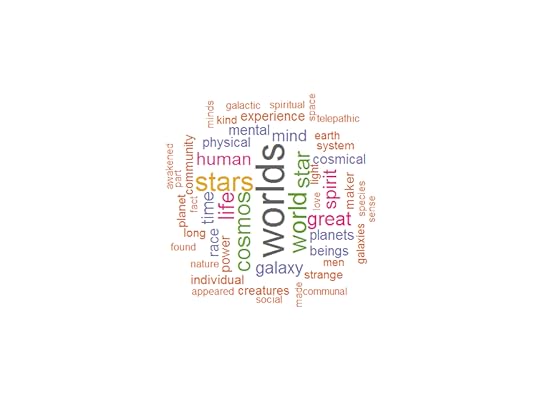

I think they outline themes of the book surprisingly well
Fun exercise! But result discourages me from wanting to read it. I mean, 'communa mind' and 'telepathic intercourse,' 'minded worlds' and 'awakened,' 'strange,' and 'communal' again... ah, maybe not something I'm willing to make time for.
What kind of influence on the development of SF can be found in this?
Mod
Probably lots. But one thing that jumped out at me is the SF of Dorris Lessing. Particularly The Making of the Representative for Planet 8 as well as other books in that series. She has admitted being a fan of "Star Maker", and her series has a similar idea of advanced societies watching and sometimes guiding more primitive ones, and also the idea that the dying of an entire world can be a joyous experience just like the birth of one. It's all good, man! (Everyone on Planet 8 dies. That's not a spoiler. It is revealed early on.) She also describes events as if in an encyclopedia or a business report.
Mod
"A recurring theme in Clarke's works is the notion that the evolution of an intelligent species would eventually make them something close to gods. This was explored in his 1953 novel Childhood's End and briefly touched upon in his novel Imperial Earth. This idea of transcendence through evolution seems to have been influenced by Olaf Stapledon, who wrote a number of books dealing with this theme. Clarke has said of Stapledon's 1930 book Last and First Men that "No other book had a greater influence on my life ... [It] and its successor Star Maker (1937) are the twin summits of [Stapledon's] literary career".
"Cheryl wrote: "What kind of influence on the development of SF can be found in this?"If nothing else, C.S. Lewis hated it, always a plus in my book. I believe he called it the devil's work or something like that, but I'm not sure if that was before or after Stapledon said something about man creating god. He didn't say that in this book, did he? It's been too long since I read it to remember. I think it was something he said later, although I believe the idea is there in this book - cosmic consciousness & evolution to godhood, if not in those words. I remember hating the book (dry as dust) but I found the lectures that the teacher gave on it really interesting.
It's one of the first works to take SF on the galactic scale, second only to his previous book, I believe. It was also influential on many great authors afterward. Both Clarke & Asimov used it as an inspiration for far better works, IMO. The cosmic mind idea is obvious in Childhood's End. Asimov said it was a prime inspiration for his Foundation series. Stapledon is supposed to have influenced Star Trek's Prime Directive in here as well describing the Dyson Sphere & more. Lots of great ideas.
 I have read about a third of the book and find it fascinating, but I can only take in so much information in a day. The alien planets he mentally visits have an interesting array of life forms.
Mod
I have read about a third of the book and find it fascinating, but I can only take in so much information in a day. The alien planets he mentally visits have an interesting array of life forms.
Mod
I agree. It is necessary to do it a few chapters per day. Otherwise, it is just too much.
In the chapter "Intimations of the Star Maker", the narrator gives their search a new name-their pilgrimage, even if they don't know exactly what they are seeking yet.
Cheryl wrote: "Fun exercise! But result discourages me from wanting to read it.
What kind of influence on the development of SF can be found in this? "
The 'supernatural' parts of the story like telepathic communications fit well within the storyline, so do not be discouraged. As for influence, definitely the most significant (self admitted) was on Arthur C. Clarke
Jim wrote: "Stapledon said something about man creating god. He didn't say that in this book, did he?"Not in this book. in this one (view spoiler)
A lot of the chapters in this book could be used as inspirations or blueprints for novels. This book reads like a textbook, it has such a matter-of- fact way of talking about the most unusual happenings.
 Rosemarie wrote: "This book reads like a textbook, it has such a matter-of- fact way of talking about the most unusual happenings."
I read this a while back and didn't much care for it. Here's my review, FWIW:
https://www.goodreads.com/review/show...
Rosemarie wrote: "A lot of the chapters in this book could be used as inspirations or blueprints for novels. This book reads like a textbook, it has such a matter-of- fact way of talking about the most unusual happe..."exactly my attitude
I finished the book today. I found it dragged at times, since the book was basically a description of his vision. He did raise some interesting ideas, but his prose was uninspired at times. As I said earlier, this book contains material for many novels.
 I plan to read this, but I just don't think I have the energy right now from the descriptions above, particularly after plowing through At the Mountains of Madness. One seriously wordy book a month is probably my limit.
 I have only read the opening scene where he is bemoaning his mundane life. I will try again later, and I appreciate this group for reading the earlier works of SF. I always say I will, but then I don't. Now you all are helping me to read some! So thanks. I wish I had found this group earlier
Mod
And some of it is still fun to read! (Though people will disagree over which ones.)
 This was such a chewy read, some bits went down well, some were a bit hard to swallow and a few were indigestible.
 As many have said, a whole raft of ideas somewhat haphazardly thrown together. Overall I read it as a sort of cosmic roadtrip in search of the answer to the question "was mankind of no more importance in the universal view than rats in a cathedral?" And I think it turned out that was pretty much true; individuals who suffered were simply red shirts included to spice up the plot or as the book more eloquently puts it, "misery.. was but a few dark strands woven into the golden tapestry."
Mod
I'd like to see what he wrote about it, but I can certainly see him being put off by some parts. In section 5, the main character finally encounters the "Star Maker", who is basically God. But this god has created many, many different universes (or multiverses?). In one of them there are three separate realms (or separate universes?): one is a heaven, one is a hell, and the creatures who live in the third realm get sent to one or the other after they die depending on what they've done while alive. The point-of-view character views that situation as morally very wrong. So, you could interpret this part of the book as saying that Christian theology is morally wrong.
Mod
"One night when I had tasted bitterness I went out on to the hill." Then he stares up at the sky and gets lost in his own thoughts. "Imagination completed what mere sight could not achieve. ... Imagination was now stimulated to a new, strange mode of perception. ... I was probably not dead, but in some sort of trance from which I might wake at any moment."
So, he takes some bitter tasting drug, lies down and looks at the stars. I mean really looks at them, man!
LOL, Ed!"I mean really looks at them, man!" But no, this book was NOT written in the sixties. I guess it fits, though. From the little I read
Of course we remember that hallucinogenics have a longer history than SF or even the printed word. One of my favorite examples is the story behind the poem of Kubla Khan, but there have even been proto- speculative fiction stories using altered states of consciousness to travel not only space but time. (Sorry I can't recall the examples that I'm thinking of right now, but I'm sure many of our talented members could research them in a twinkling and hopefully some of them will do so... ;)

The Evolution of Science Fiction
Books mentioned in this topic
Kubla Khan (other topics)At the Mountains of Madness (other topics)
Childhood’s End (other topics)
The Making of the Representative for Planet 8 (other topics)
The House on the Borderland (other topics)
More...
Authors mentioned in this topic
Arthur C. Clarke (other topics)Olaf Stapledon (other topics)
Olaf Stapledon (other topics)