
Old Books, New Readers discussion
Through the Ages Challenge
>
Christy - Captain
date newest »
newest »

Centuries:
√Ninth - The Thousand and One Nights
√Tenth - Hrotsvitha
√Eleventh - Shahnameh
Twelfth - Arthurian Legend/Romances
Thirteenth - Prose & Poetic Edda
Fourteenth - The Divine Comedy
Fifteenth - La Celestina
Sixteenth - William Shakespeare
Seventeenth - Don Quixote
Eighteenth - Candide
Nineteenth - Gothic Fiction
Twentieth - Literary Criticism/Globalization
Skips:
One
Two

Crystals:




(radiowest.kuer)The Thousand and One Nights is a collection of Indian and Middle Eastern stories. There is still an ongoing debate on when the stories originated or who it's author/s are. This is a common occurrence with early century stories as they were often told orally through generations. The first book and most well known of the collection is titled "Arabian Nights". According to sources, it has been in circulation since the Ninth century. There was no known manuscript in Arabic until the Fourteenth century. It was not published in English until the Eighteenth century. The collection's stories are put within a frame story around King Shahryar. The stories are told through his wife in order to survive the night and avoid execution. Aladdin, Sindbad and Ali Baba are the most well known stories from the collection.

Complete all 4 tasks to move to the next century:
1) Read tales from 1001 Nights (include page counts/must add up to a minimum of 100 pages)
2) Read a book that was originally published in another language.
3) Read a book set in the Middle East.
4) Read another book written or published in the 9th century OR a classic book with 9 in the publication date.
Congrats you made it and found a Sunstone!

Hrotsvitha, nun of Gandersheim, is classified as the first female German poet. Her name, as she herself attests, is "strong voice" in Saxon. Some consider her to be the first dramatist/playwright since ancient times. Hrotsvitha desired her works to "counteract the pagan morality expressed in classical works". All of her original works were written in Latin as taught by the monastery. During her lifetime, Hrosvitha categorized her works into three sections: Book of Legends, Book of Drama, and Epics. The Book of Legends contained eight legends: Ascensio, Gangolf, Pelagius, Theophilus, Basilius, Dionysius, Maria & Agnes. Theophilus is hypothesized to be the most famous. The legend describes a young archdeacon who consults a Jewish sorcerer about his disappointed promotion. A dark journey ensues soon after. The Books of Drama include six plays that are believed to be written around 960. The plays are Gallicanus, Dulcitius, Callimachus, Abraham, Pafnutius & Sapientia. During the Tenth century, the Christian church looked down upon drama and theater under the advise of the Roman Empire. Hrotsvitha turned to drama as a means of promoting Christian ideals such as chastity, poverty and obedience. Thus re-inviting the Roman Empire and Christianity back into the art form. The two historical stories included in the Epics (the Gesta Ottonis and the Primordia coenobii Gandeshemensis) have been lost.
Complete 4 tasks to move to the next century:
1) Read a play from the Book of Dramas or a legend from the Book of Legends.
PDF of Hrotsvitha's Work
2) Read a book by a German author.
3) Read a book with a church on the cover or in text. (Cite passage)
4) Read another book written or published in the 10th century or read a book with 1 & 0 in the page count.
Christy wrote: "My copy of Oliver Twist is from Barnes and Noble, but I can't get the cover to copy here."Do you have the ISBN? I cant find the version you are talking about.
Congrats you made it and found a Lapis Lazuli!

(huffingtonpost)
The epic of Shahnameh by Abu ʾl-Qasim Firdowsi Tusi describes the history of pre-Islamic Persia. The title translates to The Book of Kings. The stories center around fifty Persian Kings, hence the title. According to the Library of Congress, it includes "62 stories, told in 990 chapters with 50,000 rhyming couplets." The collection is divided into three parts. The first is the mythical, the second heroic and third is historical. Regarded as a literary masterpiece by Persian natives because it embodies the national identity. It reflects Iran's history, cultural values and ancient religions. The author published Shahnameh in 1010 when the nation's independence was compromised. This piece of work even effected modern Persian language a thousand years later. Experts believe it was due to surviving works such as Shahnameh with it's profound cultural influence that effected how the language was preserved and developed.
Complete 4 tasks to move to the next century:
1) Read a book whose both author's initials can be found in: BOOK OF KINGS
2) Read a book or anthology of poetry.
3) Read a book that features royalty.
4) Read another book written or published in the 11th century or who has 11 in the page count.
 Christy wrote: "task two
 book read- The Trial by Franz Kafka 133/133 pages
date read- finished July 5, 2019
task- read a book by a German author
explain how it fits- Kafka was German"
Kafka wasn't German. He was a German-speaking Bohemian. He was born in Prague, the capital of the Kingdom of Bohemia, then part of the Austro-Hungarian Empire, today the capital of the Czech Republic. ;)
But you're doing very well!
Congrats you made it and found Citrine!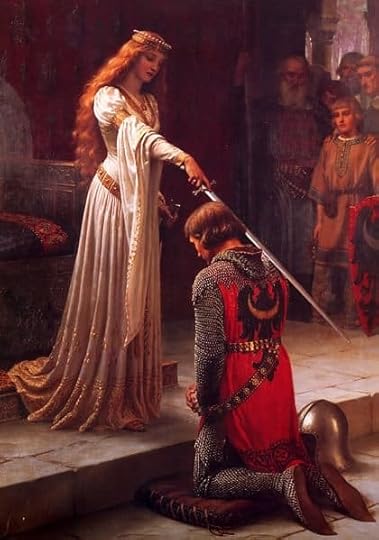
(kxcdn)
Twelfth century literature was dominated by a central character, King Arthur. Known as the Arthurian Legend began with Geoffrey of Monmouth’s 1138 work History of the Kings of Britain. Monmouth's work described the entirety of Britain's history from the seventh to twelfth century. With this increasing interest brought about the Arthurian Legend which are divided into three parts - Camelot, Age of Chivalry, and Songs of Deed. Three other authors are credited to these stories - Robert de Baron, Sir Thomas Malory & Chretien de Troyes. Within the Arthurian Legend one can find the Arthurian romances which birthed the genre of courtly romance. These stories combined Christian, Muslim and Celtic elements. Chretien de Troyes is considered the genre's founder with "Erec and Enide" published in 1160. He would go on to write four more works including the infamous romance between Lancelot and Guinevere. Not only did his works include Arthur like the others, but it included other members of his court.

Complete 4 tasks to move to the next century:
1) Read any of the Arthurian Legend stories.
2) Read a book whose title begins with a letter found in: TROYES
3) Read a French Romance novel.
4) Read another book published in the 12th century or read a book that has 12 in the page count.

*Challenge inspired by Love of Books Group Challenges*