
Art Lovers discussion
date newest »
newest »

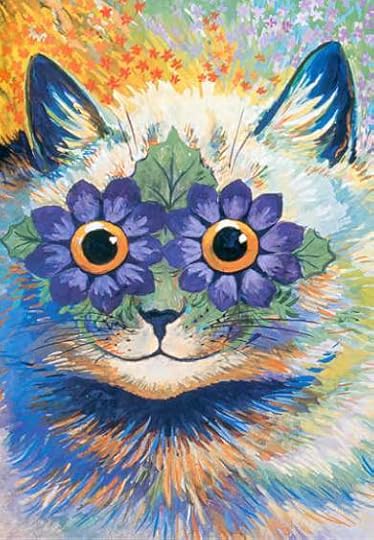
Louis Wain
anthropomorphic cat painting
A popular London commercial artist obsessed with cats, Wain was permanently hospitalized for mental illness in 1924. That his paintings became increasingly hallucinatory and abstract has been attributed to worsening schizophrenia.
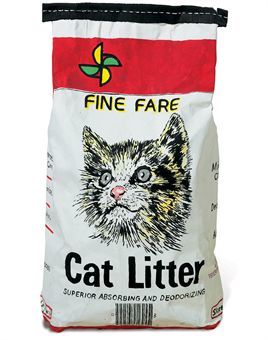
Robert Gober
Untitled
1989
Gober’s angry metaphorical sculpture consists of two bags of cat litter and an empty wedding dress standing in a room decorated with wallpaper. Its repeated motifs are a sleeping white man and a lynched black man. The litter signifies America’s attempt to deodorize a history founded on racism and the fallacy of white heterosexual purity.
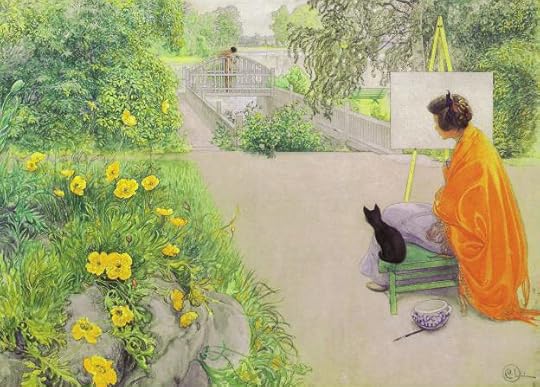
Carl Olof Larsson
The Bridge
1912
The focal point of the Swedish artist’s mysterious watercolor is the supple little cat, which peers, as does its mistress, at the male figure on the bridge. An invisible thread connects the cat’s black coat to the dark head of the man; one expects the cat to tug it, drawing the man’s attention to the woman who had, perhaps, sat down to paint the bridge in solitude.
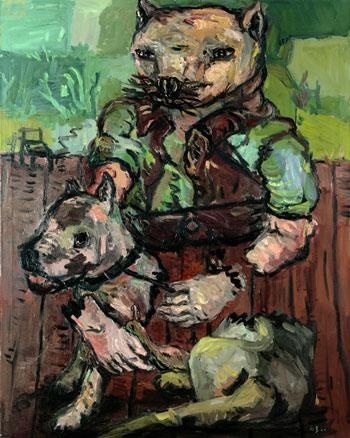
Georg Baselitz
Cat Head
1966-1967
Baselitz’s brutish humanoid cat dominates a smaller dog, from which it is separated by a fence. This typical inversion by the figurative expressionist-cum-postmodernist painter is both a commentary on ruined post-Nazi Germany and conflicting artistic movements within the divided country.
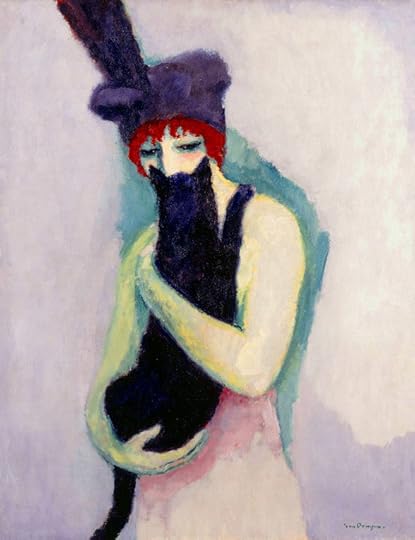
Kees von Dongen
Woman With Cat
1908
This painting by the Dutch Fauvist is distinguished by its juxtaposing of delicate colors, its serenity, and its wit. The position in which the woman tenderly holds the cat renders her almost androgynous. The bow-like curve of the cat’s tail, its long body, and the woman’s headpiece harmonizes all the elements.
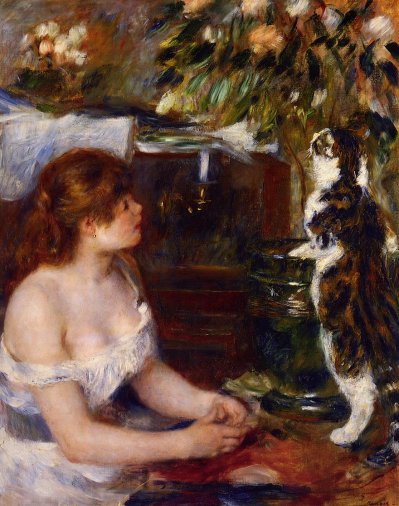
Pierre-Auguste Renoir
Girl and Cat
1880-1881
Most of Renoir’s paintings featuring females and felines are supine, like those of Berthe Morisot and Mary Cassatt. This one is the most vital. Something in the flowers has made the cat rear, mildly alerting the girl to its erect posture. The balance between indifference and inquisitiveness is perfectly weighted.
https://news.artnet.com/art-world/10-...
I just found this for your gee whiz collection (this might not be the only answer):What do cats symbolize in art?
As for symbolism, cats are symbolic of rebirth and resurrection, per their nine lives. Because they are nocturnal, they are also associated with darkness. Darkness often goes with fear, the unconscious, and things that are hidden.
More cat symbolism http://www.pure-spirit.com/more-anima...Cats have been both feared and loved throughout history by many different cultures. Some Native Americans, for instance the Oglala, would not have anything to do with any felines because they believed that cats had powerful magic and the ability to curse people. However, the Egyptians had great reverence for cats. They had multiple cat goddesses, including Bast, Sekmet (goddess with the head of a lioness), and Mafdet (goddess having come before Bast, who represented feral Egyptian cats). Each of these gods is female, which supports the association many have between cats and women. Cats are also associated with female medicine. Cats were domesticated in Egypt around 2100 BCE for the purpose of hunting.
The Celts also had a fondness for felines, associating them with their goddess Brighid. In this case, cats were representative of friends and companions, much like dogs are thought of. The Celts saw certain qualities in cats, like sensitivity and stealth, and attempted to copy them. Cats are strongly associated with magic, and appropriately, Druidic priests would use cat magic so that they would be able to cross between the spiritual and physical worlds.
There were societies like the Oglala who weren’t so fond of cats. Christianity turned these positive traditions with cats upside-down by connecting cats with Satan, witches, evil, and any other negative things that came to mind. Cats were seen as accomplices and often hung with their masters when convicted of heresy. The Pilgrims shared these opinions of cats when they came to the Americas, and thus our society has many superstitions about cats, for instance that black cats are unlucky or are ill omens. In Britain and Ireland, they believe black cats are actually lucky, even selling little black bog cat statues for good luck.
 now, without even looking at the title, how could I have possibly known it was a koons. Kitschy, kitschy, koo.
Yep! It was the first picture in the article and I didn’t know they were ‘famous’ art works at first. I thought they were more like toys or something. He’s just awful.
now, without even looking at the title, how could I have possibly known it was a koons. Kitschy, kitschy, koo.
Yep! It was the first picture in the article and I didn’t know they were ‘famous’ art works at first. I thought they were more like toys or something. He’s just awful.

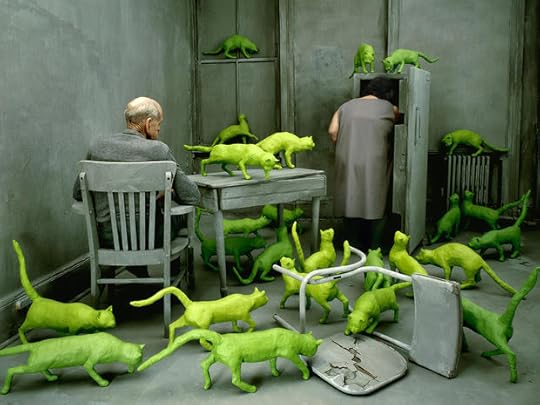
Sandy Skoglund is an American photographer and installation artist known for her Surrealist, brightly colored images. Often featuring elaborate tableaux of animals and posed human actors, one of her most famous work is 1980s Radioactive Cats, which depicts neon-green cats—painstakingly crafted out of chicken wire and plaster—stalking an otherwise drab gray kitchen. She was born on September 11, 1946 in Quincy, MA and graduated from Smith College in 1968 with a degree in art history and studio art. She went on to study at the Sorbonne and École du Louvre in Paris, as well as the University of Iowa. From 1973 to 1976, she worked as a professor of art at the University of Hartford, and then began teaching at Rutgers University in New Jersey. Her works are held in several museum collections, including the Museum of Contemporary Photography in Chicago, the San Francisco Museum of Modern Art, and the Dayton Art Institute in Ohio.
Wow, that is so cool! Thank you for posting that, Ruth!

Jeff Koons
Cat on a Clothesline
1994–2001
nspired by postcards of kittens suspended in socks, Koons sculpted his outsized polyethylene puss for his “Celebration” series. It was structured as a crucifixion to combine spirituality with preschool joyousness.