
Art Lovers discussion
Questions from the Met
>
Painting with Texture
date newest »
newest »
 I read the first question and immediately thought of the book Leaving Van Gogh. I even highlighted this description.
"Look how much paint he used for the lamps.' I reached out and touched one of them gently, a small ridged dome on the canvas" The Night Cafe pg. 45
"A golden pottery vase of sunflowers stood against a cream background. Even in the dim light, the blossoms appeared to be so thick they were almost three-dimensional" pg. 45
Well, I posted this question and kind of left it up in the air. Maybe I need to expound on it? Maybe there isn't enough information to go on? Thinking about texture, I do think more about sculpture. I was thinking about bas relief, also.
Has anyone seen Ghiberti's bronze doors? The doors of the baptistry in Florence, Italy? I'll post a picture of them:
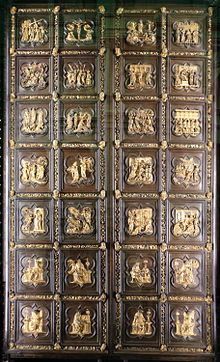
North doors by Lorenzo Ghiberti
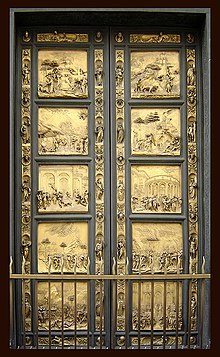
East doors, or Gates of Paradise, by Lorenzo Ghiberti
These are done in bas relief. I've seen them and the bronze is, of course, patinaed by now. But Italians have a lot of superstition. There is one leg that sticks out of one door where, if you rub the leg and make a wish, your wish will come true. You can find that leg easily because it is bright, glistening bronze! The patina is all worn off by the constant rubbing of people making a wish. I had to do it, too, of course!
When I go to an art museum and look close to a painting, I do find myself looking at the brush strokes. In many of the paintings, I find that I don't readily see the strokes go in line with the colors in the paintings. I've always wondered why that is. Can any of you painters, artists here tell me? Is it because there is a layer of gloss or some kind of paste or component that sets the paint that is painted over the whole surface? And that is painted in a circular pattern? It seems this is how the whole of the painting is set. I'm curious to know.I have seen at least one Van Gogh. I saw Irises at the J. Paul Ghetty museum in Los Angeles several years ago. I don't remember what it looked like when I looked closely at it. But I know, as stated above, his paint was very thick. In his time, did he use a sort of gloss or something to set his paint over I can't remember.
 Heather, here's an article on impasto from Wikipedia:
https://en.wikipedia.org/wiki/Impasto
I also love the way Van Gogh adds texture to his paintings using thick applications of paint.
I'm not an artist, but maybe you were thinking about artists varnishing their paintings after their work was completed. It protects their work, but the varnish can darken with age.
Oh! They use varnish? I didn’t know exactly how ignorant I was! I thought varnish was only used on wood! I didn’t know it was used on paintings. I did know they apply something on the paint, I didn’t know how recently that practice came about. Actually, I did know that Leonardo da Vinci experimented with different things he put over his work which some of them didn’t last. As in, wasn’t it on The Last Supper that he used an egg-like mixture on the paint and it made it fall apart more quickly? My memory may be deceiving me here.
So today they use varnish? That must be what I see in the brushstrokes over the paintings I view. Thank you, Connie.
Impasto Painting TechniqueIn fine art, the Italian word 'Impasto' (dough or paste) denotes a painting technique in which undiluted paint is applied so thickly (like toothpaste) onto the canvas or panel (often with a palette knife) that it stands out from the surface. When using this impasto technique, the artist often mixes paint on the canvas itself to achieve the required colour.
Oil painting is most suited to the impasto method, due to the viscosity of oils, their thickness and slow drying time, although acrylic paint or even gouache can be applied in the impasto style. Tempera is too thin to be impastoed without adding bulking or thickening agents
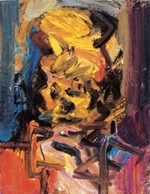
Head of Julia II
(1990) by Frank
Auerbach
German-born artist
famous for his thick impastoed paintings
The impasto painting method offers the artist several advantages.
First, its raised surface causes light to be reflected in new ways that the artist can control. It was used frequently to mimic the broken-textured quality of highlights - that is, the surfaces of objects that are struck by an intense light. Second, expressionists (notably Van Gogh) used impasto to convey feelings and emotion. Third, impasto can convey a three dimensional impression. Baroque painters like Rembrandt, Hals and Velazquez used minutely and painstakingly worked impastos to depict lined or wrinkled skin, folds in robes, or the glint of jewellery. Lastly, the rough texture can draw attention to certain points or aspects of a composition.
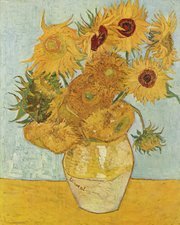
Twelve Sunflowers
(1888) by Vincent Van Gogh
noted for his impasto layers of thick paint
http://www.visual-arts-cork.com/paint...
There are 4 Types of Texture in Art:
Actual

Artists often add real-world textures to their artwork. They use tree bark or sandpaper to illustrate an idea or concept. Artists call these "actual textures." Actual textures give the artwork a natural feel; artists use them to convey an organic or earthy tone. Actual textures show up in many different types of artwork, but artists often use them in collage and papier colle, an alternate form of collage. Other types of actual textures include cotton, fur and wood.
Artist Simulated

Simulated textures imply the look of a real object through skillful rendering. Artists opt for simulated textures when actual textures are not practical. These textures show up in many different forms of art including drawings, paintings and computer graphics. Some artists create simulated textures so well they deceive the viewer into believing it is the real object. Artists call this “Trompe l’oeil” or, in English, “tricks the eye.”
Textures of Invention
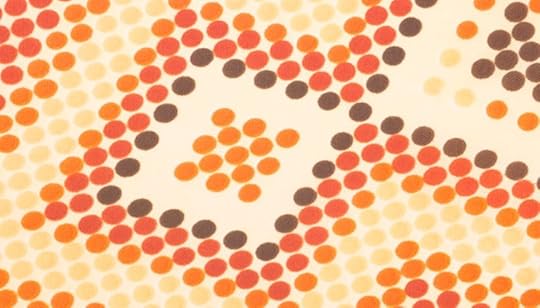
Artists often employ unseen and original textures to suit a specific artwork or style. They call these new types of textures "invented textures." Invented textures encompass any texture not found in the real world. Artists use many different techniques to create invented textures including shapes, lines and patterns. You can find invented textures in almost every form of art from pencil drawings to abstract sculptures.
Abstract Representations

Abstract textures mimic the surface of an object. Stylistically, they fall between simulated textures and invented textures. Artists incorporate the techniques of their mediums to imply the texture of an object, but in an unusual way. They simplify the texture to its most basic form, often representing it using only lines and shapes. This type of texture shows up in most forms of art.
https://ourpastimes.com/what-are-the-...


Do you prefer the hushed, powdery texture of a Degas pastel or the bold, thick surface of a Van Gogh oil painting?