
Art Lovers discussion
Introduce an Artist and/or Work
>
René Magritte
date newest »
newest »


Son of Man
1946
Magritte painted The Son of Man as a self-portrait. The painting consists of a man in an overcoat and a bowler hat standing in front of a short wall, beyond which is the sea and a cloudy sky. The man's face is largely obscured by a hovering green apple. However, the man's eyes can be seen peeking over the edge of the apple. Another subtle feature is that the man's left arm appears to bend backwards at the elbow.
About the painting, Magritte said:"At least it hides the face partly. Well, so you have the apparent face, the apple, hiding the visible but hidden, the face of the person. It's something that happens constantly. Everything we see hides another thing, we always want to see what is hidden by what we see. There is an interest in that which is hidden and which the visible does not show us. This interest can take the form of a quite intense feeling, a sort of conflict, one might say, between the visible that is hidden and the visible that is present."
At the start of 1946 Margritte was painting in both his realist style and his impressionist style. Some of his work, like The Son of Man were already headed toward more extreme colors. This extreme style, closer to some of Van Gogh's paintings, would accelerate in late 1947 when he was invited to hold his first solo exhibition in Paris at the Galerie du Faubourg in May 1948.
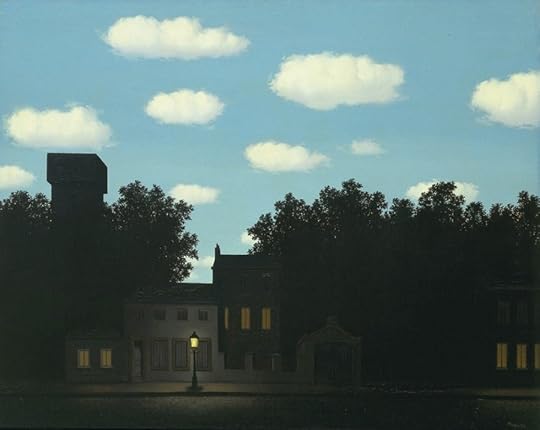
Empire of Light
1950
In 1953-1954, artist Rene Magritte painted The Empire of Lights. It is the only time that Magritte used a title that was not his own. The intriguing oil painting displays a beautiful house lit up by its interior lights, and surrounded by the darkness of the night. Especially surreal is that the sky above the house and treeline is a daytime sky full of brightness and plump white clouds. It is a serene, mysterious scene.
In Empire of Light, numerous versions of which exist, a dark, nocturnal street scene is set against a pastel-blue, light-drenched sky spotted with fluffy cumulus clouds. With no fantastic element other than the single paradoxical combination of day and night, René Magritte upsets a fundamental organizing premise of life. Sunlight, ordinarily the source of clarity, here causes the confusion and unease traditionally associated with darkness. The luminosity of the sky becomes unsettling, making the empty darkness below even more impenetrable than it would seem in a normal context. The bizarre subject is treated in an impersonal, precise style, typical of veristic Surrealist painting and preferred by Magritte since the mid-1920s.
Magritte explained the origin of the image in a radio interview in 1956, stating:
"What is represented in a picture is what is visible to the eye, it is the thing or the things that had to be thought of. Thus, what is represented in the picture are the things I thought of, to be precise, a nocturnal landscape and a skyscape such as can be seen in broad daylight. The landscape suggests night and the skyscape day. This evocation of night and day seems to me to have the power to surprise and delight us. I call this power: poetry"
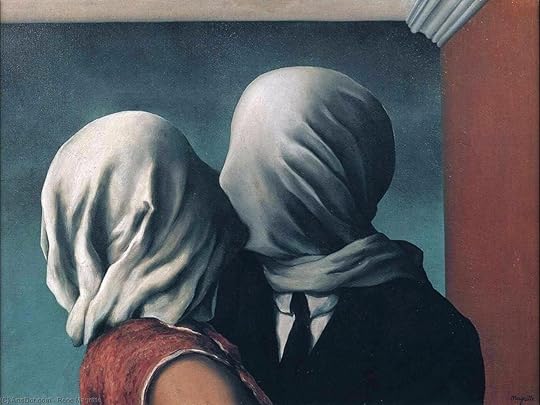
The Lovers II
1928
The Lovers II (1928), is an oil on canvas depicting two individuals locked in an embrace. The figures are kissing one another through veils. They are situated in a room with the back wall, side wall and ceiling showing. The back wall is blue-grey with a lighter shade on the bottom half and a darker shade on the top half. The side wall is brick red with it lighter at the bottom blending to a darker shade through to the top. The ceiling is white and has a decorative trim along the border of the red wall, but it does not continue along the border of the blue-grey wall. The male figure wears a black suit and tie with a solid white shirt. He embraces a woman clad in a red, sleeveless garment with white trim. The woman's tanned arm is exposed. The man is in a dominant position relative to the woman. She tilts her head up while he leans down to kiss. Both figures have a whitishveil completely covering their faces and necks. On both figures the veils are tight against the front of the face and top of the head and then relax towards the back. The woman's face is tilted slightly to the left making her lover more prominent and revealing the distinct outline of his nose.
The elements that make up this painting are the room and the lovers. Unlike the erotic and romantic scene of The Kiss by Gustav Klimt, Magritte presented two figures with their faces covered by a white cloth, locked in an ambiguous setting, and unable to truly communicate or touch, many wonder if this is a kiss of denied love. The deathlike cloth keeps the two figures forever apart and as such create an atmosphere of mystery which celebrated this image. The way the room is painted makes it seem almost insignificant. The bold colors are shadowed and there are no windows to give perspective. However it is unusual to see a room with such a variety of colored walls. The lovers are the primary object and the one that adds the most mystery and intrigue. The way they are both positioned is suggestive. The man is in a dominant position with his shoulders angled. The woman appears to be tilting her hear up towards him but after looking at the position of her body as well it appears more like she is leaning backwards. The most significant aspect of the lovers is the veils. It is actually a rather bland painting however by simply covering the faces with veils it becomes far more interesting and thought provoking. The psychological impact however is far greater with all of these elements. The color blue is associated with calm or water which is associated with life. The color red is associated with anger, lust and love while white is associated with purity which also happens to be the least shown. Black is commonly associated with death which the man may be representative of. The woman is dressed in red which may mean love or passion. The veils are of a whitish or grayish color and depending upon how you see it could mean purity or could mean the purity is fading or tainted. Trying to put all of these elements together to form a single meaning is rather difficult. It is the culmination of elements that are supposed to impact the viewer. The Lovers is one such painting that intrigues and provokes thought.
"Everything we see hides another thing, we always want to see what is hidden by what we see. ”
- Rene Magritte
"If the dream is a translation of waking life, waking life is also a translation of the dream. ”
- Rene Magritte
"If the dream is a translation of waking life, waking life is also a translation of the dream."
- Rene Magritte
Top 40 Rene Magritte Paintings
https://www.youtube.com/watch?v=nE-pR...
Length- 3:21
Rene Magritte
Biography, Paintings, and Quotes
Rene Magritte and his paintings
https://www.renemagritte.org/
(If anyone watches this short video of 40 of his paintings, it has beautiful music playing with it. I would love to know what music that is! Maybe it's famous and I'm just out of it, but can anyone enlighten me on who is the composer? Or the name of the piece? I would be your best friend! lol)
 Heather wrote: "
If anyone watches this short video of 40 of his paintings, it has beautiful music playing with it. I would love to know what music that is! Maybe it's famous and I'm just out of it, but can anyone enlighten me on who is the composer? Or the name of the piece? I would be your best friend! lol"
Damn, I know this piece, I can hum along ;-)
But I don't know the title and can only guess at the composer:
could be Scriabin:
https://youtu.be/P1qN4XFV6g0
After ploughing through 8 CD's of Scriabin sonates I have in my Itunes. I thought of a friend who plays piano I called him, hummed it and he said it was Chopin!It's opus 10 nr 3 "Tristesse"
https://youtu.be/VC3XIg6cDI8?t=99
 Which rock group/artist of the 1960's/70's issued an album whose cover featured a huge green apple by Magritte? Also name the album's title ...
That should be Beck-Ola by Jeff Beck.
Which rock group/artist of the 1960's/70's issued an album whose cover featured a huge green apple by Magritte? Also name the album's title ...
That should be Beck-Ola by Jeff Beck.And I think Jackson Brown also had one...
Beck-Ola it is. Don't know about Jackson Browne.
My sister gave me a very nice post card of Empire of Light. I still have it "up" somewhere in my house A favorite ...
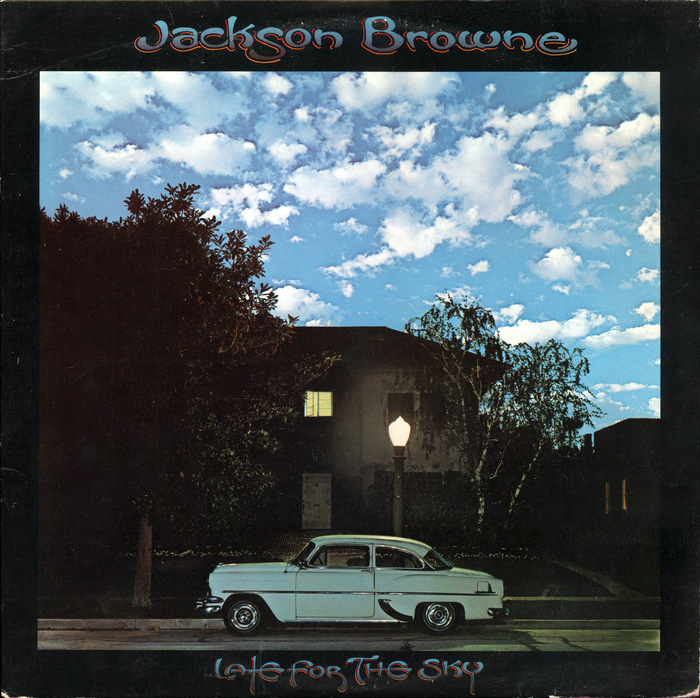
Jackson Browne - Late for the Sky
Chris wrote: "it says "image error"????"I know, working on it...

The Therapist
1937
The Therapist, 1937 by Rene Magritte. Representing the role of the Psychoanalysis in his work. This old, faceless sage that conceals below his poncho an open cage, where two birds refuse to fly away. Are the birds the neuroses, memories and repressed desires that therapy brings to the open, but that never truly go away? There is no way to know. But in analyzing this painting, aren’t we analyzing ourselves. And isn’t this exactly what psychoanalysis is all about?
Magritte's works are conceived of as riddles. In them, he explores the mysteries lurking in the unexpected juxtaposition of everyday things, involving the viewer in a self-induced disorientation. His paintings exclude symbols and myths; everything is visible. Magritte worked from several sources, which he repeated with variations: anatomical surprises, such as the hand whose wrist is a woman's face; the mysterious opening, where a door swings open onto an unexpected vista; metamorphic creatures, such as a stone bird flying above a rocky shoreline. He animates the inanimate, as a shoe with toes; he enlarges details, as an immense apple filling a room. he makes an association of complementaries, as the leaf-bird, or the mountain-eagle. His titles accompany the paintings in the way that names correspond to objects, without either illustrating or explaining them.
There is always a kind of logic to Magritte's images but when asked about analysis of the content of his paintings, Magritte replied, "If one looks at a thing with the intention of trying to discover what it means, one ends up no longer seeing the thing itself, but of thinking of the question that is raised." The interpretation of the image was a denial of its mystery, the mystery of the invisible. His images are to be looked at, not into.