
Read Women discussion

This topic is about
My Journey to Lhasa
Previous Reads: Non-Fiction
>
My Journey to Lhasa: The Classic Story
date newest »
newest »
 I hope to join on time but have had to use interlibrary loan to get a copy so it may arrive later than I'd like.
 Story❤ wrote: "I hope to join on time but have had to use interlibrary loan to get a copy so it may arrive later than I'd like."
we'll cross our fingers for swift delivery.
 I'm travelling and won't be getting my hands on my own copy until 4 March but looking forward to finally getting to this book. I'll be reading the French original, which is just titled "Voyage d'une parisienne à Lhassa".
Two English translations are available on the Library Archive:
1) to read online
https://archive.org/details/in.ernet.... ;
2) to borrow https://archive.org/details/myjourney...
Interestingly, there are at least three different English titles or subtitles:
1) My journey to Lhasa (the closest to the French original);
2) "The personal story of the only white woman who succeeded in entering the Forbidden City";
3) "The classic story of the first Western woman..."
I guess claiming firsts is a classic publishing marketing tools, but it also reminded me of a recent piece on arablit about claiming "first-dom" for Arabic literature by women, and the ways we erase women out of literature (and in this case migration/travel) and therefore keep reinventing them as "new"
https://arablit.org/2019/08/01/whats-...
 I wanted to read something else, but this book just ticked too many boxes on my interests list, so I will be joining as soon as I finish 'Passing'.
 I hope to start it later on, as I´m always interested in women travelling. Got my copy in German from the library.
Great, looking forward to hearing your thoughts!
I hope to start it later on, as I´m always interested in women travelling. Got my copy in German from the library.
Great, looking forward to hearing your thoughts!Out of curiosity, do your editions have an introduction, and what is its content? Mine just has a few pages from David-Néel herself that are more confusing than anything else, but at least it made me curious about looking into the wider context.
I finally got hold of a copy and will start this weekend.
For some reason the audiobook version on audible is read by a man, and this irritates me more than I thought. So I will see if I can find another version or get the actual book and read it some time in the future.
Well, we could not have chosen a better story of resilience in challenging circumstances than this one. I'm on page 55 and loving Alexandra David-Néel. What a woman! (view spoiler)BTW< Cam, thanks for directing me to the Library Archive. My own library was unable to track down a paper copy of the book so I appreciate you including that link.
Finally had some time and brainspace to read last weekend, and I'm enjoying this more than I expected (despite the occasional colonial cringe). It's a nice relief to hear the tales of someone whose woes are entirely self-inflicted and whose biggest fear is "but what if I get caught and they don't let me go on my completely random quest of getting to a place I've been told not to go to?" :'D.She is a fun writer to read and a very interesting woman. And the book is making me look up a lot of stunning places so definitely an enjoyable read so far.
Struggling to find the time to read at the moment... Has anyone made any progress on this book? What are your thoughts?
I lay it aside, as the print was so tiny.
*I'm going to leave this book in the "currently reading" folder for an additional couple of weeks, since we had 2 nonfiction books designated in March.
Thanks Carol!Between annoying audiobook narration and small prints, it unfortunately sounds like Journey to Lhasa hasn't been the most accessible of books...
I'm about 3/4 of the way through chapter 4, and the story has shifted from tales of hiding in forests and hiking at night in order to avoid being seen at all, to stories of trying not to be found out as a white woman. Weirdly enough (and definitely something that is surprising me), I find her way of describing her adventures less exoticising and patronising than many of today's travel logs. Are you finding this too, Story❤ and Carissa? What are your impressions of David-Néel from her narration? And how are you finding the way she talks about Yongden?
Did you finish it @Story❤? I read nearly 2/3 of it in one day because I got so engrossed in her tales. I really didn't expect to enjoy this book as much as I did, it's part adventure tale (she trecked 2,000km across the Himalayas in winter in 1924 with basic equipment and no maps!) and part intellectual and spiritual journey (she is genuinely curious about others' way of life and about Buddhism - this is deep participant observation). I expected the usual self-aggrandising, patronising and/or exoticising stories that are typical of travel literature, and unless my brain has turned to mush over the past few weeks (entirely possible), I don't think this is what Alexandra David-Néel does here at all.
Things that particularly resonated with me:
* her deep appreciation of the majesty and dangers of the mountains (some of her descriptions are magical)
* people are fascinating to be observed, to learn from, and to share with, but walking in the mountains is best done alone (or with a trusted companion) so you can appreciate wonders and simple pleasures in the midst of hardship
* her striving to understand people's world view and life choices from their own perspectives rather than always assuming white middle class European/North American ways of life are "normal" or even "obvious";
* the languages! 1) She speaks/knows so many! 2) The fact that she uses Tibetan words, explains their meaning, and doesn't rely on shoddy French approximations. The (only) good side of orientalism I guess?
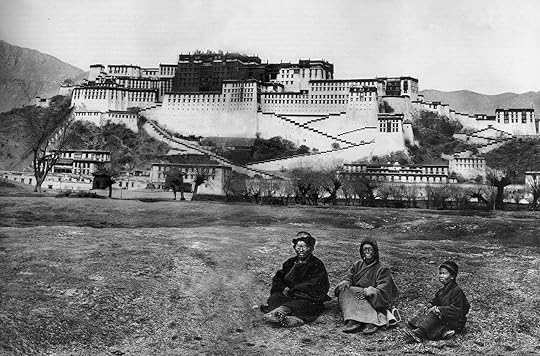
Alexandra David-Néel (centre) and Lama Yongden (left) in front of the Potala Palace in 1924
 What I assume is a re-enactment in a photographer's studio of her "equipment" (i.e. pilgrim begging for sustenance) during her hike: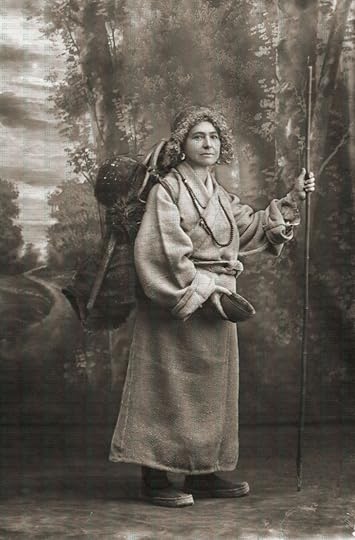
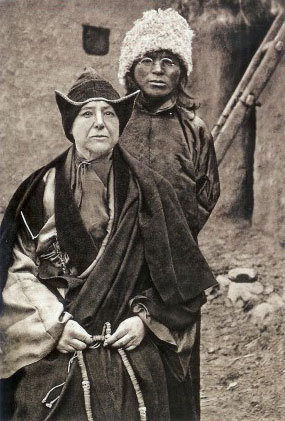
And a picture of her and Yongden (no date)
There are a lot more photos here, although without explanations: https://www.alexandra-david-neel.fr/p....
I find it fascinating that she obtained funding to do some research in Asia at the age of 43, after having already had a successful career as an opera singer (amongst other things) and having learnt at least Sanskrit and Chinese (I assume this is written Chinese but I don't know enough about this language family). She told her husband she would be gone for 8months....and came back 14 years later! Her letters to her husband throughout these years are the main sources of information about her daily life while she was travelling, although she also wrote many books on life and religious belief in Tibet (most of them published simultaneously in French and English).
 On a side note there was a BBC Reel article today about traders and travels thru Lhasa were required to quarantine for two weeks before being allowed home. This was a social and cultural rule for centuries but only stopped in the last few decades. Something to think about.
I didn't finish it Cam as my e-copy expired before I got to the end. But I read enough to see she was a remarkable woman (though perhaps not the best writer.) Thanks so much for sharing those photos. They're wonderful!
〰️Beth〰️ wrote: "On a side note there was a BBC Reel article today about traders and travels thru Lhasa were required to quarantine for two weeks before being allowed home. This was a social and cultural rule for c..."
On a side note there was a BBC Reel article today about traders and travels thru Lhasa were required to quarantine for two weeks before being allowed home. This was a social and cultural rule for centuries but only stopped in the last few decades. Something to think about.
I didn't finish it Cam as my e-copy expired before I got to the end. But I read enough to see she was a remarkable woman (though perhaps not the best writer.) Thanks so much for sharing those photos. They're wonderful!
〰️Beth〰️ wrote: "On a side note there was a BBC Reel article today about traders and travels thru Lhasa were required to quarantine for two weeks before being allowed home. This was a social and cultural rule for c..."Have you got the link? That sounds interesting, thanks for mentioning it!


My Journey to Lhasa, first published in 1927, is the remarkable, detailed account of 55-year old French/Belgian writer and adventurer Alexandra David-Neel’s secret trip to the ancient city of Lhasa in Tibet in 1923.
David-Néel was born in Paris in 1868. After studying eastern religions in Paris, she toured the Far and Middle East and North Africa as an opera singer. In 1904 she married Philippe François Néel: they separated almost immediately, but he financed many of her later travels. She spent years traveling throughout Asia, where she studied Buddhism and became a Lama. She died in 1969 - just before her 101st birthday, and just after the student riots in Paris.
The photos included in this biography at Tricycle (The Buddhist Review) are stunning.
https://tricycle.org/magazine/alexand...
Cam will lead our discussion, which starts March 1.
Who's planning to join? What interested you about My Journey?