
Terminalcoffee discussion
Health / Science / Technology
>
Coronavirus!

 I'm washing my hands a little more often than usual. We are slowly stocking up on a food n case we have to self isolate. There is a bizarre phenomena happening here. There is a severe toilet paper shortage. It's funny until you need it and can't buy any. For us it is still at the funny stage as we always have more than a weeks supply. What is going down? I'm trying not to worry but I am more concerned about people who are frightened than the I am about contracting the virus. Or if medicines become difficult to obtain. My daughter has an immune deficiency illness so I am trying not to freak about her. I'm thinking stay focused, wash my hands have the flu shot and keep calm. When I have my flu shot I am going to ask my GP if I might benefit from the Pneumonia vaccine. I'm not quite in the age bracket for it but I do have Hashimoto disease.
 Mod
Mod
Also was it the CDC who advised people who need prescription medications to "stock up". Uh, what? In the U.S. pharmacies or your insurance plan will only dole out a 30 day supply at a time - at most, a 90 day supply for certain drugs. My insurance only dispenses a 30 day supply so there's no way I can "stock up."
Mod
"Facing painfully dry and cracked hands from frequently washing hands, as experts advise to prevent the spread of coronavirus? If so, be aware of a less widely cited hygiene recommendation: moisturize hands, as well.
“Keeping skin moisturized is important,” said Craig Shapiro, an attending physician in pediatric infectious diseases at Nemours/Alfred I. duPont Hospital for Children in Delaware. “If the skin is breaking down or raw, then the soap and alcohol disinfectants do not work as well. Also, when skin is chapped and broken, it’s uncomfortable, and people can be less likely to wash their hands to prevent transmission of germs and infection.”
Cracked and bleeding hands are also more susceptible to infections, said Christina Johns, senior medical adviser and spokeswoman for PM Pediatrics.
“Whenever you have a break in that skin barrier, that allows germs and bacteria to invade the skin area,” she said.
Any microbe can technically enter through open wounds, Johns added, but coronavirus tends to enter the body through the respiratory system, in contrast to bacteria like staph infections and strep, which more typically move through the skin.
Johns and Shapiro both emphasized that moisturizing hands does not increase the likelihood of picking up or spreading germs, especially if hands are clean. That is because moisturizing hands reduces microbial shedding from the skin and is part of general good hand hygiene — all of which reduces the likelihood of picking up or transmitting viruses."
 What do you do during the regular flu season? Do that. What's the big deal?
 The big deal is that it's not just like a normal flu season. There is no vaccine for this virus. There is a lot that is still unknown about how it spreads. It seems to be in the immediate interest of business people to downplay the situation to where people are asking, "What's the big deal?"
Mod
The big deal is that it's not just like a normal flu season. There is no vaccine for this virus. There is a lot that is still unknown about how it spreads. It seems to be in the immediate interest of business people to downplay the situation to where people are asking, "What's the big deal?"
Mod
This includes workers at restaurants (sneezing and coughing into your food and onto your utensils, plate and glasses) and nursing homes.
These states require employers to offer paid sick leave: Arizona, California, Connecticut, Maryland, Massachusetts, Maine, Michigan, Nevada, New Jersey, Oregon, Rhode Island, Vermont and Washington, and the District of Columbia.
But these states have passed laws forbidding mandated sick leave (even if localities want it): Arkansas, Florida, Iowa, Kentucky, Louisiana, Mississippi, Missouri, North Carolina, Ohio, Oklahoma, South Carolina, Tennessee and Wisconsin.
Even in states which require companies to offer sick leave, companies can often get around it by calling their workers contractors rather than employees.
Mod
"Diluted solutions of household bleach, alcohol solutions with at least 70 percent alcohol and several common household disinfectants should be effective against the coronavirus, according to the Centers for Disease Control and Prevention.
The Environmental Protection Agency released a list of disinfectants against the virus. :
https://www.epa.gov/sites/production/...
 On a lighter note, I cleaned my phone this morning.
 Now for the humorous part:
WITH. DISINFECTANT. SOAP!
It was supposed to be hand and surface sanitizer, (i.e. high CH3CHOHCH3 content and some other goodies) but the dispenser had been filed with a soap type cleaner. Moments later I realized my phone and hands while now quite (almost) clean were going to require copious amounts of water to finish the job. My language was certainly NSFW or vaguely polite company. The phone at least is somewhat water resistant. The phone and case are real clean.
Mod
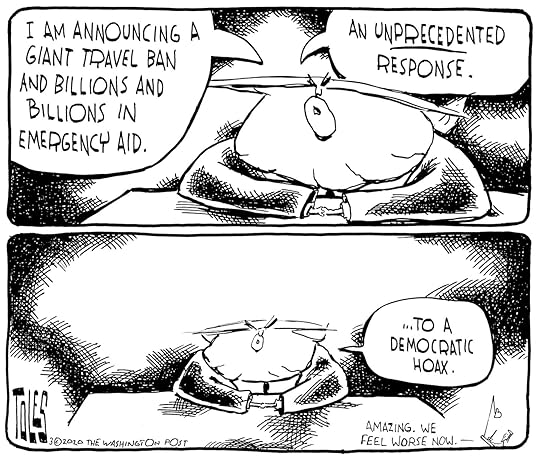
Tom Toles, via WaPo. 3-12-20
Mod
Mod
Gov. Gavin Newsom (D-Calif.) has barred gatherings of more than 250 people across the state, which includes sporting events, conferences and music festivals — but not casinos, theaters and large theme parks like Disneyland, at least for now.
Newsom said at a news conference Thursday that those industries raised enough “legitimate concerns” at the time of the state health department’s order that officials felt it was appropriate to allow more time to talk about repercussions of such a restriction."
Hmm! Given that Disneyland was the site of a major measles outbreak not too long ago, I am not sure keeping it open is a great idea.
Mod
"We don’t have enough ventilators and I.C.U. beds if there’s a significant surge of new cases. As with Italy, the health system could become overwhelmed."
"A crucial thing to understand about the coronavirus threat — and it’s playing out grimly in Italy — is the difference between the total number of people who might get sick and the number who might get sick at the same time. Our country has only 2.8 hospital beds per 1,000 people. That’s fewer than in Italy (3.2), China (4.3) and South Korea (12.3), all of which have had struggles. More important, there are only so many intensive care beds and ventilators.
It’s estimated that we have about 45,000 intensive care unit beds in the United States. In a moderate outbreak, about 200,000 Americans would need one."
Mod
I think the supply chain is just overwhelmed temporarily. It should recover in the next couple of weeks.
Mod
Fresh food is still plentiful in my local area but the major supermarkets are low on canned foods and long life milk, pasta, rice and TP. There isn't any hand sanitiser either. The local pharmacy had some hand sanitiser the other day so I bought a small pump container to keep in the car. I bought another supply of prescription meds for myself and my daughter and an extra ventolin puffer each for husband and daughter. We have stocked only a few extra long life milk, a large packet of frozen vegetables and just a few canned items like lentils beans, corn. We have only bought a couple of extra items each week recently because we are trying to share.
Mod
Thursday (3.12.2020) I was at the. pharmacy and wandered into the grocery. Now this was prior to the emergency declaration. No toilet paper, only the expensive bottled water and to the surprise of the employees ALL the boxed doughnuts in the store were sold out! Otherwise at that point only minor hysteria obviously. Today however friends trying to do the normal weekly shopping were having all kinds of experiences. Included were lots of crowds, empty shelves and people fighting over hamburger. There was plenty of hamburger, but customers had to wait for them to bring out more.
Most local stores are hiring more delivery drivers starting immediately.
Mod
Judy Woodruff asks people not to be a-holes and hoard-buy when there might be elderly or sick people who need that stuff more....
Mod
An admirable spirit, evie.
Has anyone besides me been waiting for a parody version of "The Knack's" big hit "My Sharona" to be released?You know as in My Corona? And not the beer.
Mod
Mod
In France, luxury perfume maker LVMH (maker of Dior and Givenchy) is turning their factories into making hand sanitizer which they will give away free in France. Nice. Who will do that in the U.S.? Anyone?
Mod
Mod
Mod
“Right now, we are flying blind, sharing snippets from anonymous doctors over Facebook and Twitter,” said Jennifer Ellice, an emergency room doctor in Los Angeles. “We can’t wait for the usual evidence-based, peer-reviewed data in journals and professional association guidelines.”
Dr. Ellice and her colleagues were pleading Monday for a technological platform, such as a mobile app, that could validate and authorize licensed physicians to share real-time information that would, for example, tell them whether emergency room patients showing extreme gastrointestinal distress may be stricken with the coronavirus.
“We are making policy decisions by word of mouth,” Dr. Ellice said.
Doctors say they were wading through misinformation — what World Health Organization officials call an “infodemic” of lies and rumors — in search of real-time information from doctors around the country.
One of the challenges of sharing real-time medical information is the Health Insurance Portability and Accountability Act, the federal regulations protecting patients’ confidential health information. The other is strict hospital policies on what employees can post on social media. As a result, doctors have been posting anonymously on Twitter and Facebook."
Mod
He said his hospital was down to a two-day supply of surgical masks — he wears one per shift. “Those are supposed to be disposable,” he said. Now he must carefully remove and clean the mask each time he takes it off and on. “That may sound just like a nuisance, but when you’re potentially touching something that has the virus that could kill you on it, and you’re doing it 25 times a shift, it’s kind of nerve-racking,” he said."
https://www.nytimes.com/2020/03/16/us...
CD wrote: "Has anyone besides me been waiting for a parody version of "The Knack's" big hit "My Sharona" to be released?
You know as in My Corona? And not the beer."
Somewhere Weird Al's wheels are turning.
You know as in My Corona? And not the beer."
Somewhere Weird Al's wheels are turning.
Mod
"America Is a Sham
Policy changes in reaction to the coronavirus reveal how absurd so many of our rules are to begin with.
By DAN KOIS
MARCH 14, 2020
Maybe it will be the hand sanitizer that finally exposes the sham.
The Transportation Security Administration announced Friday that due to the coronavirus outbreak, it’s waiving the familiar 3.4-ounce limit for liquids and gels—for hand sanitizer only.* You may now bring a bottle of Purell as large as 12 ounces onto the plane to assist in your constant sanitizing of yourself, your family, your seat, your bag of peanuts, and everything else. All other liquids and gels, however, are still restricted to 3.4 ounces.
Among many shocks of the past week—school closures, Tom Hanks, the shuttering of one sports league after another—this rule change registers as major. The liquid restriction has been a key component of air travel ever since 2006. If people are now allowed to bring 12-ounce bottles of hand sanitizer onto planes, won’t the planes blow up?
The TSA can declare this rule change because the limit was always arbitrary, just one of the countless rituals of security theater to which air passengers are subjected every day. Flights are no more dangerous today, with the hand sanitizer, than yesterday, and if the TSA allowed you to bring 12 ounces of shampoo on a flight tomorrow, flights would be no more dangerous then. The limit was bullshit. The ease with which the TSA can toss it aside makes that clear.
All over America, the coronavirus is revealing, or at least reminding us, just how much of contemporary American life is bullshit, with power structures built on punishment and fear as opposed to our best interest. Whenever the government or a corporation benevolently withdraws some punitive threat because of the coronavirus, it’s a signal that there was never any good reason for that threat to exist in the first place.
Each day of this public health crisis brings a new example. People thrown in jail for minor offenses? San Antonio is one of many jurisdictions to announce that, to keep jails from being crowded with sick citizens, they’ll stop doing that. Why were they doing it in the first place?
The federal government charging interest on loans to attend college? Well, Donald Trump has instructed government agencies who administer loans to waive interest accrual for the duration of the crisis. But why on earth is our government charging its own citizens interest anyway?
Broadband data caps and throttled internet? Those have been eliminated by AT&T and other internet service providers, because of the coronavirus. But data caps and throttling were really just veiled price hikes that served no real technical purpose. Why did we put up with them?
Police helping landlords evict tenants in times of financial trouble? Due to the coronavirus, not anymore in New York, Miami, and New Orleans. But—and you see where this is going—why do the police aid evictions when tenants are stricken with other, noncoronavirus illnesses?
The city shutting off your water, or your power, as punishment for hardship? During this public health emergency, plenty of cities and companies have suddenly found a way to keep service turned on. “As long as COVID-19 remains a health concern,” said Detroit Mayor Mike Duggan, “no Detroit resident should have concerns about whether their water service will be interrupted.” Why in the hell should any Detroit resident have concerns about their water service being interrupted, ever? Shouldn’t clean water be the absolute base level of service delivered by a city to its residents?
Sick employees forced to take unpaid leave or work while sick if they want to keep their jobs? Walmart recently announced it would provide up to two weeks of paid leave for any employee who contracts the coronavirus. And the House just passed a bill to address the problem, though as the New York Times editorial board notes, the House’s failure to make the bill universal “is an embarrassment that endangers the health of workers, consumers and the broader American public.” But why should any sick worker fear losing their pay or their job at any time? And why are the most vulnerable to punitive sick leave practices the workers making the lowest wages?
In every single one of these cases, it’s not just that most of these practices are accepted as “standard.” It’s that they are a way to punish people, to make lives more difficult, or to make sure that money keeps flowing upward. Up until now, activists and customers have been meant to believe that the powers that be could never change these policies—it would be too expensive, or too unwieldy, or would simply upset the way things are done. But now, faced suddenly with an environment in which we’re all supposed to at least appear to be focused on the common good, the rule-makers have decided it’s OK to suspend them. It’s a crisis, after all. Everyone’s got to do their part.
So what will happen when the crisis passes? Yes, it’s worth asking yourself now, in the early days of this pandemic, how you might change your behavior, what temporary adjustments in your lifestyle you might adopt permanently in the after times—whether that’s working from home, or cutting back on airplane travel. But it’s also worth asking if we are willing to allow governments and corporations to return to business as usual. When everything’s back to normal, will we accept cities cutting off their poorest residents’ water, or evicting the sick, or throwing someone in jail because they can’t afford to pay a fine?
I want to say that once a policy is revealed as bullshit, it gets a lot harder to convince smart, engaged citizens to capitulate to it. That’s one reason why activists are agitating to end cash bail in the coronavirus crisis, or fighting to ensure that coronavirus tests and any eventual vaccine are available to all. Not only would those measures save or better countless lives during the pandemic, but in their common-sense wisdom, they expose the absurdity of the opposing view. What kind of ghoul would argue that we shouldn’t vaccinate everyone against a pandemic threatening the health of our nation? The same kind of ghoul, perhaps, who thinks that cancer treatment, or insulin, should only be available for those lucky enough to be able to pay for them.
In a time of real anxiety, maybe this optimism is just grasping for something good to come of all of this. But that’s really up to us. Over the next few weeks, we’re going to see more and more absurd, or cruel, or counterproductive practices revealed. Pay attention when they are. Notice the statements the people in charge make when they effortlessly roll back their surcharges and threats, their punishments and impediments. Remember them. And when the time comes that the danger from the virus is no longer as severe, and those people try to quietly reinstate the policies that hurt so many around you, remember that for a lot of Americans, a “return to normal” is a scary prospect. Keep your giant bottle of hand sanitizer. You’re gonna need it to deal with all the bullshit that’s coming back when the pandemic finally passes."
https://slate.com/news-and-politics/2...
I didn't read that long post. We have 3 confirmed cases in my town, and 9 others being tested. People are taking seriously the advice to stay at home if possible, which I do. I've added a few precautions to the ones I usually take during flu season, such as disinfecting items I buy and being more careful about wiping surfaces I touch. Other than that, whatcha gonna do? I'm doing the grocery shopping for my parents in their late 80s, even though I'm 65 and being told I'm at risk. It's something I have to do, and my friends are doing the same for their parents. I don't see any reason for panic yet, and I'm certainly not going to ask anyone to do the shopping for me. Anyone using grocery delivery services? Are you still eating restaurant food? How has life changed for you?
Mod
(It was fantastic.)
Mod
Great for you that you got to fly with 7 passengers, so you're not in financial straits. Your bookstore closed. Nothing else of import going on that you saw fit to address, but many of us have a different experience.
Mod
Mod
Is the coronavirus airborne? How airborne is it? Do masks help?
The Atlantic has dropped the paywall for all their coronavirus coverage.
I saw a doc explaining that the virus may be aerosolized, meaning that the particles hang around in the air like a mist. If true, just sneezing and coughing of people in your vicinity or touching your face may not be the only things to worry about.
The CDC reports today ( about preliminary results) gives some positive encouragement regarding advances in the science of the COVID-19 pandemic. SARS-CoV-2, (the virus that causes COVID-19) is now being tested for at an unprecedented rate at the antibody level. CDC during the daily news conference today 4.10.2020 described the reconfiguring of the machinery normal used to test viral loads in HIV patients for the SARS-CoV-2 virus. This thus far has allowed about two million antibody tests to be performed. That's better but not enough for the population of the US to get a picture like the presented regarding Iceland. Of course Iceland has less than 500, 000 residents.
There were also finally reports about COVID-19 not being the leading cause of death in the US.
The messages are finally starting to get out. Just be sure that the information you are reading comes from reliable sources and not some third hand from you best F-book friend.
GOOD SOURCES for information:
https://www.webmd.com/ WEBmd
https://hub.jhu.edu/health/ Johns Hopkins University
https://www.cdc.gov/ Centers for Disease Control and Prevention
The two USA today articles linked below 'should be' encouraging as there is concrete information on how things are proceeding to determine when it may be safe.
https://www.usatoday.com/story/news/h...
https://www.usatoday.com/story/news/w...
Mod
 CD wrote: "The CDC reports today ( about preliminary results) gives some positive encouragement regarding advances in the science of the COVID-19 pandemic. SARS-CoV-2, (the virus that causes COVID-19) is now ..."
The piece I read in today's New York Times (with video of Covid units in the Bronx) was anything but reassuring. I can't believe what people on the front lines are dealing with. It's no wonder so many of them are getting sick. Ridiculous, sub-par response to an isssue we knew about how long ago? And now the Trumps and Kushners are attempting to profit? I do not understand how they sleep at night. Grifters, all of them.
Mod
Mod
Mod
"Ordinary speech can emit small respiratory droplets that linger in the air for at least eight minutes and potentially much longer, according to a study published Wednesday that could help explain why infections of the coronavirus so often cluster in nursing homes, households, conferences, cruise ships and other confined spaces with limited air circulation.
.......
This new study did not involve the coronavirus or any other virus, but instead looked at how people generate respiratory droplets when they speak. The experiment did not look at large droplets but instead focused on small droplets that can linger in the air much longer. These droplets still could potentially contain enough virus particles to represent an infectious dose, the authors said."
It's interesting to me that in this group there's no real conversation. Facts are listed and left out there hanging until another fact is listed and it's left hanging. What happened to socially interacting here?I'll reply to the last post by saying that I mentioned a few posts back that the virus may be aerosolized, meaning that it hangs around in the air. Might be why most reported cases are coming from those who socially isolate in their homes. Better to be outside when interacting. One of the TV docs said that it's unlikely that you'd be infected by jogging past someone.
Scout wrote: "It's interesting to me that in this group there's no real conversation. Facts are listed and left out there hanging until another fact is listed and it's left hanging. What happened to socially interacting here?Withered on the vine, methinks. You can't force these things. But I guess you can try.
I was out in Hamilton County, Iowa today, placing yard signs in about a dozen yards. I had the opportunity to talk with a college friend, who recently retired as editor of the local newspaper. I spent a half-hour with one of my volunteers, who has sent hundreds of hand-written postcards to voters on my behalf. It was a lovely day. Oh, and in other news, I bought an eight-acre farm in Hamilton County yesterday. So I am officially living in the district. Hooray. (Running for Iowa Senate, district 24.)
Mod
Go, our Democracy!
Thank you! I am wearing a mask in public, shocked at the number of young men out yesterday without masks. One young man tried to get everyone in the gas station to shake his hand. Entitled Asshole.
Mod
Nearly everyone in my neighborhood wears masks outdoors. The main exceptions are people running, but the polite runners have a mask or bandanna around their neck and pull it up when they get within 20 or so feet of me.
There is a small percentage of people, sometimes walking singly, sometimes in pairs, all in their 30s or younger, who don't bother social distancing when we're all out on our walks or whatever. These people make YOU do the social distancing, so I make a wide arc around them. I'm not going to endanger myself. The other day a couple (wearing masks at least) was in the middle of the sidewalk taking selfies of each other and themselves, saw me coming, had plenty of time to move, didn't move, I had to go out in the street to escape them.

I am washing my hands much more often, trying very hard not to touch my face. (It's hard.) Many people I come across in business settings are saying upfront that they don't want to shake hands, which is great. I never liked shaking hands that much anyway. Purell everywhere, at banks, accountant's office, etc. And I'm not even in an area right now where there have been any infections (that we know of).
A dog donned a face mask on a walk in Shanghai on Monday. (Credit: Aly Song/Reuters)