
The Old Curiosity Club discussion
Dombey and Son
>
D&S Chapters 49-51
date newest »
newest »
 Mod
Mod
Mr Toots’s Complaint
Chapter 50 begins with Walter and Captain Cuttle preparing Walter’s old bedroom for Florence’s use. It gives Cuttle great delight to prepare this room just as it gives him complete pleasure to refuse Walter’s offer to return Cuttle’s watch, sugar-tongs and teaspoons. These items were of great value to Cuttle. When we look back in the novel we recall how once before Cuttle’s most praised possessions were offered to Dombey and Carker as collateral for a loan. At that time, Dombey and Carker saw Cuttle’s offerings as silly, perhaps even pathetic. As reader’s however, we knew the incalculable value Cuttle put on them. Cuttle would do anything to help his friends. Now, we see Cuttle gifting his precious possessions, indeed his only possessions, “jintly” to Walter and Florence. Once again Dickens contrasts the humble nature of Cuttle and the wooden Midshipman to the extravagance Dombey’s home and Dombey’s violent and cruel nature.
One major question hovers in the air at the wooden Midshipman. Where is Sol Gills? Walter clings to the hope that his uncle is still alive and will return home. What puzzles Walter most is the fact that his uncle has never written home. Walter wonders if it is possible that his uncle has written home but Cuttle may have mislaid the letter. But how is that possible? Captain Cuttle would never neglect to be watchful for his best friend’s letters.
We then move on to Walter and Captain Cuttle discussing Florence Dombey. Walter, like Captain Cuttle, realize that Florence will not be returning to her father’s home. Walter clearly loves Florence, but believes she she sees him only as a brother. Walter is acutely aware of the gulf between his life and prospects and the life and world that was Florence’s. Together, Walter and the Captain think of how to take care of Florence and come up with the idea of finding Susan Nipper again and having her be with Florence. That is a good idea, but neither know where Susan is now living. They realize that Mr Toots would be the best person to help find Susan Nipper since he accompanied her when she left Dombey’s home. In addition, Toots deeply cares for Florence so who better to assign the task of finding Susan? At that precise moment, in comes Mr Toots who, upon seeing Walter, let out a sound that Dickens describes as “a chuckle of misery.” Could any writer better describe Toots when he sees Walter than that? What follows is Toots confusing what Captain Cuttle’s name is and granting Walter a rank he does not have. Regardless of these Tootsian errors, Cuttle and Walter know that Toots is both completely honourable and trustworthy. Toots and Walter become fast friends. Toots reveals that he has just recently come into his property and tells Captain Cuttle that he would “glide into the silent tomb with ease and smoothness” in order to help and support Florence in any way possible.
Thoughts
Once again we see Dickens contrasting Dombey and his character, personality, and home to that of Captain Cuttle and the wooden Midshipman. What do you think Dickens's motives are? To what extent is Dickens successful? In your opinion, is Dickens overdoing it?
Walter is in love with Florence but sees his own situation in life as not matching the background and prospects of Florence. Why might Dickens want to create this tension and unease in the first part of the chapter?
Captain Cuttle’s watch, sugar tongs, and other treasured paraphernalia are given to Florence and Walter and Toots offers his financial support to make Florence happy. On the other hand, we have seen the world of James Carker and Dombey, the world of Mrs Skewton and Edith and the world of Good Mrs Brown and Alice. While we still many chapters to come it might be interesting to begin to ask ourselves what Dickens is saying about the value of money, the value of human lives, and how the one effects the other. What are your early thoughts?
We know Walter’s true feelings towards Florence, but what about Florence’s true feelings towards Walter? Walter, for his part, thinks it best if he takes to the sea again. Walter’s desire is to “spare her any wound from his kind hand.” Again, the mention of a hand, and a reminder that Walter only wants to treat Florence gently, unlike her father’s hand who struck her and left a bruise on her breast. Florence wants to see Walter and so Captain Cuttle asks Walter to seek out Florence. He does. When they speak it is interesting to note the continued reference to hands. First, Walter puts “his trembling hand upon the table between them.” When Florence reminds Walter that she saw him before he left England Walter “put his hand into his breast, and took out a little purse.” Walter tells Florence that “I have always worn it around my neck! If I had gone down in the deep, it would have been with me at the bottom of the sea.” Walter promises that he will wear the purse around his neck “[u]ntil I die.” At this point, Florence “laid her hand on his.” Next, we read that Walter “caught up the hand that touched his, so entreatingly, and held it between his own.” Walter tells Florence that he owes Florence “Respect” and “Reverence.” We then read that Florence “withdrew her hand; still looking at him with unabated earnestness.” Walter tells Florence that he left her as a child only to discover that he now found a woman. At this point, Florence's face “ dropped upon her hands.”
Walter tells Florence that he is unworthy of her and that he has no means of restoring her to her former life of comfort and wealth. When asked by Florence if he is “very poor” Walter responds that “I am but a wanderer ... making voyages to live, across the sea. That is my calling now.” He tells Florence that he will soon be going away again. At this point Florence looks at Walter, and “put her trembling hand in his” and states “[i]f you will take me for my wife, Walter, I will love you dearly. If you will let me go with you, Walter, I will go to the world’s end without fear.”
Our chapter ends with Captain Cuttle very happy. He is content and realizes that “when [he] made that there little property over, jintly” it was the best thing he had ever done.
Thoughts
This chapter can be read as being excessively sentimental, melodramatic, or even maudlin. On the other hand, this chapter can also be seen as a very clear example of wonderful prose. Let's see some things to think about.
References to hands can be found throughout the novel, but in this chapter hands are highlighted. After Mr Dombey struck Florence the concept of a hand is clearly seen as one of power, domination, pain, and bruising. Dickens, however, then alters the narrative and uses hands as features of healing, discovery and love. The movement of both Florence’s and Walter’s hands is very cinematic. Through their hands, as much as from their words, we see Florence and Walter reach a union of spirit and heart. To what extent did you enjoy Dickens’s construction of this novel?
And now a question to all of you. I am racking my brain to come up with other Victorian novels where a major female character proposes to her partner. If you can think of other instances please let us know.
Were you surprised that Walter and Florence will be married? Do you see any future marriages on the horizon?
Mod
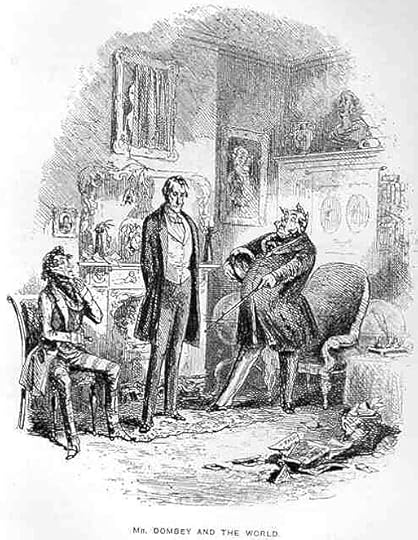
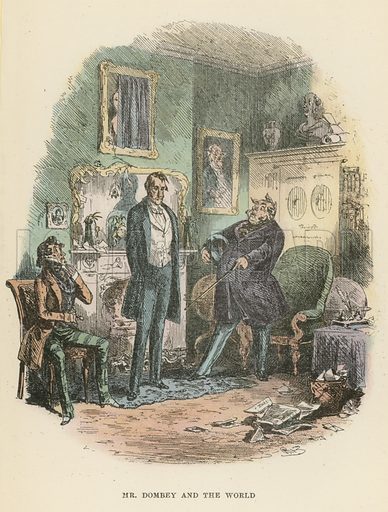
Mr Dombey and the World
In this chapter we move from the happiness of Walter and Florence and all those connected with the wooden Midshipman to enter back into the world of Mr Dombey. It would be nice to think that Dombey is feeling regret, embarrassment, shame, or any emotion, but it seems that iceberg is still to melt.
The chapter is constructed much like the ripples that are caused when a pebble hits a calm pond. The ripples that expand correspond to the various people that are connected to Dombey. Let’s see what is happening in Dombey’s world.
At the centre, of course, is Dombey. He is like the rock. We learn that he has never uttered Florence's name. All that concerns him is “[w]hat the world thinks of him, how it looks at him, what it sees in him and what it says - this is the haunting demon of his mind.”
To his sister Louisa, Dombey will not say or admit to anything. To her, he says “Louisa ...silence! Not another word of this.” Major Bagstock and Cousin Feenix are in his inner circle of friends but to them as well Dombey is impervious to their concerns and attentions. Dickens comments that Dombey, “[s]haken as he is by his disgrace, he is not yet humbled to the level earth.” I find this comment to be rather Shakespearean in tone. We learn that while Dombey is unaware of where Carker and Edith are, but he does have some intelligence.
Miss Tox is another ripple in the Dombey world pond. She dresses in disguise and joins with Mrs Pipchin in order to “get certain information on the state of Mr Dombey.” Mrs Pipchin, no doubt still hardened by her husband’s passing long ago, has bitterness towards Edith and dismisses Miss Tox, who, on here way out the door can’t resist warning Towlinson that what happened in Dombey’s house should be a warning to him. We read that Miss Tox repeatedly returns to stand as a sentinel outside the Dombey house much to the delighted derision of Mrs Pipchin and Towlinson.
In Dombey’s counting house the staff, now without either Dombey or Carker to oversee them begin to speculate on who will get Carker’s job. The staff draw closer now their overseers are absent, drift together as fellow jovial workers, and end up having dinner together. I understand that they did not meet in The Railway Arms since we would surely have heard. :-)
Perch the messenger descends into a melancholic state. His wife thinks he fears one night she will run off with a Viscount.
The rest of Dombey’s servants are becoming “dissipated, and unfit for other service.” Gossip becomes their main occupation. As the chapter ends we are told that “Mr Dombey and the world were alone together.”
Thoughts
In this chapter we discover how various groups of characters respond to the circumstance of Edith Dombey fleeing with Carker and Florence escaping from her home. This is a transition chapter which sets up the final act of the novel where the consequences of everyone’s actions in the novel will be revealed. It’s time for us to read some tea leaves. What do you think will occur as we move towards the end of the novel? Who are your favourite characters and what do you predict for them? Which characters do you dislike most? What will be their fate?
Of course, Walter and Florence are going to get married. That explains a little why she could go to The Wooden Midshipman, because Walter has known captain Cuttle all his life, and knows he is honorable and mostly like a kind uncle or the father Floy never had, but should have had.
The only Victorian book I now know of where a woman proposes to a man is of course Dickens' work too, (view spoiler) (I spoiler-tag it, because while we collectively read that book, I don't want to assume everyone did yet).
I don't think Dickens overdoes the contrasting, especially when he involves Toots. I love it that he does also make clear that it is not being wealthy that makes Dombey heartless - Toots is wealthy too, and he is one of those caring people on the Midshipman side. It's being Dombey that makes him cold and stoney and in the end alone without being lonely. Because being lonely involves missing other people in your life and caring about/wanting to interact with other people, and Dombey would have been very pleased sitting there alone, thinking about his wealth and how awesome (*coughs*) he is.
My verdict remains, Dombey is the greater villain. Especially since he is stone cold about Florence's whereabouts. She could have been killed and dumped into the Thames for all he cares, the bastard. And somehow it also strikes me as odd. Think of how people will talk if (when? Or would they go and ask Dombey for permission? I don't think that would be a good idea) Floy elopes with Walter. Or even when they realise she has been at The Wooden Midshipman all this time. While he doesn't care an ounce about Floy, I would have expected his pride would make him try to mitigate how people talk about his family as much as possible. He can't make Edith's going with Carker undone, but he could have saved his pride the pain of how people might talk about his daughter, if only he had cared about his child a teensy tiny bit.
The only Victorian book I now know of where a woman proposes to a man is of course Dickens' work too, (view spoiler) (I spoiler-tag it, because while we collectively read that book, I don't want to assume everyone did yet).
I don't think Dickens overdoes the contrasting, especially when he involves Toots. I love it that he does also make clear that it is not being wealthy that makes Dombey heartless - Toots is wealthy too, and he is one of those caring people on the Midshipman side. It's being Dombey that makes him cold and stoney and in the end alone without being lonely. Because being lonely involves missing other people in your life and caring about/wanting to interact with other people, and Dombey would have been very pleased sitting there alone, thinking about his wealth and how awesome (*coughs*) he is.
My verdict remains, Dombey is the greater villain. Especially since he is stone cold about Florence's whereabouts. She could have been killed and dumped into the Thames for all he cares, the bastard. And somehow it also strikes me as odd. Think of how people will talk if (when? Or would they go and ask Dombey for permission? I don't think that would be a good idea) Floy elopes with Walter. Or even when they realise she has been at The Wooden Midshipman all this time. While he doesn't care an ounce about Floy, I would have expected his pride would make him try to mitigate how people talk about his family as much as possible. He can't make Edith's going with Carker undone, but he could have saved his pride the pain of how people might talk about his daughter, if only he had cared about his child a teensy tiny bit.
Mod
Hi Jantine
You say at the end of your commentary “if only [Dombey] had cared about his child a teensy tiny bit.”
How true, how very true. It is hard for me to find an ounce of compassion for Dombey either.
 Peter wrote: "Were you surprised that Walter and Florence will be married? Do you see any future marriages on the horizon?"
Twice now in this book Dickens has surprised me by finishing off a plot line I thought would drag on forever. First he killed off Paul very early in the book, and now here are Walter and Florence engaged already with 12 chapters left in the book to go (if I am reading my Roman numerals right).
It makes me realize how much the main story has shifted to Edith, Carter, and Dombey, and the (now grown) children become the subplots, more easily settled.
I don't see any other marriages on the horizon but somehow I want to see Toots find a fitting wife. But if there's a prospect for him, I'm missing her.
Peter wrote: "It is hard for me to find an ounce of compassion for Dombey either."I don't even want to see him redeemed. If he were a real person I would hope for that, but since he is not, I think it would be a betrayal of the story.
Even Florence gets this. I am fascinated by how she handles leaving her father: she can't think badly of him--that would be undaughterly of her, I guess--so she declares him dead:
She had seen the murder done. In the last lingering natural aspect in which she had cherished him through so much, he had been torn out of her heart, defaced, and slain. The thought of it was so appalling to her, that she covered her eyes, and shrunk trembling from the least remembrance of the deed, or of the cruel hand that did it. If her fond heart could have held his image after that, it must have broken; but it could not; and the void was filled with a wild dread that fled from all confronting with its shattered fragments—with such a dread as could have risen out of nothing but the depths of such a love, so wronged.
On the one hand, this feels like Florence is dodging a reality: rather than admit that her father was in fact a long, long way from perfect, she pretends he's dead. But on the other hand, everything she's ever hoped her father would be *is* dead. And that has its own reality.
I've seen this happen to someone I know, who over years went so far down a wrong road and hurt so many people doing it that his sister told me "he's gone. That's not him anymore." Even though he was still alive, it made a lot of sense.
May I just say how much I've come to like Florence? She's moved as close as Victorian sensibility will allow her to understanding what her father is. She has the guts to strike out on her own path--really, how many people in her position would have left her father's house?--and is smart enough to sort out where she needs to go next. She is loyal to Edith and kind to Toots and recognizes the vice in Carker and the virtue in Cuttle. And her proposal to Walter is a knockout, if you ask me: If you will take me for your wife, Walter, I will love you dearly. If you will let me go with you, Walter, I will go to the world’s end without fear. I can give up nothing for you—I have nothing to resign, and no one to forsake; but all my love and life shall be devoted to you, and with my last breath I will breathe your name to God if I have sense and memory left.
I believe you're entitled to think all the way to the end of your life if you're thinking of getting married, but I love the wisdom and awareness with which she qualifies her "with my last breath": "if I have sense and memory left." Florence has seen enough to know nothing's wholly sure, but also that this is as sure as she can get. As Peter says, there's a lot of melodrama in that chapter, but I can't really fault the way Florence wraps it all up.
Indeed, I've grown very fond of her too. She seemed such a push-over, but she goes as far as she can within that culture, she's sensible and she's like 'hey Walter, listen up, we're talking past each other now. Here's the deal, I love you, don't sell yourself short or believe I want to have anything to do with my dad or his money anymore. Let's get married and sail away together.' You go girl!
Jantine wrote: "Indeed, I've grown very fond of her too. She seemed such a push-over, but she goes as far as she can within that culture, she's sensible and she's like 'hey Walter, listen up, we're talking past ea..."Exactly!
Mod
Yes. Florence’s comment that she “has nothing to resign, and no one to forsake” shows the insight of a mature mind which can both objectively interpret the present situation as well as access her future prospects. Given Florence’s recent experiences , her flight from her father, and settling into a new home, her thoughts are very rational, practical, and controlled.
I agree with you both ... you go girl.
 Mod
Mod
I was struck with two things that seem rather strange to me: First of all, there is Captain Cuttle's constant insistence on Walter's being "drownded". I would have thought his repeating this over and over again in very bad taste because it is not really helpful in Florence's situation: Not only that it might her feel sad, but, as we see, it also makes her feel quite guilty of reminding the Captain of Walter's death by her mere presence, and one should think that it's not really clever to make Florence feel guilty of being present when she comes from a household where her presence was wormwood to her own father.
I know that the Captain, knowing about who was next door at Mr. Brogley's, simply wanted to prepare Floy for the cheerful surprise of Walter's showing up at the door, but still, I cannot help thinking that his strategy was awkward. And ennervating, at that.
The second thing that I find very strange is that neither Dombey nor his sister nor anyone else actually cares for Florence enough to make enquiries as to her whereabouts. Even Dombey would have been likely to do this, I'd say, if not for genuine care about his daughter, then with regard to propriety and public opinion. I should think that from Mr. Dombey's viewpoint, it would just not do that a daughter of his was somewhere out there, that she might have drowned herself in the Thames and made a public spectacle of that in that way - Dombey would see it like that, wouldn't he? So, why does Dombey not make discreet enquiries in order to get Florence back where she "belongs" (not in the emotional, but in the socially proper sense)?
I would also have thought that perhaps Mr. Chick, who is not as stuck-up as Dombey and Louisa, might feel genuine worries about his niece and starting looking for her - but we don't get any information as to this happening. And what about Miss Tox? It simply seems gross to me - and unbelievable - that no one makes an effort to find Florence.
Mod
 I was surprised that Florence proposed to Walter, considering the time period. I wonder what the audience back then thought of it. I do like that Florence is taking control of her life by leaving her father, reaffirming friendships, and getting married.
Toots's "chuckle of misery" upon seeing Walter was a great sound effect that stood out to me. Poor guy. I hope he finds a nice wife, possibly Susan Nipper, but he needs to get over Florence first.
I agree that Captian Cuttle's repetition of "Walter was drownded" was weird, even morbid. Florence was depressed already, and reminding her excessively of Walter's untimely death would make her feel worse.
I wonder about the significance of Walter's appearance as a "shadow on the wall" first, before fully revealing himself. There was even an illustration by Phiz of it. In literature, shadows are typically sinister, but Walter is not sinister at all, so I found this a strange choice of imagery. I'm reminded of A Christmas Carol, "These are the shadows of things that have been."
 Mod
Mod
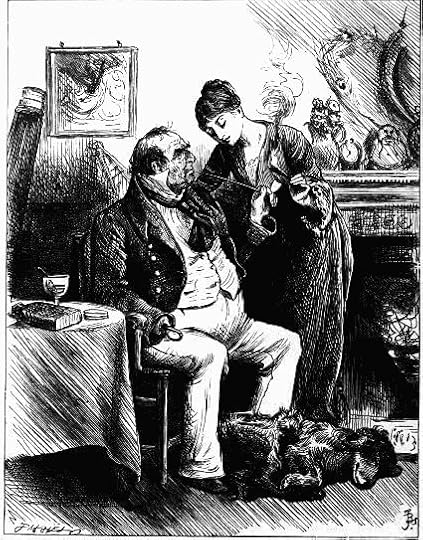
When he had filled his pipe in an absolute reverie of satisfaction, Florence lighted it for him.
Chapter 49
Fred Barnard
Text Illustrated:
The fowl and sausages were cold, and the gravy and the egg-sauce stagnant, before the Captain remembered that they were on the board, and fell to with the assistance of Diogenes, whose united efforts quickly dispatched the banquet. The Captain’s delight and wonder at the quiet housewifery of Florence in assisting to clear the table, arrange the parlour, and sweep up the hearth—only to be equalled by the fervency of his protest when she began to assist him—were gradually raised to that degree, that at last he could not choose but do nothing himself, and stand looking at her as if she were some Fairy, daintily performing these offices for him; the red rim on his forehead glowing again, in his unspeakable admiration.
But when Florence, taking down his pipe from the mantel-shelf gave it into his hand, and entreated him to smoke it, the good Captain was so bewildered by her attention that he held it as if he had never held a pipe, in all his life. Likewise, when Florence, looking into the little cupboard, took out the case-bottle and mixed a perfect glass of grog for him, unasked, and set it at his elbow, his ruddy nose turned pale, he felt himself so graced and honoured. When he had filled his pipe in an absolute reverie of satisfaction, Florence lighted it for him—the Captain having no power to object, or to prevent her—and resuming her place on the old sofa, looked at him with a smile so loving and so grateful, a smile that showed him so plainly how her forlorn heart turned to him, as her face did, through grief, that the smoke of the pipe got into the Captain’s throat and made him cough, and got into the Captain’s eyes, and made them blink and water.
The manner in which the Captain tried to make believe that the cause of these effects lay hidden in the pipe itself, and the way in which he looked into the bowl for it, and not finding it there, pretended to blow it out of the stem, was wonderfully pleasant. The pipe soon getting into better condition, he fell into that state of repose becoming a good smoker; but sat with his eyes fixed on Florence, and, with a beaming placidity not to be described, and stopping every now and then to discharge a little cloud from his lips, slowly puffed it forth, as if it were a scroll coming out of his mouth, bearing the legend ‘Poor Wal’r, ay, ay. Drownded, ain’t he?’ after which he would resume his smoking with infinite gentleness.
If I would have been there during all that "poor Walter drowned" was going on, I would have thought our captain had lost his mind. Or I would have.
Mod

Captain Cuttle and Florence Dombey
Chapter 49
Charles Green
Mod
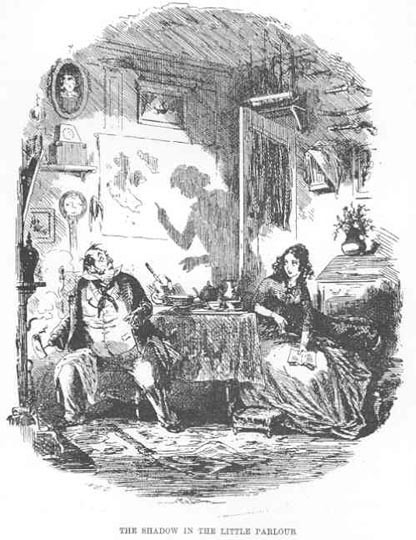
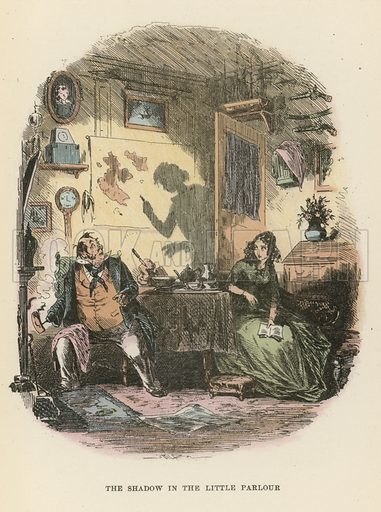
[image error]
original sketch
The Shadow in the Little Palour
Chapter 49
Phiz
Text Illustrated:
‘Days and nights they drifted on them endless waters,’ said the Captain, ‘until at last—No! Don’t look that way, pretty!—a sail bore down upon ‘em, and they was, by the Lord’s mercy, took aboard: two living and one dead.’
‘Which of them was dead?’ cried Florence.
‘Not the lad I speak on,’ said the Captain.
‘Thank God! oh thank God!’
‘Amen!’ returned the Captain hurriedly. ‘Don’t be took aback! A minute more, my lady lass! with a good heart!—aboard that ship, they went a long voyage, right away across the chart (for there warn’t no touching nowhere), and on that voyage the seaman as was picked up with him died. But he was spared, and—’
The Captain, without knowing what he did, had cut a slice of bread from the loaf, and put it on his hook (which was his usual toasting-fork), on which he now held it to the fire; looking behind Florence with great emotion in his face, and suffering the bread to blaze and burn like fuel.
‘Was spared,’ repeated Florence, ‘and—?’
‘And come home in that ship,’ said the Captain, still looking in the same direction, ‘and—don’t be frightened, pretty—and landed; and one morning come cautiously to his own door to take a obserwation, knowing that his friends would think him drownded, when he sheered off at the unexpected—’
‘At the unexpected barking of a dog?’ cried Florence, quickly.
‘Yes,’ roared the Captain. ‘Steady, darling! courage! Don’t look round yet. See there! upon the wall!’
There was the shadow of a man upon the wall close to her. She started up, looked round, and with a piercing cry, saw Walter Gay behind her!
Mod
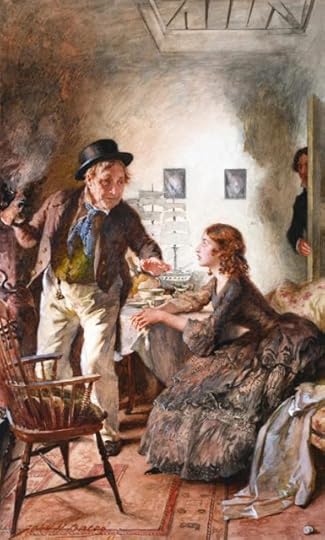
The Return of Walter Gay
Chapter 49
J F H Bacon
Mod
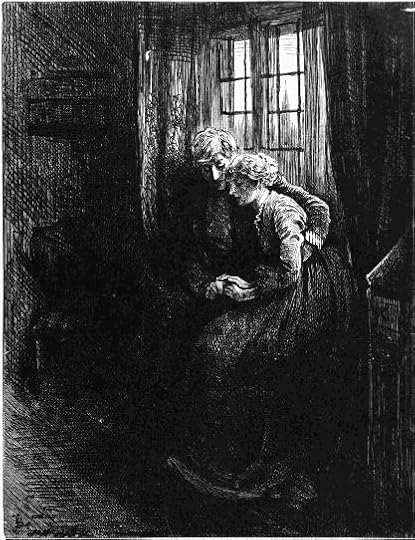
Blessed twilight stealing on, and shading her so soothlingly and gravely as she falls asleep
Chapter 50
Fred Barnard
Text Illustrated:
The head was still bent down, the tears still falling, and the bosom swelling with its sobs.
‘Dear Florence! Dearest Florence! whom I called so in my thoughts before I could consider how presumptuous and wild it was. One last time let me call you by your own dear name, and touch this gentle hand in token of your sisterly forgetfulness of what I have said.’
She raised her head, and spoke to him with such a solemn sweetness in her eyes; with such a calm, bright, placid smile shining on him through her tears; with such a low, soft tremble in her frame and voice; that the innermost chords of his heart were touched, and his sight was dim as he listened.
‘No, Walter, I cannot forget it. I would not forget it, for the world. Are you—are you very poor?’
‘I am but a wanderer,’ said Walter, ‘making voyages to live, across the sea. That is my calling now.’
‘Are you soon going away again, Walter?’
‘Very soon.’
She sat looking at him for a moment; then timidly put her trembling hand in his.
‘If you will take me for your wife, Walter, I will love you dearly. If you will let me go with you, Walter, I will go to the world’s end without fear. I can give up nothing for you—I have nothing to resign, and no one to forsake; but all my love and life shall be devoted to you, and with my last breath I will breathe your name to God if I have sense and memory left.’
He caught her to his heart, and laid her cheek against his own, and now, no more repulsed, no more forlorn, she wept indeed, upon the breast of her dear lover.
Blessed Sunday Bells, ringing so tranquilly in their entranced and happy ears! Blessed Sunday peace and quiet, harmonising with the calmness in their souls, and making holy air around them! Blessed twilight stealing on, and shading her so soothingly and gravely, as she falls asleep, like a hushed child, upon the bosom she has clung to!
Oh load of love and trustfulness that lies to lightly there! Ay, look down on the closed eyes, Walter, with a proudly tender gaze; for in all the wide wide world they seek but thee now—only thee!
Mod
Captain Cuttle and Florence. When she needed a home and a father she found both with Cuttle. That Cuttle could “magically” bring Walter back from being “drownded” is, at once, both very melodramatic and perfectly believable.
Mod
[image error]
original sketch
Mr. Dombey and the World
Chapter 51
Phiz
Text Illustrated:
The world. What the world thinks of him, how it looks at him, what it sees in him, and what it says—this is the haunting demon of his mind. It is everywhere where he is; and, worse than that, it is everywhere where he is not. It comes out with him among his servants, and yet he leaves it whispering behind; he sees it pointing after him in the street; it is waiting for him in his counting-house; it leers over the shoulders of rich men among the merchants; it goes beckoning and babbling among the crowd; it always anticipates him, in every place; and is always busiest, he knows, when he has gone away. When he is shut up in his room at night, it is in his house, outside it, audible in footsteps on the pavement, visible in print upon the table, steaming to and fro on railroads and in ships; restless and busy everywhere, with nothing else but him.
It is not a phantom of his imagination. It is as active in other people’s minds as in his. Witness Cousin Feenix, who comes from Baden-Baden, purposely to talk to him. Witness Major Bagstock, who accompanies Cousin Feenix on that friendly mission.
Mr Dombey receives them with his usual dignity, and stands erect, in his old attitude, before the fire. He feels that the world is looking at him out of their eyes. That it is in the stare of the pictures. That Mr Pitt, upon the bookcase, represents it. That there are eyes in its own map, hanging on the wall.
‘An unusually cold spring,’ says Mr Dombey—to deceive the world.
‘Damme, Sir,’ says the Major, in the warmth of friendship, ‘Joseph Bagstock is a bad hand at a counterfeit. If you want to hold your friends off, Dombey, and to give them the cold shoulder, J. B. is not the man for your purpose. Joe is rough and tough, Sir; blunt, Sir, blunt, is Joe. His Royal Highness the late Duke of York did me the honour to say, deservedly or undeservedly—never mind that—“If there is a man in the service on whom I can depend for coming to the point, that man is Joe—Joe Bagstock.”’
Mr Dombey intimates his acquiescence.
‘Now, Dombey,’ says the Major, ‘I am a man of the world. Our friend Feenix—if I may presume to—’
‘Honoured, I am sure,’ says Cousin Feenix.
‘—is,’ proceeds the Major, with a wag of his head, ‘also a man of the world. Dombey, you are a man of the world. Now, when three men of the world meet together, and are friends—as I believe—’ again appealing to Cousin Feenix.
‘I am sure,’ says Cousin Feenix, ‘most friendly.’
‘—and are friends,’ resumes the Major, ‘Old Joe’s opinion is (I may be wrong), that the opinion of the world on any particular subject, is very easily got at.’
Commentary:
The next plate to continue the Dombey-Edith-Carker triangle, "Mr. Dombey and the World" (ch. 51), pleased Dickens, and is another example of how picture and text may be closely integrated. The "stare of the pictures," and of Pitt's bust, as well as the eyes in the world's "own map, hanging on the wall," all derive from Dickens' text. Among the pictures that Phiz has included are the portrait of the first Mrs. Dombey, once again peering out from behind a cloth, and a staring miniature of little Paul; he has also introduced an especially sardonic and satyr-like Father Time immediately behind Dombey's back (perhaps a reference to Dombey's failure to control time in the case of Paul), an amused face on the urn next to Mr. Pitt, and, upon the fire place, two heads and a naked woman (or a Sphinx?) also regard Dombey. The reminders of Paul and Time imply something more than the shame of cuckoldry, but the withered and drooping flowers are suggestions of sexual impotence, while the Major's way of gesturing with his stick seems aggressively phallic in contrast to Dombey's present languidness. The peacock feathers attached to the mirror-again, hanging down, instead of displayed erectly~have three appropriate emblematic meanings: they are another example of "eyes" looking at Dombey, they inevitably evoke the idea of Dombey's overweening pride, and they symbolize the misfortune which has come to the House of Dombey.
Mod
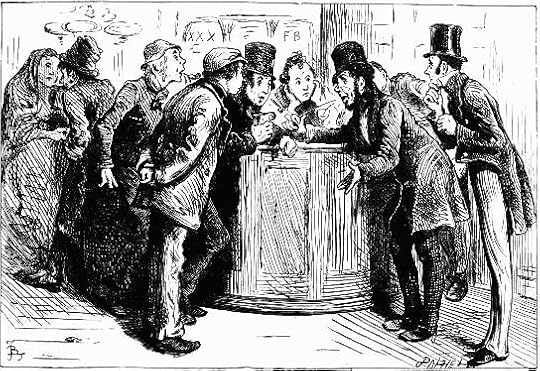
It appears that he met everybody concerned in the late transaction, everywhere
Chapter 51
Fred Barnard
Text Illustrated:
As to Perch, the messenger, he is in a fair way of being ruined for life. He finds himself again constantly in bars of public-houses, being treated and lying dreadfully. It appears that he met everybody concerned in the late transaction, everywhere, and said to them, ‘Sir,’ or ‘Madam,’ as the case was, ‘why do you look so pale?’ at which each shuddered from head to foot, and said, ‘Oh, Perch!’ and ran away. Either the consciousness of these enormities, or the reaction consequent on liquor, reduces Mr Perch to an extreme state of low spirits at that hour of the evening when he usually seeks consolation in the society of Mrs Perch at Balls Pond; and Mrs Perch frets a good deal, for she fears his confidence in woman is shaken now, and that he half expects on coming home at night to find her gone off with some Viscount—‘which,’ as she observes to an intimate female friend, ‘is what these wretches in the form of woman have to answer for, Mrs P. It ain’t the harm they do themselves so much as what they reflect upon us, Ma’am; and I see it in Perch’s eye.’
Mod
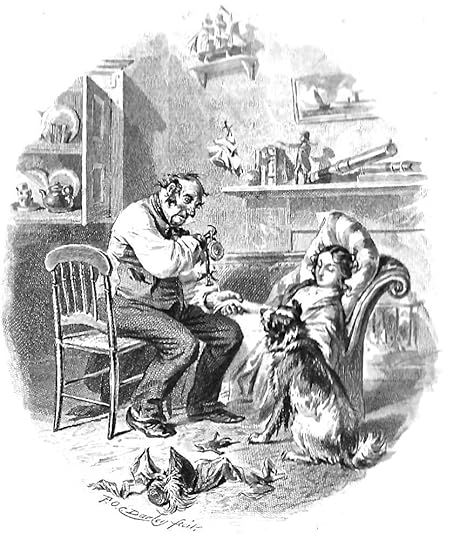
Captain Cuttle . . . took his own [watch] down from the mantel-shelf
Chapter 48
Felix O. C. Darley
1862
Text Illustrated:
"My Heart's Delight!" said the trembling Captain. "For the sake of Wal'r drownded in the briny deep, turn to, and histe up something or another, if able!"
Finding her insensible to this impressive adjuration also, Captain Cuttle snatched from his breakfast-table a basin of cold water, and sprinkled some upon her face. Yielding to the urgency of the case, the Captain then, using his immense hand with extraordinary gentleness, relieved her of her bonnet, moistened her lips and forehead, put back her hair, covered her feet with his own coat which he pulled off for the purpose, patted her hand — so small in his, that he was struck with wonder when he touched it — and seeing that her eyelids quivered, and that her lips began to move, continued these restorative applications with a better heart.
Commentary:
At this stage of the novel Dickens deftly merges the Walter Gay subplot and the Dombey main plot as the breakup of the marriage of her father and stepmother leads to Florence's rejection by both. Mr. Dombey, distraught at Edith's departure, strikes Florence, who flees her home and, wandering dazed through the London streets, arrives at The Wooden Midshipman. There, Captain Cuttle takes her under his protection and endeavours to nurse her back to health in Chapter 48. As she recovers, the noble, old sailor recounts the story of the survivors of a shipwreck, which Florence suddenly realizes is the story of Walter's survival. In the next monthly part in the original serial, Walter's shadow cast upon the wall of the parlour signals his return and ultimately leads to the marriage of Florence Dombey and Walter Gay. Needless to say, Darley had his choice of many significant events in the final volume, which covers chapters 47 through 62, which is to say "The Thunderbolt" (in which Edith demands that her husband release her from their loveless marriage) to "Final". Nevertheless, Darley has elected once again to graph that part of the story that pertains to the nautical rather than the corporate characters.
Darley had precedent for an illustration of this group aboard The Cautious Clara in Part 8 of the original serial, with Phiz's picture of the visit to Sol Gils's map-strewn parlour, Solemn Reference is Made to Mr. Bunsby (May 1847) — even though Bunsby is at best a tertiary character, and hardly an oracle to be consulted about the fate of Walter Gay. The Darley scene, set above decks, is far less congested than Phiz's in Sol Gills's parlour, and is visually more engaging because of its giving prominence to the two old salts, the protective Captain Cuttle and the obtuse Captain Bunsby, with Florence and her maid in supporting roles. In place of the crowded Phiz composition whose centre is Sol Gills, a map, and Susan Nipper, Darley has organized the composition so that the emphasis is on the comic characters with the amusing visages and extraordinary costumes, Bunsby and Cuttle.
In contrast to Phiz's January 1848 engraving signalling at the opening of the instalment Walter Gay's sudden return, The Shadow in the Little Parlour, Darley's frontispiece for the fourth and final volume does not reveal much of the plot, other than, after her father's striking her, Florence makes her way to The Wooden Midshipman and Captain Cuttle's protection. The lengthy caption merely confirms that Florence will recover: “At this stage of her recovery, Captain Cuttle, with an imperfect association of a Watch with a Physician's treatment of a patient, took his own down from the mantel-shelf, and holding it out on his hook, and taking Florence's hand in his, looked steadily from one to the other, as expecting the dial to do something” (caption beneath the photogravure). The reader will certainly have kept in mind the illustration of Captain Cuttle's nursing the distraught girl back to health, a proleptic reading that creates a sense of anticipation without revealing Walter's return. Darley has placed Florence's discarded bonnet on the floor to imply the suddenness of her arrival and the haste with which the good Captain has tended her, and the Captain's gazing at Diogenes to affirm the the improvement of her condition (although he has no idea how to employ the watch to measure her pulse rate). The bric-a-brac evident in the illustration reveals the dual nature of the apartment, with a teapot and china on the sideboard to the left suggesting a parlour and the seascape, telescope, and books above the fireplace underscoring the nautical background and occupation of the owner, who is in fact Sol Gills. Although Darley has used a caricatural treatment for the sailor's face, he has exploited the depth of field in the photogravure for photographic realism, especially effective in the dog's shaggy coat.
Whereas Darley's intention seems to have been to hint at the trajectory of the plot and engender sympathy for Florence, Phiz alerts the reader to a significant plot development. In the Household Edition volume issued by Chapman and Hall, Fred Barnard — who is not likely to have studied Darley's frontispiece — nevertheless illustrated Florence's collapsing, exhausted, before a startled Captain Cuttle, a melodramatic moment realistically realized, but eliciting sympathy only for the girl in Florence made a motion with her hand towards him, reeled, and fell upon the floor (p. 344). A few pages later, Barnard assures the reader of Florence's recovery as she tends to Captain Cuttle's comfort in When he had filled his pipe in an absolute reverie of satisfaction, Florence lighted it for him. Nevertheless, Darley's treatment remains more emotionally satisfying as the American illustrator communicates the old salt's genuine tenderness for the rich girl who, at this point, seems to have lost her family through death and divorce.
Mod
About the boy, who appears in the last chapter of the first number, I think it would be a good thing to disappoint all the expectations that chapter seems to raise of his happy connection with the story and the heroine, and to show him gradually and naturally trailing away, from that love of adventure and boyish light-heartedness into negligence, idleness, dissipation, dishonesty, and ruin. To show, in short, that common, everyday, miserable declension of which we know so much in our ordinary life; to exhibit something of the philosphy of it, in great temptations and an easy manner; and to show how the good turns into bad, by degrees. If I kept some little notion of Florence always at the bottom of it, I think it may be made very powerful and useful. What do you think? Do you think it may be done, without making people angry? I could bring out Soloman Gills and Captain Cuttle well, through such a history; and I descry, anyway, an opportunity for good scenes between Captain Cuttle and Miss Tox. This question of the boy is very important. . . Let me hear all you think about it. Hear! I wish I could.
Mod
You have given us a puzzle to unwind. The “last chapter of the first number” is, I believe, Chapter 4, “In which some more First Appearances are made on the Stage of these Adventures.” In this chapter we do have the introduction of Walter.
It was Dickens’s original plan to have Walter die but he later realized that the plot would work better with Walter in it, able to return and ... well ... no spoilers but we will see what happens in the last few chapters.
I think it sounds very ominous. I hope it is connected to The Whiner in the end, because it would fit him, while I think I would be heartbroken if this would happen to Walter. It being The Whiner would also make the connection to Miss Tox more ... better, more natural, something like that?
Mod
Alissa,
I am glad that Kim takes so many pains in keeping us up to date with the illustrations because now we see that the shadow indeed looks very menacing - just mark the Captain's posture and facial expression, although he ought to know that it is Walter who is waiting outside. It is, indeed, a riddle.
I like it, however, that Florence proposes to Walter because that makes her more active - she has been quite passive throughout the novel so far -, and it also shows her capacity to love. I think that this is the major idea behind her jumping into action for once. I'd also say that Walter couldn't well ask her to marry him because of the social distance between them and the fact that, from a strictly worldly point of view, there is little he can offer her. Maybe, that would have shocked Victorian audiences even more? I have no idea.
Mod
That's a good question, Kim. I don't think that Dickens is writing about Rob here because after all, Rob is but a minor character, and his relationship with Florence and Dombey is not extremely close, and so why would he fall into worse manners through Florence? I'd say that Dickens was thinking of having Walter go to seeds and that he thought better (or worse) of it with regard to the reactions he anticipated on his readers' part. They would clearly not like it because they were used to a happy ending.
Interestingly, it was in Bleak House that Dickens would later write a story about a basically good and hopeful young man, Richard Carstone, go down a bad road because he allowed himself to be led astray by his expectations with regard to the fortune he would one day inherit. Carstone does not really concentrate on a career in life although he has three chances, but focuses his hopes and strength on finishing that entangled lawsuit at the end of which he anticipates the famous pot of gold. The result is, to him and his young wife, disastrous. Maybe, Dickens was more daring in Bleak House because unlike Walter, Richard was not a main character in that he was not the male counterpart of the heroine, i.e. he was never going to marry Esther. His way to wreck and ruin was a side issue of the novel, a novel which is so rich in plots that Dickens could justly assume that his readers would not be overly interested in Richard's getting a happy ending. How important these happy endings were can be seen from the fact that there are two endings to Great Expectations - one for adults, and one for romanticists.
Mod
Thanks.
Mod
I was confused because to me the the last chapter of the first number was Chapter 3, simply because I am used to the numbers being three chapters, I forgot they are sometimes four. So when Peter reminded me the first number ended with Chapter 4 not 3 my confusion was gone.
Mod
Tristram wrote: "Kim wrote: "I have a question about a letter Dickens wrote to Forster on July 25, 1846. I have always thought the boy was Walter, but he isn't in the chapter Dickens mentions, but Rob the grinder i..."It seems to me the cozy domesticity of the Midshipman works against the idea of Walter's corruption. He has too many people to disappoint if he goes bad.
I know some people pull off badness anyway, but.

The Old Curiosity Club
Books mentioned in this topic
Bleak House (other topics)Great Expectations (other topics)

The Midshipman makes a Discovery
Another week of COVID has passed and we hope all the Curiosities are in good health. The restrictions are being eased here in Canada but when we all feel entirely comfortable remains to be seen. For now, let’s go to mid nineteenth century London and see how Florence is.
In the last chapter we left Florence asleep at The Wooden Shipman. She had fled her home after being struck by her father. As this chapter opens she is being tenderly watched over by Captain Cuttle. When Florence awakes he greets her with the phrase “My pretty ... what cheer?” No doubt this is the first time she has ever been complimented by an adult male or asked how she is feeling. Captain Cuttle is “quietly protective of her.”
Florence and Cuttle have both lost many they cared for and loved. Florence’s mother died giving birth to her, Paul, her only brother, died at a young age, her maid Susan Nipper was dismissed from attending her, her step-mother could not give Florence the love she needed, and her father hit her so hard that she has on her breast “the darkening mark of an angry hand.” For Captain Cuttle, Walter is apparently lost at sea as is Sol Gills, Rob the Grinder abandoned him, and Captain Bunsby is at sea.
Florence realizes that it will be necessary to buy more clothes “for she had none but those she wore” when she fled her father’s home. This is the second time we have seen Florence in need of clothes, and both times the situation has occurred when she was at The Wooden Midshipman. I do not think this is a mere coincidence. It seems to me that Dickens through the loss and assumption of a new wardrobe signals a major change and shift in the story. The first time Florence assumed a new wardrobe occurred when she first went to the sanctity of the Wooden Midshipman after escaping from Good Mrs Brown. It was at The Wooden Midshipman that she first encountered Captain Cuttle, Sol Gills and, of course, Walter. In this chapter we have Florence again obtaining a new wardrobe, which suggests a new identity or new phase in her life is about to begin.
Captain Cuttle prepares a full meal for Florence and then casually introduces the subject of Walter's loss at sea. I didn’t count the exact number of times Dickens has Cuttle point out that Walter “drownded.” Dickens does point out to the reader that “the repetition of this [word]... was a curious source of consolation.” After dinner we see Florence and Captain Cuttle set themselves into a blissful mode of comfort. Cuttle has his pipe and Florence dutifully attends to his needs. It’s a rather typical Victorian domestic scene, a calming one, after the turmoil of the last couple of days.
Thoughts
What do you think is the significance that both Cuttle and Florence are people who have lost many of their friends and family?
Why might Dickens have created such a domestic setting in the first part of this chapter?
The house of Mr Dombey and the Wooden Midshipman are very different places. Why might Dickens have created such contrasting places?
In a post last week Tristram pointed out how unsettling, if not improper, it would be to Victorian sensibilities for a young unattached female to be in residence with an older male, especially a male who was neither a relative nor an employer. How did you respond to this circumstance?
It seems that Captain Cuttle is a bit on edge. He constantly repeats the fact that Walter is “drownded” and overuses the phrase “Poor Wal’r.” Florence worries that she might be the cause of the Captain’s sorrow. Florence is also concerned about “the darkening mark upon her bosom [which] made her afraid of herself, as if she bore about her something wicked. She covered it up, with a hasty faltering hand ... and laid her weary head down weeping.” Her father’s blow has become a stigmata near her heart.
The next day Captain Cuttle introduces Walter’s name into their conversation yet again, and tells Florence a tale of a shipwreck and a gallant young lad who survives. During this narrative the Captain seems agitated, nervous, and tells Florence first to be calm, and then to look upon a shadow on the wall close to her. It is, of course, Walter. Now, Dickens knows how to create a scene, and suspense, and melodrama. Here is a good example of it. It takes many paragraphs to unravel the domestic scene that follows. We learn that some night’s ago when Diogenes barked it was in fact because Walter was at the door. We learn that Walter has been staying at Brogley’s, and that Cuttle has stage managed the unveiling of Walter to Florence. For now, Florence continues to call Walter “dear brother” and Walter calls Florence “Miss Dombey.” Florence shrieks when Walter mentions the name “father” to Florence and thus Walter realizes that Florence is “a homeless, wandering fugitive.”
If we look back to chapter 19 titled “Walter goes away” we will recall the surprise visit from Florence to The wooden Midshipman to say goodbye to Walter. When Sol Gill told Walter that Miss Dombey had come to visit Walter exclaimed “[i]s it possible? Here?” We’ll yes, it was Florence, and she surprised Walter on the eve of his departure. Now, in this chapter, we have Walter returning to the Midshipman and surprising Florence. There is a symmetry to Dickens, and our present chapter offers an example of how Dickens incorporates a symmetry of plot.
Thoughts
We have many chapters still to read, but in this chapter we witness Dickens slowly braiding strands of plot and character together. What do you foresee in the future for Walter and Florence?