
The Old Curiosity Club discussion
David Copperfield
>
DC Chp 28-31

 Mod
Mod
I visit Steerforth at his Home, again
In this chapter we visit Steerforth and his mother at their home. To me, the most interesting parts of the chapter are the sections that feature the curious and disquieting character of
Rosa Dartle. She is a mystery to me. Let’s see what we can discover together.
First, David comments on how closely Miss Dartle watches Steerforth. She enjoys “lurking” around. David compares her piercing scrutiny as “lynx-like.” Her presence, David tells us, pervades the whole house. When Steerforth, his mother, Dartle and David go for a walk Dartle “closed her thin hand on [David’s] arm like a spring.” She tells David that she always wants to be informed of what is occurring around her. In their conversation, Rosa asks if the reason Steerforth has not been to visit his mother for some time is because he has been spending time with David. David rejects her assertion. David then notices how Dartle’s face grew “sharper and paler, and the marks of the old wound lengthen[ed] out until it cut through the disfigured lip, and deep into the nether lip.” Dickens’s concentration on Dartle’s face further demonstrates the passion that she struggles to contain whenever she talks or thinks about Steerforth. She asks David what Steerforth is doing “with an eagerness that seemed enough to consume her like a fire.” She wants to know what has changed in Steerforth, what is consuming his time, what “wild fancy” or love is leading him. For his part, David thinks that nothing is markably different about Steerforth. This answer creates a “twitching or throbbing” in Dartle’s face. With this, Dartle then swears David to secrecy about her questions and the physical manifestations that occurred on her face.
Thoughts
We recall that the disfigurement of Rosa Dartle’s face is the result of Steerforth throwing a hammer at her. It is apparent that Rosa’s face also reflects a physical manifestation of her mind when she thinks of Steerforth. Why might Rosa Dartle be so interested in Steerforth’s movements and the fact he has not been home lately?
To what extent do you think the physical disfigurement of Rosa’s face and its physical changes reveals something deeply psychological in Rosa’s character.
David notices the “strong physical resemblance” between Mrs Steerforth and her son and what was “haughty or impetuous in him was softened by age and sex in her.” This tells us that David is capable of recognizing some of his friend’s faults. In a rather strange conversation between Rosa and Mrs Steerforth we learn that Rosa used to be “less guarded and more trustful.” Rosa then says that she could learn more frankness from Steerforth. Dartle then wonders what would happen if Mrs Steerforth and her son were to have a serious quarrel. What is going on here? What is being alluded to I wonder? No doubt we will find out sometime. In the meantime David observes that when Steerforth charms Rosa her “sharp glance” softens. It is evident that Steerforth has the power to at least partially tame Miss Dartle.
What happens next is rather puzzling, but richly suggestive. Rosa takes to her room, begins to play a harp and Steerforth asks her to play while he sits and listens “as I used to do.” Next, at Steerforth’s request, Miss Dartle begins to sing and David recalls that her voice was the “most unearthly I have ever heard in my life.” Steerforth approaches Rosa and says “Come on Rosa, for the future we will love each other very much.” Hearing this, Rosa Dartle strikes Steerforth and throws him off “with all the fury of a wild cat, and burst out of the room.” Earlier we read that Rosa watched others with a “lynx-like scrutiny.” Here, Rosa Dartle is compared to the “fury of a wild cat.” Later, Steerforth laughs at her and asks David if he “has ever seen such a fierce little piece of incomprehensibility.” Then, in a curious turn of phrase Steerforth asks David that if anything should separate them David should “think of me at my best, if circumstance should ever part us.”
Our chapter ends with the David’s words “Never more, oh God forgive you, Steerforth! to touch that passive hand in love and friendship. Never, never more!”
Thoughts
Steerforth once again shows a lack of empathy when he dismisses Rosa’s actions. Then he asks David to think kindly of him in the future. Lastly, we learn that something will occur in the future that will ruin their friendship forever. This chapter is one of high tension, character revelation, and foreshadowing. What do you think are the key elements in this chapter we need to focus on going forward?
Rosa Dartle tells David what he has not himself yet seen in his friend Steerforth. How important is Dartle to the narrative structure of the novel?
Dartle’s scarred face is its own language. As the novel progresses watch her face for it will speak to us very painfully and clearly. Have we encountered in previous novels other characters whose physical appearance speaks to us? One I can think of is Bagstock in Dombey and Son. At times I thought his head would explode.
Mod
A Loss
After David leaves the Steerforth home he heads down to Yarmouth in order to see Peggotty and the ailing Barkis. Hi first stop is to see Mr Omer of Omer and Joram’s. Here David (and thus the reader) gets the latest news of the town. Their conversation is tinged with humour. Mr Omer points out that an undertaker can’t really as how people are: “when a party’s ill, we can’t ask how the party is.” Next, and more critical to the plot, we learn that Little Em’ly has been acting in a peculiar fashion lately and Mr Omer says he will be glad when the marriage has taken place. When David inquires as for why Omers replies that “she wants heart.” Omer recounts how Em’ly “clings on to [Mr Peggotty], tighter and tighter, and closer and closer ... you know there is a struggle going on when that’s the case.” Apparently, the reason for Em’ly’s strange behaviour is not Ham side he has a streaky job and is a good man. Their house is furnished and comfortable. Em’ly gets fonder and fonder of her uncle and more and more loth “to part from all of us.” A kind word brings Em’ly to tears. Next, we learn more about Martha and that story is “a sad story.”
David goes to the Peggotty’s and is greeted warmly. He tries to cheer Em’ly up with the news of David’s arrival but is unsuccessful. Ham arrives but Em’ly wants to stay with Mr Peggotty. He agrees, but David observes how Em’ly clings closer to her uncle when Ham attempts to kiss her. David comments how Ham has the soul of gentleman.
David then goes up the stairs to see Peggotty and Barkis. He finds Barkis gravely ill and resting with his famous box that has keep him company for so many years. Barkis does recognize David. Indeed, his final earthy words are “Barkis is willin’” and so it being low water, the traditional time of death along the coastal region, Barkis “went out with the tide.”
Thoughts
This is a rather short chapter but within its paragraphs there is much to consider. First, what can possibly be the source or reason for Em’ly’s strange behaviour? Doubts of marriage to Ham? Some unknown fear? Guilt? But what guilt?
Have you noticed that in the preceding chapters the name of Martha passes like a shadow when Em’ly is present or discussed. Is Dickens signalling something to his readers?
Barkis passes in this chapter. How might this change the dynamics of the Peggotty family, or Peggotty specifically? Will his death have any impact on David?”
What might have been the key purpose of such a short chapter?
Mod
A greater Loss
This chapter begins with us reading that Peggotty had bought a plot in the old graveyard of Blunderstone for herself and Barkis and the plot is located near the grave of David’s mother. Throughout our time reading DC we have shared our various opinions of David's mother. In this chapter we learn that Peggotty has chosen a plot close to her. Does this help us come to a final conclusion about her character? For me, it does. I feel sorry for her. Life presented too much to a too young woman who was unsure what to do. Murdstone hoodwinked her, preyed upon her, and ultimately convinced a naive young mother to marry him.
We learn that the box Barkis carried around for so long contained property and money worth nearly £3000. Peggotty is well provided for and Little Em’ly, David, and Mr Peggotty were beneficiaries as well.
The next section of this chapter contains a great shock - that, or a confirmation of what we have been sadly anticipating from the numerous hints that Dickens has provided in earlier chapters. In order to anticipate the next pages of the narrative we read that “rain was falling heavily ... and it was a wild night.” Pathetic fallacy at its finest.
We find the Peggotty house snug, warm, and dry. Everyone is safe inside and Mr Peggotty sets a candle in the window “lighted up, accordin’ to custom! ... it’s fur our little Em’ly.” Mr Peggotty says that even after Em’ly is married he will still put a candle in the window. But where is Little Em’ly? Ham then appears at the door weeping and “deathly pale”. We learn that Em’ly is gone. Em’ly has run away, and in the worst possible manner. Ham says he “pray[s] ... gracious God to kill her ... sooner than let her come to ruin and disgrace.” How do you read that comment? What has happened to Little Em’ly?
The stoic heart of the home, Mr Peggotty, lets out a “great wail and cry.” He is a ghastly sight to behold. There is a note from Em’ly. Its contents reveal that she has left home and gone far away. She never intends to come back unless “he brings me back a lady.” The note reveals that Em’ly realizes she knows her actions are wrong, that her decision has made her suffer greatly, and that even in this moment of her dark decision she loves her uncle more than ever. She asks that the household “try to think as if I died when I was little, and was buried somewhere.” For a second time in the letter Em’ly writes “if he don’t bring me back a lady.” Mr Peggotty wants to know who the man is. Ham asks David to leave the room because “you doen’t ought to hear it, sir.”
Ham recounts that there has been a servant about the town and a gentleman too who are connected. The servant was seen with Em’ly last night. Finally, Mr Peggotty puts the pieces of the puzzle together and realizes the man who Em’ly has left with is none other than Steerforth. Mr Peggotty tells everyone that he is going to seek his niece, but first he is going to stave Steerforth’s boat. Peggotty says that if he had known what was occurring around him he would have drowned Steerforth. Mrs Gummidge urges Mr Peggotty to take some time to reflect before he goes in search of Em’ly. Mr Peggotty does calm down somewhat. As our chapter ends we learn that he was crying. David cries as well, and realizes that he has been partly responsible for what has occurred and he curses Steerforth.
Thoughts
If we go back a look at earlier chapters we will find many subtle hints that there was something brewing that was not healthy. Em’ly clung to Mr Peggotty more. Steerforth was not at school but was unaccounted for, and Steerforth mentioned to David more than once that he wished he had a father or a stronger moral compass. Steerforth had purchased a boat called the “Storm Petrel” and renamed it the “Little Em’ly.” In your reading what were the strongest hints that something was brewing between Steerforth and Little Em’ly?
Little Em’ly seems focussed on the fact that she may well become a lady because of Steerforth. To what extent do you see this as a real possibility?
The warning of Agnes to David about Steerforth has tragically come to pass. At this point in the novel what is your opinion of Steerforth? Of Little Em’ly? Of David?
If we go back to Chapter 3 of the novel young David asks Em’ly if she would like to be a lady and she replies “I should like it very much. We would all be gentlefolks together then. Me, and uncle, and Ham, and Mrs Gummidge ... not for our own sakes, I mean. We would for the poor fishermen’s to be sure, and we’d help ‘em with money.” Could this be the only reason Em’ly went away with Steerforth? What other motivations are there?
Looking back, Chapter 3 is a remarkable chapter of foreshadowing and suspense. If you have the time, read it again. It certainly shows that this novel was very well planned and constructed.
 Peter wrote: "Chapter 28
There is a clear contrast between the dinner parties held for Steerforth and his friends and the one with the Micawber’s and Tommy Traddles...
******************
I wonder why he seems to like David so much?..."
While I still don't see much charm in the Micawbers, I enjoyed the fact that David was so at ease with his company that when things went wrong they all just laughed and made the best of it. Laughing at the problems made it an enjoyable time, and gave them a bond. Then Littimer arrives, and all his efficiency takes the fun right out of it. It made me think of kids playing a pick-up ball game on the vacant lot in the neighborhood, only to have an adult come along and decide to organize teams and be their coach. Nothing takes the fun out of things more than putting an adult in charge.
The seeds of warning Agnes has planted in David's mind are taking hold, but he's not ready to accept them just yet, despite the flagrant disregard Steerforth exhibits in this chapter. Peter asks why he seems to like David so much, which is a good question. I think David's money for the dormitory feast put him on Steerforth's radar. After that, it was just the plain fact that David obviously was showing him hero-worship. What narcissist doesn't like a fawning minion?
Peter wrote: "Chapter 29I visit Steerforth at his Home, again
In this chapter we visit Steerforth and his mother at their home. To me, the most interesting parts of the chapter are the sections that feature ..."
Well, this chapter was full of dark foreboding, wasn't it?
Just like Littimer's respectability and Uriah's humility, Dickens is overdoing it with Rosa's "I really don't know, that's why I'm asking" routine. I love this story, and his writing has tightened up considerably since the earlier days of Oliver Twist and The Old Curiosity Shop, but Dickens' editors could still have given him a lesson in the old adage of "sometimes less is more."
But as to the story itself, it seems obvious that Rosa is a woman scorned. She loves Steerforth despite knowing he's toxic. The question is, what has transpired between them over the years? And is Mrs. Steerforth aware of any of it? I think not, or she'd probably cut Rosa off. Every time Rosa looks in a mirror for the rest of her life, Steerforth and his treatment of her will be staring back at her.
Amazing that someone as obtuse as David is about Steerforth's character can have such incredible powers of observation when it comes to Rosa's facial expressions. She obviously doesn't have a poker face, at least where Steerforth is concerned.
Peter wrote: "Chapter 30A Loss..."
A transitional chapter to be sure. I'm glad to see that Dickens hasn't dispensed with Mr. Omer, though his only purpose still seems to be to provide us with an update of the goings-on in Yarmouth since David's (and our) last visit. Is there such a thing as a secondary narrator? If so, I'd think Mr. Omer would fit the bill.
I'm sorry to see Barkis go. Dickens surely had something in mind for this character, so it will be interesting to find out how his death changes things for Peggoty and the other good people of Yarmouth.
PS Interesting tidbit on undertakers. It never occurred to me that having them show up to inquire about a neighbor's condition might be taken badly, though it's one of those things that makes perfect sense once it's pointed out. Just another little insight that makes Dickens the master of observation and human behavior.
Peter wrote: "Chapter 31A greater Loss
Mr Peggotty says that even after Em’ly is married he will still put a candle in the window...."
The Peggottys are just like Motel 6 -- "We'll leave the light on for you." :-)
Chapter 31 has brought us to a denouement of sorts. As Peter points out, so much of the book so far has been leading us to this point. And yet there is still so much more ahead!
As a 21st century reader, I have questions that Dickens' contemporaries probably wouldn't have. Peter wonders what the likelihood of Em'ly returning as a lady is. The fact that Em'ly herself isn't sure leads us, I suppose, to believe that she and Steerforth have not necessarily eloped, but that Em'ly has, to allude to another literary character, gone the way of Lydia Bennet.
Is it possible that they've married, but went away because Em'ly couldn't face breaking her engagement with Ham? Would that still be enough of a scandal for she and Ham to talk about it being better that she'd died? All the references to Emily (I'm sorry - I just can't!) dying, and Mr. Peggoty wishing he'd killed Steerforth seems like an overreaction, especially if she and Steerforth were husband and wife.
Questions -
Rosa Dartle obviously knew something was up with Steerforth. Just suspicions based on his behavior, or does she have some inside information? How much tongue-wagging does Littimer engage in with the other servants, or with Rosa herself? Or does Rosa have some other informant?
What will Mr. Peggoty do if he actually locates the couple? In Lydia Bennet's case, her Uncle paid Wickham to marry her, but does Steerforth need the money, and do the Peggotys have it to give? (That £3200 inheritance of Peggoty's suddenly seems like convenient timing, does it not?)
Ending my comments on a more positive note, I was pleased that David was able to use what he's learned with Mr. Spenlow to help Peggoty with her husband's estate. I actually felt like a proud mama when I read this bit:
I began to think there was more in the Commons than I had supposed. I examined the will with the deepest attention, pronounced it perfectly formal in all respects, made a pencil-mark or so in the margin, and thought it rather extraordinary that I knew so much.
And just like that, David is maturing. Nice.
I really do not believe they are married yet. Steerforth might plan to - or not, it might all be his way to get Emily into his bed - but I think it mostly is that he wants her, and he uses her hopes and dreams to get to her. And mark my words, the way Steerforth is, it will end in him not marrying Emily, ever. She will die first, or perhaps come back to Ham (who would be very ready to catch her and make sure she has some shreds of respectability left if he's given the chance, the way he behaves) and never be really happy anymore, ever. Both are viable options I think, in a Dickens novel.
Can I say it? I had difficulty getting through chapter 28. I loved the contrast with Steerforth's party - it made very clear that you are better off with only little and good company, than with much and company that is shallow and hedonistic like Steerforth and his pals. I get rather tired of the Micawbers though. I think mr. Micawber tries, and he can be a bit funny in it, but the trope of 'all is fine, here's a letter, I'm secretly desolate (and pull others down with me)' has been done enough to make me grow weary of it now. Also, I wanted to scream at Mrs. Micawber, no he is NOT talented, he either doesn't work, or he does what he does so badly that he doesn't bring in anything to provide for his family. Get off your high horse lady, and kick that good-for-nothing husband of yours to a job, any job to at least bring in something, and stop spending money you don't have, and money others don't have. Make him, I don't know, a clerk or a shoe blackening tinner or a bottle lable paster or whatever, anything would be better than advertising for a position he cannot hold. Mr. Micawber is the Dickens' era mlm hun, who refuses to get a real job and calls himself a #bossbabe while losing money everywhere. /endofmyrant
Can I say it? I had difficulty getting through chapter 28. I loved the contrast with Steerforth's party - it made very clear that you are better off with only little and good company, than with much and company that is shallow and hedonistic like Steerforth and his pals. I get rather tired of the Micawbers though. I think mr. Micawber tries, and he can be a bit funny in it, but the trope of 'all is fine, here's a letter, I'm secretly desolate (and pull others down with me)' has been done enough to make me grow weary of it now. Also, I wanted to scream at Mrs. Micawber, no he is NOT talented, he either doesn't work, or he does what he does so badly that he doesn't bring in anything to provide for his family. Get off your high horse lady, and kick that good-for-nothing husband of yours to a job, any job to at least bring in something, and stop spending money you don't have, and money others don't have. Make him, I don't know, a clerk or a shoe blackening tinner or a bottle lable paster or whatever, anything would be better than advertising for a position he cannot hold. Mr. Micawber is the Dickens' era mlm hun, who refuses to get a real job and calls himself a #bossbabe while losing money everywhere. /endofmyrant
Jantine wrote: "Can I say it? I had difficulty getting through chapter 28...."You can say it. My sentiments exactly.
Mod
A greater Loss
Mr Peggotty says that even after Em’ly is married he will still put a candle in the window...."
The Peggottys are just like Motel 6 -- "We'll leave the lig..."
Hi Mary Lou
Good question about Rosa. I find her both fascinating and perplexing. Her scar has a life of its own and seems to project onto her face her inner turmoil and emotions.
I don’t think she has any inside information or informant. To me, while she may be a rather disturbing character, I think she is a clever one. She handles Mrs Steerforth quite well. I think she has a profound understanding of exactly who Steerforth is and what he is like and likely to do. In one way she is the binary character to Agnes. Both these females are able to intuit what truly resides within Steerforth. Agnes warns David that Steerforth is a devil, not an angel. With the scar as proof, Rosa wears the mark of Steerforth’s aggressive and harmful character.
Earlier it was mentioned that David Copperfield was Freud’s favourite novel. I suspect Freud would have enjoyed having a few sessions with Rosa.
Mod
Hi Jantine
I’m in full agreement with you about Mr Micawber. I find his rambles annoying, repetitive, and not funny or enduring at all.
Also, we are on the same page with our thoughts about Mrs Micawber. Please lady, being faithful to someone is an admirable characteristic but enough is enough.
Evidently these two characters are supposed to supply some comic relief and mirth into the novel. I’m still waiting. :-(
 Mod
Mod
Undoubtedly, Rosa is still in love with Steerforth, although their union would never be a happy one, since she must also hate him for what he has done to her. She is clearly aware that there is something going on in Yarmouth and she wanted to worm particulars out of David - only he was even more ignorant than she as to what actually happened.
I thoroughly dislike Steerforth, and this is mainly because he knows that what he is doing will lead up to no good, and yet he is doing it anyway. He seems like a pampered dandy to me, and he has no reason whatever to talk with disdain about Traddles because Traddles is not as weak as he takes him. After all, Traddles was the only student to object to the way Steerforth was treating Mr. Mell, whereas David simply stood by (as he always does) and all the other boys enjoyed the racket.
I was impressed with Mrs. Gummidge at the end of the final chapter: She is ready to step in between Mr. Peggotty and any rash actions he might be about to undertake and in the process she readily admits that all her sorrows are nought compared to what has now befallen Mr. Peggotty. That's grandness.
Tristram wrote: "I was impressed with Mrs. Gummidge at the end of the final chapter: She is ready to step in between Mr. Peggotty and any rash actions he might be about to undertake and in the process she readily admits that all her sorrows are nought compared to what has now befallen Mr. Peggotty. That's grandness. ..."I meant to mention this. She's finally doing what we all must do to stop dwelling on our own problems, and that is to focus on helping others. With luck, this will be a turning point for her.
 I'm glad some of you think like me: the Micawbers are boring, annoying, irritating people! Whenever they appear I think 'oh no not them again,' and the chapter drags. I don't understand why these characters have become so famous. I find the humour in the chapters where they appear to be terribly out-dated, which is strange, given that so many other characters and passages in the book had me in stitches. There's just something not quite right about the Micawbers as characters, don't you think? Is it their artificiality? Is it their predictability? Their long-windedness? I have no idea what Mr Micawber is talking about half the time. Won't that guy ever shut up? I am now relying on Dickens's genius to pull something amazing out of the Micawber hat. Let's see if he can do it.
I think for me it mostly is the long-windedness and predictability - although the latter is not all. Gamp was predictable too, but I loved her, f.i. But then, Gamp was creative and hard-working in her own way, and while she was funny and a drunk and mean to her patients, she managed to fend for herself, while the Micawbers are always relying on others to help them - and it's never enough, there's always something more they need, something else. They'll never do it themselves or take care of themselves. I think that, their reliance on others all the time and pointing at and blaming others for their misfortune, their lack of self-reflection, is what bothers me most.
I was pleasantly surprised with Mrs. Gummidge too. And within those few sentences she has shown more character than those Micawbers did in all of those way too many pages they got.
I was pleasantly surprised with Mrs. Gummidge too. And within those few sentences she has shown more character than those Micawbers did in all of those way too many pages they got.
 I certainly agree that the Micawbers are very annoying, my least favorite characters. I have read this before and yet I have no idea what ends up with them, I guess that I had so little interest in them.
 As for Mrs. Gummidge, I do think I know how she turns out showing, I think, that I had more interest in her.
As for Steerforth, of course I was just waiting for the occurrences of this past chapter remembering it quite well. It is so difficult to imagine that David did not see that coming especially with the warnings that he had received.
 Mod
Mod
Micawber was modelled on Dickens' father, John Dickens. He is known for asserting his faith that "something will turn up." His name has become synonymous with someone who lives in hopeful expectation. This has formed the basis for the Micawber Principle, based upon his observation in Chapter 12:
Annual income twenty pounds, annual expenditure nineteen nineteen and six, result happiness. Annual income twenty pounds, annual expenditure twenty pounds ought and six, result misery.
The amounts quoted are the pre-decimal equivalents of £20.00, £19.97½ and £20.02½, in the United Kingdom's present currency.
Keith Richards of the Rolling Stones named one of his guitars (an early 1950s Fender Telecaster with a Gibson PAF humbucking pickup installed in the neck position) "Micawber." Richards is known to be a fan of Dickens. Of the unusual moniker attached to the instrument, Richards said, "There's no reason for my guitar being called Micawber, apart from the fact that it's such an unlikely name. There's no one around me called Micawber, so when I scream for Micawber everyone knows what I'm talking about."
In the U.S. Supreme Court opinion of Bell Atlantic Corp. v. Twombly, 550 U.S. 544, 562 (2007), Justice Souter criticized the court for an approach to pleading that "would dispense with any showing of a reasonably founded hope that a plaintiff would be able to make a case; Mr. Micawber's optimism would be enough."
The character of Wilkins Micawber has given rise to the English noun "Micawber" and the adjectives "Micawberish" and "Micawberesque."
The Merriam-Webster Dictionary defines a Micawber as "one who is poor but lives in optimistic expectation of better fortune." Judge David Halpern described Craig Whyte's legal arguments in a case heard in 2013 as "pure Micawberism."
Mod
The Micawber Principle: Living the Fundamental Law of Personal Finance
Who Was Micawber and What is His Principle?
In the book David Copperfield, written in 1850 by Charles Dickens, the orphaned title character is sent to work in a factory in another town. Arrangements are made for young David to rent a room in the home of Wilkins Micawber. Mr. Micawber is fond of offering advice to David and not long after he moves in Mr. Micawber confidently states:
Annual income twenty pounds, annual expenditure nineteen, nineteen and six, result happiness. Annual income twenty pounds, annual expenditure twenty pounds ought and six, result misery.
Although impressed with this sound financial advice it soon becomes obvious to David that Mr. Micawber is completely unable to follow it, as he faces one financial crisis after another. Mr. Micawber becomes a father figure to David (it is widely thought the character is based on Dickens’ own father, who also had severe financial troubles) and David is able to observe firsthand the negative consequences of living beyond your means. Mr. Micawber’s financial advice, in spite of his inability to live it, has resonated over the years and has come to be known as The Micawber Principle.
There you have it. In two short, simple sentences Charles Dickens stated the fundamental law of personal finance in an unforgettable way. Spending less than you earn – consistently, over time – will lead to at least some degree of financial success. Spending more than you earn will lead to financial misery, which is likely to negatively affect other areas of your life. It really is that simple. If you can’t live The Micawber Principle no other financial advice matters. It is the foundation of personal financial success.
Of course, we need to acknowledge that while the principle is simple, putting it in practice, as Wilkins Micawber illustrates, is difficult. That is because it requires disciplining ourselves, which is never an easy thing to do.
What We Learn from the Micawber Principle:
Although The Micawber Principle is short and simple it communicates several important truths about personal finance. Among these are:
Spending is More Important than Income – The difference between financial happiness and misery isn’t how much you make (annual income is twenty pounds in both scenarios) but in spending less than you make. I think we can all agree that more income is better than less, but if we use our income as an excuse for not living the Micawber Principle we will likely find we cannot live it no matter how much we make. The key is to discipline ourselves to live within our means now and then widen the gap between income and spending as we make more.
Little Things Matter – The difference between financial success and financial difficulty is often small in the short term, but is magnified over time. This leads to the inescapable conclusion that to win we have to keep score. If we don’t know whether we are winning or losing we are more likely to let questionable financial decisions become habits, and before we know it we are in real trouble.
Direction is More Important than Speed – The Micawber Principle could be described as a Get Rich Slow Scheme. Small financial wins give us hope and build momentum for greater wins in the future.
There are Consequences to Financial Decisions – The Micawber Principle clearly illustrates the universal law that there are consequences to our actions. We can choose our actions, but not the consequences.
See? Mr. Micawber is important. If it wasn't for him we'd all be living on the streets. :-)
Mod
Why doesn't Littimer know where Steerforth is? If anyone knows where he is wouldn't it be Littimer? But Littimer shows up because he thinks Steerforth will be with David. Why? I don't see a point for him to show up at all, and the dinner was certainly going better without him.
Mod
Traddles didn't worship Steerforth, I don't think he even likes him. Mr. Mell certainly didn't worship him. Steerforth only likes people who bow down before him. I'm hoping Emily doesn't worship him, or anyone else in the family for that matter. And David refuses to do nothing but worship him, even after being warned by his good angel Agnes. He gets on my nerves.
Mod
She's another worshipper, but different than David in that she seems to be able to see the real Steerforth, but doesn't seem to care, not enough to stop her adoration of him anyway. She may be the strangest of them all.
Mod
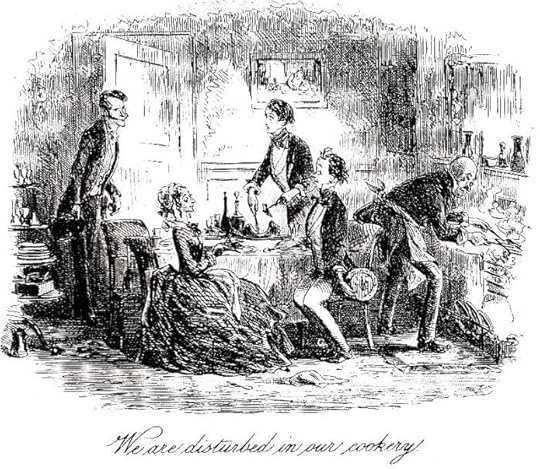
We are disturbed in our cookery
Chapter 28
Phiz
Commentary:
For the first illustration in the tenth monthly part, February 1850, Phiz finally introduces Steerforth's "gentleman's gentleman," Lattimer, and Mrs. Micawber, reintroducing the wild-haired Tommy Traddles and the ebullient and irrepressible Wilkins Micawber. According to J. A. Hammerton (1910), the textual passage realized being this:
I am ashamed to record it, but I really believe I forgot Dora for a little while. I am satisfied that Mr. and Mrs. Micawber could not have enjoyed the feast more, if they had sold a bed to provide it. Traddles laughed as heartily, almost the whole time, as he ate and worked. Indeed we all did, all at once; and I dare say there never was a greater success.
We were at the height of our enjoyment, and were all busily engaged, in our several departments, endeavouring to bring the last batch of slices to a state of perfection that should crown the feast, when I was aware of a strange presence in the room, and my eyes encountered those of Lattimer, standing hat in hand before me.
The February 1850 instalment, comprising chapters 28 through 31, contains contrasting illustrations, the comic "We are disturbed in our cookery" (ch. 28) and the serious "I find Mr. Barkis going out with the tide" (ch. 30). The oily Lattimer has called upon David in his Adelphi rooms to enquire after his young master's whereabouts; "only the rather comical print of Damocles with his sword about to descend hints at the impending disaster. The motif of the sword poised to drop may equally apply to the Micawbers, whose milk and water are both about to be terminated for non-payment of accumulated bills.
The moment that Phiz has chosen for realisation is the sort of situational comedy he relished: the "staid," judgmental Lattimer discovers the dinner guests having to cook slabs of lamb on a gridiron because David's housekeeper, Mrs. Crupp, has not sufficiently cooked the joint. David, upwardly mobile in terms of his class status, is embarrassed by the unexpected appearance of his upper-class idol Steerforth's confidential servant.
Mod
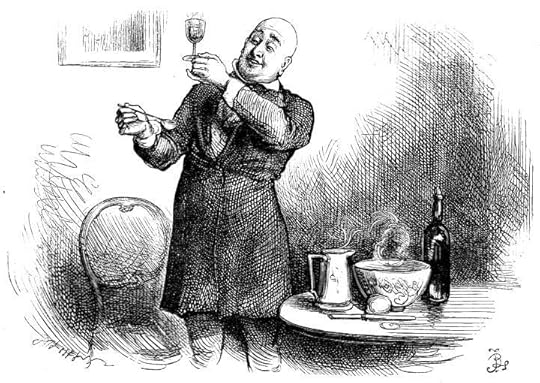
Mr. Micawber in his Element
Chapter 28
Fred Barnard
1872 Household Edition
Text Illustrated:
In the fervour of this impression, I congratulated Mr. Micawber on the treasure he possessed. So did Traddles. Mr. Micawber extended his hand to each of us in succession, and then covered his face with his pocket-handkerchief, which I think had more snuff upon it than he was aware of. He then returned to the punch, in the highest state of exhilaration.
He was full of eloquence. He gave us to understand that in our children we lived again, and that, under the pressure of pecuniary difficulties, any accession to their number was doubly welcome. He said that Mrs. Micawber had latterly had her doubts on this point, but that he had dispelled them, and reassured her. As to her family, they were totally unworthy of her, and their sentiments were utterly indifferent to him, and they might—I quote his own expression—go to the Devil.
Mr. Micawber then delivered a warm eulogy on Traddles. He said Traddles’s was a character, to the steady virtues of which he (Mr. Micawber) could lay no claim, but which, he thanked Heaven, he could admire. He feelingly alluded to the young lady, unknown, whom Traddles had honoured with his affection, and who had reciprocated that affection by honouring and blessing Traddles with her affection. Mr. Micawber pledged her. So did I. Traddles thanked us both, by saying, with a simplicity and honesty I had sense enough to be quite charmed with, ‘I am very much obliged to you indeed. And I do assure you, she’s the dearest girl!—’
Mr. Micawber took an early opportunity, after that, of hinting, with the utmost delicacy and ceremony, at the state of my affections. Nothing but the serious assurance of his friend Copperfield to the contrary, he observed, could deprive him of the impression that his friend Copperfield loved and was beloved. After feeling very hot and uncomfortable for some time, and after a good deal of blushing, stammering, and denying, I said, having my glass in my hand, ‘Well! I would give them D.!’ which so excited and gratified Mr. Micawber, that he ran with a glass of punch into my bedroom, in order that Mrs. Micawber might drink D., who drank it with enthusiasm, crying from within, in a shrill voice, ‘Hear, hear! My dear Mr. Copperfield, I am delighted. Hear!’ and tapping at the wall, by way of applause.
Our conversation, afterwards, took a more worldly turn; Mr. Micawber telling us that he found Camden Town inconvenient, and that the first thing he contemplated doing, when the advertisement should have been the cause of something satisfactory turning up, was to move. He mentioned a terrace at the western end of Oxford Street, fronting Hyde Park, on which he had always had his eye, but which he did not expect to attain immediately, as it would require a large establishment. There would probably be an interval, he explained, in which he should content himself with the upper part of a house, over some respectable place of business—say in Piccadilly,—which would be a cheerful situation for Mrs. Micawber; and where, by throwing out a bow-window, or carrying up the roof another story, or making some little alteration of that sort, they might live, comfortably and reputably, for a few years. Whatever was reserved for him, he expressly said, or wherever his abode might be, we might rely on this—there would always be a room for Traddles, and a knife and fork for me. We acknowledged his kindness; and he begged us to forgive his having launched into these practical and business-like details, and to excuse it as natural in one who was making entirely new arrangements in life.
Mod
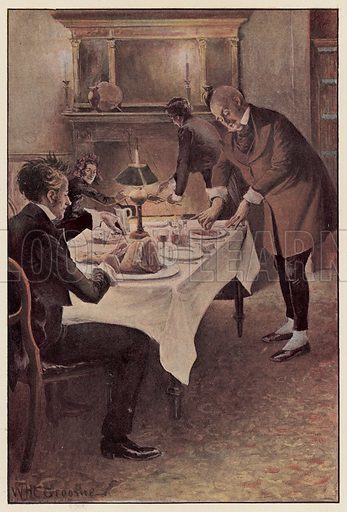
Traddles cut the mutton into slices.
Chapter 28
William Henry Charles Groome
Text Illustrated:
‘My dear friend Copperfield,’ said Mr. Micawber, ‘accidents will occur in the best-regulated families; and in families not regulated by that pervading influence which sanctifies while it enhances the—a—I would say, in short, by the influence of Woman, in the lofty character of Wife, they may be expected with confidence, and must be borne with philosophy. If you will allow me to take the liberty of remarking that there are few comestibles better, in their way, than a Devil, and that I believe, with a little division of labour, we could accomplish a good one if the young person in attendance could produce a gridiron, I would put it to you, that this little misfortune may be easily repaired.’
There was a gridiron in the pantry, on which my morning rasher of bacon was cooked. We had it in, in a twinkling, and immediately applied ourselves to carrying Mr. Micawber’s idea into effect. The division of labour to which he had referred was this:—Traddles cut the mutton into slices; Mr. Micawber (who could do anything of this sort to perfection) covered them with pepper, mustard, salt, and cayenne; I put them on the gridiron, turned them with a fork, and took them off, under Mr. Micawber’s direction; and Mrs. Micawber heated, and continually stirred, some mushroom ketchup in a little saucepan. When we had slices enough done to begin upon, we fell-to, with our sleeves still tucked up at the wrist, more slices sputtering and blazing on the fire, and our attention divided between the mutton on our plates, and the mutton then preparing.
Mod
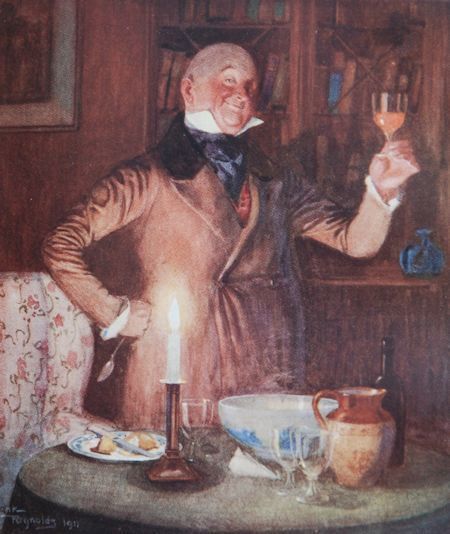
Mr. Micawber
Chapter 28
Frank Reynolds
Text Illustrated:
He was full of eloquence. He gave us to understand that in our children we lived again, and that, under the pressure of pecuniary difficulties, any accession to their number was doubly welcome. He said that Mrs. Micawber had latterly had her doubts on this point, but that he had dispelled them, and reassured her. As to her family, they were totally unworthy of her, and their sentiments were utterly indifferent to him, and they might—I quote his own expression—go to the Devil.
Mr. Micawber then delivered a warm eulogy on Traddles. He said Traddles’s was a character, to the steady virtues of which he (Mr. Micawber) could lay no claim, but which, he thanked Heaven, he could admire. He feelingly alluded to the young lady, unknown, whom Traddles had honoured with his affection, and who had reciprocated that affection by honouring and blessing Traddles with her affection. Mr. Micawber pledged her. So did I. Traddles thanked us both, by saying, with a simplicity and honesty I had sense enough to be quite charmed with, ‘I am very much obliged to you indeed. And I do assure you, she’s the dearest girl!—’
Mod
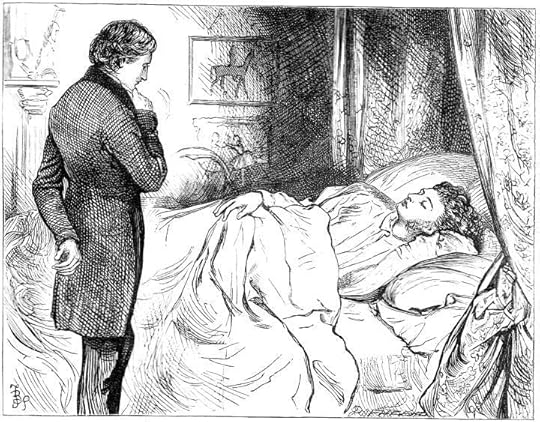
"He was fast asleep; lying, easily, with his head upon his arm"
Chapter 29
Fred Barnard
1872 Household Edition
Text Illustrated:
‘Good night!’ said I, ‘my dear Steerforth! I shall be gone before you wake in the morning. Good night!’
He was unwilling to let me go; and stood, holding me out, with a hand on each of my shoulders, as he had done in my own room.
‘Daisy,’ he said, with a smile—‘for though that’s not the name your godfathers and godmothers gave you, it’s the name I like best to call you by—and I wish, I wish, I wish, you could give it to me!’
‘Why so I can, if I choose,’ said I.
‘Daisy, if anything should ever separate us, you must think of me at my best, old boy. Come! Let us make that bargain. Think of me at my best, if circumstances should ever part us!’
‘You have no best to me, Steerforth,’ said I, ‘and no worst. You are always equally loved, and cherished in my heart.’
So much compunction for having ever wronged him, even by a shapeless thought, did I feel within me, that the confession of having done so was rising to my lips. But for the reluctance I had to betray the confidence of Agnes, but for my uncertainty how to approach the subject with no risk of doing so, it would have reached them before he said, ‘God bless you, Daisy, and good night!’ In my doubt, it did NOT reach them; and we shook hands, and we parted.
I was up with the dull dawn, and, having dressed as quietly as I could, looked into his room. He was fast asleep; lying, easily, with his head upon his arm, as I had often seen him lie at school.
The time came in its season, and that was very soon, when I almost wondered that nothing troubled his repose, as I looked at him. But he slept—let me think of him so again—as I had often seen him sleep at school; and thus, in this silent hour, I left him. —Never more, oh God forgive you, Steerforth! to touch that passive hand in love and friendship. Never, never more!
Mod
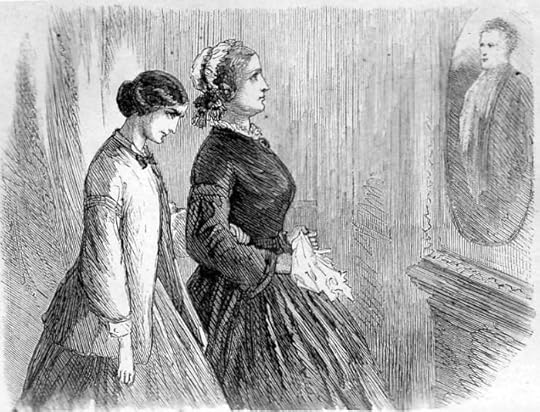
"Mrs. Steerforth and Rosa Dartle"
Chapter 29
Sol Eytinge Jr.
1867 Diamond Edition
Commentary:
Whereas Phiz depicted Mrs. Steerforth and her misanthropic companion, Rosa Dartle, in company with Dan'l Peggotty and David Copperfield, Eytinge isolates the pair in front of a portrait of the son of the house, implying their utter devotion to the beautiful image. That Rosa's attitude towards the sociopathic youth is more complex than his mother's Eytinge makes clear by her intense gaze, slightly lowered head, and hardened expression.
Phiz had no need of interpolating portraits on the walls of the old brick mansion at the fashionable north London suburb of Highgate (then just a village adjacent to Hampstead) when he depicted interior scenes in the Steerforth home, so that it is logical that Eytinge, building on Phiz's work, should have depicted Steerforth's mother and her companion studying or responding to a portrait of James Steerforth in the eleventh illustration. Although David Copperfield visits the home four times over the course of the story, beginning in Chapter 20 ("Steerforth's Home"), Eytinge has juxtaposed the picture with David's second visit, in Chapter 29, "I Visit Steerforth at His Home, Again." During his initial visit the doting mother had proudly displayed smaller pictures of her son as a child and as a school student, and David had noted a portrait of Mrs. Steerforth in James's bedroom — and an unsettling likeness of Rosa Dartle in the room assigned to himself:
Steerforth's room was next to mine, and I went in to look at it. It was a picture of comfort, full of easy-chairs, cushions, and footstools, worked by his mother's hand, and with no sort of thing omitted that could help to render it complete. Finally, her handsome features looked down on her darling from a portrait on the wall, as if it were even something to her than her likeness should watch him while he slept.
I found the fire burning clear enough in my room by this time, and the curtains drawn before the windows and round the bed, giving it a very snug appearance. I sat down in a great chair upon the hearth to meditate on my happiness, and had enjoyed the contemplation of it for some time, when I found a likeness of Miss Dartle looking eagerly at me from above the chimney-piece.
It was a startling likeness, and necessarily had a startling look. . . . . I wondered peevishly why they couldn't put her anywhere else instead of quartering her on me.
The term "quartering" here suggests that David feels that an official entity has violated his personal space, just as Canadians resented American troops being "quartered" in their homes when their country was occupied by foreign troops during the War of 1812 — American colonists suffered a similar intrusion when, during the Revolutionary War, British forces sometimes used private homes for billets. However, the salient features of these "portrait" passages are David's enjoyment of the superficialities of upper-middle-class domesticity ("picture of comfort," "render it complete") and his seduction by elegant surfaces such as Mrs. Steerforth's and her son's "handsome features." He finds, in contrast, Rosa's visage (whether represented or in the real) "unsettling" because her searching gaze penetrates beneath the smooth, comfortable veneer of the Highgate establishment, her scar a potent signifier of Steerforth's true character.
In Chapter 19, "I Visit Steerforth at His Home Again," David finds Rosa in person as unsettling as her portrait, but sees in the Steerforths "two such shades of the same nature" as if they are companion portraits rather than people. Although David attends very much to the expressions of both ladies, in this chapter (although it would certainly be characteristic) there is no scene such as Eytinge's eleventh illustration describes.
The textual reiteration of the likenesses in the Highgate house suggests the Steerforths' but also David's near-obsession with the cultivation of a beautiful image, of the proper appearance, of admirable fashion and dress, rather than a genuine appreciation of the underlying realities of character, humanistic values, and intellect. Ironically, Rosa, as we see in Eytinge's dual character study, both loves and loathes the handsome youth who had caused her facial disfigurement. Further, the illustration reveals the growing tendency in the style of the sixties to represent the idea of the story and its characters rather than an actual moment in the narrative.
Mod
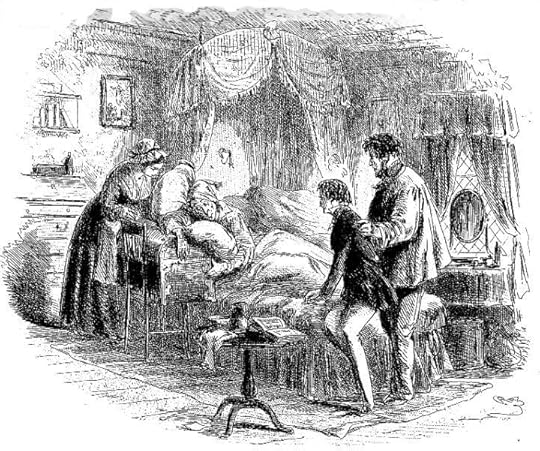
I find Mr. Barkis "going out with the Tide"
Chapter 30
Phiz
Commentary:
For the second illustration in the tenth monthly part, which appeared in February 1850, Phiz finally re-introduces the carrier, Mr. Barkis, who dies with his idiosyncratic catchphrase on his lips, "Barkis is willin'." The textual passage realized is this:
"Here's my dear boy — my dear boy, Master Davey, who brought us together, Barkis! That you sent messages by, you know! Won't you speak to Master Davy?"
He was as mute and senseless as the box, from which his form derived the only expression it had.
‘He’s a going out with the tide,’ said Mr. Peggotty to me, behind his hand.
My eyes were dim and so were Mr. Peggotty’s; but I repeated in a whisper, ‘With the tide?’
‘People can’t die, along the coast,’ said Mr. Peggotty, ‘except when the tide’s pretty nigh out. They can’t be born, unless it’s pretty nigh in—not properly born, till flood. He’s a going out with the tide. It’s ebb at half-arter three, slack water half an hour. If he lives till it turns, he’ll hold his own till past the flood, and go out with the next tide.’
We remained there, watching him, a long time—hours. What mysterious influence my presence had upon him in that state of his senses, I shall not pretend to say; but when he at last began to wander feebly, it is certain he was muttering about driving me to school.
‘He’s coming to himself,’ said Peggotty.
Mr. Peggotty touched me, and whispered with much awe and reverence. ‘They are both a-going out fast.’
‘Barkis, my dear!’ said Peggotty.
‘C. P. Barkis,’ he cried faintly. ‘No better woman anywhere!’
‘Look! Here’s Master Davy!’ said Peggotty. For he now opened his eyes.
I was on the point of asking him if he knew me, when he tried to stretch out his arm, and said to me, distinctly, with a pleasant smile:
"Barkis is willin'!"
And, it being low water, he went out with the tide.
In the February 1850 instalment, comprising chapters 28 through 31, the second illustration, "I find Mr. Barkis 'going out with the tide'" (ch. 30), contrasts the comic "We are disturbed in our cookery" (ch. 28), both being group scenes involving characters from David's childhood. Although this is the second significant death in David's life, it is the first of his adulthood. Death of the young in Dickens, as in the cases of little Paul Dombey and Little Nell in The Old Curiosity Shop, is often described with profound, overly sentimental religiosity, and such is the case of Phiz's realization of Barkis's passing with the tide. Cohen identifies the scene in the painting hanging just above Clara's head as Raphael's Transfiguration, to which the viewer's eye is drawn in an upward diagonal from the open bible (centre), Barkis's outstretched arm, and his wife's head. Balancing this juxtaposition is the smaller picture immediately above the noble head of Dan'l Peggotty to the right. However, the overt religiosity is relieved — one might even say, deflated — by Barkis's apparently hugging his carrier's trunk as he passes away in a blissful sleep, previously having been described as "half resting on the box which had cost so much pain and trouble", his uncomfortable posture emphasizing his quirky nature to the end. The elaborate canopy above Barkis which Phiz employs to suggest the carrier's spirit ascending is foiled by an object over his head, hanging on the wall, as a parody of the religious symbolism, the key to the trunk, so precious to Barkis that he attempts to carry it off even in death.
Mod
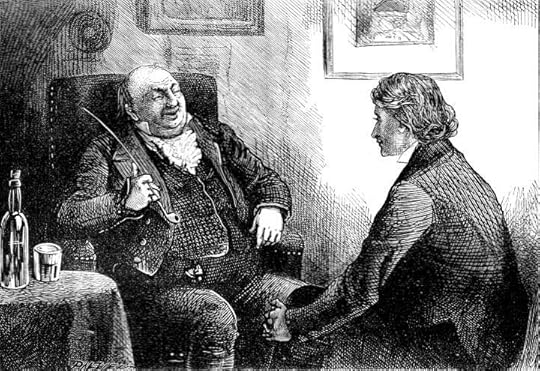
"Give me breath enough," says I to my daughter Minnie, "and I'll find passages, my dear."
Chapter 30
Fred Barnard
1872 Household Edition
Text Illustrated:
Mr. Omer had made room for me, and placed a chair. He now sat down again very much out of breath, gasping at his pipe as if it contained a supply of that necessary, without which he must perish.
‘I am sorry to have heard bad news of Mr. Barkis,’ said I.
Mr. Omer looked at me, with a steady countenance, and shook his head.
‘Do you know how he is tonight?’ I asked.
‘The very question I should have put to you, sir,’ returned Mr. Omer, ‘but on account of delicacy. It’s one of the drawbacks of our line of business. When a party’s ill, we can’t ask how the party is.’
The difficulty had not occurred to me; though I had had my apprehensions too, when I went in, of hearing the old tune. On its being mentioned, I recognized it, however, and said as much.
‘Yes, yes, you understand,’ said Mr. Omer, nodding his head. ‘We dursn’t do it. Bless you, it would be a shock that the generality of parties mightn’t recover, to say “Omer and Joram’s compliments, and how do you find yourself this morning?”—or this afternoon—as it may be.’
Mr. Omer and I nodded at each other, and Mr. Omer recruited his wind by the aid of his pipe.
‘It’s one of the things that cut the trade off from attentions they could often wish to show,’ said Mr. Omer. ‘Take myself. If I have known Barkis a year, to move to as he went by, I have known him forty years. But I can’t go and say, “how is he?”’
I felt it was rather hard on Mr. Omer, and I told him so.
‘I’m not more self-interested, I hope, than another man,’ said Mr. Omer. ‘Look at me! My wind may fail me at any moment, and it ain’t likely that, to my own knowledge, I’d be self-interested under such circumstances. I say it ain’t likely, in a man who knows his wind will go, when it DOES go, as if a pair of bellows was cut open; and that man a grandfather,’ said Mr. Omer.
I said, ‘Not at all.’
‘It ain’t that I complain of my line of business,’ said Mr. Omer. ‘It ain’t that. Some good and some bad goes, no doubt, to all callings. What I wish is, that parties was brought up stronger-minded.’
Mr. Omer, with a very complacent and amiable face, took several puffs in silence; and then said, resuming his first point:
‘Accordingly we’re obleeged, in ascertaining how Barkis goes on, to limit ourselves to Em’ly. She knows what our real objects are, and she don’t have any more alarms or suspicions about us, than if we was so many lambs. Minnie and Joram have just stepped down to the house, in fact (she’s there, after hours, helping her aunt a bit), to ask her how he is tonight; and if you was to please to wait till they come back, they’d give you full partic’lers. Will you take something? A glass of srub and water, now? I smoke on srub and water, myself,’ said Mr. Omer, taking up his glass, ‘because it’s considered softening to the passages, by which this troublesome breath of mine gets into action. But, Lord bless you,’ said Mr. Omer, huskily, ‘it ain’t the passages that’s out of order! “Give me breath enough,” said I to my daughter Minnie, “and I’ll find passages, my dear.”’
He really had no breath to spare, and it was very alarming to see him laugh. When he was again in a condition to be talked to, I thanked him for the proffered refreshment, which I declined, as I had just had dinner; and, observing that I would wait, since he was so good as to invite me, until his daughter and his son-in-law came back, I inquired how little Emily was?
‘Well, sir,’ said Mr. Omer, removing his pipe, that he might rub his chin: ‘I tell you truly, I shall be glad when her marriage has taken place.’
‘Why so?’ I inquired.
‘Well, she’s unsettled at present,’ said Mr. Omer. ‘It ain’t that she’s not as pretty as ever, for she’s prettier—I do assure you, she is prettier. It ain’t that she don’t work as well as ever, for she does. She WAS worth any six, and she IS worth any six. But somehow she wants heart. If you understand,’ said Mr. Omer, after rubbing his chin again, and smoking a little, ‘what I mean in a general way by the expression, “A long pull, and a strong pull, and a pull altogether, my hearties, hurrah!” I should say to you, that that was—in a general way—what I miss in Em’ly.’
Mod
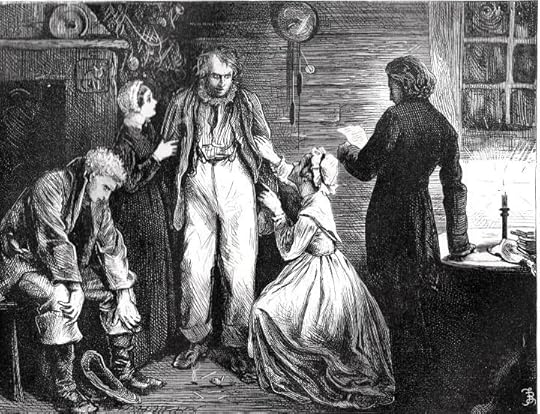

"Read it, sir," he said, in a low shivering voice.
Chapter 31
Fred Barnard
1872 Household Edition
Text Illustrated:
‘Mas’r Davy, will you come out a minute, and see what Em’ly and me has got to show you?’
We went out. As I passed him at the door, I saw, to my astonishment and fright, that he was deadly pale. He pushed me hastily into the open air, and closed the door upon us. Only upon us two.
‘Ham! what’s the matter?’
‘Mas’r Davy!—’ Oh, for his broken heart, how dreadfully he wept!
I was paralysed by the sight of such grief. I don’t know what I thought, or what I dreaded. I could only look at him.
‘Ham! Poor good fellow! For Heaven’s sake, tell me what’s the matter!’
‘My love, Mas’r Davy—the pride and hope of my art—her that I’d have died for, and would die for now—she’s gone!’
‘Gone!’
‘Em’ly’s run away! Oh, Mas’r Davy, think HOW she’s run away, when I pray my good and gracious God to kill her (her that is so dear above all things) sooner than let her come to ruin and disgrace!’
The face he turned up to the troubled sky, the quivering of his clasped hands, the agony of his figure, remain associated with the lonely waste, in my remembrance, to this hour. It is always night there, and he is the only object in the scene.
‘You’re a scholar,’ he said, hurriedly, ‘and know what’s right and best. What am I to say, indoors? How am I ever to break it to him, Mas’r Davy?’
I saw the door move, and instinctively tried to hold the latch on the outside, to gain a moment’s time. It was too late. Mr. Peggotty thrust forth his face; and never could I forget the change that came upon it when he saw us, if I were to live five hundred years.
I remember a great wail and cry, and the women hanging about him, and we all standing in the room; I with a paper in my hand, which Ham had given me; Mr. Peggotty, with his vest torn open, his hair wild, his face and lips quite white, and blood trickling down his bosom (it had sprung from his mouth, I think), looking fixedly at me.
‘Read it, sir,’ he said, in a low shivering voice. ‘Slow, please. I doen’t know as I can understand.’
In the midst of the silence of death, I read thus, from a blotted letter:
‘“When you, who love me so much better than I ever have deserved, even when my mind was innocent, see this, I shall be far away.”’
‘I shall be fur away,’ he repeated slowly. ‘Stop! Em’ly fur away. Well!’
‘“When I leave my dear home—my dear home—oh, my dear home!—in the morning,”’
the letter bore date on the previous night:
‘“—it will be never to come back, unless he brings me back a lady. This will be found at night, many hours after, instead of me. Oh, if you knew how my heart is torn. If even you, that I have wronged so much, that never can forgive me, could only know what I suffer! I am too wicked to write about myself! Oh, take comfort in thinking that I am so bad. Oh, for mercy’s sake, tell uncle that I never loved him half so dear as now. Oh, don’t remember how affectionate and kind you have all been to me—don’t remember we were ever to be married—but try to think as if I died when I was little, and was buried somewhere. Pray Heaven that I am going away from, have compassion on my uncle! Tell him that I never loved him half so dear. Be his comfort. Love some good girl that will be what I was once to uncle, and be true to you, and worthy of you, and know no shame but me. God bless all! I’ll pray for all, often, on my knees. If he don’t bring me back a lady, and I don’t pray for my own self, I’ll pray for all. My parting love to uncle. My last tears, and my last thanks, for uncle!”’
That was all.
He stood, long after I had ceased to read, still looking at me. At length I ventured to take his hand, and to entreat him, as well as I could, to endeavour to get some command of himself. He replied, ‘I thankee, sir, I thankee!’ without moving.
Mod
Micawber was modelled on Dickens' father, John Dickens. He is known for asserting his faith that "something will turn up." His name has become synonymous with someone who lives i..."
Kim
I never knew that Keith Richards was a Dickens fan. I love this anecdote. And to think he named a guitar after a Dickens character. How perfect is that? I love it!
Mod
Hi Kim
As always, thank you for posting so many illustrations, and especially making sure we see a variety of illustrators’ works.
Well now, the commentary on the death of Barkis. In comparison to the b&w illustrations of Eytinge and Barnard it is fair to say that the one of Browne is more detailed.
Now, as to whether Browne’s illustration is packed with so much meaningful detail is in the eye of the beholder, and, of course, I am a Phiz fan. So yes, I can align myself with the commentary. For a bit of suspense let’s just question the statement that Cohen sees above Clara’s head a copy of Raphael’s “Transfiguration.” Did Phiz really mean to represent such a painting with a tiny reproduction in the bedroom? Can it be a key and not a cross above the bed?
Ah, let's wait for another Phiz illustration later in the novel where we can look upon another wall at three pictures. Then we should realize how much Phiz is truly conscious of what he is doing and why. One should always study a Phiz illustration for all its rich emblematic detail. :-)
Kim wrote: "Peter may see all that, I can't. :-)"As I've said before, I think a lot of these analyses are bunk. Maybe I think that because I'm not deep enough to come up with it on my own. Who knows? Even so, it's still fun to see the connections people make.
Kim wrote: "Wilkens Micawber..."
I loved hearing all the references to Micawber. What other author has had such an impact on our culture? Shakespeare, perhaps Rowling (time will tell) - any others?
Mod
Micawber was modelled on Dickens' father, John Dickens. He is known for asserting his faith that "something will turn up." His name has become synonymous with someone..."
Same here! I love the idea of naming a guitar after a Dickens character even though, in this case, I am not particularly impressed with the Dickens character at all. Micawber may be amusing to read about for some people but I always keep thinking of his children and can only come up with the idea that they might have wished for a more responsible father. I am quite sure that there were times when Dickens had wished for a more responsible father and I wonder that the novel never gives more room to the children. They might, after all, not be so happy about their father's happy-go-lucky attitude, but then our narrator does not seem it worth his while to take the trouble talking with the Micawber offspring or giving them any room to talk in.
Mod
As I've said before, I think a lot of these analyses are bunk. Maybe I think that because I'm not deep enough to come up with it on my own. Who kn..."
My young teachers often talk about Harry Potter characters and I keep telling them that they ought to grow up and read adult books instead ;-) But in my heart of hearts I must pay my respect to Rowling for keeping my son awake in the evenings and have him stick to novel-reading.
By the way, I finally found one among my young teachers who dislikes Jane Austen as much as I do - and when she gave me her reasons, I found them to be the same as mine. What a remarkable woman that teacher is - she always laminates the worksheets for her students, and when I asked her why she does it, she says that this way the tears her students will cry about their tasks won't spoil the material and keep it usable. God bless her! :-)
 Mary Lou wrote: "Jantine wrote: "Can I say it? I had difficulty getting through chapter 28...."
You can say it. My sentiments exactly."
Yes, I enjoyed this post a lot. Especially telling Mrs. M to quit apologizing for this guy.
But I loved it when the meat was underdone and they just cooked it in the fire. Made me understand why David continues his acquaintance with the Micawbers.
Peter wrote: "In one way she is the binary character to Agnes. Both these females are able to intuit what truly resides within Steerforth. Agnes warns David that Steerforth is a devil, not an angel. With the scar as proof, Rosa wears the mark of Steerforth’s aggressive and harmful character."Oh, that's such a good take.
It's true that Rosa's repetitive and a bit frustrating that David seems puzzled or at least noncommittal about her character when it's pretty easy to see right through her. But she is still one of the most interesting characters in the book to me right now, because while it's clear to me that she means no good at all, I haven't sorted out yet what her master plan is. And there's obviously so much strong feeling there. Steerforth better watch out.
May I say I am so much happier with Mr. Peggotty, who wants to set off after his lost girl, than with Ham who “pray[s] ... gracious God to kill her ... sooner than let her come to ruin and disgrace"? Really, Ham? This is what love means to you? And don't say 'well, it was the times,' everyone, because Mr. Peggotty is in those times too, and he just wants his girl back. Not dead. Granted, he wasn't planning to marry her, unlike Ham. But I can't help thinking that as horrible, horrible, horrible as Steerforth is, he was right about Ham. Ham is the one who doesn't deserve Em'ly, not the other way around: Dickens doesn't want us to think this, but I think it anyway. It seems to me that part of the reason Em'ly runs is because she didn't want to marry her cousin who is maybe an excellent person but is not an excellent person she is in love with, and yet everyone pressures her into the marriage.
That said, I think partly she isn't in love with him because she is a snob who wants to be a lady and he is not a gentleman. I know she says she wants to be a lady to help her family, but her family is fine, and she knows very well what the consequences of running off with Steerforth will be, and maybe she and Ham deserve each other after all. But Mr. Peggotty doesn't deserve any of this nonsense. There.
Obviously this last chapter has me a little riled up.
Tristram wrote: "Mary Lou wrote: "Kim wrote: "Peter may see all that, I can't. :-)"As I've said before, I think a lot of these analyses are bunk. Maybe I think that because I'm not deep enough to come up with it ..."
Tristram, you may not like Austen, but she would have noticed that marriage to Ham is maybe not the happiest possible fate in the world for Em'ly, and so far I think Dickens has not.
Though granted there is a little Harriet from Emma in Little Em'ly. For those of you who have read it. Or seen the movie. :)
Yes, but little Harriet is different from little Em'ly ;-) Little Harriet would've been happy with Ham too, the point being that everyone has their own kind of people to fall in love with. Just like I was glad to be rid of my ex after a year and a half (you could say he was a bit of a Ham-type, he was way too dull and too much of a simpleton for me), but after that he found a new girlfriend who loves him to bits and is exactly the right person for him - and he for her. Em'ly would be the me (I admit, I even made some stupid choices before and right after the ex too), and she'd never be happy with the Ham-type imo. Little Harriet is the new girlfriend-type, Ham would be her Mr. Right.
Jantine wrote: "a new girlfriend who loves him to bits and is exactly the right person for him - and he for her..."Jantine, you made my argument. I don't think it's a matter of "deserving" but just a matter of the right fit. Emily has aspirations and, presumably, loftier interests than does Ham, who is content with his simpler life. It's been a long time since I've read Emma, so I'll make a different literary comparison. Ashley Wilkes was happy to sit by the fire and read and philosophize. He did his duty but was happier living a quiet life. Despite her many charms, Ashley knew that Scarlett O'Hara was not a compatible match. Scarlett took too long to figure that out, wasted time plotting to seduce him away from Melanie, and it eventually cost her her true soul-mate, Rhett. Young people in the throws of passion don't often consider personality type and compatibility. It leads to a lot of divorces, unfortunately.
Tristram wrote: "My young teachers often talk about Harry Potter characters and I keep telling them that they ought to grow up and read adult books instead ;-)..."Oh, there's room for both. I love children's literature. And as you allude to with your son, Rowling did more single-handedly to revive reading in an electronic age than anyone could have imagined.
While I disagree with you and your colleague about Jane Austen, I do appreciate her sense of humor, and I'm glad you have a kindred spirit to kvetch with at work. :-)
Mod
I'd say that when Emily says she wants to become a lady, it is not so much her own ambition that is speaking here but her care for Mr. Peggotty and the patchwork family - because as a lady she could find the means to stop him from endangering his life every single day. May that not be the true reason for Emily's aspirations? On the other hand, Emily might be as much fascinating by the Lucifer-like Steerforth as David is - and who can blame her and say they wouldn't? After all, there has not been a lot of fascinating people around her, and that explains why she might fall for a charmer and trickster like Steerforth, Ham being rather dull and ... what was the word ... cobble-headed after all.
Mod
Oh, there's room for both. I lov..."
You're right, Mary Lou: I have my own guilty pleasures I have cherished since my childhood days, like Karl May, a German writer of adventure stories for adolescent boys. He's probably not very well-known outside Germany, but I still re-read some of his books sometimes.
Tristram wrote: "I'd say that when Emily says she wants to become a lady, it is not so much her own ambition that is speaking here but her care for Mr. Peggotty and the patchwork family - because as a lady she could find the means to stop him from endangering his life every single day. May that not be the true reason for Emily's aspirations? On the other hand, Emily might be as much fascinating by the Lucifer-like Steerforth as David is - and who can blame her and say they wouldn't? After all, there has not been a lot of fascinating people around her, and that explains why she might fall for a charmer and trickster like Steerforth, Ham being rather dull and ... what was the word ... cobble-headed after all"
As I mentioned in the next topic: Mr. Peggotty and her patchwork family were basically taken care of by Barkis' inheritance, which would basically make them lower middle class money-wise. With the lifestyle they are used to, they could all together probably live pretty well without Mr. Peggotty ever going to sea again. So she either wanted more for them, or went for the adventure and the being a lady her running away with Steerforth promised. That the first promise would be more than she signed up for, and the latter promise would be empty, she took the risk.
As I mentioned in the next topic: Mr. Peggotty and her patchwork family were basically taken care of by Barkis' inheritance, which would basically make them lower middle class money-wise. With the lifestyle they are used to, they could all together probably live pretty well without Mr. Peggotty ever going to sea again. So she either wanted more for them, or went for the adventure and the being a lady her running away with Steerforth promised. That the first promise would be more than she signed up for, and the latter promise would be empty, she took the risk.
Mod
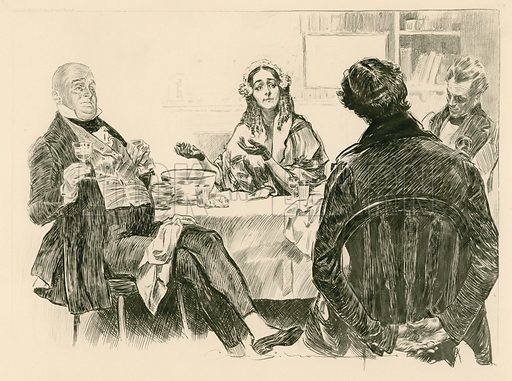
Mr and Mrs Micawber, David Copperfield and Traddles.
Charles Dana Gibson (1867–1944)
Mary Lou wrote: "Jantine wrote: "a new girlfriend who loves him to bits and is exactly the right person for him - and he for her..."Jantine, you made my argument. I don't think it's a matter of "deserving" but ju..."
I hope for Ham's sake (so I guess I more or less forgive him) that you all are right, and he'll eventually find a better fit. It would be nice if Em'ly could do the same... though it seems unlikely Steerforth is the right call.
Mod
I like Ham as a character. He is noble, faithful, and sturdy. From that perspective Steerforth’s comments about Ham are mean-spirited. On the other hand, Steerforth’s comments do ring with some truth. That said, I would much rather have Ham as a friend than Steerforth. Ham is a man of the sea. He wishes for nothing more. That is completely understandable.
As for Em’ly, her wish to be a lady is also an understandable wish of a child. If we go back to chapter three Dickens offers us an early indication of what might become of Ham and Em’ly. In this chapter Em’ly and David are by the sea on day. Em’ly is walking “much too near the brink of a sort of jetty ... and I was afraid of her falling over.” Twice Em’ly tells David that she is not afraid but can hear during storms “uncle Dan and Ham ... crying out for help.” In a flash forward of narration David says he should have held out his hand “to save her” and wonders if it “would have been better for little Em’ly to have had the waters close above her head that morning in my sight; and when I have answered Yes, it would have been.” Dickens then adds “This may be premature. I have set it down too soon, perhaps. But let it stand.” What a striking statement to offer his readers.
Then, if we move forward to twenty-two, we learn that Steerforth purchases a boat called the Stormy Petrel and plans to rename it The Little Em’ly. With that name change we see Dickens transferring the meaning of a storm petrel - a person who causes or likes trouble or strife - to that of Em’ly. I see this as Dickens symbolizing that Steerforth has taken ownership of Em’ly. How she and Ham and Peggotty and David and Steerforth resolve their relationship with the sea remains to be seen.

The Old Curiosity Club
Books mentioned in this topic
Lady Unknown: The life of Angela Burdett-Coutts (other topics)Made of gold: A biography of Angela Burdett Coutts (other topics)
Charles Dickens and the House of Fallen Women (other topics)
The heart of Charles Dickens: As revealed in his letters to Angela Burdett-Coutts (other topics)
Charles Dickens and the House of Fallen Women (other topics)

Mr Micawber’s Gauntlet
This chapter begins with David revealing to us that his life centres around thinking of Dora and drinking coffee. Mrs.Crupp brings a little reality into David’s life. In fact David says that “he was never so much afraid of any one.” I think this is a touch of hyperbole since Miss Murdstone is in David’s life as well but it is fair to say that Mrs Crupp does keep David in a state of continuing compromise and suspense.
David’s second dinner party in his rooms is with Mr and Mrs Micawber and Traddles. It is less stressful than the first with Steerforth. The Micawber’s and Traddles are delighted with his lodgings. Mr Micawber is in full verbal flight and Mrs Micawber still remains his trusty and long-suffering wife. Traddles remains in the background, no doubt partly overwhelmed by the effusive Micawber. As the party continues, it becomes increasingly apparent that the Micawber’s are again very poor in terms of money but rich in hopes, dreams, and fantasy. David first believes the dinner will be “a failure” but he was relieved by the great good humour of my company and the group’s cooperation in preparing the food. In fact, the dinner was so enjoyable David tells us he forgot Dora for a little while. High praise indeed for his companions.
To link the earlier dinner with Steerforth to the dinner of this chapter who shows up at David's door but Steerforth’s serving man. Littimer is looking for Steerforth but David does not know where Steerforth is. Littimer seamlessly fills in the role of man servant to David and serves the remainder of the meal to David and his guests. When David inquires after Steerforth, Littimer is reluctant to say anything specific. We do learn, however, how uneasy David feels in Littimer’s presence. Littimer then leaves as mysteriously as he arrived.
The narration returns to Mr Micawber and his wife’s assessment that her husband’s best chance of success is finding an occupation with “a certainty.” Well, that’s vague, but she should know. We will have to wait to see what “certainly” crops up in the future. Until then, the Micawber’s must wait for something to “turn up.” The present solution is to advertise his talents in the newspapers. Until then, Micawber keeps his dreams alive and assures Traddles he will always have a room for him and a “knife and fork.” David tries to warn Traddles that it would not be a good idea to lend Micawber any money or to put his name on any of Micawber’s bills. And so the dinner party ends and the Micawber’s and Traddles take their leave.
Soon after David’s dinner guests leave he hears steps ascending the stairs. It is Steerforth. David reflects on the warning of Agnes about Steerforth but pays no heed to it. When Steerforth learns he has just missed Traddles he says “Who’s he?” in a careless manner. In an interesting and suggestive bit of writing, Dickens says that Steerforth was beating a lump of coal on top of David’s fire with a poker as he questions “is [Traddles] as soft as ever? And where the deuce did you pick him up?” David says he tried to defend Traddles but Steerforth dismissed “the subject with a light smile, and a nod.” Do you recall Steerforth’s treatment of Mr Mell at the Salem School? Steerforth seems to have an aversion for people he perceives as weak. I wonder why he seems to like David so much?
We learn that Steerforth has been at Yarmouth “seafaring,” not at Oxford studying. Steerforth brings news of Barkis’ poor health. David then hears Steerforth’s motto for life which is “Ride on! Rough-shod if need be, smooth-shod if that will do, but ride on! Ride over all obstacles, and win the race.” When David asks Steerforth what race he replies “The race that one has started in.” A bit of an evasive answer don’t you think? David wants to go to Yarmouth to see Peggotty but Steerforth convinces him to visit to his mother instead.
Our chapter ends with David receiving a letter for Micawber that was actually written an hour and a half before the dinner party. The letter’s contents are distressing. The letter recounts that all of Micawber’s possessions are to be repossessed as well as those of Tommy Traddles. Should we dislike Micawber? Certainly this state of affairs is not good, but to put all of Traddles’ possessions in forfeit is surely unforgivable. Can we find humour in this situation? Will Traddles future wife need to wait “until the age of sixty” to be married?
Thoughts
There is a clear contrast between the dinner parties held for Steerforth and his friends and the one with the Micawber’s and Tommy Traddles. To what extent do you think this was intentional on Dickens’s part? If so, why?
Do you have any unease with the fact that Steerforth was in Yarmouth and not at school?
Steerforth’s opinion of Traddles is low, linked metaphorically to a piece of coal. Once again, the reader gets a quick glimpse into Steerforth’s character that David seems unwilling to consider. We also learn Steerforth’s philosophy or manifesto. Then Steerforth convinces David to go see his mother before travelling to Yarmouth to comfort Peggotty. Does anyone dislike Steerforth as much as I do?