
The Old Curiosity Club discussion
David Copperfield
>
DC, Chp. 54-57

 Mod
Mod
"....as the night advanced, the clouds closing in and densely over-spreading the whole sky, then very dark, it came on to blow, harder and harder. It still increased, until our horses could scarcely face the wind. Many times, in the dark part of the night (it was then late in September, when the nights were not short), the leaders turned about, or came to a dead stop; and we were often in serious apprehension that the coach would be blown over. Sweeping gusts of rain came up before this storm, like showers of steel; and, at those times, when there was any shelter of trees or lee walls to be got, we were fain to stop, in a sheer impossibility of continuing the struggle."
Even though David tells us it is the worst storm he has ever seen - "great sheets of lead had been ripped off a high church-tower, and flung into a by-street, which they then blocked up, great trees were torn out of the earth" - even though it is the worst storm he has ever seen he still goes down to the beach to watch the waves.
"The tremendous sea itself, when I could find sufficient pause to look at it, in the agitation of the blinding wind, the flying stones and sand, and the awful noise, confounded me. As the high watery walls came rolling in, and, at their highest, tumbled into surf, they looked as if the least would engulf the town. As the receding wave swept back with a hoarse roar, it seemed to scoop out deep caves in the beach, as if its purpose were to undermine the earth."
It reminded me of those weather people on television who bring us reports of hurricanes and such things standing on beaches getting knocked over by the wind and rain and all the time I'm sitting here wondering why they couldn't tell us about the storm from inside a nice safe building. Anyway, David returns to the inn - an extremely smart thing to do - and after a fitful night he is awakened by shouts from someone outside his door telling him that a ship 'A schooner, from Spain or Portugal, is wrecked down on the beach and will go to pieces at any moment.
He rushes to the scene like the rest of the crazy town and sees the schooner being battered to destruction by the wind and waves and David tells us that the rolling and beating are too tremendous for any man to survive long. So there's a whole town full of people waiting to see a bunch of men killed in a storm, if they come for me to see it I'm not going anywhere. But now the crowd gets to see one mast had been broken off and the sailors onboard are trying to cut it away. As they watch several of the seamen are washed overboard to their death until only a single, curly-haired man remains alive on the foundering vessel. See, now who would want to watch this? The men on the beach had tried to reach the wreck with a life boat but couldn't and now all they could do is watch of course it is. I found this strange:
"The wreck, even to my unpractised eye, was breaking up. I saw that she was parting in the middle, and that the life of the solitary man upon the mast hung by a thread. Still, he clung to it. He had a singular red cap on,—not like a sailor's cap, but of a finer colour; and as the few yielding planks between him and destruction rolled and bulged, and his anticipative death-knell rung, he was seen by all of us to wave it."
I just can't imagine how in a storm this bad the curly-haired man managed to keep his red cap on at all. The boat is falling apart, but this guy keeps a cap on his head. Suddenly Ham appears out of nowhere and insists on going out into the water with a rope around his waist to try to save the last sailor. David attempts to restrain him, but Ham says:
'Mas'r Davy,' he said, cheerily grasping me by both hands, 'if my time is come, 'tis come. If 'tan't, I'll bide it. Lord above bless you, and bless all! Mates, make me ready! I'm a-going off!'
He has some men tie rope around him and he swims out to the wreck. Ham never makes it aboard, however, for a huge wave breaks up the ship. When they draw in the rope, Ham gets all the way out, but a gigantic wave sweeps the ship and Ham under and kills him. Ham's body is carried to a nearby house, and David stays there until a fisherman comes and tells him to look at the other body of the other man that has washed ashore. The chapter ends with this:
"And on that part of it where she and I had looked for shells, two children—on that part of it where some lighter fragments of the old boat, blown down last night, had been scattered by the wind—among the ruins of the home he had wronged—I saw him lying with his head upon his arm, as I had often seen him lie at school."
Poor Steerforth. Poor Ham.
Mod
"Later in the day, I returned, and we laid him in his mother's room. She was just the same, they told me; Miss Dartle never left her; doctors were in attendance, many things had been tried; but she lay like a statue, except for the low sound now and then.
I went through the dreary house, and darkened the windows. The windows of the chamber where he lay, I darkened last. I lifted up the leaden hand, and held it to my heart; and all the world seemed death and silence, broken only by his mother's moaning.
That's going to be a fun place for these two ladies to spend the rest of their lives, having only each other for a companion. Their lives will be worse than Emily's will.
This chapter didn't really interest me and I don't have much more to say about it. It just seemed to be there to wrap up the Steerforth story. I suppose Dickens had to have David tell Mrs. Steerforth of the death of her son or the Steerforth story wouldn't have been finished and Dickens usually finished all his little plots in a novel. You know, all the good people have good things, all the bad people get bad things, and everyone is accounted for. As for Rosa Dartle's ranting and ravings, I do see her point that maybe if Steerforth would have been raised differently he would have been a different person, I don't think it was Rosa Dartle who would have brought the best out of him. On the other hand now that I'm thinking about it, it seems as if her life became bitter because she lost the love of Steerforth:
'I tell you,' she returned, 'I WILL speak to her. No power on earth should stop me, while I was standing here! Have I been silent all these years, and shall I not speak now? I loved him better than you ever loved him!' turning on her fiercely. 'I could have loved him, and asked no return. If I had been his wife, I could have been the slave of his caprices for a word of love a year. I should have been. Who knows it better than I? You were exacting, proud, punctilious, selfish. My love would have been devoted—would have trod your paltry whimpering under foot!'
With flashing eyes, she stamped upon the ground as if she actually did it.
'Look here!' she said, striking the scar again, with a relentless hand. 'When he grew into the better understanding of what he had done, he saw it, and repented of it! I could sing to him, and talk to him, and show the ardour that I felt in all he did, and attain with labour to such knowledge as most interested him; and I attracted him. When he was freshest and truest, he loved me. Yes, he did! Many a time, when you were put off with a slight word, he has taken Me to his heart!'
So perhaps if she and Steerforth would have married she wouldn't be the bitter, angry person she seems to me now. Perhaps her and Mrs. Steerforth could comfort each other then.
Mod
"He had provided himself, among other things, with a complete suit of oilskin, and a straw hat with a very low crown, pitched or caulked on the outside. In this rough clothing, with a common mariner's telescope under his arm, and a shrewd trick of casting up his eye at the sky as looking out for dirty weather, he was far more nautical, after his manner, than Mr. Peggotty. His whole family, if I may so express it, were cleared for action. I found Mrs. Micawber in the closest and most uncompromising of bonnets, made fast under the chin; and in a shawl which tied her up (as I had been tied up, when my aunt first received me) like a bundle, and was secured behind at the waist, in a strong knot. Miss Micawber I found made snug for stormy weather, in the same manner; with nothing superfluous about her. Master Micawber was hardly visible in a Guernsey shirt, and the shaggiest suit of slops I ever saw; and the children were done up, like preserved meats, in impervious cases. Both Mr. Micawber and his eldest son wore their sleeves loosely turned back at the wrists, as being ready to lend a hand in any direction, and to 'tumble up', or sing out, 'Yeo—Heave—Yeo!' on the shortest notice."
"I could not but observe that he had been peeling the lemons with his own clasp-knife, which, as became the knife of a practical settler, was about a foot long; and which he wiped, not wholly without ostentation, on the sleeve of his coat. Mrs. Micawber and the two elder members of the family I now found to be provided with similar formidable instruments, while every child had its own wooden spoon attached to its body by a strong line. In a similar anticipation of life afloat, and in the Bush, Mr. Micawber, instead of helping Mrs. Micawber and his eldest son and daughter to punch, in wine-glasses, which he might easily have done, for there was a shelf-full in the room, served it out to them in a series of villainous little tin pots; and I never saw him enjoy anything so much as drinking out of his own particular pint pot, and putting it in his pocket at the close of the evening."
More than once during this time when they are getting ready to depart Mr. Micawber is served with papers with the heading "Heep vs. Micawber" and is arrested for debt, the last time actually being on the deck of the ship. Each time David pays the money to have him released. Mrs. Micawber gives one of her speeches saying that now Mr. Micawber is going to a country that will appreciate him and honor him, a place where he will say:
"This country I am come to conquer! Have you honours? Have you riches? Have you posts of profitable pecuniary emolument? Let them be brought forward. They are mine!"'
I won't miss her how wonderful my husband could be speeches.
As David is leaving his friends on the ship Mr. Peggotty asks him if there is anything else that they had forgotten and David asks what should he do about Martha. Martha comes forward and David realizes that Mr. Peggotty is taking her with him:
'Heaven bless you, you good man!' cried I. 'You take her with you!'
She answered for him, with a burst of tears. I could speak no more at that time, but I wrung his hand; and if ever I have loved and honoured any man, I loved and honoured that man in my soul."
Reading these chapters gave me an idea of why this book is almost at an end, at the rate we are now going soon there won't be anyone left in the book. It seems to me like most of our characters have now died - David's mother, her child, Barkis, Dora, Dora's father, Aunt Betsey's husband, Ham, Steerforth - all dead; or are going to Australia - Mr. Peggotty, Emily, Martha, Mr. Micawber, Mrs. Micawber, all their children and Mrs. Gummidge. I'm not sure if I missed anyone who is either in a grave or on a ship, but I'll give it more thought while I go get the illustrations. Perhaps Australia is where Uriah and his mother have run off to, I didn't see them on the ship, but maybe they were hiding.
I had the same: why talk about his aunt like she is not there, with her in the room? Perhaps he hoped she would finally tell him something now she heard him tell he is concerned to Traddles? I don't know ... it seemed weird. I did laugh about this:
'Letters!' cried my aunt. 'I believe he dreams in letters!'
Aunt Betsy really seems to be just as fed up with Micawber as we are.
I found it rather ... tragic. Steerforth costing Ham his mental life in a way, and now his physical life. One could say Ham as he was before Emily was taken away by Steerforth was dead already. It really seemed he was struggling with suicidal ideation, the way he put himself forward for the most dangerous tasks all the time. It now simply was wrapped up in a way.
What I found rather hypocritical in David in that chapter is how he frantically urges everyone to do something, anything, to save the guy on the ship. And then when Ham turns up prepared to try, then at once the guy on the ship/Steerforth does not matter, and everyone should stop Ham. David, people's lives and not worth risking more because they are not your friends, you hullhead!
In the next chapter he was right though, no matter what went wrong with the way Mrs. Steerforth raised her son, she just lost him. Martha, give that poor woman some respite! On the other hand, everyone deals with grief differently, and anger certainly is one of the stages of grief - and Martha's grief is just as valid as Mrs. Steerforth's. She did not just hear her only child was dead though.
I'll be happy when we heard the last of Mr. Micawber. I do think they can keep Ham's death from Mr. Peggotty and the others, as long as Mr. Micawber does not blab. If they make it to Australia, the chance of having a lot of communication between them and England is very, very slim towards non-existent, despite what Micawber makes it out to be.
'Letters!' cried my aunt. 'I believe he dreams in letters!'
Aunt Betsy really seems to be just as fed up with Micawber as we are.
I found it rather ... tragic. Steerforth costing Ham his mental life in a way, and now his physical life. One could say Ham as he was before Emily was taken away by Steerforth was dead already. It really seemed he was struggling with suicidal ideation, the way he put himself forward for the most dangerous tasks all the time. It now simply was wrapped up in a way.
What I found rather hypocritical in David in that chapter is how he frantically urges everyone to do something, anything, to save the guy on the ship. And then when Ham turns up prepared to try, then at once the guy on the ship/Steerforth does not matter, and everyone should stop Ham. David, people's lives and not worth risking more because they are not your friends, you hullhead!
In the next chapter he was right though, no matter what went wrong with the way Mrs. Steerforth raised her son, she just lost him. Martha, give that poor woman some respite! On the other hand, everyone deals with grief differently, and anger certainly is one of the stages of grief - and Martha's grief is just as valid as Mrs. Steerforth's. She did not just hear her only child was dead though.
I'll be happy when we heard the last of Mr. Micawber. I do think they can keep Ham's death from Mr. Peggotty and the others, as long as Mr. Micawber does not blab. If they make it to Australia, the chance of having a lot of communication between them and England is very, very slim towards non-existent, despite what Micawber makes it out to be.
 Mod
Mod
 I see that I also gave DC four stars and I remember that I really liked it but was not blown away by it as I was by other Dickens novels, like Great Expectations, probably my favorite.
 As for this section, I was annoyed by this last Micawber chapter. First, I did not realize that it was included in this section and had to go back to read it. Then I was annoyed by the actual chapter. After Micawber had rather redeemed himself by his good deed in exposing Heep, I thought we would have a quick goodbye and then off to sea. No, we had a very lengthy goodbye which I did not believe we needed, it being much of the same Micawber family drama. I would have preferred hearing more of the thoughts of Mr. Peggotty and Emily anticipating their move. I did find the wave from Emily from the ship to David quite moving.
We are closing up quite nicely and I have to say that I am ready for the wrap up.
 I wonder if I feel about Ham the way Tristram feels about Little Nell. Really just too much persecuted virtue for one character to be able to bear there, and Ham's perfection as Working Class Guy is just as stilted, limited, and--okay, I'll just say it--condescending as Nell's perfection as an Innocent Young Girl.
 In fact, Miss Dartle goes a little bit crazy, even for her.
Ha!
Mod
Mod
That's it! We could have married Little Nell to Ham. I wonder how that would have ended up.
Kim wrote: "That's it! We could have married Little Nell to Ham. I wonder how that would have ended up."PERFECT MATCH!
Mod
They would all have fallen asleep at the ceremony. And you are right: I think the whole story is already perfectly wrapped up and I have to force myself to go through the final chapters. This never happened in a Dickens novel before.
 Mod
Mod
Tristram
I tend to agree with you. Yikes, the pressure is on me to come up with commentaries for the next two weeks that will not put everyone to sleep. :-)
Mod
Why not also add the general discussion to the second week's thread? This thought just occurred to me because of two things: First, the last few chapters are not really very eventful, and second, as we are going to start our Christmas read right after DC, we would have no extra week for a discussion of the entire book.
 I have just finished the final chapters of the book and I must say I was rather moved by them. They really are worth reading at a leisurely pace. I will not spoil it for you all, but savour the words and the special twilight atmosphere at the end of the book will eventually work its charm. As Freddie once sang: "it's a kinda magic."
I have really enjoyed reading Dickens with this group. Perusing your comments every week helped me see deeper levels of meaning in this book than I would otherwise have seen on my own. Thank you!
I will take a little break from Dickens for the moment, but will join you again gladly when you start on Bleak House. Happy reading and talk to you soon.
Mod
Why not also add the general discussion to the second week's thread? This thought just occurred to me because of two things: First, the last few chapters are not really very eventful, and s..."
Tristram
Good idea. I will fold in the general discussion with the final chapters.
Mod
Ulysse
Thanks for all your insights, energy, and commentary. It was a pleasure to read the book with you. I’m glad Dickens has given you pleasure.
See you for Bleak House which is my favourite Dickens novel.
May you have a wonderful holiday season.
Peter wrote: "Ulysse wrote: "I have just finished the final chapters of the book and I must say I was rather moved by them. They really are worth reading at a leisurely pace. I will not spoil it for you all, but..."Thank you, Peter. Enjoy your holiday as well, and see you in 2021 -- a new year and hopefully a better one for the world.
Mod
Glad you enjoyed our reading of DC, Ulysse. There have always been members who did not take part in the Christmas read, because more often than not, Dickens gets a little bit gushy in his Christmas writings. (I hope Kim didn't read this ...)
Hope to have you around for Bleak House next year!
Mod
If 2021 is going to be different from 2020, it will be bound to be better ;-)
Mod
I didn't read it. I don't usually read your posts they are too grumpy.
Mod
It would be my favorite novel as well if it weren't for two characters. I'd take Little Nell over those two any day.
Mod
No, don't say that! One year, 1991, my mom had cancer. She first got it in 1990 and all through 1991 it was surgery after surgery, chemo treatment after chemo treatment. Finally in November she was called cancer free and we had a wonderful holiday season. On New Year's Eve we were all sitting around at my house and went around the room toasting the new year. I can't remember what anyone else said, but I said something like "thank the Lord this year is over, next year has to be better", and my dad said "don't be so sure about that", and I just thought he was being his usual grumpy self and we moved on. The next day my husband took the kids to his parents and I was to meet them there after I got the house cleaned up again. So I was there alone when my mother came to tell me that the cancer was back, that she had known for a few weeks but didn't want to tell us until after Christmas. She died that year. Never again have I said the next year has to be better, it can always be worse.
Mod
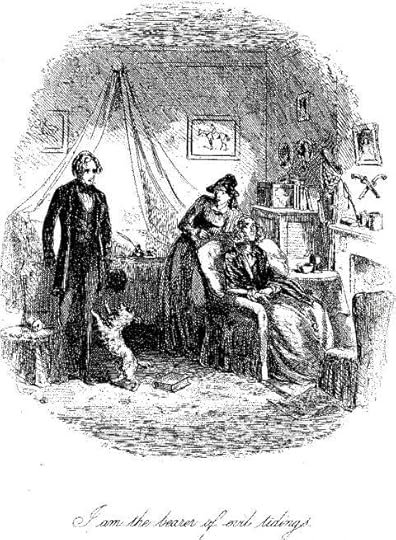
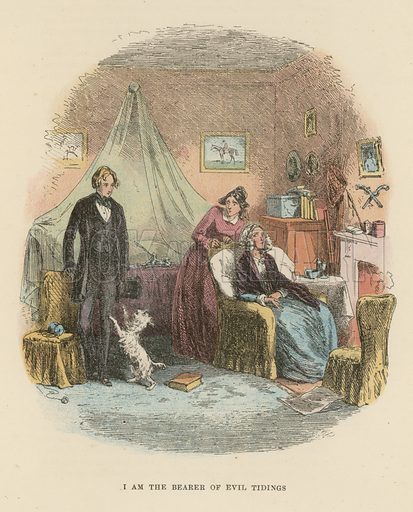
I am the bearer of evil tidings
Chapter 56
Phiz
Commentary:
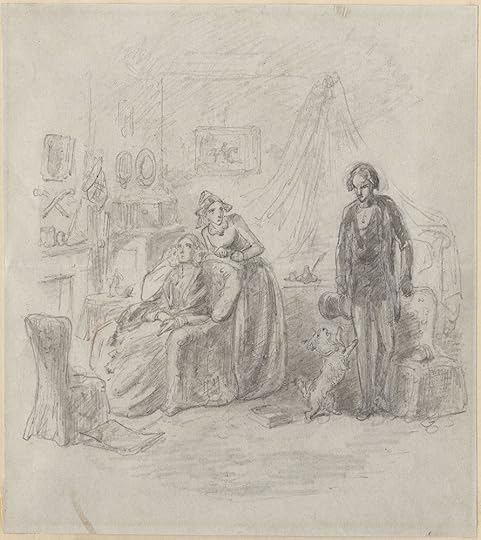
In the first illustration in the eighteenth monthly number, which was issued in October 1850 and comprises chapters 54 through 56, Phiz again brings together David, Rosa Dartle, and Mrs. Steerforth, last seen in the March 1850 illustration "Mr. Peggotty and Mrs. Steerforth" . However, here the rake's mother and her companion meet David in James Steerforth's bedroom rather than the drawing-room downstairs; again objects in the room imply the absent son's presence.
Phiz has realized the moment that provides the logical conclusion to the storm at Yarmouth and the subsequent discovery of Steerforth's body on the dunes:
At her chair, as usual, was Rosa Dartle. From the first moment of her dark eyes resting on me, I saw she knew I was the bearer of evil tidings.
‘I am sorry to observe you are in mourning, sir,’ said Mrs. Steerforth.
‘I am unhappily a widower,’ said I.
‘You are very young to know so great a loss,’ she returned. ‘I am grieved to hear it. I am grieved to hear it. I hope Time will be good to you.’
‘I hope Time,’ said I, looking at her, ‘will be good to all of us. Dear Mrs. Steerforth, we must all trust to that, in our heaviest misfortunes.’
The earnestness of my manner, and the tears in my eyes, alarmed her. The whole course of her thoughts appeared to stop, and change.
I tried to command my voice in gently saying his name, but it trembled. She repeated it to herself, two or three times, in a low tone. Then, addressing me, she said, with enforced calmness:
‘My son is ill.’
‘Very ill.’
‘You have seen him?’
‘I have.’
‘Are you reconciled?’
I could not say Yes, I could not say No. She slightly turned her head towards the spot where Rosa Dartle had been standing at her elbow, and in that moment I said, by the motion of my lips, to Rosa, ‘Dead!’
That Mrs. Steerforth might not be induced to look behind her, and read, plainly written, what she was not yet prepared to know, I met her look quickly; but I had seen Rosa Dartle throw her hands up in the air with vehemence of despair and horror, and then clasp them on her face.
The handsome lady—so like, oh so like!—regarded me with a fixed look, and put her hand to her forehead. I besought her to be calm, and prepare herself to bear what I had to tell; but I should rather have entreated her to weep, for she sat like a stone figure.
‘When I was last here,’ I faltered, ‘Miss Dartle told me he was sailing here and there. The night before last was a dreadful one at sea. If he were at sea that night, and near a dangerous coast, as it is said he was; and if the vessel that was seen should really be the ship which—’
‘Rosa!’ said Mrs. Steerforth, ‘come to me!’
She came, but with no sympathy or gentleness. Her eyes gleamed like fire as she confronted his mother, and broke into a frightful laugh.
‘Now,’ she said, ‘is your pride appeased, you madwoman? Now has he made atonement to you—with his life! Do you hear?—-His life!’
The pistols, picture of the horse and rider, and the fishing gear — "the many tokens of his old sports and accomplishments," David tells us (using generalizations of little use to the illustrator) — establish a male, sporting presence quite out of character with the elderly, white-haired invalid who now occupies the bedroom. Whereas in David's lodgings and his later Highgate home he appears consistently surrounded by books, signifiers of others' ideas, tales, and observations, here we notice a single book lying discarded on the floor. Even Steerforth's dog, an active terroir (a sporting breed) seeking David's attention, contrasts to the dog in David's world: Jip the spaniel, which is essentially a lap dog and extension of his mistress. The inclusion of the dog is not something suggested to Phiz by the text. So abstracted is David as he contemplates how the women will receive the news that he fails to notice the clamouring dog which (presumably) belonged to his dead friend.
Rosa Dartle rather melodramatically regards David with a suspicious look and shrinks from him, as if recoiling from the anticipated news of James Steerforth's death. Clad largely in white rather than black as in the previous plate, Mrs. Steerforth here is not her former, imperious self. Once again, the respectably dressed David is both middle-class actor, observer, and recorder, but here he also serves as a catalyst to the action, for his very presence provokes an angry, embittered response from Steerforth's other lover, Rosa Dartle. Phiz interprets her response as shocked rejection of the news that David will announce, but the text conveys a very different sense of Rosa's reaction. Here, as in "Mr. Peggotty and Mrs. Steerforth", an earlier illustration set in the Steerforths in Highgate, an unemotional David is positioned at the left; in the former plate his position indicates the entrance to the house and the male-dominated world beyond, but here it represents the staircase that connects the main floor and drawing-room from which Mrs. Steerforth has retreated.
Mod
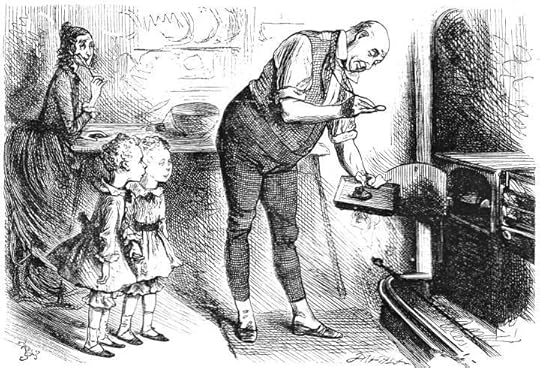
"I have myself directed some attention, during the past week, to the art of baking."
Chapter 54
Fred Barnard
1872 Household Edition
Text Illustrated:
‘Arrange it in any way you please, sir,’ said my aunt.
‘Madam,’ he replied, ‘Mrs. Micawber and myself are deeply sensible of the very considerate kindness of our friends and patrons. What I wish is, to be perfectly business-like, and perfectly punctual. Turning over, as we are about to turn over, an entirely new leaf; and falling back, as we are now in the act of falling back, for a Spring of no common magnitude; it is important to my sense of self-respect, besides being an example to my son, that these arrangements should be concluded as between man and man.’
I don’t know that Mr. Micawber attached any meaning to this last phrase; I don’t know that anybody ever does, or did; but he appeared to relish it uncommonly, and repeated, with an impressive cough, ‘as between man and man’.
‘I propose,’ said Mr. Micawber, ‘Bills—a convenience to the mercantile world, for which, I believe, we are originally indebted to the Jews, who appear to me to have had a devilish deal too much to do with them ever since—because they are negotiable. But if a Bond, or any other description of security, would be preferred, I should be happy to execute any such instrument. As between man and man.’
My aunt observed, that in a case where both parties were willing to agree to anything, she took it for granted there would be no difficulty in settling this point. Mr. Micawber was of her opinion.
‘In reference to our domestic preparations, madam,’ said Mr. Micawber, with some pride, ‘for meeting the destiny to which we are now understood to be self-devoted, I beg to report them. My eldest daughter attends at five every morning in a neighbouring establishment, to acquire the process—if process it may be called—of milking cows. My younger children are instructed to observe, as closely as circumstances will permit, the habits of the pigs and poultry maintained in the poorer parts of this city: a pursuit from which they have, on two occasions, been brought home, within an inch of being run over. I have myself directed some attention, during the past week, to the art of baking; and my son Wilkins has issued forth with a walking-stick and driven cattle, when permitted, by the rugged hirelings who had them in charge, to render any voluntary service in that direction—which I regret to say, for the credit of our nature, was not often; he being generally warned, with imprecations, to desist.’
‘All very right indeed,’ said my aunt, encouragingly. ‘Mrs. Micawber has been busy, too, I have no doubt.’
Mod
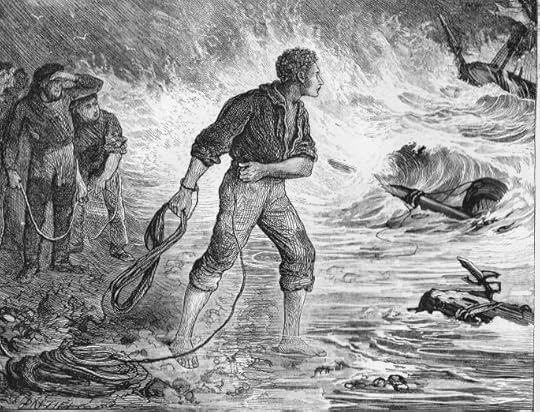
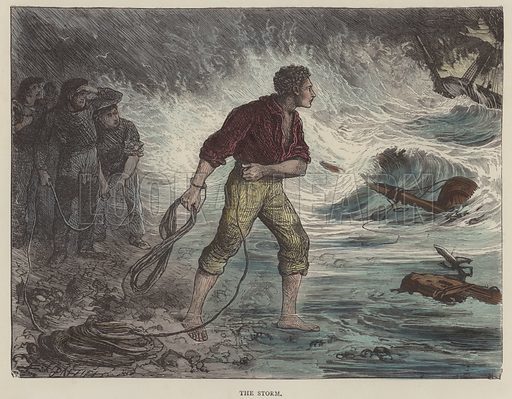
The Storm
Chapter 55
Fred Barnard
1872 Household Edition
Text Illustrated:
"Against such a sight, and against such determination as that of the calmly desperate man who was already accustomed to lead half the people present, I might as hopefully have entreated the wind. ‘Mas’r Davy,’ he said, cheerily grasping me by both hands, ‘if my time is come, ‘tis come. If ‘tan’t, I’ll bide it. Lord above bless you, and bless all! Mates, make me ready! I’m a-going off!’
I was swept away, but not unkindly, to some distance, where the people around me made me stay; urging, as I confusedly perceived, that he was bent on going, with help or without, and that I should endanger the precautions for his safety by troubling those with whom they rested. I don’t know what I answered, or what they rejoined; but I saw hurry on the beach, and men running with ropes from a capstan that was there, and penetrating into a circle of figures that hid him from me. Then, I saw him standing alone, in a seaman’s frock and trousers: a rope in his hand, or slung to his wrist: another round his body: and several of the best men holding, at a little distance, to the latter, which he laid out himself, slack upon the shore, at his feet.
The wreck, even to my unpractised eye, was breaking up. I saw that she was parting in the middle, and that the life of the solitary man upon the mast hung by a thread. Still, he clung to it. He had a singular red cap on,—not like a sailor’s cap, but of a finer colour; and as the few yielding planks between him and destruction rolled and bulged, and his anticipative death-knell rung, he was seen by all of us to wave it. I saw him do it now, and thought I was going distracted, when his action brought an old remembrance to my mind of a once dear friend.
Ham watched the sea, standing alone, with the silence of suspended breath behind him, and the storm before, until there was a great retiring wave, when, with a backward glance at those who held the rope which was made fast round his body, he dashed in after it, and in a moment was buffeting with the water; rising with the hills, falling with the valleys, lost beneath the foam; then drawn again to land. They hauled in hastily."
Mod
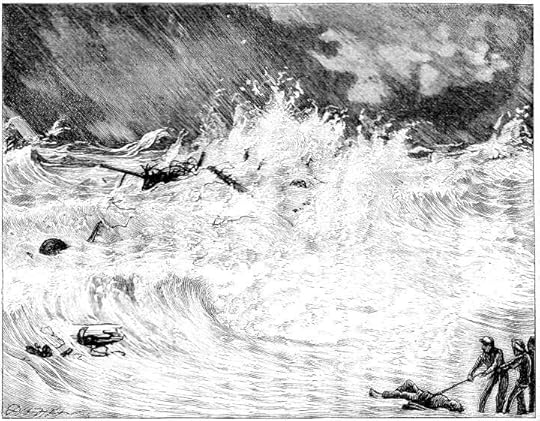
"They drew him to my very feet - insensible - dead."
Chapter 55
Fred Barnard
1872 Household Edition
Text Illustrated:
He was hurt. I saw blood on his face, from where I stood; but he took no thought of that. He seemed hurriedly to give them some directions for leaving him more free—or so I judged from the motion of his arm—and was gone as before.
And now he made for the wreck, rising with the hills, falling with the valleys, lost beneath the rugged foam, borne in towards the shore, borne on towards the ship, striving hard and valiantly. The distance was nothing, but the power of the sea and wind made the strife deadly. At length he neared the wreck. He was so near, that with one more of his vigorous strokes he would be clinging to it,—when a high, green, vast hill-side of water, moving on shoreward, from beyond the ship, he seemed to leap up into it with a mighty bound, and the ship was gone!
Some eddying fragments I saw in the sea, as if a mere cask had been broken, in running to the spot where they were hauling in. Consternation was in every face. They drew him to my very feet—insensible—dead. He was carried to the nearest house; and, no one preventing me now, I remained near him, busy, while every means of restoration were tried; but he had been beaten to death by the great wave, and his generous heart was stilled for ever.
As I sat beside the bed, when hope was abandoned and all was done, a fisherman, who had known me when Emily and I were children, and ever since, whispered my name at the door.
‘Sir,’ said he, with tears starting to his weather-beaten face, which, with his trembling lips, was ashy pale, ‘will you come over yonder?’
The old remembrance that had been recalled to me, was in his look. I asked him, terror-stricken, leaning on the arm he held out to support me:
‘Has a body come ashore?’
He said, ‘Yes.’
‘Do I know it?’ I asked then.
He answered nothing.
But he led me to the shore. And on that part of it where she and I had looked for shells, two children—on that part of it where some lighter fragments of the old boat, blown down last night, had been scattered by the wind—among the ruins of the home he had wronged—I saw him lying with his head upon his arm, as I had often seen him lie at school.
Mod

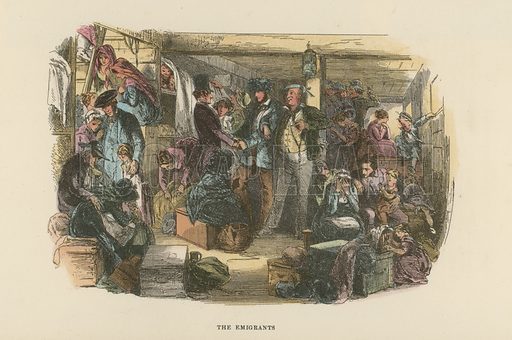
The Emigrants
Chapter 57
Phiz
Commentary:
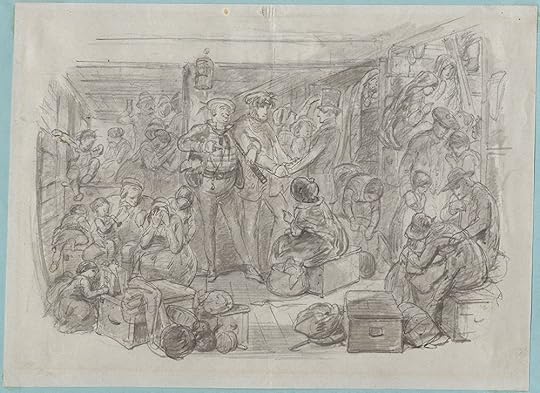
The second illustration for the eighteenth monthly number, issued in October 1850, completes the narrative-pictorial sequence that one might be entitled "Micawber's Progress" from indigence in England to affluence abroad. For this second October illustration, Phiz focuses on the figures of Wilkens Micawber, Dan'l Peggotty, and David Copperfield as they shake hands before the departure of the emigrant vessel at Gravesend. Phiz gives the reader a sense of all the other narratives of emigration and opportunity that the working-class men, women, and children "crammed" into the constricted space below decks could tell if they had a David Copperfield to record them. The illustration of final parting of Mr. Micawber and "the companion of youth," David Copperfield, may be associated with the following passage:
Mr. Peggotty was waiting for us on deck. . . . . He then took us down between decks; and there, any lingering fears I had of his having heard any rumours of what had happened, were dispelled by Mr. Micawber's coming out of the gloom, taking his arm with an air of friendship and protection, and telling me that they had scarcely been asunder for a moment, since the night before last.
In fact, Phiz has utilized Dickens's allusion to the seventeenth-century Dutch genre painter Ostade to give us "the emigrant-berths, and chests, and bundles, and barrels, and heaps of miscellaneous baggage" illuminated by on open port (right), the hatchway (left), and a single lantern (up centre), just above Micawber's head. The former bankrupt's white waistcoat seems a source of light in itself, as if his very presence illuminates the entire room. However, the illustrator's particular interest is the emigrants themselves, whom Dickens describes in a series of present participles to communicate a sense of kinetic energy:
crowded groups of people, making new friendships, taking leave of one another, talking, laughing, crying, eating and drinking . . . .
As is consistent with Ostade's genre paintings of Dutch peasant families, Phiz has chosen to depict in specific attitudes and postures the figures of emigrants suggested by Dickens: babies, crooked old men and women, ploughmen, smiths, and other adults of various conditions, classes, and occupations. Kitton noted in Dickens and His Illustrators (1899) that Phiz's original drawing of "The Emigrants," although in other respects consistent with the published version of the illustration, shows Micawber holding a telescope, a detail which Phiz or the novelist, wishing to maintain the seriousness of the scene, must have decided was not appropriate to the scene below decks. To avoid an unnecessary note of levity, the telescope was excised, but Micawber's diminutive sailor's hat and pea jacket remain,
Somewhere in the darkness must be the figures of the novel's two "fallen women," Em'ly and Martha. Thus, although the viewer's eye wanders about the groups of figures and individuals as they respond optimistically (as in the background, right) or pessimistically (for example, foreground, right) to the prospect of the long voyage and utter separation from all that they have known, the reader cannot discover either figure among the twenty-five depicted. Amidst the chaos of scattered bundles and trunks is the central supporting pillar strategically located immediately behind Micawber, as if foreshadowing the central role as magistrate and occasional journalist that Micawber will occupy in the new land "down under." We only glimpse the berths, and find neither stools nor dwarf elbow-chairs. What Phiz gives us in abundance that does not concern Dickens is the other dramas unfolding in the emigrant ship's hold. Momentarily, Martha will come forward — probably from the upper right, where one of the Micawber twins is jumping over a chest — and then the "strangers" (those not incorporated into the party of emigrants) will clear the ship, but in tableau in the midst of the group scene of action and a dramatized range of emotions Phiz focuses on the golden moment of male bonding at the vortex.
 Mod
Mod
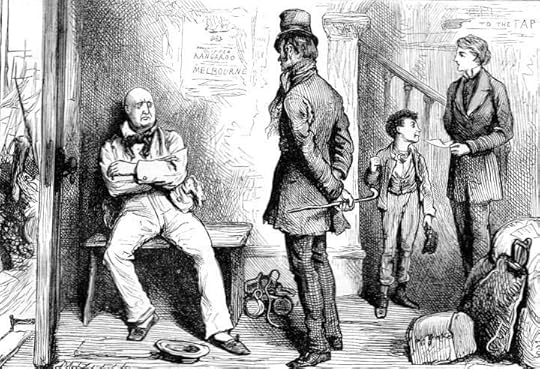
"I found Mr. Micawber sitting in a corner, looking darkly at the sheriff's officer"
Chapter 57
Fred Barnard
Text Illustrated:
Mr. Micawber withdrew, and was absent some little time; in the course of which Mrs. Micawber was not wholly free from an apprehension that words might have arisen between him and the Member. At length the same boy reappeared, and presented me with a note written in pencil, and headed, in a legal manner, ‘Heep v. Micawber’. From this document, I learned that Mr. Micawber being again arrested, ‘Was in a final paroxysm of despair; and that he begged me to send him his knife and pint pot, by bearer, as they might prove serviceable during the brief remainder of his existence, in jail. He also requested, as a last act of friendship, that I would see his family to the Parish Workhouse, and forget that such a Being ever lived.
Of course I answered this note by going down with the boy to pay the money, where I found Mr. Micawber sitting in a corner, looking darkly at the Sheriff ‘s Officer who had effected the capture. On his release, he embraced me with the utmost fervour; and made an entry of the transaction in his pocket-book—being very particular, I recollect, about a halfpenny I inadvertently omitted from my statement of the total.
This momentous pocket-book was a timely reminder to him of another transaction. On our return to the room upstairs (where he accounted for his absence by saying that it had been occasioned by circumstances over which he had no control), he took out of it a large sheet of paper, folded small, and quite covered with long sums, carefully worked. From the glimpse I had of them, I should say that I never saw such sums out of a school ciphering-book. These, it seemed, were calculations of compound interest on what he called ‘the principal amount of forty-one, ten, eleven and a half’, for various periods. After a careful consideration of these, and an elaborate estimate of his resources, he had come to the conclusion to select that sum which represented the amount with compound interest to two years, fifteen calendar months, and fourteen days, from that date. For this he had drawn a note-of-hand with great neatness, which he handed over to Traddles on the spot, a discharge of his debt in full (as between man and man), with many acknowledgements.
 Mod
Mod
I am the bearer of evil tidings - original sketch
Mod
A little grumpiness for Christmas will not do much harm, I think :-)
Mod
No, don't say that! One year, 1991, my mom had cancer. She first got it in 1990 and all through 1991..."
I am sorry to hear this, Kim. Quite honestly, when you come to think of it, there have been lots of worse times in history than what we have to go through with Covid. The plague was more deadly and more contagious, and people only knew little or next to nothing about medicine. Then there were countless years of war and terror, especially in the 20th century, and so I guess, if put into the wider context 2020 was not such a bad year after all.
Mod
What a crowd scene in this illustration but, as the commentary suggests, among the 25 figures depicted neither Em’ly or Martha are obvious or even visible. To me, I find this curious. Did Browne not include them because of their fallen nature or because Dickens did not want them in the illustration? I’m not sure, but I am certain that Browne had not forgotten the two females. Martha is the prominent figure in the illustration“The River” and Em’ly is featured in the title page of the novel.
This illustration set in the hold of the boat is somewhat reminiscent of the illustrations of the Peggotty house early in the novel. In this illustration we have the Peggotty family together again, without, of course, Ham. The link of boats and Peggotty is maintained, but one feels that once in Australia, the family will not be directly connected to the sea.
Mod
I looked up the painter Ostade since the commentary made mention of him and found this:
Adriaen van Ostade was a Dutch Golden Age painter of genre works. Ostade was the contemporary of the Flemish painters David Teniers the Younger and Adriaen Brouwer. Like them, he spent his life in delineation of the homeliest subjects: tavern scenes, village fairs and country quarters. Between Teniers and Ostade the contrast lies in the different condition of the agricultural classes of Brabant and Holland and in the atmosphere and dwellings peculiar to each region. Brabant has more sun and more comfort; Teniers, in consequence, is silvery and sparkling, and the people he paints are fair specimens of their culture. Holland, in the vicinity of Haarlem, seems to have suffered much from war; the air is moist and hazy, and the people depicted by Ostade are short and ill-favoured, marked with adversity's stamp in feature and dress.
Brouwer, who painted the peasant in his frolics and passions, brought more of the spirit of Frans Hals into his depictions than did his colleague; but the type is the same as Ostade's. During the first years of his career, Ostade tended toward the same exaggeration and frolic as his comrade, though he is distinguished from his rival by a more general use of light and shade, especially a greater concentration of light on a small surface in contrast with a broad expanse of gloom. The key of his harmonies remained for a time in the scale of greys, but his treatment is dry and careful in a style which shuns no difficulties of detail. He shows us the cottages, inside and out: vine leaves cloak the poverty of the outer walls; indoors, nothing decorates the patchwork of rafters and thatch, the tumble-down chimneys and the ladder staircases, the rustic Dutch home of those days. The greatness of Ostade lies in how often he caught the poetic side of the peasant class in spite of its coarseness. He gave the magic light of a sun-gleam to their lowly sports, their quarrels, even their quieter moods of enjoyment; he clothed the wreck of the cottages with gay vegetation. Here are some of his paintings:
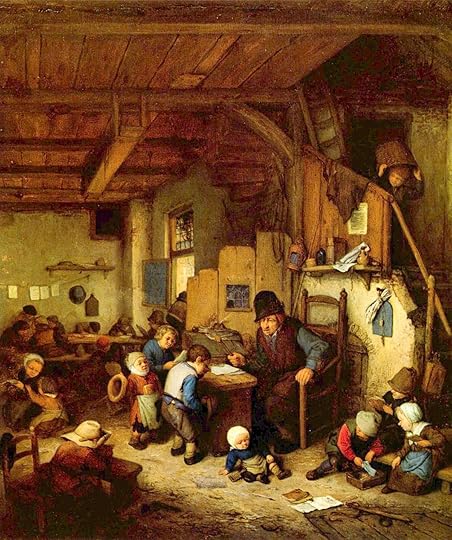
The Scoolmaster
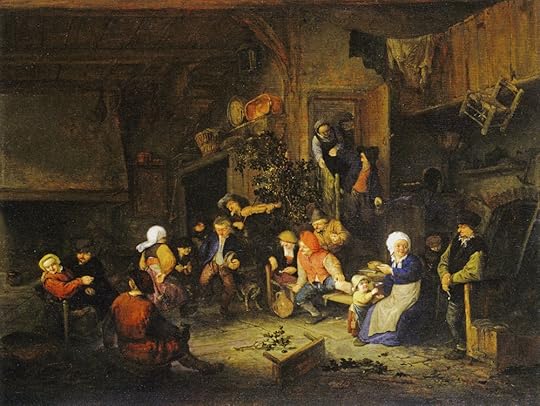
Merrymaking in a tavern
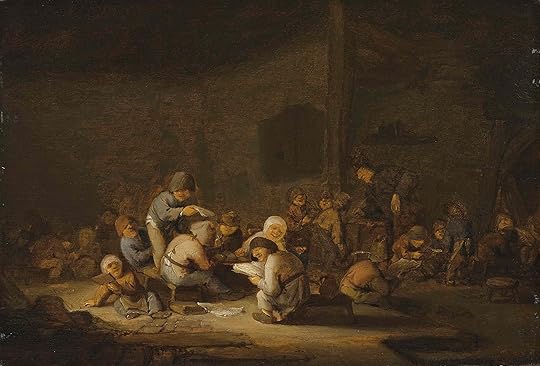
An interior of a classroom
Around the same time there was Jan Steen who depicted homely subjects too. His paintings are different though, because they are more chaotic, more gritty. 'A household of Jan Steen' is still an expression here for households that are chaotic, dirty and messy. I still hear my mother shooing us to 'clean up our room right this instant, we're not a household of Jan Steen (and you could hear her thinking 'for fuck's sake', but she never said that out loud)!!!'
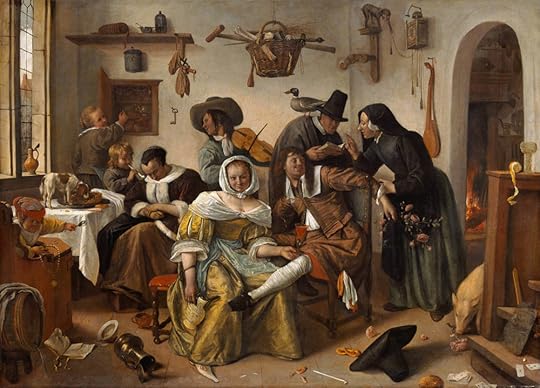
Jan Steen, In Weelde Siet Toe (of: 'De omgekeerde wereld'), 1663
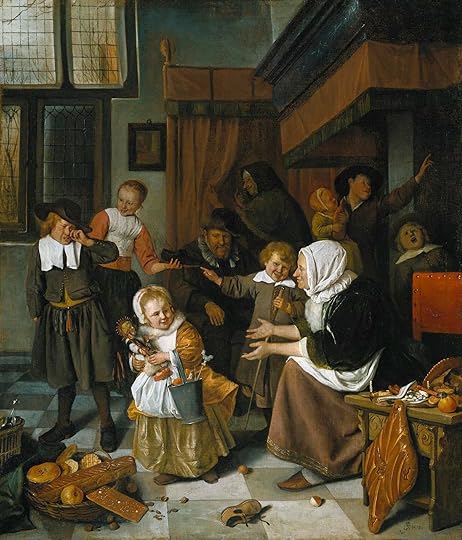
Jan Steen, Het Sint Nicolaas-feest (The Saint Nicholas-feast) 1665 - 1668
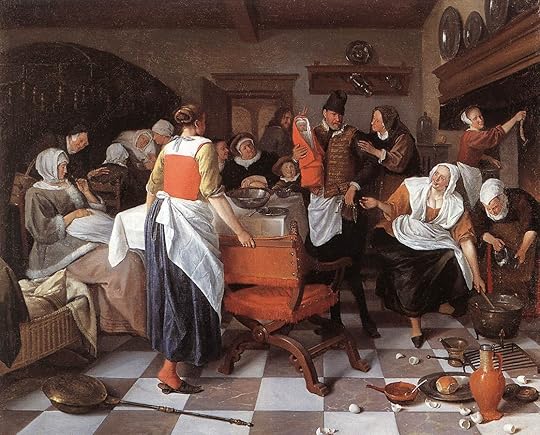
Celebrating the Birth - 1664
Jan Steen, In Weelde Siet Toe (of: 'De omgekeerde wereld'), 1663
Jan Steen, Het Sint Nicolaas-feest (The Saint Nicholas-feast) 1665 - 1668
Celebrating the Birth - 1664
Mod
Jantine
Jan Steen certainly knew how to create a rather chaotic scene. “A household of Jan Steen.” Now that’s a great expression.
Mod
Mod
Mod
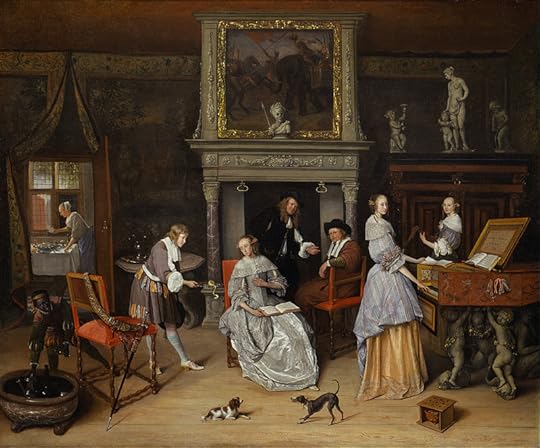
I also never understand all the stuff on the floor from a practical perspective. It of course all is from an artistic perspective - to fill up the painting, and for symbolism. F.i. the eggshells for fertility in the last painting, they have to go somewhere.
Mod
Mod
It's also how my son's room looks now that you mention it. Every now and then I can't take it anymore and go in, put everything away, dust, run the sweeper, then when he gets home he gets mad because he can't find anything. :-)


We are almost finished!! And just in time for Christmas! I'm almost done decorating inside, only the bedrooms, bathrooms and laundry room are left and they won't take long. Very soon David will be on his own without us to keep track of him. The first chapter in this installment, Chapter 54 is titled "Mr. Micawber's Transactions" and begins with David telling us of his grief on the death of Dora, but it seemed to me he talked much more about Agnes than he did Dora:
"When it was first proposed that I should go abroad, or how it came to be agreed among us that I was to seek the restoration of my peace in change and travel, I do not, even now, distinctly know. The spirit of Agnes so pervaded all we thought, and said, and did, in that time of sorrow, that I assume I may refer the project to her influence. But her influence was so quiet that I know no more.
And now, indeed, I began to think that in my old association of her with the stained-glass window in the church, a prophetic foreshadowing of what she would be to me, in the calamity that was to happen in the fullness of time, had found a way into my mind. In all that sorrow, from the moment, never to be forgotten, when she stood before me with her upraised hand, she was like a sacred presence in my lonely house. When the Angel of Death alighted there, my child-wife fell asleep—they told me so when I could bear to hear it—on her bosom, with a smile. From my swoon, I first awoke to a consciousness of her compassionate tears, her words of hope and peace, her gentle face bending down as from a purer region nearer Heaven, over my undisciplined heart, and softening its pain."
Poor Agnes, who would want to be compared to a stained-glass window in a church. How do you live up to that? I mean her gentle face bending down from near Heaven, really? This poor girl will never be able to make a mistake or she'll fall from her stained glass window position. Whatever his reasons are for concentrating on Agnes, or perhaps I may be imagining anything odd in it, David does not appear to be going anywhere abroad or otherwise by the end of the chapter so I'm not sure why he mentioned it at all. He does say he must wait until after "the final pulverization of Heep" and until the emigrants leave, but I'm still not sure why he brought it up now.
Anyway, on to the Micawber's. Shortly after this Traddles, who has been at Mr. Wickfield's "labouring ever since our explosive meeting" asks David, Agnes and Aunt Betsey to come to Mr. Micawber's house for a meeting. When they arrive Mr. Micawber tells them the move to Australia may be exactly what his family needs, and he wants to be sure that he arranges the finances between him and Miss Betsey professionally.
'Madam, you do us a great deal of honour,' he rejoined. He then referred to a memorandum. 'With respect to the pecuniary assistance enabling us to launch our frail canoe on the ocean of enterprise, I have reconsidered that important business-point; and would beg to propose my notes of hand—drawn, it is needless to stipulate, on stamps of the amounts respectively required by the various Acts of Parliament applying to such securities—at eighteen, twenty-four, and thirty months. The proposition I originally submitted, was twelve, eighteen, and twenty-four; but I am apprehensive that such an arrangement might not allow sufficient time for the requisite amount of—Something—to turn up. We might not,' said Mr. Micawber, looking round the room as if it represented several hundred acres of highly cultivated land, 'on the first responsibility becoming due, have been successful in our harvest, or we might not have got our harvest in. Labour, I believe, is sometimes difficult to obtain in that portion of our colonial possessions where it will be our lot to combat with the teeming soil.'
'Arrange it in any way you please, sir,' said my aunt.
I am beginning to wish Mr. Micawber could just be quiet some times, or at least say what he wants to in less than half the words. I don't really dislike him, but I wonder if I would if we weren't sending him out of the country soon. Mr. Micawber goes on to tell his visitors of all the preparations they have been making for their new lives in Australia:
"My eldest daughter attends at five every morning in a neighbouring establishment, to acquire the process—if process it may be called—of milking cows. My younger children are instructed to observe, as closely as circumstances will permit, the habits of the pigs and poultry maintained in the poorer parts of this city: a pursuit from which they have, on two occasions, been brought home, within an inch of being run over. I have myself directed some attention, during the past week, to the art of baking; and my son Wilkins has issued forth with a walking-stick and driven cattle, when permitted, by the rugged hirelings who had them in charge, to render any voluntary service in that direction—which I regret to say, for the credit of our nature, was not often; he being generally warned, with imprecations, to desist.'"
There must have been quite a lot of farming going on in Australia at the time, at least the Micawbers think so, if they end up in a city they won't know what to do. When the Micawber's leave the room David tells Traddles and Agnes that he is worried about his aunt:
'During the last fortnight, some new trouble has vexed her; and she has been in and out of London every day. Several times she has gone out early, and been absent until evening. Last night, Traddles, with this journey before her, it was almost midnight before she came home. You know what her consideration for others is. She will not tell me what has happened to distress her.'
My aunt, very pale, and with deep lines in her face, sat immovable until I had finished; when some stray tears found their way to her cheeks, and she put her hand on mine.
'It's nothing, Trot; it's nothing. There will be no more of it. You shall know by and by. Now Agnes, my dear, let us attend to these affairs.'
It's rather strange to talk about the lady as if she isn't there when she's sitting in the same room with them. I guess he can't be accused of gossiping about her behind her back. Traddles tells them that now that Uriah is gone Mr. Wickfield has improved, his memory and attention to business have improved so much that he has been able to assist in making certain things clear. Also that Mr. Micawber and Mr. Dick have been extremely helpful:
'I must do Mr. Micawber the justice to say,' Traddles began, 'that although he would appear not to have worked to any good account for himself, he is a most untiring man when he works for other people. I never saw such a fellow. If he always goes on in the same way, he must be, virtually, about two hundred years old, at present. The heat into which he has been continually putting himself; and the distracted and impetuous manner in which he has been diving, day and night, among papers and books; to say nothing of the immense number of letters he has written me between this house and Mr. Wickfield's, and often across the table when he has been sitting opposite, and might much more easily have spoken; is quite extraordinary.'
'Letters!' cried my aunt. 'I believe he dreams in letters!'
'There's Mr. Dick, too,' said Traddles, 'has been doing wonders! As soon as he was released from overlooking Uriah Heep, whom he kept in such charge as I never saw exceeded, he began to devote himself to Mr. Wickfield. And really his anxiety to be of use in the investigations we have been making, and his real usefulness in extracting, and copying, and fetching, and carrying, have been quite stimulating to us.'
'Dick is a very remarkable man,' exclaimed my aunt; 'and I always said he was. Trot, you know it.'
Traddles then explains that he went over the Wickfield accounts and found that most of Aunt Betsey's money would be returned, but he can't account for three thousand pounds. Aunt Betsey then explains that she had used those three thousand herself, one thousand for David's articles, the other two thousand pounds that she had withdrawn and kept by for a rainy day. Aunt Betsey informs David that she didn't tell him because she wanted to see if he could get along without her financial help and he came out nobly—"persevering, self-reliant, self-denying"!
Agnes decides she will rent out the house and run a school in order to keep herself and her father financially secure and Traddles tells them that Uriah and his mother went away by one of the London night coaches, and he knows no more about him. I hope they don't end up on the same ship as almost everyone else did, Uriah and Mr. Micawber stuck with each other on a ship going to Australia, now that would be interesting.
The next morning Aunt Betsey asks David to go for a ride and she will tell him the reason she has been so troubled. They drive to a London hospital where a hearse is waiting with the body of her missing husband, he had died a few days before:
'You understand it now, Trot,' said my aunt. 'He is gone!'
'Did he die in the hospital?'
'Yes.'
She sat immovable beside me; but, again I saw the stray tears on her face.
'He was there once before,' said my aunt presently. 'He was ailing a long time—a shattered, broken man, these many years. When he knew his state in this last illness, he asked them to send for me. He was sorry then. Very sorry.'
'Six-and-thirty years ago, this day, my dear,' said my aunt, as we walked back to the chariot, 'I was married. God forgive us all!
I didn't understand why we needed Aunt Betsey's husband in the book in the first place. Why couldn't they just have had him disappeared in India or wherever the story sent him in the beginning? I don't understand what the point was to have him here at all.