
The Old Curiosity Club discussion
David Copperfield
>
DC Cpt 62-64

 Mod
Mod
A Visitor
As we approach the end of the novel David tells us that there “one thread in the web I have spun” yet to be recalled or his story would “have a ravelled end.” What a wonderful phrase, and an accurate one as well. A novel is a web of interconnected threads. To have a ravelled end in a novel would leave the web of a narrative incomplete and weakened.
We learn from the beginning of this chapter that 10 years has passed and Agnes and David are the parents of three children. One evening they learn that there is a stranger at their door. Who is it? It is none other than Mr Peggotty. He has come to see David and Agnes in “their wedded happiness, afore I got to be too old.” The reader is again reminded of the time when Peggotty tells David that he was himself the height of the littlest of David’s own children when Peggotty first met him. Time has certainly passed. The cycle of life continues. What news does Peggotty bring David about all the people who emigrated to Australia?
Peggotty says all have survived and thrived in their own ways. Peggotty has done sheep-farming and stock-farming and done well. Em’ly has kept David in her prayers and nursed her neighbours and taken care of their children. She knows that a Steerforth is dead. She has not married but has found solace in the fact that many people who face troubles have found comfort in her.
Martha met a man who is a farm-labourer and they live “fower hundred mile away from any voices but their own and the singing birds.”
Mrs Gummidge has turned down offers of marriage and is determined to continue the life as she now lives it. She is happy, content, and an honest woman.
And then there is, of course, the Micawber’s. He has applied his skills of talking and desire to succeed and become a Magistrate. Are we surprised to learn that he is widely celebrated and still retains the ability to be unable to say two words when twenty two are available?
Dr Mell is now also in Australia and is described as “highly talented and ... widely popular.”
Mr Peggotty stays with David and Agnes for “something less than a month” and got to enjoy a visit with Aunt Betsey and his sister. Before he leaves he and David fo to see the simple grave that David had established in the churchyard of Yarmouth. There, he stoops and takes a tuft of grass and a little grass from the plot. As he explains to David, he is taking them for Em’ly.
Thoughts
In this novel, like the previous ones we have read the general rule of thumb is that all the good and bad characters have their lives and their futures outlined in the final chapters. Are you satisfied, disappointed, or surprised with how Dickens brings the lives of the characters in this chapter to their conclusion?
Mod
A last Retrospect
In this chapter David looks back, once more - for the last time - at his story.
His aunt is over eighty, and yet is still a steady walker. Always accompanying her is Peggotty. Time has dimmed her eyes yet she is firmly and always in David’s heart. We learn the name of three of Agnes and David’s children. They are Betsey, Dora, and Agnes. In this way, our story, or at least the names of important people in our story can continue into another generation. Peggotty still has David’s old Crocodile-Book. Memories of his past flood David’s mind.
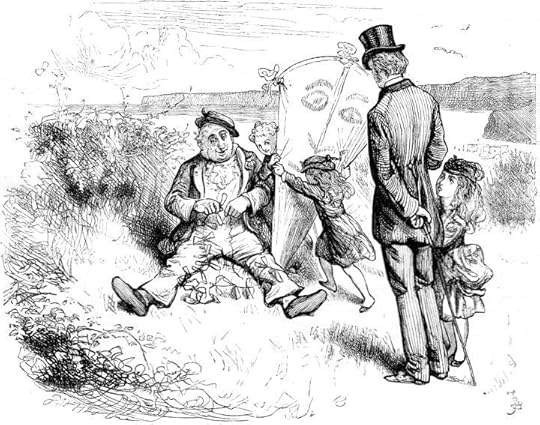
We learn that David also has sons who delight in flying kites with an old man. Could their names be David and Tommy? I wonder why Dickens does not give us their names?
We learn that Rosa Dartle and Mrs Steerforth are still alive and their personalities have not changed. The mind of Mrs Steerforth wanders. Rosa remains an unpleasant companion. David says that “they wear their time away, from year to year.”
Julia Miles is now married to an old withered man who is wealthy.
Doctor Strong continues on with his dictionary and his wife is always by his side.
And dear Traddles... he is as happy and as content as ever. He and Sophy are parents of successful children. His house is still happily overrun with family and he is David’s best friend.
Agnes. She is the centre of David's life and universe. She is his soul. David’s wish is that she will always be beside him, “pointing upward.”
Thoughts
In the first paragraph of this book we learned that David was born at the stroke of midnight. At that moment, he cried. David Copperfield wonders whether he will be found to be a hero in his life’s story and journey.
The thought for this chapter is clear. Is David the hero of his life? Is he a hero at all? Indeed, how would you define a hero?
Dickens said that this novel was his favourite child. Is this your favourite novel to date on our journey through his work?
Mod
We have finished David Copperfield. Dickens himself said that it was his favourite child. In my mind it is certainly the most autobiographical of his novels. Many people even point to the fact if you take the first letter of both David and Copperfield and switch them around you get C D which is, of course, the first letters of Charles and Dickens. Was this a conscious act?
I have compiled a few questions for consideration about the novel. Please ... if YOU have any questions about the novel, a character, a seeming inconsistency or flaw, or a compliment, insight, or untold thought about the novel this is the place to open a discussion.
I will begin by offering a couple of questions, but first want to thank Kim for her weekly postings of the illustrations. These illustrations are delightful, and show us how different artists pictured the world of the characters and their situations in the novel. And now my first question, or perhaps it is more of a puzzle. There are over forty illustrations by Hablot Browne in this novel, two published for each monthly part. What similarity exists in all the chapter illustrations? As a hint, the only exception exists is the illustration found on the title page which depicts Little Em’ly on the sea shore with the Peggotty home in the background.
There is much that can be found in this novel that is autobiographical in nature. In general, how autobiographical do you think novels generally are? Do you think Dickens’s autobiographical moments in this novel helped or hindered his overall narrative?
What literary devices did you find most frequent, most enjoyable, or most annoying in the novel.
Nineteenth century novels often tended to be very lengthy. To an extent, this was due to their being published in serial form. Serial form put much pressure on the novelist to write to a designated length under time constraints. With all these factors in mind, how different do you think David Copperfield would have been had it been written without time pressure?
I believe that Dickens thrives on his own knowledge and experiences in the world, and that such knowledge and experience spills out in his novels. If you are familiar with Dickens’s biography, what part of his own life did you find most clearly represented in the novel? If you are not familiar with Dickens’s biography, what emotion, fear, or concern do you find to be the most obvious in the novel?
What would you like to observe or comment upon about this novel?
 Mod
Mod
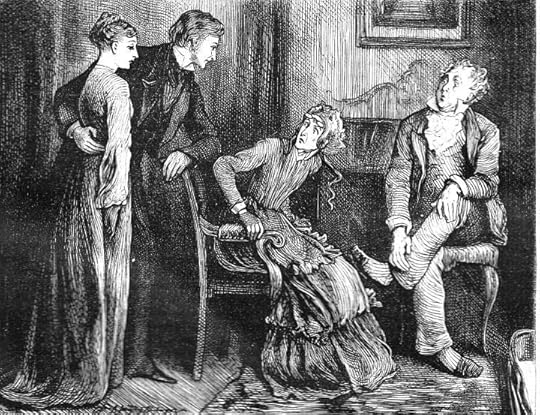
‘Goodness me!’ said my aunt, peering through the dusk, ‘who’s this you’re bringing home?’
Chapter 62
Fred Barnard
1872 Household Edition
Text Illustrated:
It was nearly dinner-time next day when we appeared before my aunt. She was up in my study, Peggotty said: which it was her pride to keep in readiness and order for me. We found her, in her spectacles, sitting by the fire.
‘Goodness me!’ said my aunt, peering through the dusk, ‘who’s this you’re bringing home?’
‘Agnes,’ said I.
As we had arranged to say nothing at first, my aunt was not a little discomfited. She darted a hopeful glance at me, when I said ‘Agnes’; but seeing that I looked as usual, she took off her spectacles in despair, and rubbed her nose with them.
She greeted Agnes heartily, nevertheless; and we were soon in the lighted parlour downstairs, at dinner. My aunt put on her spectacles twice or thrice, to take another look at me, but as often took them off again, disappointed, and rubbed her nose with them. Much to the discomfiture of Mr. Dick, who knew this to be a bad symptom.
‘By the by, aunt,’ said I, after dinner; ‘I have been speaking to Agnes about what you told me.’
‘Then, Trot,’ said my aunt, turning scarlet, ‘you did wrong, and broke your promise.’
‘You are not angry, aunt, I trust? I am sure you won’t be, when you learn that Agnes is not unhappy in any attachment.’
‘Stuff and nonsense!’ said my aunt.
As my aunt appeared to be annoyed, I thought the best way was to cut her annoyance short. I took Agnes in my arm to the back of her chair, and we both leaned over her. My aunt, with one clap of her hands, and one look through her spectacles, immediately went into hysterics, for the first and only time in all my knowledge of her.
The hysterics called up Peggotty. The moment my aunt was restored, she flew at Peggotty, and calling her a silly old creature, hugged her with all her might. After that, she hugged Mr. Dick (who was highly honoured, but a good deal surprised); and after that, told them why. Then, we were all happy together.
Mod
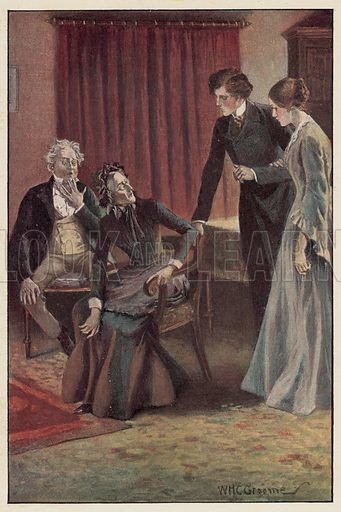
We both leaned over her
William Henry Charles Groome (1881-1914)
Mod
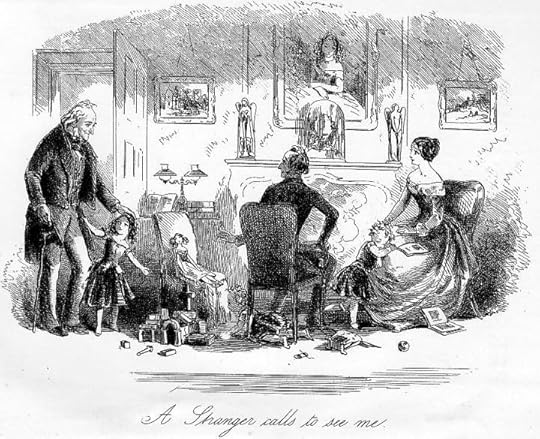
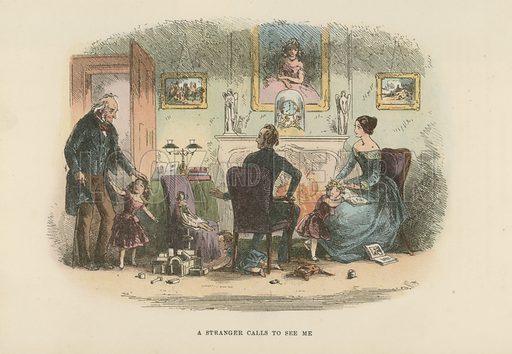
A Stranger calls to see me
Chapter 63
Phiz
Commentary:
The second illustration for the nineteenth (double) monthly number, issued in November 1850, completes the story of Dan'l Peggotty, his niece, and those who accompanied them to Australia. For this second November illustration, the illustrator shows a mature David Copperfield, his middle age made obvious by his receding hairline, seated before a domestic hearth with his second wife Agnes seated beside him, his children playing happily with numerous toys, and his first wife, Dora, presiding over the scene from the painting above the mantelpiece. According to J. A. Hammerton (1910), this illustration of well deserved domestic bliss may be associated with the following passage:
Little Agnes ran to bring the old man in, and my wife cried out to me that it was Mr. Peggotty!
In fact, Hammerton has collapsed the passage that Phiz, likely prompted by Dickens, has utilized to demonstrate that the highly moral couple, David and Agnes, are enjoying the benefits of spousal companionship and family that fate has denied to Em'ly, still a single woman in Port Middlebay, Australia, tending her uncle's home:
I had advanced in fame and fortune, my domestic joy was perfect, I had been married ten happy years. Agnes and I were sitting by the fire, in our house in London, one night in spring, and three of our children were playing in the room, when I was told that a stranger wished to see me.
He had been asked if he came on business, and had answered No; he had come for the pleasure of seeing me, and had come a long way. He was an old man, my servant said, and looked like a farmer.
As this sounded mysterious to the children, and moreover was like the beginning of a favourite story Agnes used to tell them, introductory to the arrival of a wicked old Fairy in a cloak who hated everybody, it produced some commotion. One of our boys laid his head in his mother’s lap to be out of harm’s way, and little Agnes (our eldest child) left her doll in a chair to represent her, and thrust out her little heap of golden curls from between the window-curtains, to see what happened next.
‘Let him come in here!’ said I.
There soon appeared, pausing in the dark doorway as he entered, a hale, grey-haired old man. Little Agnes, attracted by his looks, had run to bring him in, and I had not yet clearly seen his face, when my wife, starting up, cried out to me, in a pleased and agitated voice, that it was Mr. Peggotty!
It WAS Mr. Peggotty. An old man now, but in a ruddy, hearty, strong old age. When our first emotion was over, and he sat before the fire with the children on his knees, and the blaze shining on his face, he looked, to me, as vigorous and robust, withal as handsome, an old man, as ever I had seen.
The pleasant domestic scene, with the husband and wife keeping company with "three of [their] children" (a turn of phrase implying that David and Agnes by the tenth year of their marriage have had more than that number of offspring) is reminiscent of pictures in the popular press (notably, The Illustrated London News) of the royal couple and their numerous progeny at mid-century. If we assume that the date of Dan'l Peggotty's London visit is the spring of 1850, the time of this instalment's publication, then David and Agnes Copperfield would have married about the same year as Queen Victoria and Prince Albert (1840). The royal couple eventually had nine children in total, and certainly by mid-century had seven children.
In the final illustration in the narrative-pictorial sequence, and discounting the ornamental title-page and frontispiece as flashbacks, the story essentially comes to closure with respect to the David-Agnes romance. The boy who had nothing but the rags on his back as he approached Dover is now a comfortably circumstanced middle-class parent of a growing family, a benign Victorian pater familias in contrast to the despotic stepfather who killed his mother with unkindness. Testifying to the source of his wealth and respectability, books lie strewn across the floor, as if (however unlikely) these have been the playthings of the Copperfield children, the building blocks of cognition and sensibility, so to speak, analogous to the physical building blocks with which little Agnes has been playing. Since another few years will pass in the succeeding chapters before we arrive, so to speak, at the present, the year 1850, we may assume this domestic scene and reunion with Dan'l Peggotty occur in the mid-1840s, when both Charles Dickens and Queen Victoria had growing families: while Dickens's oldest child was a boy (Charles Dickens, Junior, born 6 January 1837), the Queen's oldest child was Victoria, the Princess Royal, born in 1840, and was therefore about five years of age (roughly the same age as the child named for after her mother, Kate Dickens, born 31 January 1839) when the scene is set chronologically. Interesting but by sheer coincidence, both couples, Charles and Catherine Dickens and Victoria and Albert, each had nine children survive infancy. There are certain similarities between this picture of the Copperfield family and that of the Royal family in The Illustrated London News in the 12 October 1844 issue: "The Crimson Drawing-room: — Introduction of Louis Philippe to the Infant Royal Family".
The drawing-room of this final scene in Phiz's narrative-pictorial sequence bears certain points of resemblance to that other Copperfield drawing-room scene by Phiz, "My child-wife's old companion", even though the house in which David and Agnes reside is located in London rather than on the outskirts of the metropolis, in Highgate, where David and Dora lived. The same clock, indicative of the passage of time and its effects on the characters, sits on the mantelpiece, and Dora's picture looks down up David, whom she has bequeathed in both scenes to the more intellectually able Agnes. As Jane Rabb Cohen notes,
After Agnes and David are married, the same portrait, hanging between the two sculptured angels, and next to it apparently a drawing of Em'ly before her Yarmouth boat home, recall the turbulent past that made the present idyllic scene possible . . . .
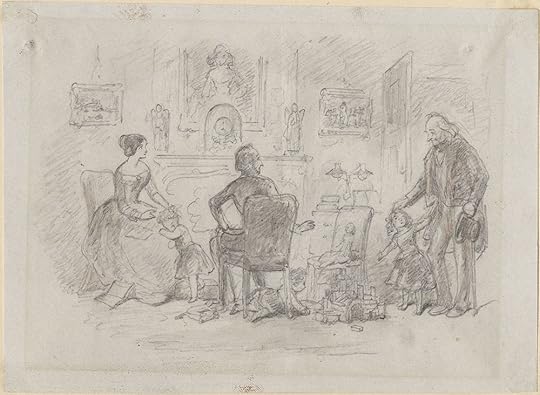
One should add, as Phiz's including so many books again in David's domestic situation implies, that the present idyllic scene is also made possible by the fruits of David's imagination, so that, in a sense, the scene contains two varieties of Copperfield children. The scene to the right of the fireplace, then, corresponds with the title-page vignette, while the picture to the left appears to be an old house, possibly the Blunderstone Rookery, which in a different view is the subject of the frontispiece. The angels whose presence Cohen notes do not in fact represent the twin angels of David's life, Dora and Agnes, since one (right) is clearly male, so that the logical construction to place upon the sculptures is that they are analogues for the destined couple themselves. The picture of Dora is unchanged since "My child-wife's old companion", although less dark and therefore more easily discerned in its details; since the posture and the off-the-shoulder dress are the same, one is tempted to note that, whereas Agnes was wearing a more modest dress suitable to the gloomy mood in the earlier plate (in which she is about to announce Dora's death), now Agnes is wearing a dress in precisely the same fashion, a subtle suggestion that she has replaced Dora in David's life. Daniel Peggotty, a respectable dressed, affluent, old farmer, seems to have aged dramatically since his last appearances (in "The Emigrants" and "Mr. Peggotty's dream comes true"), and the wild-haired Copperfield boys resemble the Micawber twins in "Restoration of mutual confidence between Mr. and Mrs. Micawber". A significant difference is the size of the chairs in each drawing-room scene, for whereas David's chair is much larger than Dora's armless chair (identified by the guitar and music folio leaning against it) in the former scene, in the latter scene David and Agnes occupy chairs of similar size and design, suggesting their intellectual and moral equality. Nevertheless, in terms of composition, one chair has its back to the viewer in each scene; however, while that chair is vacant in the former scene, in the latter it is occupied by David (once again shown in in profile), who formerly was wrapped up in his melancholy thoughts of the ailing Dora but now turns away from the fire to welcome Mr. Peggotty. Although Fred Barnard also provides an illustration for ch. 63 in the Household Edition of the novel, the "stranger" is not in fact Mr. Peggotty; rather, the Barnard plate realizes a moment in the sixty-fourth chapter, when Mr. Dick fashions and flies kites for David's boys in the summertime.
 Mod
Mod
"If a ship's cook that was turning settler, Mas'r Davy,"
Chapter 63
Fred Barnard
1872 Household Edition
Text Illustrated:
‘Is Martha with you yet?’ I asked.
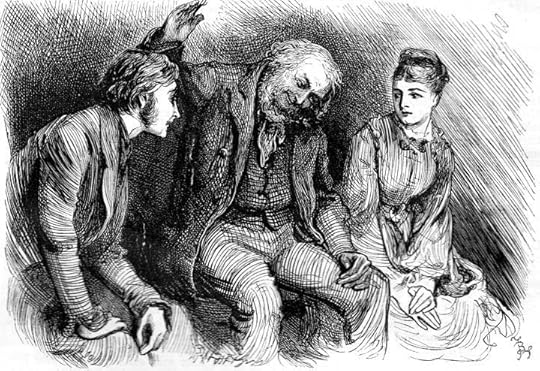
‘Martha,’ he replied, ‘got married, Mas’r Davy, in the second year. A young man, a farm-labourer, as come by us on his way to market with his mas’r’s drays—a journey of over five hundred mile, theer and back—made offers fur to take her fur his wife (wives is very scarce theer), and then to set up fur their two selves in the Bush. She spoke to me fur to tell him her trew story. I did. They was married, and they live fower hundred mile away from any voices but their own and the singing birds.’
‘Mrs. Gummidge?’ I suggested.
It was a pleasant key to touch, for Mr. Peggotty suddenly burst into a roar of laughter, and rubbed his hands up and down his legs, as he had been accustomed to do when he enjoyed himself in the long-shipwrecked boat.
‘Would you believe it!’ he said. ‘Why, someun even made offer fur to marry her! If a ship’s cook that was turning settler, Mas’r Davy, didn’t make offers fur to marry Missis Gummidge, I’m Gormed—and I can’t say no fairer than that!’
I never saw Agnes laugh so. This sudden ecstasy on the part of Mr. Peggotty was so delightful to her, that she could not leave off laughing; and the more she laughed the more she made me laugh, and the greater Mr. Peggotty’s ecstasy became, and the more he rubbed his legs.
‘And what did Mrs. Gummidge say?’ I asked, when I was grave enough.
‘If you’ll believe me,’ returned Mr. Peggotty, ‘Missis Gummidge, ‘stead of saying “thank you, I’m much obleeged to you, I ain’t a-going fur to change my condition at my time of life,” up’d with a bucket as was standing by, and laid it over that theer ship’s cook’s head ‘till he sung out fur help, and I went in and reskied of him.’
Mod
"Trotwood, you will be glad to hear that I shall finish the memorial"
Chapter 64
Fred Barnard
1872 Household Edition
Text Illustrated:
Among my boys, this summer holiday time, I see an old man making giant kites, and gazing at them in the air, with a delight for which there are no words. He greets me rapturously, and whispers, with many nods and winks, ‘Trotwood, you will be glad to hear that I shall finish the Memorial when I have nothing else to do, and that your aunt’s the most extraordinary woman in the world, sir!’
Mod
Uncaptioned tail-piece
Fred Barnard
1872 Household Edition
Commentary:
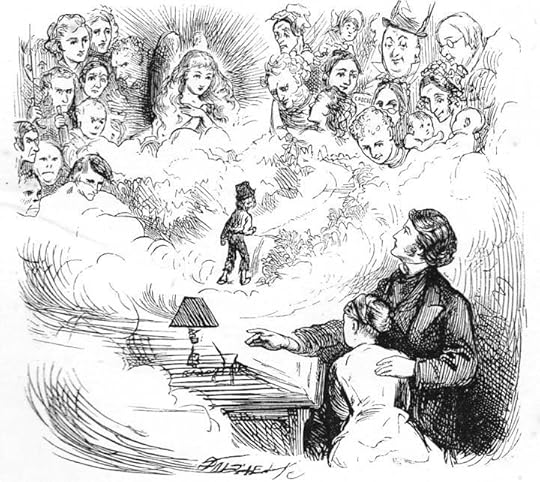
Barnard shows the mature David Copperfield and his second wife, Agnes, lower right, at his writing desk, with all the characters of the story, notably a waif-like David, centre, and above him, in the clouds, an angelic young woman (realized from the closing paragraphs of the letterpress, to the left of whom are the autobiography's less pleasant persons, notably Uriah Heep). The apotheosis of his former wife, Dora, which Barnard has chosen to effect in spite of the text's invoking Agnes as the great spiritual force in David's life, anticipates Coventry Patmore's treatment of marriage:
The Married Lover
Why, having won her, do I woo?
Because her spirit's vestal grace
Provokes me always to pursue,
But, spirit-like, eludes embrace;
Because her womanhood is such
That, as on court-days subjects kiss
The Queen's hand, yet so near a touch
Affirms no mean familiarness. . . .
(Coventry Patmore, "Husband and Wife," The Angel in the House, Canto XII, 1-10)
Coventry Patmore's poetic bildungsromanen The Angel in the House (1854) and The Victories of Love (1862) were immensely influential in crystallizing Victorian attitudes towards middle-class, married women not merely as chatelaines, but as vessels of purity and "vestal grace" upon whom the moral health of the entire society depended. However, that Patmore was working on his initial multi-part dramatic monologue while the last installments of the hero-narrated David Copperfield were appearing in print points to the enormous influence of Dickens in both assimilating and authorizing this construction of sainted Victorian womanhood. (Patmore would likely have been following Copperfield since in August 1850, in the midst of the novel's serial run, the poet submitted to Dickens a short story entitled "Evil is Wrought by Want of Thought" for publication in the recently founded Household Words.) In a sense, Agnes Wickfield is but the noblest and most sanctified of a long line of Dickensian heroines, including Mary Graham in Martin Chuzzlewit (1843-4), Edith Dombey in Dombey and Son (1846-1848), and Milly Swidger in The Haunted Man (1848), all of whom owe something of their intense inner goodness and outward beauty to Dickens's sister-in-law, Mary Hogarth. However, this incarnation of the Victorian feminine ideal is not merely a sainted maiden, but a wife and mother who replaces the childless and immature Dora Spenlow as David's life's companion, and who performs the role of ministering angel for which Dora was neither morally nor intellectually equipped.
The decidedly masculine shift in the final chapter, "A Last Retrospect," foregrounding the fortunes of Mr. Dick and Tommy Traddles, reinforces David's role as pater familias, but does not diminish the importance of Agnes as the Angel in the House, reified by Barnard's final illustration for the novel, in which he translates into the visual medium Dickens' effusion of Agnes as a ministering spirit ("O Agnes, O my soul, so may thy face be by me when I close my life indeed"), but substitutes in the clouds above the couple's heads the beaming visage of Dora with angel's wings and arms crossed on her breast. Thus, Barnard, having had the advantage of access to Patmore's poems and being aware of the convention of "The Angel in the House," elides Dora and Agnes as the presiding "Angel" in David Copperfield's house.
Mod
A Stranger calls to see me
Chapter 63
Phiz
Commentary:
The second illustration for the nineteenth (double) monthly number, issued in November 1850, completes the story of Dan'l Peggotty, his ..."
Now here is an illustration to ponder and enjoy. There are three levels of viewing one can enjoy here. First is the broad view of the illustration that a viewer brings. We then move towards the mantle where we see a portrait of Dora who is looking with contentment back at Agnes and David who sit before her. As noted in the above commentary that Kim provided, we see that Agnes, by the way she is dressed, reflects Dora. Thus we see both the past and the present at one time.
If we then direct our gaze at the two smaller pictures on the wall, one one each side of the Dora portrait, we see Browne having some fun with the reader/viewer. In the top right corner of the illustration the picture on the wall is the illustration that Browne produced for the title page of the novel which has Little Em’ly on the beach with the Peggotty home in the background. What is interesting about this picture on the wall is that the illustration did not appear until the novel was complete so we actually have Browne placing and previewing his own illustration within another of his illustrations. And, that’s not all. If we look at the small picture to the left top of the illustration we have a reproduction of Browne’s illustration when David arrived at his Aunt Betsey’s. Thus, we actually have two illustrations by Browne placed within another illustration by Browne.
With the two angels on the mantle and the clock we have, as the commentary points out, other parts of the earlier novel now projected into the present and future.
In David Copperfield, and the upcoming Bleak House, we have the high water mark of Browne’s career with Dickens.
 Peter wrote: "Martha met a man who is a farm-labourer and they live “fower hundred mile away from any voices but their own and the singing birds."
Julia Miles is now married to an old withered man who is wealthy.
I was surprised by both of these.
It was good to see Martha accepted back into society, and I liked it that she even made sure her prospective husband knew about her past--and that wasn't a problem. Makes me think maybe Australia was a better place than England, though maybe it was just short on women.
As for Julia Mills--what a puzzling wrap-up. Was she so bad as to deserve this? I know she encouraged the dismal David-Dora marriage, but it's not like David needed much encouragement. It was hardly her fault. And the particular punishment of "marry a rich guy you don't really care for" doesn't seem all that fitting for a character so wrapped up in other people's romances. Maybe that's the point, but I'm not quite grasping it.
Peter wrote: "In our reading since Pickwick has there been a couple that you think were more suited to each other than David and Agnes? If so who, and why?"This is a fun question. I nominate (for starters) Rose and Harry Maylie. I don't really think David and Agnes are a very good couple, because their communication is so awful. Rose and Harry had a problem, communicated clearly about it, and solved it with a minimum of fuss, largely by coming to the resolution that the problem was kind of bunk anyway and nobody who cared about it ought to matter to them. I admire that on a number of counts! Though I am sorry Harry didn't end up in Parliament.
Also, I think I am partial to lovers in novels who are willing to sacrifice for each other. Did David ever sacrifice a thing for Agnes, other than temporarily keeping quiet about his feelings for her? Poor woman sure had to wait around a long time while he gallivanted. I am with the Penelope comparison.
Mod
Julia Miles is now married to an old withered man ..."
Hi Julie
Yes, it was good to see that Martha found a man to love her. I also agree with you that Australia was a place that was rather short of eligible women.
As a person who lives in the Pacific Northwest did you know that your neighbour Victoria “imported” eligible women? A number of ships called bride ships were sent from England in the mid nineteenth century loaded with young eligible women to meet the high numbers of single males who lived in Victoria. The first was the “Tynemouth.” Bachelors lined the wharf as the ships arrived.
There is even a plaque by the inner harbour of Victoria that records the event. The trip to Victoria from England took months. One wonders what a young lady would do if she changed her mind half way through the trip.
Peter wrote: "The trip to Victoria from England took months. One wonders what a young lady would do if she changed her mind half way through the trip."I don't know, sounds like a setup for the best bachelorette party ever.
I really would have liked to have been there watching when that ship came into port. So many stories starting up! And what brave people, all of them, pulling up roots to begin a new life like that.
 Mod
Mod
We as readers have waited a long time for David and Agnes to be joined in love and married. Did you find this chapter too maudlin, too predictable, very satisfying?
At any point in the novel did you doubt that Dickens would unite David and Agnes? If so, where and why?"
Honestly, I would have been very surprised unless David had finally married Agnes because they just seem made for each other, or in other words: Agnes is the typical mildly interesting female saint, and David is the hero. Some matches are made in heaven, others in a die of stereotypical expectations ;-)
The only other alternative I could have thought of was that Agnes and David would have stayed single and nobly pined for each other for the rest of their lives. The only difficulty the author had was to get Dora out of the way, and he did that very elegantly: Not only did Dora die at a convenient point in the novel, but she also insisted that Agnes take over her place. That's would I would call apple pie order.
Mod
In this novel, like the previous ones we have read the general rule of thumb is that all the good and bad characters have their lives and their futures outlined in the final chapters. Are you satisfied, disappointed, or surprised with how Dickens brings the lives of the characters in this chapter to their conclusion?"
As an inveterate reader of Dickens I am used to and dearly love such wrap-ups for the characters involved. I would have thought it more realistic for Emily to also get married to some decent man, like Martha, because after all, nobody can reasonably be expected to mope over their fate for the rest of their lives because that might grow a bit boring after a while. However, Emily being the stereotype of the fallen woman, Dickens probably had no other choice but to leave her single - Martha is, after all, just a minor character - because of a didactic effect in the eyes of his Victorian readers: In a way, they would have expected her to atone for her earlier "sins".
I like Mrs. Gummidge the better for her change, and one of my favourite passages is when she suddenly turns over a new leaf and stops being such a nuisance, seeing that her support and fortitude are sorely needed by the people who have put up with her whims for so long. The reference to Mr. Mell, however, seemed a bit too contrived - I must confess that I had completely forgotten him.
Mod
In the first paragraph of this book we learned that David was born at the stroke of midnight. At that moment, he cried. David Copperfield wonders whether he will be found to be a hero in his life’s story and journey.
The thought for this chapter is clear. Is David the hero of his life? Is he a hero at all? Indeed, how would you define a hero?
Dickens said that this novel was his favourite child. Is this your favourite novel to date on our journey through his work?"
I really can't think of David as a hero because he hardly does anything but watch other people getting into difficulty and get out of it more or less successfully. I really loved this chapter, though, because it gave us a heartwarming glimpse on many of the characters we grew to love in their old age.
Even though Dickens called DC his favourite child, I must say that there were other of his previous novels I enjoyed more - Pickwick Papers, for a start. If you compare it with Dombey and Son, the other of the two maturer novels he had written so far, I would say that Dombey and Son is far more satisfying, because it had more interesting conflicts - e.g. the marriage between Dombey and Edith -, more compelling villains - Carker! - and more memorable side characters - like Major Bagstock, Mr. Toots and the endearing Susan Nipper as well as her foe Mrs. Pipchin.
Mod
We have finished David Copperfield. Dickens himself said that it was his favourite child. In my mind it is certainly the most autobiographical of his novels. Many people even point to ..."
I think that DC is remarkable in that it dealt with Dickens's most memorable and haunting childhood trauma and used barely disguised parallels. I liked especially those parts in which David is still young and views the world through the eyes of a child, and where the narrator, who is indubitably much maturer, tries to capture the naivity and wonder of the child. The older David gets, the blander the novel becomes, I'd say, and many passages just seem drawn out for the sake of filling the instalment. This became most obvious towards the end.
All in all, much of the plot happened behind the scenes: Emily's seduction and awakening, Uriah's machinations and Micawbers' counter-machinations - and on the whole, this was rather dissatisfying.
 I would say David is a hero on the strength of his writing alone. After all, it is thanks to him that we have the story of his life as we know it. And to be as candid as he is (to avoid saying humble, a word that belongs to another character altogether) with regard to his self-portrayal is, if anything, a minor act of bravery.
Has anyone ever thought of writing a sequel to David Copperfield, told from the point of view of Uriah Heep? It could begin in the following manner : "Whether I shall turn out to be the 'ero of my own life, or whether that station will be 'eld by anybody else, these pages must show. "
Tristram wrote: "However, Emily being the stereotype of the fallen woman, Dickens probably had no other choice but to leave her single - Martha is, after all, just a minor character - because of a didactic effect in the eyes of his Victorian readers: In a way, they would have expected her to atone for her earlier "sins"."See, I think she has to be sacrificed on the altar of Perfect Ham (which kind of sounds like a Christmas dish). If she fell in love with someone else, even though she was never in love with Ham, it wouldn't pay back his fidelity--even though it was a useless fidelity for both of them since he wasn't going to accept her once she'd fallen, since he is perfect. Ham is my least favorite character in the book, worse than the Micawbers.
Aunt Betsey is my most favorite. I'd say she's pretty high on my list of favorite Dickens characters ever, though I regret that the story of her husband is so under-developed. Makes me want to write an Aunt Betsey novel to fill it in. She reminds me of my grandmother who was also mildly crazy and infinitely energetic and a force of nature.
Tristram wrote: "If you compare it with Dombey and Son, the other of the two maturer novels he had written so far, I would say that Dombey and Son is far more satisfying, because it had more interesting conflicts - e.g. the marriage between Dombey and Edith -, more compelling villains - Carker! - and more memorable side characters - like Major Bagstock, Mr. Toots and the endearing Susan Nipper as well as her foe Mrs. Pipchin."I agree. Dombey and Son was satisfying in so many ways. Florence may be the only perfect Dickens heroine I care for, though some of his imperfect ones are pretty great.
Mod
But Uriah would add "... although I already 'ave a hinkling at what these 'ere pages will say." ;-)
Mod
I love the expression "Alter of Perfect Ham" because Ham is quite a ham in his poor and simple ways. I can fully subscribe to your analysis of why Emily could not have been allowed to marry, Julie.
It does make me a bit sad though, that Emily is sacrifised to the Perfect Ham in that way. I agree, Ham is my least favourite character too.
I liked the wrap-up. I do notice that I find it hard to say anything about it, because like the good wrap-up that it is, it kind of closed the story for me. It was what it was, and apparently what it should be. Of course the characters are where they are now, and all is well.
I liked the wrap-up. I do notice that I find it hard to say anything about it, because like the good wrap-up that it is, it kind of closed the story for me. It was what it was, and apparently what it should be. Of course the characters are where they are now, and all is well.
Mod
Mod
Hi Ulysse
If a sequel ever comes out featuring Uriah Heep I’ll take a pass on reading it. One time with him was enough. :-)
Mod
Julie
Yes. The Ham was a bit too perfect. Perhaps overdone?
I would like to read a book featuring Aunt Betsey. As for your comment about grandmother’s being a force of nature I agree with you. My paternal grandmother deserves a book covering her life as well.
Tristram wrote: "Emily should have done it like David, Jantine: Marry Ham and then wait for fate - in the form of the sea - to get rid of him. As an angelic widow she would have had the right to remarry, especially..."David really did manage things well. :)
Peter wrote: "Yes. The Ham was a bit too perfect. Perhaps overdone?"Ha! That pun is a bit too perfect.
Tristram wrote: "Emily should have done it like David, Jantine: Marry Ham and then wait for fate - in the form of the sea - to get rid of him. As an angelic widow she would have had the right to remarry, especially..."
Nah, how would Ham have gotten his reason to be a martyr then? He would have lived on to be the perfect husband she never wanted, I tell you!
And yes, the sequel from Aunt Betsey would be great. :-) A whole book about Mr. Mell would be great too perhaps. (And please, please not one from Micawber's viewpoint - imagine the length, and the letters!)
Nah, how would Ham have gotten his reason to be a martyr then? He would have lived on to be the perfect husband she never wanted, I tell you!
And yes, the sequel from Aunt Betsey would be great. :-) A whole book about Mr. Mell would be great too perhaps. (And please, please not one from Micawber's viewpoint - imagine the length, and the letters!)
Jantine wrote: "Tristram wrote: "Emily should have done it like David, Jantine: Marry Ham and then wait for fate - in the form of the sea - to get rid of him. As an angelic widow she would have had the right to re..."I think James Joyce already wrote Micawber's.
Mod
Why that sounded so nice, so warm, so ungrumpy, I can't believe it was you.
Mod
Well now that's a thought. One of you give it a try I want to see what you come up with.
Mod
I'm glad no one in my family read that, it could have started the great ham battle all over again.
Mod
Mod
No other character in any any other novel comes even close. I wonder if it is partly because DC is written in the first person? Sadly, the first edition of Great Expectations, the other novel written in the first person, was not illustrated so that train of thought will not take us anywhere.
A bit of Dickens/Hablot Browne for our Christmas stockings.
Mod
Mod
Mod
I sure hope I’m right about David being in all the illustrations. ;-)
Great Expectations and Hard Times were published weekly and there was no time to create and publish illustrations for the first book edition.
How I would have loved to see how Browne would have conceived Pip. Alas, Dickens fired Browne after A Tale of Two Cities.
Mod
Ha! That pun is a bit too perfect."
Unlike the Ham it was intended to roast ;-)
Mod
Perfect ;-)
Mod
Why that sounded so nice, so warm, so ..."
I hope I'll be good for many surprises to come!
Mod
Oh dear, I would have to re-read all his letters again to get tuned in for the task. I always was glad when Micawber cleared off because he tried my patience more and more.
Mod
I never noticed this before, Peter, but it might have something to do with the viewpoint after all. We could test your hypothesis by watching out if Esther appears in all the illustrations for the chapters that are told by her as a first-person narrator.
 We just watched The Personal History of David Copperfield with Dev Patel and I was disappointed. It was as stated "tongue in cheek" but it also was very scattered in my opinion and did not follow the plot at all. I don't recommend it.
Mod
We just watched The Personal History of David Copperfield with Dev Patel and I was disappointed. It was as stated "tongue in cheek" but it also was very scattered in my opinion and did not follow the plot at all. I don't recommend it.
Mod
Bobbie
Thanks for the heads up.
Mod
Great Expectations and Hard Times were published weekly and there was no time to create and publish illustrations for ..."
So the Hard Times illustrations I have - somewhere - must have been for a later edition. I can't believe I can even remember there were illustrations since it's been so long since we read it. I have no idea who the artist was though.

A Light shines on my way
This chapter is set during Christmas time and David has been home for a little over two months. David tells us he has seen Agnes frequently. Now Christmas is about many things - renewal, new beginnings, hope, birth, and love among them. What will this chapter bring us? The epigraph to the chapter suggests something promising. As the three wise men followed a light to a wondrous discovery, what could this light suggest?
David reveals that he reads his work in progress to Agnes. He terms this fictional work “the shadowy events of that imaginative world in which I lived.” In his real world David admits that he loves Agnes. During the time spent with his aunt David has, however, felt a certain restraint. When and how and should his aunt push David in the direction of Agnes? Aunt Betsey is coy when David questions her about the unnamed attachment of Agnes. She tells David that she believes Agnes is going to be married. Notice she does not mention the person’s name.
David sets out on his wintery ride to see Agnes. When he arrives David finds Agnes alone. They sit and talk and David slowly gets round to asking Agnes to tell him of her secret attachment. Agnes gets upset, cries, and leaves the room. Come on David! Read the tea leaves! And yet David persists in believing that someone else has claimed the heart of Agnes. Finally, David blurts out that he sees Agnes as more than a sister and admits he wants Agnes to be more than a sister for the rest of his life. David confides to Agnes that he has loved her for a long time.David tells Agnes that he “went away, dear Agnes, loving you. I stayed way loving you, I returned home, loving you.” David unburdens his heart to Agnes. After this long and protracted unburdening of David’s heart Agnes tells David there is one thing she “must say.” Agnes tells David “I have loved you all my life.”
And so David has finally found his true soulmate. It has been long and arduous journey for him. For Agnes, she has exhibited patience that might only be understood by Penelope. David and Agnes return to Aunt Betsey and announce their engagement to Aunt Betsey and Peggotty.
David and Agnes are married within a fortnight with only Traddles and Sophy, the Doctor and Mrs Strong, and Aunt Betsey and Peggotty in attendance. Thus, Dickens has united the forces of good, of perseverance, and of faithfulness together. There is only one item left to touch on in this chapter. Agnes tells David that on the night of Dora’s death Dora left Agnes something. We learn that Dora had a final request. It was that only Agnes would occupy her vacant place. And so the chapter ends with David and Agnes shedding tears and yet being happy.
Thoughts
We as readers have waited a long time for David and Agnes to be joined in love and married. Did you find this chapter too maudlin, too predictable, very satisfying?
At any point in the novel did you doubt that Dickens would unite David and Agnes? If so, where and why?
In our reading since Pickwick has there been a couple that you think were more suited to each other than David and Agnes? If so who, and why?