
The Old Curiosity Club discussion

This topic is about
Bleak House
Bleak House
>
Bleak House, Chapters 57-59
date newest »
newest »
 Mod
Mod
"Rumour, busy overmuch, however, will not go down into Lincolnshire. It persists in flitting and chattering about town. It knows that that poor unfortunate man, Sir Leicester, has been sadly used. It hears, my dear child, all sorts of shocking things. It makes the world of five miles round quite merry. Not to know that there is something wrong at the Dedlocks' is to augur yourself unknown. One of the peachy-cheeked charmers with the skeleton throats is already apprised of all the principal circumstances that will come out before the Lords on Sir Leicester's application for a bill of divorce."
"At feasts and festivals also, in firmaments she has often graced, and among constellations she outshone but yesterday, she is still the prevalent subject. What is it? Who is it? When was it? Where was it? How was it? She is discussed by her dear friends with all the genteelest slang in vogue, with the last new word, the last new manner, the last new drawl, and the perfection of polite indifference. A remarkable feature of the theme is that it is found to be so inspiring that several people come out upon it who never came out before—positively say things!"
"And not the least amazing circumstance connected with her being vaguely the town talk is that people hovering on the confines of Mr. Sladdery's high connexion, people who know nothing and ever did know nothing about her, think it essential to their reputation to pretend that she is their topic too, and to retail her at second-hand with the last new word and the last new manner, and the last new drawl, and the last new polite indifference, and all the rest of it, all at second-hand but considered equal to new in inferior systems and to fainter stars."
People do these things now, it's annoying. Apparently they were done in Dickens days also. Meanwhile Sir Leicester is lying in his bed only able to speak a little with difficulty and indistinctness. He doesn't sleep but dozes, and watches out the window the entire day. Whenever he hears a noise he asks Mrs. Rouncewell, who has been sitting with him, if Bucket has returned, but of course he hasn't. He has the servants prepare Lady Dedlock's rooms wanting them ready for when she returns. He writes he wants them warm and welcoming and wants it known that he expects her return. Mr. George is below waiting for his mother and he helps her get the rooms ready. Mrs. Rouncewell tells George she has a bad feeling about this and that she feels certain that Lady Dedlock "will never more set foot within these walls." She tells him:
"When I saw my Lady yesterday, George, she looked to me—and I may say at me too—as if the step on the Ghost's Walk had almost walked her down."
"Come, come! You alarm yourself with old-story fears, mother."
"No I don't, my dear. No I don't. It's going on for sixty year that I have been in this family, and I never had any fears for it before. But it's breaking up, my dear; the great old Dedlock family is breaking up."
"I hope not, mother."
"I am thankful I have lived long enough to be with Sir Leicester in this illness and trouble, for I know I am not too old nor too useless to be a welcomer sight to him than anybody else in my place would be. But the step on the Ghost's Walk will walk my Lady down, George; it has been many a day behind her, and now it will pass her and go."
The lady's empty rooms, without a familiar presence, seem gloomy and abandoned. We are told this about the rooms:
"As all partings foreshadow the great final one, so, empty rooms, bereft of a familiar presence, mournfully whisper what your room and what mine must one day be. My Lady's state has a hollow look, thus gloomy and abandoned; and in the inner apartment, where Mr. Bucket last night made his secret perquisition, the traces of her dresses and her ornaments, even the mirrors accustomed to reflect them when they were a portion of herself, have a desolate and vacant air. Dark and cold as the wintry day is, it is darker and colder in these deserted chambers than in many a hut that will barely exclude the weather; and though the servants heap fires in the grates and set the couches and the chairs within the warm glass screens that let their ruddy light shoot through to the furthest corners, there is a heavy cloud upon the rooms which no light will dispel."
Well that was depressing. Volumnia has been sitting with Sir Leicester while Mrs. Rouncewell was away, and has spent her time " with distracting smoothings of the bed-linen, elaborate locomotion on tiptoe, vigilant peeping at her kinsman's eyes, and one exasperating whisper to herself of, "He is asleep." In disproof of which superfluous remark Sir Leicester has indignantly written on the slate, "I am not."
We are told that Sir Leicester keeps Volumnia close to him to keep her from gossiping about Lady Dedlock. Becoming bored and needing conversation Volumnia asks Mrs. Rouncewell how her son George is doing, going on to say:
"that he positively is one of the finest figures she ever saw and as soldierly a looking person, she should think, as what's his name, her favourite Life Guardsman—the man she dotes on, the dearest of creatures—who was killed at Waterloo."
Sir Leicester hearing this shows so much surprise that Mrs. Rouncewell explains to him what has happened and that George is in the house. Sir Leicester asks to see him immediately. This is what happens when George enters the room:
"Good heaven, and it is really George Rouncewell!" exclaims Sir Leicester. "Do you remember me, George?"
The trooper needs to look at him and to separate this sound from that sound before he knows what he has said, but doing this and being a little helped by his mother, he replies, "I must have a very bad memory, indeed, Sir Leicester, if I failed to remember you."
"When I look at you, George Rouncewell," Sir Leicester observes with difficulty, "I see something of a boy at Chesney Wold—I remember well—very well."
He looks at the trooper until tears come into his eyes, and then he looks at the sleet and snow again.
"I ask your pardon, Sir Leicester," says the trooper, "but would you accept of my arms to raise you up? You would lie easier, Sir Leicester, if you would allow me to move you."
"If you please, George Rouncewell; if you will be so good."
The trooper takes him in his arms like a child, lightly raises him, and turns him with his face more towards the window. "Thank you. You have your mother's gentleness," returns Sir Leicester, "and your own strength. Thank you."
He signs to him with his hand not to go away. George quietly remains at the bedside, waiting to be spoken to."
Sir Leicester tells George he is far from well, that he has had an attack that deadens and confuses. Sir Leicester now tells everyone in the room—Volumnia, Mrs. Rouncewell, and George—that if he gets worse and becomes unable to communicate, then they should make it known that his feelings for Lady Dedlock have not changed whatsoever and that he harbors no anger toward her. He says there has been only a slight disagreement between the two of them, that there has been no difference between them only a slight misunderstanding. Sir Leicester says:
"Therefore I desire to say, and to call you all to witness—beginning, Volumnia, with yourself, most solemnly—that I am on unaltered terms with Lady Dedlock. That I assert no cause whatever of complaint against her. That I have ever had the strongest affection for her, and that I retain it undiminished. Say this to herself, and to every one. If you ever say less than this, you will be guilty of deliberate falsehood to me."
Volumnia tremblingly protests that she will observe his injunctions to the letter.
"My Lady is too high in position, too handsome, too accomplished, too superior in most respects to the best of those by whom she is surrounded, not to have her enemies and traducers, I dare say. Let it be known to them, as I make it known to you, that being of sound mind, memory, and understanding, I revoke no disposition I have made in her favour. I abridge nothing I have ever bestowed upon her. I am on unaltered terms with her, and I recall—having the full power to do it if I were so disposed, as you see—no act I have done for her advantage and happiness."
After his speech he lays back. George stays with him. By now the day is coming to an end and the room is getting dark but Sir Leicester refuses to admit it. He insists that it is not growing late and for a long time they sit in the dark. The narrator tells us this of what Mrs. Rouncewell does:
"She knows that this is not a period for bringing the rough light upon him; she thinks his tears too sacred to be seen, even by her. Therefore she sits in the darkness for a while without a word, then gently begins to move about, now stirring the fire, now standing at the dark window looking out. Finally he tells her, with recovered self-command, "As you say, Mrs. Rouncewell, it is no worse for being confessed. It is getting late, and they are not come. Light the room!" When it is lighted and the weather shut out, it is only left to him to listen."
The rest of the night George and his mother stay with Sir Leicester, with George leaving the room to check on the weather often because it seems to calm him. Whenever George goes to check on the weather he finds Volumnia waiting for him. She refuses to go to bed in case Sir Leicester asks for her. We are told she is a prey to horrors of many kinds, "not last nor least among them, possibly, is a horror of what may befall her little income in the event, as she expresses it, "of anything happening" to Sir Leicester. Eventually George convinces her to go to bed. Finally the morning comes and George lifts Sir Leicester into an easier position, extinguishes the light and undraws the curtains at the first late break of day. The chapter ends with:
"The day comes like a phantom. Cold, colourless, and vague, it sends a warning streak before it of a deathlike hue, as if it cried out, "Look what I am bringing you who watch there! Who will tell him!"
Mod
"I will not dwell on the suspense and anxiety with which I reflected all this time that we were leaving my mother farther and farther behind every minute. I think I had some strong hope that he must be right and could not fail to have a satisfactory object in following this woman, but I tormented myself with questioning it and discussing it during the whole journey. What was to ensue when we found her and what could compensate us for this loss of time were questions also that I could not possibly dismiss; my mind was quite tortured by long dwelling on such reflections when we stopped."
As they travel through the winding London streets, now Bucket occasionally stops and meets with others. I found it amusing that when Bucket realizes how cold and wet Esther is he and the driver get some straw put it all around her and she tells us that she was then warm and comfortable. If I knew someone was cold and wet I wouldn't think of covering him or her with straw, at least I wouldn't have before reading this. Finally he says he’s tracked the woman down and that they need to walk for a bit. As they walk down Chancery Lane, they cross paths with Mr. Woodcourt who immediately takes off his cloak and wraps Esther in it, which makes more sense to me than the straw idea. He then joins them. As they walk he tells Esther he has been with Richard all night. When she asks if he is sick he replies:
"No, no, believe me; not ill, but not quite well. He was depressed and faint—you know he gets so worried and so worn sometimes—and Ada sent to me of course; and when I came home I found her note and came straight here. Well! Richard revived so much after a little while, and Ada was so happy and so convinced of its being my doing, though God knows I had little enough to do with it, that I remained with him until he had been fast asleep some hours. As fast asleep as she is now, I hope!"
Now not only does everyone love Esther they are beginning to love Woodcourt too. They now turn down a narrow lane and arrive at Mr. Snagsby’s home. They can hear a girl sobbing and Bucket tells Esther not to be alarmed it’s the Snagsbys’ servant, Guster, and she is prone to fits. He tells them he needs information from her and asks Woodcourt to try to calm her down so that he can get a letter he needs. Mr. Snagsby lets them in and introduces them to Mrs. Snagsby. Woodcourt and Snagsby go to see Guster. Bucket chastises Mrs. Snagsby for being so jealous and suspicious. I was confused during this part, Bucket is speaking to Mrs. Snagsby:
"Why, at the very moment while I speak, I know what your mind's not wholly free from respecting this young lady. But shall I tell you who this young lady is? Now, come, you're what I call an intellectual woman—with your soul too large for your body, if you come to that, and chafing it—and you know me, and you recollect where you saw me last, and what was talked of in that circle. Don't you? Yes! Very well. This young lady is that young lady."
This leads me to believe that Mrs. Snagsby is jealous of Esther, among other people. I don't remember her ever seeing Esther before. And when he says Mrs. Snagsby should recollect the last time they met and what was talked about he says Esther is that lady. I don't remember them talking about Esther, of course right now I don't remember him meeting Mrs. Snagsby at all, I didn't go back and check yet.
Meanwhile Woodcourt has apparently calmed Guster and returns with the letter, and Bucket asks Esther whose writing it is. She says it’s Lady Dedlock’s. This confuses me also, has she seen Lady Dedlock's writing before? I don't remember it, certainly she wouldn't have seen enough of it to remember it the moment she sees it again. Would she? Anyway, the letter says she went to Bleak House to see Esther, not to speak to her just see her, and then got help from Jenny. She tells Esther not to blame Jenny for anything, she only helped Lady Dedlock because Lady Dedlock assured her it was for Esther's own good. Her purpose for this was to avoid pursuit and be lost. She goes on to say that she has now come a long way and knows that she will now soon die. The letter ends with this:
"I have done all I could do to be lost. I shall be soon forgotten so, and shall disgrace him least. I have nothing about me by which I can be recognized. This paper I part with now. The place where I shall lie down, if I can get so far, has been often in my mind. Farewell. Forgive."
Now they question Guster and find that she had met a lady in the street that night and this lady had given her the letter asking her to post it for her in the morning. Guster agreed and then the woman asked the way to the poor burying ground, the one that Nemo had been buried in so very long ago it seems. Esther, Bucket and Woodcourt leave then and walk to the burying ground. For some reason I can't imagine Esther still seems to think they are looking for Jenny, by now I had forgotten they were ever looking for Jenny in the first place. But Esther seems to believe that Jenny is the one that walked to London with a letter from Lady Dedlock apparently who gave it to Guster once arriving and heading off to the burying ground. The two things I'm still wondering about are why Esther hasn't figured out it is her mother we are looking for and why Bucket didn't just tell her that when they turned around in the first place.
But now they arrive and on the step at the gate, drenched in water, which oozed and splashed down everywhere, they see a woman lying, and Esther tells us it is Jenny, the mother of the dead child. However now Bucket finally tries to tell her the truth, that her mother and Jenny had changed clothes at the cottage to throw everyone off her trail, but Esther doesn't understand. I'm pretty sure her illness has done something to her mind. Here is the end:
"I saw but did not comprehend the solemn and compassionate look in Mr. Woodcourt's face. I saw but did not comprehend his touching the other on the breast to keep him back. I saw him stand uncovered in the bitter air, with a reverence for something. But my understanding for all this was gone.
I even heard it said between them, "Shall she go?"
"She had better go. Her hands should be the first to touch her. They have a higher right than ours."
I passed on to the gate and stooped down. I lifted the heavy head, put the long dank hair aside, and turned the face. And it was my mother, cold and dead."
And those rather depressing lines bring us to the end of this installment and I can pass Esther back to Peter and Tristram to finish with. And I must say I am greatly looking forward to Tristram closing our book, I'm sure by then we will find many, many people who love and adore Esther but she will be almost too ashamed to tell us, Tristram will have to. :-)
Mod
To William F. De Cerjat
Villa des Moulineaux, Bologne
Twenty First September 1853. Wednesday
My Dear Cerjat,
A short note of two heads--as it is soon to be followed by a third head supposed to be a rather long one.
First, I received your letter in due course. And as you were so very thoughtful of me beforehand, and gave me my choice in the matter, I made no sign to the lady at the Hotel. Not only because I was intensely occupied at that time, rising very early and working late, but also because I know no one here. It would be impossible for one so notorious as I am to live in this place and not know everybody--except on the cast iron condition of knowing nobody. That refuge I have taken from the first, and consequently have been able to live in peace here. If the lady and spouse had been friends of yours whom you had commended to me, of course I should have sought them out straightway. But I understood your letter (I hope) and acted accordingly.
Secondly. Townshend tells me that you have been libeling me by doubting my intention on coming to Lausanne next month on my way to Italy. To overwhelm you with confusion and repentance, I hereby give you to understand that I start on the 10th.--Monday the 10th. of October, one thousand eight hundred and fifty three--and come straight to the dear old place; where I shall have a delight in shaking hands with you again, not easily to be expressed. I am looking forward to the happiness of a reunion for a few hours, with great impatience and expectation.
Mrs. Dickens and her sister send their kindest affectionate remembrances to you and Mrs. Cerjat, and bind me to say "that they envy me, and that they think it's a shame!" I heard from Mrs. Watson a week ago. Very much improved, thank God, and very cheerful.
It was necessary to kill Lady Dedlock, and to kill her so. I had intended it from the first, and everything worked to that end.
I shall not take the effect off my appearance in person, by saying anything more.
Ever My Dear Cerjat affectionately Yours,
Charles Dickens
Bucket did meet Mrs. Snagsby. She was with that nasty group - the Smallweeds and the Chadbands - when Bucket was telling Sir Dedlock about the whole thing surrounding Lady Dedlock and who killed Tulkinhorn.
I'll react more at a later point, it's almost 20 past 11 ;-) and I'm tired.
I'll react more at a later point, it's almost 20 past 11 ;-) and I'm tired.
 Kim wrote: "are told that Jenny, Liz, and their husbands live together in a different cottage, I bet that's fun. ..."
This is the type of editorial content that always gives me a chuckle when I read your reviews, Kim. :-)
I know finding Lady D right away would have been counter-productive to the plot, but these travel chapters always cause me to zone out. Like you, Kim, I felt as if they were maybe not driving in circles, but definitely zig-zagging. And not being privy to Bucket's thoughts, I wondered if they were actually accomplishing anything. Why did Bucket know to go to Jenny's?
PS Thanks for saving me the trouble of having to look up when they passed Bucket on the road. Sounds as if his asking Jo to "move on" was for his own safety, not for the sensibilities of the upper crust. Points to Bucket for that.
Kim wrote: "Chapter 58 ..."Did anyone else see the relationship between these two scenes:
First:
"I ask your pardon, Sir Leicester," says the trooper, "but would you accept of my arms to raise you up? You would lie easier, Sir Leicester, if you would allow me to move you"...
The trooper takes him in his arms like a child, lightly raises him, and turns him with his face more towards the window. "Thank you. You have your mother's gentleness," returns Sir Leicester, "and your own strength. Thank you."
And this, from chapter 21:
The excellent old gentleman being, at these times, a mere clothes-bag with a black skull-cap on the top of it, does not present a very animated appearance until he has undergone the two operations at the hands of his grand-daughter, of being shaken up like a great bottle, and poked and punched like a great bolster.
Same action, done with love and gentleness in the one case, and in the other, rather violently. I love the way Dickens subtly slips these comparisons into the text without drawing attention to it the way most modern authors would feel the need to.
Kim wrote: "has she seen Lady Dedlock's writing before? ...."She has. When Lady D revealed herself to Esther as her mother, she gave her a letter explaining some of the details, with the directive to burn it after reading it. I believe Esther took a few days to follow through with that, wanting to commit the contents of the letter to memory. It does seem unlikely that she'd be so certain about the handwriting, though, with just that little exposure to it. Interesting that the recognition of someone's penmanship would be so significant on two occasions in our story. Similarly, we have three occasions now in which swapping clothes has been significant to the plot. How fortunate that three women, Honoria, Hortense, and Jenny, from three different social classes, would wear exactly the same size. You'd think Jenny would be a bit skinnier from, you know, poverty and everything.
I admit to being a bit confused about how we reached this point. Specifically, how Lady D got involved with Jenny, not once, but twice, and how Bucket made all of these magical connections. Perhaps in true Columbo style, he'll explain it all for us at some point. The weird thing is, in THIS book I finally trust that Dickens had it all there for us to find and I just missed it.
Dickens wrote: "She had better go. Her hands should be the first to touch her. They have a higher right than ours."...
More hands. It was an odd thing to say, I thought, but is in keeping with the hand theme. Hopefully, in real life, the doctor would have wanted to be sure the poor woman wasn't possibly still alive and suffering on the ground in the sleet rather than worry about Esther's hands being the first to touch her.
 Kim wrote: As they walk he tells Esther he has been with Richard all night. When she asks if he is sick he replies:
"....Well! Richard revived so much after a little while, and Ada was so happy and so convinced of its being my doing, though God knows I had little enough to do with it, that I remained with him until he had been fast asleep some hours. As fast asleep as she is now, I hope!"
Now not only does everyone love Esther they are beginning to love Woodcourt too."
Yes, That line of his was straight out of the Esther playbook. They are going to get old together like the Cheeryble brothers and muse in astonishment over everyone's inexplicable gratitude toward them. I know many readers will find this prospect nauseating but I like the thought of them that way.
Unless Dickens has to kill Woodcourt off so Esther can be happier about marrying Jarndyce.
Kim wrote: "Sir Leicester now tells everyone in the room—Volumnia, Mrs. Rouncewell, and George—that if he gets worse and becomes unable to communicate, then they should make it known that his feelings for Lady Dedlock have not changed whatsoever and that he harbors no anger toward her. He says there has been only a slight disagreement between the two of them, that there has been no difference between them only a slight misunderstanding."The more Dickens I read, the more I realize my favorite parts are not the parts with the villainous characters, and not the parts with the saintly characters, but the parts where reasonably flawed people are inordinately kind to other reasonably flawed people.
Sir L hasn't been one of my favorites in this book and is too proud and too inobservant, but he really does love his wife.
Mary Lou wrote: "The weird thing is, in THIS book I finally trust that Dickens had it all there for us to find and I just missed it."Honestly it's a lot of work keeping track of all these clues and crossing paths and mostly I just take everybody's word for it that these things happened and/or make sense. But it's all kind of clumsy. Hurray for Dickens and his evolution as a writer in that everybody in this book finally seems to have a reason to have been where they were--it's not just unlikely coincidence. But I think he has a ways to go as far as designing a plot that both works and is not so clockwork-elaborate that very few readers can actually track what's happening.
Kim wrote: "I remember hoping they would find her and she would know that it didn't matter what happened all those years ago, her husband still loved her. And now that everyone knows, or thinks they know, the truth she may be able to have a relationship with Esther."Me too.
Or at least that she could learn of Sir L's fidelity while dying in Esther's arms.
That's such an interesting letter, Kim. What are people's thoughts on why Dickens had Lady Dedlock doomed from the start?
I think in a way she symbolised the pride of the upper class - and he saw the pride of the upper class was slowly but steadily dying.
That might also be the reason why she in the end died of cold and exhaustion, and not in a violent way like (view spoiler), some kind of robbery gone wrong when she still wore her own clothes and her watch, or murder or something. She had to die in a way that pointed out her stubbornness, and a way that was slow and sad.
That might also be the reason why she in the end died of cold and exhaustion, and not in a violent way like (view spoiler), some kind of robbery gone wrong when she still wore her own clothes and her watch, or murder or something. She had to die in a way that pointed out her stubbornness, and a way that was slow and sad.
Okay, then on to my own notes.
The part in the police station always feels a bit creepy to me. It's past midnight, and dark apart from the gaslight in the police station, the person banging on the door ... The drowned people having their own designated spot to be identified next to the river too. Dickens really paints a confusingly dark and grim picture.
I too applauded Bucket for being the first person to say out loud that he does not trust Skimpole at all, and that his 'I am a mere child'-spiel is so obviously fake.
Of course Lady Dedlock is talked about everywhere. I wouldn't be surprised if it was the snooping Volumnia who read something in those personal papers before alarming people with her little scream, so she had something to tell and feel important about for once. All through the novel she has given me the idea that she was jealous of Lady Dedlock being more important than her, in a behind the elbows-way. Volumnia too has that vulture-like appearance all through the novel, picking at things that better be left alone, hoping to get crumbs of food out of dead things. And did anyone else notice how at the start of chapter 58 is mentioned that the rumors are brought into the world by an old woman that seems to be described as a vulture?
Another prediction that the old ways are making room for new ones.
I love Sir Dedlock for making sure Volumnia knows how much he loves and always will love Lady Dedlock. Slap back at her jealous, mean, vulture-like behaviour indeed!
Again it is obvious that Esther is still in love with Woodcourt. Does she really think it is still a secret who her mother is? The way she does not tell him because 'it's not her secret she hides' seems to imply such. How thick can she be? I usually am in the 'love Esther'-camp, but here I wanted to slap her for a moment. Someone I wanted to slap more was Mrs. Snagsby though. How many people have to tell her she is wrong before she stops being a total bitch, even hindring them getting the information they need because she low-key refused to be kind to Guster even once?
Then another quote that I copied, just because I loved it so much:
The part in the police station always feels a bit creepy to me. It's past midnight, and dark apart from the gaslight in the police station, the person banging on the door ... The drowned people having their own designated spot to be identified next to the river too. Dickens really paints a confusingly dark and grim picture.
I too applauded Bucket for being the first person to say out loud that he does not trust Skimpole at all, and that his 'I am a mere child'-spiel is so obviously fake.
Of course Lady Dedlock is talked about everywhere. I wouldn't be surprised if it was the snooping Volumnia who read something in those personal papers before alarming people with her little scream, so she had something to tell and feel important about for once. All through the novel she has given me the idea that she was jealous of Lady Dedlock being more important than her, in a behind the elbows-way. Volumnia too has that vulture-like appearance all through the novel, picking at things that better be left alone, hoping to get crumbs of food out of dead things. And did anyone else notice how at the start of chapter 58 is mentioned that the rumors are brought into the world by an old woman that seems to be described as a vulture?
But it's breaking up, my dear; the great old Dedlock family is breaking up."
Another prediction that the old ways are making room for new ones.
I love Sir Dedlock for making sure Volumnia knows how much he loves and always will love Lady Dedlock. Slap back at her jealous, mean, vulture-like behaviour indeed!
Again it is obvious that Esther is still in love with Woodcourt. Does she really think it is still a secret who her mother is? The way she does not tell him because 'it's not her secret she hides' seems to imply such. How thick can she be? I usually am in the 'love Esther'-camp, but here I wanted to slap her for a moment. Someone I wanted to slap more was Mrs. Snagsby though. How many people have to tell her she is wrong before she stops being a total bitch, even hindring them getting the information they need because she low-key refused to be kind to Guster even once?
Then another quote that I copied, just because I loved it so much:
And as all partings foreshadow the great final one, so, empty rooms, bereft of a familiar presence, mournfully whisper what your room and what mine must one thay be.
 Mod
Mod
Did anyone else see the relationship between these two scenes:
First:
"I ask your pardon, Sir Leicester," says the trooper, "but would you accept of my arms to raise..."
Mary Lou
Excellent catch. I fully agree that Dickens is a master of placing either parallel or completely contrasting scenes in his novels with subtlety. When he does, and I discover one, I annotate it with my pen. It is great to reflect on this aspect of Dickens's style.
I’m going to mark your information right now. :-)
Mod
Hi Julie
In response to your question could it be as simple as it clears Esther of both parents. With both parents dead Esther’s slate is clean to begin a life without any encumbrance either known or still lurking about the novel as it ends. That’s a rather weak reason but all I can come up with. :-)
Jantine wrote: "I think in a way she symbolised the pride of the upper class - and he saw the pride of the upper class was slowly but steadily dying. That might also be the reason why she in the end died of cold..."
I like this explanation. :-)
Julie wrote: "But I think he has a ways to go as far as designing a plot that both works and is not so clockwork-elaborate that very few readers can actually track what's happening. .."I used to assume everyone shared my experiences, but in recent years I've realized that my mind isn't as sharp as it once was, so I assume other people are catching things I'm missing. Good to know that, in this case at least, others aren't tracking all the little details, either.
 Mod
Mod
Did anyone else see the relationship between these two scenes:
First:
"I ask your pardon, Sir Leicester," says the trooper, "but would you accept of my arms to raise..."
Wow, good power of observation, Mary Lou! This reflects those lines from "Sailing to Byzantium" about the old man.
Mod
Julie.
I agree. For all his faults, Sir Leicester truly does love Lady Dedlock and will continue to do so. I like Sir Leicester. He is the human embodiment of Chesney Wold. Both he and his house are relics of the past and fated to fade away in time. Still, he is true to his breeding. There are elements of his emotional character that are regretfully lost but still have value in today’s world.
Mary Lou wrote: "I used to assume everyone shared my experiences, but in recent years I've realized that my mind isn't as sharp as it once was, so I assume other people are catching things I'm missing. Good to know that, in this case at least, others aren't tracking all the little details, either."Maybe also you're just above the curve good at that kind of tracking. I should admit this is also the reason I'm not a huge Agatha Christie fan (though I love the movie adaptations)--because the kind of read where I have to keep track of the details is not something I enjoy as much as the kind of read where I have to keep track of what the characters are thinking and feeling and what they might logically do as a result.
Anyway as much as I am enjoying Bleak House, I think it's kind of creaky in its mechanisms compared to the relative simplicity of the later and also plot-twisty Great Expectations, for instance. It reminds me more of the earlier Oliver Twist, which wraps up Oliver's story in such a convoluted fashion that I can never exactly remember it even though I've read it maybe 5 times.
I like these Lady Dedlock theories--that she has to go with the aristocracy and that her going gives Esther a clean slate. I think also by Victorian thinking she has to be punished for her past transgression, and killing her off allows her to go with her head still high and not have to live with the people she used to triumph over looking down on her. But I prefer the ending a haughty sinner in a different book got, (view spoiler), as more merciful and I think also more realistic.
Mod
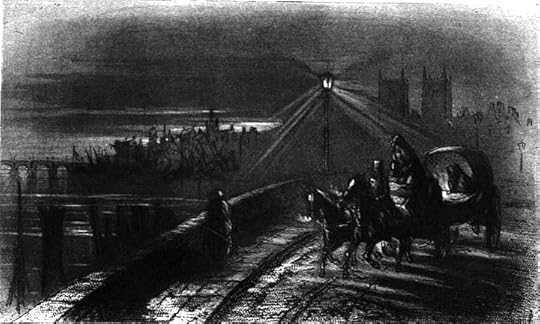
The Night
Chapter 57
Phiz
Text Illustrated:
I had gone to bed and fallen asleep when my guardian knocked at the door of my room and begged me to get up directly. On my hurrying to speak to him and learn what had happened, he told me, after a word or two of preparation, that there had been a discovery at Sir Leicester Dedlock's. That my mother had fled, that a person was now at our door who was empowered to convey to her the fullest assurances of affectionate protection and forgiveness if he could possibly find her, and that I was sought for to accompany him in the hope that my entreaties might prevail upon her if his failed. . . .
But I dressed and wrapped up expeditiously without waking Charley or any one and went down to Mr. Bucket, who was the person entrusted with the secret. In taking me to him my guardian told me this, and also explained how it was that he had come to think of me. Mr. Bucket, in a low voice, by the light of my guardian's candle, read to me in the hall a letter that my mother had left upon her table; and I suppose within ten minutes of my having been aroused I was sitting beside him, rolling swiftly through the streets.
His manner was very keen, and yet considerate when he explained to me that a great deal might depend on my being able to answer, without confusion, a few questions that he wished to ask me. These were, chiefly, whether I had had much communication with my mother (to whom he only referred as Lady Dedlock), when and where I had spoken with her last, and how she had become possessed of my handkerchief. When I had satisfied him on these points, he asked me particularly to consider — taking time to think — whether within my knowledge there was any one, no matter where, in whom she might be at all likely to confide under circumstances of the last necessity. I could think of no one but my guardian. But by and by I mentioned Mr. Boythorn. He came into my mind as connected with his old chivalrous manner of mentioning my mother's name and with what my guardian had informed me of his engagement to her sister and his unconscious connexion with her unhappy story.
My companion had stopped the driver while we held this conversation, that we might the better hear each other. He now told him to go on again and said to me, after considering within himself for a few moments, that he had made up his mind how to proceed. He was quite willing to tell me what his plan was, but I did not feel clear enough to understand it.
We had not driven very far from our lodgings when we stopped in a by-street at a public-looking place lighted up with gas. Mr. Bucket took me in and sat me in an arm-chair by a bright fire. It was now past one, as I saw by the clock against the wall. Two police officers, looking in their perfectly neat uniform not at all like people who were up all night, were quietly writing at a desk; and the place seemed very quiet altogether, except for some beating and calling out at distant doors underground, to which nobody paid any attention.
Commentary:
The first pair of dark plates within a single part, The Night (ch. 57) and The Morning (ch. 59), have captions which remind us of Light and Shadow, but Browne apparently was confused about which was which, since on the paired proofs in the Dexter Collection the penciled captions are reversed, and there is a note from Browne, "Which is 'Night' of these subjects?" Such confusion is understandable in view of the darkness of both subjects, and it suggests that Dickens did not always take Browne fully into his confidence by explaining the sequence of the plates and what they represent. Both are effectively in keeping with the dark tone of the novel. The narrative is indefinite about exactly where Bucket spots the brickmaker's wife disguised as Esther's mother, except that they first drive through a riverside neighborhood and then see the woman as they cross a bridge. The etching shows Westminster Abbey in the background, at an angle which suggests that this is where Millbank turns into Lambeth Bridge. The Abbey here has much the same connotations as does the parish church in "Tom all alone's," implying the church's isolation from human suffering.
Mod
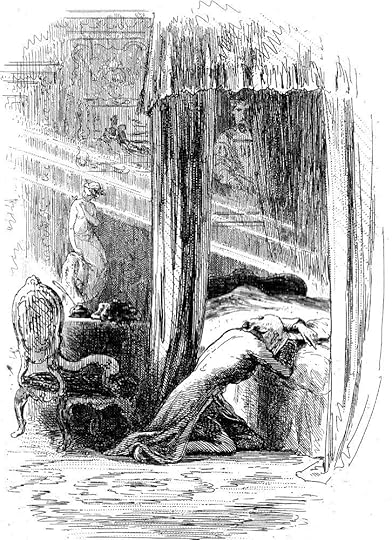
Night
Chapter 57
Phiz
Text Illustrated:
Volumnia's pet little scream acquires a considerable augmentation of reality from this surprise, and the house is quickly in commotion. Servants tear up and down stairs, bells are violently rung, doctors are sent for, and Lady Dedlock is sought in all directions, but not found. Nobody has seen or heard her since she last rang her bell. Her letter to Sir Leicester is discovered on her table, but it is doubtful yet whether he has not received another missive from another world requiring to be personally answered, and all the living languages, and all the dead, are as one to him.
They lay him down upon his bed, and chafe, and rub, and fan, and put ice to his head, and try every means of restoration. Howbeit, the day has ebbed away, and it is night in his room before his stertorous breathing lulls or his fixed eyes show any consciousness of the candle that is occasionally passed before them. But when this change begins, it goes on; and by and by he nods or moves his eyes or even his hand in token that he hears and comprehends.
He fell down, this morning, a handsome stately gentleman, somewhat infirm, but of a fine presence, and with a well-filled face. He lies upon his bed, an aged man with sunken cheeks, the decrepit shadow of himself. His voice was rich and mellow and he had so long been thoroughly persuaded of the weight and import to mankind of any word he said that his words really had come to sound as if there were something in them. But now he can only whisper, and what he whispers sounds like what it is—mere jumble and jargon.
Mod
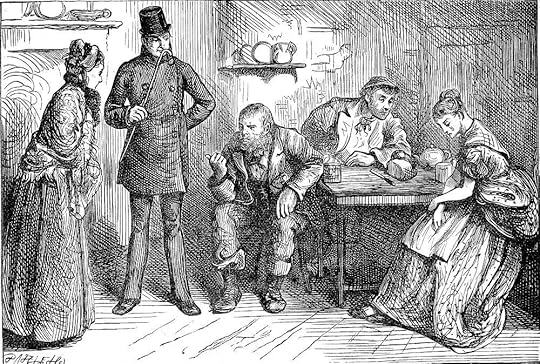
In the brickmaker's cottage.
Chapter 57
Fred Barnard
Text Illustrated:
We set off again immediately. On arriving at the cottage, we found it shut up and apparently deserted, but one of the neighbours who knew me and who came out when I was trying to make some one hear informed me that the two women and their husbands now lived together in another house, made of loose rough bricks, which stood on the margin of the piece of ground where the kilns were and where the long rows of bricks were drying. We lost no time in repairing to this place, which was within a few hundred yards; and as the door stood ajar, I pushed it open.
There were only three of them sitting at breakfast, the child lying asleep on a bed in the corner. It was Jenny, the mother of the dead child, who was absent. The other woman rose on seeing me; and the men, though they were, as usual, sulky and silent, each gave me a morose nod of recognition. A look passed between them when Mr. Bucket followed me in, and I was surprised to see that the woman evidently knew him.
I had asked leave to enter of course. Liz (the only name by which I knew her) rose to give me her own chair, but I sat down on a stool near the fire, and Mr. Bucket took a corner of the bedstead. Now that I had to speak and was among people with whom I was not familiar, I became conscious of being hurried and giddy. It was very difficult to begin, and I could not help bursting into tears.
"Liz," said I, "I have come a long way in the night and through the snow to inquire after a lady —"
"Who has been here, you know," Mr. Bucket struck in, addressing the whole group with a composed propitiatory face; "that's the lady the young lady means. The lady that was here last night, you know."
Mod
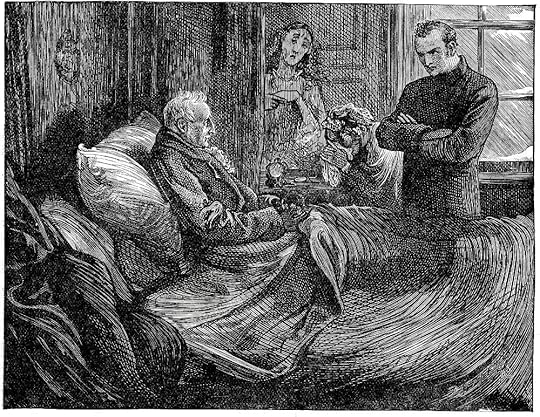
the trooper with his arms folded and his head a little bent, respectfully attentive.
Chapter 58
Fred Barnard
Text Illustrated:
"I was about to add," he presently goes on, "I was about to add, respecting this attack, that it was unfortunately simultaneous with a slight misunderstanding between my Lady and myself. I do not mean that there was any difference between us (for there has been none), but that there was a misunderstanding of certain circumstances important only to ourselves, which deprives me, for a little while, of my Lady's society. She has found it necessary to make a journey — I trust will shortly return. Volumnia, do I make myself intelligible? The words are not quite under my command in the manner of pronouncing them."
Volumnia understands him perfectly, and in truth he delivers himself with far greater plainness than could have been supposed possible a minute ago. The effort by which he does so is written in the anxious and labouring expression of his face. Nothing but the strength of his purpose enables him to make it.
"Therefore, Volumnia, I desire to say in your presence — and in the presence of my old retainer and friend, Mrs. Rouncewell, whose truth and fidelity no one can question, and in the presence of her son George, who comes back like a familiar recollection of my youth in the home of my ancestors at Chesney Wold — in case I should relapse, in case I should not recover, in case I should lose both my speech and the power of writing, though I hope for better things —"
The old housekeeper weeping silently; Volumnia in the greatest agitation, with the freshest bloom on her cheeks; the trooper with his arms folded and his head a little bent, respectfully attentive.
"Therefore I desire to say, and to call you all to witness — beginning, Volumnia, with yourself, most solemnly — that I am on unaltered terms with Lady Dedlock. That I assert no cause whatever of complaint against her. That I have ever had the strongest affection for her, and that I retain it undiminished. Say this to herself, and to every one. If you ever say less than this, you will be guilty of deliberate falsehood to me."
Mod
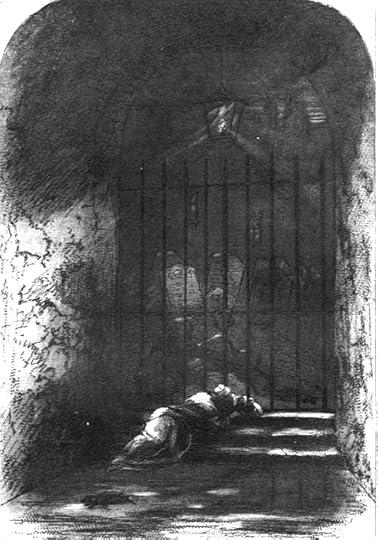
The Morning
Chapter 59
Phiz
Text Illustrated:
At last we stood under a dark and miserable covered way, where one lamp was burning over an iron gate and where the morning faintly struggled in. The gate was closed. Beyond it was a burial ground — a dreadful spot in which the night was very slowly stirring, but where I could dimly see heaps of dishonoured graves and stones, hemmed in by filthy houses with a few dull lights in their windows and on whose walls a thick humidity broke out like a disease. On the step at the gate, drenched in the fearful wet of such a place, which oozed and splashed down everywhere, I saw, with a cry of pity and horror, a woman lying — Jenny, the mother of the dead child.
I ran forward, but they stopped me, and Mr. Woodcourt entreated me with the greatest earnestness, even with tears, before I went up to the figure to listen for an instant to what Mr. Bucket said. I did so, as I thought. I did so, as I am sure.
"Miss Summerson, you'll understand me, if you think a moment. They changed clothes at the cottage."
They changed clothes at the cottage. I could repeat the words in my mind, and I knew what they meant of themselves, but I attached no meaning to them in any other connexion.
"And one returned," said Mr. Bucket, "and one went on. And the one that went on only went on a certain way agreed upon to deceive and then turned across country and went home. Think a moment!"
I could repeat this in my mind too, but I had not the least idea what it meant. I saw before me, lying on the step, the mother of the dead child. She lay there with one arm creeping round a bar of the iron gate and seeming to embrace it. She lay there, who had so lately spoken to my mother. She lay there, a distressed, unsheltered, senseless creature. She who had brought my mother's letter, who could give me the only clue to where my mother was; she, who was to guide us to rescue and save her whom we had sought so far, who had come to this condition by some means connected with my mother that I could not follow, and might be passing beyond our reach and help at that moment; she lay there, and they stopped me! I saw but did not comprehend the solemn and compassionate look in Mr. Woodcourt's face. I saw but did not comprehend his touching the other on the breast to keep him back. I saw him stand uncovered in the bitter air, with a reverence for something. But my understanding for all this was gone.
I even heard it said between them, "Shall she go?"
"She had better go. Her hands should be the first to touch her. They have a higher right than ours."
I passed on to the gate and stooped down. I lifted the heavy head, put the long dank hair aside, and turned the face. And it was my mother, cold and dead.
Commentary:
The Morning is still darker in tone, and the more heavily bitten of the two steels is rather muddy, even in an exceptionally good impression. But the other steel is better: though startlingly dark, in a good impression the gravestones are possible to make out with a putto visible on one stone, a skull on another (as in Consecrated ground. Although these could not literally be the ones in the earlier illustration, an iconographic connection is made. This dark plate does center on a human figure, but it is still comparable to those which lack such figures because Lady Dedlock's corpse has been reduced almost to a thing by Browne's treatment of it as part of a pattern of light and shade — although her hand can be seen reaching through the bars of the graveyard gate, an important thematic emphasis. Browne has reached a stage in his own art where he seems to find it more and more fascinating to experiment with the possibilities of form, tone, pattern, and structure, and this could contribute to the de-emphasis of human figures; yet although many of the dark plates for other novels demonstrate similar aesthetic concerns, they never again, within a single work, appear so devoid of recognizable human figures.
The four plates for the final, double number were executed as usual according to the novelist's directions; a letter survives which indicates that instructions for Part XVIII, and those for Part XIX-XX, six in all, were dispatched to Phiz from Boulogne within a few days of one another, which implies that Dickens had this group, at least, planned out in advance as a kind of sequence. It is thus conceivable that the dark plate technique and the dehumanized subject matter were specified by him.
Mod
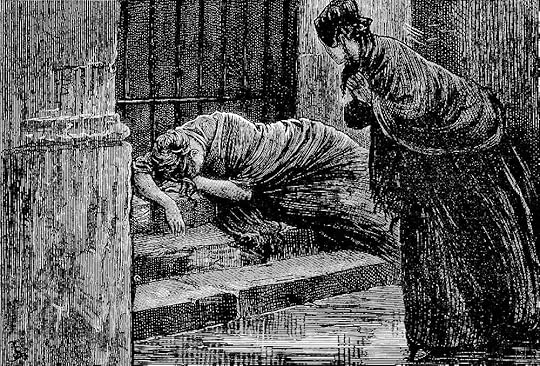
She lay there, with one arm creeping around the bar of an iron grate
Chapter 59
Fred Barnard
Text Illustrated:
At last we stood under a dark and miserable covered way, where one lamp was burning over an iron gate and where the morning faintly struggled in. The gate was closed. Beyond it was a burial ground — a dreadful spot in which the night was very slowly stirring, but where I could dimly see heaps of dishonoured graves and stones, hemmed in by filthy houses with a few dull lights in their windows and on whose walls a thick humidity broke out like a disease. On the step at the gate, drenched in the fearful wet of such a place, which oozed and splashed down everywhere, I saw, with a cry of pity and horror, a woman lying — Jenny, the mother of the dead child.
I ran forward, but they stopped me, and Mr. Woodcourt entreated me with the greatest earnestness, even with tears, before I went up to the figure to listen for an instant to what Mr. Bucket said. I did so, as I thought. I did so, as I am sure.
"Miss Summerson, you'll understand me, if you think a moment. They changed clothes at the cottage."
They changed clothes at the cottage. I could repeat the words in my mind, and I knew what they meant of themselves, but I attached no meaning to them in any other connexion.
"And one returned," said Mr. Bucket, "and one went on. And the one that went on only went on a certain way agreed upon to deceive and then turned across country and went home. Think a moment!"
I could repeat this in my mind too, but I had not the least idea what it meant. I saw before me, lying on the step, the mother of the dead child. She lay there with one arm creeping round a bar of the iron gate and seeming to embrace it. She lay there, who had so lately spoken to my mother. She lay there, a distressed, unsheltered, senseless creature. She who had brought my mother's letter, who could give me the only clue to where my mother was; she, who was to guide us to rescue and save her whom we had sought so far, who had come to this condition by some means connected with my mother that I could not follow, and might be passing beyond our reach and help at that moment; she lay there, and they stopped me! I saw but did not comprehend the solemn and compassionate look in Mr. Woodcourt's face. I saw but did not comprehend his touching the other on the breast to keep him back. I saw him stand uncovered in the bitter air, with a reverence for something. But my understanding for all this was gone.
I even heard it said between them, "Shall she go?"
"She had better go. Her hands should be the first to touch her. They have a higher right than ours."
I passed on to the gate and stooped down. I lifted the heavy head, put the long dank hair aside, and turned the face. And it was my mother, cold and dead.
Mod
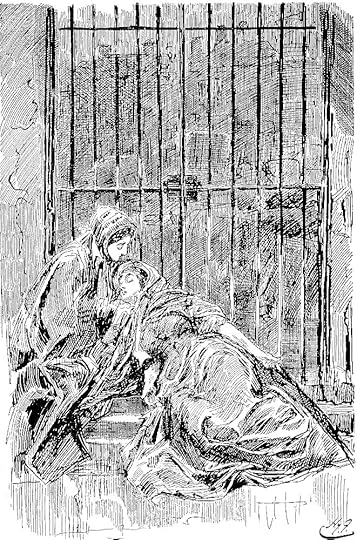
The Death of Lady Dedlock
Chapter 59
Harry Furniss
Text Illustrated:
I ran forward, but they stopped me, and Mr. Woodcourt entreated me with the greatest earnestness, even with tears, before I went up to the figure to listen for an instant to what Mr. Bucket said. I did so, as I thought. I did so, as I am sure.
"Miss Summerson, you'll understand me, if you think a moment. They changed clothes at the cottage."
They changed clothes at the cottage. I could repeat the words in my mind, and I knew what they meant of themselves, but I attached no meaning to them in any other connexion.
"And one returned," said Mr. Bucket, "and one went on. And the one that went on only went on a certain way agreed upon to deceive and then turned across country and went home. Think a moment!"
I could repeat this in my mind too, but I had not the least idea what it meant. I saw before me, lying on the step, the mother of the dead child. She lay there with one arm creeping round a bar of the iron gate and seeming to embrace it. She lay there, who had so lately spoken to my mother. She lay there, a distressed, unsheltered, senseless creature. She who had brought my mother's letter, who could give me the only clue to where my mother was; she, who was to guide us to rescue and save her whom we had sought so far, who had come to this condition by some means connected with my mother that I could not follow, and might be passing beyond our reach and help at that moment; she lay there, and they stopped me! I saw but did not comprehend the solemn and compassionate look in Mr. Woodcourt's face. I saw but did not comprehend his touching the other on the breast to keep him back. I saw him stand uncovered in the bitter air, with a reverence for something. But my understanding for all this was gone.
I even heard it said between them, "Shall she go?"
"She had better go. Her hands should be the first to touch her. They have a higher right than ours."
I passed on to the gate and stooped down. I lifted the heavy head, put the long dank hair aside, and turned the face. And it was my mother, cold and dead.
Commentary:
The discovery of Lady Dedlock's corpse serves as the climax of the plot involving Esther's discovery of her past and re-establishing her relationship with the woman who gave birth to her, but did not raise her. Ancilliary figures in the climactic scene, Detective Bucket and Dr. Alan Woodcourt (who joins them in Chancery Lane), try to protect Esther, but she has become psychologically strong enough to confront her mother's corpse in Tom-all-Alone's without their emotional support. Nevertheless, Phiz's dark plate and its derivative, Harry Furniss's 1910 lithograph, are suitable to the sombre mood of the recognition scene at the close of Chapter 59. Sir Leicester waits in vain with George Rouncewell for his wife's return.
Having pursued Lady Dedlock on her false trail north of St. Alban's, Esther and Bucket return to the neighbourhood of Chancery at 3:00 A. M. in search of news of a woman dressed like Jenny, the bricklayer's wife. At Snagsby's in Chancery Lane Bucket discovers that the servant girl has Lady Dedlock's letter, written in pencil and addressed to Esther at her guardian's, explaining her recent movements and final state of mind; it concludes with a heart-felt plea to the daughter she never knew as a child:
I have done all I could do to be lost. I shall be soon forgotten so, and shall disgrace him least. I have nothing about me by which I can be recognized. This paper I part with now. The place where I shall lie down, if I can get so far, has been often in my mind. Farewell. Forgive.
From Snagsby's servant, they learn about a ragged woman who was looking for the graveyard where Nemo was interred at the beginning of the novel. Here, at the outer, iron-barred gate, Bucket and Esther discover Honoria Dedlock disguised as Jenny, dead on the pavement. However, whereas Phiz focuses on the dead woman's alienation, on her failure to cross the threshold and be reunited in death with the lover of her youth, Furniss emphasizes Esther's final meeting with her mother. The moment realized in the serial is Esther's first glimpse of the corpse in the darkened archway, shortly before dawn:
At last we stood under a dark and miserable covered way, where one lamp was burning over an iron gate and where the morning faintly struggled in. The gate was closed. Beyond it was a burial ground—a dreadful spot in which the night was very slowly stirring, but where I could dimly see heaps of dishonoured graves and stones, hemmed in by filthy houses with a few dull lights in their windows and on whose walls a thick humidity broke out like a disease. On the step at the gate, drenched in the fearful wet of such a place, which oozed and splashed down everywhere, I saw, with a cry of pity and horror, a woman lying—Jenny, the mother of the dead child.
The 1910 lithograph transforms the dark plate into a better-lit recognition scene as Esther, having just turned the woman's head, suddenly responds to seeing not Jenny's but her mother's face. Realizing the climactic, final line of the chapter, Furniss has moved in for the closeup, eliminating both the light above the archway, the archway itself, and the enveloping darkness. Esther cradles her mother in an act that bespeaks tenderness towards and acceptance of the woman who unknowingly abandoned her as an infant.
Mod
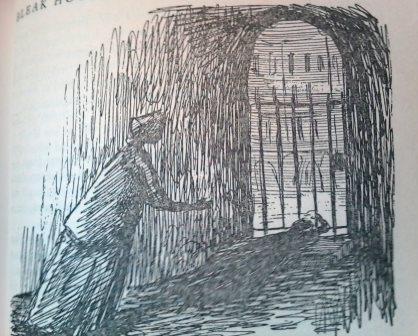
The death of Lady Dedlock
Chapter 59
Ed Gorey
Text Illustrated:
"I could repeat this in my mind too, but I had not the least idea what it meant. I saw before me, lying on the step, the mother of the dead child. She lay there with one arm creeping round a bar of the iron gate and seeming to embrace it. She lay there, who had so lately spoken to my mother. She lay there, a distressed, unsheltered, senseless creature. She who had brought my mother's letter, who could give me the only clue to where my mother was; she, who was to guide us to rescue and save her whom we had sought so far, who had come to this condition by some means connected with my mother that I could not follow, and might be passing beyond our reach and help at that moment; she lay there, and they stopped me! I saw but did not comprehend the solemn and compassionate look in Mr. Woodcourt's face. I saw but did not comprehend his touching the other on the breast to keep him back. I saw him stand uncovered in the bitter air, with a reverence for something. But my understanding for all this was gone."
Mod
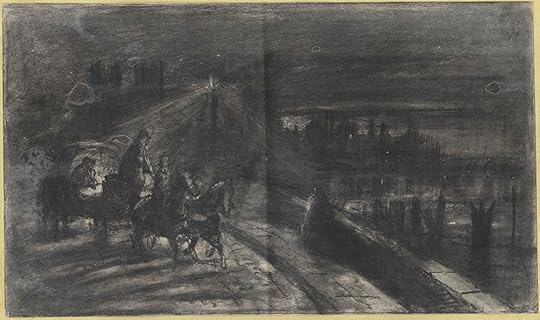
Original drawing by Phiz for The Night
Mod
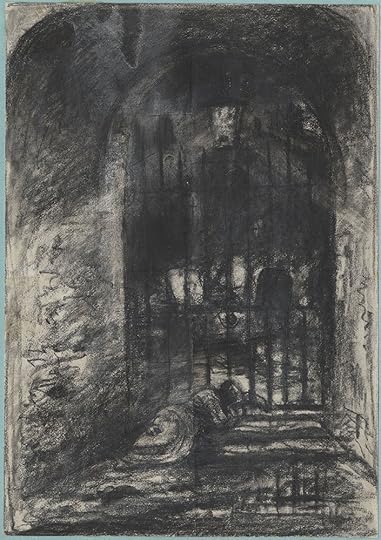
Original drawing by Phiz for The Morning
A point of contention with Phiz's drawing of Lady Dedlock... We see headstones beyond the gate. Would a potter's field even have any stones? Either way, Barnard's illustration of that scene is my favorite. Furniss's isn't bad, but I wish he could have shown Esther with some anguish. Her expression is much too placid.
Mod
She lay there, with one arm creeping around the bar of an iron grate
Chapter 59
Fred Barnard
Text Illustrated:
At last we stood under a dark and miserable covered way, where one lamp was burn..."
Of all the images of Lady Dedlock at the gates to the graveyard, this one is the best. Yes, I like this one much better that Phiz’s. Did I just write that last sentence?
With the exception of “Tom-all-Alone’s” the dark plates are, well, too dark in BH. In DC the dark plate titled “The River” is very evocative and in D&S the chase of Carker is great as well. Here, well, if you really can’t distinguish much of anything then there is a definite problem.
If we were not to see Lady Dedlock’s face again there could well be some emblematic meaning folded into the image. The image, however, of Lady Dedlock at the entrance to the graveyard in “The Morning” falls short of conveying much to the viewer. We can distinguish her arm entwined around the gate by Phiz. Lady Dedlock has attempted to reach out to Nemo but been locked out.
.
Peter wrote: "We can distinguish her arm entwined around the gate by Phiz. Lady Dedlock has attempted to reach out to Nemo but been locked out."She still loves him and Sir L still loves her and we never know how she really feels about Sir L.
I am glad this is allowed to be complicated.
Mod
Personally, I like Phiz's usual illustrations more than his dark plates - because in these latter, we can hardly see any people, whereas his usual illustrations are brimming and humming with life. However, the plate of Lady Dedlock seems very effective to me because first of all, Lady Dedlock is on her own and then her body only makes a quarter of the whole picture - the rest being the potter's ground, the wall and gate and the lantern. This underlines, to me, her loneliness and the fact that her life has come to an end, in fact the deadlock-situation of it all. We can even see, through the gate, right into the cemetary - and the headstones mark it as such, although Mary Lou is probably right in saying they shouldn't be there, it being a burial place for the poorest of the poor (but maybe, the cemetary was used for wealthier people in former times and has socially declined?).
Barnard focuses on Lady Dedlock and on Esther but the focus seems to lie so much on the figures that there is little of their surroundings to be seen. So, I keep on defending Phiz ;-)
Mod
There is an incredible energy to chapter 59. Bucket and Esther are constantly on the move. The streets, lanes, and banks of the Thames seem to swirl around their pursuit as they search for Lady Dedlock.
And then the end of the chapter comes. As Kim points out, the relentless momentum comes to a screeching halt. Esther finds her mother dead at the gate to the cemetery where Esther's father already lies dead. Esther is now finally in the presence of both her parents but they are dead. If we reflect on who is with Esther at this point in the novel we may have a very broad hint as to who will be the most important person in Esther's future life.
Mod
Are the disguises simply a plot device to move her from one place to another with anonymity?
Could we say that the disguises are, in fact, a suggestion of what Lady Dedlock’s life could have turned out to be like if she remained a unwed mother and attempted to raise Esther.
Mod
If she had married Captain Hawdon, her life might have been worse financially - because she would have been forced to depend on her husband for financial support. I don't think, however, that she would ever have become as miserable as those brickmakers' wives because her husband would probably never have become addicted to drugs if she had lived with him.
Tristram wrote: "If she had married Captain Hawdon, her life might have been worse financially - because she would have been forced to depend on her husband for financial support. I don't think, however, that she would ever have become as miserable as those brickmakers' wives because her husband would probably never have become addicted to drugs if she had lived with him. "You think he became an addict out of a broken heart?
This observation makes me realize how much addicted behavior there is in this book: Hawdon, the brickmakers, everyone who gets over their head in Jarndyce and Jarndyce... anyone else? Mrs. Jellyby maybe?
Mrs. Jellyby absolutely. Mr. Jellyby too I think, he seems addicted to misery. Krook, since hoarding is a kind of addiction too.
Mod
As to Hawdon, I think it very likely that his drug addiction was partly caused by his being thwarted in his love - but then his living an obscure life as a poor law-writer might also have contributed to it.
Mod
Yes. Addictions come in many shapes and sizes. Addiction in its many forms is definitely part of the fabric of BH.
To be honest, I don't think Hawdon would not be addicted only because he would not have been thwarted in love. I think there is a chance he would have gone the same road as Richard: telling himself he would need more money to care for his wife and child, so he could close his eyes for going at it the wrong way. Seeing as the rumor was that he sold his soul to the devil, I think that stems from him working so bloody hard, fuelled by the opium. Meanwhile all of his money went back to the drugs. I also wonder if it would not have been the other way around. Perhaps Lady Dedlock distanced herself from him because she realised that a drug addict spiraling down was not a person she'd want in her life - especially since Esther might have been a wake up call for that. She might have dodged a bullet there, no matter how kind he was to Jo, he was a drug addict after all. And a bad one at that (just as a reminder, we're talking about a variant of heroin here. A socially more accepted variant, but still). And with that, Lady Dedlock made a much smarter decision than Ada did.
I also wonder, with Richard's decline of health and that it was not something physical apparently ... would he be addicted in the same way to cope with working on the suit day and night? I wouldn't be surprised.
I also wonder, with Richard's decline of health and that it was not something physical apparently ... would he be addicted in the same way to cope with working on the suit day and night? I wouldn't be surprised.
Mod


We are now at the eighteenth installment of Bleak House and the end of the book is almost upon us. We begin with Chapter 57 titled once again "Esther's Narrative" and Esther tells us that JJ wakes her up telling her that something has happened at the Dedlock's. He goes on to tell her that her mother has fled and that someone has come and is asking for Esther to accompany him in the hope that Esther might prevail upon her mother to return to her home giving her the fullest assurances of protection and forgiveness. She quickly gets dressed and within ten minutes finds herself with Mr. Bucket and they are on their way in search of her mother. Bucket first stops in a police station and quietly gives instructions and a description of Lady Dedlock to a few men. They then continue on their journey. Esther tells us they travel on such a labyrinth of streets that she has no idea where they are, crossing and re-crossing the river often. Finally they stop at a slimy little corner where Bucket spends some time in conversation with a mixture of police and sailors. Esther notices a notice on the wall that says "Found Drowned", Bucket then goes down some stairs and comes back after turning "something" over. Esther says; "but thank God it was not what I feared!"
Now they leave the city and Bucket stops at public houses talking to the owners and at roads talking to the turnpike keepers asking if a woman fitting Lady Dedlock's description has been seen. He is told that a woman fitting the description had passed through and they continue on their way toward Bleak House. As they near Bleak House this happens:
"As we ascended the hill, he looked about him with a sharp eye—the day was now breaking—and reminded me that I had come down it one night, as I had reason for remembering, with my little servant and poor Jo, whom he called Toughey.
I wondered how he knew that.
"When you passed a man upon the road, just yonder, you know," said Mr. Bucket.
Yes, I remembered that too, very well.
"That was me," said Mr. Bucket.
Seeing my surprise, he went on, "I drove down in a gig that afternoon to look after that boy. You might have heard my wheels when you came out to look after him yourself, for I was aware of you and your little maid going up when I was walking the horse down. Making an inquiry or two about him in the town, I soon heard what company he was in and was coming among the brick-fields to look for him when I observed you bringing him home here.
I remembered nothing about Esther and Charley passing Bucket while taking Jo with them to Bleak House, so I went back and looked. This is what it says in Chapter 31:
"But he turned and followed when I beckoned to him, and finding that he acknowledged that influence in me, I led the way straight home. It was not far, only at the summit of the hill. We passed but one man. I doubted if we should have got home without assistance, the boy's steps were so uncertain and tremulous. He made no complaint, however, and was strangely unconcerned about himself, if I may say so strange a thing."
So there it was, one line saying they had passed Bucket. I wondered if Dickens had thought of it later and inserted the line, but that installment would have been printed long before the chapter we are at now. Bucket tells Esther that he is the one who took Jo away that night he was staying with them at Bleak House. When Esther asks if he had committed any crime Bucket says:
"None was charged against him," said Mr. Bucket, coolly lifting off his hat, "but I suppose he wasn't over-particular. No. What I wanted him for was in connexion with keeping this very matter of Lady Dedlock quiet. He had been making his tongue more free than welcome as to a small accidental service he had been paid for by the deceased Mr. Tulkinghorn; and it wouldn't do, at any sort of price, to have him playing those games. So having warned him out of London, I made an afternoon of it to warn him to keep out of it now he WAS away, and go farther from it, and maintain a bright look-out that I didn't catch him coming back again.
Mr. Bucket it appears didn't do his job very well, for if I'm remembering it right Jo went right back to London when Bucket made him move on from Bleak House. Arriving at Bleak House Bucket tells Esther that Skimpole had showed him where to find Jo after Bucket had given him money for the information. Esther says she thinks this is very treacherous on the part of Mr. Skimpole towards JJ and as passing his usual bounds of childish innocence. To which Bucket tells her, and I like him for this:
"Bounds, my dear?" returned Mr. Bucket. "Bounds? Now, Miss Summerson, I'll give you a piece of advice that your husband will find useful when you are happily married and have got a family about you. Whenever a person says to you that they are as innocent as can be in all concerning money, look well after your own money, for they are dead certain to collar it if they can. Whenever a person proclaims to you 'In worldly matters I'm a child,' you consider that that person is only a-crying off from being held accountable and that you have got that person's number, and it's Number One. Now, I am not a poetical man myself, except in a vocal way when it goes round a company, but I'm a practical one, and that's my experience. So's this rule. Fast and loose in one thing, fast and loose in everything. I never knew it fail. No more will you. Nor no one. With which caution to the unwary, my dear, I take the liberty of pulling this here bell, and so go back to our business."
I'm glad to see there is one person in the book who not only sees Skimpole as he really is, but says it out loud. Esther now inquires at Bleak House if anyone has been there asking for her and is told no one has. This had me thinking they seem to be driving around in circles, I don't understand why. They then go on to the house of the brickmaker. Arriving there they find it empty and are told that Jenny, Liz, and their husbands live together in a different cottage, I bet that's fun. When they enter they find that Jenny is not there, but the others are. Bucket tells them he already knows a lady had been there the night before; and he wants to know where she went. Esther suspects that Liz wants to talk to her alone, but there is no way for her to do this, when Liz tries to answer Esther's questions her husband kicks her. Esther asks if Jenny was home when the lady visited and Jenny's husband said yes. He tells them the lady had stayed there an hour resting then went on her way. Then he says that the lady went one way and Jenny went the other. He says he isn’t sure what time it was, since they don’t have a watch. When they leave the cottage Bucket tells Esther he is sure they have Lady Dedlock's watch and when Esther asks how he knows he says:
"Else why should he talk about his 'twenty minutes past' and about his having no watch to tell the time by? Twenty minutes! He don't usually cut his time so fine as that. If he comes to half-hours, it's as much as HE does. Now, you see, either her ladyship gave him that watch or he took it. I think she gave it him. Now, what should she give it him for? What should she give it him for?"
As they travel on Bucket seems to lose some of his confidence and eventually admits to Esther that he has lost the trail. Later, when they stop again to change horses, Bucket comes back to the carriage excited and says he realizes something and says he finally understands. He orders the driver to return to London, which shocks Esther and when she questions him he says he is going to follow Jenny. Esther protests that they shouldn’t abandon Lady Dedlock, but Bucket tells her not to worry. The chapter ends:
"My dear," he answered, "I know, I know, and would I put you wrong, do you think? Inspector Bucket. Now you know me, don't you?"
What could I say but yes!
"Then you keep up as good a heart as you can, and you rely upon me for standing by you, no less than by Sir Leicester Dedlock, Baronet. Now, are you right there?"
"All right, sir!"
"Off she goes, then. And get on, my lads!"
We were again upon the melancholy road by which we had come, tearing up the miry sleet and thawing snow as if they were torn up by a waterwheel."