
Art Lovers discussion
Open for Debate
>
Comics as Art and Commercialization
date newest »
newest »
 If anyone else has more questions they would like to add, please do so!! I’d love it!
Please be honest, are my questions...how should I say it...stupid? Like, things I should know, common knowledge, no-brainers?
If anyone else has more questions they would like to add, please do so!! I’d love it!
Please be honest, are my questions...how should I say it...stupid? Like, things I should know, common knowledge, no-brainers? Or this doesn't interest anyone? I thought at least one question would promote an answer.
I am not guilting anyone into adding to this thread. Please don't think that. Of course, if you have no interest, you have not interest! That's fine. I am just wondering if anyone cares to let me know, or pose a question yourself.
Of course, if this thread is left with three comments- mine, that's fine, too. No worries, I'm not offended in the least, I'm just trying to start a conversation. I feel this group needs...something! But I can't figure out what yet. If anyone has any ideas, feel free to PM me, or suggest it in the general folder. I would love it!
 Heather wrote: "...was Warhol even trying to advertise for Campbells Soup? Did they pay him to do his soup cans which now are worth an amazing amount of money? Did he get a kickback afterward? Why or why not?"
From the MOMA page for Warhol's 1962 Campbell's Soup Cans:
Andy Warhol famously appropriated familiar images from consumer culture and mass media, among them celebrity and tabloid news photographs, comic strips, and, in this work, the widely consumed canned soup made by the Campbell’s Soup Company. When he first exhibited Campbell’s Soup Cans in 1962, the canvases were displayed together on shelves, like products in a grocery aisle. At the time, Campbell’s sold 32 soup varieties; each one of Warhol’s 32 canvases corresponds to a different flavor. (The first flavor the company introduced, in 1897, was tomato).
Though Campbell’s Soup Cans resembles the mass-produced, printed advertisements by which Warhol was inspired, its canvases are hand-painted, and the fleur de lys pattern ringing each can’s bottom edge is hand-stamped. Warhol mimicked the repetition and uniformity of advertising by carefully reproducing the same image across each individual canvas. He varied only the label on the front of each can, distinguishing them by their variety. Warhol said of Campbell’s soup, “I used to drink it. I used to have the same lunch every day, for 20 years, I guess, the same thing over and over again.”
Lichtenstein, like Warhol, appropriated images from American popular art (like comic books and billboards) to comment on corporatized mass-consumption society. Ironically, not everybody got the joke and thought Pop Art was a perfect vehicle for selling products. As you go through the 1960s and 1970s, you can see advertising reflect the Pop Art sensibility, which was itself a reflection of mass-market advertising and packaging. It still lives today:
 Lance wrote: "Heather wrote: "...was Warhol even trying to advertise for Campbells Soup? Did they pay him to do his soup cans which now are worth an amazing amount of money? Did he get a kickback afterward? Why ..."
Thank you, Lance, for that information! Thank you for your contribution! I had heard that each fleur de lys pattern was hand-stamped and they were individually painted. That's some cool information, though.
And about commercialism and pop art in general. What's the difference? I can see why companies thought pop art was a great way to advertise and today, they still do even though 'pop art' is out, the idea in advertising is still in.
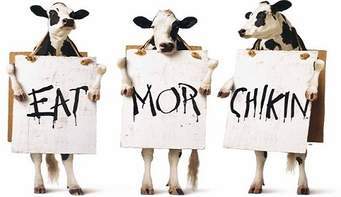 Heather wrote: "And about commercialism and pop art in general. What's the difference? I can see why companies thought pop art was a great way to advertise and today, they still do even though 'pop art' is out, the idea in advertising is still in."
Pop Art is still around. Takashi Murakami and Jeff Koons are two leading (and highly successful) practitioners.
Murakami exists in the intersection of manga, kawaii (the esthetic that gave us Hello Kitty and candy-colored microcars), and whatever you consider Ralph Steadman to be. Koons is (depending on who you talk to) either a pioneering conceptual artist or a kitschmeister; he's dabbled in Dadaesque works using found or purchased objects, Oldenburgian gigantism, and is best known for rendering inflatable toys in stainless steel and glass.
Both are relentlessly commercial. Like Warhol, they produce vast amounts of marketable work through studios in which dozens of assistants execute pieces based on the master's "guidance" (the same model James Patterson uses for books). And like Warhol, art advisors tell their well-heeled clients that no contemporary art collection is complete without a Murakami and a Koons. As a result, their auction prices are semi-insane.
Is it art? Does it matter? Contemporary art in general has become thoroughly commercialized as a small number of very rich people have transformed the market into a cash machine. Marvel and DC comics have become billion-dollar industries. It's a very short walk from The Avengers or Justice League to Murakami's hentai sculptures or Koons's balloon dogs.
Lance wrote: "Heather wrote: "And about commercialism and pop art in general. What's the difference? I can see why companies thought pop art was a great way to advertise and today, they still do even though 'pop..."I can tell so well that you are an author yourself, Lance. You sure have a way with words! Your explanations are exceptional, easy for the lay person to understand, but acutely accurate. Thank you so much for your addition!
Thanks! And thanks for asking these good questions.


First, I’m again on my phone and can’t post any pictures but I will allude you to different artists or works to discuss or to spark your own thoughts.
So, do you think comics could be considered art? Some comics and not others? Why or why not? Please explain
As far as commercialization, was Warhol even trying to advertise for Campbells Soup? Did they pay him to do his soup cans which now are worth an amazing amount of money? Did he get a kickback afterward? Why or why not?
What’s the difference between a Liechtenstein and Andy Warhol? How are they alike?
How did Norman Rockwell’s cover pages become art? Who suggested that? What made it art? Why?
And what about Manga? Is this art?