
Classics and the Western Canon discussion

This topic is about
The Decameron
Boccaccio, The Decameron
>
Schedule, Translations, and Background
date newest »
newest »
 I´ll be using a Dutch translation by Frans Denissen from 2003 (my copy is a later print from 2016).
The ballads are a translation by Paul Claes from 1995
As per usual I will be reading in Dutch as I'm borrowing a copy from the local library. I've found that whenever an acceptable translation is available (and this one seemed to be quite well recieved) reading in my native Dutch is more appealing to me, as reading in English woud require an extra translation on my part
 Beware of the The Decameron (First Edition) (Norton Critical Editions). Wayne A. Rebhorn (Editor, Translator). I wanted this edition but was disappointed to discover it is abridged.
A Note on the abridgement of the text and on the contextual and critical materials explains:
This edition offers readers a very generous selection of stories from Boccaccio's Decameron, including many of the most aesthetically successful ones as well as those that Italianists teach most frequently. It also retains a substantial portion of the frame in which Boccaccio describes the effects of the plague on Florence; the flight of the ten young narrators into the countryside; the account of the daily activities, including their storytelling and their response to one another's stories; and finally their decision to return to Florence after fourteen days spent away from the city. . .
ETA: There are other editions available by Wayne A. Rebhorn (Editor, Translator) that are unabridged.
 David wrote: "Beware of the The Decameron (First Edition) (Norton Critical Editions). Wayne A. Rebhorn (Editor, Translator). I wanted this edition but was disappointed to discover it is abridged.
A Note on the ..."
Thanks for the warning, David. An abridged Rebhorn translation is news to me! Not every story in the Decameron is a masterpiece, but they're all worth reading.
Another warning, an obvious one: The Decameron contains earthy tales with humorous but frank scenes of sexuality. Some involving members of the clergy (so to speak) and few with any sense of guilt. It's not for everyone.
 My copy is translated by G. H. McWilliam (1972).
 He ends his introduction by saying “The variations and complexities of Boccaccio’s style and language are limitless, and no translator can ever hope to do them full justice. But because, like Everest, the Decameron is there, and because it is inconceivable that a truly satisfactory English translation of this great European masterpiece will ever be produced, there will always be someone who is foolhardy enough to attempt the task, even if he is familiar with Dante’s somber warning from the first book of the Convivo: “Nothing that is harmonized by the bond of the Muse can be transformed from its own language into another without upsetting all its sweetness and harmony.” I appreciate his humility and foolhardiness ;)
 Thomas wrote: "Another warning, an obvious one: The Decameron contains earthy tales with humorous but frank scenes of sexuality. Some involving members of the clergy (so to speak) and few with any sense of guilt. It's not for everyone."
FWIW, I don't know if I'd call them "frank", they all seem to be conveyed (unambiguously) using euphemisms and puns etc. In fact someone commented Dante used more "frank" or explicit dirty words than Boccaccio, implying Boccaccio is more "decorous", yet the Decameron is clearly way more racy than anything Dante wrote.
What I found most difficult to deal with is not the sexual content or jibes at the clergy, what made me uncomfortable is actually the cruelty of the tricks played on the gullible. It reminds me a bit of Don Quixote... or trolls tricking vulnerable (gullible) people into humiliating themselves or even committing criminal acts online.
Lia wrote: "FWIW, I don't know if I'd call them "frank", they all seem to be conveyed (unambiguously) using euphemisms and puns etc. ."Good point, and "unambiguous" is a good way to put it. Boccaccio can be quite graphic without using explicit language.
 I've read this recommendation for Rebhorn's translation and this shows a glimpse into how it compares with Musa/Bondanella and McWilliam.
https://www.brown.edu/Departments/Ita...
That's a really good read, Borum, thanks for sharing the link.I have the Rebhorn translation and I'm kind of sorry I missed out on the "John Thomas" shenanigan ... it tickles the juvenile portion of my funny bone somehow.
I've heard bad things about Payne and Rigg (sort of unreadable), and I am curious to know about other translations as well (Nichols, McWilliams, Waldman, Hainsworth)Here is another list of the English translations.
https://www.gradesaver.com/the-decame...
Lia wrote: "That's a really good read, Borum, thanks for sharing the link.I have the Rebhorn translation and I'm kind of sorry I missed out on the "John Thomas" shenanigan ... it tickles the juvenile portion..."
I know ;-) It shouldn't be the only comparison to consider but it's a bit like picking your favorite type of euphemism.. I could totally relate with John Thomas, but I guess Messer Mace or Messer Hammerhead is closer to the original messer Mazza. It depends on the reader to pick the style of translation (I didn't enjoy most of the P&V translations for Tolstoy although it was reknowned to be closer to the original Russian) so it helps to compare not only the translations but compare them to the original words.
Borum wrote: "I've heard bad things about Payne and Rigg (sort of unreadable)..."They are both available on Gutenberg if you want to check them out.
Payne:
https://www.gutenberg.org/ebooks/23700
Rigg:
https://www.gutenberg.org/ebooks/3726
I definitely struggled to get through them, I ended up starting over from the Proem when I got my hands on the Rebhorn trans.
I'm thinking about getting the McWilliams (Penguin) translation to read along with this group, but I enjoyed Rebhorn (especially his endnotes/comments) so much I feel tempted to reread that just for risk (but not risque) free pleasure.
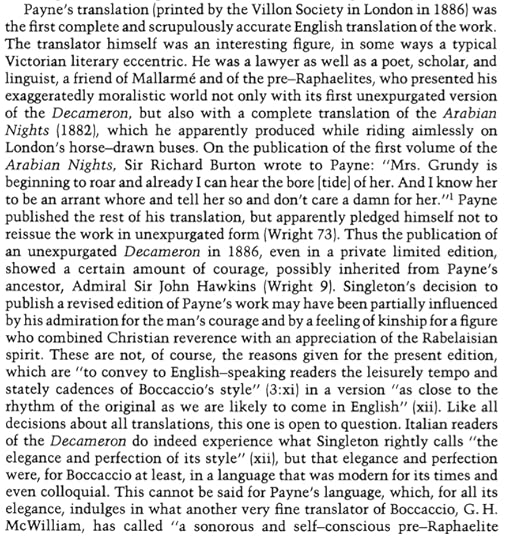
 A strictly naive question: was Payne a Victorian translator affecting an early modern style, or was he actually an early modern translator?
I downloaded it because it was free, but I wouldn't be surprised to learn- the hard way- that you get what you pay for.
Christopher wrote: "A strictly naive question: was Payne a Victorian translator affecting an early modern style, or was he actually an early modern translator?..."What's early modern? I think of Shakespeare as early modern ...
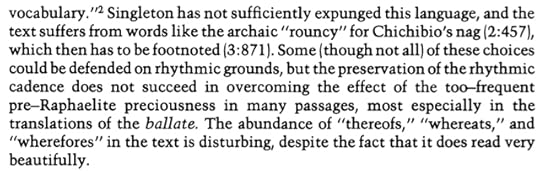
McWilliam calls it "a sonorous and self-conscious pre-Raphaelite vocabulary". Imaginably that makes him squarely Victorian ...
Here's a review I found:
http://www.jstor.org/stable/478630
The relevant passages:
Christopher wrote: " I wouldn't be surprised to learn- the hard way- that you get what you pay for."
Get the Payne translation revised by Singleton ;-)
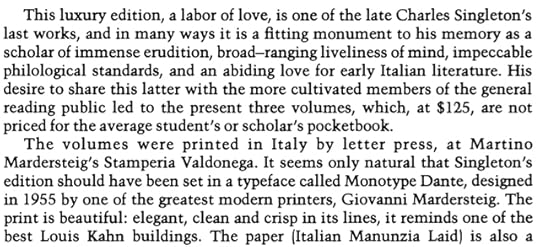
At $125 back in 1982 I bet you'll have an elegant and luxurious reading experience ;')
I personally think it's more fun to pay peanuts and read with monkeys.
Lia wrote: "Christopher wrote: "A strictly naive question: was Payne a Victorian translator affecting an early modern style, or was he actually an early modern translator?..."What's early modern? I think of ..."
Thanks, Lia.
Yes, Shakespeare is early modern. I guess I could have said "Elizabethan," in contrast to "Victorian," but Pre-Raphaelite explains it all.
 Those of you who prefer to savor a text without outside influences may prefer to avoid the links embedded in this May, 2020, Vogue article espousing the current popularity of The Decameron: https://www.vogue.com/article/why-is-...
Personally, I am finding Jane O. Newman's video for the National Humanities Center's Virtual Book Club to be both inspiring and useful. (I especially enjoyed her responses to questions.) And, of course, as Borum indicated, there are the resources at Brown University, several of which provide contextual background material (medieval) as well as various "reading tools," like some short-note ordering and grouping of the characters and the stories -- although considerable such "digestion" is still left to us as readers.
 Thomas wrote: "There are a number of English translations available. I am partial to Wayne Rebhorn's 2013 translation, which contains unobtrusive notes and a fine introduction. (It is not necessary to read the introduction, by the way. Boccaccio provides his own introduction, and that is all you need.) ..."
Thanks, Thomas! I am now reading Waldman's 1993 translation, my copy just arrived a few days ago. His style is a bit more elaborate (at least compared to Rebhorn), but at the same time modern and readable.
I like the fact that he deliberately shortened some of the story's headings to avoid revealing the conclusion of the story. For example Day I, story 2:
Waldman:
"Giannotto urges his Jewish friend Abraham to become a Christian. As Abraham insists on first making a visit to Rome, CIannotto fears that his cause is lost."
Rebhorn:
"Abraham the Jew, urged on by Giannotto di CIvigni, goes to the court of Rome, and after having seen the wickedness of the clergy, returns to Paris and becomes a Christian"
Boccaccio added detailed headers for a reason, but I'm sure that most modern readers would prefer to have an element of surprise.
 Yes. Though I am enjoying the stories much more than I anticipated, I am beginning to feel irritated by the headers. Still we can’t avoid to read headers as we have an impulse to read whatever meets our eyes. lol.
I was wondering about the word ‘guy’ used in Rebhorn’s translation. I had the impression that this is a modern word, I don’t think Shakespeare has used it or has he ?
Rebhorn's translation has been reviewed fairly well, but some readers have been put off by his Americanisms. I don't find "guy" that distracting though. At least he didn't use "dude."
Thomas wrote: "Rebhorn's translation has been reviewed fairly well, but some readers have been put off by his Americanisms. I don't find "guy" that distracting though. At least he didn't use "dude.""I agree, "dude" would have been out of place but "guy" seems fine to me. It's not so new anyway, it has been used since the 19th century.
This word has a peculiar etymology. It involves hanged Catholics, burning effigies, and a failed assassination attempt against King James VI. For anyone interested:
https://en.wikipedia.org/wiki/Guy_Fawkes
Boccaccio would have made a nice story out of it...
 Emil wrote: "Thomas wrote: "...This word has a peculiar etymology. It involves hanged Catholics, burning effigies, and a failed assassination attempt against King James VI..."
Thank you so much, Emil! Although I knew about Guy Fawkes, I had never known that the word "guy" was related to him...
 When I was a little girl growing up in England, on the evening of November 5, the community would gather in the common green at the center of which was a big bonfire with an effigy of Guy Fawkes. The bonfire would be set alight and then fireworks would shoot up in the sky. I remember it vividly even though it was decades ago.
https://www.goodreads.com/group/show/...
When I was a little girl growing up in England, on the evening of November 5, the community would gather in the common green at the center of which was a big bonfire with an effigy of Guy Fawkes. The bonfire would be set alight and then fireworks would shoot up in the sky. I remember it vividly even though it was decades ago.
https://www.goodreads.com/group/show/...Some may find this board of some interest/use while reading The Decameron . Most of the posts are several years old, but there are a number of enjoyable links to artwork related to Boccaccio's writings -- and other background material. It calls itself a public site, so you should not have difficulties in accessing it.
Lily wrote: "...a number of enjoyable links to artwork related to Boccaccio's writings..."In particular, I was somewhat blown away by the reproductions from "The Bodleian Edition" which I learned about from ReemK10 here:
https://www.goodreads.com/topic/show/...
"The Bodleian Library is the main research library of the University of Oxford, and is one of the oldest libraries in Europe, and derives its name from it founder Sir Thomas Bodley. With over 13 million printed items, it is the second-largest library in Britain after the British Library." Wikipedia
The link RK provides may be only one of several of medieval editions of The Decameron at the Bodleian. The link and Provenance I find for this one are:
https://digital.bodleian.ox.ac.uk/obj...
"Provenance:
"Identifiable as the MS. illuminated for Teofilo Calcagnini (1441-88) of Ferrara, courtier of Borso d'Este, for which Taddeo Crivelli (fl. 1452-76) was paid in 1467. A three-line inscription at the end of the text has been erased. The Franciscan monastery of Santo Spirito in Reggio Emilia, with their ex libris inscriptions: 'Di. S. Spirito di Reggio' (fols. 1r, 89r). Probably acquired by Thomas Coke, Earl of Leicester in Italy between 1714 and 1717; signed by 'Thos. Willm. Coke (1754-1842); formerly Norfolk, Holkham Hall, MS. 531. Acquired by the Bodleian in 1981."
In the next note, I'll draft where I "found" illustration of each of our tale-bearers as I browsed these pages. In several cases, I am uncertain of accurate identification and beg your help in correcting!
From the manuscript described in just previous post:Pampinea Folio 9v Image 22 x
Filomena Folio 20v Image 44 Phylomina
Neifile Folio 46r Image 95 Neyphile
Filostrato Folio 64v Image 132 Phylostrato
Fiammetta Folio 80v Image 164 Fiammeta
Elissa Folio 96v Image 196 x
Dioneo Folio 105r Image 213 Dvoneo
Emilia Folio 118v Image 240 (no discernable writing)
Lauretta Folio 137v Image 278 (couldn’t identify)
Panfilo Folio 148r Image 299 x
Spellings on the right are as I discerned them in the images. "x" indicates same as the spelling on the left. {Sorry -- I tried to enter these as columns. GR doesn't seem to support the spaces I used.}
https://digital.bodleian.ox.ac.uk/obj...
If you do scan the pages for these illustrations (easy from the top), do take the time to note at least a bit of the variety and beauty of many of the other pages. The scroll work reminds me of Mandelbrot images, but I don't believe any really are. The group is portrayed on Image 13, with labels.
Thanks, Lily! I can see what I’ll be doing this evening!
Susan wrote: "Thanks, Lily! I can see what I’ll be doing this evening!"Enjoy!
These two chunks from a Goodreads discussion provide a considerable amount of background and support information. In my rather arbitrary tradeoffs, I've decided these belong far more to this discussion's research classification rather than to the ongoing discussions of the story:https://www.goodreads.com/topic/show/... (Maybe this should be with our first day discussion?)
https://www.goodreads.com/topic/show/... (These posts definitely seemed to be primarily background information, including discussions of symbolism, numerology, commonalities with other types of literature....)
I found this tidbit interesting:"Boccaccio is generally the least appreciated of the “Three Crowns” of the Italian literary canon (after Petrarch and Dante), yet his focus on the realistic, even gritty details of everyday life, everyday characters, and everyday language has no real precedent, at least not one of the scope of the Decameron. Studies of the novel typically identify Boccaccio’s masterpiece as an influential precursor in the development of modern literary realism, and Erich Auerbach devotes a critical chapter to the Decameron in his monumental history of Western mimesis."
https://www.representations.org/bocca...
Follow-up to previous post re: Mimesis: The Representation of Reality in Western Literature and The Decameron. If you or your library has a copy, you might find it of interest to scan chapter 9, "Frate Alberto," featured on the fourth day by the second speaker in Boccaccio's magnum opus. (If I grasp Auerbach's notation accurately; I didn't double check.)Auerbach's erudition goes beyond my comprehension relative to comparative literature, but he is still interesting to peruse from time to time to glean some new insight or two or three.... This New Yorker article gives some sense of him and his work: https://www.newyorker.com/magazine/20....
(Given the time we spent a while ago with Kierkegaard, I realize I do want to go back and (try to?) read the comparisons of Abraham/Issac that Auerbach makes in "Odysseus' Scar.")
Thomas asked, in the discussion of the tenth week: "And finally, I have to ask this: Is the Decameron worthy of inclusion in the Western Canon? Is it truly a masterpiece worthy of a place next to the Divine Comedy or The Canterbury Tales? If so, why?'Here is a set of words from Encyclopedia Britannica that (sort of?) address the question: https://www.britannica.com/biography/...
I also found this comparison of Dante, Boccaccio, and Montaigne insightful: https://cs.stanford.edu/people/swong/...
I find myself: a) wanting to read The Inferno again, b) wondering what it means to create and use a flexible language to communicate the complex reality (think of the words and terms and the ideas they represent currently making their appearance in international media), c) wishing I knew better how to contrast Dante and Boccaccio with the tales of the troubadours, and d) reminding myself of the dysfunctional human relationships that sometimes seem to so dominate current (fictional) literature and how does such fit with any macro view for judgement of value to time spent in so exploring.
Lily wrote: "Thomas asked, in the discussion of the tenth week: "And finally, I have to ask this: Is the Decameron worthy of inclusion in the Western Canon? Is it truly a masterpiece worthy of a place next to t..."Another tantalizing comparison -- I haven't signed up in order to read the whole thing, but probably will.
Comparison Between Boccaccio & Dante's Work
https://www.researchomatic.com/compar...
 Lily wrote: "Comments on eight of the ten storytellers of The Decameron:
http://decameronbyboccaccio.blogspot...."
Thank you for the links, especially as I found that there were not much individual characteristics to recognise the different storytellers by.
I also liked the line:
It is Boccaccio's intention that we look deeper into the stories of the Decameron, so that it becomes a vehicle from which "useful advice" can be gleaned.
Because again the deeper meaning of the stories eludes me, I think I would have to do a lot of research to understand the symbolism and culture of the time.
Clarissa wrote: "Because again the deeper meaning of the stories eludes me, I think I would have to do a lot of research to understand the symbolism and culture of the time. ..."Clarissa -- I find myself sorta wishing I had done that exploration when I was so much younger. I keep on my shelves a series on personal lives through the ages. As I pull a volume while reading The Decameron, I realize how little I know about the evolution of knowledge. Personally, the past several years, I have been part of groups that have been tracing the path of religious thought through the centuries, with many surprising discoveries. (With focus on the early Christian thought in Central and Northern Europe, the long arguments over the nature of Divinity, the scholasticism that flowed into the Renaissance and Reformation, the pervasive social, political, geographic presence of Islam, ...) The struggle and interaction between the practical, the pragmatic, the physical, the economic, the humane, and whether one can meaningfully map them unto into sort of a time line? All sorts of room for the scholar, the pedant, the curious, ... In terms of literature, I find myself wanting to know more about languages and their evolution, at the moment, especially about French versus Italian versus Latin, before engulfing English impinged its greedy ways. And where does German fit into the picture? I don't even know the so-called Western Canon: where are the troubadours and chivalry, what are the "better" questions to be asking, to be exploring, for living into our world. (view spoiler)
(view spoiler)
However, I'm not certain one needs go to the symbolism and culture of the (Boccaccio's?) time -- that one can find insights in comparisons with the symbols and culture(s) of our time.
Lily wrote: "Clarissa wrote: "Because again the deeper meaning of the stories eludes me, I think I would have to do a lot of research to understand the symbolism and culture of the time. ...""It sounds like you have a wide breadth of knowledge, Lily, I fear I just have very broad strokes. How does your study of history influence your thoughts and feelings in modern life?
Clarissa wrote: "...I fear I just have very broad strokes. How does your study of history influence your thoughts and feelings in modern life?"Clarissa -- I'm not sure any of us, deepest specialist or most harried avoid-er of study, has any but "very broad strokes of knowledge." (If you follow our interim read, you will see me say this again: Go read Ecclesiastes.)
Having been given the privilege of at least a fairly long life, I can say that "study -- of history, of philosophy, of technology, of storytelling, of ...." broadens and deepens my life continuously, even if sometimes that very study may cause it to veer off course or not pay attention where time may have been better spent else-wise. It has been fun, it has led to some remarkable acquaintances and relationships -- both personal and virtual, it has made available to me parts of the universe in which we reside that I should never have had the personal energy or resources to experience. (view spoiler) I don't really know how to "answer" your question, Clarissa, but thanks for having the audacity to ask me. (view spoiler) That's part of the fun!?
Lily wrote: "down the track of pondering what happens when human institutions readjust power -- a head game thrown a curve by a fascinating article prophesying the paths AI (artificial intelligence) may take the earth"That is a very intriguing, sometimes a little frightening train of thought. My eldest child is studying computers and some of the information they drip down to me is very hard to comprehend.

Classics and the Western Canon
Books mentioned in this topic
A History of Private Life: From Pagan Rome to Byzantium (other topics)Revelations of the Medieval World (other topics)
Mimesis: The Representation of Reality in Western Literature (other topics)
The Decameron (other topics)
The Decameron (other topics)

August 11 - Preface and Day One
August 18 - Day Two
August 25 - Day Three
September 1 - Day Four
September 8 - Day Five
September 15 - Day Six
September 22 - Day Seven
September 29 - Day Eight
October 6 - Day Nine
October 13 - Day Ten and Author's Conclusion
There are a number of English translations available. I am partial to Wayne Rebhorn's 2013 translation, which contains unobtrusive notes and a fine introduction. (It is not necessary to read the introduction, by the way. Boccaccio provides his own introduction, and that is all you need.) Rebhorn breaks down Boccaccio's sometimes complicated sentence structure so that it flows well and is easy to read in (American) English. I can also recommend Guido Waldman's translation (Oxford World Classics) in audiobook format, read by a wonderful cast of actors for Naxos Audio. But I have to admit I am partial to what I've already read and haven't compared translations carefully. If you've read other translations and have opinions you can offer, this is the place for them.
This is also the place, and the only place, for extensive background material, including scholarly criticism. Boccaccio provides his own description of the Black Death, and this is all that is needed to frame his work. It's a long book and it will take some dedication to reach the end, so detours into extrinsic scholarship should be contained to this thread.